March 8 – International Women’s Day

Who Says Women Can't Be Doctors by Tanya Lee Stone and Marjorie Priceman picture book review

About the Holiday

When the United States celebrated International Women’s Day in 1911, it paved the way for more extensive recognition of the contributions of women. Women’s Day stretched to a week officially in 1981 when Republican Senator Orin Hatch of Utah and Democratic Representative Barbara Mikulski of Maryland co-sponsored a Joint Congressional Resolution that established Women’s History Week. Six years later Congress named March as Women’s History Month.

March is a great time to discover and learn about the women who have shaped our country in all fields of endeavor from the arts to education to the sciences and beyond. Today we celebrate a woman who changed the medical profession forever.

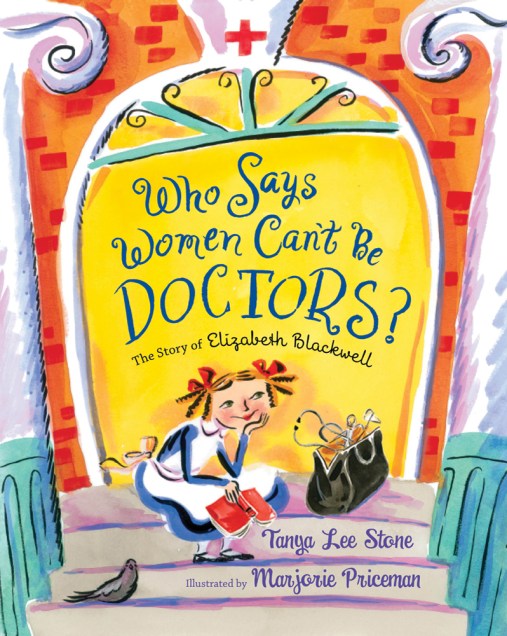
Who Says Women Can’t be Doctors? The Story of Elizabeth Blackwell

Written by Tanya Lee Stone | Illustrated by Marjorie Priceman


Once upon a time there were no women doctors. Women weren’t even allowed to be doctors. Sounds like a fairy tale, doesn’t it? Fortunately, this one-time fact has entered the realm of fiction—all thanks to Elizabeth Blackwell. Elizabeth was not like other girls of the 1830s. She loved to explore and take on challenges. She could lift her brother over her head, and to toughen herself up she slept on the hard wood floor. To get a better look at the world she climbed to the roof of her house and leaned waaaaay out with a spyglass. What did she see? Maybe she saw her future. But it wasn’t what she imagined at the time. Blood made her queasy, dissection was disgusting, and being sick just made her want to hide from all the fussing.

But a comment by a sick friend, puts a bee in her bonnet. Mary Donaldson tells Elizabeth that she would much rather have been examined by a woman than her male doctor. “You should be a doctor, Elizabeth,” Mary says.

What a crazy notion, right? Well… Elizabeth can’t stop thinking about it. She asks around. Some people think it’s a good idea, but impossible; others just think it’s impossible. They believe women aren’t strong enough or smart enough and they laugh at her. By this time, though, Elizabeth is determined.

She applies to 28 medical schools, and they all say, “No.” But one day a “Yes” arrives in the mail. Elizabeth packs her bags. The townspeople all come out to see this new medical student, but they aren’t outside to welcome Elizabeth; they just want to whisper and point and stare. Surely, Elizabeth thinks, the students will be happy to see her.

But she receives the same reception on the college campus. In fact, she learns, the only reason she was accepted is because the men voted to let her in as a joke! Elizabeth knows how to handle it. She studies hard and gives her opinions, and soon she wins the respect of her fellow students—even if the townspeople still don’t accept her.

On January 23, 1849 Elizabeth Blackwell graduates from medical school with the highest grades in the class. She has become the first woman doctor in America! Many people hope that she would be the last. But as we know…she was Not!

Tanya Lee Stone magnificently imbues this short biography of Elizabeth Blackwell with enough mystery, conflict, and history for even the youngest readers to understand the type of girl and woman Elizabeth was as well as the challenges she faced. The details of Blackwell’s life that Stone includes are deftly chosen, and make her instantly recognizable and relatable to children. One line in the text written in the present tense amid the historical past transforms this biography into a universal story for all generations. Blackwell may have started out as a reluctant dreamer, but once she dared to believe she accomplished more than she or anyone could have imagined. It is what we want for all our children.

Marjorie Priceman’s illustrations, swirling with words, angled on the page and floating in white space, are as topsy-turvy as the world Elizabeth Blackwell created. Blackwell’s boldness is echoed in the rich colors and strong lines of the gouache and India-ink paintings, and the emotions she stirred in others—from derision to horror to admiration—are cleverly and exceptionally drawn in a minimal style on the characters’ faces.

Ages 5 – 9

Christy Ottaviano Books, Henry Holt and Company | ISBN 978-0805090482

International Women’s Day Activity
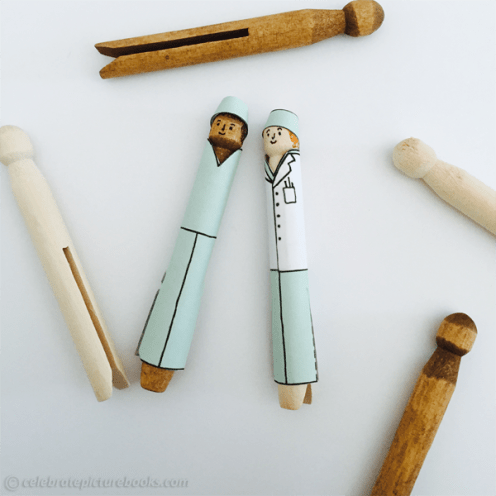
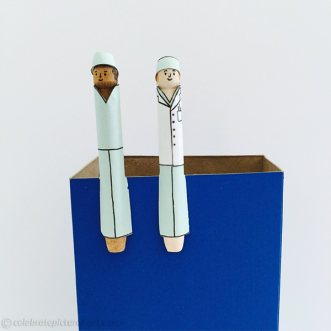
CPB - Doctors Clothespins

Doctor Clothespin Figure


Make one of these clothespin figures that honors International Women’s Day and Women’s History Month as well as everything doctors do to help us stay healthy.

Supplies

CPB - Doctors Clothespins on box

Directions

  1. Draw a face and hair on the clothespin
  2. Cut out the outfit you want your doctor to wear (color pants on your clothespin if you choose the lab coat)
  3. Wrap the coat or scrubs around the clothespin. The slit in the clothespin should be on the side.
  4. Tape the clothes together
  5. Wrap the cap around the head and tape it.
  6. If you’d like to display your clothespin doctor on a wire, string, or the edge of a box or other container, cut along the dotted lines of the clothes template.


March 5 – Expanding Girls’ Horizons in Science and Engineering Day

celebrate-picture-books-picture-book-review-look-up-henrietta-leavitt-cover

About the Holiday

March has been designated by the Expanding Your Horizons network as a time to increase awareness of and promote programs for girls and young women in the sciences and engineering fields. Giving girls interested in pursuing careers in science and engineering more access to resources and opportunities for education will benefit all.

Look Up! Henrietta Leavitt, Pioneering Woman Astronomer

Written by Robert Burleigh | Illustrated by Raúl Colón       


Henrietta Leavitt loves the stars. Every night she sits on the front porch and asks herself what were in the early 1900s unanswerable questions. How high was the sky? How far away are the stars? She traces the form of the Big Dipper to the North Star and feels that the stars are trying to tell her something.

celebrate-picture-books-picture-book-review-look-up-henrietta-leavitt-student

Image copyright Raúl Colón, text copyright Robert Berleigh. Courtesy of simonandschuster.com

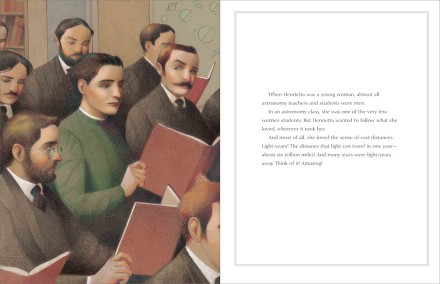
As a young woman she takes an astronomy class—one of the few women to do so. She learns about light years, planets, and the vast distances that fascinate her. After graduation she takes a job at an observatory, and while it houses a large telescope to study the sky, Henrietta is not allowed to use it. She and the other woman who work at the observatory are only there to record, measure, and calculate data, not to have new ideas.

celebrate-picture-books-picture-book-review-look-up-henrietta-leavitt-studies-star-map

Image copyright Raúl Colón, courtesy of Simon & Schuster

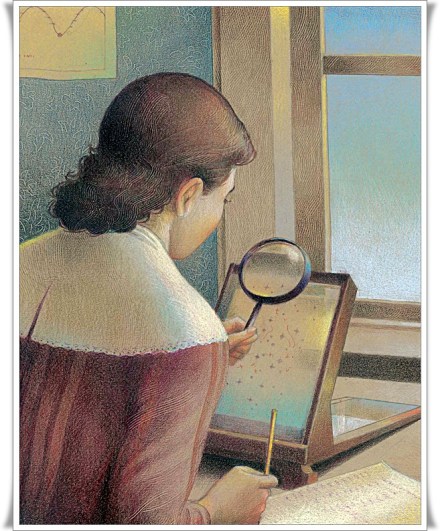
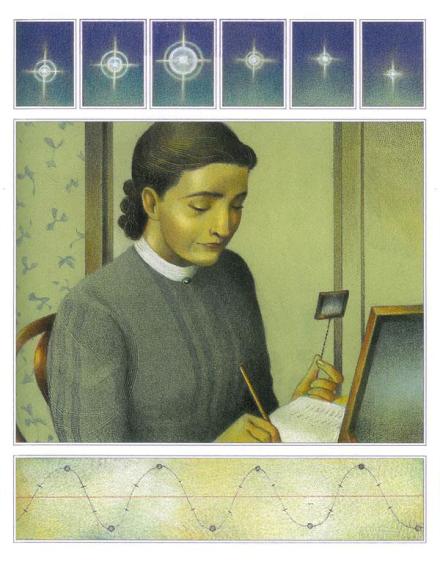
But in doing her job, Henrietta begins to notice a pattern in the brightness of certain stars. She discovers new “blinking” stars. Taking careful measurements, Henrietta finds that a star with a slower “blink” time—the time it takes for a star to go from dim to bright, or from off to on—contains more light power than stars with faster blink times. But what does this mean? After more study she realizes that the blink time can determine the true brightness of any blinking star, even those far, far away.

celebrate-picture-books-picture-book-review-look-up-henrietta-leavitt-makes-notes

Image copyright Raúl Colón, courtesy of Simon & Schuster

Henrietta has made a breakthrough in astronomy! By knowing the true brightness of a star, astronomers can figure out the star’s distance from Earth. Henrietta publishes her star chart in a magazine, and it helps other astronomers measure first the Milky Way and then galaxies they didn’t even know existed! Henrietta is an astronomer–one who advances her beloved science! Even as she grows older Henrietta continues to look to the sky, to ask questions and dream.

More information about Henrietta Leavitt and her discoveries, Internet and print resources on astronomy and other women astronomers, a glossary, and more are provided on the final pages.

celebrate-picture-books-picture-book-review-look-up-henrietta-leavitt-sees-stars-in-sleep

Instead of first presenting Henrietta Leavitt as an adult already working as an astronomer, Robert Burleigh chooses to introduce her as a child, when all she had were questions and dreams about the sky and the stars. It’s a fitting emphasis for a picture book aimed at children who themselves are only just discovering the questions that will guide their lives.  Burleigh’s style is simple and straightforward, revealing pertinent facts about the working conditions of a woman scientist in the early 1900s, but emphasizing Henrietta’s internal contemplations that led to her important discoveries. It’s good for children to see that one does not always need to be the “astronaut” rocketing to the Space Station; the life of the mind is just as noble and needed a pursuit.

Raúl Colón’s watercolor and ink illustrations echo the theme of dreams and contemplation with soft muted colors and antique, sepia tones. Brightness on the pages comes from the points of light that fill the skies and Henrietta’s mind. As a child and young woman, Henrietta sits and stands in the glow of the stars and, one imagines, her own thoughts.

Ages 4 – 8

Simon & Schuster/Paula Wiseman Books | ISBN 978-1416958192

Expanding Girls’ Horizons in Science and Engineering Day Activity

CPB - Star Coloring Page

Be the Star You Want to Be Coloring Page


Everyone has “stars in their eyes”—dreams and hopes for what they will accomplish in life. Decorate this printable Be the Star You Want to Be coloring page to show what’s in your imagination and in your heart.

February 16 – Innovation Day

CPB - Girls Think of Everything Innovation Day

About the Holiday

Today we celebrate all those people who look at a problem and design a solution, or who just ask, “What if…?” and search for answers. So put on your thinking cap, look around you, and do something new, novel, and completely unexpected. Who knows…you may be the next great inventor!

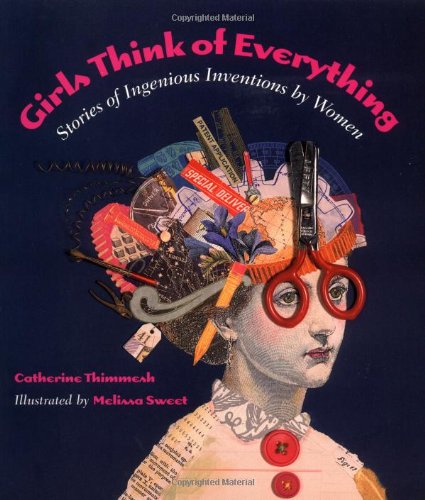
Girls Think of Everything: Stories of Ingenious Inventions by Women

Written by Catherine Thimmesh | Illustrated by Melissa Sweet


Throughout history women have invented new and clever ways of doing things—necessity is the Mother of invention, after all. In her fascinating picture book, Catherine Thimmesh highlights ten women and two girls whose creativity has changed the world.

Here, you’ll learn the intriguing stories behind each invention, the struggles for recognition, and the ultimate victory of innovation. Did you know that the original recipe for chocolate chip cookies was just a time-saver? Or that people once thought windshield wipers weren’t necessary? You’ll also discover how liquid paper, flat-bottomed paper bags, and the Glo-sheet came to be. Women in science have contributed Kevlar, Scotchgard, the COBOL computer language, and the space shields that protect the International Space Station, satellites, and more.

Catherine Thimmesh is an excellent storyteller, drawing you into the actions and minds of these women innovators and the situations or environments that fostered their talents. Melissa Sweet accompanies each profile with portraits of the inventor and colorful collage illustrations that build on the text and tell stories of their own.

Ages 7 – 12

Houghton Mifflin Company, Boston, 2000 | ISBN 978-0618195633

Innovation Day Activity

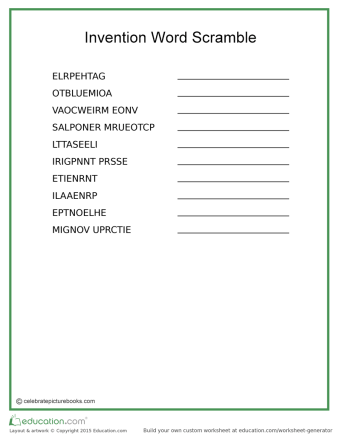
CPB - Invention Word Scramble

Invention Word Scramble


Every invention started out as a jumble of ideas in someone’s head. In this Invention Word Scramble you can unscramble the letters of some of the world’s greatest creations. Solutionincluded. Odog cklu!


February 15 – Susan B. Anthony Day

celebrate=picture-books-picture-book-review-heart-on-fire-cover

About the Holiday

On February 15, 1820 in Adams, Massachusetts a girl was born who would grow up to set the world afire with her belief in women’s rights. Her name was Susan Brownell Anthony. An early feminist, her father believed it was as important for his five daughters to receive an education as for his two sons. After graduating from school, Susan Anthony became a teacher—at the age of 14—making $2.50 a week compared to the $10.00-per-week salary of the male teachers. Anthony later became active in the abolition and temperance movements. She recognized that the inability to vote limited women’s influence in these causes and began promoting women’s rights. She worked tirelessly to change the voting laws until her death on March 13, 1906 without seeing her greatest wish fulfilled. It was not until 1920, with the ratification of the 19th Amendment, that women were allowed to vote.

Susan B. Anthony has been honored for her dedication with commemorative stamps, and her portrait appears on the dollar coin. We also remember her work on behalf of all women on her birthday with memorial services at her gravesite in Rochester, NY and in Washington DC. Susan B. Anthony Day is a legal holiday in Florida, West Virginia, Wisconsin, New York and California.

Heart on Fire: Susan B. Anthony Votes for President

Written by Ann Malaspina | Illustrated by Steve James


It’s November 1, 1872 and only four days until the presidential election. Everywhere people are being urged to register to vote. Knowing how important voting is, Susan B. Anthony races to the registration office with her sister and a friend in tow. The men in the office stare at her in confusion.

They know that women can’t vote—only men! What is Susan B. Anthony trying to do? But Anthony argues that the new 14thAmendment, which says “all persons born in the United States have the same rights as citizens,” gives women the right to vote. Some inspectors think she is right, some disagree. Finally they allow Anthony to sign the registration card.

celebrate=picture-books-picture-book-review-heart-on-fire-susan-goes-to-vote

Image copyright Steve James, courtesy of Albert Whitman & Company

On November 5, Voting Day, Anthony and 15 other women cast their ballots. Thirteen days later, however, a deputy federal marshal shows up at Anthony’s door with a warrant for her arrest. The charges? Voting illegally! The other women and the men who had allowed them to register and vote are also arrested.

In January word comes that unless Anthony pays a $1,000 fine, she will have to spend the time until her trial in prison. Anthony is adamant about not paying, but her lawyer sends the money. People in the country are split over whether she is right or not, but Anthony knows she’s right. Without being able to vote, women will have no voice in government.

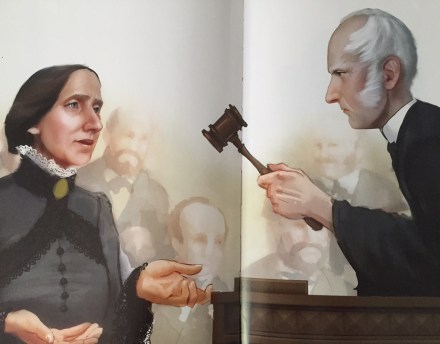
She gives speeches, trying to rally people to her cause, and when her trial begins on June 17, 1873 the courtroom is packed. After Anthony’s lawyer and the prosecutor speak, the judge decides that Anthony has broken the law. He proclaims her guilty. When the judge asks if she has anything to say, Anthony answers, “You have trampled under foot every vital principle of our government. My natural rights, civil rights, political rights….” The judge stops her and does not allow her to continue speaking. He fines her $100, plus court costs. Susan B. Anthony refuses to pay, and she never did.

celebrate=picture-books-picture-book-review-heart-on-fire-susan-pleads-case

Image copyright Steve James, courtesy of Albert Whitman & Company

Through action, dialogue, and the metaphorical theme of fire, Ann Malaspina has written an exciting biography of Susan B. Anthony. Readers will understand and, more importantly, feel the opinions and determination that fueled Anthony’s crusade for women’s rights. The final pages follow the history of the women’s suffrage movement until the ratification of the 19th Amendment in 1920 and provide photographs from the time. The text of the 14th and 19th Amendments is also included.

Opening the pages of Heart on Fire is like walking into a city of the 1800s. The lush colors and intricate details of Steve James’ illustrations immediately immerse readers in the time and place of Susan B. Anthony’s world, depicting the reality of her struggles. This is a perfect book to share with children, especially in this election year when they can see how far women have come—from being denied the vote to running for president.

Ages 5 – 9

Albert Whitman & Company, Chicago, 2012 | ISBN 978-0807531884

Learn more about Ann Malaspina and her books on her website!

View a gallery of illustration by Steve James on his website!

Susan B. Anthony Day Activity

CPB - Vote For Me round (2)

Vote For Me! Campaign Poster and Frame


If you were running for President, what would be important to you? Here’s a Vote For Me! Poster and Picture Frame to get your campaign started!

Supplies

Directions

  1. Print Vote For Me! Poster and Picture Frame templates
  2. Take a selfie or use your school picture
  3. Cut out the Picture Frame and the circle or rectangle in the middle
  4. Tape or glue your picture in the circle or rectangle
  5. If you are using a clear magnetic frame, slip the template inside and hang on your refrigerator or any metal object.
  6. If you are using a magnetic sheet, peel the paper off the adhesive side. Stick the Vote For Me! Picture Frame template with your picture attached to the adhesive. Cut around the edges. Hang!
  7. On the Vote For Me! Poster, list the things you would do if you were President. Talk to your family and see if you might be able to do some of them now! Hang your poster in your room or in the house where others can see it.

February 14 – Frederick Douglass Day

CPB - Words Set Me Free

About the Holiday

Although the exact date is not known, history records Frederick Douglass’ birthday as around Valentine’s Day in 1818, so February 14 was chosen to honor this most unique and influential man. Born into slavery, Frederick Bailey (he later changed his last name to Douglass) learned how to read and write when still a child. As a young man he used his intellect and courage to secure his freedom. He became a compelling speaker, writer, leader of the abolition movement, and statesman. His writings, especially his autobiography Narrative of the Life of Frederick Douglass, an American Slave, are among the most powerful accounts of the slave experience and are still widely read today.

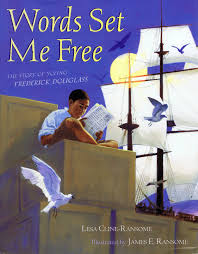
Words Set Me Free

Written by Lesa Cline-Ransome | Illustrated by James E. Ransome


Born into slavery and separated from his mother in infancy, Frederick Bailey is raised by his Grandmama while his mother works on a separate plantation. When she is able Harriet Bailey walks the 12 miles between plantations to spend a few short hours with her son, watching him sleep, before making the long journey back. While Frederick is still a very young child, his mother falls ill and dies. Douglass recalls never seeing his mother’s face in daylight.

At the age of six, Frederick is moved from his Grandmama’s cabin to the plantation house. At eight, he is sent to the master’s brother in Baltimore, Maryland. Here, the master’s wife, Sophia Auld, treats Frederick more like a paid servant then as a slave. When Frederick says he wants to learn how to read and write, she immediately begins teaching him the alphabet. Frederick is always mindful, however, that he may be punished for these lessons, and he has only memorized the letters and a few words before his master puts an end to his education. Angrily, the master explains to his wife, “If you teach him how to read…it would forever unfit him to be a slave.”

These words are perhaps Frederick’s greatest lesson. He never forgets them, and they fuel his resolve to pursue an education. He makes clever use of the few resources he has and slowly learns to read and write. From the newspapers he discovers that the North offers freedom, and Frederick decides to escape. It’s many long years, however, before he can fulfill his dreams. At last, he sees an opportunity to leave the South behind, and using his talent for writing makes his escape a reality.

Lesa Cline-Ransome has written a compelling biography of Frederick Douglass for children in Words Set Me Free. In straightforward language and through first-person point of view, Cline-Ransome reveals the brutal truth of Douglass’s life as a slave and his fight against injustice. As the title suggests, the book focuses on Frederick’s desire to become educated and the obstacles he overcame to succeed. This universally important message continues the work Douglass engaged in long ago.

James Ransome’s stirring paintings highlight pivotal scenes of Frederick’s story. Readers witness the tender moments with his mother, the cruel contrast of slavery and his blossoming intellect, and Frederick’s growing resolve to educate himself and escape.

Ages 5 and up                                                                                                            

Simon & Schuster, New York, 2012 | ISBN 978-1416959038

Frederick Douglass Day Activity

CPB - Words Set Me Free word search

Words Set Me Free word search


Words were so important to Frederick Douglass that he risked everything to learn how to read and write. In this printable Words Set Me Free Word Search Puzzle you will find words about the man we honor today. Solution

February 12 – Abraham Lincoln’s Birthday

CPB - I am Abraham Lincoln

About the Holiday

Today we celebrate Abraham Lincoln’s birthday! Abe Lincoln was born in a one-room log cabin in Kentucky and later worked as a riverboat worker, a shopkeeper, and a postmaster in Illinois before becoming the 16th President of the United States. With compassion, bravery, and strength, Lincoln shepherded the country through the Civil War and signed the 13th Amendment to the Constitution outlawing slavery in the United States. Lincoln’s birthday is commemorated with wreath-laying ceremonies at his birthplace and at the Lincoln Memorial in Washington D.C.

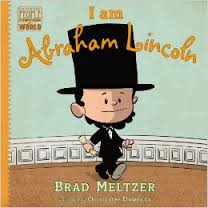
I am Abraham Lincoln

Written by Brad Meltzer / Illustrated by Christopher Eliopoulos


In his I am… series of biographies, Brad Meltzer writes about famous people as they grow from childhood into the influential adults they became. In I am Abraham Lincoln, Meltzer illuminates various experiences of Lincoln’s life that formed his beliefs of equality and inclusiveness. At a time when most children liked to hunt, fish, and tend the farm, young Abe spent his time reading, and he was one of the few people in town who could write. Even at the age of 10, his compassion showed when he stopped a group of his peers from treating a turtle roughly. Later, as a young man and newcomer to Illinois, he faced a group of bullies and dispersed them without throwing a punch.

It was when he witnessed the indignities of a slave boat, however, that his most deeply held beliefs took hold. As President, Lincoln acted on those beliefs, helping the country through the Civil War, gave speeches, and signing laws that ensured all people would be treated equally.

By relating stories from Abraham Lincoln’s childhood, Meltzer not only teaches children about his life, but demonstrates that his young readers can also make a difference by speaking up and helping others whenever they see injustice.

Christopher Eliopoulos’s cartoon-like illustrations are particularly effective in showing the earnestness of Abraham Lincoln’s personality from early childhood on. Speech bubbles display dialogue, modeling the simple words that can so often create great change. Part of the book’s charm is that even as a child Lincoln sports his iconic beard and top hat, making him instantly recognizable as the hero children are familiar with and emphasizing the “man in the child” theme.

Ages 4 – 8

Dial Books for Young Readers, Penguin Group, New York, 2014 | ISBN 978-0803740839

Abraham Lincoln’s Birthday Activities

CPB - Abe Lincoln's Top Hat chalkboard (2)

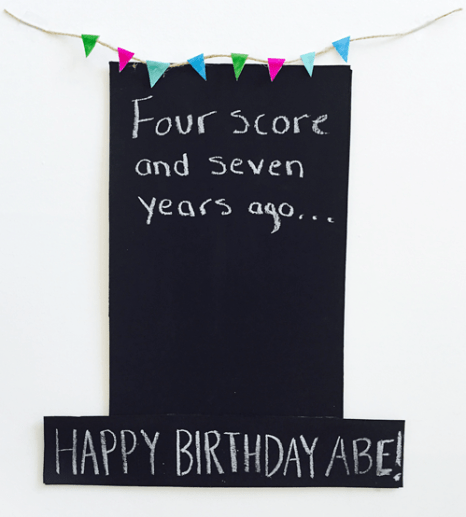
Abe Lincoln’s Top Hat Chalkboard

Abraham Lincoln was known for the black top hat he wore – and for his inspiring words In this activity you can learn how to make a top hat chalkboard to use for your own drawings or inspiring words!

Supplies

  • Cereal Box (I used a large sized cereal box), cardboard or poster board
  • Chalkboard Paint (black)
  • Paint brush
  • Hot Glue Gun or extra-strength glue
  • Removable mounting squares
  • Chalk

Directions

  1. If you are using cardboard or poster board: cut a rectangle at least 8 inches wide by 12 inches long for the hat and 12 inches long by 2 inches wide for the brim (but your top hat can be any size you’d like!)
  2. If you are using a Cereal Box: open the seams of the Cereal Box
  3. Cut the panels of the cereal box apart
  4. Take one face panel and one side panel
  5. With the chalkboard paint, paint both panels
  6. Let the panels dry
  7. Attach the side panel to the bottom of the face panel to create the shape of Lincoln’s top hat
  8. Hang Abe Lincoln’s Top Hat Chalkboard 

Donate to a Food Bank

Today can be a day to remember the hardships that many people still endure. Many still live with hunger every day. Today, gather a bag of non-perishable foods and donate them to your local food bank. This activity can also be done by a group—a classroom, scout troop, youth group, or group of friends. Even a little bit helps a lot!


February 6 – Lace Day

celebrate-picture-books-picture-book-review-fionas-lace-cover

About the Holiday

Lace, that delicate material that trims clothing, covers tables, ties up hair, and makes anything seem more dainty and lovely, has been used since the 1500s. When you look at the intricate patterns and fine threads of lace, it’s hard to believe that people once made it all by hand. Lace makers were paid well for their art by the fashion industry, which used it to attract distinguished customers. While lace is mostly made by machines now, the handcraft is making a comeback. Today’s reviewed picture book is about a girl whose lace work was invaluable.

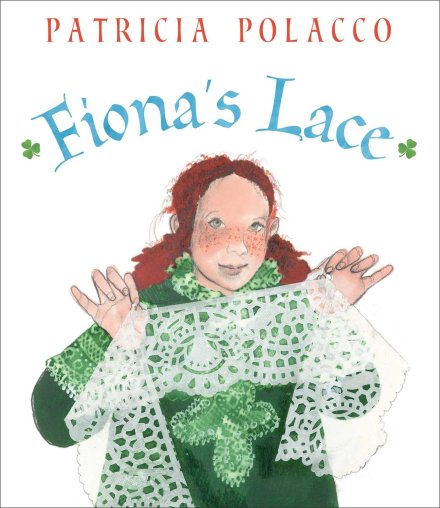
Fiona’s Lace

By Patricia Polacco


In Fiona’s Lace author-illustrator Patricia Polacco weaves a tale of family love and America’s early immigrant heritage that is as intricate and lovely as the material we celebrate today. The story begins in Ireland, where Fiona and her sister Ailish live with their muther and da. They live happily in Glen Kerry, where their father works in the textile mill and their mother teaches Fiona her art of lace making.

celebrate-picture-books-picture-book-review-fiona's-lace-ma-teaches-lacemaking

Copyright Patricia Polacco, courtesy of simonandschuster.com

In the evenings the girls are entertained by family stories, especially their favorite about how, when their parents first met, their mother left a trail of lace from the factory to her house for her young suitor to follow.

When the textile mill closes, Fiona’s family signs a contract indenturing themselves to a family in Chicago. The voyage to America is long and arduous, but when they arrive in Chicago they marvel at the grand houses and elegant clothes, imagining that this awaits them too in their new home. The reality, however, is much different. Their 2-room apartment is ramshackle, and only by working two jobs can their parents make enough money to live on.

celebrate-picture-books-picture-book-review-fiona's-lace-fiona-gets-job

Copyright Patricia Polacco, courtesy of simonandschuster.com

Fiona wants to help and soon finds that dressmakers will pay handsomely for the lace she makes. The family’s money tin begins to fill up and they are prospering. One night while Muther and Da are away working, a fire rages through Chicago. Fiona and Ailish escape with only the money tin and Fiona’s lace. They run far from home, but worry—how will their parents find them?

Remembering their favorite story, Fiona cuts her lace into strips and ties bits of it along their route to their hiding place. The girls cower in fear until they hear the familiar voices of their parents. Happily reunited, the family lets go of what they have lost, but Ailish cries over the now sooty, torn lace. Ma reassures her and brings comfort, revealing that far from being ruined, this scorched lace is the most valuable and cherished of all because it saved the family.

celebrate-picture-books-picture-book-review-fiona's-lace-trail-of-lace-story

Copyright Patricia Polacco, courtesy of simonandschuster.com

Patricia Polacco’s heartwarming and harrowing story of an Irish immigrant family is a beautiful reminder of the unique talents and strong bonds that built America. Readers will be enthralled by Polacco’s realistic dialogue and detailed storytelling in this compelling and suspenseful tale and will cheer as Ailish cleverly uses her ma and pa’s trick and her own skills to save her family.

Polacco’s gorgeous illustrations bring the time period alive for young readers, portraying the intricate art of lacemaking and the clothing styles that made use of this delicate trimming. Her depictions of tenement living are realistic, yet reveal the love and close family ties within through a warm color palette and the inclusion of cozy comforts brought from Ireland.

Fiona’s Lace is a wonderful book for classroom and home story times.

Ages: 4 – 8

Simon & Schuster, New York 2014 | ISBN 978-1442487246

Discover more about Patricia Polacco and her many, many books on her website!

Lace Day Activity

Hide-and-Seek Game

While Fiona and her sister used a lace trail to lead their parents to their hiding place, you can have fun making a hide-and-seek game for your friends. This game can be played inside or outside

Supplies

  • 1 or 2 yards of lace, cut into sections about 6-inches each. You can use lace to celebrate Lace Day or use string, ribbon, or other kinds of material
  • Choose something to hide – this can be a toy, a secret letter, a snack, or anything

Directions

  1. Hide the item you choose in a secret place
  2. Determine the starting place for your hide-and-seek game
  3. Along the route from the starting point to the hidden item, tie the sections of lace onto things like lamps, furniture, stair banisters, door knobs, etc. if  you’re playing inside. If you are playing outside, tie it onto trees, bushes, bird feeders, swing sets, etc.
  4. For very young children the trail of lace can be straightforward; for older children the trail can be longer and more difficult