November 2 – Look for Circles Day

celebrate-picture-books-picture-book-review-squares-and-other-shapes-with-josef-albers-cover

About the Holiday

Today is one of those days that gets you really observing the world in a new way. As you go about your day at the office, at school, at shops, or just while driving here and there, be aware of all the different circles you see. Sure, there are the obvious ones—the tires on your car, the signals on a stoplight, the lid of your water bottle or coffee cup…but how about all the less-seen circles? Knots on trees, a lemon slice, the center of a flower, the ripple of a raindrop or pebble dropped in a puddle… Whether you look for circles through the eye of geometry or they eye of art, be fully aware of the shapes around you!

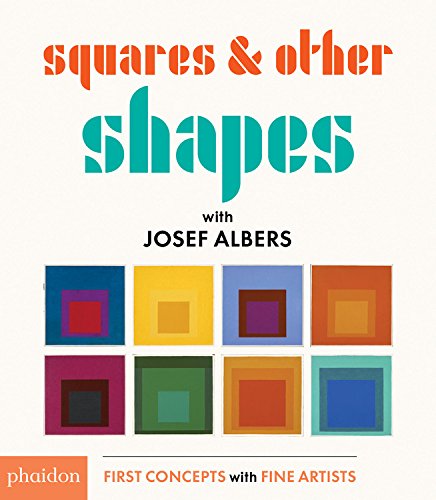
Squares & Other Shapes: with Josef Albers (First Concepts with Fine Artists)

Paintings by Josef Albers


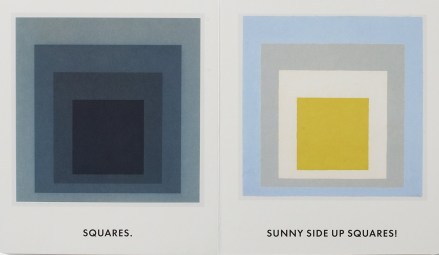
Opening Squares & Other Shapes, readers encounter a vibrant magenta square nesting in an autumn maple leaf-hued square which floats in a square of clear, winter-sky blue. On the next page two orange squares beckon you to follow into the glowing, yellow center square. Could it be a doorway or window leading somewhere?

In another painting, a bold yellow rectangle and an equally bold blue rectangle host guests: “two little rectangles lying down for a nap.” But the calm is shattered on the next page as stacks of red and blue rectangles shake and tumble: “Watch Out! It’s raining rectangles!”

celebrate-picture-books-picture-book-review-squares-and-other-shapes-with-josef-albers-circle-circle-stop

Image courtesy of phaidon.com

Now circles want a turn, and they want to have fun! In a large black rectangle a white circle and a red circle play stoplight: “Circle, Circle, Stop!” while on the next page blue, black and spirally circles jump and frolic—“Bounce, Circles, Bounce!” Turn the page—can you count all of the little circles in the rectangle or all of the baby circles in the rectangle on the right-hand page? Some of the babies are leaping away—or are they just joining the group? What do you think?
celebrate-picture-books-picture-book-review-squares-and-other-shapes-with-josef-albers-hey-circles

Image courtesy of phaidon.com

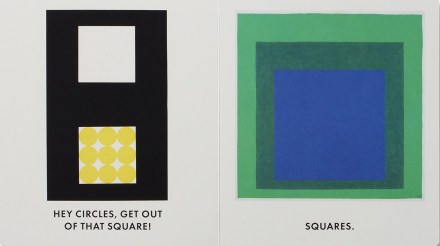
Next the black rectangle is back, but this time with two white squares inside. Wait a minute—how did those little yellow circles get into the bottom square? “Hey circles, get out of that square!” Of course triangles don’t want to be left out. Dusky triangles in many sizes connected tip to tip enjoy their light, white background, but on the next page they’re left in shadow—“Hey triangles, who turned out the lights?”
celebrate-picture-books-picture-book-review-squares-and-other-shapes-with-josef-albers-sharp-triangles

Image courtesy of phaidon.com

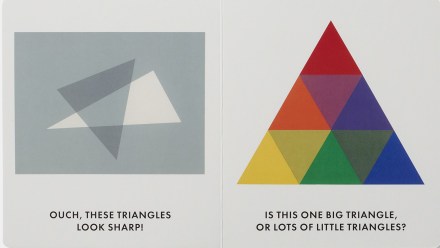
Be careful turning the page to look at the two intersecting triangles: “Ouch, these triangles look sharp!” Maybe it’s better to move on to the big, vivid triangle on the right. Oooh, so many colors! Nine, in fact! Hmmm… “Is this one big triangle, or lots of little triangles?” These paintings are getting more complex! Now there are “blue squares in pink squares, pink squares in blue squares; rectangles in rectangles, circles in circles, and more triangles in triangles. But here’s a different painting: the rectangles are perfect rectangles, but the squares are a little off, and what kinds of shapes do those curved lines make?—“Funny shapes in funny shapes!” And the last painting? Back to squares. Red, purple, and blue squares. “Beautiful squares.”

Following the paintings, the last page provides a captivating biography about Josef Albers’ life and work aimed at the book’s young audience.
celebrate-picture-books-picture-book-review-squares-and-other-shapes-with-josef-albers-sunny-side-up-squares

Image courtesy of phaidon.com

Imagine being able to own a stunning collection of famous paintings by a world-renowned artist and educator to teach your child about shapes, color, and art. With Squares & Other Shapes by Josef Albers you can! The second in the First Concepts with Fine Artists series, Squares & Other Shapes presents readers with more than 30 painting by Josef Albers, one of the most influential artists of the 20th century. Most well-known for his Homage to the Square paintings, Albers worked with color and shapes to challenge perceptions and promote creative thinking.

Shapes are one of the earliest concepts introduced to babies and young children. Even the youngest readers will be riveted by the beautifully reproduced paintings in this large board book that present squares, circles, rectangles, and trianges in clear but creative ways. The easily understood labels, repetition, and recognizable patterns offer key strategies that are known to build strong reading and comprehension skills. Kids will love the humorous text that brings the paintings to life, helping them to also see that art is not static, but active and open to interpretation by each viewer.

Squares & Other Shapes with Josef Albers is a wonderfully conceived concept book that can grow with children as it offers readers enjoyment and education on so many levels. The book would be an often-sought-out addition to home and library bookshelves and also makes a perfect present for baby showers and other gift-giving holidays.

Ages birth – 5 (and up)

Phaidon Press, 2016 | ISBN 978-0714872568

Look for Circles Day Activity
celebrate-picture-books-picture-book-review-circle-puzzle

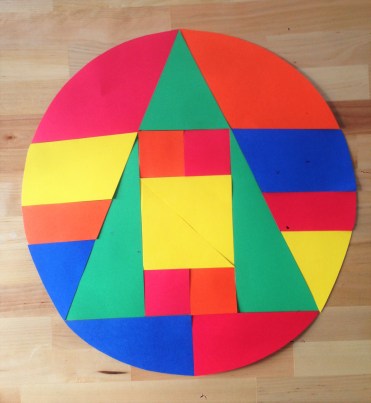
Circle of Shapes Puzzle


Build a circle from different shapes with this puzzle that grows as you add pieces! You can also use these shapes to create your own art!

Supplies

Directions

  1. Print the shape templates
  2. Cut out the shapes
  3. Trace shapes onto different colored paper
  4. Cut out the colorful shapes
  5. Build the puzzle from the central square to the edges of the circle (It may be easier to keep the puzzle in place by sticking the pieces down with a little tape applied to the back of the pieces)

You can also use the shapes to create your own art!

Picture Book Review


November 1 – Dia de los Muertos (Day of the Dead)

celebrate-picture-books-picture-book-review-funny-bones-posada-and-his-day-of-the-dead-calaveras-cover

About the Holiday

Originating in Mexico, but celebrated throughout Latin America, Dia de los Muertos commemorates the lives of deceased loved ones with music, food, parties, and activities the person enjoyed in life. Dia de los Muertos revolves around the belief that death is just a natural part of the life cycle, and the dead are awakened from their eternal rest to once more join their community for this special day.

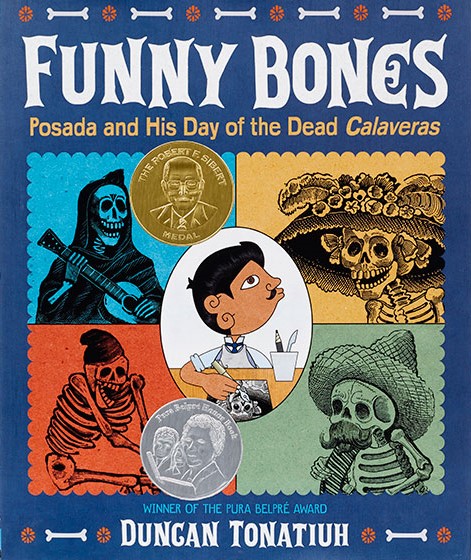
Funny Bones: Posada and His Day of the Dead Calaveras

By Duncan Tonatiuh


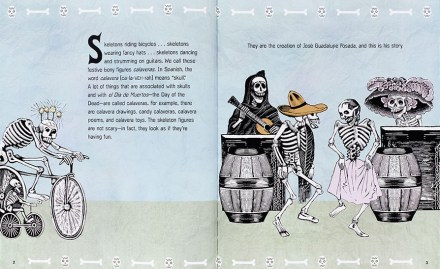
José Guadalupe Posada was born in 1852 in the Mexican city of Aguascalientes. His older brother, a teacher, taught Lupe how to read and write, and seeing how well he drew, helped him enroll in art classes. When Lupe was 18, he went to work in a print shop where he learned lithography and engraving. During working hours Lupe created labels, invitations, flyers, and other documents.

celebrate-picture-books-picture-book-review-funny-bones-posada-and-his-day-of-the-dead-calaveras-introduction

Copyright Duncan Tonatiuh, courtesy of abramsbooks.com

After work, he gathered with other artists and talked about the government. They didn’t like how their government officials ran things. Lupe’s boss, Don Trinidad Pedroza, at the print shop also published a newspaper, and he invited Lupe to create editorial drawings to be included in the paper. Lupe’s drawings were humorous, but also highlighted the officials’ bad traits. After the elections some of these politicians remained in power and were angry with Lupe and his boss. Lupe and Don Trinidad decided to move to the city of León.

In León Lupe opened his own print shop, he got married, and had a son. He became well known not only for his printing work but also for book and pamphlet illustrations. People began to call him Don Lupe as a sign of respect. “But in 1888 a terrible flood destroyed a large part of the city, including Don Lupe’s shop.” He and his family moved to Mexico City, where in time he was able to open another print shop.

celebrate-picture-books-picture-book-review-funny-bones-posada-and-his-day-of-the-dead-calaveras-calavera-love

Copyright Duncan Tonatiuh, courtesy of abramsbooks.com

He worked with Antonio Vanegas, a writer, who published his stories on large sheets of paper called ‘broadsides.’ “The tales were about a wide range of topics, including scary creatures, fires, miracles, violent crimes, heroes, bandits, cockfights, and bullfights.” Don Lupe drew illustrations for many of these stories. Even people who couldn’t read began buying the broadsides because they were fascinated by Don Lupe’s art.

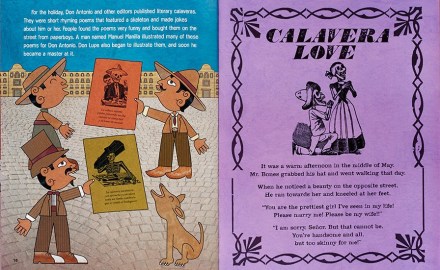
Every November first and second, during the Dia de Muertos celebrations venders sold special “pan de muerto (bread), cempasúchil (marigold flowers), alfeñiques (sugar skulls), and papel picado (paper cutouts). People bought these and other items to decorate the ofrendas (offerings) they made for their loved ones who had died.” Don Antonio and other editors published “literary Calaveras, which were “short rhyming poems that featured a skeleton and made jokes about him or her. People thought they were very funny. Soon Don Lupe began drawing illustrations for these poems.

celebrate-picture-books-picture-book-review-funny-bones-posada-and-his-day-of-the-dead-calaveras-fancy-hat

Copyright Duncan Tonatiuh, courtesy of abramsbooks.com

Over time Don Lupe began using the technique of etching, and his illustrations grew more complex. In his calaveras drawings Don Lupe interpreted and commented on what he saw not only on Dia de Muertos, but every day. For example, he watched families gather at loved ones’ graves with food, stories, and music then “drew skeletons dancing and partying. Was he saying that…El Dia de Muertos is not only a celebration of death but also a celebration of life? A day when the dead become alive?”

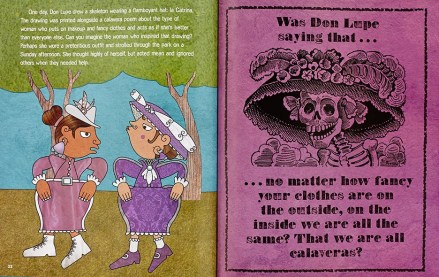
In another drawing a skeleton wears a large hat covered with lace, feathers, and flowers. This illustration accompanied a poem about a woman who wore expensive clothes and thought she was better than others and ignored them when they needed help. “Was Don Lupe saying that…no matter how fancy your clothes are on the outside, on the inside we are all the same? That we are all calaveras?

Don Lupe also commented on the ever increasing hustle and bustle of society, the Mexican Revolution of 1910, revolutionary leaders and government officials, and just common people and events. Perhaps the main idea Don Lupe was trying to communicate was that “calaveras are all around us. That we are all calaveras, whether we are rich or poor, famous or not.”

celebrate-picture-books-picture-book-review-funny-bones-posada-and-his-day-of-the-dead-calaveras-today

Copyright Duncan Tonatiuh, courtesy of abramsbooks.com

While many people loved and looked forward to Don Lupe’s artwork, they did not know the artist who drew them. It wasn’t until many years after his death in 1913 that “historians and artists such as Jean Charlot and Diego Rivera began to wonder who had drawn such wonderful images.” Today, we know Don Lupe by his last name—Posada—which is how he signed his work, and he and his work is still beloved around the world.

An extensive Author’s Note about El Dia de Muertos and Posada’s influence on other artists. A glossary, bibliography, art credits, and places where Posada’s work is displayed follow the text.

celebrate-picture-books-picture-book-review-funny-bones-posada-and-his-day-of-the-dead-calaveras-etching

Copyright Duncan Tonatiuh, courtesy of abramsbooks.com

In Funny Bones Posada and His Day of the Dead Calaveras, Duncan Tonatiuh accomplishes many things. First, his book is a fascinating look at the life of the man who entertained and enlightened the world with his distinctive talent and ideas. Tonatiuh’s straightforward storytelling reveals the personal and historical events that influenced Posada from childhood through adulthood, clearly explaining and highlighting each concept for his young audience. Second, Tonatiuh provides readers with brief primers on the printing processes of lithography, engraving, and etching with step-by-step descriptions of these interesting art forms.

Third, his own vibrant and expressive stylized illustrations both contrast with and complement the depictions of Posada’s life and his calaveras drawings. On nearly every two-page spread readers experience this biography through Tonatiuh’s portrayals of Don Lupe, the townspeople, and others as well as through Posada’s actual broadsides and editorial drawings. The juxtapositions allow children to fully appreciate the meaning and humor behind these famous drawings that are still so popular and resonant today.

Ages 6 – 10

Harry N. Abrams, 2015 | ISBN 978-1419716478

View a gallery of Duncan Tonatiuh‘s artwork for children and adults on his website!

Dia de los Muertas (Day of the Dead) Activity

celebrate-picture-books-picture-book-review-day-of-dead-coloring-page

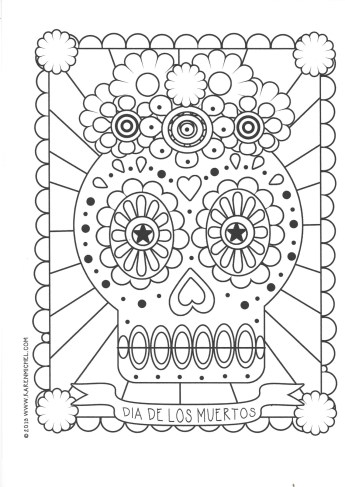
Calaveras Coloring Page


With their intricate designs and vibrant hues, calaveras are a joy to color. Grab your entire set of markers, pencils, or crayons and design a masterpiece with this printable Calaveras Coloring Page.

Picture Book Review