November 24 – Picture Book Month

About the Holiday

We’re still celebrating one of the best months of the year—Picture Book Month! If you’re starting your holiday shopping, don’t forget to add picture books to your list for the kids in your life. With so many picture books to choose from on all kinds of topics, there’s sure to be a perfect book for each child. You know what they say—and it’s really true: A book is a gift you can open again and again, and today’s book is loaded with interactive elements that will keep kids coming back again and again! 

Thank you to Twirl and Barbara Fisch at Blue Slip Media for sending me a copy of this book for review!

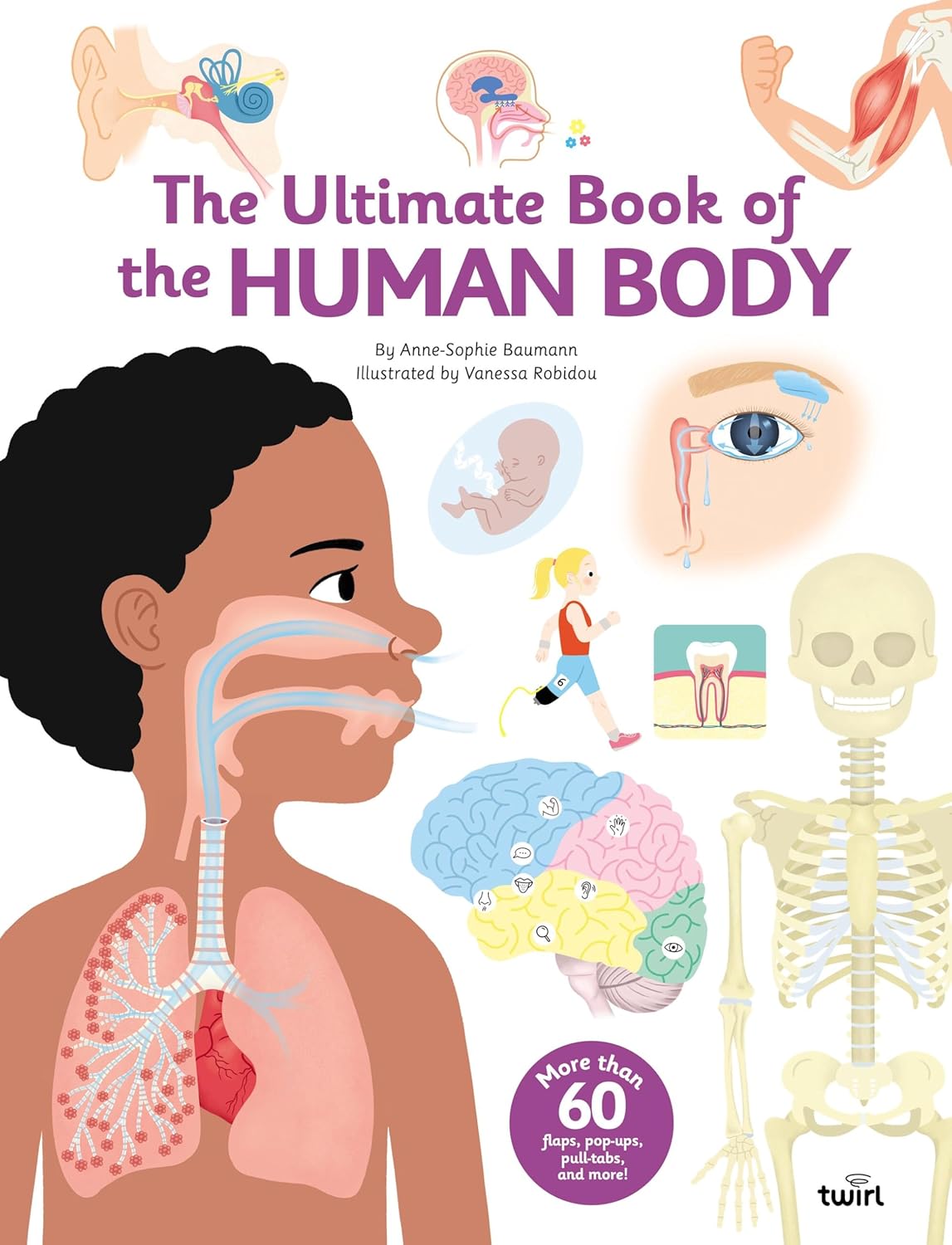
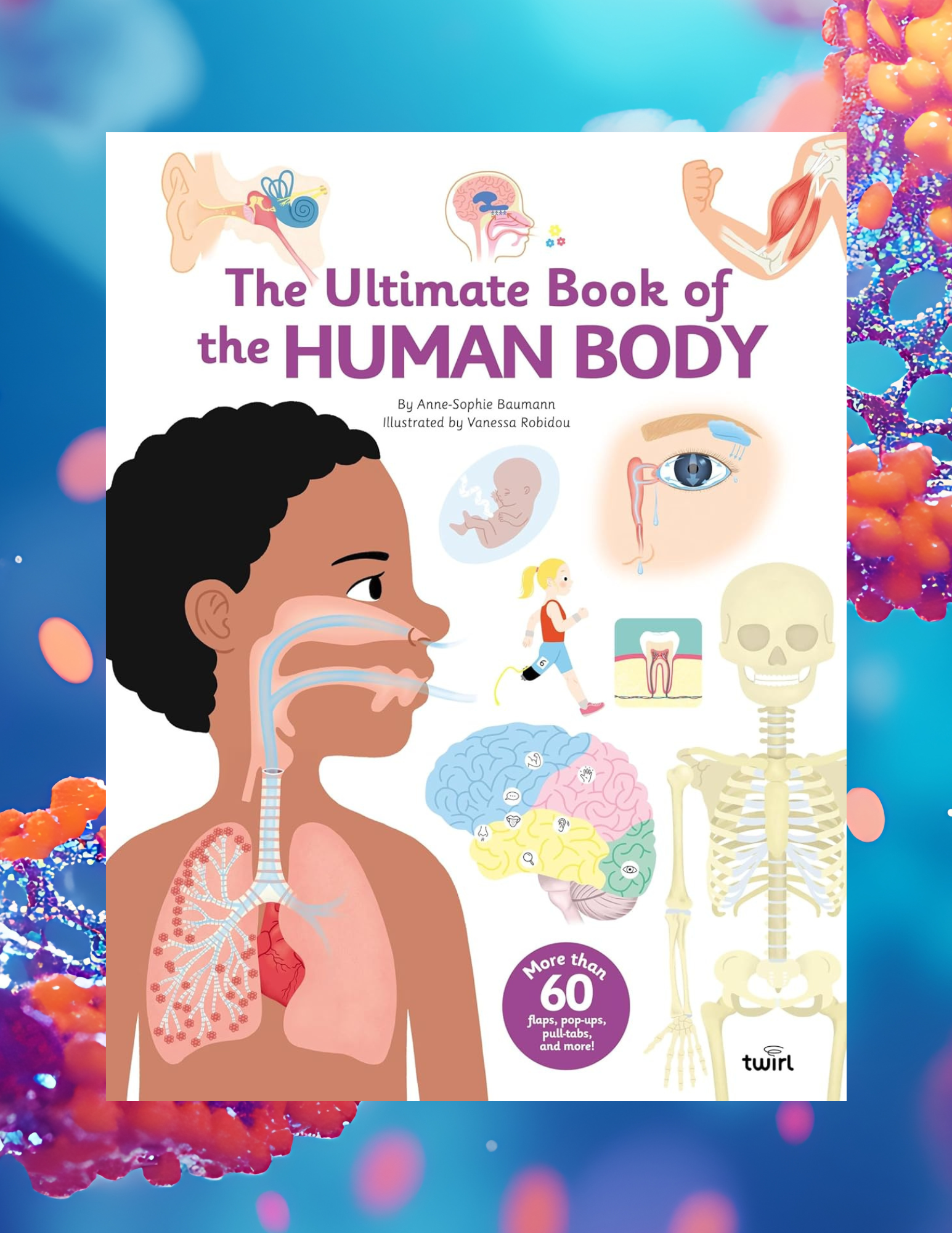
The Ultimate Book of the Human Body

Written by Anne-Sophie Baumann | Illustrated by Vanessa Robidou


If you’re raising or know a child who’s a future medical professional or one who’s simply interested in learning all about health and anatomy, they’ll be enthralled with The Ultimate Book of the Human Body. Teachers and other educators will also find this book an impactful introduction to how the body works that students will love exploring.

Offering an astonishing amount of information on every page, this oversized book is an interactive marvel that engages children through short and detailed, yet easily understood paragraphs that analyze all parts of the body from the tiniest mole to the largest organ: the skin. More than 60 flaps, pull tabs, and tiny booklets take kids under the skin and inside the body with illustrations worthy of a medical textbook. There’s even an articulated skeleton that demonstrates how our joints work. 
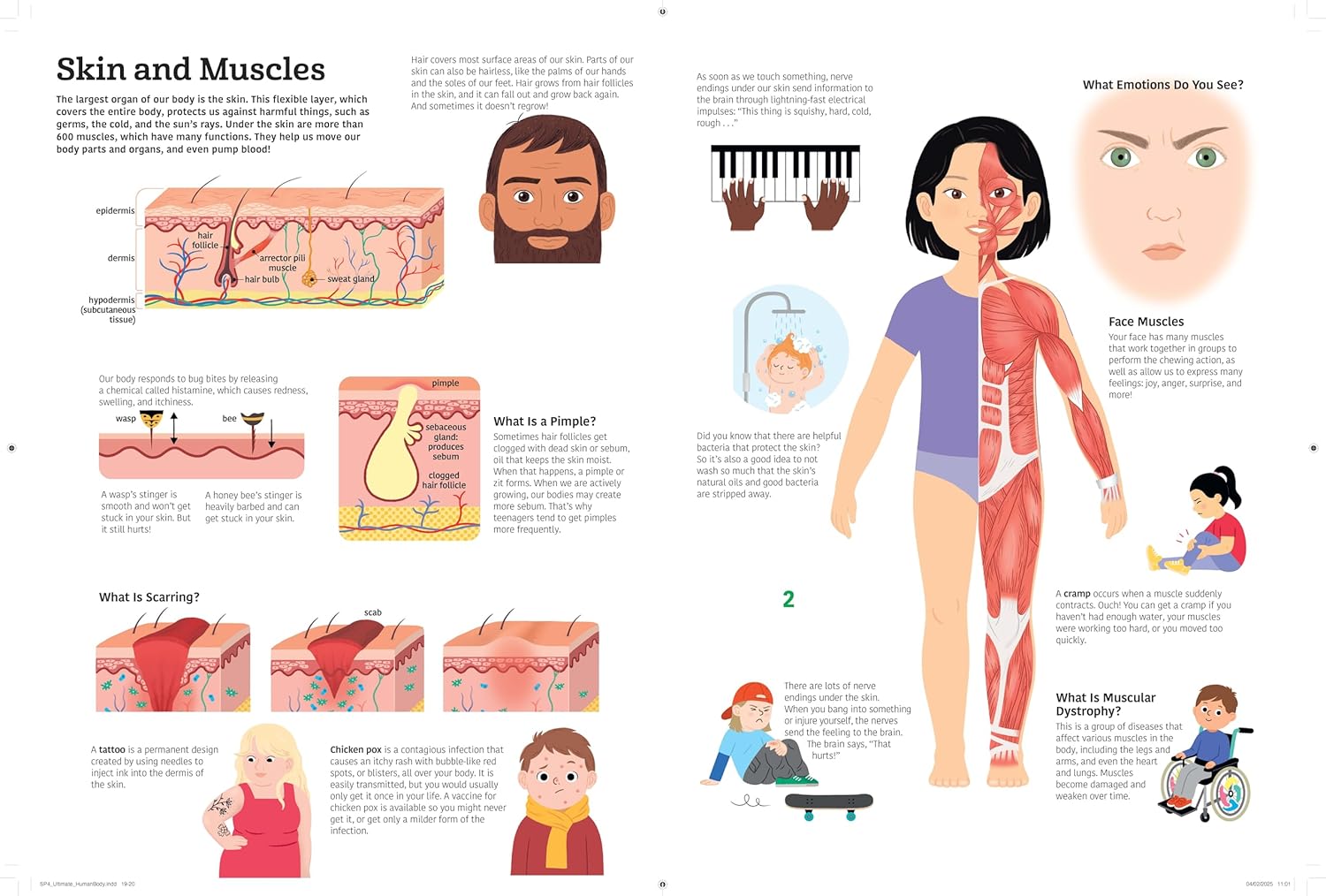
Illustration @ 2025 by Vanessa Robidou. Text © 2025 by Anne-Sophie Baumann. Courtesy of Twirl.

The book is broken into these eleven sections:

The Skeleton: Bones and More in which children learn about bone shapes; the makeup of bones; how bones heal; and information on the skull, spine, and joints. They can interact with a full-size hand that reveals all 27 bones that allow the fingers and wrists to move the way they do.

Skin and Muscles introduces kids to the layers of skin; how the skin heals and reacts to various types of bug bites; how impulses flow from our fingers to the brain; what a pimple and a mole are; what tanning is, and more. Children also get a full view of the muscles and how they work to show different emotions. 

Lungs reveals why we need oxygen, why we cough, what asthma is, how our diaphragm works when we inhale and exhale, and how the voice is produced.

Heart and Blood covers the circulatory system, our pulse and blood pressure, how the heart works, all about blood, and even the fact that “an adult’s heart is about the size of a large apple.”
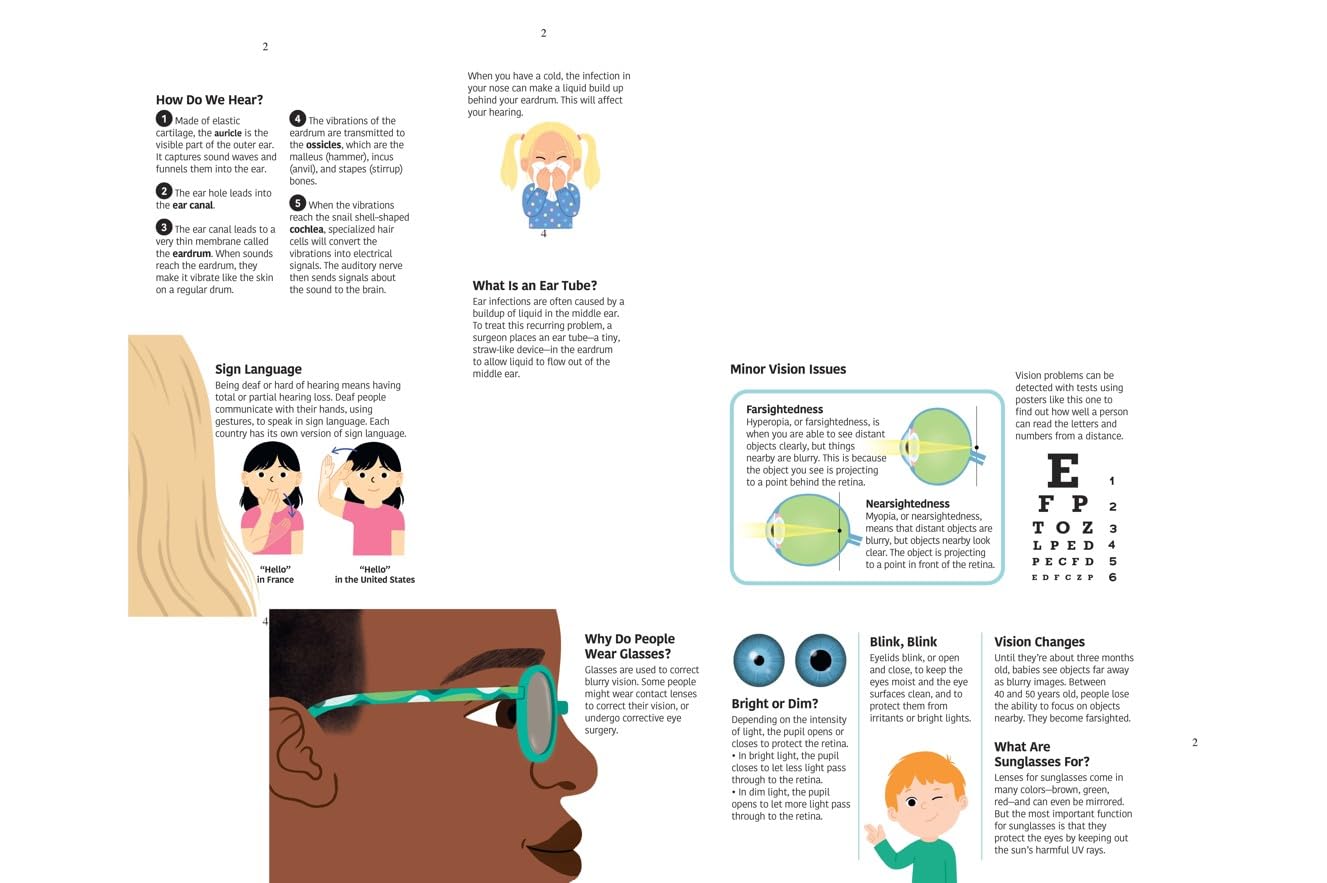
Illustration @ 2025 by Vanessa Robidou. Text © 2025 by Anne-Sophie Baumann. Courtesy of Twirl.

Seeing and Hearing contains information on the parts and working of the eyeball, vision issues, eye color, and more. The hearing section gives kids a look into the inner ear while also learning about sound frequency, earaches, balance, and hearing issues.

Smelling and Tasting talks about the mechanisms of smell, the inner nose, sneezing, the connection between the ear and the nose, the tongue, tasting, ear pain, and sore throats.

Biting and Chewing shows the development of teeth through various ages, and talks about parts of a tooth, cavities, braces, and caring for our teeth.

Eating and Drinking contains a wide range of topics and includes interactive elements that expose the workings of the urinary and digestive systems. Other topics include vitamins, foods, constipation, and appendicitis.
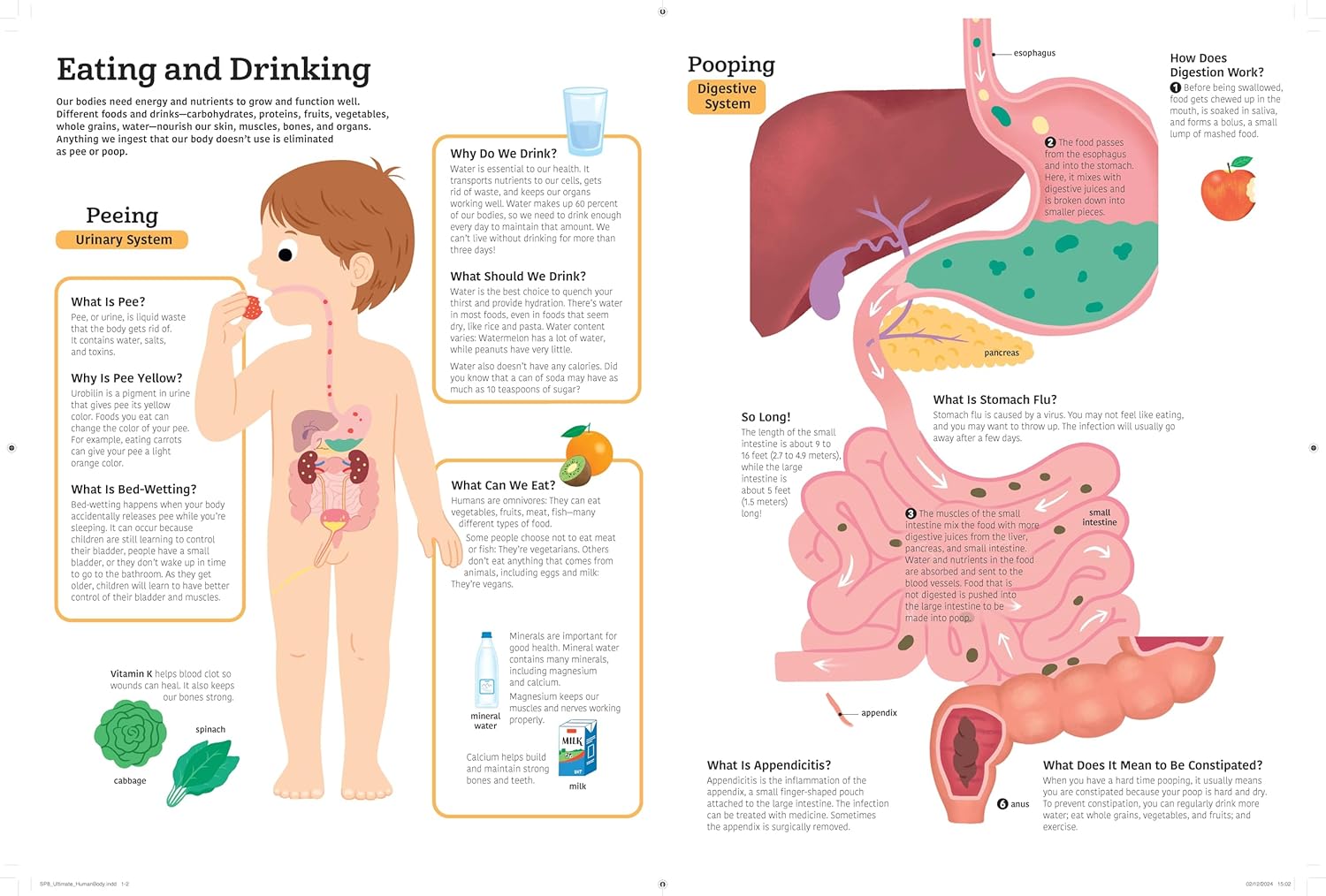
Illustration @ 2025 by Vanessa Robidou. Text © 2025 by Anne-Sophie Baumann. Courtesy of Twirl.

The Brain and the Nervous System is a comprehensive section that goes in-depth on how these intricate systems work and provides detailed illustrations on how the nerves run through the body as well as a pop-up, multilayered depiction of the brain that shows where in the brain our senses, memory, speech, and muscle control originate. You’ll find information on mysteries of the brain, brain disorders, and more.

Birth and Growing Up provides adults and children with a wealth of knowledge about the reproductive organs, how babies are made, how a sperm fertilizes an egg, the major stages of development from embryo to fetus by month, how twins develop, what a cell is, DNA, and highlights of growth and development from birth to adulthood.

Living Well discusses ways people can take care of themselves throughout their lives as well as disabilities, diabetes, Down syndrome, and the role of medical professionals, medications, inventions, and procedures that can help people live a better life.
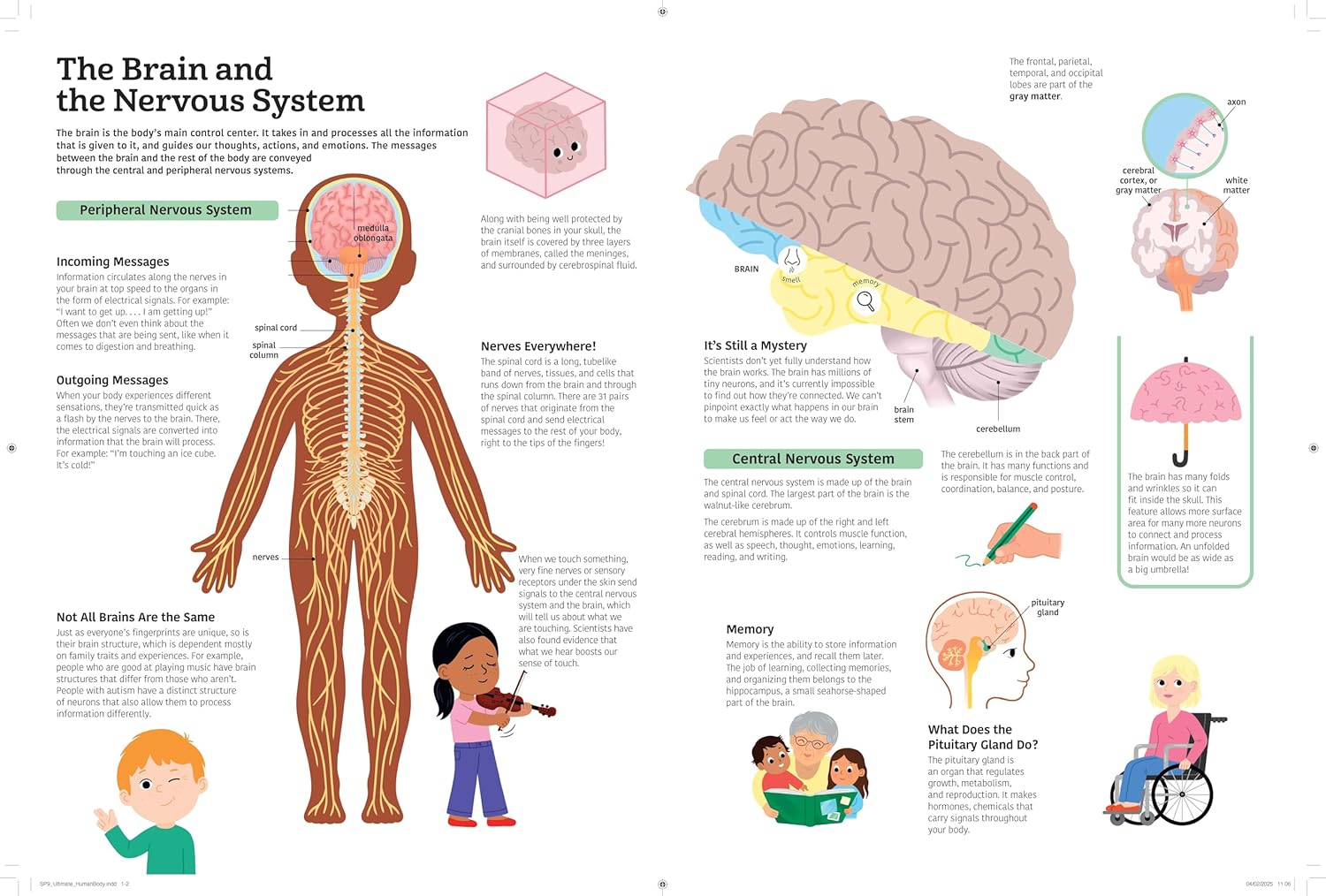
Illustration @ 2025 by Vanessa Robidou. Text © 2025 by Anne-Sophie Baumann. Courtesy of Twirl.

Anne-Sophie Baumann engages her target audience of children ages 8 through 12 with intelligent writing that uses scientific terminology always followed up with an easily understood definition. She addresses her readers directly, drawing them into this extensive education on anatomy and physiology through discussions about the body’s makeup as well as by spotlighting particular issues of interest for her young readers, such as pimples and skin issues, changing voices, braces, and stages of growth and development.

Accompanying Baumann’s text are Vanessa Robidou‘s incredibly detailed, and in some cases life-sized illustrations. Through the wealth of interactive elements, Robidou invites children to peer inside bones; the ear, eye, and mouth; the skin; and the organs as well as to follow breath, food, blood, and even tears through their dedicated systems. Colorful and expressive, these illustration will wow kids as they support Baumann’s text in exciting ways that reinforce learning.

If you’re looking for a hands-on book about the workings of the human body to share with your child or student, The Ultimate Book of the Human Body is highly recommended and would make a fantastic gift for children interested in topics about anatomy and health.

Ages 8 – 12

Twirl, 2025 | ISBN 979-1027613649

About the Author

Anne-Sophie Baumann studied science and literature before becoming an editor and author. She lives hear Paris, France. You can find her on Instagram.

About the Illustrator

Vanessa Robidou‘s illustrations can be found in various media and in many children’s books. She lives in Rennes, France. You can see more of her work on Instagram.

Picture Book Month Activity
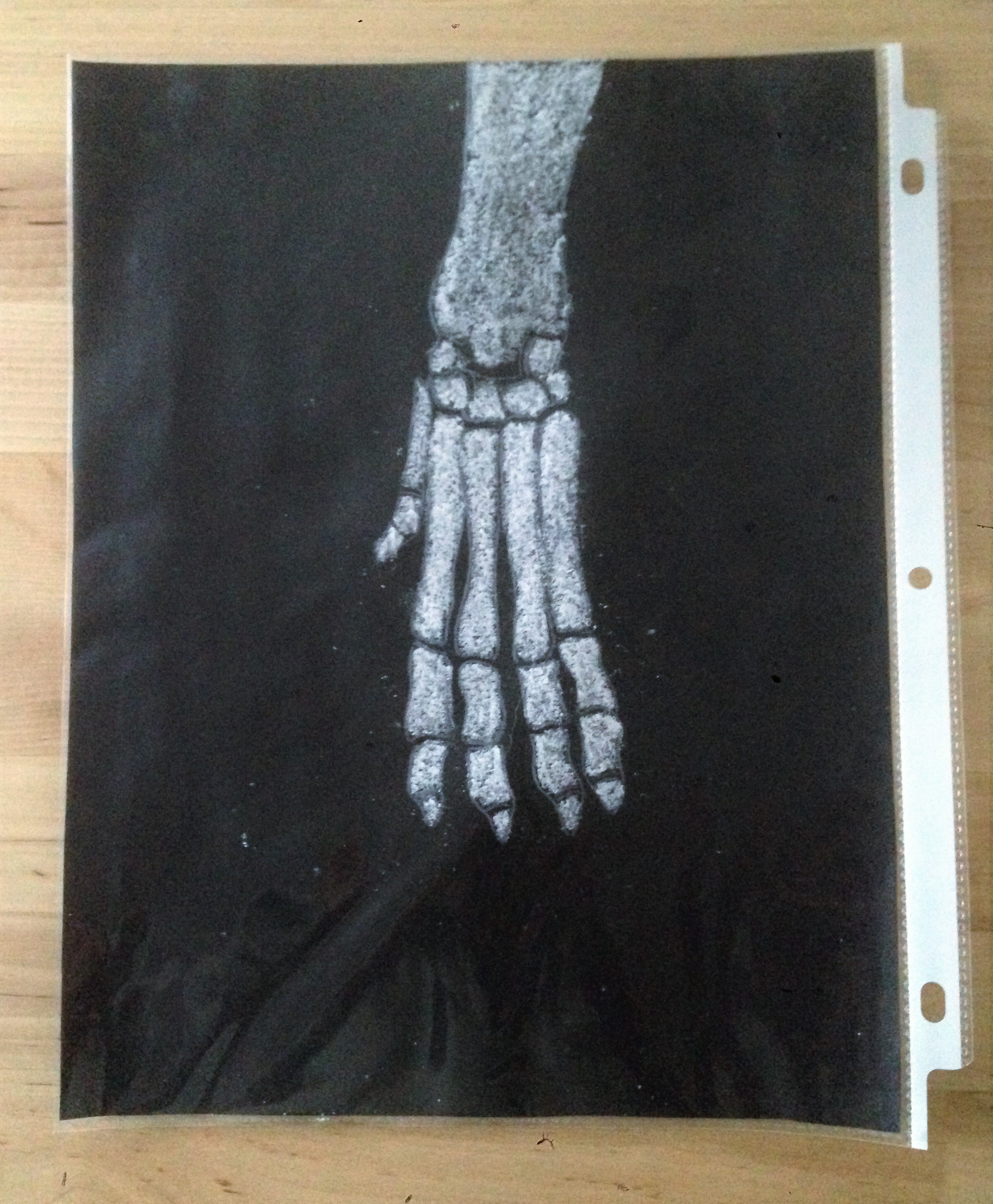
celebrate-picture-books-picture-book-review-x-ray-craft-dog-paw

Dog Paw and Human Hand X-Ray Craft


X-rays are cool to look at, but they always stay at the doctor’s office! With this craft you can simulate X-rays of a dog’s paw and a human hand!

Supplies

  • Printable skeleton templates: Human Hand Template | Dog Paw Template
  • Black chalkboard drawing paper, 8 ½ inches by 11 inches
  • White colored pencil
  • White chalk
  • Clear Plastic Report Sheet Protectors

Directions

  1. Print the Human Hand and Dog Paw Templates (you may want to print two—one to cut and one to follow when transferring the bones to the black paper)
  2. Cut the bones apart
  3. Lay the bones on the black chalkboard paper
  4. Trace the bones with the white colored pencil
  5. Color in the bones with the white chalk
  6. Slip the black paper into the plastic report sheet protector
You can purchase The Ultimate Book of the Human Body from these booksellers

Amazon | Barnes & Noble | Bookshop

Picture Book Review

May 30 – National Water a Flower Day

About the Holiday

National Water a Flower Day reminds us of the vast diversity of plants and flowers in the world and even in our own backyards, gardens, and communities. The holiday encourages us to show how much we appreciate plants for their sumptuous colors, their fragrant blossoms, their delicious fruits and seeds, and for the unique ways they survive under sometimes challenging conditions. To this end, as the name of the holiday nudges, we should take special time today to make sure all of our plants—both indoor and outdoor—are watered and cared for.

Superpowered Plants: Meet the Smartest, Strongest, Sneakiest Plants

Written by Soledad Romero Mariño | Illustrated by Sonia Pulido


From the beginning of time (perhaps even before) plants have been growing, spreading, and evolving to survive and thrive.  To do this, they’ve had to become smart, resilient, and even sneaky—ingenious. Plants and their blooms can last only a day or hundreds of years, quietly coexisting with generations of a family. Among the plants on Earth are some of nature’s craftiest mimics, chemists, thieves, and predators.

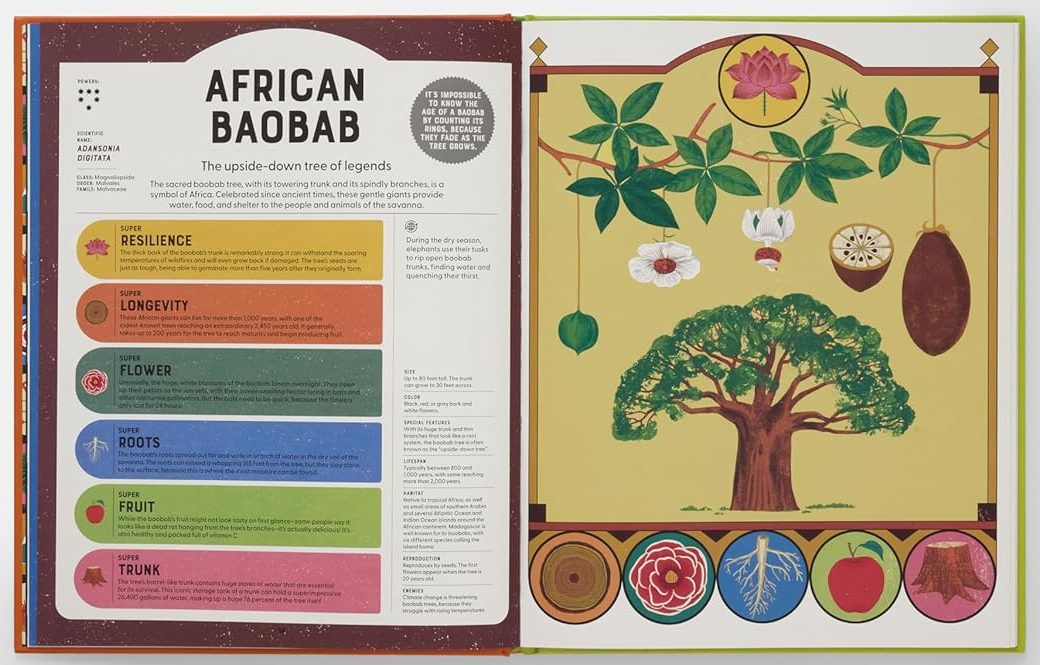
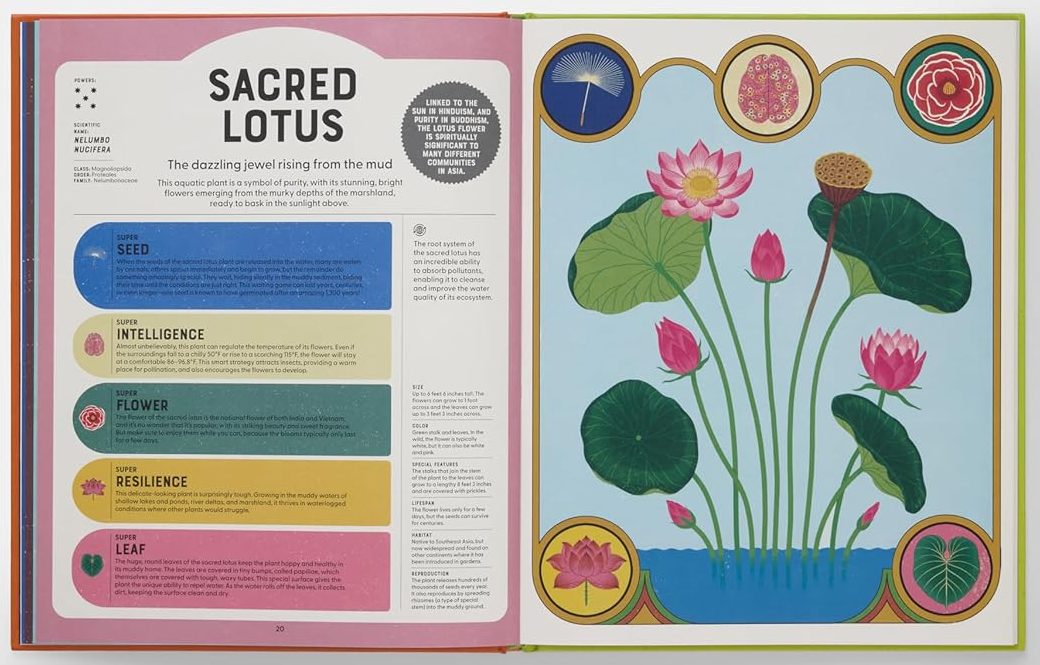
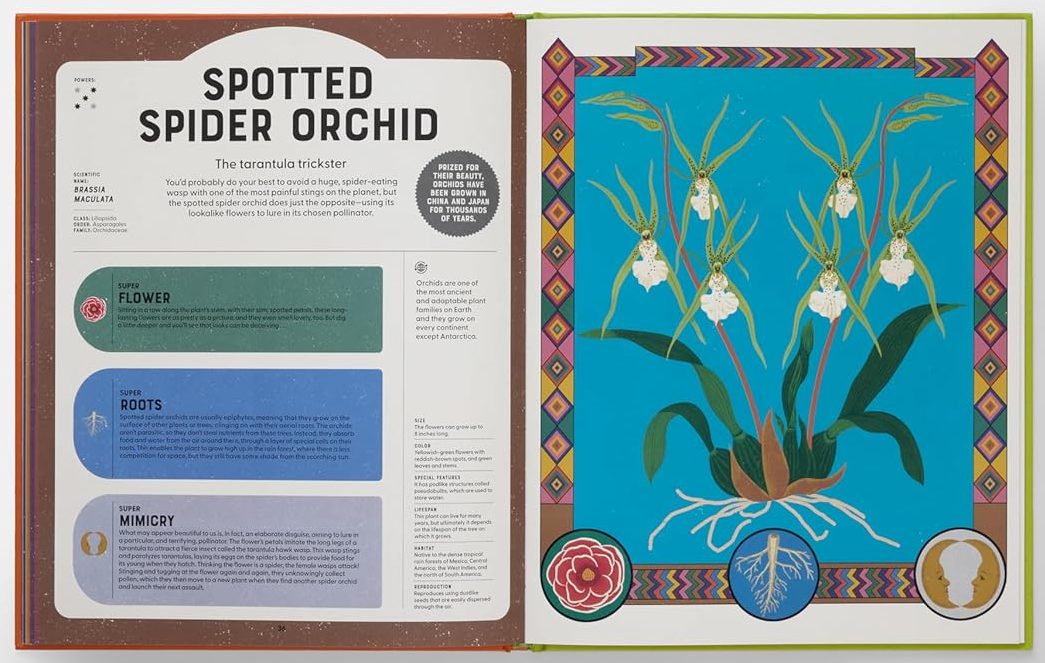
In Superpowered Plants, author Soledad Romero Mariño introduces readers to 22 astonishing plants from across the globe, including the African baobab, sacred lotus, spotted spider orchid, titan arum, and whistling thorn as well as more common varieties like dandelions and sunflowers. She identifies 17 superpowers that plants rely on to feed themselves, multiply, cope with extreme conditions, regenerate after fire or other challenges, and protect themselves. Some of these are super speed, super intelligence, super teamwork, super resilience, and super flower. 

Illustration © 2025 by Sonia Pulido, text © 2025 by Soledad Romero Mariño. Courtesy of Phaidon Press.

Working in tandem with illustrator Sonia Pulido, Mariño provides a short description of each plant before outlining its superpowers in clear, easily-digested tidbits presented in color-coded sections, further marked by a recognizable icon. Other information on the left-hand page includes the plant’s scientific name, class, order, and family as well as its size, color, lifespan, habitat, reproduction method, enemies, and special features, along with a fascinating trivia fact. 

To the right—in stunning tarot card-inspired illustrations that would easily be at home in any fine art museum—Pulido captures each plant in full-page, glorious, realistic splendor while stylishly displaying its flower, seed, and fruit and bordering it with representations of its habitat, superpowers, and unique features. 

Illustration © 2025 by Sonia Pulido, text © 2025 by Soledad Romero Mariño. Courtesy of Phaidon Press.

So what are a couple of examples of these astounding plants? Well, take the Whistling Thorn, which is native to the East African savanna. This plant really has the will (and the way) to survive! Not only are its branches covered in prickly spikes, but it teams up with a particular species of ant, offering colonies a home in exchange for aggressive attacks on any herbivore that dares take a nibble. And if that isn’t enough, the whistling thorn has “developed the superspecial skill of communication.” Where many whistling thorns grow in proximity, if one tree is attacked it releases a scent into the air, “alerting other trees in the area to the threat.” These trees “immediately secrete a toxic substance into their leaves, which can be harmful to touch and eat, therefore putting off the predator and keeping the community of trees safe.”

There’s also the Sandbox, native to tropical regions such as the Amazon rain forest, who’s playful name belies its nickname—the dynamite tree. Determined to spread its seeds far and wide, the sandbox produces fruit that, when ripe, explodes with such force “that it can cause injury to anyone standing in its way.” The seeds are propelled at “speeds of 230 feet per second and can cover distances of up to 150 feet.” It’s also best not to attempt to climb the sandbox, as its trunk is covered in “supersharp spikes.” 

Illustration © 2025 by Sonia Pulido, text © 2025 by Soledad Romero Mariño. Courtesy of Phaidon Press.

“Fascinating” hardly begins to describe all the discovery inside Superpowered Plants: Meet the Smartest, Strongest, and Sneakiest Plants. This well-conceived compendium will enthrall readers of all ages and spur a deeper appreciation for the earth’s vegetation—both the unusual and the common, which might just be more cunning than we imagine. Superpowered Plants is a must for all library collections and is highly recommended for home bookshelves, especially for nature lovers.

Ages 7 – 12+ (adults will be equally captivated)

Phaidon Press, 2025 | ISBN 978-1838669515

About the Author

Soledad Romero Mariño is an experienced children’s non-fiction author who specializes in ‘best of’ round-up style books. Her works include Superpowered Animals: Meet The World’s Strongest, Smartest, and Swiftest Creatures (also published by Phaidon), Awesome Accidents: 19 Discoveries that Changed the World, and Famous Robberies: The World’s Most Spectacular Heists.

About the Illustrator

Sonia Pulido’s illustrations have appeared in publications globally, including The New Yorker and The New York Times. In 2020 Pulido won the Spanish National Illustration Award and she is the illustrator of Phaidon’s bestselling What a Shell Can Tell.

National Water a Flower Day Activity

celebrate-picture-books-picture-book-review-flower-garden-game

Plant a Flower Garden Game


With this fun game you and your family and friends can grow gardens inside! Roll the dice to see whose garden will fully blossom first!

Supplies

Directions

Object: The object of the game is for each player to fill their garden or garden rows with flowers. Depending on the ages of the players, the game can be adjusted to fill all of the rows, some or all rows, or just one.           

  1. Print one Game Board for each player
  2. Print one or more sets of Flower Playing Cards for each player, depending on how  (for sturdier playing items, print on card stock)
  3. Cut the flowers into their individual playing cards
  4. Print one Flower Playing Die and assemble it (for a sturdier die, print on card stock)
  5. Color the “dirt” on the Garden Plot with the crayon (optional)
  6. Choose a player to go first
  7. The player rolls the die and then “plants” the flower rolled in a row on the game board
  8. Play moves to the person on the right
  9. Players continue rolling the die and “planting” flowers until each of the number of determined rows have been filled with flowers or one row has been filled with all six flowers.
  10. The first person to “grow” all of their flowers wins!

You can purchase Superpowered Plants: Meet the Smartest, Strongest, Sneakiest Plants from these booksellers

Amazon | Barnes & Noble | Bookshop

Picture Book Review

March 3 – World Wildlife Day

About the Holiday

In December of 2013 the United Nations General Assembly proclaimed March 3rd as World Wildlife Day to promote awareness of our environment and the dangers to it. Every year a different theme is chosen to spotlight an area of the world, a particular species, or a group of activists. This year’s theme is “Wildlife Conservation Finance: Investing in People and Planet” and focuses on innovative ideas for financing can contribute to halting biodiversity loss, raising the interest of private sector stakeholders to invest in wildlife conservation, and creating a sustainable future. The day also celebrates successful conservation and sustainability initiatives. To learn more about the day, special events, and how you and your kids can get involved today and throughout the year, visit the World Wildlife Day website.

Thanks to Eerdman’s Books for Young Readers for gifting us a copy of Kingdoms of Life for review.

Reviewed by Dorothy Levine

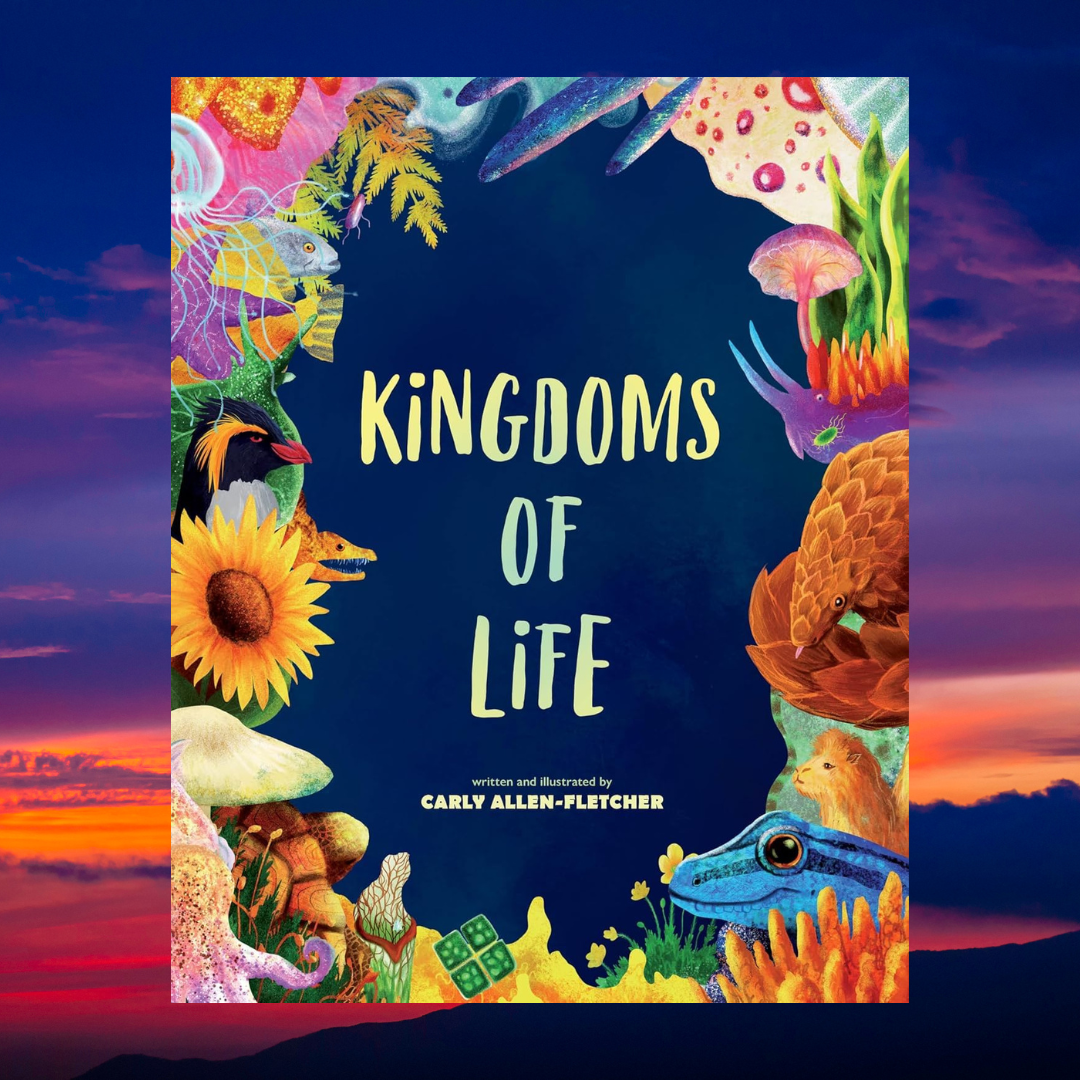
Kingdoms of Life

By Carly Allen-Fletcher


“Life is all around us…In the sky, the sea, and the soil, life exists in millions of different incredible ways.” 

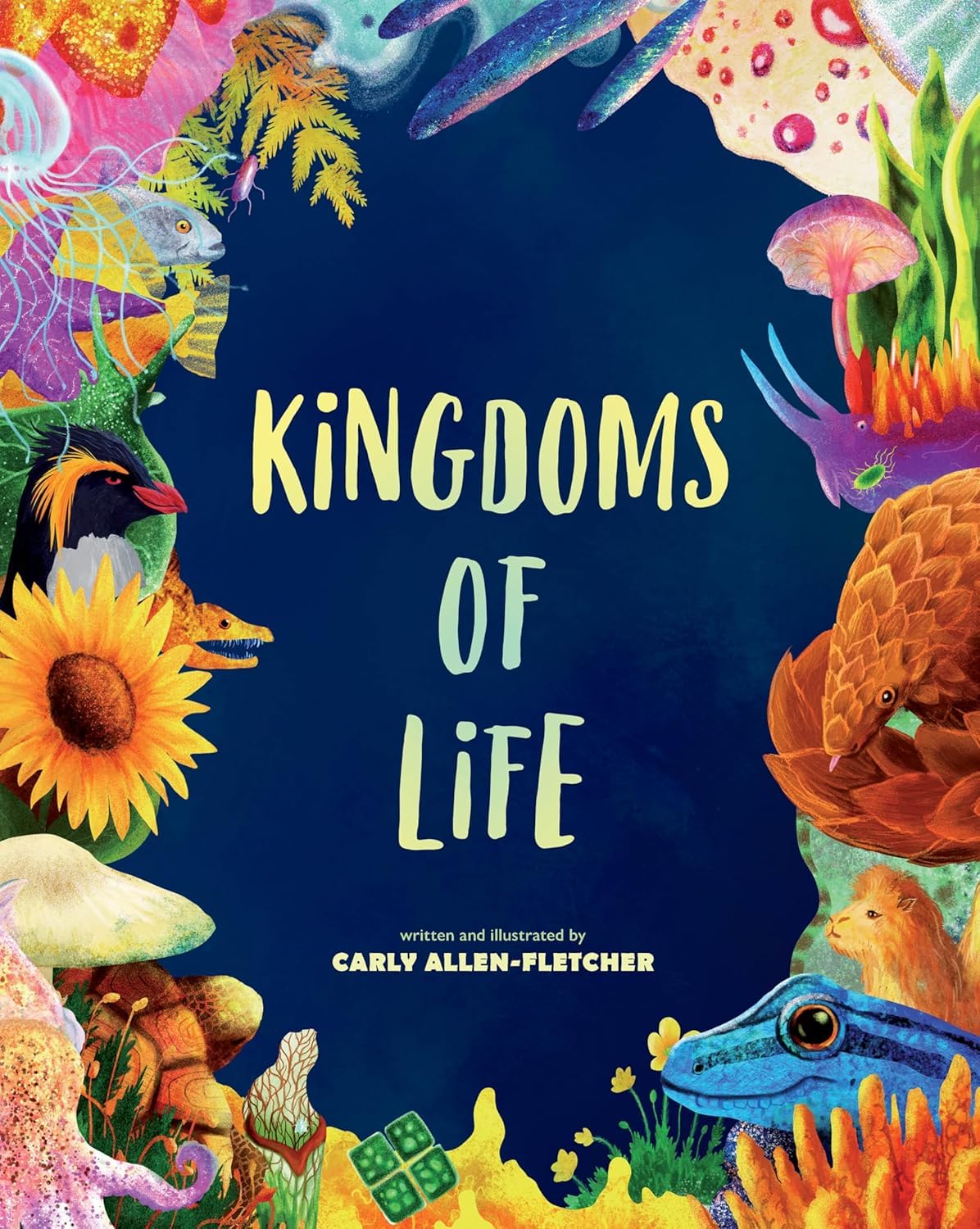
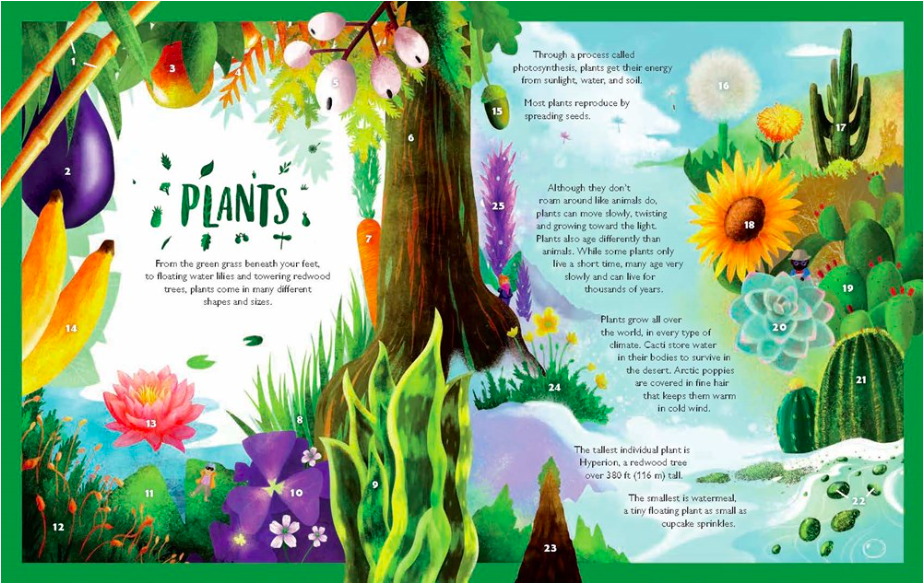
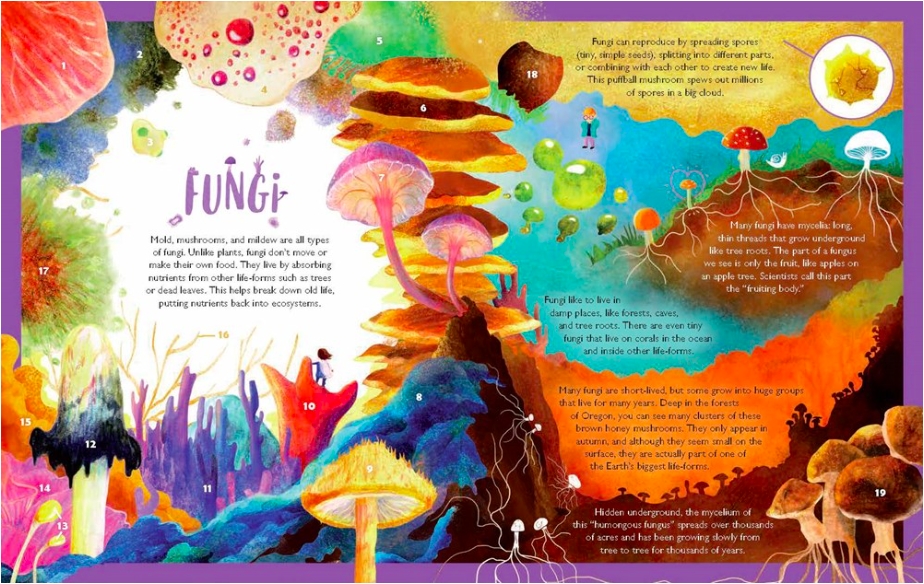
Jump into Carly Allen-Fletcher’s vibrant fact-filled guidebook for kids for a deep-dive exploration of the kingdoms of life. Each Kingdom rules over its own color-coded section, jam-packed with information on how the classified organisms feed, grow, and reproduce. Information also includes the ways in which the organisms across Kingdoms are related or work together with other lifeforms. The pages are royally packed with vibrant illustrations that appear to burst out from the very edges of the book. 

Allen-Fletcher begins with an explanation of how all life is formed—from tiny building blocks called cells. These cells can join to create complex multicellular life forms or just exist on their own as unicellular forms of life. She then zooms out to examine the six biggest categories of life. Allen-Fletcher makes sure to note that these categories are not fixed; they change as scientists learn more and arrange beings in different ways. 

Illustration and text © 2025 Carly Allen-Fletcher. Courtesy of Eerdmans Books for Young Readers.

The first category investigated in depth is the most complex of the life-form groups—animals. The animal pages are filled with a diverse range of species, each numerated to a corresponding key at the back. Allen-Fletcher shows the wide range of animals by comparing the smallest species (fairy wasps) to the largest (blue whales), while also explaining how even within one species (dogs) there can be glorious variety. Examples of animals that don’t quite fit in the animal category, such as a sea slug that can make energy from the sun, as well as animals that can survive extreme conditions or are thought to be practically immortal, are also discussed.

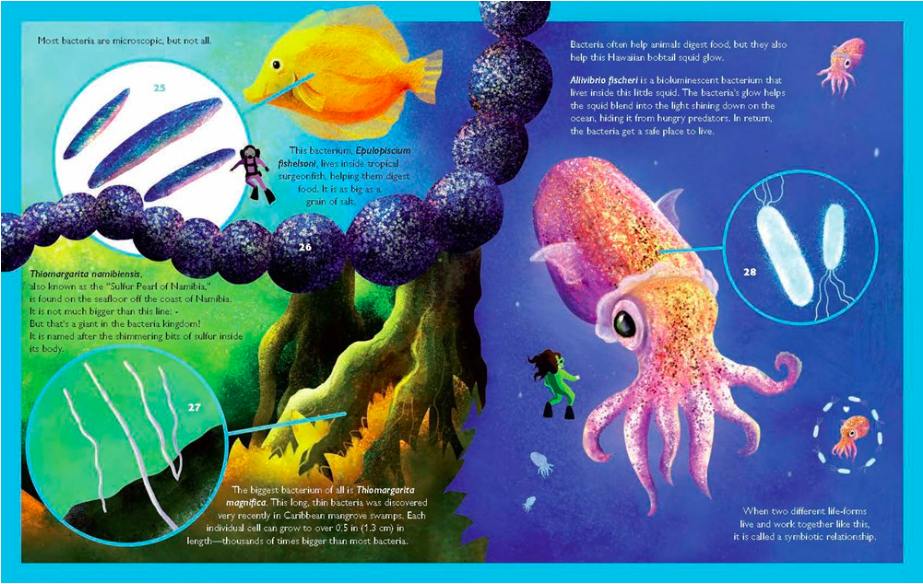
In addition to the animals, plants, fungi, protists, bacteria, and archaea are each given equal attention in their respective kingdom sections. From protists like giant kelp and slime mold to bacteria in our gut and bioluminescent bacteria found in squid, each kingdom is filled with fascinating examples of life and interesting facts on specific organisms. 

Illustration and text © 2025 Carly Allen-Fletcher. Courtesy of Eerdmans Books for Young Readers.

Kingdoms, Allen-Fletcher explains, can also be broken down further, into smaller and smaller groups such as family, genus, and species. A few taxonomists (scientists who study and sort lifeforms into categories) from around the world and throughout many different centuries are highlighted for their contributions to the field.

The book ends with a last dose of wonder: “We know more about the moon than we do about the deepest parts of our oceans. / Every year, we learn more about our home and the incredible life-forms we share it with. / What will we discover next?” The inclusion of “we” in this ending invites readers to feel welcome in this process of study and discovery. Taxonomy need not be only for adult scientists, but anyone who shares a passion for nature and careful observation. 

Back matter features each of the categories taxonomists use to sort life into groups as well as all the names of the featured life-forms throughout the book. The science is detailed while also distributed into easy-to-read bite-sized chunks.

Illustration and text © 2025 Carly Allen-Fletcher. Courtesy of Eerdmans Books for Young Readers.

Carly Allen-Fletcher illuminates a topic that is usually reserved for upper-level biology courses making it accessible and intriguing for young learners. The facts from her book will inspire a passion for all species—large or small, animal or bacteria—and help children to understand where in this big wide world we as humans stand and the symbiotic relationships that exist between creatures. Mini scientists dot the lusciously illustrated pages, comically examining life-forms in all the kingdoms up close.

Kingdoms of Life would make a valuable addition to home, school and library collections.

Ages 6 – 10

Eerdmans Books for Young Readers, 2025 | ISBN 978-0802855916

About the Author/Illustrator

Carly Allen-Fletcher is a British illustrator and author whose books include Goodnight Forest (Muddy Boots), Beastly Biomes (Creston), and Animal Antipodes (Creston). Inspired by nature and science, she creates her art by combining hand-drawn elements, painted textures, and graphic shapes. Carly loves reading about the latest biological discoveries, and if she hadn’t become a professional illustrator, she would have become a scientist instead. Follow Carly on Instagram or visit her website at carlydraws.com.

World Wildlife Day Activity

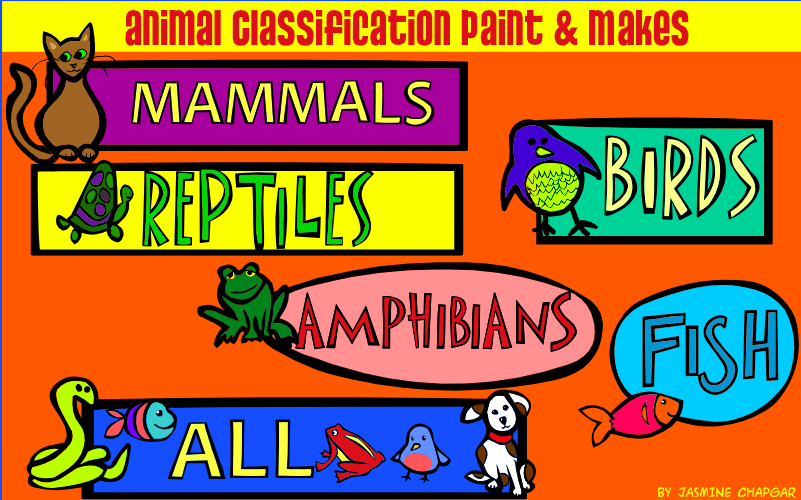
It Takes All Kinds game illustration courtesy of Science Trek.


Kingdoms of Life Fun

Watch a Kingdoms of Life Classification Video with Science Trek

  • As Allen-Fletcher notes in Kingdoms of Life, scientists are constantly evolving the categories for living organisms as they learn more. Do you notice any differences between the book and video kingdom categories? Since this video was published, scientists have started using the kingdom names bacteria and archaea instead of the previously used term, monera!

You can also explore their Online Games on kingdoms of life and animal classification, and practice sorting with Generation Genius’s Candy Classification Activity

You can purchase Kingdoms of Life at these booksellers

Amazon | Barnes & Noble | Bookshop (to support your local independent bookstore)

Picture Book Revie

May 11 – National Eat What You Want Day

celebrate-picture-books-picture-book-review-poop-for-breakfast-cover

About the Holiday

Do you feel like you’ve been on a diet forever? Have you been denying yourself a favorite treat because maybe it’s not the best thing you can eat? Or do you find yourself always making meals to suit everyone else’s taste when what you really want is just a grilled cheese sandwich? If so, today’s holiday gives you carte blanche to enjoy the foods you want without feeling guilty. It also seems like a fitting day to learn about the rather unusual (at least to us) diet of many creatures in the animal kingdom—and that’s where today’s book come in!

Poop for Breakfast: Why Some Animals Eat It 

Written by Sara Levine | Illustrated by Florence Weiser


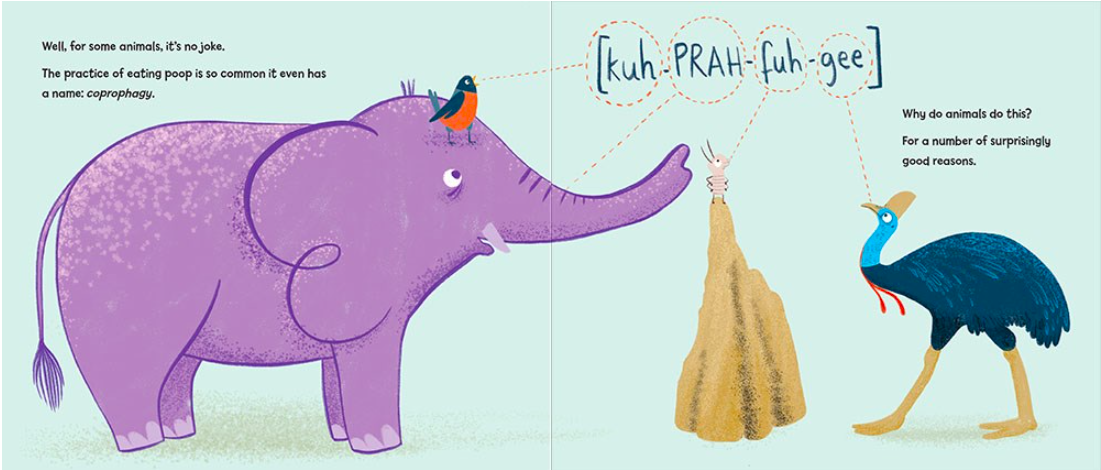
So, you wake up starving for a delicious meal. You’ve been dreaming of pancakes, maybe, or a plate of eggs and bacon. But when you get to the table, there’s a bowl of poop waiting for you?! Come on! While you might sulk (and probably hold your nose), there are plenty of creatures who’d be thinking “Bring it on!” Who are these critters? They’re animals that practice coprophagy, and they do it “for a number of surprisingly good reasons,” Sara Levine reveals.

celebrate-picture-books-picture-book-review-poop-for-breakfast-coprophagy

Image copyright Florence Weiser, 2023, text copyright Sara Levine, 2023. Courtesy of Millbrook Press.

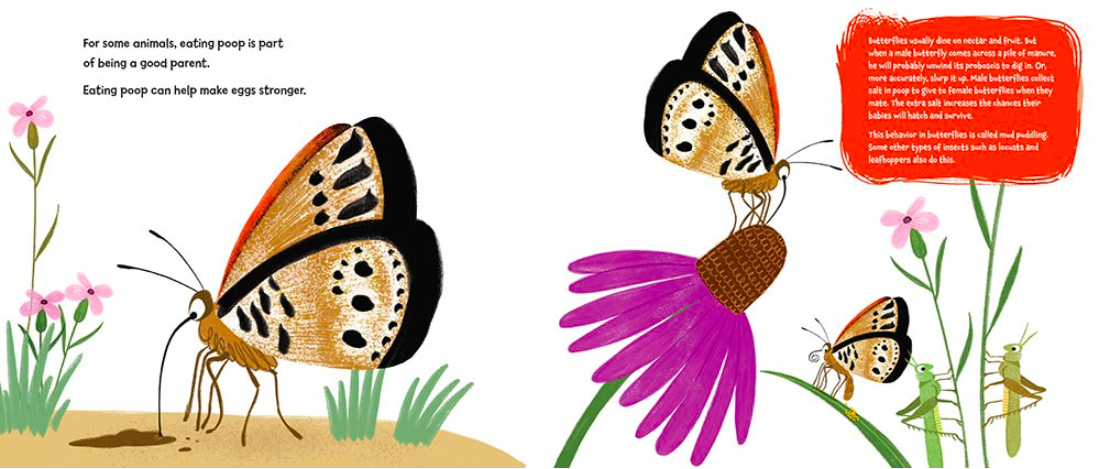
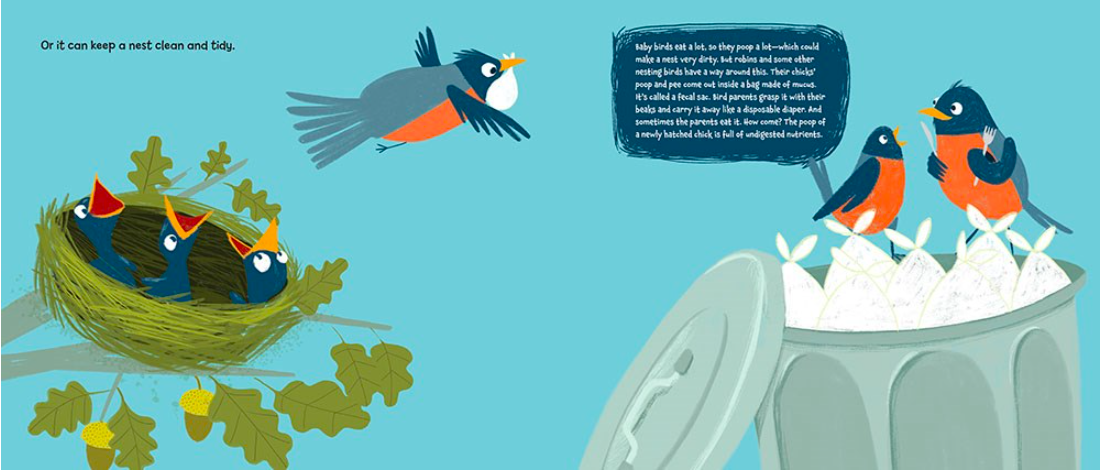
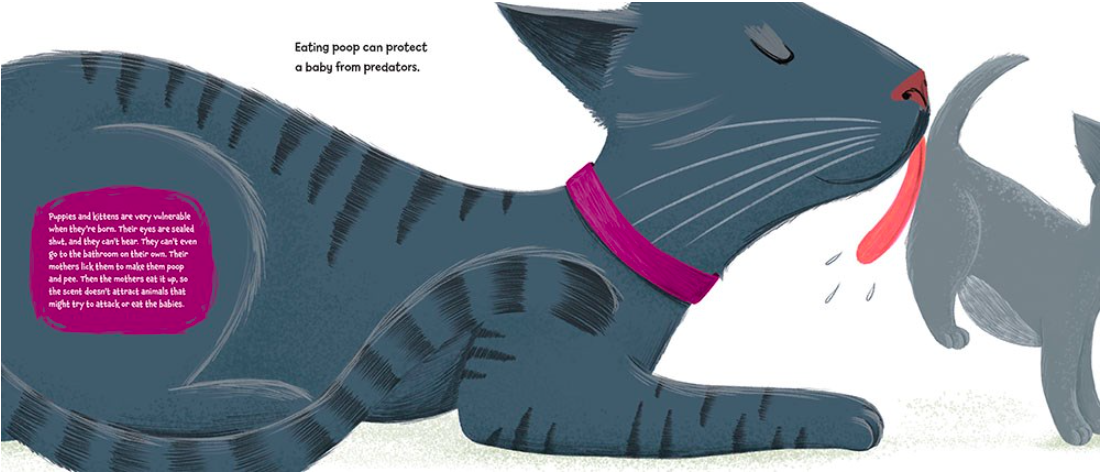
For some animals eating poop is just part of being a Number 1 (or maybe Number 2 is better in this case) parent. Butterflies, cats, and dogs as well as robins and other birds all have specific reasons for dining on doo-doo, from making eggs strong to protecting their babies from predators to keeping “a nest clean and tidy.” Birds have a particularly fascinating way to do this. Since baby birds eat a lot, they poop a lot. Keeping up with that level of cleaning could be daunting. Amazingly, though, these “chicks’ poop and pee come out inside a bag made of mucus. It’s called a fecal sac. Bird parents grasp it with their beaks and carry it away like a disposable diaper. And sometimes the parents eat it. How come? The poop of a newly hatched chick is full of undigested nutrients.”

celebrate-picture-books-picture-book-review-poop-for-breakfast-butterflies

Image copyright Florence Weiser, 2023, text copyright Sara Levine, 2023. Courtesy of Millbrook Press.

While these animals eat poop for external or aesthetic reasons, others engage in coprophagy to keep their digestive system working well. Still others, because of the length or shape of their digestive tract, require that food travels through their body twice to extract all of the nutrients. If you have a rabbit, hamster, guinea pig, or other small rodent as a pet, you know that their poop looks like little round balls or small pellets. As Levine tells readers, “this is the poop that has been through their digestive tract a second time. The first poop comes out soft, sticky, and full of nutrients. It’s called a cecotrope (SEE-ca-trope),” and these animals “gobble it up at night when it comes out. That’s why you don’t see it” in the cage.

celebrate-picture-books-picture-book-review-poop-for-breakfast-robins

Image copyright Florence Weiser, 2023, text copyright Sara Levine, 2023. Courtesy of Millbrook Press.

Since there are so many creatures who do eat poop, why don’t humans? Levine has included a whole list of reasons (and, yes, the frowny- crinkled-nose-face you’re making right now is one of them) for why we don’t—and don’t need to. She’s also provided back matter that includes “The Scoop on Poop”—an explanation of what poop and pee are, how they’re created in the body, and how they’re eliminated through the anus and the urethra as well as a paragraph about creatures that have a single cloaca instead of two openings. Kids will also have fun becoming “poop detectives” with the help of Levine’s and illustrator Florence Weiser’s guide to the sizes and shapes of poop from common pets and wildlife and playing a silly synonym game.

celebrate-picture-books-picture-book-review-poop-for-breakfast-cats

Image copyright Florence Weiser, 2023, text copyright Sara Levine, 2023. Courtesy of Millbrook Press.

Sara Levine is exceptional at presenting fascinating nature science topics in humorous and accessible ways for young audiences, and her latest book is no exception, Leaning into the “Ewww!” factor, Levine dishes up short, take-away reasons certain animals, birds, and insects practice coprophagy followed up with longer passages that explain the science and/or behavior behind them in easy-to-understand language sprinkled with humor that will keep readers riveted to this already high-interest subject.

Florence Weiser’s colorful illustrations perfectly bridge the humorous and the scientific nature of Levine’s text. Readers’ skeptical view of this “gross” habit is amusingly juxtaposed with creatures’ excited anticipation of a delicious meal through the characters’ facial expressions while the anatomical reasons for or against coprophagy are clearly depicted in images of human and various animals’ digestive systems.

Anatomy and nature science education at its best, Poop for Breakfast: Why Some Animals Eat It will keep kids enthralled as each page turn brings on a new round of giggles and avid learning. The book would enhance any home STEM collection and is a must for classroom, school, and public library bookshelves.

Ages 5 – 10

Millbrook Press, 2023 | ISBN 978-1728457963

About the Author

Sara Levine is an author, educator, and veterinarian. Her science books for children include the Animal by Animal series, Germs Up Close, and A Peek at Beaks: Tools Birds Use. Her books have received a number of awards including AAAS/Subaru SB&F Prize, Utah Beehive Book Award, Cook Prize finalist, Monarch Award master list, and Bank Street College Best Children’s Book of the Year.

About the Illustrator

Florence Weiser is a French illustrator currently based in beautiful, rainy Belgium. While growing up in Luxembourg, she always knew she wanted to draw and draw. She lives and works surrounded by nature, from which she gathers most of her inspiration.

celebrate-picture-books-picture-book-review-poop-for-breakfast-cover

You can find Poop for Breakfast: Why Some Animals Eat It at these booksellers

Amazon | Barnes & Noble | Books-a-Million

To support your local independent bookstore, order from

Bookshop

Picture Book Review


March 24 – It’s Women’s History Month

celebrate-picture-books-picture-book-review-june-almeida-virus-detective-cover

About the Holiday

From its beginning as a single-day observance in 1911 in Sonoma, California, the celebration of women’s achievements and contributions throughout history grew to a week-long event in 1980 and finally to encompass the entire month of March in 1987. During this month we remember the trail-blazing women of yesteryear who used their creativity, intelligence, and perseverance to promote rights for women while contributing their own innovations to science, art, social reform, medicine, and other disciplines as well as today’s pioneers who carry on their legacy and make our world a better place. Today, we feature a book about a woman who revolutionized virology and medical research, connecting the past and the present. To learn more about the holiday, visit the National Women’s History Museum website and check out their resource toolkit.

June Almeida, Virus Detective! The Woman Who Discovered the First Human Coronavirus

Written by Suzanne Slade | Illustrated by Elisa Paganelli

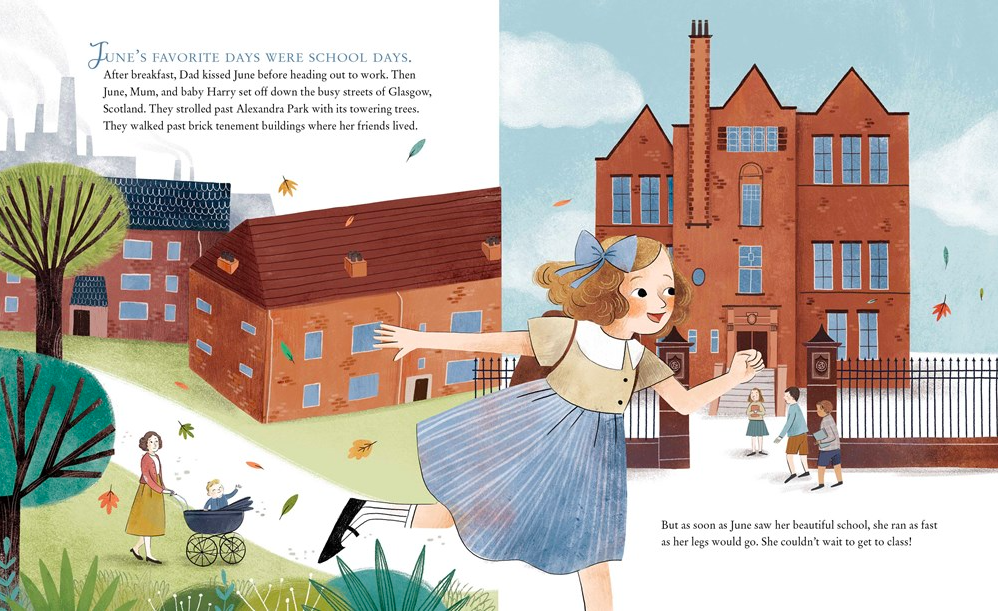
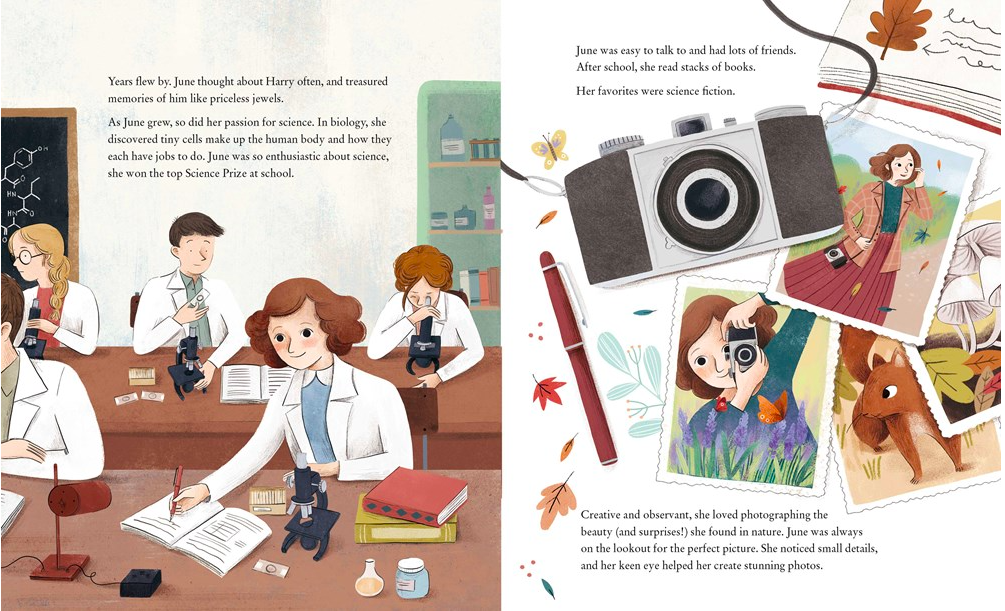
Growing up in Glasgow, Scotland, June Almeida loved school. After class she couldn’t wait to share what she’d learned—especially science subjects—with her mother, father, and little brother, Henry. When June was ten, however, her life changed when Henry became sick and passed away. Throughout elementary school and into high school, June loved studying science, especially biology in which she learned about the cells in the body and their functions. “June was so enthusiastic about science, she won the top science prize at school.”

celebrate-picture-books-picture-book-review-june-almeida-virus-detective-childhood

Image copyright Elisa Paganelli, 2021, text copyright Suzanne Slade, 2021. Courtesy of Sleeping Bear Press.

But science wasn’t the only thing June loved. She had lots of friends, was an avid reader, and became an excellent photographer. Whenever she was out with her camera, “she noticed small details, and her keen eye helped her create stunning photos.” June dreamed of attending college, but the jobs her father and mother held did not pay enough, and when June was sixteen, she dropped out of school to get a job to help pay the bills. June wanted to make a difference, “so she applied to work at the nearby hospital” and was hired as a lab worker. Here she learned how to examine cells with a microscope. “Her findings helped doctors treat patients.”

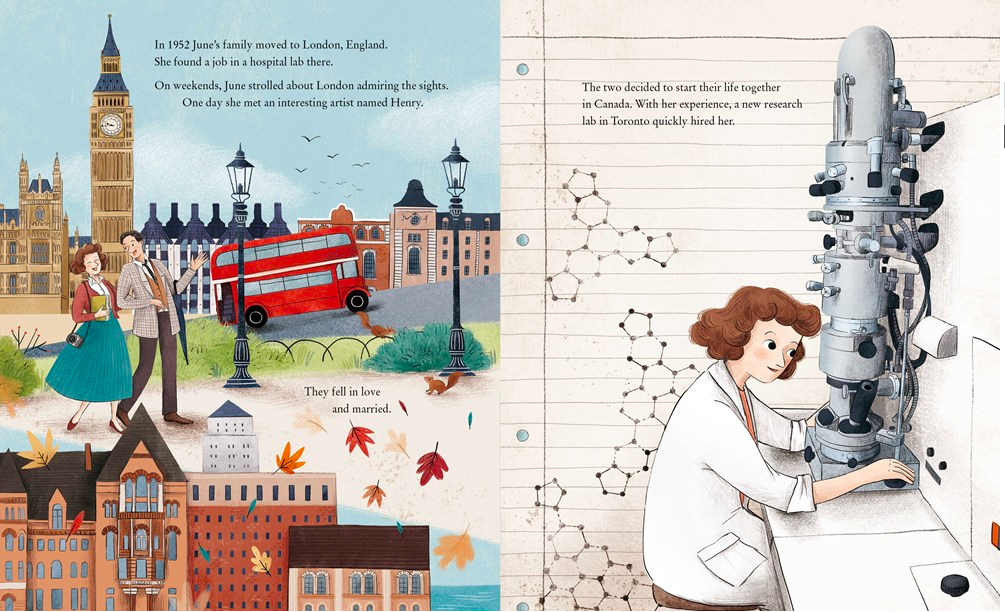
When June was twenty-two, she and her family moved to London. She got a job in a hospital lab and also met and married an artist named Henry. June and Henry moved to Canada, where she quickly found a job at a “new research lab in Toronto.” In this lab, June worked with an electron microscope that could magnify things 25,000 times and produced detailed pictures of the samples being studied. These photos “were helpful. But it was hard to tell which tiny blobs were viruses and which were cells.” June thought she could improve on the photos.

celebrate-picture-books-picture-book-review-june-almeida-virus-detective-photographer

Image copyright Elisa Paganelli, 2021, text copyright Suzanne Slade, 2021. Courtesy of Sleeping Bear Press.

June knew that in the body antibodies would surround viruses as they worked to fight it. June wondered if by introducing antibodies to her samples, scientists would be able to determine the virus from the cells. June’s idea worked. The scientists were astonished. Because of June’s innovation, they now had clear pictures that would help them study and combat viruses.

After June took time away from work to have a baby in 1960, she returned to her research and often lectured about her work. She was recruited to work at a hospital lab in London, so she and her family moved once again. At the time, a researcher named David Tyrrell had been trying to identify a virus that had affected a young boy. Could it be a new virus? He was hoping that June could help.

celebrate-picture-books-picture-book-review-june-almeida-virus-detective-hospital

Image copyright Elisa Paganelli, 2021, text copyright Suzanne Slade, 2021. Courtesy of Sleeping Bear Press.

When June received the sample, she knew that “since it was an unknown virus, there were no antibodies to help find it.” But she was an expert at using another method that might work. Carefully, June implemented the intricate steps. Then she put the sample under the microscope and scanned the picture. “June was stunned.” Each virus blob was encircled by tiny dots “like a crown. ” She had seen this twice before when looking at viruses from sick animals. She had written a paper on it, but it had been rejected by other researchers because they thought her pictures were just blurry and not those of a new virus.

June presented her findings to doctors who agreed with her discovery. They decided to name the new virus coronavirus, after the Latin word for crown, corona. June and David then published a paper telling other doctors and researchers about the new virus. Following this discovery, June continued to study viruses, such as hepatitis B and HIV. Her pictures of these viruses helped researchers develop medications that could “block them from making people sick.” Even after she retired, June never lost her love of learning, teaching herself to play the flute, about antiques, and how to use a digital camera to continue creating incredible photos.

Backmatter includes more about June Almeida and her life’s work, an illustrated timeline of her life, and a selected bibliography.

celebrate-picture-books-picture-book-review-june-almeida-virus-detective-London

Image copyright Elisa Paganelli, 2021, text copyright Suzanne Slade, 2021. Courtesy of Sleeping Bear Press.

Suzanne Slade’s compelling biography of June Almeida gives context for and insight into the research and discovery of the coronavirus and informs present-day events and breakthroughs. Slade’s fluid storytelling clearly reveals Almeida’s intelligence and passion for science as well as her determination to use her skills to the betterment of society. Kids will be astounded that June was able to begin her career at the age of sixteen, and that her beloved hobby of photography became a career that changed medical research. Slade’s sprinkling of personal details about Almeida’s life creates a well-rounded understanding of this influential woman.

Through Elisa Paganelli’s realistic and detailed illustrations, children have the opportunity to see a researcher at work in world-class laboratories. Readers will be especially impressed by images of the electron microscope and how Almeida improved the photographs these powerful machines produced. Children familiar with the shape of the coronavirus will be interested in seeing the faithfully reproduced photographs and how the virus got its name. Kids will also enjoy seeing illustrations of Almeida’s family life, including her daughter Joyce, who is herself a doctor.

An inspirational and fascinating biography of a woman with a very innovative mind, June Almeida, Virus Detective! will thrill children interested in science, medicine, and the arts. The book would be an impactful addition to STEM and STEAM lessons. It is highly recommended for home libraries and is a must for school and public library collections.

Ages 6 – 9 

Sleeping Bear Press, 2021 | ISBN 978-1534111325

Discover more about Suzanne Slade and her books on her website.

To learn more about Elisa Paganelli, her books, and her art, visit her website.

Women’s History Month Activity

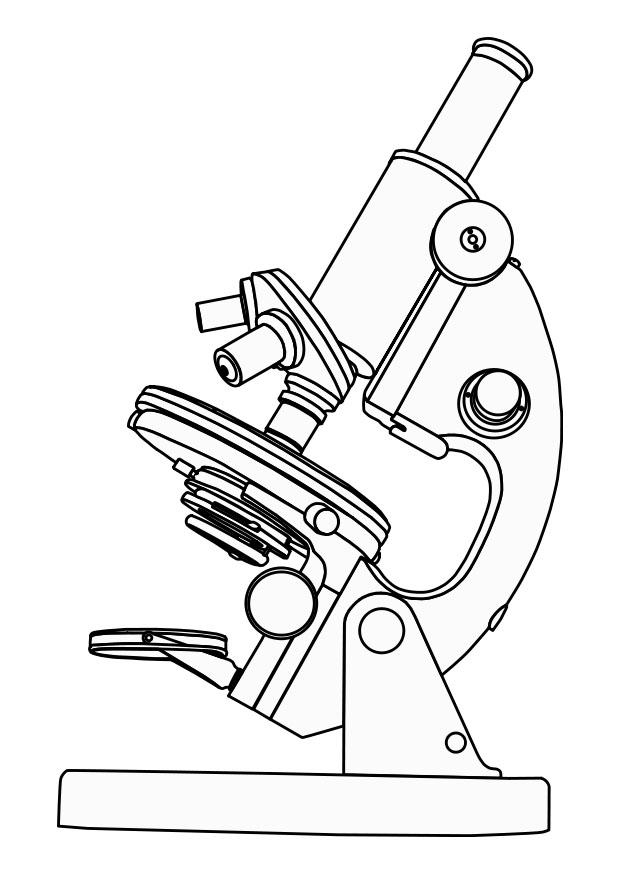
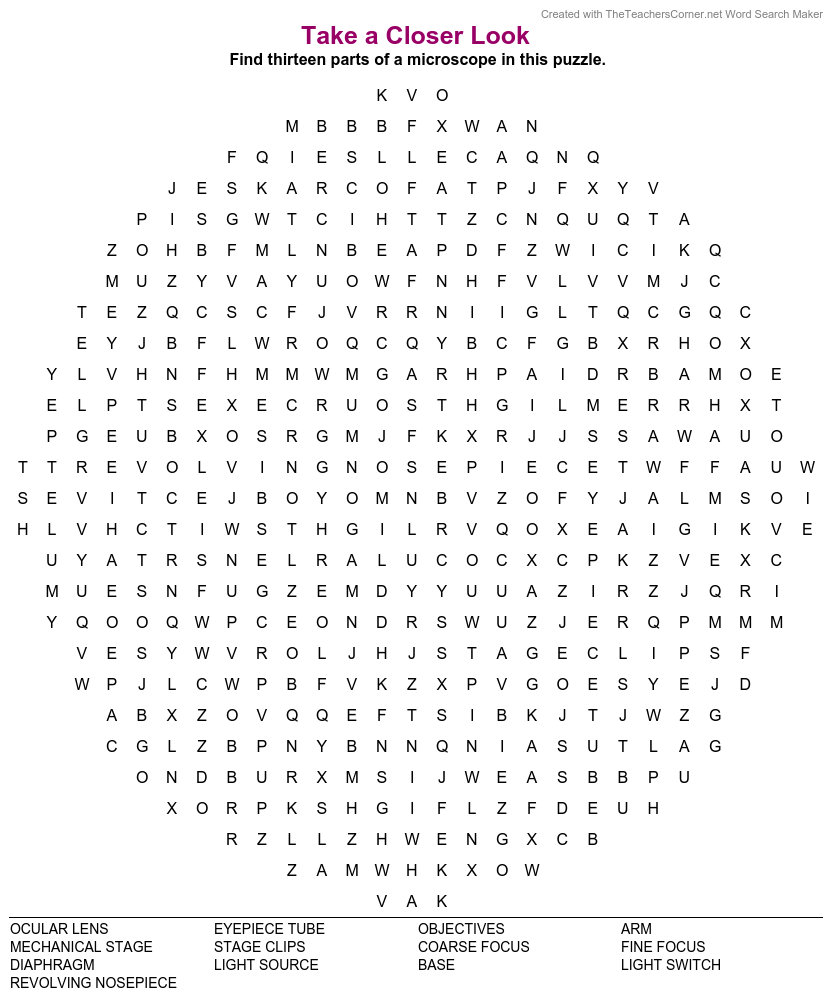
celebrate-picture-books-picture-book-review-microscope-coloring-page          celebrate-picture-books-picture-book-review-microscope-wordsearch-puzzle

Take a Closer Look Coloring Page and Word Search 

You can examine the parts of a microscope with this printable word search puzzle and coloring page.

Take a Closer Look Word Search Puzzle | Take a Closer Look Word Search Solution | Coloring Page

celebrate-picture-books-picture-book-review-june-almeida-virus-detective-cover

You can find June Almeida, Virus Detective! at these booksellers

Amazon | Barnes & Noble | Books-a-Million

To support your local independent bookstore, order from

Bookshop | IndieBound

Picture Book Review