December 22 – It’s Human Rights Month

About the Holiday

During the month of December we honor the world’s citizens and the Universal Declaration of Human Rights (UDHR), an international document adopted by the General Assembly of the United Nations on December 10, 1948. The Universal Declaration describes basic rights and fundamental freedoms to which all people are entitled. Some of these include freedom from discrimination, the right to equality, and the right to be considered innocent until proven guilty. Outlined in thirty articles, the declaration is aimed at ensuring equality of rights for all. For a version of the articles for children, visit Compasito.

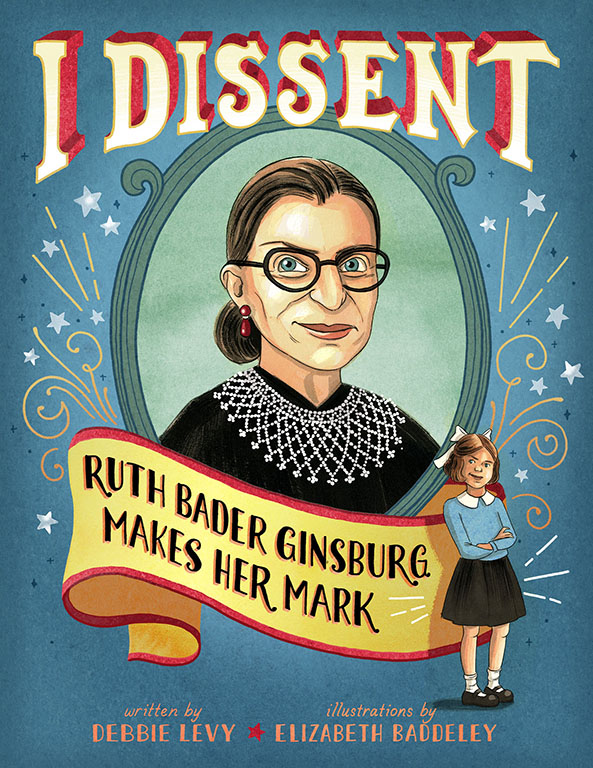
I Dissent: Ruth Bader Ginsburg Makes Her Mark

Written by Debbie Levy | Illustrated by Elizabeth Baddeley


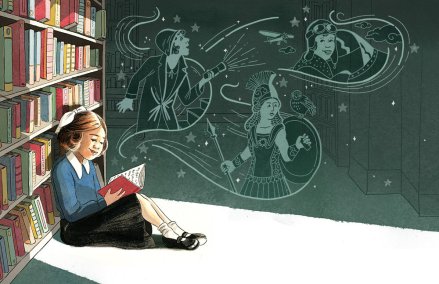
Ruth Bader grew up during the 1940s in Brooklyn, New York’s multicultural neighborhood. It was a time when boys were educated for jobs and bright futures while girls were expected to marry and raise children. Ruth’s mother, Celia Amster Bader, however, “thought girls should also have the chance to make their mark on the world.” She introduced Ruth to books in which she discovered women who used their strength, courage, and intelligence to do big things.

celebrate-picture-books-picture-book-review-i-dissent-in-the-library

Image copyright Elizabeth Baddeley, text copyright Debbie Levy. Courtesy of simonandschuster.com.

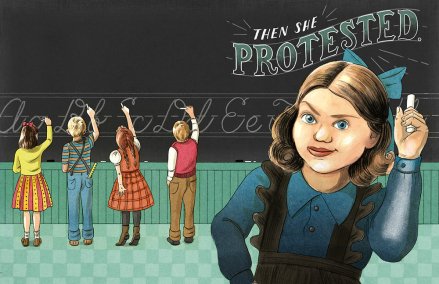
Ruth also saw and felt the sting of prejudice while growing up. Her family was Jewish, and at the time “hotels, restaurants, even entire neighborhoods” denied access to Jews, African Americans, Mexicans, and others. Ruth disagreed and never forgot. She was even discriminated against for being left-handed. In school she was instructed to write with her right hand, but her awkward penmanship earned a D. First, she cried; then she protested by only writing with her left hand—“it turned out she had quite nice handwriting!”

celebrate-picture-books-picture-book-review-i-dissent-in-the-left-handed

Image copyright Elizabeth Baddeley, text copyright Debbie Levy. Courtesy of simonandschuster.com.

During elementary school, Ruth was outstanding in some classes, such as history and English, and did not do so well in others, such as sewing and cooking. Music, especially opera, was another favorite subject—even though she did not have the voice to match her dreams. She excelled in high school and was even chosen as a graduation speaker. But Ruth had been hiding the fact that her mother was very ill. The day before graduation, her mother died. Ruth did not go to her graduation, but she did fulfill her mother’s wish and entered college.

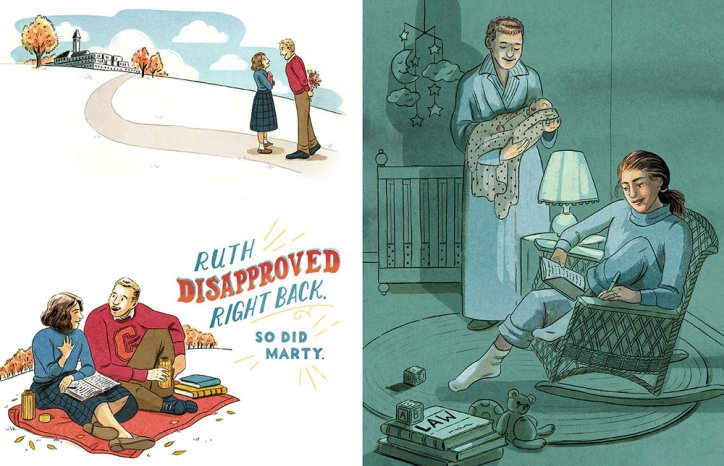
In college Ruth met Marty Ginsberg, and the two fell in love. They both decided to become lawyers to fight prejudice and unfairness in court. People thought this was a great idea for Marty, but disapproved of it for Ruth. “Ruth disapproved right back. So did Marty.” After college they got married, went to law school, and had a baby girl.

celebrate-picture-books-picture-book-review-i-dissent-college

Image copyright Elizabeth Baddeley, text copyright Debbie Levy. Courtesy of simonandschuster.com.

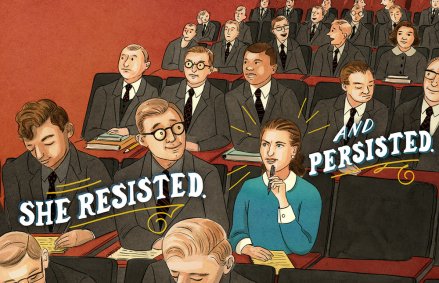
In law school Ruth was one of nine women in a class of 500. She worked hard and tied with another student as first in the class, but after graduation she couldn’t find a job. Employers objected because she was a woman, a mother, and Jewish. Finally, she found work with a judge. Her excellent work for him translated into jobs at one law school after another, and she became “one of the few female law professors in the whole country.”

All around her Ruth saw other women who were denied jobs or paid less than men. Women also had very little voice in courtrooms or in government. Rulings by the Supreme Court, the highest court in America, had helped maintain this inequality. The Court had stated that women were unfit for many jobs because of their “natural and proper timidity and delicacy.” Besides, the Supreme Court also said, “Woman has always been dependent upon man.”

celebrate-picture-books-picture-book-review-i-dissent-in-the-law-school

Image copyright Elizabeth Baddeley, text copyright Debbie Levy. Courtesy of simonandschuster.com.

“Ruth really, really disagreed with this!” So she began fighting in court for equal rights for women. But equal rights for women also meant equal rights for men: Ruth believed men should be able to stay home with children if they wanted to while women worked. “These were fresh ideas in the 1970s. Ruth did not win every case, but she won enough. With each victory, women and men and girls and boys enjoyed a little more equality.”

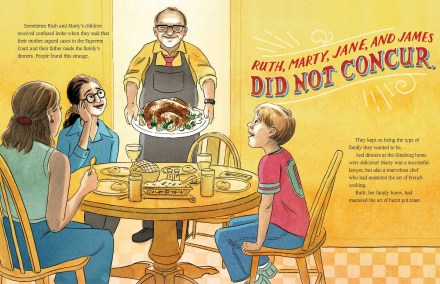
At home, Ruth’s own family agreed with her. Marty was a successful lawyer and also an accomplished chef who cooked the family’s meals. Ruth went on to become a well-known and well-respected lawyer. President Jimmy Carter asked her to be a judge in Washington DC. Then President Bill Clinton chose her to fill a vacancy on the Supreme Court. “Ruth agreed.

celebrate-picture-books-picture-book-review-i-dissent-family-life

Image copyright Elizabeth Baddeley, text copyright Debbie Levy. Courtesy of simonandschuster.com.

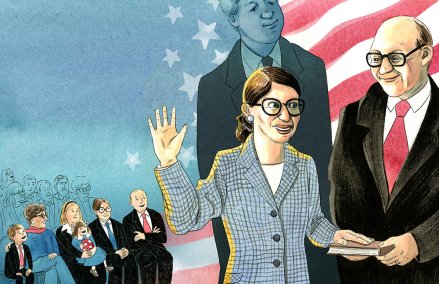
In 1993, Justice Ruth Bader Ginsburg became the first Jewish woman on the nation’s highest court.” When the nine justices decide a case, they listen to both sides and then vote. The winning side then writes an opinion explaining their ruling. When Justice Ginsburg votes with the winning side, she wears a special lace collar over her robe. When she does not agree with the ruling, she says, “I dissent” and writes an opinion explaining why. She has a special collar for dissenting too.

Some of her dissensions were influenced by her early experiences. She dissented when “the court wouldn’t help women or African Americans or immigrants who had been treated unfairly at work.” She dissented when the court did not protect voting rights for all citizens. She dissented when the court disagreed with schools that offered African Americans a better chance to go to college.” And once when she dissented, Congress and the president agreed with her and overturned the Supreme Court’s ruling.

celebrate-picture-books-picture-book-review-i-dissent-supreme-court

Image copyright Elizabeth Baddeley, text copyright Debbie Levy. Courtesy of simonandschuster.com.

Justice Ruth Bader Ginsburg is now the oldest member of the Supreme Court. Some people think she should retire, but she disagrees. She still has work to do. Over the years, she has “cleared a path for people to follow in her footsteps—girls in college, women in law school, and everyone who wants to be treated without prejudice….Step by step, she has made a difference…one disagreement after another.”

An extensive Author’s Note about Ruth Bader Ginsburg’s life, notes on Supreme Court Cases, and a selected bibliography follow the text.

Debbie Levy’s outstanding biography allows readers to journey with Ruth Bader Ginsburg as her experiences and beliefs lay the foundation for her life’s work. Well-chosen anecdotes from Ginsburg’s childhood make her accessible to kids and may even inspire them to look toward their own futures. Ginsburg’s trajectory from college student to lawyer to judge and finally to the Supreme Court is balanced and uplifting, emphasizing the positive impact of persistence and self-confidence.

Elizabeth Baddeley’s illustrations go hand-in-hand with Levy’s text to fully illuminate the life of Ruth Bader Ginsburg for children. Ginsburg’s intelligence, sense of humor, courage, and principles are evident as she matures from school girl to Supreme Court Justice. Dynamic typography highlights the theme of dissent and disagreement as a force for positive change. The color, expression, and spirit imbued in each page make I Dissent: Ruth Bader Ginsburg Makes Her Mark an exciting and eye-catching read for all children.

I Dissent: Ruth Bader Ginsburg Makes Her Mark is a superb and recommended book for girls and boys. The book’s focus on a woman who continues to make a difference will inspire children and even adult readers to speak up and act on their convictions.

Ages 5 – 9

Simon & Schuster Books for Young Readers, 2016

To learn more about Debbie Levy and her books for children and young adults, visit her website!

Discover a gallery of illustration by Elizabeth Baddeley on her website!

Universal Human Rights Month Activity

celebrate-picture-books-picture-book-review-human-rights-month-coloring-page-balloon

Soar Together Coloring Page


Making friends from around the world is a wonderful way to learn about human rights and make the world a better place. Grab your colored pencils or crayons and enjoy this printable Soar Together Coloring Page!

Picture Book Review
December 10 – Jane Addams Day

celebrate-picture-books-picture-book-the-house-that-jane-built-cover

About the Holiday

Today’s holiday was established in 2007 and commemorates the day in 1931 when Jane Addams became the first American woman to win the Nobel Peace Prize for her work to bring about social change, equality, and peace. Each year the Jane Addams Peace Association presents awards to outstanding children’s books that promote peace and justice. To learn more about Jane Addams and the Jane Addams Peace Association, visit janeaddamspeace.org.

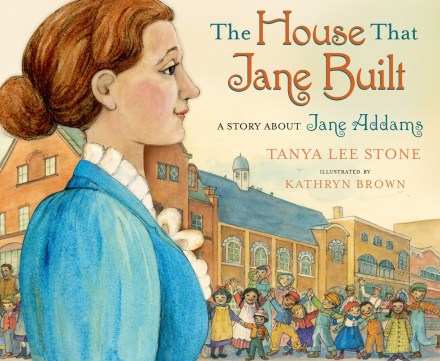
The House that Jane Built: A Story about Jane Addams

Written by Tanya Lee Stone | Illustrated by Kathryn Brown


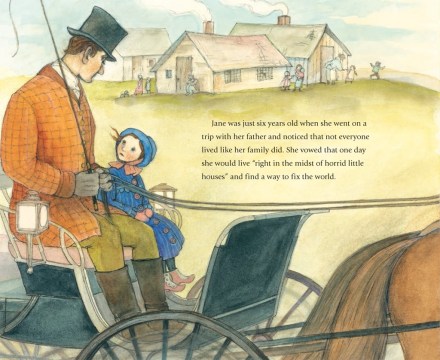
On a busy street stands a very special house where anyone is welcome and some find a home. In 1889 Jane Addams, a wealthy young woman, bought an elegant house in one of Chicago’s poorest neighborhoods. Why? At just six years old on a trip with her father, Jane “noticed that not everyone lived like her family did.” Right then she vowed that when she grew older, she would live in a poor community and “find a way to fix the world.”

celebrate-picture-books-picture-book-the-house-that-jane-built-trip-with-father

Image copyright Kathryn Brown, 2015, text copyright Tanya Lee Stone. Courtesy of us.macmillan.com.

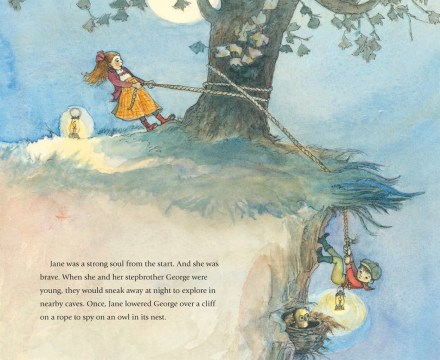
Jane was brave and strong. Sometimes she and her stepbrother George would “sneak away at night to explore in nearby caves.” Jane was also smart and “read and read her father’s book collection,” which also served as the town library. Unlike most women at the time, Jane went to college. She attended Rockford Female Seminary and “graduated at the top of her class.”

celebrate-picture-books-picture-book-the-house-that-jane-built-exploring-with-George

Image copyright Kathryn Brown, 2015, text copyright Tanya Lee Stone. Courtesy of us.macmillan.com.

After graduation, she didn’t know what she wanted to do, and when her father died that same summer, “Jane felt lost.” Two years later some friends invited her to travel to Europe with them. Although they went to the opera, museums, and many beautiful places, it was an experience in London that stuck with her. There she saw many “people in ragged clothes with outstretched hands, begging a cart vendor to buy his rotten fruits and vegetables that hadn’t sold at the market.” 

celebrate-picture-books-picture-book-the-house-that-jane-built-London-settlement-house

Image copyright Kathryn Brown, 2015. Courtesy of us.macmillan.com.

When Jane returned home, the question of how she could help nagged at her. She returned to London to learn about Toynbee Hall, where poor and wealthy people lived together and learned from each other. Here, skills, such as cooking, were taught to provide people with the education to find jobs. Toynbee Hall was called a settlement house, because the rich people who worked there lived there as well.

celebrate-picture-books-picture-book-the-house-that-jane-built-Chicago-neighborhood

Image copyright Kathryn Brown, 2015, text copyright Tanya Lee Stone. Courtesy of us.macmillan.com.

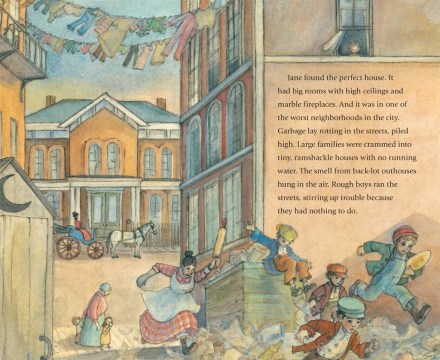
Jane now knew what she wanted to do. In 1889 Chicago was a diverse city with a large immigrant population. Many didn’t speak English, which made it hard for them to find jobs. “Large families were crammed into ramshackle houses with no running water.” Garbage lay in the street, and tough kids ran wild with nothing else to do.

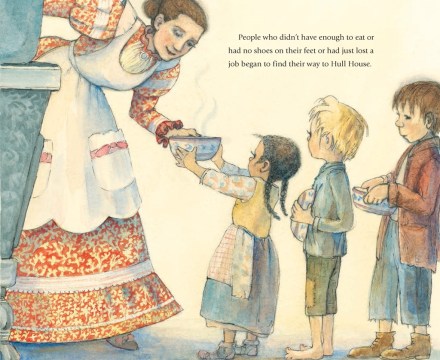
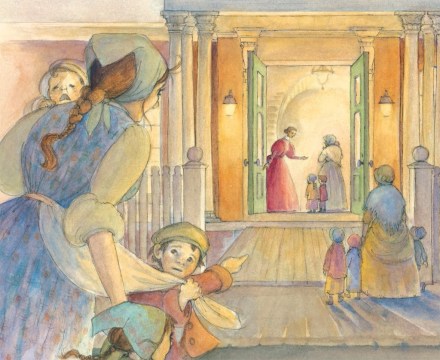
Jane found a large house in the middle of one of these areas that had once belonged to Charles J. Hull and upon his death had been given to his cousin, Helen Culver.  When Helen discovered what Jane wanted to do, she donated the house for free. Jane left the house unlocked, letting people know that they could come there whenever they needed. In time, people did find their way to Hull House when they were hungry or out of work. Jane also had her own way of dealing with unruly children or those who didn’t understand her generosity. Once when a man broke into Hull House twice because he had no job and no money, Jane gave him a job.

celebrate-picture-books-picture-book-the-house-that-jane-built-feeding-hungry

Image copyright Kathryn Brown, 2015, text copyright Tanya Lee Stone. Courtesy of us.macmillan.com.

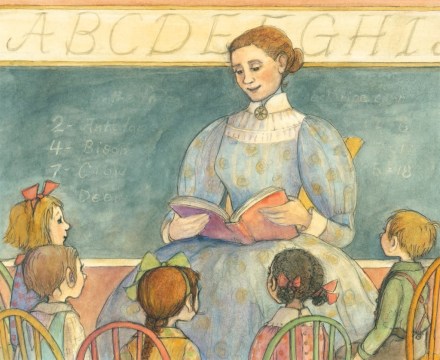
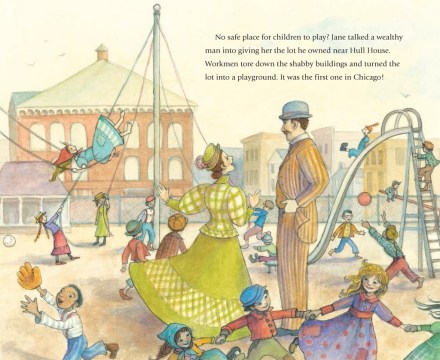
Jane helped the neighborhood in other ways too. She built a public bath so that people could stay clean and avoid illness. She convinced “public officials to build more public baths.” Because children had nowhere to play, Jane convinced a neighbor to give her his unused lot near Hull House. She tore down the buildings and built Chicago’s first playground. For kids whose parents worked long hours, she started a morning kindergarten and after school clubs. She also began offering evening classes for children who worked during the day.

celebrate-picture-books-picture-book-the-house-that-jane-built-kindergarten

Image copyright Kathryn Brown, 2015. Courtesy of us.macmillan.com.

Jane had help with her endeavors. Her friend “Ellen Gates Starr was her partner from the start.” Many other people also helped. They moved into Hull House and “taught literature, art, English, math, science, and cooking.” Hull House continued to grow, and by 1907 Jane oversaw thirteen buildings, including “a gymnasium, coffee house, theater, music school, community kitchen, and an art gallery.”

By the early 1920’s more than 9,000 people visited Hull House every week. Jane’s work “changed a bad neighborhood into a great and strong community.” Today, you can still see Jane Addams’ commitment to others in the community centers that bring people together in nearly every city and town.

An Author’s Note with more information on Jane Addams follows the text.

celebrate-picture-books-picture-book-the-house-that-jane-built-playground

Image copyright Kathryn Brown, 2015, text copyright Tanya Lee Stone. Courtesy of us.macmillan.com.

Tanya Lee Stone brings the story of Jane Addams’ work in Chicago to children in a compelling biography that gives readers a fully developed portrait of this most amazing woman. Stone’s active and evocative language puts children in the Hull House neighborhood, allowing them to get a feeling for and understanding of the issues of the time. Stone’s excellent examples of how Jane Addams responded to a variety of problems facing her community and even Hull House itself, demonstrate how generosity, empathy, and kindness can make positive changes in people’s lives. Depictions of Jane’s early compassion and commitment give children a sense that they too can make a difference in areas that are important to them.

celebrate-picture-books-picture-book-the-house-that-jane-built-front-door

Image copyright Kathryn Brown, 2015. Courtesy of us.macmillan.com.

Kathryn Brown’s riveting illustrations capture Jane’s early moments of concern for others, bravery, and study that informed her adult life; times of decision and cooperation that led to the establishment of Hull House; scenes of poverty, upheaval, and need that touched Jane’s heart; and images of her successes in Chicago that inspired others around the country. Brown’s softly hued watercolors are beautifully infused with realistic period details and honest emotion that provide readers with a strong foundation for understanding and appreciating the life of Jane Addams.

The House that Jane Built: A Story about Jane Addams is an inspiring choice for children with a philanthropic heart and to open discussions on how one person can make a difference. The book would be a welcome addition to home and classroom libraries.

Ages 6 – 10

Henry Holt Books for Young Readers, 2015 | ISBN 978-0805090499

To learn more about Tanya Lee Stone and her books, visit her website.

You can view a gallery of illustration work by Kathryn Brown on her website

Jane Addams Day Activity

celebrate-picture-books-picture-book-jane-addams-coloring-page

Jane Addams Coloring Page Poster


Jane Addams is an inspiration to all! Print this Jane Addams Coloring Page and hang it in your room or locker to inspire you to make a difference and be a positive influence in your community!

Picture Book Review
November 25 – Shopping Reminder Day

celebrate-picture-books-picture-book-review-fancy-party-gowns-cover

About the Holiday

Of course there are reminders everywhere we look that it’s time to do that kind of shopping. But today’s holiday encourages people to count the days until their gift-giving day or days and plan accordingly. Today is also Small Business Saturday, so if you’re out there doing some shopping, consider spending some of that holiday budget at your local shops. Festive events and parties are also often on the calendar during this month and are just perfect for the beautiful creations found in today’s book!

Fancy Party Gowns: The Story of Fashion Designer Ann Cole Lowe

Written by Deborah Blumenthal | Illustrated by Laura Freeman


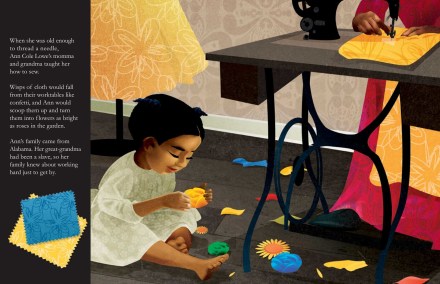
From the time that Ann Cole Lowe was old enough to thread a needle, she loved to sew. While her momma and grandma worked at their sewing machines, making dresses for the socialites of Alabama, Ann sat nearby turning “the wisps of cloth” that fell to the floor into “flowers as bright as roses in the garden.” Even at a young age Ann understood that “doing what you love could set your spirit soaring.”

celebrate-picture-books-picture-book-review-fancy-party-gowns-ann-as-child

Image copyright Laura Freeman, text copyright Deborah Blumenthal, courtesy of simonandschuster.com

When Ann was only sixteen years old, her momma died. Not only did her mother’s death leave Ann bereft, it left her in charge of the business, and many women were waiting for gowns, most importantly the Alabama governor’s wife. “Ann thought about what she could do, not what she couldn’t change.” She sat down and finished the dresses. “Then she stood up and ran the business.”

celebrate-picture-books-picture-book-review-fancy-party-gowns-design-school

Image copyright Laura Freeman, text copyright Deborah Blumenthal, courtesy of simonandschuster.com

In 1916 a woman in Florida hired her to sew dresses. She also sent Ann to design school in New York. Because she was African American, however, Ann was required to study in a separate classroom by herself. Ann was not deterred. She continued to make unique gowns and dresses, and her client list grew. Finally, Ann had saved enough money to open a salon of her own in Manhattan. Sometimes she didn’t have enough money to pay all the bills, but she persisted. Her life was about “what she could do, not what she couldn’t change.”

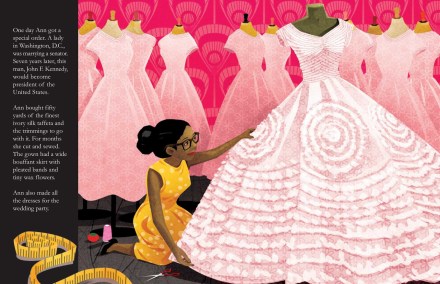
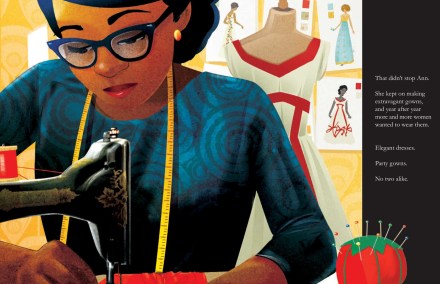
One day Ann received an order for a wedding dress from a woman who was marrying a United States senator. The woman’s name was Jacqueline Bouvier and the man was John F. Kennedy, a future president of the U.S. Ann bought 50 yards of ivory silk taffeta and designed a beautiful dress with a bouffant skirt and pleated bands decorated with tiny wax flowers. She also made the dresses for Jacqueline’s attendants.

celebrate-picture-books-picture-book-review-fancy-party-gowns-wedding-dress

Image copyright Laura Freeman, text copyright Deborah Blumenthal, courtesy of simonandschuster.com

Then ten days before the wedding, Ann walked into her workroom and discovered that a water pipe had burst, flooding the dresses, material, everything. Ten of the sixteen gowns Ann had sewn were destroyed. “Ann though about what she could do, not what she couldn’t change.” She ordered new fabric, hired more seamstresses, and went to work. On this job she lost money instead of making it, but none of that mattered. In eight days all of the dresses were ready.

When Ann delivered the gowns to the mansion in Newport, Rhode Island, the butler who answered the door told her workers needed to use the back entrance. Ann replied that “if she had to enter through the back door, the bride and bridesmaids wouldn’t be wearing her dresses for the wedding.” The front door swung open. On the day of the wedding—September 12, 1953—the whole world “Oohed” and “Aahed” over Jacqueline Bouvier Kennedy’s gorgeous gown and her bridesmaids’ dresses, but not many people thought about or knew the name of the woman who had created them. “Why? Because Ann Cole Lowe was African American. And life wasn’t fair.”

celebrate-picture-books-picture-book-review-fancy-party-gowns-sewing

Image copyright Laura Freeman, text copyright Deborah Blumenthal, courtesy of simonandschuster.com

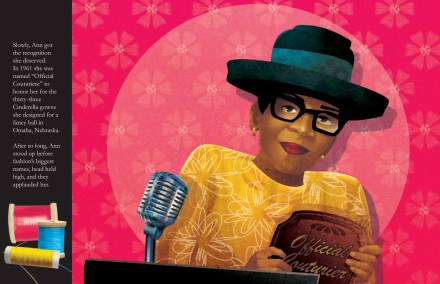
Ann continued to design and sew party dresses and evening gowns for the women of high society. She “didn’t make fine clothes to get rich or famous,” however, but, as she once said, “‘To prove that a Negro can become a major dress designer.’” In 1961 Ann finally gained public recognition for her work when she was named “Official Couturiere” in honor of the 33 ball gowns she created for an elegant ball in Omaha, Nebraska. She proudly accepted her award as the fashion world applauded.

An Author’s Note explaining more about Ann Cole Lowe’s life and work follows the text.

celebrate-picture-books-picture-book-review-fancy-party-gowns-recognized

Image copyright Laura Freeman, text copyright Deborah Blumenthal, courtesy of simonandschuster.com

With straightforward storytelling adorned with lyrical passages, Deborah Blumenthal reveals Ann Cole Lowe’s lifelong love of fashion design, her struggles, and her ultimate acclaim. Lowe’s natural talent, single focus, self-confidence, courage, and persistence come through as she overcomes obstacles and prejudice to become the first African American couture designer. Children interested in fashion and history will find much to spark their curiosity and desire to know more about the woman and her times. Blumenthal’s repetition of Lowe’s philosophy to think about what she could do instead of what she couldn’t change will inspire readers to push past difficulties and find solutions.

Laura Freeman’s full-bleed illustrations are as bold and vivacious as Ann Cole Lowe herself. Beginning with the endpapers, which are scattered with drawings of Lowe’s one-of-a-kind gowns, Freeman takes readers on a tour of the workrooms and salons stocked with the fabrics that gave form to Lowe’s creativity. While the backgrounds are typically brilliantly colored and patterned, twice Freeman places Lowe on a completely white page—after her mother has recently died and she is left alone to finish dresses and when she is segregated from the other students in design school. These pages make a moving and effective statement. Children fascinated by fashion will love seeing the beautifully depicted gowns, and may be stirred to create styles of their own.

Ages 4 – 8

little bee books, 2017 | ISBN 978-1499802399

To learn more about Deborah Blumenthal and her books for children, young adults, and adults, visit her website!

Discover a gallery of illustration work by Laura Freeman on her website!

Shopping Reminder Day Activity

celebrate-picture-books-picture-book-review-tablecloth-dress


Create Your Own Party Dress 


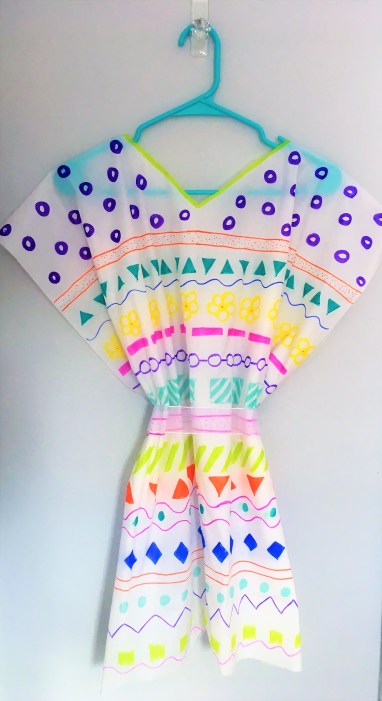
With this easy craft you can make a  fun sheath dress for playing dress-up. It’s also a great party activity! All you need is a plastic or paper party table cloth, Sharpies, and your imagination!

Supplies

  • 1 plastic party tablecloth (1 cloth will most likely make 4 dresses)
  • Sharpies or other permanent markers
  • Ribbon, scarf, crepe paper garland, or other material for a belt
  • Scissor
  • Newspaper, old sheeting or other material to protect the floor

Directions

  1. With the table cloth folded along one edge, cut a rectangle the appropriate size for the child
  2. In the middle of the folded edge cut a V-shaped or rounded opening for the child’s head. Begin with a small opening and enlarge it as needed
  3. Lay the dress on newspaper or other material to protect the floor
  4. Draw and color shapes, lines, figures, or other designs on the dress
  5. Slip on over a shirt and pants or leggings
  6.  Add a belt with a ribbon, scarf, piece of crepe paper garland, or other material

Picture Book Review