April 8 – National Zoo Lovers Day

The View at the Zoo by Kathleen Long Bostrom and Guy FrancisAbout the Holiday

Zoos are wonderful places to see and learn about exotic animals from around the world. In addition to creating educational exhibits, zoological experts are involved in the preservation of endangered species. To celebrate the day, you might visit your local zoo, donate your time or money to further a zoo’s mission, or consider “adopting” a zoo animal—many zoological institutions offer this fun and rewarding program.

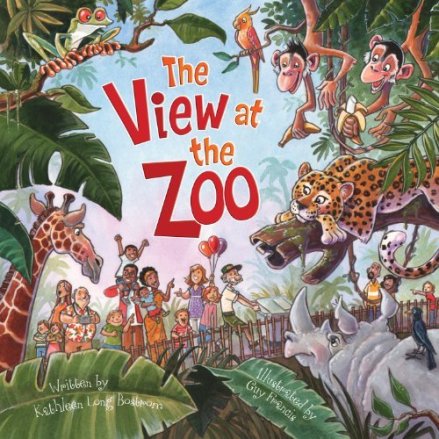
The View at the Zoo

Written by Kathleen Long Bostrom | Illustrated by Guy Francis


“Rise and shine! Attention, please! Monkeys get down from those trees!” So calls the zookeeper as he begins his rounds, waking up the zoo animals to greet another day of visitors. Once the bear cubs are up, the lion’s mane is combed, the elephant has wiped his nose, and the giraffes are standing tall, the gates are flung open.

The day is full of excitement, observations, and education—“My, what silly things they do, all these creatures at the zoo.” Some creatures walk and waddle to an inner beat. Some carry babies in pouches or on their backs while others are noisy—howling and shrieking. And look at how some love to eat! There are those who primp to stay neat and clean, and those that will nip your fingers if you get too close!

Yes, the zoo is full of intriguing specimens! As the sun goes down the visitors head for the exit, and the animals watch them leave. It’s been another good day; those people put on quite a show! The owl exclaims, “What a hoot! Folks have no clue the view that we have at the zoo!”

The View at the Zoo is a perfect union of words and illustration. Kathleen Long Bostrom’s text tells the story while Guy Francis’s illustrations reveal the meaning of the story. Kids will have fun picking the animal and people pairs out of the crowd who are “dancing to their own inner beat,” carrying babies on their backs or in pouches, making noise, chowing down, getting clean, and flashing dangerous teeth. This zoo is colorful, wild, and populated with animals happy to study the exotic creatures on the other side of the fence.

Ages 3 – 6

Ideals Children’s Books, 2010 | ISBN 978-0824956295

National Zoo Lovers Day Activity

CPB - Zoo Day Word Search II (2)

Round up the Animals! Word Search


Find all the animals in the zoo! Print this Round Up the Animals! word search and have fun! Here’s the Solution.

April 1 – National One Cent Day

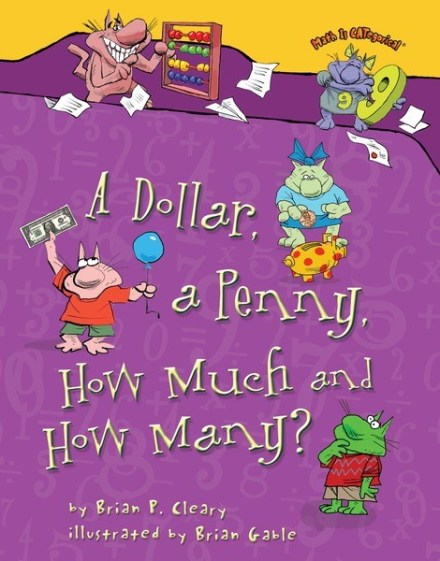
A Dollar, a Penny, How Much and How Many? by Brian Cleary and Brian Gable Picture Book Review

About the Holiday

Do you pick up a penny on the street or step over it as worthless? If you do the latter, you might want to reconsider. Today we celebrate the one-cent coin and its historical and artistic significance. The penny has been in circulation since 1793 and derives its name from the English “penny” but is pluralized in the US as “pennies” instead of the British “pence.”

It wasn’t until 1909 that Abraham Lincoln’s face appeared on the coin as part of President Roosevelt’s initiative to improve the artistic nature of the country’s coinage. Roosevelt enlisted famed sculptor August Saint-Gaudens to design the new penny, as well as the other gold pieces in use at the time. While the designs of other coins have changed over the years, Lincoln has remained the iconic image on the copper-colored penny.

While a single penny may not buy much these days, added together they can still make a difference. And remember the old adage: Find a penny pick it up. All the day you’ll have good luck!

A Dollar, a Penny, How Much and How Many?

Written by Brian P. Cleary | Illustrated by Brian Gable


Part of the Math is CATegorical series, this book is all about money—what it looks like, what it’s used for, and how the different denominations add up to equal the same price for a desired or needed item. Each two-page spread relates in verse a little lesson. The book opens with a general definition of money: “Money is the term for coins and bills that people use / to buy things such as pizzas, pencils, planes, and chains and shoes.”

Kids learn the names of our coins, what they are made of, and the value of each. They discover that coins can be added together or mixed and matched—10 pennies equal a dime; two dimes and a nickel equal a quarter, and so on. The story moves to a dollar store, where the cats buy different items with various combinations of coins. Jenny has 4 quarters, while her brother has 10 dimes. Anna has 100 pennies and Zack is carrying 7 dimes, 1 quarter, and 5 pennies. Kids see that all of these combinations have the same value.

Paper money is up next. A short description of the minting process leads to a discussion of value as the cats purchase a $20 book with various bills.

Brian Cleary’s catchy rhymes and straightforward explanations make this a perfect book for introducing money, its value, and the mathematical concepts of addition, subtraction, and multiplication of using money to buy things.

Brian Gable’s well-known comical cats of the series walk kids through the pages as they ponder prices on items on the shelf and the amount of money in their pocket. The cats’ humorous expressions and silly situations turn this money math lesson into a funny and fun experience. The brightly colored pages focus on the coins and bills, which are clearly displayed, and the direct connections between this money and the objects being bought is obvious.

Ages 5 – 9

Millbrook Press, 2012 | ISBN 978-0822578826

National One Cent Day Activity

CPB - Penny matching

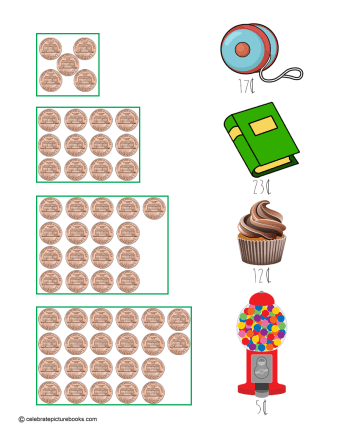
Count Your Pennies! Matching Game


Counting pennies can be so much fun! Saving them can be even better! Collect enough pennies and you can buy something special or donate to your favorite cause! In this printable Count Your Pennies! matching game, draw a line from the stack of pennies to the object they will buy.

March 30 – National Pencil Day

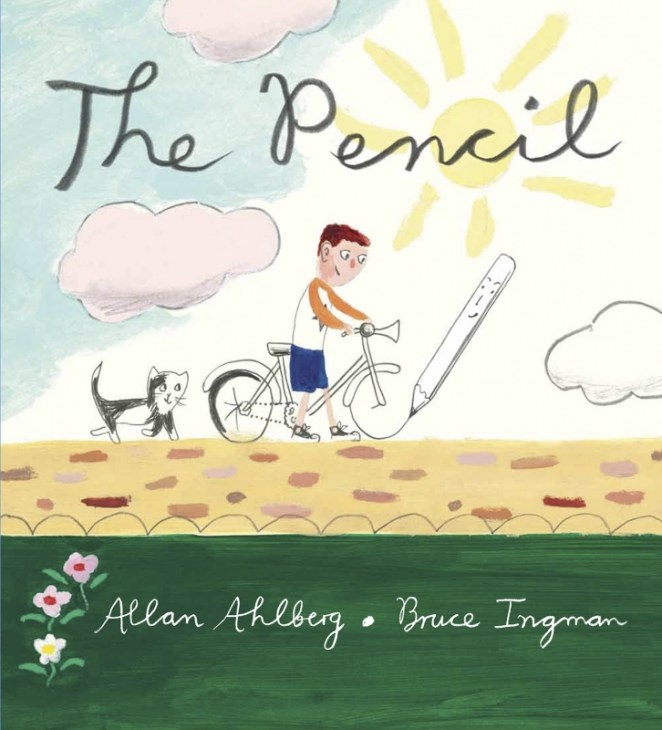
The Pencil by Allan Ahlberg and Bruce Ingman Picture Book Review

About the Holiday

Writers and artists, this day is for you! On this date in 1858 Hymen Lipman received a patent for the very first graphite pencil with an eraser attached. Lipman must have been an optimist because the pencil he created was ¾ graphite and ¼ India rubber eraser. The user would sharpen both ends to expose the material. There are conflicting reports on why most pencils sport that familiar yellow hue, but both agree that the color was associated with grandeur. One fascinating fact about this most noble instrument is that a single one can pen pencil 45,000 words or draw a line 35 miles long!

So sharpen those pencils—whatever color they are—and spend this day creating something wonderful!

The Pencil

Written by Allan Ahlberg | Illustrated by Bruce Ingman


Even before the title page readers learn of a little pencil, alone in the world. One day the pencil quivers and begins to draw. The pencil draws a boy, who asks for a name, and receives “Banjo” in reply. The boy wants a dog, and the pencil obliges. Bruce is the dog’s name, and he wants a cat. Mildred is immediately created, and of course Bruce chases Mildred. Banjo chases Bruce. They need a place to run, so the pencil draws a house, a town, and a park.

All this excitement makes the trio hungry and tired. Banjo demands the pencil draw him an apple, Bruce wants a bone, and Mildred really wants a mouse but settles for cat food. There’s just one problem—the food is so unappetizing in black and white. The pencil thinks for a bit and comes up with a solution. He draws a paintbrush named Kitty. Kitty colors the food, the boy, the dog, the house, the town, and the park. Mildred is left as created – she’s a black-and-white cat anyway.

The team of Pencil and Paintbrush create a family, a friend for Bruce, a ball (Sebastian) for Banjo, and a kitten for Mildred. But all these extra characters cause trouble. Sebastian breaks a window, and the mom, dad, sister, and grandpa aren’t completely satisfied with their traits. What’s a pencil to do? Draw an Eraser, of course!

The eraser takes care of the problems, but grows fond of his power to rub things out. He erases the table, chair, front door—the whole house. And that’s not all! Nothing the Pencil and Paintbrush have created is safe. Eraser rubs everything out until all that’s left is the pencil and the eraser locked in opposition.

The pencil draws a wall, a cage, a river and mountains with fierce animals but none of it is a match for the eraser. Then the pencil has a brainstorm and draws…another eraser! The two erasers engage in an epic battle, and in the end they rub each other out.

The Pencil recreates everything he had before, and Kitty colors it all in, including a new picnic with a runaway boiled egg named Billy and 10 A-named ants to clean up the crumbs. As the day fades into night, a moon appears in the sky along with a cozy box for Pencil and Paintbrush to sleep in.

Allen Ahlberg’s endearing story of a little pencil who creates himself a world full of friends and excitement as well as the inevitable conflict will appeal to kids for whom the imagination looms large and even competes with and enhances reality. On a subtle metaphorical level, as the eraser rubs out everything in its path, kids may see that simply getting rid of problems can sometimes cause more, and that resolution is a better tact.

Bruce Ingman’s illustrations deftly depict the friendship and collaboration between Pencil and Paintbrush. Graphite lines outline the characters and objects that Pencil draws, and the colorful accents from Paintbrush are vivid and joyful.

Ages 4 – 8

Candlewick Press, 2012 | ISBN 978-0763660888

National Pencil Day Activity

CPB - Pencil Maze

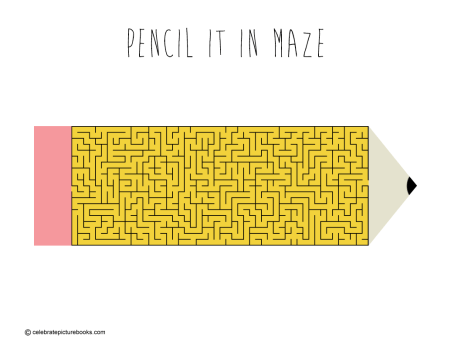
Pencil It In! Maze


Line up here to test your skills against this printable Pencil It In! pencil-shaped maze. Solution included. Sharpen your pencil and start having fun!

Picture Book Review

March 29 – Smoke and Mirrors Day

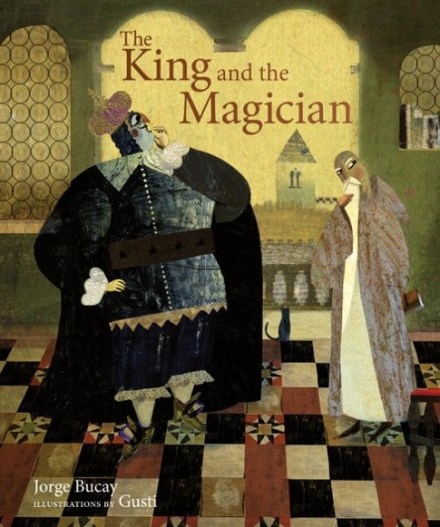
The King and the Magician by Jorge Bucay and Gusti Picture Book Review

About the Holiday

Abracadabra! With a puff of smoke and a few mirrors, I have made this blog post appear out of thin air! Okay, so maybe that’s not quite true, but today is the perfect day to try a little magic. On Smoke and Mirrors Day we celebrate the practitioners of this most mysterious art, who often extend and retract mirrors within a cloud of smoke to accomplish their deceptions. The term is also used generally whenever someone is trying to pull the wool over another person’s eyes. Whether you like sleight of hand, disappearing acts, or the magic of a soothing cup of tea, have fun, make a little mischief, and enjoy the day!

The King and the Magician

Written by Jorge Bucay | Illustrated by Gusti


In a faraway land there once lived a King who was very powerful. Not only does he love power, he commands that everyone in his kingdom obey and admire him. Trembling, his subjects reassure him every day that he is the most powerful man in the kingdom.

One day, however, the King hears a rumor that down in the village lives a Magician who can predict the future. The King fears that this man will become more powerful than he, and he sends his spies to learn more. The spies return and reveal that not only can the Magician tell the future, he is loved and admired by everyone.

The King becomes terribly jealous and plots to do away with his most hated enemy. He devises a plot to trick the Magician. He will host a party, and at the end will ask the Magician if he can truly predict the future. If the Magician says “No,” he will be exposed as a fraud, and the king will kill him. If the Magician answers “Yes,” the King will ask him to predict the date of the Magician’s death and will then kill him. The King is pleased with his scheme because either way, he will be rid of his rival.

On the night of the party, the King summons the Magician and asks him the fatal question. The Magician is more than just a seer or a sorcerer—he is wise. He looks at the King and states, “the Magician of this kingdom will die the exact same day as his King.

Now the King is in a terrible quandary. He does not want to risk the possibility that this old man’s prediction is true. He must now protect the Magician in order to save his own life. He quickly concocts a ruse and asks the Magician to stay the night in the castle, saying he wants to consult with him about some royal matters. In fact, he just wants to keep an eye on him.

The Magician agrees. The next morning the King goes to the Magician and asks his advice on some kingly decisions. The Magician offers good suggestions, and the king accepts them. As the months go by, the King continues to rely on the Magician for guidance, and slowly the King learns to be fair and wise. He becomes the respected and admired ruler he always wanted to be.

The King realizes that not only is the Magician a trusted advisor, he is a loyal and beloved friend. One day, wracked with guilt over his one-time plot to kill the Magician, the King reveals the story. The Magician listens to the King’s secret, and shares one of his own.

He relates that when the king questioned him on the night of the party, he saw the king reach for the hilt of his sword and realized his intentions. He then divulges that he made up the prediction of their shared death date to teach the King a lesson—one the King has learned. He says, “It is our lives that have become entwined, not our deaths.”

For many more years the King and the Magician live as friends and confidants. The kingdom grows stronger and the King kinder and more loved by his people. One day the Magician dies. The King is sad, and realizes he is no longer afraid of his own death. The King has learned the Magician’s lesson well, and even though his advisor is gone, he continues to make wise and beneficial decisions.

Ten years later the King writes a letter to his son and heir. In his letter, the King cautions his son that during his life he may come across someone or something that “will arouse fear and jealousy in your soul” and will want to destroy them or it to alleviate his fear. Instead, says his father, “open  your heart or your home” because “what you thought was your most feared enemy, is really your most powerful friend.”

Jorge Bucay has written a classic tale of wisdom verses power wrapped around a clever psychological trick that initiates the kind of thought which leads to true enlightenment. The straightforward storytelling and the pacing of the plot build suspense, while lyrical descriptions create a beautiful flow that depicts both the quandary of the King and the kindness of the Magician.

Gusti’s lavish illustrations, reminiscent of hieroglyphics and Medieval tapestries, are rendered in dark, rich brown, rust, black, olive and blue hues that gorgeously portray the splendor of the King and his castle, but also signal the somber weight in his soul. The regal tone even extends to the gilded text. The King is drawn as an imposing rounded figure, towering over everyone else in his kingdom, but his feet and hands are tiny, lending him a bit of a comical yet vulnerable air. The King’s eyes narrow with cunning as he plots his evil deed but widen in doubt and despair as the Magician works his special brand of magic.

Ages 4 – 8

Abbeville Kids, 2014 | ISBN 978-0789212047

Smoke and Mirrors Day Activity
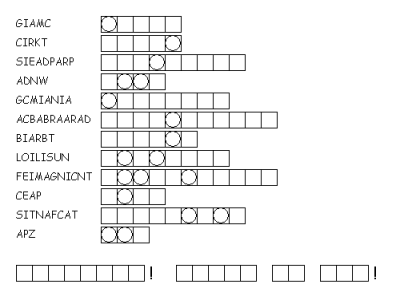
CPB - Magic Word Scramble II


Say the Magic Word! Word Scramble


Magic is all about mystery—and so is this scrambled word puzzle! Print the Say the Magic Word! word scramble. Then unscramble each magic-related word and, using the letters in the circles, discover the mystery phrase. Here’s the Solution!

March 26 – Noodle Day

Noodle Magic by Roseanne Greenfield Thong and Meilo So Picture Book Review

About the Holiday

Noodle on this: what’s the difference between noodles and most other dry pastas? Noodles contain eggs! It’s just this kind of fascinating fact you can learn during noodle month. Whether you like spinning the long strands around your fork or slurping them right from the bowl, noodles make the perfect comfort food whether they’re mixed with sauce, pesto, or meat and veggies. People make some pretty awesome crafts from them too! Did you know that 13th century bakers made their dough into birds, stars, words, and other shapes? Too bad Pinterest wasn’t around then! So boil up some water and get cookin’ on a delicious day!

Noodle Magic

Written by Roseanne Greenfield Thong | Illustrated by Meilo So


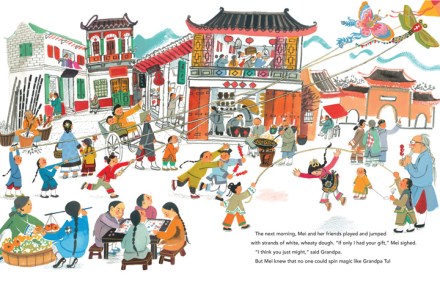
The emperor’s birthday is coming, and everywhere excitement fills the air. Mei’s Grandpa Tu will no doubt be making his famous noodles for the celebration. Mei loves to watch her grandfather work, slapping and kneading the dough and pulling the strands of noodles. He is so creative with his cooking that everyone marvels, even the Moon Goddess. In fact, Grandpa Tu is such an extraordinary artist that he makes noodle jump ropes and kite strings for Mei and her friends. They are as “simple as a sunflower” and as “easy as a sea breeze” to make, says Grandpa Tu.

celebrate-picture-books-picture-book-review-noodle-magic-playing-with-noodles

Image copyright Meilo So, text copyright Roseanne Thong. Courtesy of meiloso.com

But Mei thinks there is more to his talent and wishes that she had his magic. Her grandfather believes she does possess it. One afternoon the pair watch animal-shaped clouds fill the sky, and Mei asks if her grandpa can catch them with noodles. That night he makes a batch of noodles, and in the morning the two collect clouds as the sun appears.

On the day before the emperor’s birthday, everyone is busy making something special—everyone except Grandpa Tu. The villagers are perplexed. On such an important day, they will all want to enjoy noodles—and what about the special long-life noodles for the emperor? It is time, Grandpa Tu tells Mei, for her to make the noodles.

Mei is surprised and terrified. She slaps and kneads the dough as she has seen her grandfather do, but it remains ordinary. Where is the magic? “‘Trust in yourself,’” Grandpa Tu tells her, but Mei is doubtful. She decides that perhaps if she gives the Moon Goddess a gift, she will get magic in return. “‘You have all the magic you need,’” her grandfather assures her. Still, he helps Mei make enough dough to form an enormous ball of noodles.

celebrate-picture-books-picture-book-review-noodle-magic-making-noodles

Image copyright Meilo So, text copyright Roseanne Thong. Courtesy of meiloso.com

Mei throws the ball to the Moon Goddess and calls out for the Goddess to give her magic. Wisely, the Goddess reminds Mei that magic must come from inside. Mei closes her eyes and thinks very hard. She tussles with the Moon Goddess in a noodle tug-of-war, and suddenly…Snap!…the noodles break. The sky rains noodles of all shapes and sizes, Mei has discovered the magic that was in her all along!

With the charm of a Chinese folktale, Roseanne Greenfield Thong tells the universal tale of self-discovery. Her lyrical language adds a magic of its own to the tale, as when Mei watches her grandfather make dough: “she loved the powdery flakes that hung in the air and freckled the morning light.” The relationship between the little girl and her grandfather is lovingly portrayed, offering a gentle depiction of the wisdom and reassurance provided by extended family members.

Meilo So brings the story to vibrant life with her colorful paintings of village life, Mei and Grandpa Tu’s home, and the Moon Goddess. The magic of Grandpa Tu’s noodles is cleverly shown in the transparent animals, dragons, and birds outlined in noodles that frolic across the pages. The two-page spreads of Mei’s village are particularly captivating, as packed with interesting scenes and details as any bustling town.

Ages 4 – 8

Orchard Books, 2014 | ISBN 978-0545521673

Noodle Day Activity

CPB - Noodle Puzzle

Noodle on This Puzzle


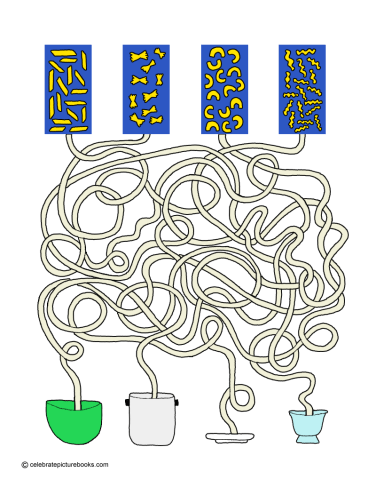
Everyone has their favorite kind of noodles! Help these noodles get to the right plate, bowl, or pot in this printable Noodle on This puzzle that’s as wiggly as a wet noodle!

Picture Book Review

March 15 – National Shoe the World Day

Shoes by Elizabeth Winthrop Illustrated by William Joyce Picture Book Review

About the Holiday

Today’s observance was begun in 2014 by Donald Zsemonadi and the United Indigenous People in Fontana, California to raise awareness of the more than 500 million people around the world who have no shoes to wear. These children, teenagers, and adults must walk barefoot wherever they go, enduring harsh terrain and long distances without relief or protection. Such conditions lead to further problems, which can be lifelong and life-threatening.

Some national and international organizations and companies provide ways you can help by donating new and gently worn shoes or through buy one/give one programs.

Shoes

Written by Elizabeth Winthrop | Illustrated by William Joyce

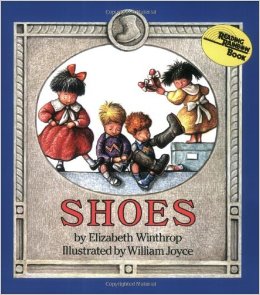
Kids love shoes—especially if their squeaky new or completely destroyed. In this classic picture book by Elizabeth Winthrop and William Joyce, an incredible array of feet coverings are introduced in a jaunty, bubbling perfectly rhymed poem that makes the reader look at shoes in a new and appreciative way.

Kids who are often stuck behind tall adults or seemingly sky-high counters will recognize “shoes too low.” And all kids know that wearing “Shoes to skate in, shoes to skip in, shoes to turn a double flip in” or “shoes for fishing, shoes for wishing, rubber shoes for muddy squishing” means the day is going to be awesome.

A fun-to-read rhyme at the end of the book sprints to an unexpected and completely satisfying twist.

Interpreting all of these shoes is William Joyce in his inimitable style. The rakish children ponder tangled laces; tower over friends with stilts; tumble, jump, and turn somersaults; skate, climb, and perform for an audience all while shod in the finest of shoes. Joyce’s adorable children make this a book kids will want to read and/or hear again and again.

Ages 4 – 8

Harper Collins, 1988 | ISBN 978-0064431712

National Shoe the World Day Activity

CPB - Shoe Day Maze

Tangled Laces Shoe Match

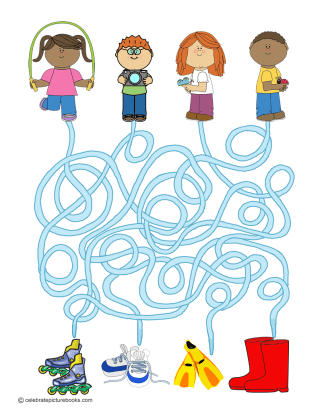
Four kids think today’s a perfect day to go swimming, stomping in the mud, roller skating, and climbing trees. But they can’t find the right shoes for their favorite activity! Can you untangle the shoelaces and help each kid have a fantastic day? Print the Tangled Laces Shoe Match puzzle and get started!

March 14 – National Pi Day

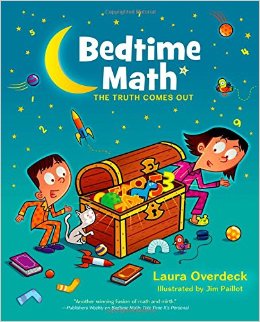
Bedtime Math The Truth Comes Out Picture Book Review

About the Holiday

What would we do without pie, huh? The flaky crust, the delicious filling….What? Oh, how embarrassing! It’s Pi Day! Well, what would we do without pi, huh? All those circles would go unmeasured, the world just wouldn’t fit together quite right…

Pi Day recognizes the usefulness of the mathematical constant Pi, the first three numbers of which are 3.14. In 1988 Larry Shaw noticed the correlation to March 14 and organized the first Pi Day celebration at the Exploratorium in San Francisco, California. In 2009 The U.S. House of Representatives officially named March 14 as National Pi Day. The day is celebrated by schools and other organizations with math projects, pie-eating contests, and other fun events.

Bedtime Math: The Truth Comes Out

Written by Laura Overdeck | Illustrated by Jim Paillot


Bedtime has never been so numerical! Oh sure, kids might count the stars out their window or sheep leaping a fence, but how about flavors of astronaut ice cream or towns named for food? Wouldn’t it be fun to figure out how far a marshmallow shot from a rubber band will go? Or how to stop a charging rhino? Or whether a snake can lose its tongue? You bet it would! And that’s the genius behind the Bedtime Math series, which also includesBedtime Math: A Fun Excuse to Stay up Late and Bedtime Math: This Time It’s Personal.

Bedtime Math goes way beyond simply presenting math problems for kids to solve. Each problem begins with fascinating facts or trivia about topics kids care about, such as space, animals, food, themselves, and the world they live in. Adults will find as much to like about these revealing tidbits as kids.

Reluctant math students will respond to this series, as the presentation is light-hearted, humorous, and educational in the best way. They may not even realize they’re doing higher math as they try to solve these brain ticklers.

Each mind boggler comes with three difficulty levels—Wee Ones, Little Kids, and Big Kids—plus a bonus question that’s more advanced so that everyone can join in the fun. An extensive introduction gives tips and suggestions for using the book and answers any questions readers may have about the approach.

Of course, these cool calculations don’t have to wait for bedtime. They’re a smart way to fill those “I’m bored” moments or to just spend time together no matter when it is. Bedtime Math has expanded to include its own website and a nation-wide afterschool math club, Crazy 8s.

Author Laura Overdeck began using this technique to math learning with her own children and with a BA in astrophysics is well-qualified to take your child’s math skills to the stars and beyond!

Jim Paillot enhances each page with colorful exaggerated and humorous takes on the math teaser at hand, which increase kids’ interest in and even understanding of the concepts being “taught.”

Ages 3 – 8

Feiwell & Friends Publishers, 2015 | ISBN 978-1250047755

National Pi Day Activity

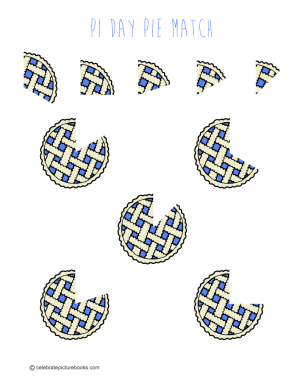
CPB - Pi Day Pie Match


Pi Day Pie Match


All this talk about math has made me hungry! You too? Well, just put these pies together and then you can enjoy a snack! Print the Pi Day Pie Match game here.