April 27 – Tell a Story Day

celebrate-picture-books-picture-book-review-one-day-the-end-cover

About the Holiday

Are you a raconteur? Do you love to weave a tale so intricate and intriguing that your listeners are on the edge of their seats? Or are you the one leaning forward, all ears, feeling the tingling thrill of that story? Either way—this day is for you! So take some time to tell or listen to a story—or even write your own!

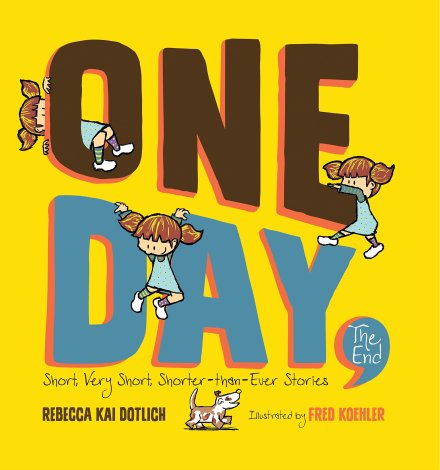
One Day, The End: Short, Very Short, Shorter-than-Ever Stories

Written by Rebecca Kai Dotlich | Illustrated by Fred Koehler


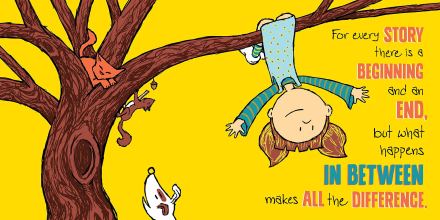
Hey! I have a fantastic story to tell you! Ya gotta minute? Ok! See… “One day I went to school. I came home. The End” What do you mean, “Is that it?” Don’t you get it?  So many things happened—funny, messy, worrisome, happy. It was an amazing day! I didn’t say that? But it’s all right there! Where? In the middle. In the pictures!
celebrate-picture-books-picture-book-review-one-day-the-end-tree

Image copyright Fred Koehler, 2015, text copyright Rebecca Kai Dotlich, 2015. Courtesy of Boyds Mills Press.

On other days the little girl who went to school in the story above becomes a detective to find her lost dog, invents ingenious ways to hide from her brother, and creates something awesome for her mom. She also runs away from home, but of course comes back, and shadows her cat to a surprising discovery. On yet another day she just feels like stomping. And on still another she  relents to a much-needed bath…and shares it with her dog!

And what does she want to do after all these adventures? She wants to write a book…and does!

celebrate-picture-books-picture-book-review-one-day-the-end-school

Image copyright Fred Koehler, 2015, text copyright Rebecca Kai Dotlich, 2015. Courtesy of Boyds Mills Press.

Rebecca Kai Dotlich’s One Day…The End is such an ingenious concept that readers will keep turning the pages just to see what clever idea comes next. Each story consists of a first sentence that introduces a plot and the last line that wraps it up. Sure Dotlich could have fleshed out the characters, detailed the setting, added dialogue, and symbolized a theme, but sometimes pictures are worth a thousand words, and this is where Fred Koehler comes in.

Koehler takes these kid-centric tales and fills in the exploding science experiments, ice-cream trucks, accidental oopsies, distractions, clues, and more that make up each day’s adventure. With humor and an eye for real-kid emotions and actions (the little girl pours glue from the bottle held above her head), Koehler creates a unique plot for each story.

celebrate-picture-books-picture-book-review-one-day-the-end-write

Image copyright Fred Koehler, 2015, text copyright Rebecca Kai Dotlich, 2015. Courtesy of Boyds Mills Press.

In “One day I felt like stomping” the little girl doesn’t stomp for no reason: her cat eats her pizza lunch, she splatters herself with purple paint, and her fishing pole breaks. She just feels like…! The word STOMP grows bigger across the page and even gets stomped on itself as the girl vents her frustration in a puddle, on a pile of leaves, and—almost—on a flower. But seeing the daisy saves her day and she saves the daisy. Haven’t we all been there?

One Day…The End is a joy to share with kids. They’ll love to spend time pointing out the humorous details and depth of story each page holds, and may even like to “tell” the story as they read. This book would be a fantastic jumping off point for kids wanting to write their own stories or for teachers wanting to demonstrate the elements of active, detailed story writing. As Dotlich says on the first page: “For every story there is a beginning and an end, but what happens in between makes all the difference.”

Ages 4 – 8

Boyds Mills Press, 2015 | ISBN 978-1620914519

Discover more about Rebecca Kai Dotlich and her books on her website.

To learn more about Fred Koehler, his books, and his art, visit his website.

Tell a Story Day Activity
celebrate-picture-books-picture-book-review-tell-a-story-maze

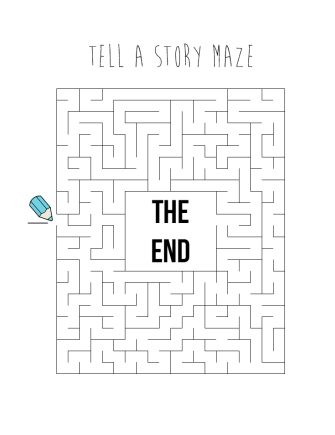
Tell a Story Maze


This puzzle may look like a regular maze, but there’s a secret to it! Within this maze is any story you’d like to make up. Why do you go left instead of right? Are you avoiding a zombie or a rain shower? Why do you go up instead of down? Is it because you can you float? What lurks in that dead end you’ve entered? There are as many cool stories as you can imagine right in those little pathways. And when you find your way to The End, you’ll have written a story with this printable puzzle!

Tell a Story Maze | Tell a Story Maze Solution 

picture book review

April 26 – Hug an Australian Day

celebrate-picture-books-picture-book-review-alfies-lost-sharkie

About the Holiday

Hug an Australian Day was initiated by Ruth and Thomas Roy of Wellcat.com. It’s a perfect time to celebrate all things from the land Down Under—like the people’s sunny personalities and the awesome (or should I say aussieome?) wildlife. Today, listen to your fav Australian music, watch an Australian movie, and if you have friends or relatives who are Australian, send them good wishes.

Alfie’s Lost Sharkie

By Anna Walker


It’s Alfie’s bedtime, but Alfie is lodged headfirst in his toy basket searching for Sharkie. He’s quite distinctive, Alfie tells his dad. with “white fins, sharp teeth, and scary eyes.” Oh, yeah, and “he’s blue.” Could he be outside? Alfie’s dad relents and lets him look while he runs water in the tub.

Outside in a tall tree Alfie hangs from a branch and asks a bug, a bird, and a cat if they’ve seen Sharkie. Come down now, his dad calls, it’s bath time. Alfie dives to the depths of the bathtub to look for Sharkie, but all he finds is a jellyfish. Pajama time, says his dad.

Like quicksand the pajama drawer sucks Alfie in. “I’m okay,” he says, struggling to the top only to see his cat wearing his pajama bottoms. Alfie looks under the chair and in his jack-in-the-box. A tear rolls down Alfie’s nose as he stares longingly out the window. It’s story time, says his dad.

While his dad reads, Alfie stands on his head contemplating the whereabouts of Sharkie. Why is his dad making him brush his teeth and pick out a toy to sleep with when he’s obviously so not tired? Reluctantly Alfie chooses a toy—in fact all his toys—and marches toward bed.  And who should he find? The armful of toys goes flying as Alfie leaps onto the covers. He’s so happy to see Sharkie!

Dad tucks Alfie and all the toys under the blankets, and Alfie closes his eyes hugging Sharkie tight. But a new thought strikes Alfie—“Where’s Bunny?”

In Alfie’s Lost Sharkie, Melbourne-based Anna Walker has created a picture book that will have kids and adults laughing at the familiar bedtime scenario. The story’s spare text echoes the rhythms of the nighttime routine with a child trying to wring just a few more minutes out of the day.

The sweetly drawn illustrations are equal parts humorous and cute as Alfie wrangles time under the curious gaze of his toys and mischievous cat. The final picture of Alfie tossing Sharkie aside will make adults nod their heads in recognition while kids will probably think, “Yeah! That’s a good point!” Funny visual details and the loving relationship between Alfie and his patient dad will make Alfie’s Lost Sharkie a book kids will want to read again and again.

Ages 3 – 7

Clarion Books, 2016 | ISBN 978-0544586567

Hug an Australian Day Activity

celebrate-picture-books-picture-book-review-australian-puzzle

Awesome Aussie Word Scramble


A cute koala invites you to unscramble the names of Animals found in Australia and discover the secret phrase!  Print your Awesome Aussie Animals Word Scramble here!

April 25 – World Penguin Day

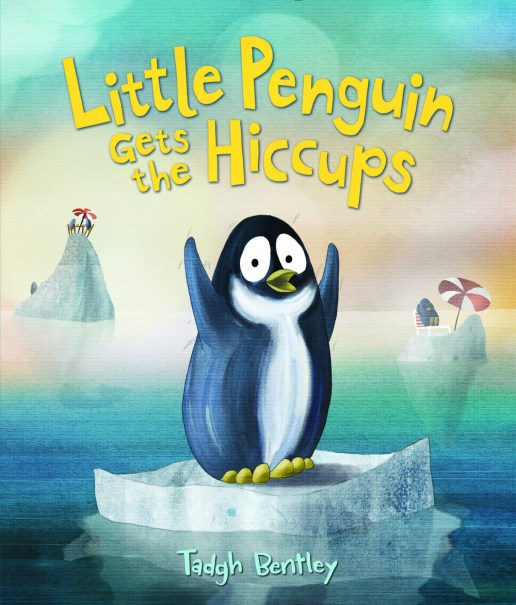
celebrate-picture-books-picture-book-review-little-penguin-gets-the-hiccups

About the Holiday

As Antarctica’s Adelie Penguins begin their northern migration today, we should remember that conservation of the environment is crucial to the survival of this and all 17 living species of penguins. Eleven species are listed as vulnerable or endangered. Why not learn a little more about the various kinds of penguins today? Or it would be a perfect day to visit a local aquarium and watch these waddling wonders dive and frolic in the water!

Little Penguin Gets the Hiccups

By Tadgh Bentley


“Oh, hello. It’s so nice to HIC! meet you,” the little penguin greets readers from his ice floe on the first page. The penguin’s been expecting you and he’s so glad you’re here. You see, he has a HIC! problem and needs your help. Ever since last week when he ate a bowl of chili, he’s had the worst hiccups!

His friend Frederick—the one who told the penguin you were coming—suggested he stand on his head. Chester said to drink backward from a cup. And Albert thought a combination of the two would do the trick. But nothing works. Franklin came up with another idea, and that’s where you come in.

The penguin needs someone to scare him. Unfortunately the little guy doesn’t like being scared, so he’s ready for you to say “Boo!” on the count of three. Ready? “One – two – three.”

“boo”

“Hic!”

Well, that didn’t work. How about louder? “Boo!” Nope. Will nothing cure the hiccups? The disappointed penguin lies on the ice wondering if he’ll have the hiccups forever, but he’s willing to give it another go. This time shout, go crazy! Ready? “One – two – three.”

“ROAR!”

Was that you? No? Oh! It was Franklin! “What are you doing, Franklin?” the very scared penguin says, climbing out of the ocean. Now his feathers are all wet and his mom is NOT going to be happy because she just washed them and…wait a minute! His hiccups are gone, and he wants to celebrate! But, wait—with tacos? Hmmm…this could be a problem…

Tadgh Bentley’s adorable penguin with a problem of hicstorical proportions is sure to get kids giggling and shouting “Boo!” in this interactive picture book. The conversational tone and hiccup-interrupted story will have kids empathizing with and rooting for the little penguin in the throes of a very familiar condition. Bentley’s illustrations of the cute, plump penguin are full of angst, action, and humor. As little penguin greets readers, his friends play cards, fish, eat chili, and frolic on other ice floes. Kids will laugh out loud at the penguin’s attempts to banish the hiccups, and roar along with Franklin when he makes his dramatic appearance.

Ages 3 – 8

Balzar + Bray, Harper Collins, 2015 | ISBN 978-0062335364

World Penguin Day Activity

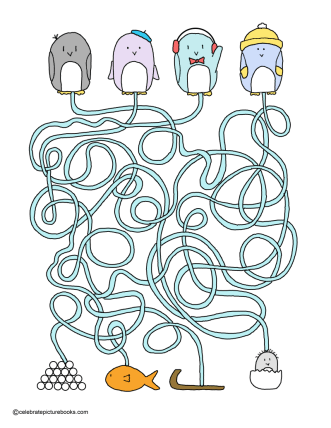
celebrate-picture-books-picture-book-review-penguin-puzzle

Puzzled Penguin Puzzler


These four penguins have lost their stuff! Can you untangle the paths that will lead the right penguins to the snowballs, sled, fish, and baby? Print the Puzzled Penguin Puzzler here!

April 24 – It’s National Garden Month

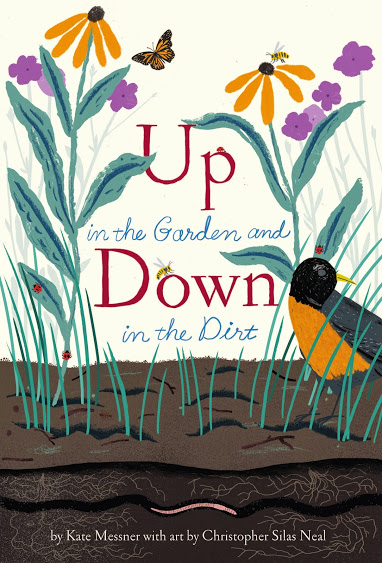
picture-book-review-up-in-the-garden-and-down-in-the-dirt

About the Holiday

April is the month when the earth comes alive again after a long winter! Flowers bloom in brilliant colors, trees bud and blossom with pale, green leaves, and the birds and animals prepare for new life to come. Today enjoy the warmer weather, plan a garden or flower bed, or visit a nursery or park and take in the sights and smells of spring!

Up in the Garden and Down in the Dirt

Written by Kate Messner | Illustrated by Christopher Silas Neal


Snow still blankets the ground as a little girl and her Nana survey their garden plot. The girl’s head is full of dreams of the bounty to come. As the days warm and the wind whistles, the girl and her Nana dig in the mud. “’It’s not quite time,’” says Nana. “’Down in the dirt, things need to dry out and warm up.’” Her granddaughter is curious about what’s below.

Down in the dirt, Nana tells her, a whole world of insects are already working. Up above, the two gardeners are working too—gathering scattered twigs, removing weeds, and spreading compost.

Down in the dirt, pill bugs chew dead leaves, rolling into tight balls when poked. Up in the garden planting is taking place, the seeds carefully snuggled into beds and watered. As peas and other early plants sprout, bees pollinate and wasps hover.

Down in the dirt earthworms tunnel, enjoying the cool soil. Up in the garden the girl and her Nana rest in the shade then play in a sprinkled shower. Down in the dirt the water soaks deep, feeding the squash plants’ roots.

The summer is progressing and up in the garden tomatoes and beans are ripe for eating. Down in the dirt a robin finds a meal too. Up in the garden there’s so much to harvest. Nana and her granddaughter work until dark, sharing the garden with bats and June bugs. With nightfall a skunk finds grubs and cutworms down in the dirt.

The air is turning cooler up in the garden. Pumpkins turn orange under towering sunflowers while down in the dirt a spider weaves her sticky web. As Autumn wanes it’s time for the final garden harvest. Down in the dirt the insects know it too; they scurry to gather food.

Up in the garden and down in the dirt everything is prepared for winter. As snow once again blankets the garden plot, the girl and her Nana, the earthworms and pill bugs, the bees, and the skunk are all waiting for spring to come again.

Kate Messner’s lyrical paean to gardening is a wonderful way to introduce children to the changing seasons and how nature works together. Comparing and contrasting what gardeners do up above as they plant, tend, and harvest their crops to the work insects and animals perform down below emphasizes the interconnectedness contained in even a small plot of land. Messner’s language is beautifully evocative—the snow is sleepy, brittle stalks snap and are rustly when gathered, chickens squabble and scratch, newly planted seeds snuggle in the dark, pumpkins blush orange, and sunflowers bow to September.

Christopher Silas Neal illustrates the changing garden with striking up-close, ground view images of the plants and creatures that call the garden home. Vibrant green grasshoppers, brilliant yellow sunflowers, deliciously red tomatoes, soft pink worms, scruffy backyard animals, and more join a sprightly Nana and her curious granddaughter in soil so dark and fertile that any gardener would be envious.

The final pages include more information on the creatures found in the book, a list for further reading, and an author’s note. Up in the Garden and Down in the Dirt would be a welcome and special addition to any budding gardener’s or outdoor lover’s library.

Ages 5 – 9

Chronicle Books, 2015 | ISBN 978-1452119366

National Garden Month Activity

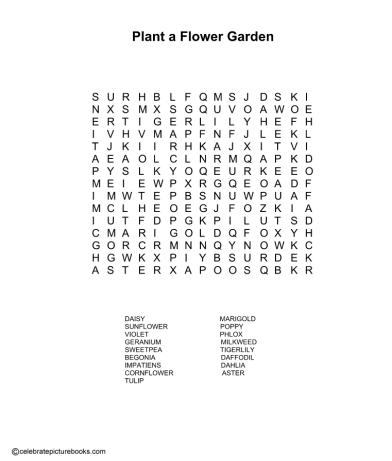
celebrate-picture-books-picture-book-reviews-garden-word-search


Plant a Flower Garden! Word Search


Whether you like to plant your flower bed in horizontal or vertical rows or just scatter the seeds for a wild burst of color, you’ll love this word search planted with favorite spring and summer blooms. Print your Plant a Flower Garden! word search and the Solution here!

April 20 – It’s Jazz Appreciation Month

How Jelly Roll Morton Invented Jazz by Jonah Winter and Keith Mallett picture book review
About the Holiday

Jazz Appreciation Month, nicknamed JAM, was initiated by the Smithsonian National Museum of American History in 2002 to celebrate the heritage and history of jazz and to inspire people to embrace this musical form by attending concerts, listening to recordings, reading about jazz, and playing your own jazz music. The theme for JAM 2016 is an exploration of how jazz is a form of democracy in itself. Jazz works as a method of communication, brings people together, and can be enjoyed individually or in a group. This year’s events also remember the legacy of bandleader Benny Carter.

How Jelly Roll Morton Invented Jazz

Written by Jonah Winter | Illustrated by Keith Mallett


So “here’s what could’ve happened” if you were the baby born to grow up and become one of the best, most innovative talents—maybe even the inventor—of jazz music: Living in New Orleans in the 1890s you might have been put under the spell of music by your godmother, who was a voodoo queen. This same godmother might have taken you with her to a saloon, and later that night you may have accompanied her to jail when trouble broke out at the bar. In jail you may have cried and cried until the other people in your cell “commenced to singing—‘cause music was the only thing that calmed you down.”

When you were still a little child, it might have happened that you sat down at a piano and without training “commenced to play.” With that kind of talent you might have snuck out at night to play for adults who loved to hear your music and paid you well. But one morning your great-grandmother who was raising you may have seen you sneaking back home. She’d ask where you’ve been and how you got such a fancy suit.

When you tell her, she says “she wouldn’t have no LOWLIFE MUSICIAN livin’ under her respectable roof.” But music is who you are, and so still a child, you have nowhere to live and must make your way in the world. This is how and why in 1902 “a thing called JAZZ got invented by a man named Jelly Roll Morton.” At least that’s how the story goes.

Jelly Roll Morton knew the only way to escape his life and show people who’s the best is by playing the music inside him “one piano note at a time.” He had a recipe for jazz as spicy as a pot of Creole gumbo combining the rhythms of New Orleans, the beat of Africa, a dash of Spanish melodies and a pinch of Calypso syncopation. Stir in the Blues and add a bit of “messin’ around” and the tones of laughter. Throw in a teaspoon of symphony, with its flavorful instruments, and you’ve got a ragtime band that produces “high-steppin’, low-down, horn-blowin’ spectacularamicus!”

Jelly Roll Morton took his unique style to Mobile, Alabama and Chicago, Illinois and to every place in between, showing people how music should be played. And while Jelly Roll Morton might not have invented jazz all by himself, he “sure did spread it around the towns,” waving that magic spell everywhere he went.

The final pages give more information about the life of Ferdinand Joseph La Menthe, nicknamed Jelly Roll, as well as further reading and listening resources.

Immersing yourself in Jonah Winter’s biography of Jelly Roll Morton is akin to sitting at the knee of the most captivating storyteller. With mesmerizing rhythms Winter weaves the events of Morton’s life into a tale as enthralling as jazz music itself. Passages of the text are infused with the flavor of New Orleans: “I thought I heard Mister Jelly Roll too / Sayin’ ‘I invented jazz in 1902, / It was me who invented jazz—‘cause it sure wasn’t you.’”

Complimenting Winter’s story, Mallett paints Jelly Roll Morton’s environment in dark washes of night illuminated by the glow of music. The bayou of New Orleans, the dance halls, and city streets glimmer in golden hues from lamp light, the dawning sun, and the radiance of Jelly Roll’s piano keyboard. Notes fly away from Morton’s piano, becoming birds as they soar over the wakening city, and the recipe for “Jazz Gumbo” is stunningly illustrated.

How Jelly Roll Morton Invented Jazz is a unique, fascinating true-life tale that will entice music lovers and all readers.

Ages 5 – 9

Roaring Brook Press, 2015 | ISBN 978-1596439634

Jazz Appreciation Day Activity

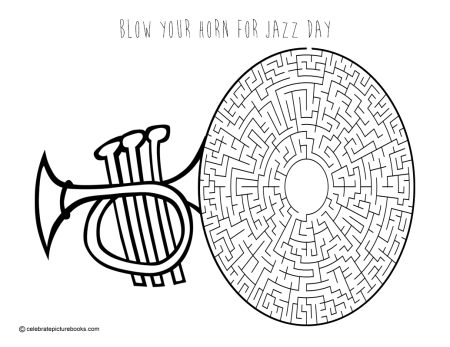
CPB - Trumpet maze

Blow Your Horn for Jazz Day! Maze


Jazz music is amazing in so many ways! Enjoy this riff on the usual maze and trumpet your success to your friends! Print the Blow Your Horn for Jazz Day! maze here. And here’s the Solution.

April 19 – It’s Mathematics Awareness Month

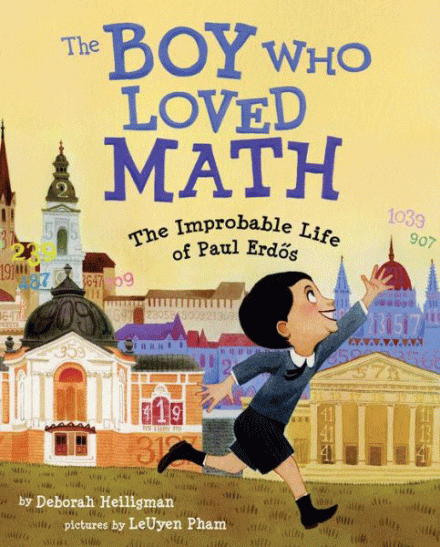
The Boy Who Loved Math: The Improbable Life of Paul Erdős by Deborah Heiligman and LeUyen Pham picture book review
About the Holiday

If you think numbers are numero uno then Math Awareness Month is for you! During April mathematicians, engineers, and all techie types are honored for their contributions to the advancements in science, medicine, computer technology, environmental concerns, and other areas. It’s also a great time to explore and experiment and discover all the benefits of being a numbers-oriented person. This year’s theme is “The Future of Prediction.” Activities will explore how math and statistics are the future of prediction, providing insight and driving innovation. 

The Boy Who Loved Math: The Improbable Life of Paul Erdős

Written by Deborah Heiligman | Illustrated by LeUyen Pham


In Budapest, Hungary a boy is born who loves math. His name is Paul Erdős and he lives with his mother, who loves him “to infinity” just as Paul loves her. When she goes back to work as a math teacher, she leaves Paul with Fräulein, his nanny. Fräulein loves rules and tries to get Paul to sit still, eat all his lunch, take a nap—to obey. But Paul hates rules.

At three years of age he teaches himself to count the days until his mother will be home with him 100 percent of the time. Knowing the number makes Paul feel better as his head is constantly full of numbers and what they can do. One day when he is four years old, he meets a woman and asks her two questions—what year she was born and at what time. When the woman tells him, it only takes him a moment to reveal how many seconds she has been alive.

He continues to play with numbers, learning more and more about the various types. He decides he will be a mathematician when he grows up. When Paul is old enough to go to school, he once again encounters rules he can’t abide. His mother decides he will be schooled at home, and even though this means more time with Fräulein, Paul considers it the better option.

There’s just one thing – while Paul thinks about numbers, Fräulein and his mother do everything for him. At meals they cut his meat and butter his bread; they dress him, and tie his shoes. When he becomes a teenager, he goes to high school and meets other kids who love math. He and his friends spend all their time doing math and by the time Paul is 20 he is famous around the world for his math equations.

There’s just one problem – even as an adult, Paul is so focused on numbers and math that he still doesn’t know how to do basic things for himself. When he is 21 he’s invited to go to England to work. At his first dinner there he stares at his bread and he stares at his meat. What is he supposed to do? With a little experimentation, he figures it out, but he also figures out that he sees the world in a different way.

He doesn’t want a normal life with a family and a house and a regular job. He designs for himself a very unusual lifestyle. Everything he owns fits into two suitcases, and with a little money in his pocket he flies from city to city to do math. He knows so many mathematicians that wherever he goes they invite Paul to stay with them. These families take care of Paul just as his mother and Fräulein had! They do his laundry, cook his meals, and pay his bills.

But even so, everyone loves “Uncle Paul!” He brings people together and shares his knowledge. His work in mathematics has given the world better computers, better search engines, and better codes for our spies to use. He was so admired that even now people represent their relationship with Paul by giving it a number – the “Erdős number.” Paul was a unique person who counted numbers and people as his best friends and experienced the world in a way that added up to a very special life.

Reading Deborah Heiligman’s The Boy Who Loved Math is a liberating experience. Her biography reveals not just what Paul Erdős did, but the quirky genius he was. It also honors all the people around the world who embraced his personality, allowing Erdős to focus on the work he was born to do. Heiligman’s engaging patter, full of interesting anecdotes, humor, and personality, is storytelling at its best and provides an absorbing look at a very unique life.

LeUyen Pham’s illustrations perfectly complement the text, exposing Erdős’s chafing under rules, his delight in math, and his development from youth to old age. Each fascinating page cleverly represents the way Erdős saw the world as numbers, equations, and geometric shapes appear on buildings, domes, and even in the very air! The text too is infused with numerals and mathematical symbols (“Paul loved Mama to ∞, too!), making this a prime book for any math lover!

Ages 5 – 9

Roaring Brook Press, 2013 | ISBN 978-1596433076

Mathematics Awareness Month Activity

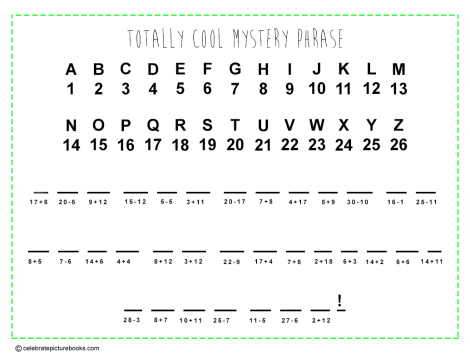
CPB - Math Mystery Phrase


Totally Cool Mystery Phrase! Puzzle


What plus what equals an equation that can’t be beat? You and numbers, of course! Complete this Printable Totally Cool Mystery Phrase! puzzle to discover a coded sentence! Here’s the Solution!

April 11 – National Pet Day

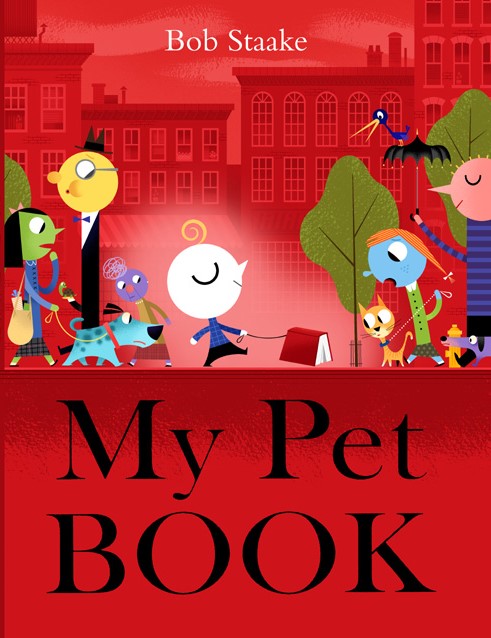
celebrate-picture-books-picture-book-review-my-pet-book-cover

About the Holiday

Pets are often our best friends—they love us unconditionally, are always there for us, and make us laugh. Today we celebrate pets—whether they’re as small as a goldfish, as large as a horse, or as unique as…well, you’ll see as you read on. National Pet Day also raises awareness of the number of animals available for adoption and encourages people to donate to animal shelters or consider taking a dog, cat, bird, or other pet into their family. If you already have a pet, observe the day by giving them an extra pat, offering a special treat, or spending more time with them.

My Pet Book

By Bob Staake


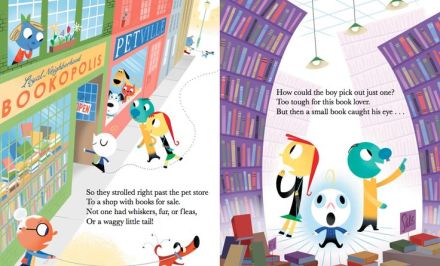
In a town named Smartytown a little boy has a most unusual pet—a book! Not one for puppies and allergic to kittens, he wants a pet that’s “easy.” His mom and dad suggest a book, and the family heads to the bookstore to adopt one. The shelves are so full of appealing potential pets that it’s hard to choose. But then the little boy spies a small “frisky red hardcover,” and it’s love at first sight.

celebrate-picture-books-picture-book-review-my-pet-book-choosing-pet

Copyright Bob Staake, courtesy of Random House Books for Young Readers.

The tiny book turns out to be the perfect pet—it doesn’t need food or water, its cover never sheds or hides fleas, it never needs a bath, and best of all there’s no housebreaking required. The boy takes his pet for walks in the evening, finding it superior to dogs that yap and run away and cats that constantly purr and lick their fur.

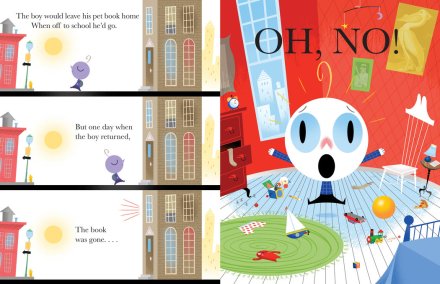
With his new pet, the boy’s days are full of adventure, fun, and excitement. He can’t wait to get home from school and spend time with the little book. But one day when he walks into his house, the boy discovers that his best friend is gone. “‘He ran away! He ran away!’ / The boy began to bleat. / ‘How could a pet book run away / Without a pair of feet?’”

celebrate-picture-books-picture-book-review-my-pet-book-book-gone

Copyright Bob Staake, courtesy of Random House Books for Young Readers.

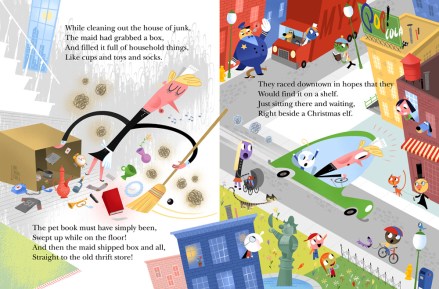
Soon the answer comes: “The maid could hear the crying boy. / (That sound was such a rarity.) / ‘I think I know what happened…’ (gulp) / ‘I gave your book to…charity.’” The boy and the maid race downtown to the thrift store, hoping to find the beloved book. They search through clothes, and furniture, through toys and shelves of books, but the little pet is nowhere to be found. There is only one conclusion—the book has just been sold!

The boy and maid sit down to cry, but then the maid has an idea. Maybe their pet is only hiding, Suddenly the boy remembers something that caught his eye in the dog-and-cat-stuff aisle. They race over to where a lone dog house sits. The boy says, “‘If I were just a scared pet book, / I’d likely sneak in here. / Perhaps the dark would help me hide, / And make me disappear!’”

celebrate-picture-books-picture-book-review-my-pet-book-searching-for-book

Copyright Bob Staake, courtesy of Random House Books for Young Readers.

He reaches in and discovers his pet book just waiting for him. The boy checks his pet over carefully and finds him well from cover to cover. The boy and the maid drive home relieved. Although they are tired, this crazy day has a happy ending, and now the boy and his pet have their own special story to share.

Perhaps Bob Staake is onto something in this humorous page-turner. Don’t we love our favorite books just like pets? And when they’re mysteriously missing, don’t we search and search for them? Through fast-paced and cleverly worded verses, Bob Staake leads his readers on a jaunt of book love that includes love, excitement, companionship, suspense, and a happy ending. What more can you ask for from a book—or a pet?

Staake’s vibrant and whimsical illustrations create a world all its own yet rooted in the here and now. A bit surreal, a bit silly, the action-packed scenes will have kids giggling and searching for every detail.

For book lovers, pet lovers, and those who love a good story, My Pet Book is perfect for snuggling up with.

Ages 3 – 7

Random House Books for Young Readers, 2014 | ISBN 978-0385373128

National Pet Day Activity

CPB - Pet Day Word Search

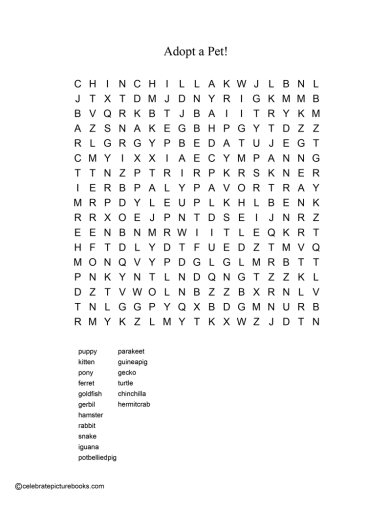
Adopt a Pet! Word Search

There are so many awesome pets to choose from! Can you find all the animals in this fun printable Adopt a Pet! word search?

Picture Book Review