June 21 – World Music Day

celebrate-picture-books-picture-book-review-hey-charleston

About the Holiday

Celebrated every year on the summer solstice, World Music Day, also known as the Fête de la Musique, brings together professional and amateur musicians to ply their trade and entertain audiences for a day full of sound. The day was first conceived in 1982 by French Minister of Culture Jack Lang, who elicited the help of Maurice Fleuret, the Director of Music and Dance. When Fleuret discovered that half of the nation’s children played a musical instrument, he devised a way to bring people out into the streets for a music festival. Since then, the event has become an international phenomenon, celebrated in more than 700 cities in 120 countries worldwide. To participate consider organizing or attending a  free concert or enjoying music in your favorite way.

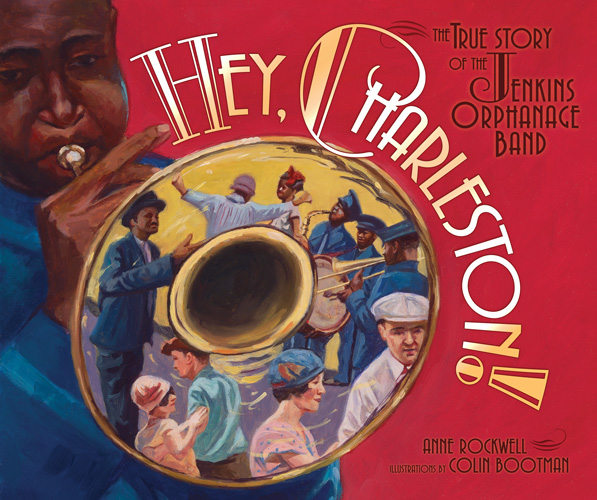
Hey, Charleston! The True Story of the Jenkins Orphanage Band

Written by Anne Rockwell | Illustrated by Colin Bootman


“Have you ever known someone who was always trying to turn bad into good, always seeing hope where others saw despair?” This question, which begins the biography of Reverend Daniel Joseph Jenkins and the orphans he loved is as relevant today as it was in the early 1900s, when this story takes place. Reverend Jenkins was the pastor of a small church in Charleston, South Carolina. One night while collecting scrap wood at a railroad yard, he discovered a group of boys huddled and sobbing inside a freight car. Reverend Jenkins took them to his church, fed them, and gave them a warm place to sleep. He knew what it was like to be an orphan because he had been one too.

Soon more orphans showed up at the church door, and Reverend Jenkins accepted them all. Room grew tight so he convinced the city officials to give him an abandoned warehouse for his orphanage. There was just one drawback: the warehouse was next to a prison, where less-than-desirable sounds emanated from the walls. Reverend Jenkins figured out a way to drown out the noise, however. He gathered the orphans and led them in song outside the orphanage door. The kids were good singers, and that gave the reverend an idea.

He had grown up during the Civil War and remembered the marching bands that led the soldiers into battle. He remembered the instruments these musicians carried and asked for any that were now unused to be donated to the children. Instruments poured in! They were polished and tuned and the children learned to play under the direction of the best teachers in Charleston. With the money Reverend Jenkins thought they could make entertaining people, he planned to buy a farm for the orphans.

Soon the Jenkins Orphanage Band was playing on street corners and in other venues. Many of the kids were descended from the Geechee or Gullah people who lived on islands off the coast of South Carolina, and they played the old band music with their own special rhythm, called “rag.” “A couple of Geechee boys would lead the band by doing a dance—twisting and twirling and tapping their toes, knocking their knees, and flapping their arms.” People loved the music, but most South Carolinians were poor and couldn’t donate much to the orphans. Reverend Jenkins decided to take his band to New York City. The band took the city by storm! People loved when the kids played their raggedy music and soon were imitating the Geechee boys’ dance. “Hey, Charleston,” they’d shout, “Give us some rag!” They called the dance “the Charleston,” and soon everyone was doing it.
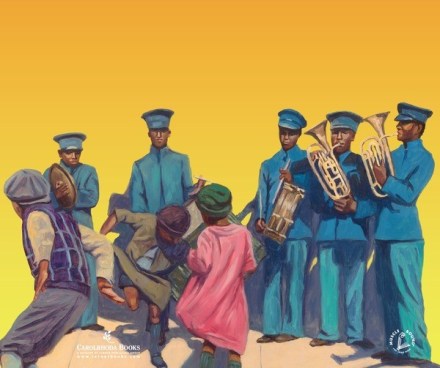
celebrate-picture-books-picture-book-review-hey-charleston-interior-art

The orphans made so much money they were able to buy a new house, and the music instruction became so renowned that families began paying to have their children taught along with the orphans. The band continued to travel around the United States, and they were even invited to perform in the inaugural parade for President Theodore Roosevelt. Finally, they were able to buy the farm Reverend Jenkins had dreamed of.

In 1914 the Jenkins Orphanage Band was even invited to play for Britain’s King George V at the Anglo-American Exposition in London. While they were there, however, Britain entered World War I. The British government ensured that the band had safe passage back home, but many other Americans were stranded in England. Reverend Jenkins offered to lend these citizens the money needed for them to return home as well.

The ship sailed silently through the dangerous Atlantic Ocean until it reached an American port. Once safe the passengers shouted, “‘Hey, Charleston! Give us some rag!’” Happy to be home, the band tuned up their instruments and played loudly and enthusiastically for the shipboard audience. As the passengers disembarked in New York Harbor, crowds greeted them with a hearty welcome. Back home “as they lay down to sleep that night, those band players knew they had done what Reverend Jenkins always taught them. They had turned bad into good.”

Anne Rockwell succinctly and clearly relays the story of the Jenkins Orphanage Band while also retaining all the heart and soul of this fascinating group of children and their dedicated caregiver. The true-life tale is mesmerizing, not only for the historical details of the growth of ragtime music and the Charleston dance but for the accomplishments of the orphans once given love, acceptance, and education. Rockwell’s conversational tone contributes to the story’s smooth, flowing pace, which will keep listeners or readers rapt from beginning to end.

Colin Bootman’s bold two-page spreads illuminate the sights and sounds of the early 1900s for readers. Emphasizing the personal connections between Reverend Jenkins and the orphans as well as the band and their audiences, Bootman’s vibrant paintings are full of people watching, dancing, marching, and celebrating these boys’ awesome gifts.

Ages 6 – 10

Carolrhoda Books, 2013 | ISBN 978-0761355656

World Music Day Activity
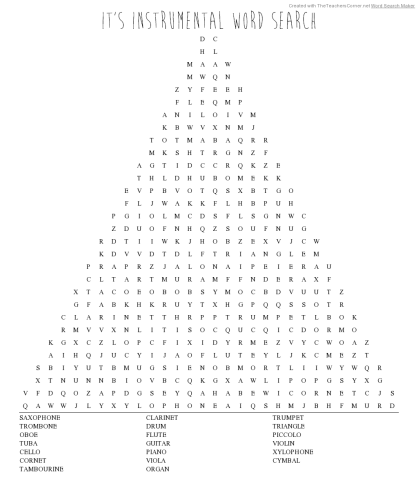
celebrate-picture-books-picture-book-review-musical-instruments-word-search


It’s Instrumental Word Search


Triangles may not get a lot of play in an orchestra, but there’s plenty of play in this printable It’s Instrumental Word Search that contains the names of 20 instruments! 

June 20 – American Eagle Day

celebrate-picture-books-picture-book-review-is-a-bald-eagle-really-bald

About the Holiday

The first American Eagle Day was proclaimed by President Bill Clinton and Tennessee Governor Don Sundquist in 1995 to commemorate and bring awareness to this most enduring American symbol. Chosen as the United States’ National Emblem by our Founding Fathers on June 20, 1782, the Bald Eagle represents the best of America: freedom, courage, strength, spirit, and excellence. Once threatened with extinction—only 400 nesting pairs existed in the early 1960s—the American Eagle has made a comeback, with 15,000 nesting pairs living in the lower 48 states. Besides celebrating what the American Eagle symbolizes, today’s holiday is used to raise awareness of conservation efforts for this most majestic bird.

Is a Bald Eagle Really Bald?

Written by Martha E. H. Rustad  | Illustrated by Holli Conger


“Our class is having a visitor today,” Ms. Patel tells her class. “Guess who it is,” she urges after giving the kids a hint that the visitor eats fish. Anabelle thinks it might be her dad, but Ms. Patel adds that the visitor has a sharp beak and feathers. Joshua guesses that it’s a duck. The kids are getting closer, and with one more hint—Ms. Patel holds up a one-dollar bill—Rose correctly shouts, “‘a bald eagle!’”

Natalie wants to know why there’s a bald eagle on the dollar, and Ms. Patel tells her that the eagle is a symbol of our country. When John asks what a symbol is, she compares the eagle to the school’s bear mascot and goes on to say that the eagle can also be found on the Great Seal. Luke is momentarily excited about the prospect of a seal also visiting the class, but Ms. Patel shows the class that the Great Seal is actually an image. This image demonstrates that something is officially American and appears on stamps, government buildings, important papers, and even the buttons on military uniforms.

The class takes a closer look at the Great Seal, with its eagle in the center. In one foot the eagle is holding a plant, says Karen. Right, Ms. Patel says. “‘It’s an olive branch. It stands for peace.’” Noah notices that in the other foot the eagle carries arrows. The arrows represent strength, Ms. Patel explains. The banner in the eagle’s beak reads E. Pluribus Unum, which is Latin for “one from many” and describes how the single country of America is made of many states. The thirteen stars above the eagle’s head reminds us of the 13 original colonies and states.

Dr. Kelly from the raptor center soon arrives with a bald eagle named Sam. Dr. Kelly puts on a protective glove and carefully takes Sam out of his carrier. Sam is huge! Kyra exclaims, and Jackson wants to know why he’s called “bald.” Dr. Kelly explains that the word bald actually comes from piebald, which means “‘having white marks.’” The class learns many facts about bald eagles, including that they have keen eyesight, can see their prey from high overhead, and can swallow a meal in mid-air.

Then the class talks about how the bald eagle became America’s mascot. Lily raises her hand and suggests it’s because eagles fly free and Americans are free. “‘Good answer,’” Ms. Patel says. She adds that bald eagles are native to North America, and shows the class a map of their summer and winter habitats.

All too soon class is over and it’s time for lunch. “Fish is on today’s menu,” Ms. Patel tells the kids, and they feel just like bald eagles. The children say “thank you” and “goodbye” to Dr. Kelly and Sam, and after lunch they draw their own mascots. You can do that too with the activity at the back of the book!

Scattered throughout the pages, sidebars expand on the facts delivered in the story. Readers learn that the Great Seal has been used since 1782, what raptors and raptor centers are, the weight and wingspan of an adult bald eagle, incredible statistics on eagle’s nests, and about conservation efforts to protect bald eagles.

A Draw-Your-Own Mascot activity follows the text along with a glossary and resources for further study, including free downloadable educational resources.

In her Our American Symbols books Martha E. H. Rustad does a wonderful job of explaining the importance of America’s emblems to children. Through classroom discussions between a teacher and her students, Is a Bald Eagle Really Bald? answers readers’ questions about how and why the bald eagle became a United States symbol. The natural give-and-take will resonated with kids, and Rustad’s clear and kid-friendly definitions of concepts will make an impact. The inclusion of a representative from a raptor center will also feel familiar to children experienced with these types of classroom visitors as well as similar field trips. Sidebars provide more scientific and historical facts.

Holli Conger’s bright, bold illustrations distinctly depict the concepts in the text through large, colorful, and easily understood images. A bulletin board holds pictures of a bald eagle and the American flag, while the teacher holds up a school mascot t-shirt to help relay the idea of a symbol; the Great Seal is shown with well-defined details as the teacher uses a pointer to indicate its various parts; and pages portraying the visit by the raptor center representative give kids a good idea of the size and grandeur of the bald eagle. The children portrayed in the classroom are enthusiastic and welcoming, and readers will feel right at home in their midst.

Ages 5 – 9

Millbrook Press, 2014 | ISBN 978-1467744669

American Eagle Day Activity

celebrate-picture-books-picture-book-review-american-eagle-coloring-page

American Eagle and Flag Coloring Page


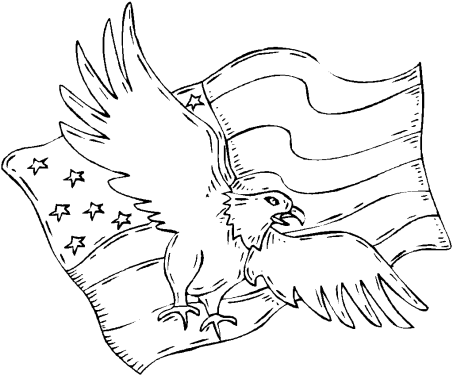
The majestic American Bald Eagle is a perfect symbol to represent the courage, freedom, and spirit of the USA. Here’s a printable American Eagle and Flag Coloring Page for you to enjoy!

June 2 – Leave the Office Earlier Day

celebrate-picture-books-picture-book-review-the-secret-subway

About the Holiday

The brain child of Laura Stack, a specialist in employee motivation, Leave the Office Earlier Day urges a look at how employees and employers use the working hours of the day to best advantage. Today’s holiday motivates employees to finish their tasks before schedule by making a conscious effort to increase efficiency and productivity. Greater cooperation between workers and their bosses can lead to less downtime and more success. To celebrate today’s holiday, employees can ask their bosses if they can leave the office once their work is truly and well finished. Employers may want to allow their workers to leave as soon as they have completed all their tasks. Both sides may find this tactic improves productivity and creates a more positive work environment.

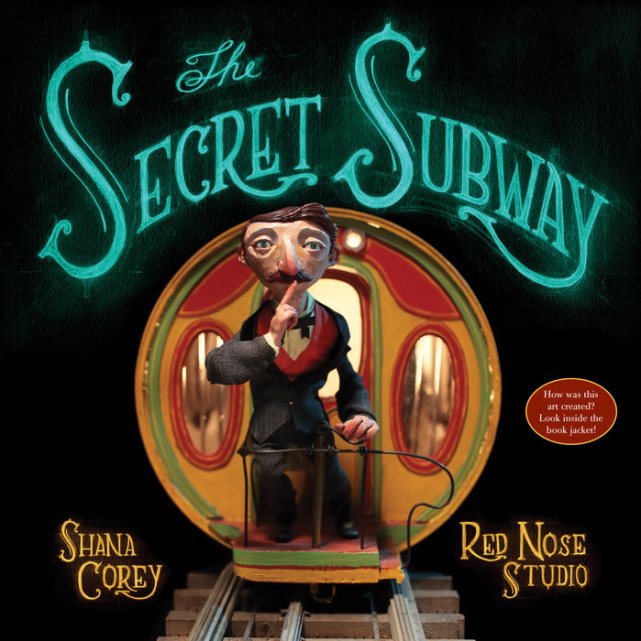
The Secret Subway

Written by Shana Corey | Illustrated by Red Nose Studio (Chris Sickels)


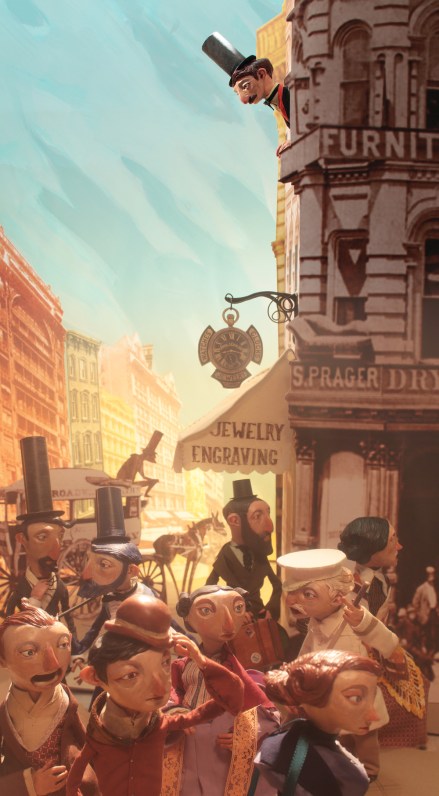
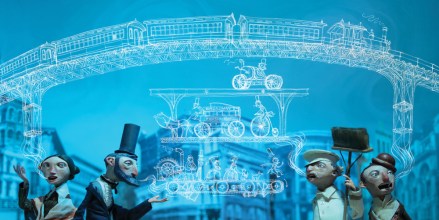
In the 1860s the streets of New York were…well, not to put too fine a point on it…disgusting. Cobblestone and filled with trash, waste, horse manure, dust, dirt, and throngs of people, the roads made for rough travel. Many people had ideas about what could be done to make the streets safer and cleaner. Some thought a moving sidewalk would work, others talked about double-decker roads or an elevated train system. But although there was a lot of talk, nothing ever got done.

celebrate-picture-books-picture-book-review-the-secret-subway-city

Image copyright Chris Sickles, courtesy of rednosestudio.com

Alfred Ely Beach, however, peered down from his high office room and studied the street below him. Alfred Beach was a thinker, a publisher, and an inventor. He put his clever mind to work and came up with a solution. He envisioned a train powered by an enormous fan that would travel underground. “People would get where they needed to go as if by magic!” he thought. He couldn’t wait to start building. There was just one problem—he didn’t own the streets. And getting permission to dig them up would be hard. “So Beach hatched a sneaky plan. He would propose building an underground tube to carry mail instead.” As he had imagined, no one objected to this project when he proposed it—not even Boss Tweed, who unofficially ran the city.

celebrate-picture-books-picture-book-review-the-secret-subway-designing

Image copyright Chris Sickles, courtesy of rednosestudio.com

Given the okay, Beach rented the basement of Devlin’s Clothing Store. Every day he sent in workers to dig and every night wagons took away the debris. For 58 days and nights Beach’s men tunneled under the city, moving forward 8 feet each day. At last the tunnel was finished. It was 8 feet across and 294 feet long—large enough to hold a train full of people.

Beach then decorated the basement to be a beautiful, welcoming waiting room. Gaslight lamps and paintings dotted the walls, flowers added color, and a grandfather clock rang out the time. There was even a fountain with goldfish, a man playing a grand piano, and a delicious lunch. When everything was ready, Beach invited reporters, government officials, and distinguished citizens to join him on February 26, 1876 at the “Beach Pneumatic Transit Company.”

celebrate-picture-books-picture-book-review-the-secret-subway-designing

Image copyright Chris Sickles, courtesy of rednosestudio.com

That first day Alfred Beach’s guests only admired the train, but they gave it glowing praise. Soon Beach opened his train to the public. With a WHOOSH of a gigantic fan, the train zipped down the track and then back again. “Beach’s train was a SENSATION! All winter while wagons slipped and slid on the slushy streets above, people poured into Devlin’s for the twenty-five-cent ride.”

While riders loved it, some people objected. Shop keepers didn’t want potential buyers underground. Property owners were afraid the digging would hurt their buildings, and some felt Beach wanted too much power. Even Boss Tweed no longer supported it since some of his friends had their own ideas on building a subway. When the governor of New York refused to let Beach expand his train, the project came to a halt.

celebrate-picture-books-picture-book-review-the-secret-subway-invites-riders

Image copyright Chris Sickles, courtesy of rednosestudio.com

The idea didn’t die, however, and “many years later drilling could be heard once again under the streets of New York City” as a train system powered with electricity was being built. Diggers discovered many unusual things buried under the city. Perhaps the most surprising was a brick wall behind which stood a little railroad car rusting in its tracks, a memorial to innovation and the future.

Alfred Ely Beach was one clever man, and Shana Corey tells his story with historical perspective, wit, and suspense. Corey’s language crackles with evocative alliteration, stealth, and action. Kids will be excited to learn of the intrigue and imagination that led to this remarkable snippet of America’s history.

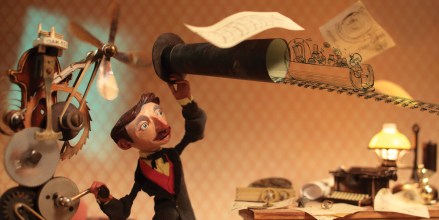
Fans of Claymation will love Chris Sickels’ multimedia artwork that combines sculpted characters, specially built props, photographs, and illustration. Sickels’ characters are nothing short of astounding. Their period clothing, hairstyles, and expressive faces lend an engaging and realistic dimension to the vintage scenes. Sickels cleverly depicts early New York City and people’s alternative ideas to the traffic problem. His use of color and lighting sets the perfect tone for this highly entertaining and educational picture book. Kids will want to linger over each page to catch all the details of The Secret Subway.

Ages 4 – 10

Schwartz & Wade, Random House Kids, 2016 | ISBN 978-0375870712

Leave the Office Early Day Activity


celebrate-picture-books-picture-book-review-the-secret-subway-chris-sickels-craft

Chris Sickels’ Secret Subway


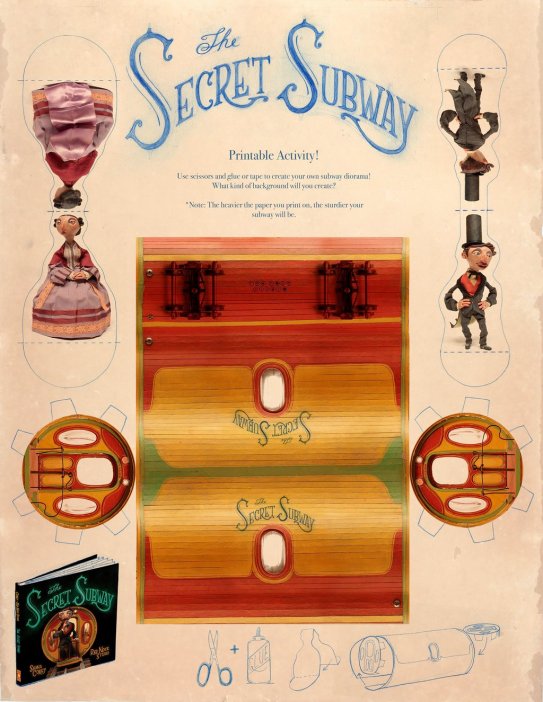
Chris Sickels of Red Nose Studio invites you to build your own Secret Subway with this printable play set, complete with Alfred Ely Beach and a passenger! Click here to download your printable Secret Subway Activity!

Build a Super Subway Car

celebrate-picture-books-picture-book-review-subway-car

Every day, millions of people all over the world travel to work, school, and other activities by subway. Here’s an easy and fun way to build your own subway train from recycled materials. You can make just one car or make a few and connect them to create a long train worthy of any big city!

Supplies

  • Printable Subway Car Template
  • Medium or long toothpaste box
  • Silver paint
  • Glue
  • Paintbrush
  • Scissors

Directions

  1. Paint the toothpaste box with the silver paint, let dry
  2. Cut out the windows, doors, and stripe templates
  3. Trim the stripes to fit your box
  4. To make the little sign near the door, trim a small aquare from one of the stripes
  5. Glue the templates to the box

Picture Book Review

May 30 – Memorial Day

celebrate-picture-books-picture-book-review-the-poppy-lady

About the Holiday

Memorial Day, originally called Decoration Day to commemorate the laying of wreaths and flowers on soldiers’ gravesites, was first celebrated on May 30, 1868. In 1971 Congress passed the Uniform Monday Holiday Act and established the last Monday in May as Memorial Day. The day is honored with parades and special commemorative events. At Arlington National Cemetery in Washington DC, the President or Vice President lays a wreath at the Tomb of the Unknown Soldier

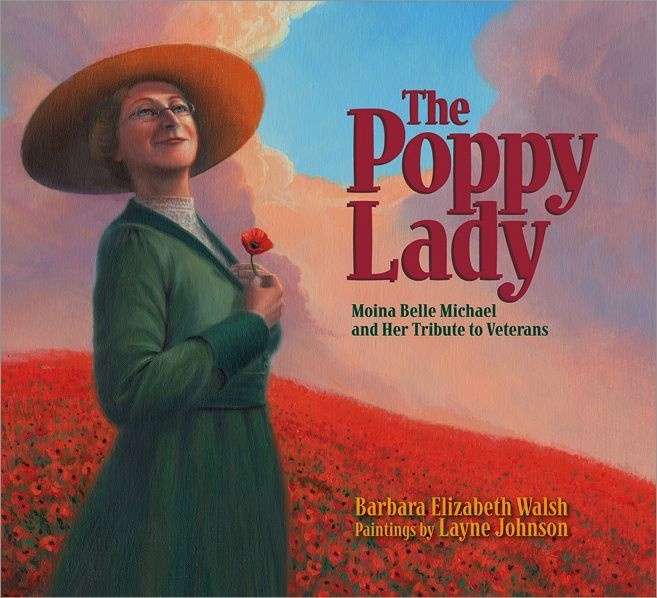
The Poppy Lady: Moina Belle Michael and Her Tribute to Veterans

Written by Barbara Elizabeth Walsh | Illustrated by Layne Johnson


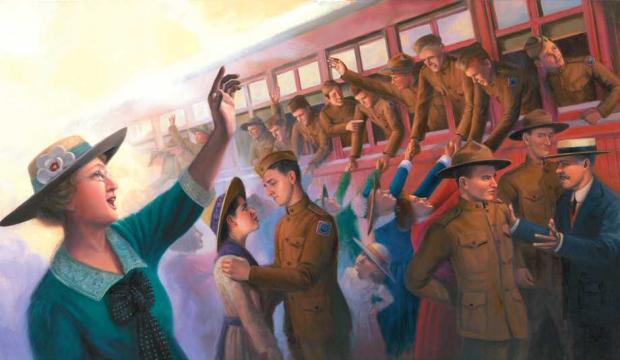
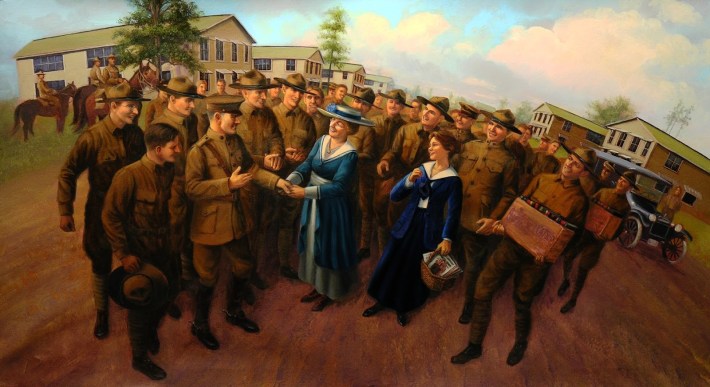
In April of 1917 President Woodrow Wilson declared that America was going to war in Europe. As a teacher and foster mother to girls at the University of Georgia’s Normal School, Moina Belle Michael wanted to do something to honor the boys going off to fight—boys who were the brothers, sweethearts, even fathers of her students. Moina did what the other women were doing to help—knitting socks and sweaters and rolling bandages—but she wanted to do more. She went to the soldiers’ camps nearby to deliver books, magazines, and candy, and she waved goodbye to them at the train station. But she still wanted to do more.

celebrate-picture-books-picture-book-review-the-poppy-lady-waving-goodbye

Image copyright Layne Johnson, 2012, text copyright Barbara Elizabeth Walsh, 2012. Courtesy of Boyds Mills Press.

Moina wanted to go overseas to help the young men with the Y.M.C.A, but after she finished her training at New York’s Columbia University, she was told she was too old to go. She then set up a desk in the basement of Hamilton Hall on the Columbia University campus where she assisted soldiers before they deployed, but the room was dark and dreary. Moina wanted them to have a more cheerful meeting place.

celebrate-picture-books-picture-book-review-the-poppy-lady-poppy-camp

Image copyright Layne Johnson, 2012, text copyright Barbara Elizabeth Walsh, 2012. Courtesy of Boyds Mills Press.

Moina brightened the room with fresh flowers she bought with her small salary. More soldiers came to spend time with her, to share their pictures, letters, and hometown news. But Moina wanted to do even more. One day she rediscovered a poem she had read many times. Titled We Shall Not Sleep, it was written by Lieutenant Colonel John McCrae and was a tribute to soldiers who had died on the battlefields of Flanders. The poem was illustrated with a field of nameless crosses and bright red poppies. The last verse of the poem urged others to take up the torch of the noble fight. Suddenly, Moina knew what she had to do.

celebrate-picture-books-picture-book-review-the-poppy-lady-war

Image copyright Layne Johnson, 2012, text copyright Barbara Elizabeth Walsh, 2012. Courtesy of Boyds Mills Press.

She wrote a poem of her own, giving poppies a special meaning: “And now the Torch and Poppy red / We wear in honor of our dead. / Fear not that ye have died for naught; / We’ll teach the lesson that ye wrought / In Flanders Field.” Moina shared her poem with soldiers at the Y. Many wanted to wear red poppies on their uniforms to honor their fallen friends. With a ten dollar donation, Moina went shopping to find artificial red poppies that she and the soldiers could wear.

celebrate-picture-books-picture-book-review-the-poppy-lady-poppy-on-coat

Image copyright Layne Johnson, 2012, text copyright Barbara Elizabeth Walsh, 2012. Courtesy of Boyds Mills Press.

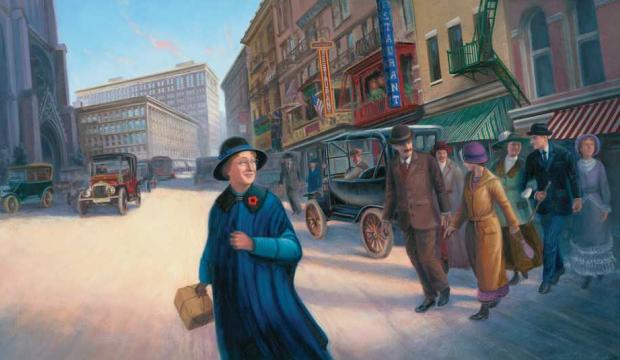
But finding these flowers was difficult. She finally found one large poppy and 24 smaller ones. She pinned the large one to her coat and with the others wrapped, hurried back to the Y. There she gave the small flowers to some of the men and women leaving for the war in France. But there were so few flowers to share. Moina wanted every American to wear a poppy to remember the soldiers. Always.

The epilogue goes on to reveal that two days after Moina bought those 24 poppies, World War I ended.  While everyone was happy to see the soldiers coming home, people wanted to move on, to forget the horrors of the war. But for veterans it wasn’t easy. Jobs were scarce, some veterans were disabled or suffered lingering effects of war.

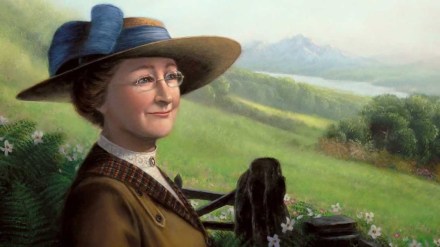
Moina wanted to help. She wondered if the poppy could benefit returning veterans. After much work she convinced local and international veterans’ groups to adopt the poppy as their memorial flower. People began donating to veterans’ causes, and in return they received a red poppy. Millions of dollars were raised to help the soldiers. Even today, Moina’s red poppies benefit veterans and remind us of their sacrifices and service.

celebrate-picture-books-picture-book-review-the-poppy-lady-moina

Image copyright Layne Johnson, 2012, text copyright Barbara Elizabeth Walsh, 2012. Courtesy of Boyds Mills Press.

Through her detailed telling of how Moina Belle Michael discovered her life’s work, Barbara Elizabeth Walsh provides a realistic view of the World War I era and the desire of most citizens to do something to help the soldiers fighting the war. The sense of suspense, comaraderie, fear, and disappointment that fueled Moina Michael’s heart and actions are beautifully and straightforwardly presented and give children true knowledge of this time period.

Accompanying the text to maximum effect are Layne Johnson’s inspiring, realistic paintings of the scars of war on both the landscape and the human heart. In close-up portraits, Johnson captures the emotions of the women learning that their brothers, boyfriends, and fathers will be joining the war effort as well as scenes of soldiers training, deploying, and returning to tell their stories. Turning the pages is like stepping onto the university campus, visiting the basement gathering space, and walking the city streets. Especially evocative are the two battle scenes and the view of the Flanders Fields with their endless carpet of poppies and straight rows of white cross markers.

For anyone wanting to teach or learn about the origins and meaning of Memorial Day and the significance of the red poppy, The Poppy Lady: Moina Belle Michael and Her Tribute to Veterans is a must read.

Ages 7 – 12 and up

Calkins Creek, Boyds Mills Press, 2012 | ISBN 978-1590787540

Memorial Day Activity

celebrate-picture-books-picture-book-review-memorial-day-word-scramble

Memorial Day Word Scramble


Unscramble the words associated with today’s holiday and discover a secret message! Print your Memorial Day Word Scramble here!

Picture Book Review

May 12 – National Odometer Day

celebrate-picture-books-picture-book-review-are-we-there-yet

About the Holiday

In 1847 William Clayton invented a little add-on to the automobile that provides perspective, history, and interesting information on our beloved cars—the odometer! Whether you like to keep track of how many miles you travel on a trip, how economical your gas mileage is, when your next tune-up is due, or just marvel at how long your car has lasted, the numbers on the odometer tell the story. Today, take your car out for a spin—perhaps to the car wash or out to the open road!

Are We There Yet?

By Dan Santat


When you’re invited to a very special birthday party and it’s far away, what do you do? Pack up the car, of course, and head out on an adventure! Going to Grandma’s house is always exciting—at least for the first hour, but after that each minute seems to take for- ev-er. You might even think “Are we there yet?” or “This is taking forever.” Wait! Did you say that out loud? The look on your parents’ faces tell you you did!

You can only stare out the window at the landscape for so long. “But what happens when your brain becomes too bored? That’s when your whole world can turn upside down. Minutes feel like hours. Hours turn to days. Days seem like months and then years. Pretty soon that “quick trip” feels like a million years.

As you ride in the car, tucked in the back seat, feeling a little sick, needing to use the bathroom, your butt growing numb—and bored, bored, bored—could time actually be going backward? While you’re zipping down the highway suddenly a steam train is chugging past, trying to outrun a team of bandits. Now pirates have captured your car and sent it down the plank toward the briny deep! I hope you’re good with a lance because somehow your family’s the main attraction at the royal jousting tournament. And there’s no stopping for the bathroom in Ancient Egypt, or you’ll be put to work building a pyramid.

You think you’ve reached the end of your patience? You’ve actually reached the beginning of time. You may love dinosaurs, but you don’t belong in the Cretaceous Period. So play fetch with T-Rex one time and then climb aboard his back for a wild ride back.

But as quickly as you turned back time you can find yourself in the future—a future you don’t even recognize, where everything you love is gone. So take time now—yes, while you’re bored, bored, bored—to really look around you and see what’s going on. After all, you don’t want to miss this party—it’s the one you’ve been invited to.

Dan Santat’s Are We There Yet? is a rambunctious reminder to enjoy the moment you’re in, because Time is a wily beast that creeps up on you when you’re not paying attention. The art in this book is the star, with its full, two-page vibrant spreads and topsy-turvy format. An old steam train is chased by bandits in the western heat. A rag-tag crew of scallywag pirates menace the family at sword point. Crowds roar at a medieval jousting tournament. Ancient Egyptians toil in the golden sun overshadowed by the Sphynx and pyramids. And it’s love at first sight when the boy comes eye to eye with T-rex in the lush jungles of early Earth.

The scenes of the future, complete with flying cars, neon colors, and helpful robots make clever use of QR codes, and kids will relate to the funny twist ending.

Ages 4 – 8

Little Brown and Company, 2016 | ISBN 978-0316199995

Gardening for Wildlife Activity

celebrate-picture-books-picture-book-review-flower-dot-to-dot

Who’s in the Garden Dot-to-Dots


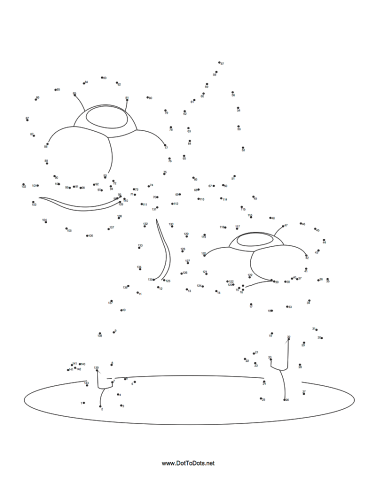
Completing a dot-to-dot puzzle can be a little like taking a trip—you go from stop to stop, not knowing exactly what you’ll find at the end. In these dot-to-dots, you’ll discover who’s hiding in the garden.

Printable dot-to-dot, page 1

Printable  dot-to-dot, page 2

April 28 – Workers’ Memorial Day

celebrate-picture-books-picture-book-review-brave-girl

About the Holiday

Some jobs are so dangerous that workers get hurt or even die doing them. Around the world organizations have been established to help industries provide safer working environments for their employees by establishing standard rules and regulations for buildings, machinery, working hours, and more. Unions and other groups have also been founded that represent workers to ensure their rights are upheld and their needs are met. Today we honor the sacrifices of workers in dangerous professions and raise awareness for safe working conditions.

Brave Girl: Clara and the Shirtwaist Maker’s Strike of 1909

Written by Michelle Markel | Illustrated by Melissa Sweet


Among the immigrants sailing to New York, stands five-foot-tall Clara Lemlich. She may not know it now, but she’s going to change her new city. While her father can’t find work, Clara gets a job in the garment industry, which hires school-age girls to make women’s clothing. Instead of going to school, Clara spends her days hunched over her sewing machine in a dark, smelly factory with many other girls, making clothes as fast as she can.

The rules of the factory are severe. For minor mistakes workers can be fined or worse—fired, leaving their families without an income. The doors are locked so the girls can’t leave without being inspected to ensure they haven’t stolen anything. And the workers must toil long into the night. Despite it all Clara is determined to get an education even though it means walking to the library after work and missing sleep to read her lessons. 

At the factory the girls become friends and reveal stories and secrets. The working conditions make Clara angry. She hears that the men at the factory want to form a union. If all the workers team up, they can hold a strike and force the management to treat them better, the men say. But they don’t think the girls are tough enough.

Clara knows what the girls are capable of. Every day she talks to her friends and the other women, urging them to fight for their rights—and they do! But it’s not as easy as the men predicted. The bosses don’t want to give in. In fact Clara’s life is in danger! She is beaten and arrested. Despite the intimidation she continues to picket. These small strikes make little difference, however—the bosses just hire new girls and the work continues.

Clara and other union leaders think only a huge strike by all workers in every garment factory in New York will cause the bosses to listen and make changes. At a union meeting workers pack the seats to listen to leaders from across the country. Not one of them recommends such a large strike. Clara can keep silent no more. She moves to the front of the hall and calls out. People lift her to the stage. Shouting “Unity is strength” she rallies the crowd and begins the largest strike of women workers ever in United States history.

The next morning thousands of women take to the sidewalks, leaving their sewing machines empty and silent. New York is stunned! Newspapers call the strike a “revolt,” and the girls an “army.” But this is really an army of children—the girls range in age from only 12 to 25 years old. Clara knows how to lead and motivate the girls. She gives rousing pep talks, sings, and stands up to thugs sent to harass them.

All winter the girls join the men strikers. They are starving and cold and become the inspiration for newspaper articles and fundraising. Many wealthy women donate to their cause and join them on the picket lines. Finally the bosses relent. They agree to the formation of unions in their factories, raise salaries, and shorten the work week. Factory workers in Philadelphia and Chicago take heart from Clara’s work and improve conditions in their cities.

Even though Clara is young and small, she proves that anyone can right wrongs and make a difference.

The final pages include more information about the garment industry in the early 1900s as well as a bibliography.

Michelle Markel’s Brave Girl is a spirited biography of Clara Lemlich, clearly outlining the life and working conditions of immigrants in the early 1900s—especially industries’ use of children to fill low-paying, oppressive jobs. This true-life story of a girl who wouldn’t give up or give in is told with pride and balance, touching on the dangers Clara faced in a sensitive manner appropriate for children. Overall, the idea that one person can make a difference no matter how big or how old shines through, making this not only a tale of the past, but an inspiration for today’s children and the future.

Melissa Sweet cleverly combines watercolor and gouache paintings with colorful fabric, ribbon, sewing pattern paper, and ledger pages to create illustrations fitting to the story. The pictures appear sewn onto the pages with straight, zigzag, and embroidery stitches, and the vibrant colors depict the fiery nature of Clara and all the workers who strove for better lives.

Ages 4 – 9 (and up as Brave Girl makes a wonderful teaching text)

Balzar + Bray, Harper Collins, 2013 | ISBN 978-0061804427

Workers’ Memorial Day Activity

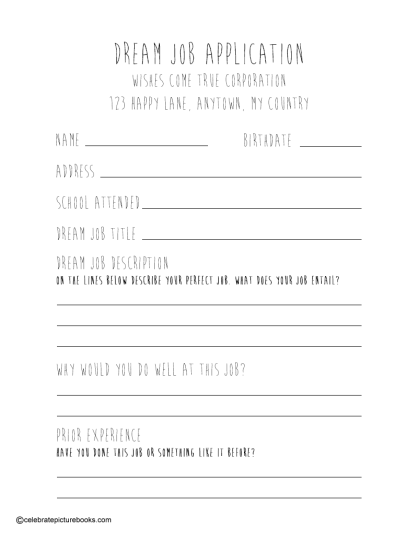
celebrate-picture-books-picture-book-review-dream-job-application

Dream Job Application


Work isn’t working when you love your job—it’s fun! What is your perfect job? Is it working with animals? Playing a sport? Being an artist, scientist, entrepreneur? Fill out this application and get started on following your dreams! Print the Dream Job Application below!

Dream Job Application 

April 20 – It’s Jazz Appreciation Month

How Jelly Roll Morton Invented Jazz by Jonah Winter and Keith Mallett picture book review

About the Holiday

Jazz Appreciation Month, nicknamed JAM, was initiated by the Smithsonian National Museum of American History in 2002 to celebrate the heritage and history of jazz and to inspire people to embrace this musical form by attending concerts, listening to recordings, reading about jazz, and playing your own jazz music. The theme for JAM 2016 is an exploration of how jazz is a form of democracy in itself. Jazz works as a method of communication, brings people together, and can be enjoyed individually or in a group. This year’s events also remember the legacy of bandleader Benny Carter.

How Jelly Roll Morton Invented Jazz

Written by Jonah Winter | Illustrated by Keith Mallett


So “here’s what could’ve happened” if you were the baby born to grow up and become one of the best, most innovative talents—maybe even the inventor—of jazz music: Living in New Orleans in the 1890s you might have been put under the spell of music by your godmother, who was a voodoo queen. This same godmother might have taken you with her to a saloon, and later that night you may have accompanied her to jail when trouble broke out at the bar. In jail you may have cried and cried until the other people in your cell “commenced to singing—‘cause music was the only thing that calmed you down.”

When you were still a little child, it might have happened that you sat down at a piano and without training “commenced to play.” With that kind of talent you might have snuck out at night to play for adults who loved to hear your music and paid you well. But one morning your great-grandmother who was raising you may have seen you sneaking back home. She’d ask where you’ve been and how you got such a fancy suit.

When you tell her, she says “she wouldn’t have no LOWLIFE MUSICIAN livin’ under her respectable roof.” But music is who you are, and so still a child, you have nowhere to live and must make your way in the world. This is how and why in 1902 “a thing called JAZZ got invented by a man named Jelly Roll Morton.” At least that’s how the story goes.

Jelly Roll Morton knew the only way to escape his life and show people who’s the best is by playing the music inside him “one piano note at a time.” He had a recipe for jazz as spicy as a pot of Creole gumbo combining the rhythms of New Orleans, the beat of Africa, a dash of Spanish melodies and a pinch of Calypso syncopation. Stir in the Blues and add a bit of “messin’ around” and the tones of laughter. Throw in a teaspoon of symphony, with its flavorful instruments, and you’ve got a ragtime band that produces “high-steppin’, low-down, horn-blowin’ spectacularamicus!”

Jelly Roll Morton took his unique style to Mobile, Alabama and Chicago, Illinois and to every place in between, showing people how music should be played. And while Jelly Roll Morton might not have invented jazz all by himself, he “sure did spread it around the towns,” waving that magic spell everywhere he went.

The final pages give more information about the life of Ferdinand Joseph La Menthe, nicknamed Jelly Roll, as well as further reading and listening resources.

Immersing yourself in Jonah Winter’s biography of Jelly Roll Morton is akin to sitting at the knee of the most captivating storyteller. With mesmerizing rhythms Winter weaves the events of Morton’s life into a tale as enthralling as jazz music itself. Passages of the text are infused with the flavor of New Orleans: “I thought I heard Mister Jelly Roll too / Sayin’ ‘I invented jazz in 1902, / It was me who invented jazz—‘cause it sure wasn’t you.’”

Complimenting Winter’s story, Mallett paints Jelly Roll Morton’s environment in dark washes of night illuminated by the glow of music. The bayou of New Orleans, the dance halls, and city streets glimmer in golden hues from lamp light, the dawning sun, and the radiance of Jelly Roll’s piano keyboard. Notes fly away from Morton’s piano, becoming birds as they soar over the wakening city, and the recipe for “Jazz Gumbo” is stunningly illustrated.

How Jelly Roll Morton Invented Jazz is a unique, fascinating true-life tale that will entice music lovers and all readers.

Ages 5 – 9

Roaring Brook Press, 2015 | ISBN 978-1596439634

Jazz Appreciation Day Activity

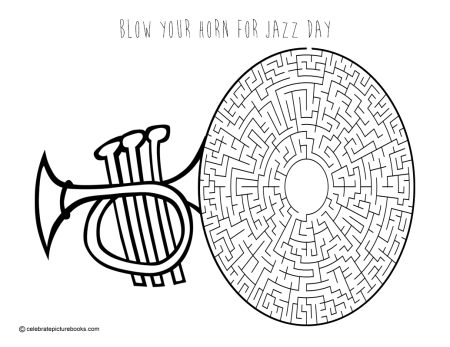
CPB - Trumpet maze

Blow Your Horn for Jazz Day! Maze


Jazz music is amazing in so many ways! Enjoy this riff on the usual maze and trumpet your success to your friends! Print the Blow Your Horn for Jazz Day! maze here. And here’s the Solution.