May 14 – International Astronomy Day

celebrate-picture-books-picture-book-review-star-stuff

About the Holiday

Instituted by Doug Berger in 1973, International Astronomy Day is held twice a year—in spring and fall—to raise awareness of the benefits and wonder of studying the stars. Museums, observatories, universities and astronomy clubs around the world provide public access to astronomical instruments and hold special programs about this interesting and ancient science. To celebrate, attend an International Astronomy Day event, take time tonight to gaze at the sky and pick out the constellations you recognize, or read about the stars and their importance to history and the future.

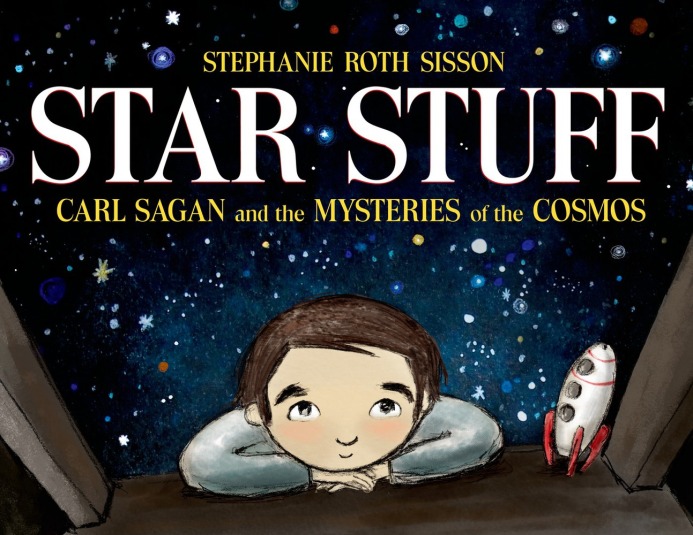
Star Stuff: Carl Sagan and the Mysteries of the Cosmos

By Stephanie Roth Sisson


A boy named Carl Sagan may have lived in a small apartment in Brooklyn, New York, but he was part of so much more—a large city on the third planet from the sun in a “neighborhood of stars” which are part of the Milky Way galaxy. Growing up, Carl marveled at the connections. He had an innate curiosity and was astonished by everything he saw; his imagination was out of this world!

When he attended the 1939 World’s Fair as a young child, he experienced things he had never seen before; he saw a robot, new inventions, and a time capsule filled with messages for the future. At night he looked up at the stars and wondered; he thought they looked like lightbulbs on long black wires. He went to the library to read about the stars.At first the librarian thought he meant movie stars, but soon he got the book he wanted. Reading it made his heart beat fast.

Carl imagined what kinds of creatures and sights he might discover if he were able to travel through space. He tried standing with his arms outstretched and wishing he was on Mars like his favorite science fiction character, John Carter, but nothing happened. He decided he would have to make his “life in space” a reality himself so he went to college and became an astronomer, cosmologist, astrophysicist, astrobiologist, and so much more.

Dr. Carl Sagan then worked with other scientists to develop the exploratory crafts Mariner 2, Mariner 9, and Pioneer 10 that have gone into space to investigate Mars, Venus, and Jupiter. When they sent back pictures, Carl analyzed them and learned more about our solar system

Carl wanted everyone to know and understand Space. He created a television program that explained in easy terms what the stars, planets, and other celestial bodies are made of, how they came to be, and how we are connected to them. The Earth and every living thing are made of star stuff, Carl told his audience. The show – Cosmos: A Personal Voyage – was a hit, watched by millions of people.

Scientists have long wanted to know if life exists on other planets, and as time went on they had the technology to explore the possibilities. Carl worked with other engineers to create Voyager 1 and Voyager 2 to tour the outer solar system and beyond. Remembering that time capsule he saw so long ago at the World’s Fair, Carl had a marvelous idea! He recorded messages and sounds from Earth and made a Golden Record that was carried on each Voyager mission.

Carl Sagan, that boy made of star stuff who grew up to be so many things—astrophysicist, explorer, educator, philosopher, writer, and more—changed the world through the power of his imagination.

Stephanie Roth Sisson’s biography of Carl Sagan wonderfully honors the dreamer and scientist whose imagination went into Space and brought it down to Earth for others to understand and enjoy. The story begins in Sagan’s neighborhood and home, where illustrations depict the curiosity that fueled his passion. Just as the mysteries of Space quickly captured his attention, the pages fill with the night sky and its twinkling lights and celestial bodies. A most ingenious page takes advantage of a two-page vertical spread that transforms Carl’s bedroom window into a space capsule that blasts him into the cosmos as he ponders the stuff of stars.

His work as an adult collaborating with scientists and engineers to develop deep space exploration craft is clearly drawn with pages containing multiple panels of his job and accomplishments up close and from the distance of outer space. A particularly arresting three-page fold-out spread reveals the moment Carl discovered his love of the stars and Earth’s sun (holding a flashlight behind the depiction of the fiery sun would be a show-stopper, especially during a night-time read).

Kids familiar with today’s space travel and the awe-inspiring images sent back to Earth will love this book. To quote Carl Sagan, Star Stuff will definitely elicit a “Wowie!” from readers.

Ages 4 – 8

Roaring Brook Press, 2014 | ISBN 978-1596439603

International Astronomy Day Activity

celebrate-picture-books-picture-book-glow-stars

Make a Room Observatory


If you like gazing at the stars before going to sleep, why not bring them inside? With adhesive glow-in-the-dark stars, available at craft and toy stores, you can create a night sky full of celestial bodies that stay lit long after you’ve said goodnight. You can add planets, rocket ships—even your favorite constellation! This can be a nice alternative to a night light or transition children from a full night light to a gentle, comforting glow in their room.

Picture Book Review

April 28 – Workers’ Memorial Day

celebrate-picture-books-picture-book-review-brave-girl

About the Holiday

Some jobs are so dangerous that workers get hurt or even die doing them. Around the world organizations have been established to help industries provide safer working environments for their employees by establishing standard rules and regulations for buildings, machinery, working hours, and more. Unions and other groups have also been founded that represent workers to ensure their rights are upheld and their needs are met. Today we honor the sacrifices of workers in dangerous professions and raise awareness for safe working conditions.

Brave Girl: Clara and the Shirtwaist Maker’s Strike of 1909

Written by Michelle Markel | Illustrated by Melissa Sweet


Among the immigrants sailing to New York, stands five-foot-tall Clara Lemlich. She may not know it now, but she’s going to change her new city. While her father can’t find work, Clara gets a job in the garment industry, which hires school-age girls to make women’s clothing. Instead of going to school, Clara spends her days hunched over her sewing machine in a dark, smelly factory with many other girls, making clothes as fast as she can.

The rules of the factory are severe. For minor mistakes workers can be fined or worse—fired, leaving their families without an income. The doors are locked so the girls can’t leave without being inspected to ensure they haven’t stolen anything. And the workers must toil long into the night. Despite it all Clara is determined to get an education even though it means walking to the library after work and missing sleep to read her lessons. 

At the factory the girls become friends and reveal stories and secrets. The working conditions make Clara angry. She hears that the men at the factory want to form a union. If all the workers team up, they can hold a strike and force the management to treat them better, the men say. But they don’t think the girls are tough enough.

Clara knows what the girls are capable of. Every day she talks to her friends and the other women, urging them to fight for their rights—and they do! But it’s not as easy as the men predicted. The bosses don’t want to give in. In fact Clara’s life is in danger! She is beaten and arrested. Despite the intimidation she continues to picket. These small strikes make little difference, however—the bosses just hire new girls and the work continues.

Clara and other union leaders think only a huge strike by all workers in every garment factory in New York will cause the bosses to listen and make changes. At a union meeting workers pack the seats to listen to leaders from across the country. Not one of them recommends such a large strike. Clara can keep silent no more. She moves to the front of the hall and calls out. People lift her to the stage. Shouting “Unity is strength” she rallies the crowd and begins the largest strike of women workers ever in United States history.

The next morning thousands of women take to the sidewalks, leaving their sewing machines empty and silent. New York is stunned! Newspapers call the strike a “revolt,” and the girls an “army.” But this is really an army of children—the girls range in age from only 12 to 25 years old. Clara knows how to lead and motivate the girls. She gives rousing pep talks, sings, and stands up to thugs sent to harass them.

All winter the girls join the men strikers. They are starving and cold and become the inspiration for newspaper articles and fundraising. Many wealthy women donate to their cause and join them on the picket lines. Finally the bosses relent. They agree to the formation of unions in their factories, raise salaries, and shorten the work week. Factory workers in Philadelphia and Chicago take heart from Clara’s work and improve conditions in their cities.

Even though Clara is young and small, she proves that anyone can right wrongs and make a difference.

The final pages include more information about the garment industry in the early 1900s as well as a bibliography.

Michelle Markel’s Brave Girl is a spirited biography of Clara Lemlich, clearly outlining the life and working conditions of immigrants in the early 1900s—especially industries’ use of children to fill low-paying, oppressive jobs. This true-life story of a girl who wouldn’t give up or give in is told with pride and balance, touching on the dangers Clara faced in a sensitive manner appropriate for children. Overall, the idea that one person can make a difference no matter how big or how old shines through, making this not only a tale of the past, but an inspiration for today’s children and the future.

Melissa Sweet cleverly combines watercolor and gouache paintings with colorful fabric, ribbon, sewing pattern paper, and ledger pages to create illustrations fitting to the story. The pictures appear sewn onto the pages with straight, zigzag, and embroidery stitches, and the vibrant colors depict the fiery nature of Clara and all the workers who strove for better lives.

Ages 4 – 9 (and up as Brave Girl makes a wonderful teaching text)

Balzar + Bray, Harper Collins, 2013 | ISBN 978-0061804427

Workers’ Memorial Day Activity

celebrate-picture-books-picture-book-review-dream-job-application

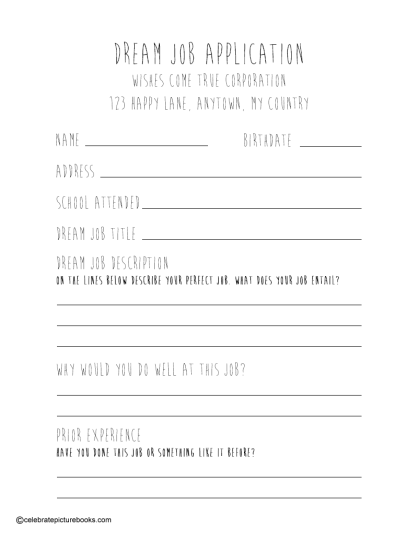
Dream Job Application


Work isn’t working when you love your job—it’s fun! What is your perfect job? Is it working with animals? Playing a sport? Being an artist, scientist, entrepreneur? Fill out this application and get started on following your dreams! Print the Dream Job Application below!

Dream Job Application 

April 23 – Talk Like Shakespeare Day

picture-book-review-will's-words

About the Holiday

To read or not to read—is that even a question?! Of course “to read!” And who produced literature containing some of the most excitement ever? William Shakespeare! Not only did Shakespeare write astounding plays and poems, he coined words and phrases that are still part of our everyday speech 400 years after his death in 1616. In recognition, the Chicago Shakespeare Theater initiated Talk Like Shakespeare Day in 2009. To honor Shakespeare’s legacy today, read or reread one of his famous plays, attend a performance, or watch a film adaptation of his work, and for goodness sake – use some of the terms he so cleverly invented.

*Italicized words were invented by William Shakespeare

Will’s Words: How William Shakespeare Changed the Way You Talk

Written by Jane Sutcliffe | Illustrated by John Shelley


“In 1606 London was a bustling, jostling, clanging, singing, stinking, head-chopping, pickpocketing wonder of a city.” With that phenomenal sentence Jane Sutcliffe begins this fascinating and ingenious look at the Globe Theatre and the experience of attending a play in William Shakespeare’s time.

In addition to all the qualities of London mentioned above, the town was also a “play-going city.” Every day of the week except Sunday, a play—or maybe even two or three—was performed, and as many as 18,000 (!) people attended plays every week! They just couldn’t get too much of a good thing!” And everyone loved the plays written by William Shakespeare!

How did a day at the theater begin? Well, at 1:00 a banner was raised from the roof of the playhouse, and men, women, and children streamed through the streets toward the Globe. It cost a penny to get in, but if you paid more you got a chair, and if you paid a little more than that you were seated in the Lord’s Rooms. The Lord’s Rooms were actually for fashionable people who wanted to be seen but didn’t really care what they were seeing.

All the actors were…well…actors. There were no actresses in those days. Men played women’s parts as well as men’s. And if you think phones and talking are problematic in today’s theaters, you would have been aghast at the audiences back then! They were not well behaved at all!

There were plays to please all tastes—comedies, tragedies, histories, and romances—all full of complicated plots and plenty of twists and turns. While the stories may have been intricate, the sets were not. But the bare-bones sets were made up for in gorgeous costumes and even some special effects accomplished with trap doors and ceiling holes. Sounds full of amazement, right? Good thing too because these plays could go on for hours, and most people stood through the whole thing, rain or shine!

William Shakespeare’s plays didn’t end when the last line was spoken. In fact theatre-goers repeated the lines they’d heard long after they left the Globe. They used Will’s words so much that his new phrases became part of the common language, and we still use them today!

Jane Sutcliffe inserts a tongue-in-cheek apology before the main text, explaining how she wanted to tell the world about the Globe Theatre in her own words, but that William Shakespeare’s words kept getting in the way. Yes, using another writer’s words is a no-no—but if they’re Shakespeare’s words? Words we use every day? Hmmm…Sutcliff’s lively history of the Globe Theatre and Old London’s theater culture is conversational, humorous, and highly informative.

The left-hand page tells the story of the Globe with phrases and words coined by William Shakespeare sprinkled throughout and set in bold type. On the right-hand page readers learn the meaning of those words and phrases (some have changed a bit since Will’s time) and which play they come from. A final note from Sutcliffe at the end of the book reveals a bit more about the playwright. A timeline of Shakespeare’s life and a bibliography are also included.

John Shelley’s incredible illustrations of London and the Globe Theatre will take your breath away. The streets teem with vendors, knights, shoppers, kids, Ladies, and Lords. If you look closely at the intricate paintings you’ll also spy the seamier side of Old London—a pickpocket, a criminal in the stocks, a tavern brawl, a cat snatching a free meal, a woman about to empty a chamber pot on her unsuspecting downstairs neighbor’s head, and…could that be a dead rat?— and that’s only on the first page!!

Subsequent pages show the waterfront with its sailing vessels, a peek into Shakespeare’s study and a look at the printing press, an aerial view of London, the Globe Theatre with its thatched awning, the actors donning wigs and costumes, and the audiences enjoying the plays and the fun of a day out. Each illustration is alive with color and movement, texture and design, expressive faces, and all the sights, sounds, and aspects of Old London. Kids will love lingering over each page picking out the funny events going on in the lanes, in the theatre seats, and on stage.

So hurry to get your own copy of Will’s Words and enjoy it to your heart’s content! You will definitely get your money’s worth!

Ages 6 – 10 and up (Anglophiles and Shakespeare lovers will enjoy this book)

Charlesbridge, 2016 | ISBN 978-1580896382

Talk Like Shakespeare Day Activity

picture-book-reviews-quill-pen-craft

Fashion a Quill Pen


William Shakespeare didn’t have a laptop to compose his great plays; he didn’t even have a desktop or a typewriter or a ballpoint pen! Shakespeare wrote all of those intrigues, characters, settings, sonnets and words with a feather!! (Plus a little ink!) Try your hand at making a quill pen—you may not be able to write with it, but it sure will look cool on your desk!

Supplies

  • Medium to large size feather with quill, available at craft stores
  • Clay, oven-bake or air-dry, in various colors if desired
  • Wire, beads, paint, and/or markers for decorating     
  • Scissors
  • Baking pan for oven-bake clay

Directions

  1. Roll clay 2 ½ inches to 4 inches long 
  2. Push the quill end of the feather into the clay
  3. Add bits of clay or roll sections of the clay between your fingers to give the clay shape
  4. To make the twisted shape pen, twist the length of clay around itself before adding the feather
  5. Shape the end or cut it with scissors to make the pointed writing nib
  6. If using air-dry clay: Add beads and/or wire and let clay dry around feather
  7. If using oven-bake clay: Add beads and other layers of clay before baking then carefully remove feather. Bake clay according to package directions
  8. Add wire and other decorations after clay has baked and cooled
  9. Reinsert feather into clay

April 22 – Earth Day

picture-book-review-green-city-allan-drummond

About the Holiday

In 1970 the first Earth Day was celebrated to bring awareness to environmental issues and begin a dialogue about how governments, corporations, communities, and individuals could create change that would benefit the Earth and all her inhabitants. Forty-six years later, we are working toward solutions to problems like pollution, climate change, renewable energy, and more. Today look around your home, office, school, or community and see how you can better support our Mother Earth.

Green City: How One Community Survived a Tornado and Rebuilt for a Sustainable Future

By Allan Drummond


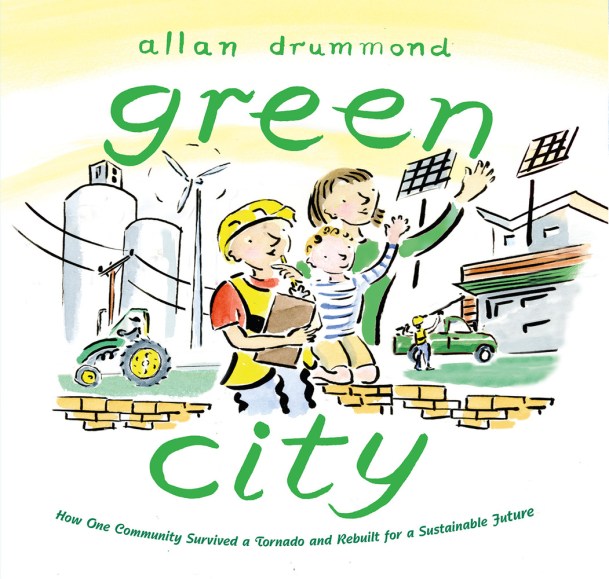
On May 4, 2007 a devastating tornado hits Greensburg, Kansas, destroying the town in 9 minutes. When the residents of the town climb from their shelters, they emerge into a world completely changed. There are no more homes, no school, no hospital, no grocery store or other shops. No banks, theater, churches, or water tower. Even the trees have been shredded. Only three buildings remain.

The citizens are urged to move away. Rebuilding will be impossible, some say, and what’s the point anyway when the wind could destroy it all again? But others see opportunity to construct a different kind of town. With the help of volunteers and donations from around the world, Greensburg begins the Herculean task of designing and building a new town.

After clearing away 388,000 tons of debris and moving into a community of trailer homes, the people begin to envision a unique, green town. Individuals design sustainable houses of different shapes and materials to work with the environment. Businesses, too, incorporate sustainability into their offices, retail centers, and hotels as do the hospital and the water tower. A wind farm large enough to provide energy for the entire town is built on the edge of this innovative city.

A new school is central to the town’s survival, and for three years the teachers hold class in small trailers. Along with their regular studies, the kids become experts in environmental science. After several years Greenburg is now thriving—a testament to conservation and sustainability that is an example for global communities now and in the future.

Allan Drummond tells this fascinating story of a community that would not give up in an honest and sensitive way that highlights the courage and pride of a town amid devastating loss. Told from a child’s point of view, the story has extra impact for readers who are growing up amid an era of environmental awareness and activism. The sustainable construction of homes and other buildings is effectively explained and clearly depicted in Drummond’s colorful illustrations.

The images also demonstrate the process of negotiation and cooperation among townspeople that went into designing and building a new Greensburg. The final two-page spread of the town’s layout will interest kids as well as adults who have followed this story in the news.

Ages 5 – 9

Farrar, Straus and Giroux, 2016 | ISBN 978-0374379995

Earth Day Activity

celebrate-picture-book-review-caterpillar-planter-craft

Hatch a Caterpillar Planter


As spring days grow warmer, it’s fun to start growing your own garden. Propagating plants from seed on a windowsill or sun room gives you an up-close view as the seeds develop roots, sprout, and flourish!

Supplies

  • Egg carton made from recycled paper
  • Seeds for your favorite veggies or flowers
  • Potting soil
  • Spoon or small shovel
  • Craft paint or markers in the colors you’d like for your caterpillar
  • Pipe cleaners or wire
  • Googly eyes
  • Marker

Directions

  1. Carefully cut the egg carton into two rows lengthwise, you may need to trim the cardboard between cups
  2. If the cups have low openings on one side, place the second row of cups inside the first facing the opposite way.
  3. Paint or color the carton, let dry
  4. Push pipe cleaners or wire through the edge of the egg carton on one end to form antennae (I used wrapped wire and painted it)
  5. Attach googly eyes and draw a smile on the front of the carton
  6. Fill cups with soil
  7. Plant seeds according to package directions
  8. Place caterpillar planter in a sunny spot

Picture Book Review

April 19 – It’s Mathematics Awareness Month

The Boy Who Loved Math: The Improbable Life of Paul Erdős by Deborah Heiligman and LeUyen Pham picture book review

About the Holiday

If you think numbers are numero uno then Math Awareness Month is for you! During April mathematicians, engineers, and all techie types are honored for their contributions to the advancements in science, medicine, computer technology, environmental concerns, and other areas. It’s also a great time to explore and experiment and discover all the benefits of being a numbers-oriented person. This year’s theme is “The Future of Prediction.” Activities will explore how math and statistics are the future of prediction, providing insight and driving innovation. 

The Boy Who Loved Math: The Improbable Life of Paul Erdős

Written by Deborah Heiligman | Illustrated by LeUyen Pham


In Budapest, Hungary a boy is born who loves math. His name is Paul Erdős and he lives with his mother, who loves him “to infinity” just as Paul loves her. When she goes back to work as a math teacher, she leaves Paul with Fräulein, his nanny. Fräulein loves rules and tries to get Paul to sit still, eat all his lunch, take a nap—to obey. But Paul hates rules.

At three years of age he teaches himself to count the days until his mother will be home with him 100 percent of the time. Knowing the number makes Paul feel better as his head is constantly full of numbers and what they can do. One day when he is four years old, he meets a woman and asks her two questions—what year she was born and at what time. When the woman tells him, it only takes him a moment to reveal how many seconds she has been alive.

He continues to play with numbers, learning more and more about the various types. He decides he will be a mathematician when he grows up. When Paul is old enough to go to school, he once again encounters rules he can’t abide. His mother decides he will be schooled at home, and even though this means more time with Fräulein, Paul considers it the better option.

There’s just one thing – while Paul thinks about numbers, Fräulein and his mother do everything for him. At meals they cut his meat and butter his bread; they dress him, and tie his shoes. When he becomes a teenager, he goes to high school and meets other kids who love math. He and his friends spend all their time doing math and by the time Paul is 20 he is famous around the world for his math equations.

There’s just one problem – even as an adult, Paul is so focused on numbers and math that he still doesn’t know how to do basic things for himself. When he is 21 he’s invited to go to England to work. At his first dinner there he stares at his bread and he stares at his meat. What is he supposed to do? With a little experimentation, he figures it out, but he also figures out that he sees the world in a different way.

He doesn’t want a normal life with a family and a house and a regular job. He designs for himself a very unusual lifestyle. Everything he owns fits into two suitcases, and with a little money in his pocket he flies from city to city to do math. He knows so many mathematicians that wherever he goes they invite Paul to stay with them. These families take care of Paul just as his mother and Fräulein had! They do his laundry, cook his meals, and pay his bills.

But even so, everyone loves “Uncle Paul!” He brings people together and shares his knowledge. His work in mathematics has given the world better computers, better search engines, and better codes for our spies to use. He was so admired that even now people represent their relationship with Paul by giving it a number – the “Erdős number.” Paul was a unique person who counted numbers and people as his best friends and experienced the world in a way that added up to a very special life.

Reading Deborah Heiligman’s The Boy Who Loved Math is a liberating experience. Her biography reveals not just what Paul Erdős did, but the quirky genius he was. It also honors all the people around the world who embraced his personality, allowing Erdős to focus on the work he was born to do. Heiligman’s engaging patter, full of interesting anecdotes, humor, and personality, is storytelling at its best and provides an absorbing look at a very unique life.

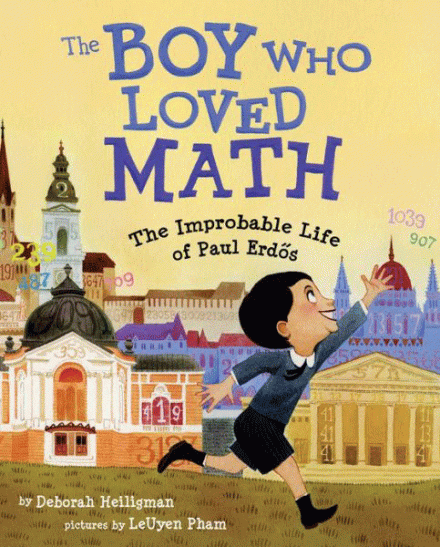
LeUyen Pham’s illustrations perfectly complement the text, exposing Erdős’s chafing under rules, his delight in math, and his development from youth to old age. Each fascinating page cleverly represents the way Erdős saw the world as numbers, equations, and geometric shapes appear on buildings, domes, and even in the very air! The text too is infused with numerals and mathematical symbols (“Paul loved Mama to ∞, too!), making this a prime book for any math lover!

Ages 5 – 9

Roaring Brook Press, 2013 | ISBN 978-1596433076

Mathematics Awareness Month Activity

CPB - Math Mystery Phrase


Totally Cool Mystery Phrase! Puzzle


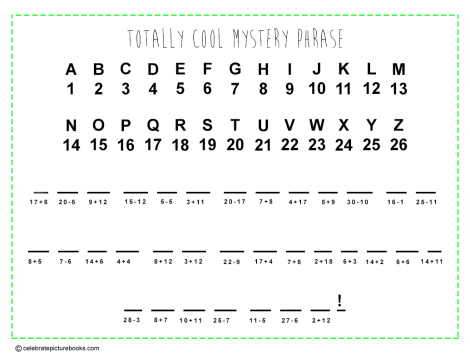
What plus what equals an equation that can’t be beat? You and numbers, of course! Complete this Printable Totally Cool Mystery Phrase! puzzle to discover a coded sentence! Here’s the Solution!

April 17 – International Haiku Poetry Day

The Maine Coon's Haiku and Other Poems for Cat Lovers by Michael J. Rosen and Lee White picture book review

About the Holiday

Part of National Poetry Month, International Haiku Writing Day celebrates the wonders of this most minimalistic yet impactful type of poetry. The familiar 5-7-5 syllable rule doesn’t begin to describe the intricacies of form and thought that goes into these beautiful creations. If you have the opportunity today, read or write some haiku, or attend a recitation of this lovely form of expression.

The Maine Coon’s Haiku and Other Poems for Cat Lovers

Written by Michael J. Rosen | Illustrated by Lee White


Fortunately for poetry—and cat—lovers there are as many types of felines as there are ways to describe them. With wit and keen insight, this collection of haiku depicts the mystery, stealth, crouching, and curiosity of twenty breeds of cats.

The remains of a shredded plant elicits an unanswerable question in Ragdoll: “why today the cat / who sleeps beneath the ivy / halved the blameless hearts”.

celebrate-picture-books-picture-book-review-the-maine-coon's-haiku-american-shorthair

Image copyright Lee White, text copyright Michael J. Rosen. Courtesy of Candlewick Press

Any cat owner who finds vases or lamps overturned will appreciate Siamese: “a toppled lamp shade / moon moth must be here somewhere / batted from the dark” It is commonly known that cats own their domain, a fact acknowledged in British Shorthair: “paws plant mud-daisies / along the polished hillside / parked on the cat’s street.”

In these lines felines become baseball players, gymnasts, ghosts, and mist, as in Bombay: “paired shadows prowling / in nightfall, but just two lights / pierce that darkness” and Norwegian Forest Cat: “caught among branches / fog descends the trunk headfirst / one foot at a time.”

celebrate-picture-books-picture-book-review-the-maine-coon's-haiku-norwegian-forest-coon

Image copyright Lee White, text copyright Michael J. Rosen. Courtesy of Candlewick Press

While the haiku form is necessarily rigid, the supple rhythms of Michael Rosen’s phrases perfectly capture the vast array of quirks, moves, attitudes, and friskiness that make cats such favorite pets. These poems are in turn sweet, spirited, and humorous—just like their subjects.

Lee White similarly highlights the bounding, creeping, prowling, and snoozing postures of all manner and colors of the breeds represented here. The Turkish Angora is painted as transparent as it leaps through the door, becoming more opaque as it reaches mid-page and disappearing from the edge of the book, leaving only its back end behind. The Abyssinian plunks its head and whole body across the open book on its owner’s lap, its eyes closed in dreamy sleep, and the Scottish Fold indomitably maintains its perch in the magnolia tree, determined not to fall like the raining petals.

Ages 5 and up (any cat lover will enjoy these poems)

Candlewick Press, 2015 | ISBN  978-0763664923

Get to know Michael J. Rosen and discover books for kids and adults, poems, videos, work for radio and TV, and more on his website!

View a beautiful gallery of artwork for books and personal illustration by Lee White on his website!

International Haiku Poetry Day Activity

CPB - Cat Bookmark (2)

Hang in there, Kitty! Bookmark


Love cats? Love reading? Then here is the purrfect bookmark for you!

Supplies

Directions

  1. Print the Hang in there, Kitty! bookmark
  2. Color the bookmark
  3. Cut around the toes of the paws, leaving the top of the paws attached to make flaps that will hang over the book’s page you want to mark

Picture Book Review

April 15 – Take a Wild Guess Day

Guess Who, Haiku by Deanna Caswell and Bob Shea picture book review

About the Holiday

Do you have a knack for guessing right answers? Then today is your day! Conjured up by Jim Barber to celebrate hunches, surmises, estimates, and other forms of speculation, today is the perfect time to put your powers of deduction to work. Enjoy the day with games of chance, shell games, card tricks, guessing competitions, or friendly wagers. Just don’t guess on your taxes!

Guess Who, Haiku

Written by Deanna Caswell | Illustrated by Bob Shea


Down on the farm the animals are playing games and they invite readers to join in the fun! Combining poetry with a guessing game, this cute book introduces younger children to haiku. On each page an animal presents a riddle about another animal in the form of a haiku. When readers turn the page, they discover the answer to the riddle as well as another one to solve.

celebrate-picture-books-picture-book-review-guess-who-haiku-cow-haiku

Image copyright Bob Shea, text copyright Deanna Caswell. Courtesy of Harry N. Abrams Books

As morning dawns the first haiku reveals: “new day on the farm / muffled mooing announces / a fresh pail of milk”. Then kids are asked, “Can you guess who from this haiku?” Flipping the page, kids see a smiling cow who in turn has a haiku for them: “flower visitors / busy buzzing in the field / black and yellow stripes”.

Other animals familiar to kids—a horse, bird, fish, mouse, cat, dog, and this guy: “from a lily pad / keen eyes spy a careless fly / a sticky tongue—SNAP!”— also puzzle over each other from page to page. The final haiku describes an animal like no other: “two hands hold a book / guessing animals’ puzzles / written in haiku”. Who can it be? Kids will giggle and beam when they discover that they too are in the book!

celebrate-picture-books-picture-book-review-guess-who-haiku-cow-haiku

Image copyright Bob Shea, text copyright Deanna Caswell. Courtesy of Harry N. Abrams Books

Deanna Caswell’s Guess Who, Haiku is a fun way to get kids interacting with poetry and the very accessible haiku form. Her clever riddles contain lovely images and lyrical alliteration that make these poems as enjoyable to read as they are to hear.

Bob Shea’s animals are adorably illustrated on vibrant solid-colored backgrounds, and each haiku is accompanied by an image that helps kids guess the answer to the riddle. The text and illustrations work together to make Guess Who, Haiku a wonderful way to spend time with kids—who, after reading, may want to make up some poems of their own!

Ages 3 – 6

 Harry N. Abrams, 2016 | ISBN 978-1419718892

Check out a gallery of work by Bob Shea on his website!

Take a Wild Guess Day Activity

CPB - Animal Matching Cards

Match Up the Animals! Game


Test your powers of memory—or your ability to guess correctly—with this Animal Pairs matching game!

Supplies

Directions

  1. Print the Animal Pairs Cards, print two pages to have double cards. To make the game more difficult print 3 or more pages to find 3 or more groups of matching animals
  2. Color the cards
  3. Cut out the cards
  4. Lay the cards face down on a table in random order
  5. Turn over cards to look for matching pairs
  6. When you find a matching pair leave the cards face up
  7. Continue playing until you find all the matching animal pairs or groups

Picture Book Review