March 20 – International Day of Happiness

Double Happiness by Nancy Tupper Ling Picture Book Review

About the Holiday

In 2011, the UN General Assembly adopted a resolution stating that happiness is a “fundamental human goal” and called for a more inclusive, equitable and balanced approach to economic growth that promotes the happiness and well-being on all peoples.” March 20 was chosen by all 193 United Nations member states as the day to remember and honor this goal. The holiday was first celebrated in 2013.

Today you get a free pass to spend the day doing what makes you and others happy—so enjoy! If you’d like to learn more about the holiday visit the International Day of Happiness organization.

Double Happiness

Written by Nancy Tupper Ling | Illustrated by Alina Chau


This quiet, thoughtful picture book tells the story of a family’s move from China to America in a series of unrhymed verses that reveal the experience honestly from alternating viewpoints of a brother, Jake, and his sister, Gracie. Each page is dedicated to one or the other sibling with the boy’s poems written in blue and the girl’s in purple. In several poems the children interact with each other, the blue and purple lines acting as dialog tags.

In the first poem, The Move, Gracie stand on her doorstep surrounded by boxes and suitcases and thinks, “I won’t go! / I won’t move / away / from our city house / by the trolley tracks….” Jake is already imagining his new room in the second poem,Train. After considering different décor, he decides what he really wants is something familiar, something outside—“just one long train / that rocks and wobbles / my bed each night. /I can’t fall asleep until the train passes by.”

The siblings are each given a happiness box by their Nai Nai inGrandmother, who wisely challenges her grandchildren to “Find four treasures each, / leading from this home / to your new.” The search is taken up in the next poems—Treasure, Lucky, and Leaf—in which the kids find objects for their happiness boxes. The train and treasures for the happiness boxes are threads that unite many of the poems and the children’s experiences.

In keeping with the long hours of travel from China to the United States, the next 6 poems chronicle the brother and sister’s experience in the airport, waiting for their plane, and during the flight.

In Here the children wake up to see their new city far below them and wonder, “can I found our house / from the sky?” Marble andSadness juxtapose Jake’s happiness at finding a treasure for his box with the apprehension of Gracie.

At last the family reaches their new home by taxi. Gracie seems only to see the “piles of snow,” but Jake likes the “windy roads, lots of trees, and the curvy driveway.” In Explore Gracie and Jake walk around the countryside, and while Gracie still determines that she won’t like it, Jake hears a train and is happy. My Roomand Dinner see the kids settling in, with a photograph of the family they’ve left behind accompanying them on the table while they eat. In A Surprise, Gracie finds that her grandmother is still with her through a special scarf, and Paints resolves the move as Jake and Gracie paint their happiness boxes: Jake decorates his with a dragon and a train, while Gracie depicts her and her brother walking in the snow and “they look very, / very / happy.”

While Double Happiness tells the story of a family’s distant move, Nancy Tupper Ling’s gentle verses are appropriate for any situation involving change or uncertainty. She reminds children that happiness can be found wherever they are and all around them if they look for it. The unrhymed poems flow as freely as thoughts, fears, and unguarded moments. As Gracie and Jake resolve their feeling, readers or listeners will also see that feelings of apprehension are common, and that happiness is waiting for them.

Alina Chau’s soft, lovely watercolor illustrations are beautiful representations of Gracie and Jake’s move from the familiar surroundings of their home in China to a new home in a snowy countryside. The children’s emotions resonate as they alternate between sadness and happiness and between concrete places and their own imagination.

Ages 5 – 8

Chronicle Books, 2015 | ISBN 978-1452129181

International Day of Happiness Activity

CPB - Happiness typography

Happiness Is…Game


Happiness is all around you! Grab one or more friends to play a game that reveals what things make you happy. Here are two ways to play:

  1. Like the “Geography” game: the first player names something that makes them happy, the next player must think of something that starts with the last letter of the word the previous player said. The game continues with each player continuing the pattern. Players drop out as they cannot think of a word. The last player left is the winner.
  2. Within a certain time limit (depending on age), players must think of something that makes them happy. Players drop out if they cannot think of a word within the time limit. The last player left is the winner.

February 29 – Haiku Writing Day

celebrate-picture-books-picture-book-review-guyku-cover

About the Holiday

In honor of the shortest form of poetry, February—the year’s shortest month—has been designated as haiku writing month. While it may be the shortest form of poetry, a good haiku creates feelings and recognition far beyond its tiny size. Through objective words and unique juxtapositions, a haiku can make a reader experience a common event or emotion in a new and surprising way. February is National Haiku Writing Month, but you can write and enjoy this beautiful form of poetry every day of the year!

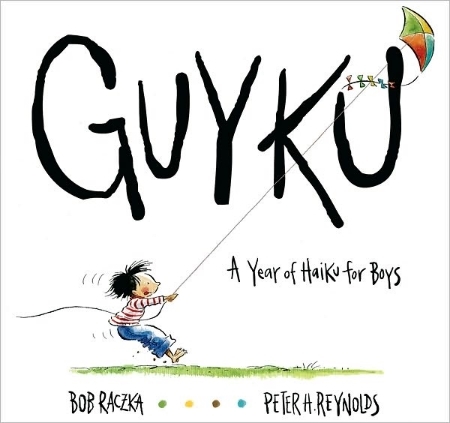
Guyku: A Year of Haiku for Boys

Written by Bob Raczka | Illustrated by Peter H. Reynolds


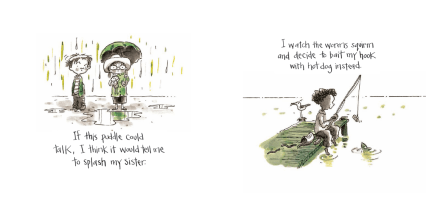
When you’re a guy sometimes the best moments in life are just that—moments. Observing insects or splashing in puddles doesn’t need pages of explanation. And feelings?—Yuck! But still, wouldn’t it be cool to describe these unforgettable moments creatively? Bob Raczka and Peter H. Reynolds have done just that in Guyku, which plucks the essence out of such seasonal activities as kite flying, raking leaves, swatting mosquitos, skipping stones, building snowmen, and more. Each haiku is a small gem that boys (and girls) will recognize and identify with.

celebrate-picture-books-picture-book-review-guyku-fishing

Image copyright Peter H. Reynolds, text copyright Bob Raczka. Courtesy of bobraczka.com

Peter Reynolds’ minimalist pen, ink, and watercolor illustrations highlight the brief poetry while giving each haiku individual boys who are curious, mischievous, determined, happy, and full of fun.Guyku stands up to multiple readings and will spark an appreciation for the joy in life’s fleeting moments.

Ages 4 – 8

Houghton Mifflin Books for Children, New York, 2010 | ISBN 978-0547240039

Discover so many more books by Bob Raczka on his website!

Meet Peter H. Reynolds and view a gallery of art and books on his website!

Haiku Day Activity

CPB - Haiku Day Bookmark (2)

Cute-as-a-Button Bookmark


Sometimes you just can’t finish a book in one sitting, or you want to mark your favorite poem so you can go back and read it again and again. This bookmark is easy to make and will keep your page in style.

Supplies

  • Fleece or felt in your favorite color
  • Buttons of different colors and/or styles
  • Pony beads in various colors
  • Fabric or strong glue
  • Scissors

Directions

  1. Cut a strip of fleece or felt 1 – 1½ inches wide and 4 – 5 inches longer than the book you want to use it in.
  2. Glue the buttons onto the top of the bookmark
  3. Cut ¼ inch-wide by 1 inch-long fringe strips at the bottom of the fleece or felt.
  4. Slide pony beads onto the fringe strips (you may need to pull the fleece or felt through the bead with a tweezers)

February 10 – Library Lovers Day

CPB - Jumping Off Library Shelves

About the Holiday

Today I’ve chosen to celebrate a month-long holiday. February is Library Lovers Month! Chances are if you’re reading this, you also love libraries! For readers there’s no better place than standing in the stacks, surrounded on all sides by shelves and shelves of books. In those pages you meet new friends, defeat the bad guys, discover poetry, laugh, sometimes cry, see astonishing art, find new hobbies, and learn fascinating facts about…wow! Anything and everything!

What’s your favorite library or thing about libraries? Mine is the East Lyme Public Library in Connecticut, where they have a fantastic selection of books and awesome librarians who feel like family! Tell me about your special library in the Comments section below.

Jumping Off Library Shelves: A Book of Poems

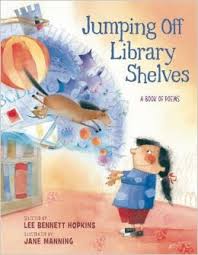
Poems selected by Lee Bennett Hopkins | Illustrated by Jane Manning


From morning, which “pours spoons of sun through tall windows” of a library in Rebecca Kai Dotlich’s poem “Breakfast between the Shelves,” to night, when shadowed mice huddle to read a mystery in Dotlich’s closing poem “Midnight in a Library,” kids can enjoy a full day of poems in this delightful collection. Many of today’s best-loved poets for children are represented here, celebrating the power of a library card, the kindness of librarians, and the enchantment of reading.

Jane Manning’s soft, dreamy illustrations swirl with imagination, shimmer with the warm glow of a reading nook, and enchant with the smiles of children thrilled with the pleasures of reading.

Library Lovers Day Activity

CPB - Bookworm Book (2)


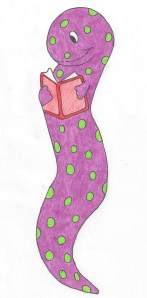
Bookworm Bookmark

For all you bookworms out there who love to read, here’s your very own Bookworm Bookmark to color and put between the pages of your favorite story!

Supplies

Directions

  1. Print out the Bookworm Bookmark template
  2. Color the bookworm
  3. Cut out the Bookworm
  4. Cut the Bookworm’s mouth at the dotted line. The top part of the bookworm’s mouth hangs over the page and marks your place!

February 7 – Popcorn Day

CPB - Popcorn Astronauts

About the Holiday

While National Popcorn Day is often celebrated in January, some people believe that Superbowl Sunday is the perfect day to celebrate this tasty treat. I say why not celebrate it on both days! The history of popcorn goes back to the Aztecs and beyond. Early explorers of the 1500s wrote about native peoples roasting corn until it popped and described it as looking like a “white flower.” The natives ate it and strung it to use for decoration.

Most people now eat popcorn with salt and butter, but can you imagine having it with milk? Way before Corn Flakes and Cheerios came on the scene people ate it as cereal! And popcorn really became popular during the Great Depression, when it was one of the only inexpensive treats people could afford. Why not pop up a batch and snuggle in to read today’s reviewed  picture book. For more interesting Popcorn Facts visit www.popcorn.org.

The Popcorn Astronauts and Other Biteable Rhymes

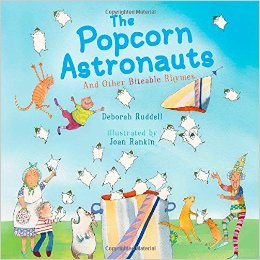
Written by Deborah Ruddell | Illustrated by Joan Rankin


Deborah Ruddell’s rollicking poems celebrate the delicacies each season offers, and they are as fresh and surprising as that first luscious taste of strawberries after a cold winter. For National Popcorn Day, and Ruddell and Rankin offer a unique take on those fluffy nuggets which, like floating astronauts, are as light as air.

In these rhymes that are as fun to say as they are to hear, kids will meet a strawberry queen, a picky ogre, and peaches with “flannelpajamaty” skin. They will also learn the ingredients for an impromptu picnic and wonder what ingredient creates that indescribable taste of the smoothie supreme. And if you’d like to know how a poet orders a milkshake or if Dracula ever gets tired of his nightly routine, you’ll find the clever answers here.

Joan Rankin’s vivid illustrations enhance each poem with plenty of action, humor, and expressive characters to keep kids giggling and lingering over each page.

Ages 4 – 8

Simon & Schuster, New York, 2015 | ISBN 978-1442465558

Popcorn Day Activity

CPB - popcorn1

Popcorn Blast-Off Game

The popcorn is flying! Can you catch it? This is a fun game to celebrate this most delicious day! And if you keep the popcorn socks, it will make a great quick activity for those times when you want to get up and move but just don’t know what to do.

Supplies

  • 6 pairs of girls socks – white
  • A large bag of cotton ballsCPB - popcorn2
  • Towel or small blanket

Instructions

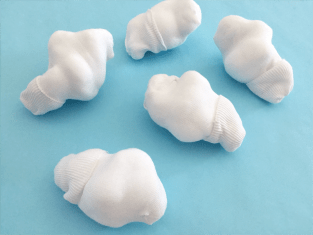
  1. Stuff the socks with a large handful of cotton balls (about 25)
  2. Knot the sock as you would a balloon and fold down the remaining sock
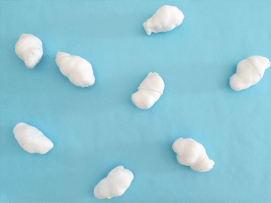
  3. Squish the sock to move the cotton balls until your sock looks like a piece of popcorn
  4. Players hold each end of the towel or side of the blanket so it sags
  5. Place popcorn in the middle of the towel or blanket
  6. On the count of 3, players pull tight on the towel or blanket
  7. Try to catch as many flying popcorn pieces in the towel or blanket as you can