May 6 – International Space Day

celebrate-picture-books-picture-book-review-otter-in-space

About the Holiday

Each year International Space Day is observed on the first Friday in May to commemorate the extraordinary achievements, benefits, and opportunities of space exploration. The goal of International Space Day is to promote math, science, technology and engineering education to inspire students to pursue a career in science and especially a career in space-related fields.

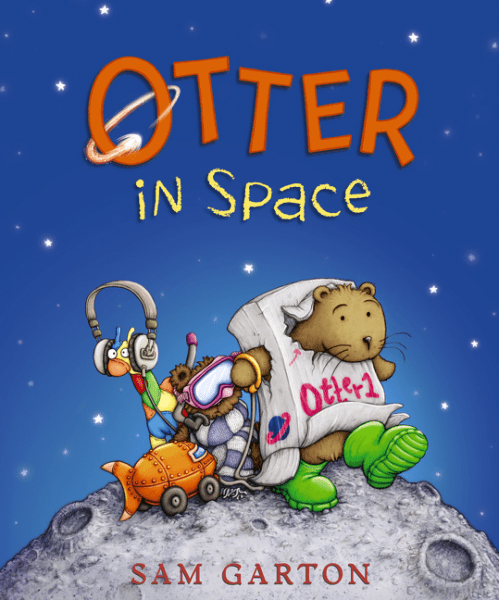
Otter in Space

By Sam Garton


On Sunday Otter goes to the museum with Otter Keeper and Teddy to see the Space Exhibition. They see a Triceratops skeleton and meet a stuffed bear that must be Teddy’s cousin. On the walls are old paintings made before the invention of crayons, and ancient, interesting things are everywhere.

Otter likes all these exhibits, but her favorite is the room dedicated to outer space—there are buttons to push just like a real astronaut, videos to watch, and a rock that came all the way from the moon. At last Otter gets to go to the gift shop. She loads up her arms with toys, but Otter Keeper says, “One thing only.” The spaceship travels home with them, but Otter and Teddy really want a moon rock too.

The next day while Otter Keeper is at work, Otter and Teddy play with their new spaceship, but it’s just not as fun without a moon rock. Teddy suggests going back to the museum, but no one can drive them. Otter thinks and thinks and suddenly has “the best idea ever!” She and Teddy will blast to the moon and retrieve a moon rock.

Otter makes a very important list of very important things to do. After lunch she builds two space suits and starts training. Although Teddy has some trouble keeping his space suit on and with problem solving, his performance in anti-gravity training is impressive so they move on to constructing the spaceship. With ingenuity and a bunch of household items, Otter builds a rocket and takes it to the Launchpad.

With Giraffe at “mishun control” lift-off is easy, but the moon landing is a little bumpy. Otter’s suit gets torn, but she perseveres and discovers the perfect moon rock nearby. It’s huge! With a little trouble Otter and Teddy transport it back to Earth, where it makes a perfect companion, playing board games and pirates—until Otter Keeper comes home and says it has to go back where it belongs.

The discussion is carried over to dinnertime, and Otter Keeper relents when he sees how serious Otter is in her space suit. If Otter cleans the moon rock she can keep it, says Otter Keeper. But one more restriction has been added to the Otter DO NOT list: dig up moon rocks! That’s okay, though. There are other things to dig up on the moon—like a dinosaur!

Sam Garton’s Otter in Space is a cute, spot-on portrayal of the fantastic ideas kids get when exposed to new concepts or places. Told from Otter’s point of view, the text hits on the serious-yet-humorous observations of kids: the gift shop as the favorite museum “exhibit,” a lingering regret for the toy left behind, and “the best ideas ever!” to correct situations.

Garton’s colorful illustrations of wily Otter and her faithful Teddy as they visit the museum, plan their space trip with the help of Giraffe and other toys, and blast off wearing a cereal box space suit are endearing. Kids will giggle at Teddy’s anti-gravity training in the washing machine. They and their parents will also appreciate Otter’s crafty discovery of the moon rock in the garden and recognize with a laugh his adoption of it as a member of the family.

Otter in Space is a book kids will want to explore again and again!

Ages 4 – 8

Balzar + Bray, Harper Collins, 2015 | ISBN 978-0062247766

International Space Day Activity
celebrate-picture-books-picture-book-review-rocket

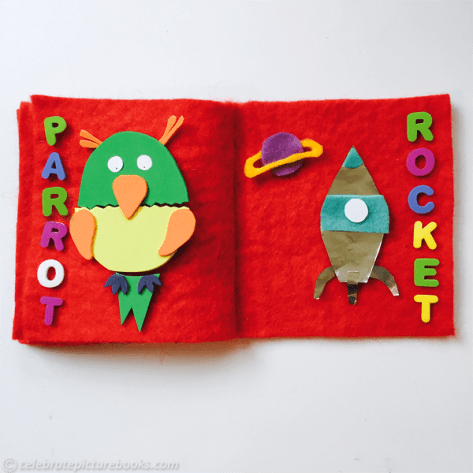
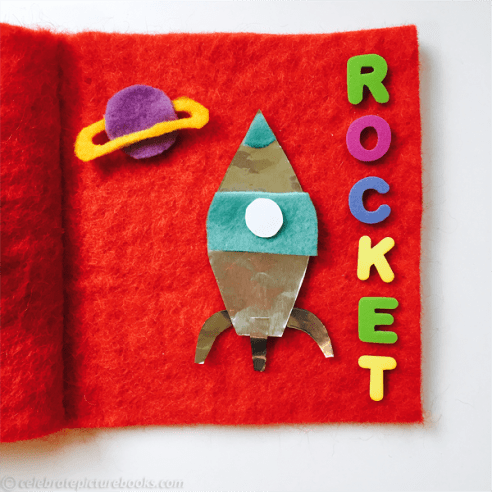
Create a Soft Book, Page 6—Rocket


Blast off with fun on Page 6 of your soft book with this shiny rocket on its way to an undiscovered planet! See previous posts from May 1 through 5 for each page of the book.

Supplies

  • Printable Rocket Template
  • Adhesive felt or foam letters
  • Tin foil
  • Felt, fleece, or foam in various colors of your choice (I used aqua, white, yellow, and purple)
  • Scissors
  • Strong glue or fabric glue

celebrate-picture-books-picture-book-review-rocket-and-parrot

Directions

  1. Cut out the rocket and feet from tin foil
  2. Cut out the nose cone and body stripe from felt, fleece or foam
  3. Cut out the round window from white felt, fleece, or foam
  4. Cut out the planet from your choice color of felt, fleece, or foam
  5. Cut out planet’s ring from your choice color of felt, fleece, or foam
  6. Glue rocket and feet to page
  7. Fit ring around planet and glue to page
  8. Attach adhesive letters to page, making sure they are stuck firmly. If they aren’t use fabric glue

I hope you enjoy your book!

Picture book review

February 22 – Museum Advocacy Day

CPB - How the Dinosaur Got to the Museum II

About the Holiday

Today is a day when we can show our museum curators and representatives in government how much we value museums. Without these grand (and sometimes small) buildings dedicated to preserving and teaching about our historical, scientific, and cultural achievements, our lives would be much poorer. Show your support for museum funding by visiting and/or donating to your favorite museum!

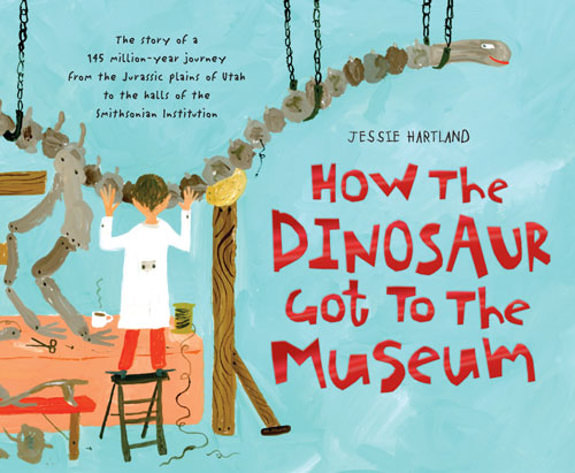
Another wonderful way to celebrate our custodians of history, science, art, and life is by reading the clever How the Dinosaur Got to the Museum / How the Sphinx Got to the Museum / How the Meteorite Got to the Museum series by author-illustrator Jessie Hartland.

How the Dinosaur Got to the Museum

By Jessie Hartland


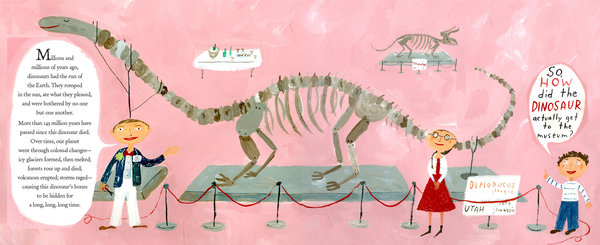
“So…” asks a little boy visiting the Smithsonian Museum of Natural History, “how did the dinosaur get to the museum?” Thus begins the tale—not of the dinosaur’s life, but of its journey from life to the museum exhibit hall.

celebrate-picture-books-picture-book-review-how-the-dinosaur-got-to-the-museum-talking-about-dinosaur

Image and text copyright Jesse Harland, courtesy of Blue Apple Books

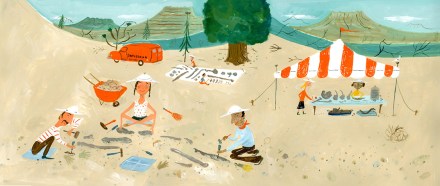
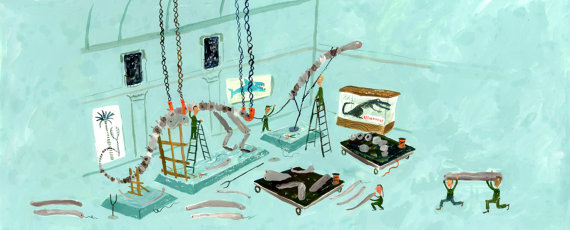
One hundred and forty-five million years ago, the dinosaur roamed the plains of what is now Utah, Overcome by weather and evolutionary events, the dino is buried and much, much later once again exposed. A Dinosaur Hunter finds one large bone and believes it to be from a Diplodocus Longus. He calls in the Paleontologist who confirms it. A team of Excavators arrives and unearths the rest of the skeleton.

The Movers pack the skeleton which was found by the Dinosaur Hunter, confirmed by the Paleontologist, and dug up by the Excavators and load it on a train that transports it to the Smithsonian. Here, the bones are cleaned and preserved by the Preparators, who discover that the head and neck are missing!

celebrate-picture-books-picture-book-review-how-the-dinosaur-got-to-the-museum-digging

Image copyright Jesse Harland, courtesy of Blue Apple Books

The Curator locates a plaster cast at another museum and work continues. The Diplodocus is assembled, but in the darkness the Night Watchman trips over its tail and breaks it! In come the Welders to fix it, and finally the Riggers can display the skeleton.

The Exhibits Team creates a background, lighting, and signs for Diplodocus, and the Cleaners give it a final dusting before the Director invites the public to view the magnificent exhibit with a speech and a toast.

celebrate-picture-books-picture-book-review-how-the-dinosaur-got-to-the-museum-exhibit

Image copyright Jesse Harland, courtesy of Blue Apple Books

Jessie Hartland’s bold, colorful illustrations offer a child’s-view perspective on the behind-the-scenes working of a museum, while her highly entertaining and educational text will keep kids giggling and reciting along as each page builds on the next to reveal the story of the men, women, and processes engaged in creating a museum exhibit.

Ages 5 – 9

Blue Apple Books, New Jersey, 2011 | ISBN 978-1609050900

Museum Advocacy Day Activity

CPB - Cookie Jar Museum (2)

Create a Museum Exhibit

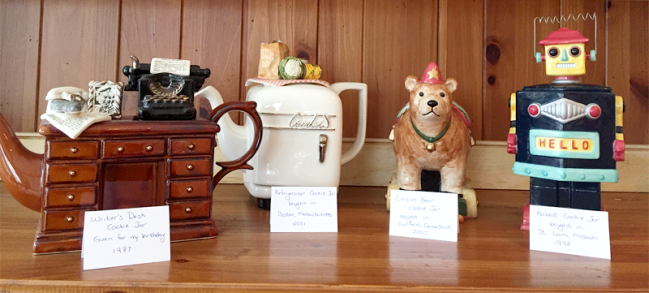
Every item has a story. Is there a funny anecdote behind that knick-knack on the shelf? Does your favorite serving dish hold sentimental value? A fun and educational way for kids to learn family stories and interact with their own history is to create a museum exhibit of objects in your home.

For teachers this can be a fun classroom activity that incorporates writing, art, and speaking, and categorizing skills. Students can use objects in the classroom or bring items from home to set up museum exhibits. This activity can be done as a whole-class project or by smaller groups, who then present their exhibit to the rest of the class.

Supplies

  • A number of household or classroom items
  • Paper or index cards
  • Markers
  • A table, shelf, or other area for display

Directions

  1. To get started have children gather a number of items from around the house to be the subjects of their exhibit. An exhibit can have a theme, such as Grandma’s China or Travel Souvenirs, or it can contain random items of your child’s choice, such as toys, plants, tools, even the furniture they see and use every day.
  2. Using the paper or cards and markers, children can create labels for their exhibit items. Older children will be able to write the labels themselves; younger children may need adult help.
  3. Spend a little time relating the story behind each object: where it came from, how long you’ve had it, when and how it was used in the past, and include any funny or touching memories attached to the item. Or let your child’s imagination run free, and let them create histories for the objects.
  4. When the labels are finished, arrange the items on a table, shelf, or in a room, and let your child lead family members or classmates on a tour. You can even share the exhibit with family and friends on social media.
  5. If extended family members live in your area, this is a wonderful way for your child to interact with them and learn about their heritage.