March 4 – It’s Umbrella Month

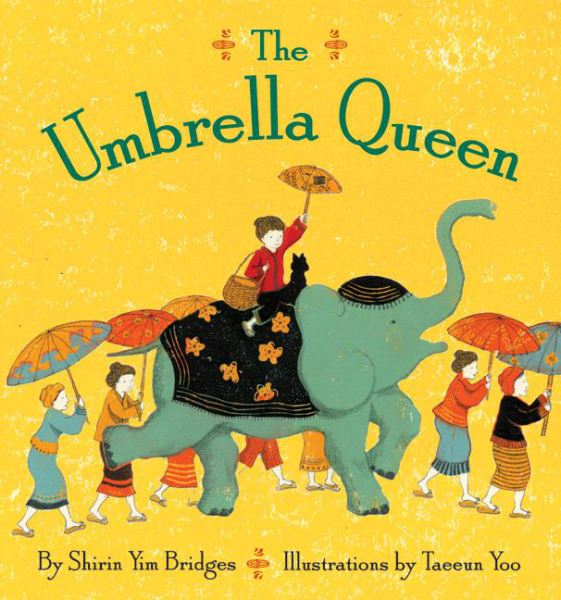
celebrate-picture-books-picture-book-review-the-umbrella-queen-cover

About the Holiday

Today I am celebrating a month-long holiday. As spring returns with its rainy weather, walkers everywhere appreciate the protection umbrellas give. The need for umbrellas has been recognized since earliest days, when palmetto fronds were used by ancient civilizations. The Chinese were the first to create waterproof umbrellas by waxing or lacquering their paper parasols. Parasols were a woman’s accessory until Jonas Hanway, a Persian travel writer, used one in public in England in the 1700s. English men took up the practice, calling their version a “Hanway.” The first collapsible umbrella was designed in 1710, and in 1928 the folding pocket umbrella appeared. Since then, umbrellas have become fashionable and necessary accessories

The Umbrella Queen

Written by Shirin Yim Bridges | Illustrated by Taeeun Yoo

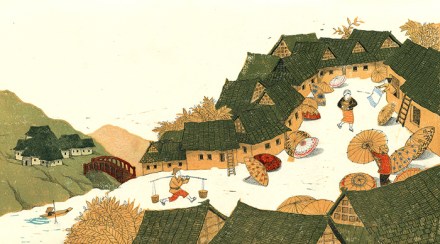
The residents of a small village in Thailand are well known for the beautiful paper umbrellas they make and sell in the local shops. The umbrellas are colorful, but always decorated with flowers and butterflies. Every New Year’s Day the villagers hold an Umbrella Parade, and the woman who has painted the most beautiful umbrella is chosen as the Umbrella Queen.

Noot is a little girl who longs to paint her own umbrellas and partake in the parade. One day her mother gives her an umbrella to paint and shows her how to copy her design. Noot is a natural artist, and her finished umbrella is nearly indistinguishable from her mother’s. She is given her own painting spot in the garden and five umbrellas to decorate.

celebrate-picture-books-picture-book-review-the-umbrella-queen-village

Image copyright Taeeun Yoo, courtesy of taeeunyoo.com

Noot paints the familiar butterflies and is about to start on the flowers when she is inspired to draw elephants instead. She covers all five umbrellas with elephants doing handstands, playing and squirting water, walking trunk-to-tail, and just being silly. When her mother sees these umbrellas, she is unhappy. Flowers and butterflies sell in the local shops, not elephants. Noot understands the importance of the money made from the umbrellas to her family. For the next year she paints the large umbrellas with the traditional design. At night, however, using bits and pieces, she fashions tiny umbrellas. These she paints with elephants, and displays them on her windowsill.

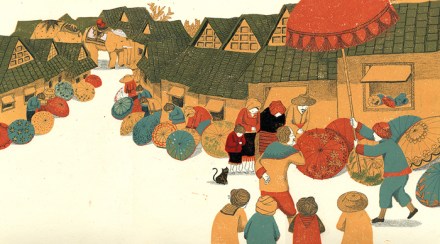
celebrate-picture-books-picture-book-review-the-umbrella-queen-emperor-visits

Image copyright Taeeun Yoo, courtesy of taeeunyoo.com

As New Year approaches there is much excitement in the village. It is rumored that the king will be visiting and will choose the Umbrella Queen himself. One day the villagers receive the message that the king will indeed arrive. The villagers spruce up their town and each woman displays her umbrellas in front of her home.

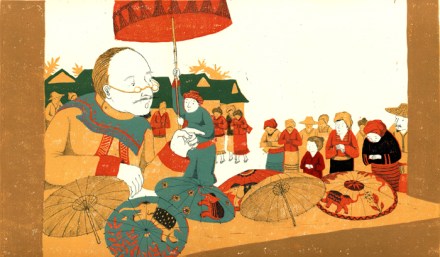
The king walks the length of the street, considering each umbrella until he comes to Noot’s house. He is very impressed with the umbrellas painted by Noot’s mother, but his gaze wanders to Noot’s windowsill, and he asks who painted the “strange” umbrellas.

celebrate-picture-books-picture-book-review-the-umbrella-queen-emperor-judges-umbrellas

Image copyright Taeeun Yoo, courtesy of taeeunyoo.com

A bit embarrassed by the attention, Noot shyly answers the king’s questions about the size of the small umbrellas and the unusual designs. In trying to explain herself, she forgets to look at the ground when talking to the king, and when her eyes meet his she realizes that, instead of judging her, he is charmed. “I like elephants,” she tells him, and he laughs.

The king takes Noot’s hand and names her the Umbrella Queen because “she paints from her heart.”

Shirin Yim Bridges has written a unique story that presents the often conflicting dilemma of responsibility to others while staying true to yourself effectively and engagingly. Noot’s journey from an observer in her family’s business to a valued artist is told straightforwardly and the familial love and support are clearly emphasized. The king’s recognition of Noot’s talent and heart will be highly satisfying for young readers or listeners.

Taeeun Yoo’s delicate illustrations in gold, red, black, and green set the story firmly in Thailand and perfectly demonstrate the close-knit village and relationships as well as the intricate beauty of the umbrellas and the pride the villagers take in them.

The Umbrella Queen is a wonderful story about family, discovering your talents, and self-expression that would find a welcome spot on any child’s bookshelf.

Ages 4 – 8

Greenwillow Books, Harper Collins, New York, 2008 | ISBN 978-0060750404

Learn more about Taeeun Yoo, her books, and her art on her website!

Umbrella Month Activity

CPB - Umbrella Matching Game

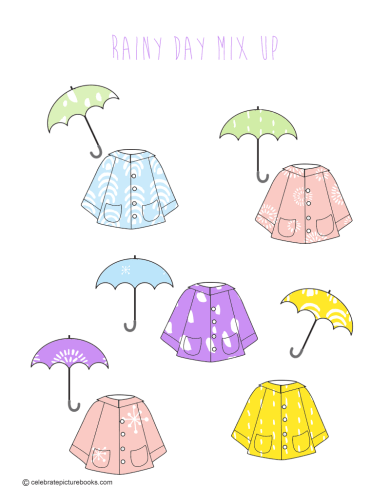
Rainy Day Mix Up Matching Game

A sudden storm scattered all the umbrellas and raincoats! Can you put the pairs together again? Draw a line to connect the umbrella and the raincoat that have the same pattern. Print the Rainy Day Mix Up Game here!


February 6 – Lace Day

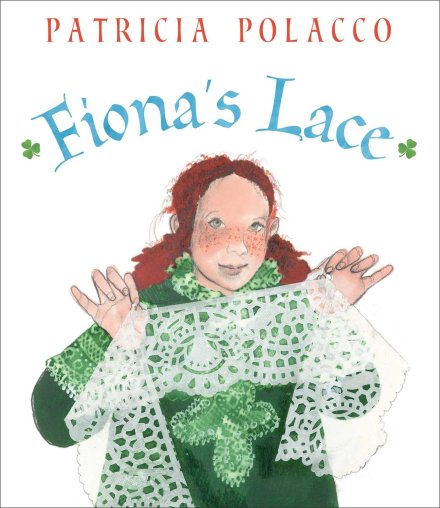
celebrate-picture-books-picture-book-review-fionas-lace-cover

About the Holiday

Lace, that delicate material that trims clothing, covers tables, ties up hair, and makes anything seem more dainty and lovely, has been used since the 1500s. When you look at the intricate patterns and fine threads of lace, it’s hard to believe that people once made it all by hand. Lace makers were paid well for their art by the fashion industry, which used it to attract distinguished customers. While lace is mostly made by machines now, the handcraft is making a comeback. Today’s reviewed picture book is about a girl whose lace work was invaluable.

Fiona’s Lace

By Patricia Polacco


In Fiona’s Lace author-illustrator Patricia Polacco weaves a tale of family love and America’s early immigrant heritage that is as intricate and lovely as the material we celebrate today. The story begins in Ireland, where Fiona and her sister Ailish live with their muther and da. They live happily in Glen Kerry, where their father works in the textile mill and their mother teaches Fiona her art of lace making.

celebrate-picture-books-picture-book-review-fiona's-lace-ma-teaches-lacemaking

Copyright Patricia Polacco, courtesy of simonandschuster.com

In the evenings the girls are entertained by family stories, especially their favorite about how, when their parents first met, their mother left a trail of lace from the factory to her house for her young suitor to follow.

When the textile mill closes, Fiona’s family signs a contract indenturing themselves to a family in Chicago. The voyage to America is long and arduous, but when they arrive in Chicago they marvel at the grand houses and elegant clothes, imagining that this awaits them too in their new home. The reality, however, is much different. Their 2-room apartment is ramshackle, and only by working two jobs can their parents make enough money to live on.

celebrate-picture-books-picture-book-review-fiona's-lace-fiona-gets-job

Copyright Patricia Polacco, courtesy of simonandschuster.com

Fiona wants to help and soon finds that dressmakers will pay handsomely for the lace she makes. The family’s money tin begins to fill up and they are prospering. One night while Muther and Da are away working, a fire rages through Chicago. Fiona and Ailish escape with only the money tin and Fiona’s lace. They run far from home, but worry—how will their parents find them?

Remembering their favorite story, Fiona cuts her lace into strips and ties bits of it along their route to their hiding place. The girls cower in fear until they hear the familiar voices of their parents. Happily reunited, the family lets go of what they have lost, but Ailish cries over the now sooty, torn lace. Ma reassures her and brings comfort, revealing that far from being ruined, this scorched lace is the most valuable and cherished of all because it saved the family.

celebrate-picture-books-picture-book-review-fiona's-lace-trail-of-lace-story

Copyright Patricia Polacco, courtesy of simonandschuster.com

Patricia Polacco’s heartwarming and harrowing story of an Irish immigrant family is a beautiful reminder of the unique talents and strong bonds that built America. Readers will be enthralled by Polacco’s realistic dialogue and detailed storytelling in this compelling and suspenseful tale and will cheer as Ailish cleverly uses her ma and pa’s trick and her own skills to save her family.

Polacco’s gorgeous illustrations bring the time period alive for young readers, portraying the intricate art of lacemaking and the clothing styles that made use of this delicate trimming. Her depictions of tenement living are realistic, yet reveal the love and close family ties within through a warm color palette and the inclusion of cozy comforts brought from Ireland.

Fiona’s Lace is a wonderful book for classroom and home story times.

Ages: 4 – 8

Simon & Schuster, New York 2014 | ISBN 978-1442487246

Discover more about Patricia Polacco and her many, many books on her website!

Lace Day Activity

Hide-and-Seek Game

While Fiona and her sister used a lace trail to lead their parents to their hiding place, you can have fun making a hide-and-seek game for your friends. This game can be played inside or outside

Supplies

  • 1 or 2 yards of lace, cut into sections about 6-inches each. You can use lace to celebrate Lace Day or use string, ribbon, or other kinds of material
  • Choose something to hide – this can be a toy, a secret letter, a snack, or anything

Directions

  1. Hide the item you choose in a secret place
  2. Determine the starting place for your hide-and-seek game
  3. Along the route from the starting point to the hidden item, tie the sections of lace onto things like lamps, furniture, stair banisters, door knobs, etc. if  you’re playing inside. If you are playing outside, tie it onto trees, bushes, bird feeders, swing sets, etc.
  4. For very young children the trail of lace can be straightforward; for older children the trail can be longer and more difficult

February 1 – National Freedom Day

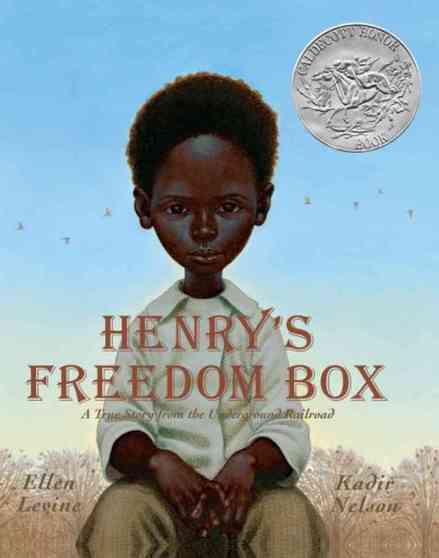
celebrate-picture-books-picture-book-review-henry's-freedom-box-cover

About the Holiday

National Freedom Day was created by a former slave named Major Richard Robert Wright Sr. and was established as a national holiday on June 30, 1948 by President Harry S Truman. The observance commemorates the day in 1865 when Abraham Lincoln signed a resolution that would become the thirteenth amendment to the U.S. Constitution. The amendment was ratified almost one year later by each state and outlawed slavery.

Today, people often celebrate National Freedom Day by laying a wreath at the Liberty Bell, which is located in Philadelphia, Pennsylvania.

Henry’s Freedom Box: A True Story from the Underground Railroad

 Written by Ellen Levine | Illustrated by Kadir Nelson


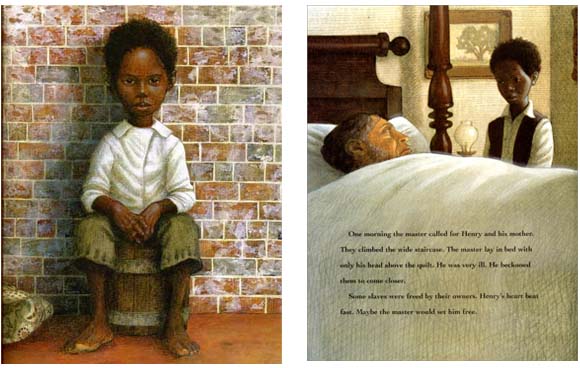
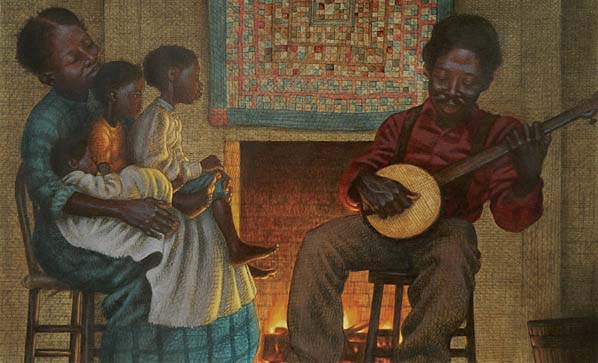
Henry Brown was born a slave. He didn’t know his birthday and he never knew security. “Like autumn leaves are torn from the trees,” his mother tells him, “slave children can be torn from their families.” When Henry’s master calls him to his sickbed, Henry hopes to be freed, but instead, his mother’s fear comes true. Henry is taken away and grows up far from his family, learning to be careful not to make mistakes that will bring severe punishment.

celebrate-picture-books-picture-book-review-henry's-freedom-box-henry

Image copyright Kadir Nelson, text copyright Ellen Levine. Courtesy of Scholastic Press

One day Henry, now a young man, falls in love with Nancy, a slave on another plantation. Henry and Nancy marry and are allowed to live together despite being owned by separate masters. Henry and Nancy have three children and are living happily.

But one day Nancy tells Henry that her master’s plantation is in financial trouble. She is afraid her master will sell their children to make money. The idea strikes fear into Henry’s heart. The next day Henry learns that indeed Nancy and his children have been sold. He knows he can show no emotion, but “his heart twisted in his chest.”

celebrate-picture-books-picture-book-review-henry's-freedom-box-henry-plays-music-for-his-family

Image copyright Kadir Nelson, courtesy of Scholastic Press

Henry runs to the town square and sees his children and Nancy being driven away. Henry is devastated. Time passes and Henry thinks about freedom. Lifting a crate used for shipping tobacco gives him an ingenious idea. He will mail himself to the North, where he can be free.

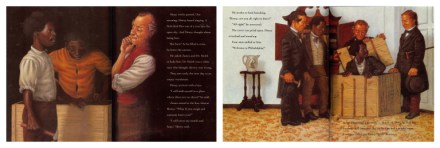
Henry’s friends agree to help him, and although they’re afraid he will be discovered, they seal him into a wooden box, address it to people in Philadelphia, and send him off. The crate is handled roughly throughout the journey north, and Henry must endure pain for many hours. Henry finally arrives safely in Philadelphia on March 30, 1849. Known from then on as Henry “Box” Brown, he became one of the most famous runaway slaves in America.

celebrate-picture-books-picture-book-review-henry's-freedom-box-henry-comes out of box

Image copyright Kadir Nelson, text copyright Ellen Levine. Courtesy of Scholastic Press

Based on an actual story of The Underground Railway, Henry’s Freedom Box is written and illustrated to stunning effect. Ellen Levine’s lyrical and metaphorical language combines with the excellent pacing of the pages to enhance the emotional impact of this powerful and original true story. Children will be inspired by this man who suffered devastating loss, but persevered and through cunning, bravery, and the help of friends, obtained freedom.

Kadir Nelson took inspiration for his illustrations from an antique lithograph of Henry Brown, created by Samuel Rowse in 1850. Through a combination of watercolor and oils crosshatched with pencil lines, Nelson’s richly hued paintings capture the poignancy of Henry’s struggles and ultimate freedom. His characters’ facial expressions are particularly moving.

Henry’s Freedom Box: A True Story from the Underground Railroad is a riveting story of slavery and one man’s fight for freedom that would make an excellent addition to children’s libraries.

To view a gallery of books and other illustration work by Kadir Nelson, visit his website!

Ages 4 – 8

Scholastic Press, 2007 | ISBN 978-043977733

National Freedom Day Activity

CPB - Freedom Stamp template (2)

Create Your Own Freedom Stamp


If you were going to create a postage stamp representing freedom, what would it look like? Think about what freedom means to you, then grab some colored pencils and design your own stamp!

Supplies

Directions

  1. Print the Freedom Stamp template
  2. Draw your own design about what freedom means to you
  3. Cut out the stamp and display it in your room or in a common area of your home

OR:

  1. Inside the stamp template write a letter to:
  • Someone in the Military: Thank them for their service to the United States to help keep our country free. You can learn how to send letters to members of the military here.
  • Your Teacher: Thank your teacher for all of her or his hard work. Only through education can we really be free.
  • Someone else who inspires you: Tell this person why they inspire you and thank them for their work.
  1. Give your Freedom Stamp letter to the person it is written to

Picture Book Review