April 23 – Talk Like Shakespeare Day

picture-book-review-will's-words

About the Holiday

To read or not to read—is that even a question?! Of course “to read!” And who produced literature containing some of the most excitement ever? William Shakespeare! Not only did Shakespeare write astounding plays and poems, he coined words and phrases that are still part of our everyday speech 400 years after his death in 1616. In recognition, the Chicago Shakespeare Theater initiated Talk Like Shakespeare Day in 2009. To honor Shakespeare’s legacy today, read or reread one of his famous plays, attend a performance, or watch a film adaptation of his work, and for goodness sake – use some of the terms he so cleverly invented.

*Italicized words were invented by William Shakespeare

Will’s Words: How William Shakespeare Changed the Way You Talk

Written by Jane Sutcliffe | Illustrated by John Shelley


“In 1606 London was a bustling, jostling, clanging, singing, stinking, head-chopping, pickpocketing wonder of a city.” With that phenomenal sentence Jane Sutcliffe begins this fascinating and ingenious look at the Globe Theatre and the experience of attending a play in William Shakespeare’s time.

In addition to all the qualities of London mentioned above, the town was also a “play-going city.” Every day of the week except Sunday, a play—or maybe even two or three—was performed, and as many as 18,000 (!) people attended plays every week! They just couldn’t get too much of a good thing!” And everyone loved the plays written by William Shakespeare!

How did a day at the theater begin? Well, at 1:00 a banner was raised from the roof of the playhouse, and men, women, and children streamed through the streets toward the Globe. It cost a penny to get in, but if you paid more you got a chair, and if you paid a little more than that you were seated in the Lord’s Rooms. The Lord’s Rooms were actually for fashionable people who wanted to be seen but didn’t really care what they were seeing.

All the actors were…well…actors. There were no actresses in those days. Men played women’s parts as well as men’s. And if you think phones and talking are problematic in today’s theaters, you would have been aghast at the audiences back then! They were not well behaved at all!

There were plays to please all tastes—comedies, tragedies, histories, and romances—all full of complicated plots and plenty of twists and turns. While the stories may have been intricate, the sets were not. But the bare-bones sets were made up for in gorgeous costumes and even some special effects accomplished with trap doors and ceiling holes. Sounds full of amazement, right? Good thing too because these plays could go on for hours, and most people stood through the whole thing, rain or shine!

William Shakespeare’s plays didn’t end when the last line was spoken. In fact theatre-goers repeated the lines they’d heard long after they left the Globe. They used Will’s words so much that his new phrases became part of the common language, and we still use them today!

Jane Sutcliffe inserts a tongue-in-cheek apology before the main text, explaining how she wanted to tell the world about the Globe Theatre in her own words, but that William Shakespeare’s words kept getting in the way. Yes, using another writer’s words is a no-no—but if they’re Shakespeare’s words? Words we use every day? Hmmm…Sutcliff’s lively history of the Globe Theatre and Old London’s theater culture is conversational, humorous, and highly informative.

The left-hand page tells the story of the Globe with phrases and words coined by William Shakespeare sprinkled throughout and set in bold type. On the right-hand page readers learn the meaning of those words and phrases (some have changed a bit since Will’s time) and which play they come from. A final note from Sutcliffe at the end of the book reveals a bit more about the playwright. A timeline of Shakespeare’s life and a bibliography are also included.

John Shelley’s incredible illustrations of London and the Globe Theatre will take your breath away. The streets teem with vendors, knights, shoppers, kids, Ladies, and Lords. If you look closely at the intricate paintings you’ll also spy the seamier side of Old London—a pickpocket, a criminal in the stocks, a tavern brawl, a cat snatching a free meal, a woman about to empty a chamber pot on her unsuspecting downstairs neighbor’s head, and…could that be a dead rat?— and that’s only on the first page!!

Subsequent pages show the waterfront with its sailing vessels, a peek into Shakespeare’s study and a look at the printing press, an aerial view of London, the Globe Theatre with its thatched awning, the actors donning wigs and costumes, and the audiences enjoying the plays and the fun of a day out. Each illustration is alive with color and movement, texture and design, expressive faces, and all the sights, sounds, and aspects of Old London. Kids will love lingering over each page picking out the funny events going on in the lanes, in the theatre seats, and on stage.

So hurry to get your own copy of Will’s Words and enjoy it to your heart’s content! You will definitely get your money’s worth!

Ages 6 – 10 and up (Anglophiles and Shakespeare lovers will enjoy this book)

Charlesbridge, 2016 | ISBN 978-1580896382

Talk Like Shakespeare Day Activity

picture-book-reviews-quill-pen-craft

Fashion a Quill Pen


William Shakespeare didn’t have a laptop to compose his great plays; he didn’t even have a desktop or a typewriter or a ballpoint pen! Shakespeare wrote all of those intrigues, characters, settings, sonnets and words with a feather!! (Plus a little ink!) Try your hand at making a quill pen—you may not be able to write with it, but it sure will look cool on your desk!

Supplies

  • Medium to large size feather with quill, available at craft stores
  • Clay, oven-bake or air-dry, in various colors if desired
  • Wire, beads, paint, and/or markers for decorating     
  • Scissors
  • Baking pan for oven-bake clay

Directions

  1. Roll clay 2 ½ inches to 4 inches long 
  2. Push the quill end of the feather into the clay
  3. Add bits of clay or roll sections of the clay between your fingers to give the clay shape
  4. To make the twisted shape pen, twist the length of clay around itself before adding the feather
  5. Shape the end or cut it with scissors to make the pointed writing nib
  6. If using air-dry clay: Add beads and/or wire and let clay dry around feather
  7. If using oven-bake clay: Add beads and other layers of clay before baking then carefully remove feather. Bake clay according to package directions
  8. Add wire and other decorations after clay has baked and cooled
  9. Reinsert feather into clay

April 22 – Earth Day

picture-book-review-green-city-allan-drummond

About the Holiday

In 1970 the first Earth Day was celebrated to bring awareness to environmental issues and begin a dialogue about how governments, corporations, communities, and individuals could create change that would benefit the Earth and all her inhabitants. Forty-six years later, we are working toward solutions to problems like pollution, climate change, renewable energy, and more. Today look around your home, office, school, or community and see how you can better support our Mother Earth.

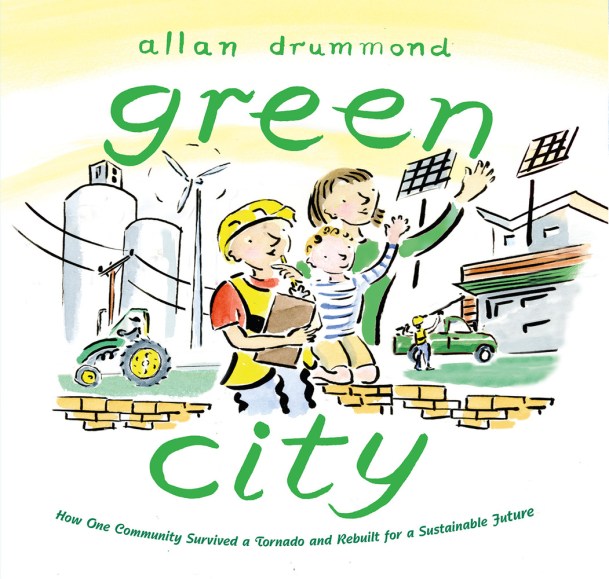
Green City: How One Community Survived a Tornado and Rebuilt for a Sustainable Future

By Allan Drummond


On May 4, 2007 a devastating tornado hits Greensburg, Kansas, destroying the town in 9 minutes. When the residents of the town climb from their shelters, they emerge into a world completely changed. There are no more homes, no school, no hospital, no grocery store or other shops. No banks, theater, churches, or water tower. Even the trees have been shredded. Only three buildings remain.

The citizens are urged to move away. Rebuilding will be impossible, some say, and what’s the point anyway when the wind could destroy it all again? But others see opportunity to construct a different kind of town. With the help of volunteers and donations from around the world, Greensburg begins the Herculean task of designing and building a new town.

After clearing away 388,000 tons of debris and moving into a community of trailer homes, the people begin to envision a unique, green town. Individuals design sustainable houses of different shapes and materials to work with the environment. Businesses, too, incorporate sustainability into their offices, retail centers, and hotels as do the hospital and the water tower. A wind farm large enough to provide energy for the entire town is built on the edge of this innovative city.

A new school is central to the town’s survival, and for three years the teachers hold class in small trailers. Along with their regular studies, the kids become experts in environmental science. After several years Greenburg is now thriving—a testament to conservation and sustainability that is an example for global communities now and in the future.

Allan Drummond tells this fascinating story of a community that would not give up in an honest and sensitive way that highlights the courage and pride of a town amid devastating loss. Told from a child’s point of view, the story has extra impact for readers who are growing up amid an era of environmental awareness and activism. The sustainable construction of homes and other buildings is effectively explained and clearly depicted in Drummond’s colorful illustrations.

The images also demonstrate the process of negotiation and cooperation among townspeople that went into designing and building a new Greensburg. The final two-page spread of the town’s layout will interest kids as well as adults who have followed this story in the news.

Ages 5 – 9

Farrar, Straus and Giroux, 2016 | ISBN 978-0374379995

Earth Day Activity

celebrate-picture-book-review-caterpillar-planter-craft

Hatch a Caterpillar Planter


As spring days grow warmer, it’s fun to start growing your own garden. Propagating plants from seed on a windowsill or sun room gives you an up-close view as the seeds develop roots, sprout, and flourish!

Supplies

  • Egg carton made from recycled paper
  • Seeds for your favorite veggies or flowers
  • Potting soil
  • Spoon or small shovel
  • Craft paint or markers in the colors you’d like for your caterpillar
  • Pipe cleaners or wire
  • Googly eyes
  • Marker

Directions

  1. Carefully cut the egg carton into two rows lengthwise, you may need to trim the cardboard between cups
  2. If the cups have low openings on one side, place the second row of cups inside the first facing the opposite way.
  3. Paint or color the carton, let dry
  4. Push pipe cleaners or wire through the edge of the egg carton on one end to form antennae (I used wrapped wire and painted it)
  5. Attach googly eyes and draw a smile on the front of the carton
  6. Fill cups with soil
  7. Plant seeds according to package directions
  8. Place caterpillar planter in a sunny spot

Picture Book Review

April 21 – Poem in Your Pocket Day

Wet Cement: A Mix of Concrete Poems by Bob Raczka picture book review

About the Holiday

Poem in Your Pocket Day has become one of the favorite events of National Poetry Month. Requiring nothing but a pocket and a treasured poem, the day is a perfect way for poets, non-poets, and poetry lovers of all types to interact with this beloved art form. Originally enacted in 2002 by the Office of the Mayor in conjunction with the New York City Departments of Cultural Affairs and Education, the holiday was embraced as a national observance by the Academy of American Poets in 2008.

Here are some suggestions from the Academy of American Poets on how to spend the day. So clean the lint, coupons, old receipts, tissues, and loose change out of your pockets and replace them with a poem! Those crumpled bits may even inspire your own poem—try it!

  • Post pocket-sized verses in public places
  • Create and distribute bookmarks with your favorite lines of poetry
  • Start a “poems for pockets” giveaway at school or work
  • Add a poem to your email footer
  • Post lines from your favorite poem on your Twitter, Tumblr, Instagram, Facebook, or Snapchat
  • Send a poem to a friend

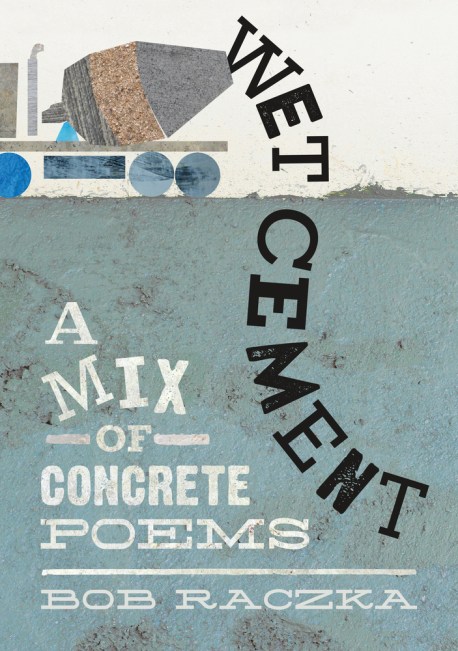
Wet Cement: A Mix of Concrete Poems

By Bob Raczka


When you envision a poem in your head, what do you see? A block of lines? A square or a rectangle? Well, sweep that image from your mind because in Bob Raczka’s Wet Cement: A Mix of Concrete Poems, verses become actions, objects, puzzles, and natural phenomena. Not only are the poems shaped to illustrate their theme, the titles use clever imagery as well.

As you encounter the poem hanger you’ll see that “han” has broken away and is dangling from the hook of g in “ger.” The words of the poem itself are shaped like a hanger and contain a giggle-invoking twist: “I hang out in blue jeans and comfy old shirts. I hang out in blouses and long frilly skirts. I hang out in sport coats and sweaters and shawls. I even hang out with no clothes on at all!”

You might want to get your baseball mitt out before you read homer, in which the first line zooms straight as a pitch and the second—written backwards and at an upward angle—soars like a homerun hit: “The pitcher hurls his hummer toward the slugger squeezing lumber CRA / CK! The slugger slams the hummer toward the bleachers for a homer.”

But don’t put that mitt away just yet! You may need to catch the o, which has escaped from the title p p-up. And if you’ve ever played t-ball, baseball, softball, or even wiffleball, you’ll cringe in recognition of this short but pointed poem.

The sky darkened by night in Dipper and by clouds in Lightning holds two poems expressing very different thoughts. In the title Dipper, the second p has floated to the top of the page where it hangs like a miniature reflection of the dipper-shaped poem, which reads: “Way down there on earth you hold firefly jars, filled up to their lids with light. Up here in the sky, I’m a vessel of stars, my brim overflowing with night.” In the title LIGHTNING, the L strikes the I to create the familiar jagged crack echoed in the shape of the verse: “from a bad mood sky, / tears, / then a jag- / ged slash- / ing flash of anger, / ear- / splitting, / obnoxious, / a cloud tantrum”

Any writer will love poeTRY which is such a clever take on the word as well as the revision and editing process:

“poetry is about taking away the words you don’t need

poetry is taking away words you don’t need

poetry is words you need

poetry is words

try”

Put simply, Bob Raczka’s concrete poems will make you smile. Even more than that, you’ll find yourself wanting to carry this book around, saying “Look at this!” to everyone you meet. Raczka calls these poems “word paintings”—because a poet “uses words like colors to paint pictures inside your head.” If creativity is the talent to present the world in new and surprising ways, making connections that enhance life, then Wet Cement is artistry at its best!

Ages 5 – 9 and up (adults will enjoy these poems as much as kids)

Roaring Brook Press, 2016 | ISBN 978-1626722361

Poem in Your Pocket Day Activity

CPB - Pocket Poem Craft

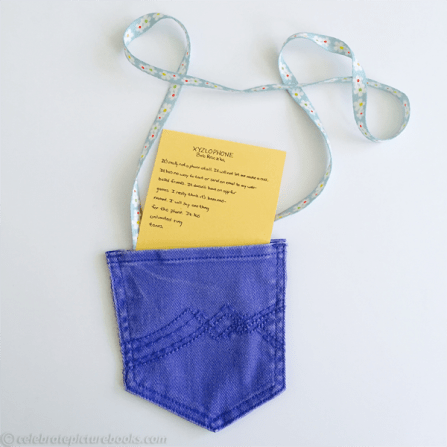
Pocket Poem Carrier


Sometimes you just need a little more inspiration in your day. Here’s a cute way to carry your favorite poem—today and every day!

Supplies

  • An old pair of pants or shorts with back pockets
  • A decorative shoelace
  • Thread or fabric glue
  • Needle
  • Paper
  • Your favorite poem or a poem you write yourself
  • Pen

Directions

  1. Cut one back pocket off an old pair of pants or shorts
  2. Use the shoelace at its full length or cut to desired length
  3. Inside each edge of the pocket sew or glue the ends of the shoelace to make a strap
  4. Print your favorite poem on the paper
  5. Insert the poem into the pocket poem carrier
  6. Take your poem with you and share it with your friends!

April 20 – It’s Jazz Appreciation Month

How Jelly Roll Morton Invented Jazz by Jonah Winter and Keith Mallett picture book review

About the Holiday

Jazz Appreciation Month, nicknamed JAM, was initiated by the Smithsonian National Museum of American History in 2002 to celebrate the heritage and history of jazz and to inspire people to embrace this musical form by attending concerts, listening to recordings, reading about jazz, and playing your own jazz music. The theme for JAM 2016 is an exploration of how jazz is a form of democracy in itself. Jazz works as a method of communication, brings people together, and can be enjoyed individually or in a group. This year’s events also remember the legacy of bandleader Benny Carter.

How Jelly Roll Morton Invented Jazz

Written by Jonah Winter | Illustrated by Keith Mallett


So “here’s what could’ve happened” if you were the baby born to grow up and become one of the best, most innovative talents—maybe even the inventor—of jazz music: Living in New Orleans in the 1890s you might have been put under the spell of music by your godmother, who was a voodoo queen. This same godmother might have taken you with her to a saloon, and later that night you may have accompanied her to jail when trouble broke out at the bar. In jail you may have cried and cried until the other people in your cell “commenced to singing—‘cause music was the only thing that calmed you down.”

When you were still a little child, it might have happened that you sat down at a piano and without training “commenced to play.” With that kind of talent you might have snuck out at night to play for adults who loved to hear your music and paid you well. But one morning your great-grandmother who was raising you may have seen you sneaking back home. She’d ask where you’ve been and how you got such a fancy suit.

When you tell her, she says “she wouldn’t have no LOWLIFE MUSICIAN livin’ under her respectable roof.” But music is who you are, and so still a child, you have nowhere to live and must make your way in the world. This is how and why in 1902 “a thing called JAZZ got invented by a man named Jelly Roll Morton.” At least that’s how the story goes.

Jelly Roll Morton knew the only way to escape his life and show people who’s the best is by playing the music inside him “one piano note at a time.” He had a recipe for jazz as spicy as a pot of Creole gumbo combining the rhythms of New Orleans, the beat of Africa, a dash of Spanish melodies and a pinch of Calypso syncopation. Stir in the Blues and add a bit of “messin’ around” and the tones of laughter. Throw in a teaspoon of symphony, with its flavorful instruments, and you’ve got a ragtime band that produces “high-steppin’, low-down, horn-blowin’ spectacularamicus!”

Jelly Roll Morton took his unique style to Mobile, Alabama and Chicago, Illinois and to every place in between, showing people how music should be played. And while Jelly Roll Morton might not have invented jazz all by himself, he “sure did spread it around the towns,” waving that magic spell everywhere he went.

The final pages give more information about the life of Ferdinand Joseph La Menthe, nicknamed Jelly Roll, as well as further reading and listening resources.

Immersing yourself in Jonah Winter’s biography of Jelly Roll Morton is akin to sitting at the knee of the most captivating storyteller. With mesmerizing rhythms Winter weaves the events of Morton’s life into a tale as enthralling as jazz music itself. Passages of the text are infused with the flavor of New Orleans: “I thought I heard Mister Jelly Roll too / Sayin’ ‘I invented jazz in 1902, / It was me who invented jazz—‘cause it sure wasn’t you.’”

Complimenting Winter’s story, Mallett paints Jelly Roll Morton’s environment in dark washes of night illuminated by the glow of music. The bayou of New Orleans, the dance halls, and city streets glimmer in golden hues from lamp light, the dawning sun, and the radiance of Jelly Roll’s piano keyboard. Notes fly away from Morton’s piano, becoming birds as they soar over the wakening city, and the recipe for “Jazz Gumbo” is stunningly illustrated.

How Jelly Roll Morton Invented Jazz is a unique, fascinating true-life tale that will entice music lovers and all readers.

Ages 5 – 9

Roaring Brook Press, 2015 | ISBN 978-1596439634

Jazz Appreciation Day Activity

CPB - Trumpet maze

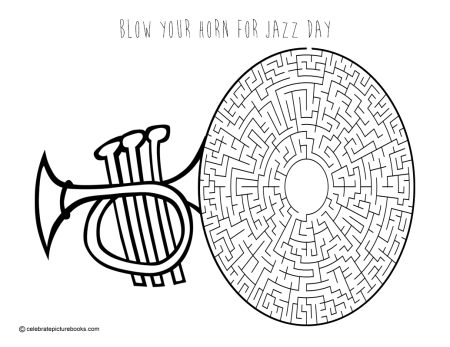
Blow Your Horn for Jazz Day! Maze


Jazz music is amazing in so many ways! Enjoy this riff on the usual maze and trumpet your success to your friends! Print the Blow Your Horn for Jazz Day! maze here. And here’s the Solution.

April 19 – It’s Mathematics Awareness Month

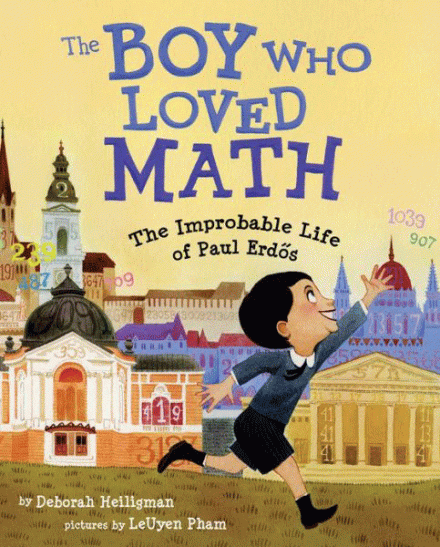
The Boy Who Loved Math: The Improbable Life of Paul Erdős by Deborah Heiligman and LeUyen Pham picture book review

About the Holiday

If you think numbers are numero uno then Math Awareness Month is for you! During April mathematicians, engineers, and all techie types are honored for their contributions to the advancements in science, medicine, computer technology, environmental concerns, and other areas. It’s also a great time to explore and experiment and discover all the benefits of being a numbers-oriented person. This year’s theme is “The Future of Prediction.” Activities will explore how math and statistics are the future of prediction, providing insight and driving innovation. 

The Boy Who Loved Math: The Improbable Life of Paul Erdős

Written by Deborah Heiligman | Illustrated by LeUyen Pham


In Budapest, Hungary a boy is born who loves math. His name is Paul Erdős and he lives with his mother, who loves him “to infinity” just as Paul loves her. When she goes back to work as a math teacher, she leaves Paul with Fräulein, his nanny. Fräulein loves rules and tries to get Paul to sit still, eat all his lunch, take a nap—to obey. But Paul hates rules.

At three years of age he teaches himself to count the days until his mother will be home with him 100 percent of the time. Knowing the number makes Paul feel better as his head is constantly full of numbers and what they can do. One day when he is four years old, he meets a woman and asks her two questions—what year she was born and at what time. When the woman tells him, it only takes him a moment to reveal how many seconds she has been alive.

He continues to play with numbers, learning more and more about the various types. He decides he will be a mathematician when he grows up. When Paul is old enough to go to school, he once again encounters rules he can’t abide. His mother decides he will be schooled at home, and even though this means more time with Fräulein, Paul considers it the better option.

There’s just one thing – while Paul thinks about numbers, Fräulein and his mother do everything for him. At meals they cut his meat and butter his bread; they dress him, and tie his shoes. When he becomes a teenager, he goes to high school and meets other kids who love math. He and his friends spend all their time doing math and by the time Paul is 20 he is famous around the world for his math equations.

There’s just one problem – even as an adult, Paul is so focused on numbers and math that he still doesn’t know how to do basic things for himself. When he is 21 he’s invited to go to England to work. At his first dinner there he stares at his bread and he stares at his meat. What is he supposed to do? With a little experimentation, he figures it out, but he also figures out that he sees the world in a different way.

He doesn’t want a normal life with a family and a house and a regular job. He designs for himself a very unusual lifestyle. Everything he owns fits into two suitcases, and with a little money in his pocket he flies from city to city to do math. He knows so many mathematicians that wherever he goes they invite Paul to stay with them. These families take care of Paul just as his mother and Fräulein had! They do his laundry, cook his meals, and pay his bills.

But even so, everyone loves “Uncle Paul!” He brings people together and shares his knowledge. His work in mathematics has given the world better computers, better search engines, and better codes for our spies to use. He was so admired that even now people represent their relationship with Paul by giving it a number – the “Erdős number.” Paul was a unique person who counted numbers and people as his best friends and experienced the world in a way that added up to a very special life.

Reading Deborah Heiligman’s The Boy Who Loved Math is a liberating experience. Her biography reveals not just what Paul Erdős did, but the quirky genius he was. It also honors all the people around the world who embraced his personality, allowing Erdős to focus on the work he was born to do. Heiligman’s engaging patter, full of interesting anecdotes, humor, and personality, is storytelling at its best and provides an absorbing look at a very unique life.

LeUyen Pham’s illustrations perfectly complement the text, exposing Erdős’s chafing under rules, his delight in math, and his development from youth to old age. Each fascinating page cleverly represents the way Erdős saw the world as numbers, equations, and geometric shapes appear on buildings, domes, and even in the very air! The text too is infused with numerals and mathematical symbols (“Paul loved Mama to ∞, too!), making this a prime book for any math lover!

Ages 5 – 9

Roaring Brook Press, 2013 | ISBN 978-1596433076

Mathematics Awareness Month Activity

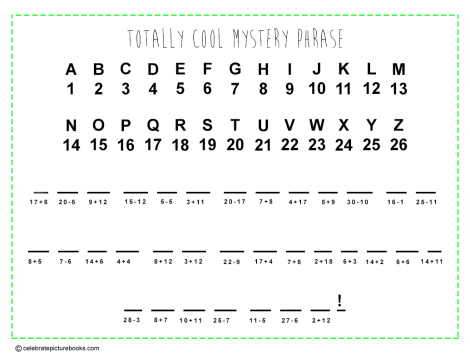
CPB - Math Mystery Phrase


Totally Cool Mystery Phrase! Puzzle


What plus what equals an equation that can’t be beat? You and numbers, of course! Complete this Printable Totally Cool Mystery Phrase! puzzle to discover a coded sentence! Here’s the Solution!

April 18 – It’s National Inventor’s Month

The Most Magnificent Thing by Ashley Spires picture book review

About the Holiday

Perhaps April was chosen as Inventor’s Month because the blossoms of early spring echo the flourish of ideas that come from fertile minds. This month honors all the men and women throughout history who dared to think differently and changed the world. Today, that proud tradition continues in the excitement of school labs and classrooms, through online courses and computer technology, and in private homes where people of all ages are pondering and creating the next big thing. If you have a knack for innovation or invention, take time to sit down and work on your ideas today.

The Most Magnificent Thing

By Ashley Spires


A little pony-tailed girl and her puppy do everything together. They race, eat, explore, and relax. When she makes things, her best friend unmakes them. One day the girl has a brilliant idea—she is going to make “the most MAGNIFICENT thing!” In her mind it’s going to be “easy-peasy.” She knows exactly how it will look and how it will work.

With her faithful assistant following at her heels, the girl gathers materials and goes to work on the sidewalk outside her home. The girl “tinkers and hammers and measures” while her assistant “pounces and growls and chews.” When the little invention is finished, they stand back to examine it. Hmmm…it doesn’t look quite right. It doesn’t feel quite right either. In fact it is all wrong! The girl tries again.

She “smooths and wrenches and fiddles” while her assistant “circles and tugs and wags.” It still turns out wrong. Determined to make her vision reality, she gives it another go…and another…and another. She makes her invention different shapes, gives it various textures, measures out assorted sizes. One attempt even smells like stinky cheese! But none of these creations are MAGNIFICENT.

People stop by and offer encouraging—even admiring—remarks, but the little girl just gets mad. Can’t they see how wrong her invention is? In her anger the little girl works at a fevered pitch, shoving parts together, her brain fogged by “all the not-right things.” In her haste she hurts her finger. This is the last straw. She explodes and declares that she QUITS!

The ever-watchful assistant suggests a bit of fresh air. The girl takes her puppy for a walk and at first her feelings of defeat stay with her. Little by little, though, she pays attention to the world around her and her mind clears. Coming home, she encounters all the wrong things she has made lined up on the sidewalk. Her disappointment threatens to return, but then she notices something surprising—there are parts of each iteration that she likes!

After studying each earlier attempt, she knows just what to do! Slowly and carefully she once more begins to tinker. At the end of the day she and her assistant stand back to look. The machine may lean a bit, and be a little heavy, and it may need a coat of paint…but as the girl and her puppy climb aboard, they both agree that “it really is THE MOST MAGNIFICENT THING!”

You are never too young or too old for Ashley Spires’ inspiring and inspired story. The journey from idea to realization—so often fraught with disaster (or apparent disaster)—is depicted here honestly and with humor as the on-going process it is. Step-by-step the little girl thinks, gathers materials, tinkers, discovers, tinkers some more, and triumphs. It is this last step that is so “magnificently” presented—it’s only by not giving up that success can be achieved.

Spires’ tale is a delight of language—the girl “smooths, wrenches, fiddles, twists, tweaks, and fastens, pummels, jams, and smashes.” Likewise, her illustrations wonderfully depict the changing emotions of this thoughtful, steely-eyed, shocked, and ultimately thrilled young inventor. Her faithful puppy is a charming companion and foil, and kids will love examining the early inventions that lead up to the final product.

The Most Magnificent Thing is a fabulous book to keep on any child’s or adult’s bookshelf for those times when inspiration hits but achievement seems elusive.

Ages 3 – 7 and up (creative types of all ages will enjoy this book)

Kids Can Press, 2014 | ISBN 978-155453704

National Inventor’s Month Activity

CPB - Inventor's Tool Kit II (2)

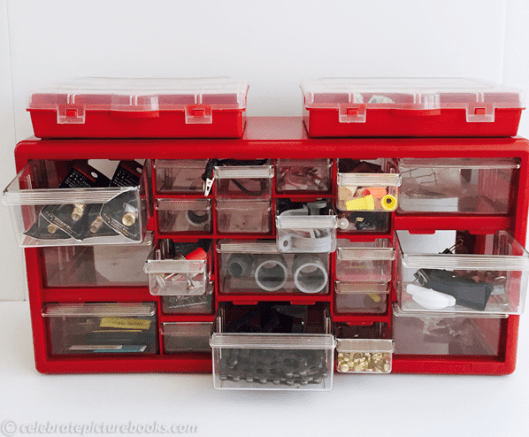
Inventor’s Tool Kit


Every idea begins as a jumble of seemingly unrelated parts. Gathering whatever types of material inspires you and keeping it in a box ready to go when inspiration hits is a great way to support innovation and spark experimentation.

Supplies

  • Small parts organizer with drawers or compartments, available at hardware stores and craft stores
  • A variety of parts or craft materials that can be combined, built with, or built on
  • Some hardware ideas—pulleys, wheels, small to medium pieces of wood, wire, nuts, bolts, screws, hooks, knobs, hinges, recyclable materials
  • Some craft ideas—clay, beads, wooden pieces, sticks, paints, pipe cleaners, string, spools, buttons, glitter, scraps of material, recyclable materials

Directions

  1. Fill the organizer with the materials of your choice
  2. Let your imagination go to work! Build something cool, crazy, silly, useful—Amazing!

April 17 – International Haiku Poetry Day

The Maine Coon's Haiku and Other Poems for Cat Lovers by Michael J. Rosen and Lee White picture book review

About the Holiday

Part of National Poetry Month, International Haiku Writing Day celebrates the wonders of this most minimalistic yet impactful type of poetry. The familiar 5-7-5 syllable rule doesn’t begin to describe the intricacies of form and thought that goes into these beautiful creations. If you have the opportunity today, read or write some haiku, or attend a recitation of this lovely form of expression.

The Maine Coon’s Haiku and Other Poems for Cat Lovers

Written by Michael J. Rosen | Illustrated by Lee White


Fortunately for poetry—and cat—lovers there are as many types of felines as there are ways to describe them. With wit and keen insight, this collection of haiku depicts the mystery, stealth, crouching, and curiosity of twenty breeds of cats.

The remains of a shredded plant elicits an unanswerable question in Ragdoll: “why today the cat / who sleeps beneath the ivy / halved the blameless hearts”.

celebrate-picture-books-picture-book-review-the-maine-coon's-haiku-american-shorthair

Image copyright Lee White, text copyright Michael J. Rosen. Courtesy of Candlewick Press

Any cat owner who finds vases or lamps overturned will appreciate Siamese: “a toppled lamp shade / moon moth must be here somewhere / batted from the dark” It is commonly known that cats own their domain, a fact acknowledged in British Shorthair: “paws plant mud-daisies / along the polished hillside / parked on the cat’s street.”

In these lines felines become baseball players, gymnasts, ghosts, and mist, as in Bombay: “paired shadows prowling / in nightfall, but just two lights / pierce that darkness” and Norwegian Forest Cat: “caught among branches / fog descends the trunk headfirst / one foot at a time.”

celebrate-picture-books-picture-book-review-the-maine-coon's-haiku-norwegian-forest-coon

Image copyright Lee White, text copyright Michael J. Rosen. Courtesy of Candlewick Press

While the haiku form is necessarily rigid, the supple rhythms of Michael Rosen’s phrases perfectly capture the vast array of quirks, moves, attitudes, and friskiness that make cats such favorite pets. These poems are in turn sweet, spirited, and humorous—just like their subjects.

Lee White similarly highlights the bounding, creeping, prowling, and snoozing postures of all manner and colors of the breeds represented here. The Turkish Angora is painted as transparent as it leaps through the door, becoming more opaque as it reaches mid-page and disappearing from the edge of the book, leaving only its back end behind. The Abyssinian plunks its head and whole body across the open book on its owner’s lap, its eyes closed in dreamy sleep, and the Scottish Fold indomitably maintains its perch in the magnolia tree, determined not to fall like the raining petals.

Ages 5 and up (any cat lover will enjoy these poems)

Candlewick Press, 2015 | ISBN  978-0763664923

Get to know Michael J. Rosen and discover books for kids and adults, poems, videos, work for radio and TV, and more on his website!

View a beautiful gallery of artwork for books and personal illustration by Lee White on his website!

International Haiku Poetry Day Activity

CPB - Cat Bookmark (2)

Hang in there, Kitty! Bookmark


Love cats? Love reading? Then here is the purrfect bookmark for you!

Supplies

Directions

  1. Print the Hang in there, Kitty! bookmark
  2. Color the bookmark
  3. Cut around the toes of the paws, leaving the top of the paws attached to make flaps that will hang over the book’s page you want to mark

Picture Book Review