July 20 – National Moon Day

celebrate-picture-books-picture-book-review-to-the-stars-cover

About the Holiday

Today’s holiday celebrates the astounding technological achievement that saw men land—and walk—on the moon. On July 20, 1969 Apollo 11 with astronauts Neil Armstrong, Buzz Aldrin, and Michael Collins touched down on the moon. Six hours after landing, Armstrong made the first “small step for man, one giant leap for mankind” when he descended the ladder of the space craft to the moon’s surface. He spent two and a half hours exploring our nearest neighbor. Aldrin also made a lunar walk. Between them, the two astronauts brought 47.5 pounds of material back to Earth. Millions of people watched live coverage of the moon landing on television, cheering along with NASA at this amazing feat.

To the Stars! The First American Woman to Walk in Space

Written by Carmella Van Vleet and Dr. Kathy Sullivan | Illustrated by Nicole Wong


As a child Kathy Sullivan loved to explore. Her father designed airplanes, and when he brought home blueprints, she carefully studied every line and curve. When she saw airplanes in the sky she wished she were on them, flying to exciting locations all over the world. Maps and foreign languages fascinated her. “Their strange symbols, exotic tales, and musical sounds made her feel like the world was waiting for her.” Kathy wanted to see that whole world and thought maybe she’d like to be a spy or a diplomat, but her friends and other adults told her those weren’t jobs for women.

celebrate-picture-books-picture-book-review-to-the-stars-blueprints

Image copyright Nicole Wong, courtesy of nicole-wong.com

But Kathy always followed her heart. She loved going fishing with her dad and brother, finishing the day with a swim. She “delighted in how her arms and legs moved in slow motion underwater.” Kathy was still a teenager when she learned how to pilot a plane. At first the busy instrument panel made her nervous, but she quickly learned how to manage all the “dials, buttons, and numbers.”

Kathy got a taste for the thrill of space when she bravely jumped at the opportunity to ride in a Breezy—an open air framework plane. Sitting at the very tip of the airplane, in front of the pilot, Kathy had a bird’s eye view. “The wind rushed past her face so fast it pushed her cheeks back. Higher! Faster! Young Kathy looked at the ground below her feet. She felt like she could see the whole world.”

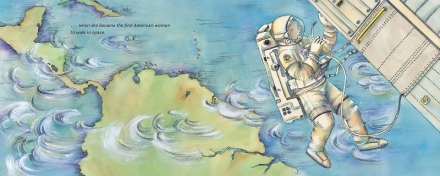
Later, as the first American woman to walk in space, she did!
celebrate-picture-books-picture-book-review-to-the-stars-spacewalk

Image copyright Nicole Wong, courtesy of charlesbridge.com

Carmella Van Vleet and Dr. Kathy Sullivan, have written a compelling biography of Dr. Sullivan that not only tells the story of her adult achievements, but also reveals the childhood and teenage motivations and influences that fostered her journey to the stars. As each event in Kathy’s young life is introduced, it is followed by an adult accomplishment: Kathy’s poring over her father’s aircraft blueprints leads to a spread of college-age Kathy studying charts in textbooks. Her enjoyment of swimming underwater is followed by an illustration showing her NASA training underwater. Her initial introduction to a plane’s instrument panel informs her later responsibilities inside the spacecraft. And the question she once asked herself as a child—what kind of job would allow her to see the whole world—is answered as the astronaut Kathy gazes down at Earth from space.

celebrate-picture-books-picture-book-review-to-the-stars-breezy

Image copyright Nicole Wong, courtesy of charlesbridge.com

Nicole Wong’s lovely, realistic watercolor and ink paintings clearly show readers Kathy Sullivan’s trajectory from curious girl to accomplished astronaut. The blueprints that Kathy studies are filled with schematics. The aqua water she swims in swirls and bubbles in the wake of her cannonball dive, the crisscrossing fields lay like a mottled green quilt under the Breezy. Especially stunning and effective are the illustrations of Dr. Sullivan’s work with NASA. Kids will love the up-close view of the spacecraft’s instrument panel with its myriad buttons and dials, and find the gorgeous two-page spreads of the space shuttle’s launch, the view from the cockpit, and Kathy’s spacewalk particularly thrilling.

Following the text are a personal note from Kathy Sullivan to her young readers, as well as more extensive biographical notes on how Dr. Sullivan discovered her love of science and the NASA missions she supported. Two more pages highlight the women of the first space-shuttle class, which included Kathy Sullivan, and other firsts by eight other women in space.

To the Stars is a wonderful book to teach children that following their own heart is the best path to future happiness and personal accomplishment. It’s a nice addition to any budding scientist’s or adventurer’s library!

Ages 5 – 9

Charlesbridge, 2016 | ISBN 978-1580896443

To find fun activities for To the Stars—including how to make space play dough—as well as other books by Carmella Van Vleet, visit her website!

To learn more about Nicole Wong and view a portfolio of her artwork, visit her website!

National Moon Day Activity

celebrate-picture-books-picture-book-review-moon-and-earth-coloring-page

Out of this World Coloring Page


The view of the Moon from Earth or of Earth from the Moon is spectacular! Have fun coloring this printable Out of this World Coloring Page!

Picture Book Review

June 30 – Meteor Watch Day

celebrate-picture-books-picture-book-review-oh-no-astro-cover

About the Holiday

When space debris, such as pieces of rock as small as a pebble or as large as an apple, fall through Earth’s atmosphere they glow with the heat of friction and streak through the night sky creating a beautiful spectacle. These shooting stars can occur individually or in meteor showers. The early Greeks believed that meteors were stars that escaped the heavens when the gods peeked through to see what the humans were up to. People felt that the gods may be more disposed to grant them wishes during these times, and so the tradition of wishing on a star began. According to the American Meteor Society the average hourly rates for meteors during this week should be nine meteors per hour in the mid-northern latitudes (45N) and about 12 per hour in the tropical southern locations (25S). Dark, cloudless skies are optimal for viewing. Tonight gather friends and/or family and have a stargazing party!

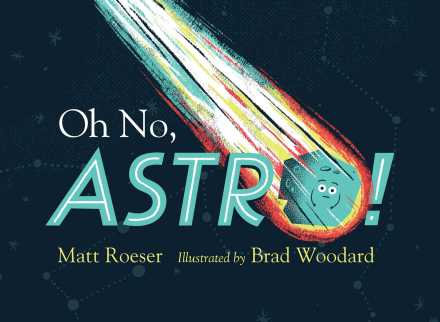
Oh No, Astro!

Written by Matt Roeser | Illustrated by Brad Woodard


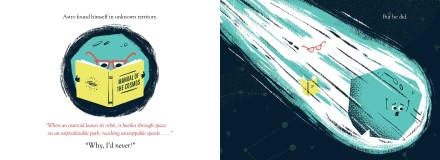
Astro was not a typical asteroid. Instead of zooming around crashing into obstacles, he believed in “personal outer space” and had for millions of years. When Astro spies an approaching satellite he greets him cordially and lays down the rules: “please keep your distance” and “stay in your orbit.” But the satellite ignores him and comes closer and closer until…

celebrate-picture-books-picture-book-review-oh-no-astro-interior-art-satellite

Image copyright Brad Woodard, courtesy of Simon & Schuster


“‘Good gravity! You’ve struck me!” Astro exclaims. He’s just about to “point out to the satellite that it had done considerable damage to one of his favorite craters” when he discovers that he is spinning out of his orbit and out of control. How humiliating! The usually unflappable space rock suddenly finds himself hurtling past Mars at the same time that young astronomer, Nova, is “enjoying a quiet night of stargazing” through her telescope. She catches sight of Astro as he zips past an astronaut, rushes past the Moon, and finds himself on an inevitable crash course with Earth.

As he enters Earth’s atmosphere he begins to break apart, shedding bits of the past, as the universe watches. He lands on Earth with a SMASH! Reeling from the impact Astro slowly opens one eye and then the other; he’s smaller but in one piece. Nova is waiting to welcome him to his new home. “‘My stars,’” he mutters. “‘Dare I say that was…FUN?!’”

And as Astro gazes at the night sky from a fresh perspective with Nova by his side, he asks, “‘What on Earth shall we do next?!’”

celebrate-picture-books-picture-book-review-oh-no-astro-hurtling

Image copyright Brad Woodard, courtesy of Simon & Schuster


For anyone stuck in the rut of their own orbit, Matt Roeser’s story of the unwitting space traveler is a humorous invitation to explore the universe around them. Roeser’s language—from calling asteroids “rambunctious” and the satellite a “celestial wanderer” to exclamations of “good gravity!” and “Pluto’s revenge!”—is an inspired treat. Kids and adults will laugh at Astro’s attempts to handle his undesirable predicament with dignity. Complacent Astro with his dry-as-space-dust wit and sparkling puns makes a stellar guide on this journey to more self-discovery and life enjoyment.

In the hands of Brad Woodard deep space is a very cute and cool place! Rendered in flat tones of black, aqua, yellow, red, and white, Woodard’s illustrations give Oh No, Astro! a retro feel for a space-savvy audience. The oblivious satellite floats through Astro’s orbit with wide eyes and a sweet grin, while angular Astro with his stick arms, expressive face, and boldly displayed “No loitering” banner would be a welcome alien intruder in any back yard. And Nova in her ponytails and Saturn-patterned dress is the perfect companion to greet him! The night sky abounds with constellations, but Astro is the real star!

In the final pages, Astro leads readers in a “A Selection of Space Facts” from the  very Manual of the Cosmos, 2nd edition that he used to sort things out. A short list of suggested reading is also included.

Kids would love to find Oh No, Astro! on their bookshelf for story times of cosmic fun!

Ages 4 – 8

Simon & Schuster Books for Young Readers, 2016 | ISBN 978-1481439763

Visit Matt Roeser’s Website to discover his gallery of book jacket designs!

You can learn more about design and illustration work by Brad Woodard at Brave the Woods!

Meteor Watch Day Activity

celebrate-picture-books-picture-book-review-spaceship-coloring-page


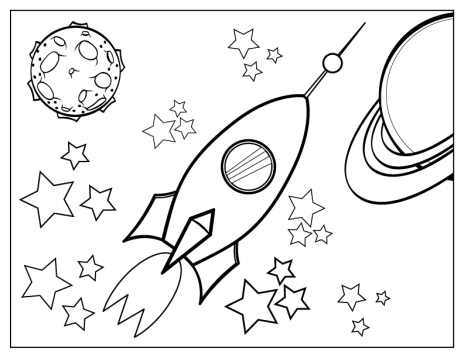
Shooting Star and Spaceship Coloring Pages


With these coloring pages you can make a universe that’s all your own!

May 6 – International Space Day

celebrate-picture-books-picture-book-review-otter-in-space

About the Holiday

Each year International Space Day is observed on the first Friday in May to commemorate the extraordinary achievements, benefits, and opportunities of space exploration. The goal of International Space Day is to promote math, science, technology and engineering education to inspire students to pursue a career in science and especially a career in space-related fields.

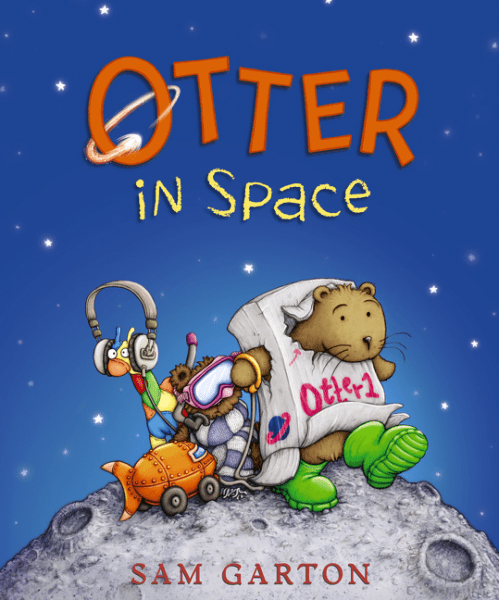
Otter in Space

By Sam Garton


On Sunday Otter goes to the museum with Otter Keeper and Teddy to see the Space Exhibition. They see a Triceratops skeleton and meet a stuffed bear that must be Teddy’s cousin. On the walls are old paintings made before the invention of crayons, and ancient, interesting things are everywhere.

Otter likes all these exhibits, but her favorite is the room dedicated to outer space—there are buttons to push just like a real astronaut, videos to watch, and a rock that came all the way from the moon. At last Otter gets to go to the gift shop. She loads up her arms with toys, but Otter Keeper says, “One thing only.” The spaceship travels home with them, but Otter and Teddy really want a moon rock too.

The next day while Otter Keeper is at work, Otter and Teddy play with their new spaceship, but it’s just not as fun without a moon rock. Teddy suggests going back to the museum, but no one can drive them. Otter thinks and thinks and suddenly has “the best idea ever!” She and Teddy will blast to the moon and retrieve a moon rock.

Otter makes a very important list of very important things to do. After lunch she builds two space suits and starts training. Although Teddy has some trouble keeping his space suit on and with problem solving, his performance in anti-gravity training is impressive so they move on to constructing the spaceship. With ingenuity and a bunch of household items, Otter builds a rocket and takes it to the Launchpad.

With Giraffe at “mishun control” lift-off is easy, but the moon landing is a little bumpy. Otter’s suit gets torn, but she perseveres and discovers the perfect moon rock nearby. It’s huge! With a little trouble Otter and Teddy transport it back to Earth, where it makes a perfect companion, playing board games and pirates—until Otter Keeper comes home and says it has to go back where it belongs.

The discussion is carried over to dinnertime, and Otter Keeper relents when he sees how serious Otter is in her space suit. If Otter cleans the moon rock she can keep it, says Otter Keeper. But one more restriction has been added to the Otter DO NOT list: dig up moon rocks! That’s okay, though. There are other things to dig up on the moon—like a dinosaur!

Sam Garton’s Otter in Space is a cute, spot-on portrayal of the fantastic ideas kids get when exposed to new concepts or places. Told from Otter’s point of view, the text hits on the serious-yet-humorous observations of kids: the gift shop as the favorite museum “exhibit,” a lingering regret for the toy left behind, and “the best ideas ever!” to correct situations.

Garton’s colorful illustrations of wily Otter and her faithful Teddy as they visit the museum, plan their space trip with the help of Giraffe and other toys, and blast off wearing a cereal box space suit are endearing. Kids will giggle at Teddy’s anti-gravity training in the washing machine. They and their parents will also appreciate Otter’s crafty discovery of the moon rock in the garden and recognize with a laugh his adoption of it as a member of the family.

Otter in Space is a book kids will want to explore again and again!

Ages 4 – 8

Balzar + Bray, Harper Collins, 2015 | ISBN 978-0062247766

International Space Day Activity

celebrate-picture-books-picture-book-review-rocket

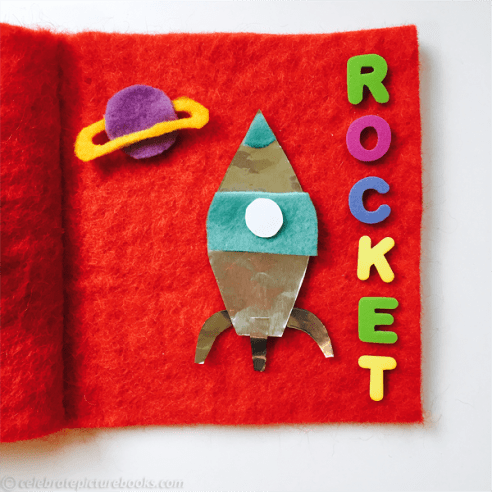
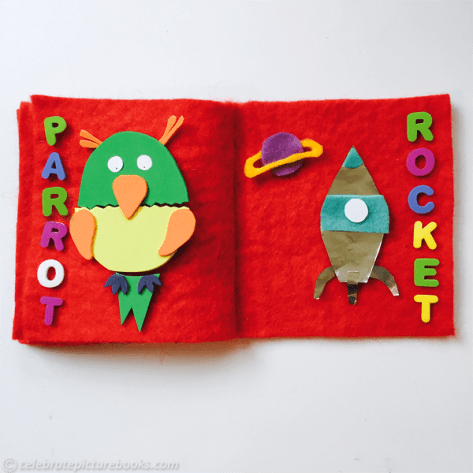
Create a Soft Book, Page 6—Rocket


Blast off with fun on Page 6 of your soft book with this shiny rocket on its way to an undiscovered planet! See previous posts from May 1 through 5 for each page of the book.

Supplies

  • Printable Rocket Template
  • Adhesive felt or foam letters
  • Tin foil
  • Felt, fleece, or foam in various colors of your choice (I used aqua, white, yellow, and purple)
  • Scissors
  • Strong glue or fabric glue

celebrate-picture-books-picture-book-review-rocket-and-parrot

Directions

  1. Cut out the rocket and feet from tin foil
  2. Cut out the nose cone and body stripe from felt, fleece or foam
  3. Cut out the round window from white felt, fleece, or foam
  4. Cut out the planet from your choice color of felt, fleece, or foam
  5. Cut out planet’s ring from your choice color of felt, fleece, or foam
  6. Glue rocket and feet to page
  7. Fit ring around planet and glue to page
  8. Attach adhesive letters to page, making sure they are stuck firmly. If they aren’t use fabric glue

I hope you enjoy your book!

Picture book review