About the Holiday
Today marks the 75th anniversary of the foundation of the Tuskegee Airmen, the first black military aviators in the U. S. armed forces during World War II. The regiment consisted of 996 pilots and more than 15,000 ground personnel who were trained at Tuskegee Army Air Field and other locations. These brave pilots have been credited with 15,500 combat sorties and earned more than 150 Distinguished Flying Crosses. The success of the Tuskegee Airmen paved the way for the integration of the U.S. military under President Harry S Truman in 1948.
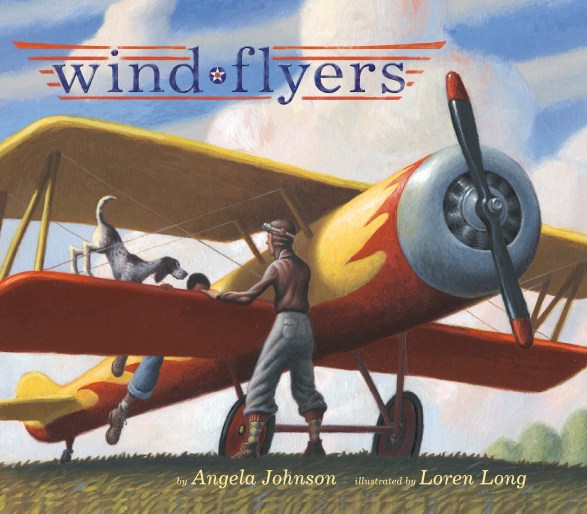
Wind Flyers
Written by Angela Johnson | Illustrated by Loren Long
With pride a young African-American boy tells the story of his great-great-uncle who was a Tuskegee Airman in World War II. His uncle was “a smooth wind flyer. A Tuskegee wind flyer…” Like a bird, his uncle tells his nephew, he was born to fly, jumping off a chicken coop at the age of five and into a pile of hay from a barn when he was seven. He has his first real flight at the age of eleven, when he pays to be a passenger with a barnstormer.
Flying over lakes and fields, his uncle feels as if he’s in Heaven, among soft clouds that beckon for him to be a wind flyer too. The experience changes him forever, and always there is the desire to fly “into the wind, against the wind, beyond the wind.” As a young adult his uncle contributes his dream and his skills to the World War II effort, becoming a Tuskegee Airman, one of the first black pilots in the United States military.
The boy and his uncle look through old photographs, seeing once more those young and brave pilots—the Tuskegee wind flyers. After the war, his uncle crop dusted in order to fly. Now planes are different, he says, but the clouds remain the same. The boy and his uncle climb to the highest point of the uncle’s barn to watch the jets—and in those moments they once more become the smooth wind flyers, flying into the wind and beyond.
In her soaring, rhythmic language, Angela Johnson captures the dreams and yearning of a young boy whose greatest desire is to fly among the clouds. When he gets his chance by joining the Tuskegee Airman in World War II, Johnson combines straightforward narrative with poetic lines to enhance the sense of achievement and pride the young pilots felt. The structure of the story is well chosen, as the relating of the uncle’s life from childhood through old age through the eyes of his nephew, strengthens themes of strong familial relationships as well as shared dreams across generations.
Loren Long gives Wind Flyers additional power with his strong, vibrant paintings. Two-page spreads provide a sense of the vastness of the skies that so enticed the young would-be pilot. Even the clouds echo the emotion of the page—fluffy, floating, and alive in the flight scenes while linear, flat, and stationary when the plane and the uncle are earthbound. Realistic portrayals of the boy, his uncle, and the other Tuskegee Airmen are reminiscent of the WPA murals of the 1940s while still setting this book firmly in today for a new generation.
Wind Flyers is a wonderful book to share with aviation buffs and dreams of all types.
Ages 4 – 9
Simon & Schuster Books for Young People, 2007 | ISBN 978-0689848797
Tuskegee Airmen Day Activity
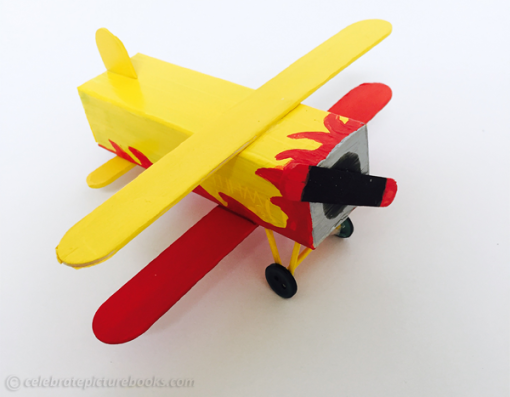
Head in the Clouds Box Biplane
If you love airplanes and flying, you’ll have fun making your own plane from recycled materials! Use your creativity to decorate your plane while you imagine yourself flying through the clouds on a beautiful day. Younger children will have fun sharing this activity with an adult or older sibling too!
Supplies
- Travel-size toothpaste box
- 3 6-inch x 1/2-inch craft sticks
- 2 2 1/2-inch x 7/8-inch mini craft sticks
- 5 Round toothpicks, with points cut off
- Paint in whatever colors you like for your design
- 4 small buttons
- 2 mini buttons
- Paint brushes
- Strong glue or glue gun
Directions
- Empty toothpaste box
- Paint toothpaste box and decorate it
- Paint the craft sticks and 5 toothpicks
- Paint one small craft stick to be the propeller
- Let all objects dry
To assemble the biplane
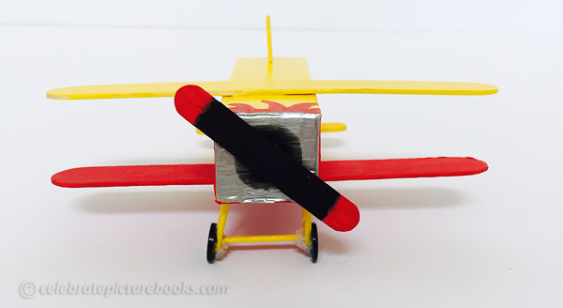
- For the Bottom Wing – Glue one 6-inch-long craft stick to the bottom of the plane about 1 inch from the end of the box that is the front of the plane
- For the Top Wing – Glue the other 6-inch-long craft stick to the top of the plane about 1 inch from the front of the plane
- For the Tail – Glue one mini craft stick to the bottom of the box about ¾ inches from the end that is the back of the plane
- For the Vertical Rudder – Cut the end from one of the painted 6-inch-long craft sticks, glue this to the back of the box, placing it perpendicular against the edge and half-way between each side
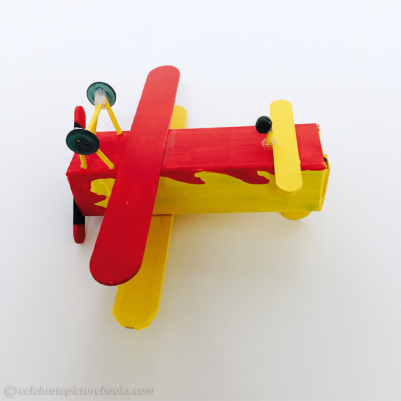
To assemble the front wheels
- Cut 4 painted toothpicks to a length of ¾-inches long
- Cut one painted toothpick to a length of 1-inch long
- Glue 2 of the 3/4-inch toothpicks to the back of 1 button, the ends of the toothpicks on the button should be touching and the other end apart so the toothpicks form a V
- Repeat the above step for the other wheel
- Let the glue dry
- Glue the 1-inch long toothpick between the wheels at the center of each wheel to keep them together and give them stability. Let dry
To make the back wheel
- Cut two ¼-inch lengths of painted toothpick and glue them together. Let dry
- Glue two mini buttons together to form the back wheel. Let dry
- Glue the ¼-inch toothpicks to the mini buttons. Let dry
- Glue these to the bottom of the plane in the center of the box directly in front of and touching the tail
Display your biplane!