April 6 – April is National Poetry Month

When Green Becomes Tomatoes by Julie Fogliano and Julie Morstad

About the Holiday

The Academy of American Poets established National Poetry Month in 1996 to promote the enjoyment and awareness of poetry. Over the 20 years since its beginning, National Poetry Month has become the largest literary event in the world. Schools, poets, booksellers, and publishers all hold special events to honor the vital place of this well-loved art form in our culture.

Celebrate the month by attending poetry readings, reading poems by your favorite author or discovering a new poet, and creating your own poetry!

When Green Becomes Tomatoes: Poems for All Seasons

Written by Julie Fogliano | Illustrated by Julie Morstad


Sometimes you wish for just the right words to express a moment in time, a skip of the heart, or a glimpse of color that truly captures the elation, sadness, or awe you feel. Those words live on every page of When Green Becomes Tomatoes: Poems for All Seasons. Each season omonth of the year is represented by three to five dated poems that expose a nugget of inspiration or a spark of recognition about the natural world and our place in it.

Spring is revealed as chilly, rainy, and blooming with early flowers:

march 26: “shivering and huddled close / the forever rushing daffodils / wished they had waited”

Summer brings swimming, tomatoes, and deep dark nights:

september 10

“a star is someone else’s sun / more flicker glow than blinding / a speck of light too far for bright / and too small to make a morning”

Fall is a time for sweaters, pumpkins, and falling leaves:

november 2

“more silent than something / much noisier than nothing / the last leaf / when it landed / made a sort of sound / that no one knew they heard”

Winter  is quiet, cozy fireplaces, and snow, snow, snow:

december 21

“as if one day, the mountain decides / to put on its white furry hat / and call it winter”

december 29

“and i woke / to a morning / that was quiet / and white / the first snow / (just like magic) came / on tiptoes / overnight”

The volume begins and ends with a poem dated the same day—March 20, the vernal equinox—giving this book a cyclical form that echoes the passing of time. To accompany Julie Fogliano’s beautiful poems, Julie Morstad has created gorgeous watercolors of children experiencing each day and the changes they bring. The soft, matte pages enhance the colors of each season and the quiet reflections these poems offer.

Ages 6 and up (adults will enjoy these poems too)

Roaring Brook Press, 2016 | ISBN 978-1596438521

National Poetry Month Activity

Grow a Poem
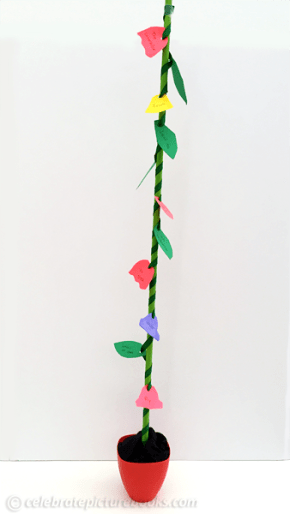
CPB - Plant Poem

A poem often grows in your imagination like a beautiful plant—starting from the seed of an idea, breaking through your consciousness, and growing and blooming into full form. With this craft you can create a unique poem that is also an art piece!

Supplies

  • Printable Leaves Template, available here and on the blog post
  • Printable Flower Template, available here and on the blog post
  • Wooden dowel, ½-inch diameter, available in craft or hardware stores
  • Green ribbon
  • Green craft paint
  • Green paper if leaves will be preprinted
  • Colored paper if flowers will be preprinted
  • Flower pot or box
  • Oasis, clay, or dirt
  • Hole punch
  • Glue
  • Markers or pens for writing words
  • Crayons or colored pencils if children are to color leaves and flowers

Directions

  1. Paint the dowel green, let dry
  2. Print the leaves and flower templates
  3. Cut out the leaves and flowers
  4. Punch a hole in the bottom of the leaves or flowers
  5. Write words, phrases, or full sentences of your poem on the leaves and flowers (you can also write the poem after you have strung the leaves and flowers)
  6. String the leaves and flowers onto the green ribbon (if you want the poem to read from top to bottom string the words onto the ribbon in order from first to last)
  7. Attach the ribbon to the bottom of the pole with glue or tape
  8. Wrap the ribbon around the pole, leaving spaces between the ribbon
  9. Gently arrange the leaves and flowers so they stick out from the pole or look the way you want them to.
  10. Put oasis or clay in the flower pot or box
  11. Stick your poem pole in the pot
  12. Display your poem!

April 4 – National School Librarian Day

The Midnight Library by Kazuno Kohara Picture Book Review

About the Holiday

One of the best parts of going to school is visiting the school library! Whether you go to the library to listen to a story or do research, the librarian is there to help you discover amazing books! School librarians thoughtfully read hundreds of books a year to choose just the right ones. Many school librarians are also involved in multimedia education and programs for school assemblies, morning news programs, and special meetings.

Today, thank your school librarian and tell them how much they mean to you!

The Midnight Library

By Kazuno Kohara


A little librarian opens the doors to her library only as the sun goes down. Working with her three assistant owls, she helps the forest animals find the perfect book. The animals read quietly and the library is peaceful until one night when a band of squirrels begins playing their instruments in the reading room. The little librarian shushes the squirrels and they apologize, saying they’re just working on a new song. The librarian has the perfect solution and shows the band to the upstairs activity room. Peace reigns once more in the library,

Later that night it begins to rain—inside! The little librarian climbs the ladder to look at the roof, but instead of a leak she finds a wolf sobbing away. Her book is so sad, she says, that she can’t read on. Gently, the librarian takes her to the storytelling corner where she, the owls, and Miss Wolf read the story together. The wolf discovers the book has a happy ending, something the library workers knew all along.

All too soon the sun peeks over the horizon, and it’s time for the library to close. The patrons file out one by one, but who is left plodding along with his book in the corner? It’s a tortoise who says he is not leaving until he finishes his book—only 500 pages to go! Once again the little librarian has the answer! She gives the tortoise a library card and reveals that he can take the book home with him and finish it there. The tortoise leaves happy and feeling lucky with the book strapped to his shell.

The owls and the librarian tidy up the shelves and grab one last book—bedtime stories for the sleepy owls.

The Midnight Library is a perfect bedtime—or daytime—book for budding bibliophiles and library lovers. While simply written, Kazuno Kohara’s story has a dreamy quality and is as inviting as a favorite library reading nook. Just as libraries are comforting in their hushed rooms and neatly organized shelves, the little librarian of the story is reassuring as she quickly and calmly resolves the issues that arise in her domain. 

The characters are sweetly drawn, smiling with pleasure at being in their favorite place, and the picture of the owls holding Miss Wolf’s hands as they read her book together is particularly touching. The pages are composed of three colors—the structures inside the library are the black of night’s shadows; the walls and characters are the gold of starlight and moonlight; and the beloved books are the violet blue of the deep night sky. As you reach the end of the story, you will look forward to the next night when you can visit the midnight library again.

Ages 3 – 6

Roaring Brook Press, 2014 | ISBN 978-1596439856

National School Librarian Day Activity

CPB - Librarian Thank You card

Create a Thank You Card


Today’s a perfect day to make a card to thank your school librarians or the librarians at your local town library. Here’s one that you can use to tell your librarians why you love them and what you like best about the programs they create for you! Print the Thank You! card, draw a picture on the front and/or inside, sign your name, and write a message. Then fold it and give it to your favorite librarian. Get the Thank You! card here.

February 27 – International Polar Bear Day

Hush Little Polar Bear picture book review

About the Holiday

International Polar Bear Day was established as a day for people to learn more about these majestic animals and conservation efforts to protect them and their environment. You can celebrate by discovering ways to lessen global warming, which is believed to be a factor in the loss of polar bears’ natural habitats.

Hush Little Polar Bear

By Jeff Mack


A baby polar bear listens to the voice that tells him to “Hush, little polar bear. Sleep in the snow, and dream of the places where sleeping bears go.” The adorable polar bear, with its eyes shut tight, then dreams of sailing the seas while riding on the back of a whale, following a crab onto the beach, wading through a meadow and chasing butterflies, bounding after cows in a field, and having adventure after adventure. But who is the little girl on a sailboat, hiding behind a sandcastle, near the tree, and always popping up where the polar bear explores?

celebrate-picture-books-picture-book-review-hush-little-polar-bear-with-whale

Copyright Jeff Mack, courtesy of us.macmillan.com

At the end of the book as the polar bear drifts through a window, kids discover that the traveling polar bear has been heeding the wishes of that mysterious little girl. As the bear takes its place cuddled up beside the young sleeper, readers may wonder—who is really dreaming, the girl or the little polar bear?

celebrate-picture-books-picture-book-review-hush-little-polar-bear-on-beach

Copyright Jeff Mack, courtesy of us.macmillan.com

Jeff Mack has created a warm, fuzzy lullaby of a picture book, perfect for bedtime or any snuggle time. The lyrical text invites listeners to float along in the polar bear’s wake as it romps, swings, crawls, and flies through each two-page spread that presents the bear’s and the little girl’s dreamscapes as vividly as the best remembered dreams.

Ages 2 – 6

Roaring Brook Press, New York, 2008 | ISBN 978-1596433687

Discover more about Jeff Mack and his books on his website!

Polar Bear Week Activity

CPB - Polar Bear scarf

CPB - Polar Bear Banner

Polar Bear Scarf or Banner


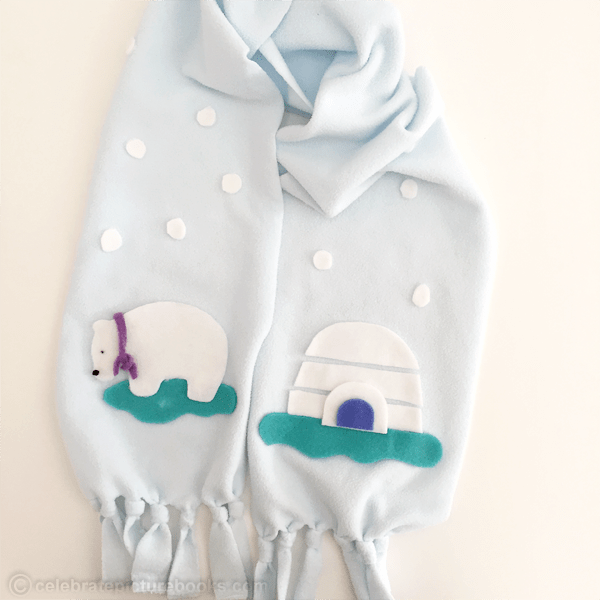
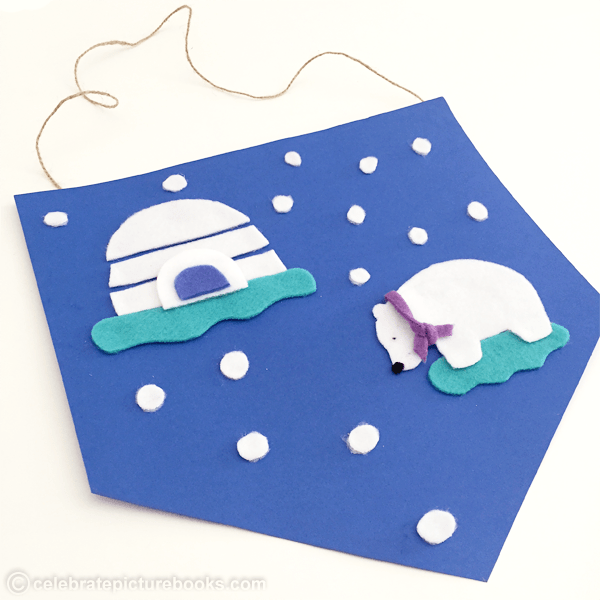
Polar bears aren’t cold in the winter—and neither should you be! Here are directions and printable templates for making a cute scarf to keep you warm, or—if you’d rather—a banner to warm up your room.

Supplies

  • Printable Polar Bear and Igloo Template
  • 1 Strip of blue fleece 4 ½ feet long x 7 inches wide for the scarf
  • 1 Piece of blue scrapbooking paper for a banner
  • Pieces of white, black, blue, and purple fleece or scrapbooking paper to make the polar bear, igloo, snowflakes, and ice floes.
  • String or twine for banner
  • Scissors
  • Fabric or paper glue

Directions for Scarf

To make the fringe at each end of the scarf:

  1. Make 7 cuts about 4 inches long
  2. Tie a knot at the top of each fringe section

To make the pieces for the scarf or banner:

  1. Trace the polar bear and igloo sections from the Printable Template onto white fleece and cut out
  2. Trace the two ice floes onto blue fleece and cut out
  3. Trace the door of the igloo onto blue fleece and cut out
  4. Trace the polar bear’s scarf onto purple (or any color) fleece and cut out
  5. Cut out round snowflakes
  6. Cut out a small circle from black fleece for the Polar Bear’s nose

On one end of the scarf:

  1. Glue the smaller ice floe on one end of the scarf
  2. Tie the bear’s scarf around its neck before gluing the bear to the scarf
  3. Glue the polar bear onto the scarf with its feet on the ice floe
  4. Glue on the polar bear’s nose
  5. Make a small dot for the polar bear’s eye with a marker
  6. Glue snowflakes above polar bear

On the other end of the scarf:

  1. Glue the bigger ice floe to the scarf
  2. Glue the three pieces of the large igloo to the scarf, leaving a little space between sections
  3. Glue the small white door of the igloo on top of the last two igloo sections
  4. Glue the small blue door onto the white door
  5. Glue snowflakes above the igloo

Directions for Banner

  1. Cut a point at the bottom of your banner
  2. Follow the directions above to trace the pieces of the polar bear and igloo from the printable template onto scrapbooking paper
  3. Follow the directions above to glue the pieces of the polar bear and igloo to your banner
  4. Attach string or twine to back of banner to make a hanger

Picture Book Review

February 26 – National Tell a Fairy Tale Day

CPB - There's a Wolf at the Door

About the Holiday

Today we celebrate the long tradition of oral and written stories that have captivated both children and adults since earliest times. While many of the fairy tales we love began as lessons in good manners or avoiding danger, they have remained popular and a part of our culture that we pass down to children through the generations. These tales stand up to traditional treatments as well as variations that turn the familiar plots on their heads.

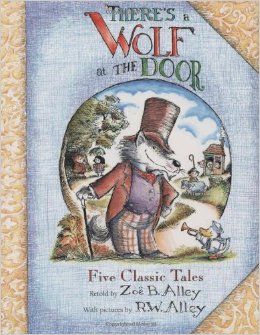
There’s a Wolf at the Door: Five Classic Tales

Retold by Zoë B. Alley | Illustrated by R.W. Alley


There are big books of fairy tales and then there’s There’s a Wolf at the Door! In this oversized graphic-novel style picture book, that big, bad wolf who is so familiar in children’s stories follows his nose and his hungry stomach through 5 classic tales.

In “The Three Little Pigs,” the wolf starts out with much confidence and bluster. He huffs and he puffs, but in the end he’s outsmarted by the third little pig. In quite a fright he follows the sign to “Greener Pastures” where he finds Barry, a shepherd boy with an unfortunate aversion to boredom. The wolf suddenly finds himself accused of eating sheep, but quickly realizes he can turn the boy’s foolish cries to his advantage. He doesn’t count on the crafty sheep, however, who thwart the wolf’s plans while their shepherd runs around in circles, screaming.

The wolf finds his escape on a path through the woods marked “To Granny’s House.” On the path he meets up with Rhonda, a fashionista who loves red clothing and appreciates her strange companion’s sense of style. While they walk toward Granny’s house together, discussing coats, hats, and flowers for Rhonda’s hair, the wolf gives Rhonda the slip and runs a frightened Granny out the back door. Rhonda scares him off with a well-aimed red shoe and a grab at Granny’s stolen nightgown. Not wanting to appear so naked, the wolf pulls the white wooly rug around his shoulders and hightails it to a peaceful meadow.

Here a family out for a picnic discovers him napping. The little girl mistakes him for a poodle, but her mother believes he is a sheep. When he tries to menace them with a display of fierceness, the unimpressed family simply calls him rude and wanders off to find another picnic spot. Who does he spy a short distance away, but Barry the shepherd and his sheep. Disguised under his rug, the wolf creeps up on the flock, who are not fooled. This time as Barry runs away, the sheep use his crook to toss the wolf around.

As the wolf catches his breath by the river, he receives a package from Rhonda, who has learned to be kind and considerate from her experience with the wolf. Inside, he discovers a new outfit, and he is once again restored to his dapper self. Hearing that the nearby house is full of unattended goslings, the wolf devises a plan to capture them and take them home for dinner. While these goslings may be rambunctious and disobedient to their brother Alphonse, when threatened they work together to foil their pesky visitor.

In the end the wolf decides that perhaps he’s better off as a vegetarian and readers leave him contemplating a shortcut through the woods to Farmer McGregor’s Garden.

Using clever inside jokes, humorous asides, sassy heroines and heroes, and a woebegone wolf out of his depth, the husband and wife team of Zoë B. Alley and R.W. Alley have transformed these well-known classics into unique, rib-tickling stories for a new generation. The comic strip style drawings fit the droll tone of the tales perfectly and are full of details kids will love to point out. While older children will enjoy reading this book on their own,There’s a Wolf at the Door also makes for an exciting read-aloud storytime.

Ages 4 – 8

Roaring Brook Press, 2008 | ISBN 978-1596432758

National Tell a Fairy Tale Day Activity

CPB - Fairy Tale box

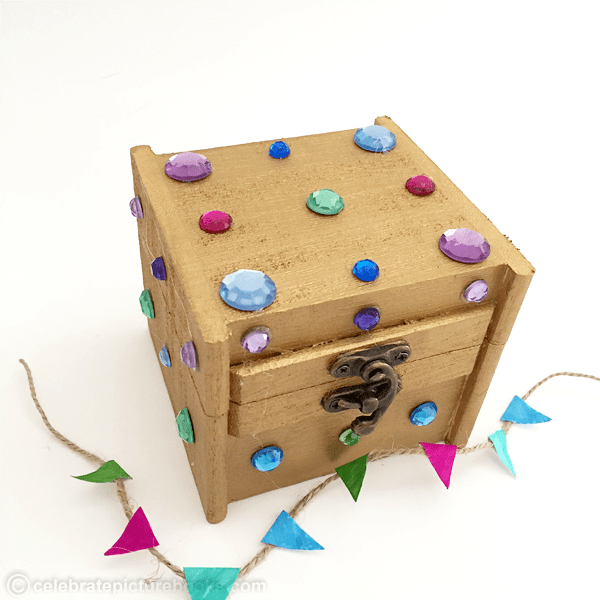
Treasure Box of Imagination

Whether it’s gold, silver, jewels, pirate loot, or just bits of nature or knick-knacks, our favorite things are our treasures and fuel our imaginations. For Fairy Tale Day make your own Treasure Box

Supplies

  • 1 small wooden box, available at craft stores
  • Gold acrylic craft paint
  • Craft gems
  • Paint brush
  • Hot glue gun or strong glue

Directions

  1. Paint your wooden box with the gold paint
  2. Let the box dry
  3. Decorate your Treasure Box of Imagination with gems