
About the Holiday
It’s Shark Week! In its 38th year of highlighting all things shark-related, the Discovery Channel is once again hosting one of the most iconic weeks of summer with education and entertainment revolving around these denizens of the deep, especially the Great White. But there are many more sharks in the sea – about 500 species! – and they’re all an important part of the world’s ecosystem. To celebrate ancestors of today’s sharks and the wonders of discovery, you’ll want to put today’s book at the top of your reading list!
Thank you to Random House Studio and Barbara Fisch at Blue Slip Media for gifting me a copy of this book!
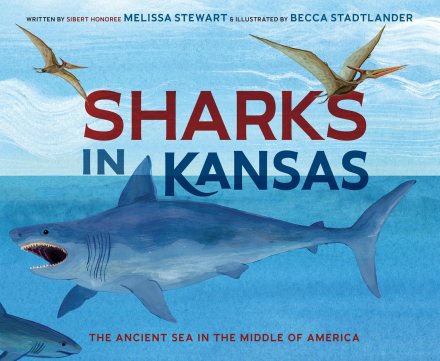
Sharks in Kansas: The Ancient Sea in the Middle of America
Written by Melissa Stewart | Illustrated by Becca Stadtlander
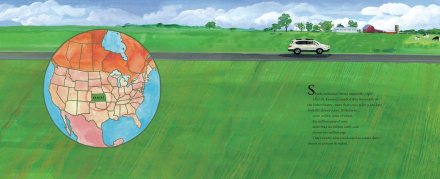
When you think of finding sharks, you might consider the east and west coasts of the United States and South America, areas around Africa, or perhaps the waters off the coast of Australia. I’d hazard a guess, however, that the US midwestern state of Kansas would not be on your list. Melissa Stewart is here to change that.
In Sharks in Kansas, Stewart reveals that Kansas—yes, that state known for its “seven million acres of wheat, five million acres of corn, more than six million cattle, and almost two million pigs” that add up to “90 percent farmland” was once the home to sharks and a plethora of other prehistoric creatures. She begins with fossilized evidence that 85 million years ago what is now Kansas as well as “thirteen states and five Canadian provinces” was underwater in what scientists now call the Western Interior Seaway.
Stewart then transports readers back millions of years to experience the vibrant and strange creatures that plied the sea, land, and sky. As a herd of herbivore Claosaurus track the shoreline, “a Pteranodon glides across the sky in search of fish.” But what about the sharks, you ask? They’re in attendance too. Different types of sharks of various sizes, one nearly twice as long as a Great White, lurk in the water’s depths, waiting . . . Those early sharks aren’t alone, either. Quirky—and toothy—mosasaurs, plesiosaurs, and fish as well as mollusks that would never fit in a bucket vie for space and food.
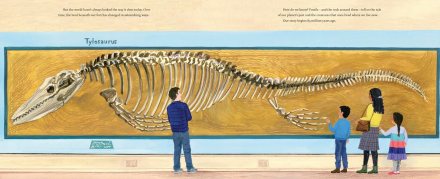
So what happened to the Western Interior Seaway? Stewart takes readers on a fascinating tour through the changes that slowly occurred to the land, the creatures, and this body of water that was once so vital. You may wonder how people—both scientists and casual observers—know all this. As Stewart explains, they can see its effects in the fossils discovered under those fertile fields; in the “rippled sandstone” walls that stand as reminders of an “ancient shoreline” and which visitors to Dinosaur Ridge in Colorado can trace with their fingers; and in the towering “chalky white” Monument Rocks of Kansas, created by untold numbers of coccolithophore fossils. Stewart and Becca Stadtlander then team up to textually and visually explain how the Western Interior Seaway was formed and then displaced by land once again.
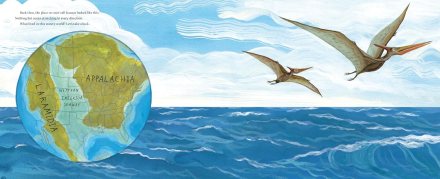
A master of setting a scene that envelops children in mysterious landscapes, Melissa Stewart introduces readers to prehistoric sharks and other sea creatures that once populated the Western Interior Seaway. Portraying dramatic encounters between marine animals, Stewart brings to life the vitality of this ancient ocean while clearly outlining how the seaway came to be and receded again.
Becca Stadtlander’s stunning gouache illustrations immerse readers in the prehistoric period, providing perspective on the size of these marine animals and diving into the depths of the Western Internal Seaway to witness the awe-inspiring interactions among them. Tails flick, teeth are bared, and chomps are taken for food and defense. The images of above-ground proof of the seaway’s existence will also entice kids to learn more about this ancient phenomenon.
Sharks in Kansas is extremely well-designed, with most pages containing sidebars that present illustrations of and facts about the creatures featured in that spread. There’s no flipping back and forth to a glossary at the end to discover the information readers want to know and match with what they see in front of them.
Children will be surprised and entranced by the strong science, dynamic storytelling, and riveting illustrations found in Sharks in Kansas: The Ancient Sea in the Middle of America. The book is a must for all library collections and will be a pored-over favorite for kids fascinated by science, marine creatures, and history.
Ages 4 – 8
Random House Studio, 2026 | ISBN 978-0593904718
Melissa Stewart has written more than 200 science books for children, including Whale Fall, winner of the AAAS/Subaru Prize for Excellence in Science Books; Feathers: Not Just for Flying, an ALA Notable Book; and Pipsqueaks, Slowpokes, and Stinkers: Celebrating Animal Underdogs, an SCBWI Golden Kite Honor title. She co-authored 5 Kinds of Nonfiction: Enriching Reading and Writing Instruction with Children’s Books and edited the anthology Nonfiction Writers Dig Deep: 50 Award-Winning Authors Reveal the Secret of Engaging Writing. Melissa maintains the award-winning blog Celebrate Science and serves on the Society of Children’s Book Writers and Illustrators board of advisors. Visit her at melissa-stewart.com.
Becca Stadtlander is an illustrator and fine artist. In 2019, she won the Golden Kite Award for Picture Book Illustration for Made by Hand: A Crafts Sampler. Picture books she has illustrated include Mr. McCloskey’s Marvelous Mallards, Sleep Tight, Farm, and On Wings of Words, which received four starred reviews. Her work is also featured in adult books, editorial publications, stationery, home decor products, and book covers. Visit her at beccastadtlander.com.
Shark Week Activity
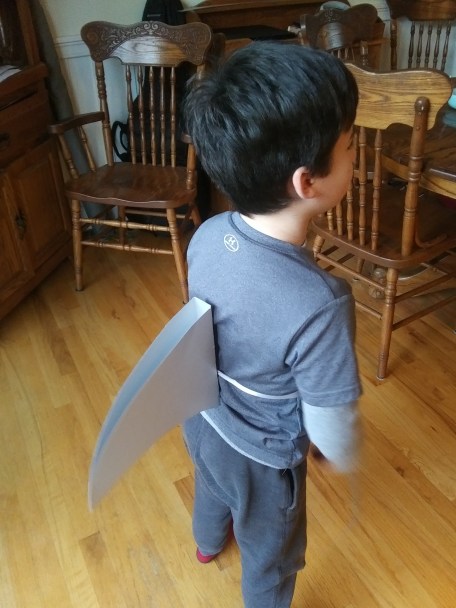
Fintastic Shark Fun
Dive into some shark fun with this shark fin craft! Just follow the directions below!
Supplies
- 2 pieces of 8.5 x 11 gray cardstock paper
- Ribbon
- Tape
- Scissors
- Pencil


Directions
- Tape the top of the two pieces of paper together
- Fold them back together
- Measure an inch up from the bottom of the papers (the un-taped side) and trace a straight line across both papers
- Trace a shark fin outline onto your paper. The shark outline should stop an inch above the bottom
- Cut out the fin on both pieces of paper. If you should cut through the tape, re-tape the tops together
- Fold along the lines of both papers so the folds face towards each other.
- Tape the folds so the fin becomes a triangle
- Cut two slits parallel to the folded lines
- Thread ribbon through slits
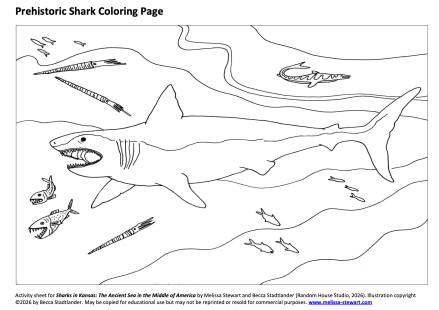
Sharks in Kansas Coloring Page and Reading Guide
Families and educators can find a Sharks in Kansas coloring page as well as a Reading Guide on Melissa Stewart’s website.
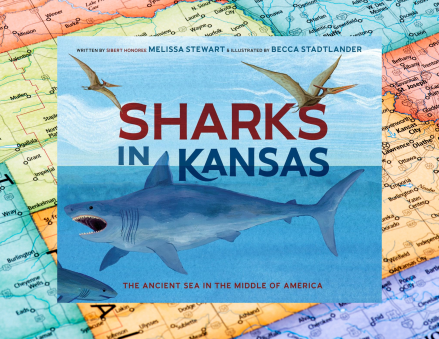
You can purchase Sharks in Kansas: The Ancient Sea in the Middle of America from these booksellers
Amazon | Barnes & Noble | Bookshop
Picture Book Review


