April 25 – National DNA Day

celebrate-picture-books-picture-book-review-when-I-grow-up

About the Holiday

National DNA Day commemorates the completion of the Human Genome Project in April 2003 and the discovery of the double helix of DNA in 1953 that have led to advanced research in the medical, science, and other fields. As part of the observance, students in grades 9 through 12 can compete in an essay contest for monetary prizes and grants.

When I Grow Up

By Anita Bijsterbosch


In Anita Bijsterbosch’s adorable and eye-catching animal kingdom book, little ones will identify with their counterparts in the wild who are also just starting out on their journey through life. Opening to the first page, children enter the jungle, where a lion cub romps among the foliage. He looks directly at the reader as he tells them, “Now I’m just a little lion and I can only growl softly. But someday….” This lead-in to the future invites kids to turn the half-cut page and discover the cub all grown up and able to “roar so loudly that all the animals can hear me!”
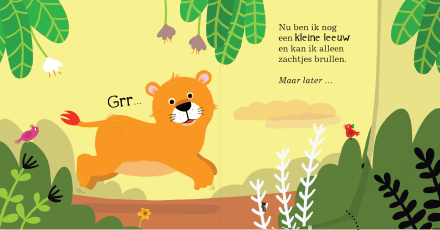
celebrate-picture-books-picture-book-review-when-I-Grow-Up-lion-cub

When I Grow Up is available in Dutch and English versions. Copyright Anita Bijsterbosch, courtesy of anitabijsterbosch.nl

Next, children visit the bayou, where a young crocodile can now only wade through puddles. On the next page, though he’s big enough to “jump into the deep water to swim with my friends!” Little Toucan is just learning how to fly. With a monkey, a lemur, and a bird looking on, he tells readers a secret: “I pretend to fly when I jump. But someday…I’ll be a big toucan and I’ll spread my winds. Then I’ll fly high in the sky!”

In the savanna, a baby giraffe lifts her head toward the treetops. She says, “Now I’m just a little giraffe and I can barely touch the leaves with my nose.” When she gets older, however, young readers can see that meals and snacks of tasty leaves will be within easy reach.

Curled around a thin branch, a little snake dreams of the day when he will be long enough to wrap around the whole tree—many times. Turning to the last page, Little Elephant happily splashes in the water and sprinkles her friends, but someday she knows that she will be big enough to use her trunk “to spray everything and everyone!”

celebrate-picture-books-picture-book-review-when-I-Grow-Up-lion-adult

When I Grow Up is available in Dutch and English versions. Copyright Anita Bijsterbosch, courtesy of anitabijsterbosch.nl

Toddlers and older youngsters beginning to learn about the vast world around them will delight in this early science book that combines the sturdiness of a board book and the sensory-stimulating interactivity of a lift-the-flap book. Anita Bijsterbosch’s vibrant illustrations engage little ones’ visual senses with bold images of the animals as well as smaller pictures of birds, insects, and flowers for them to discover. A tiny red bird with rakish green head feathers seems to be friends with all of the animals, and readers will love pointing him out on every page.

Little ones will recognize the animal traits spotlighted through Bijsterbosch’s straightforward and easy-to-understand language and will be reassured that they too will soon grow big enough and old enough to do what the “big kids” do.

With sweet illustrations and opportunities for multiple types of learning, When I Grow Up would make a great baby shower or new baby gift as well as a nice addition to a toddler’s growing home library.

Ages 2 – 5

Clavis Publishing, 2017 | ISBN 978-1605373348

You’ll find more books and artwork by Anita Bijsterbosch on her website!

National DNA Day Activity

celebrate-picture-books-picture-book-review-elephants-coloring-page

Mom and Baby Elephant Coloring Page


This mommy elephant and her baby are out for a walk. Give their world a little color with your crayons or pencils and this printable Mom and Baby Elephant Coloring Page!

Picture Book Review

March 14 – International Ask a Question Day

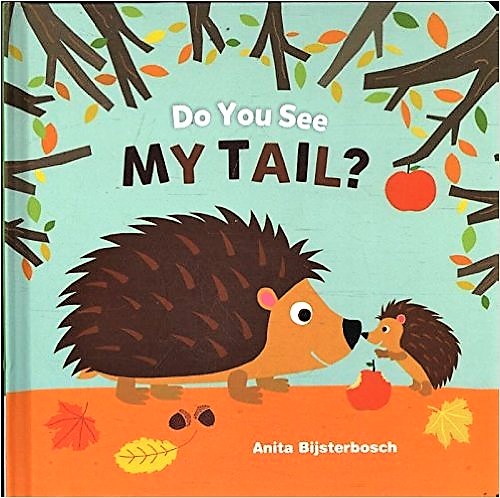
celebrate-picture-books-picture-book-review-do-you-see-my-tail-cover

About the Holiday

Admit it—you have a ton of questions. These days, don’t we all! Well, now’s the time to get them out there! Go on—even if you think it’s silly or it seems as if everyone else understands (believe me, they don’t!)—ask away! It’s only through questions that we learn the truth or make new discoveries. Little ones seem to come preloaded with questions, and each one is an opportunity for you to introduce them to our world!

Do You See My Tail?

By Anita Bijsterbosch


A bushy tailed animal hails readers from its place in the treetop—“Do you see my tail? Guess who I am!” A red-bellied bird, butterfly, cricket, spider, and ladybug are all standing by to find out too. Opening the flap, little ones are cheerfully greeted by a squirrel who is feeding its babies. “My babies live in a nest in a hollow tree. They like acorns,” the squirrel says. The young squirrels happily reach for the tasty nuts while their mom or dad says, “Hello, squirrel. Hello, sweet baby squirrels.’

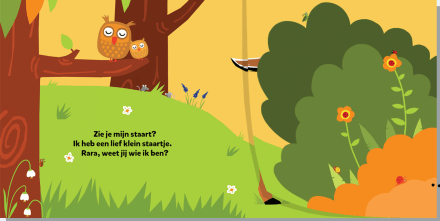
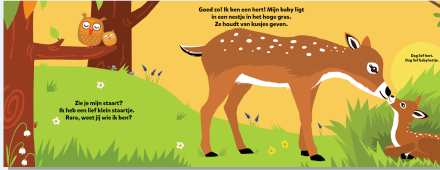
On the next page, a small, brown tail trimmed in black and white peeks out from behind a bush. “Do you see my tail?” the owner asks. “I have a cute little tail. Guess who I am!” Two sleepy owls, a pair of mice and adorable insects can’t wait to find out either. The open flap reveals a mother deer and her fawn who is “lying in a little nest in the high grass.” As the two give kisses, Mom says, “Hello, deer. Hello, sweet baby deer.”

celebrate-picture-books-picture-book-review-do-you-see-my-tail-deer-closed-flap

Copyright Anita Bijsterbosch, courtesy of anitabijsterbosch.nl. Image from the original Dutch-language edition.

Next, a long black feathered tail pokes out from behind a tree. This tail belongs to a bird, and it’s fluffy babies are getting a nutritious worm snack. “How loudly they chirp,” the bird tells readers. Along with their meal, the babies get a little love: “Hello bird. Hello, Hello, sweet baby birds.” Turning the page, young readers see a flat brown tail dipping into the water. Inside the flap a beaver cuddles three babies who “are playing in a nest made of tree trunks and branches.”

“Do you see my tail?” the next animal asks. Who could that ball of fluff belong to? Lift the flap to discover an adult rabbit and four scampering babies “hopping around in a hole under the ground.” You can tell the rabbits hello! “Hello, rabbit. Hello, sweet baby rabbits.” A flip of the page reveals another part of the woods where a fiery red tail sways to and fro in the hedges, a woodpecker makes a hole in a nearby tree trunk, and tiny insects enjoy the day. Baby foxes “love to frolic” in their underground nest.

Can readers spot the next animal’s “teeny tiny tail” and guess who it belongs to? Under the flap they will find a hedgehog and three babies “sleeping and eating in a nest made of branches and leaves.” The hedgehogs love the apples that fall from the nearby tree. Say hello to the little hedgehogs! “Hello, sweet baby hedgehogs.”

celebrate-picture-books-picture-book-review-do-you-see-my-tail-deer-open-flap

Copyright Anita Bijsterbosch, courtesy of anitabijsterbosch.nl. Image from the original Dutch-language edition.

Anita Bijsterbosch’s charming lift-the-flap book introduces toddlers and young children to a variety of animals and their babies through one easily identifiable feature. Each invitation to guess is followed up by a positive, upbeat answer that rewards a little one’s efforts. Two more complete sentences reveal information about the animal’s home as well as a behavioral trait that mirrors the kind of fun or snuggling that young children like to do themselves. The repeated greeting to each animal and their “sweet” babies not only emphasizes the love that families have for each other, but also provides a gentle lesson in the singular and plural forms of each animal’s name. The rich choices, such as frolic, bushy, and hollow used throughout the story promote early language development.

Bijsterbosch’s colorful pages will enchant young readers as cute birds, insects, mice, and other small creatures join in the fun. The fold-out flap is large enough for a detailed depiction of each animal and their home, and the bright eyes and friendly smiles of the adult and baby animals invite children in to learn and play. Little ones will love to name the other creatures and talk about their different habitats. The open art style offers opportunities to count and to discuss concepts such as in, out, inside, outside, on, near, and far, which are the building blocks of early math literacy. Readers will also love looking for the little ladybug on each spread.

Do You See My Tail? would be a wonderful early addition to any toddler’s or young child’s home bookshelf.

Ages 1 and up

Clavis, 2017 | ISBN 978-1605373201

International Ask a Question Day Activity

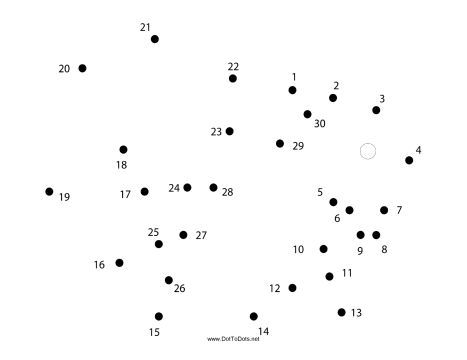
celebrate-picture-books-picture-book-review-squirrel-dot-to-dot

Cute Dot-to-Dot Pages


Can you guess what animals you’ll find when you connect the dots in these two printable Cute Dot-to-Dot Pages?

Dot-to-Dot Page 1 | Dot-to-Dot Page 2

Picture Book Review

March 4 – National Grammar Day

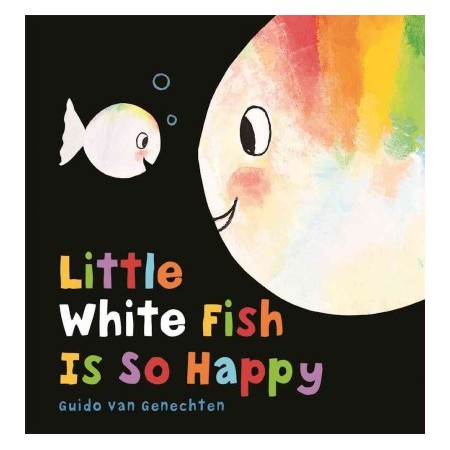
celebrate-picture-books-picture-book-review-little-white-fish-is-so-happy-cover

About the Holiday

I must confess that today’s holiday is one of my favorites. Even as a kid I howled at the unintentional ridiculousness misplaced punctuation and poor editing created and absolutely loved diagramming sentences (I know, right?!). While the rules of grammar in any language may sometimes seem confusing and unnecessary, they help structure the language so what you write and say makes sense and exactly states your meaning. National Grammar Day was established in 2008 by author Martha Brockenbrough, the founder of the Society for the Promotion of Good Grammar.

Little White Fish Is So Happy

By Guido Van Genechten


Little White Fish has been swimming on his own, but is so happy that his “mom is coming to get him.” Before he leaves, however, he wants to say “goodbye” to his many friends. “Bye-bye, snail in the shell,” he burbles. The “frog on the rock” also receives a happy “goodbye.” Little seahorse is playing under a leaf, but Little White Fish spies him.

Crab waves from behind a stone as Little White Fish swims by, and goldfish smiles at him from his spot “between the reeds.” As Little White Fish sends his friends a final farewell, they all stand “next to each other” to see him off. The best part of going home for Little White Fish, though, may be getting to swim “in front of” his mom!

In Little White Fish Is So Happy, young grammarians are introduced to a few of the most common prepositions, with clear visuals to reinforce their meaning. Bold type prompts adult readers to emphasize the prepositions and to expand on the idea by pointing out how the words apply to each particular sea creature. The endearing relationship among these friends will charm young children as the idea of being away from home is presented in an upbeat way that encourages independence while also reassuring little ones of parents’ love and attention.

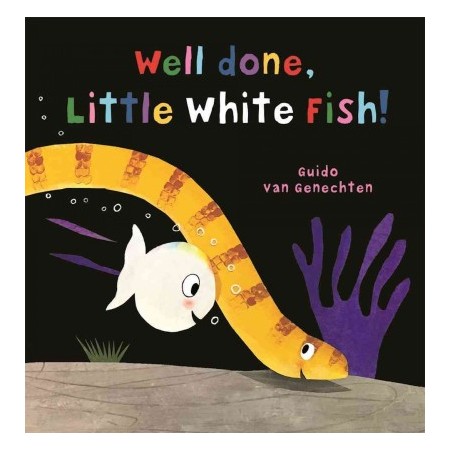
celebrate-picture-books-picture-book-review-well-done-little-white-fish-cover

Well Done, Little White Fish

By Guido Van Genechten


Little White Fish is visiting his friends. First up is crab who is “can cut sea grass with his claws.” This is a pretty cool talent, and Little White Fish wonders what he can do. Turtle is strong enough to carry a rock on his shell, and “sea urchin easily does seven somersaults in a row. And Little White Fish? What can he do?”

Wow! Little jellyfish “can light up the dark.” Little White Fish is astonished; he knows he can’t do that. Starfish is like a ballet dancer when she stands on one leg. “Little White Fish doesn’t even have legs….” Little White Fish knows he must watch out for Octopus when he spits out ink, and he likes playing over and under with sea snake when he makes “a beautiful arch.

And Little White Fish? He “can swim really well, even backwards and upside down!” Now it’s time for his friends to be amazed, and as Little White Fish swims around his group of friends, they all cheer and applaud his special talent.

Well Done, Little White Fish explores individuality as the small fish watches each of his friends demonstrate their talents. At first everyone seems to be cleverer, stronger, and more agile than he is, but when Little White Fish displays his swimming skills, he learns that he too is unique. Bold text points out each creature’s special ability and can also serve as a gentle lesson about verbs. Van Genechten’s adorable sea creatures, with their ready smiles and buoyant enthusiasm, will delight young children as they learn facts about nature while embracing these characters.

Guido Van Genechten’s Little White Fish books, including Little White Fish, Little White Fish Has a Party, and Little White Fish Has Many Friends, make a sweet series for the youngest readers. The spare text is lively and cheerful and makes use of the type of repetition that little ones respond to. The bold, multicolored and multilayered illustrations set on a black background are eye-catching. Small children will love the smiling sea creatures and the playful relationship among the friends.

Ages 2 – 5

Clavis Publishing, 2017

Little White Fish Is So Happy | ISBN 978-1605373263

Well Done, Little White Fish | ISBN 978-1605373270

Grammar Day Activity

Active Words Playtime


It can be fun to teach grammar by playing! Prepositions such as up, down, under, in, on, through, over, and out can provide opportunities for active fun inside or outside. A playground is a perfect place to demonstrate prepositions to kids while they climb, slide, crawl, and swing on the equipment.

Inside, all you might need is a large box or a homemade pillow fort to build your child’s vocabulary. Kids will love jumping up, crouching down, getting in the box or fort, getting out of the box or fort. Pillows or an open-ended box make a great tunnel to crawl through. You and your child can even make up a story to go along with the actions.

That old perennial favorite Simon Says is another great way to play with grammar, so get creative…and enjoy grammar!

Picture Book Review