
About the Holiday
What could be more satisfying on a mid-winter day than a spicy bowl of chili? Whether made with meat or veggies, combined with macaroni, or served in potato skins, the simmered flavors make for a scrumptious meal. Although the origins of chili are lost to history, it’s believed that the dish is a southwestern, specifically Texan, concoction. It began to attract attention in the early 1800s, and by the 1880s”Chili Queens” were selling “bowls o’red” at chili stands throughout San Antonio. In 1893 the San Antonio Chili Stand made an appearance at the Chicago World’s Fair. It’s popularity took off across Texas and throughout the west by the 1920s. When the Great Depression hit, chili became one of the only affordable meals for the hungry population.
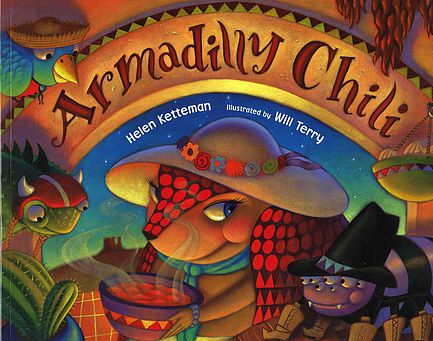
Armadilly Chili
Written by Helen Ketteman | Illustrated by Will Terry
What a hoot! The knee-slappin’, root-a-tootin’ phrasing in Hellen Ketteman’s Armadilly Chili is shor ‘nuf gonna make this a favorite on any child’s bookshelf. While the plot may be familiar, the southwest setting and Miss Billie Armadilly put a fresh, funny twist on it.
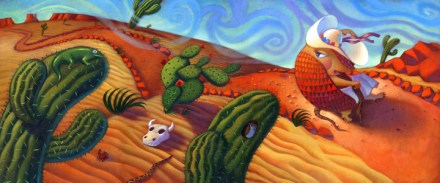
Image copyright Will Terry, courtesy of willterry.com
Miss Billie Armadilly is gathering ingredients for her hot armadilly chili as a blue norther blows in. She’s gathering beetles when her friend Tex, a many eyed tarantula tip taps by. When Billie asks him to help her collect beetles, he tells her he can’t because he’s going dancing. Miss Billie harrumphs and does it herself. Next Miss Billie is picking peppers, and when Mackie the bluebird flies in she thinks she has some help. Once again, though, she’s left on her own since Mackie is going to the movies. Her friend Taffy, the horned toad, begs off from chopping prickly pear, saying he’s got plans to go skating.
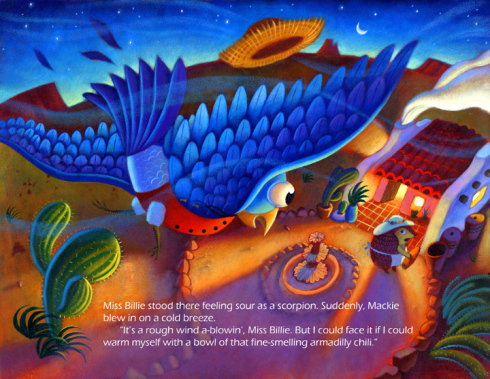
Image copyright Will Terry, text copyright Helen Ketteman, courtesy of willterry.com
At home, Miss Billie stirs her chili to a scrumptious bubble. The aroma entices first Tex, then Mackie, and finally Taffy to come a’knockin’ at her door looking for a bowlful. Billie has something to say about that—specifically, “no workin’ with Billie, no sharin’ the chili!”
Billie’s friends hurry away, and Billie sits down to her feast. But after all that work, the chili tastes as “flat as a Texas prairie.” What’s wrong? She realizes what the missing ingredient is just as the doorbell rings. She opens the door to find her friends standing there with bags in their hands. What’s in those sacks? Apologies! And hot apple cider, jalapeno biscuits, and homemade chocolate fudge. Now that the friends are all together, the chili tastes just right, and they laugh and talk and eat throughout the blustery night.
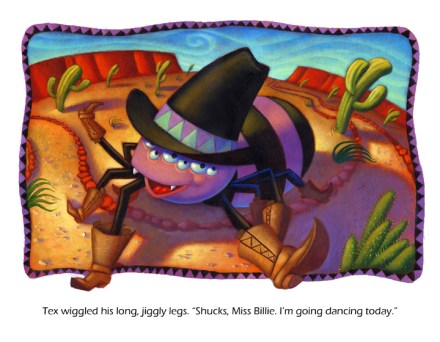
Image copyright Will Terry, text copyright Helen Ketteman, courtesy of willterry.com
Helen Ketteman’s fast-paced Armadilly Chili is a welcome take on what it means to be a good friend. Her Western setting, lively language, and fast pacing will keep kids laughing and rooting for Billie and her pals. Will Terry’s bright illustrations washed with a palette of deep reds, oranges, greens, and yellows firmly sets the story in the Southwest. Billie’s facial expressions as each of her friends abandon her to her chores are priceless, and their final camaraderie is highly satisfying.
Ages 4 – 8
Albert Whitman & Company, 2008 | ISBN 978-0807504581
Discover more about Helen Ketteman and her books on her website!
View a gallery of illustration work, drawings, and picture books by Will Terry on his website!
National Chili Day Activity
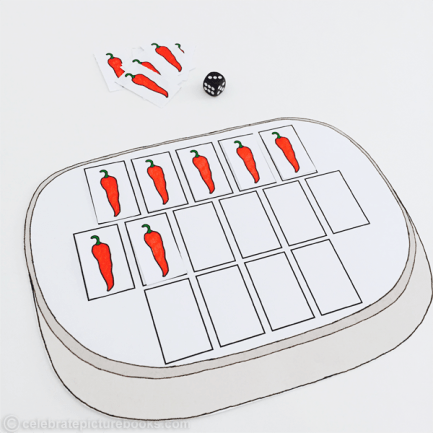
Hot, Hot, Hot! Chili Pepper Chili Game
Chili just isn’t chili without a little heat! But can you take 15 chili peppers in your bowl? If you want to win the Hot, Hot, Hot! Chili Pepper Chili Game you’ll have to!
Object of the Game
The object of the game is to collect 15 chili peppers in your bowl before any other player.
Supplies
- Chili Bowl Game Board (print one game board for each player)
- Chili Pepper Playing Cards (print one page of 15 chili pepper cards for each player and color the peppers)
- 1 playing die
Rules
- Any number of players can play at one time. Print 1 Chili Bowl game board and 1 set of 15 Chili Pepper cards for each player
- Give 1 Chili Bowl Game Board to each player
- Place the Chili Pepper Cards in a pile or in a bowl
- Roll the die to see who goes first. The person with the highest roll goes first
- To begin play, the first player must roll a 1, 2, or 3. They should roll until they get one of these numbers.
- Players roll the die and collect or lose chili pepper cards by the number of dots on the die. If you roll a:
- 1 – Pick up 1 chili pepper card and place it on your chili bowl game board
- 2 – Pick up 2 chili pepper cards and place them on your chili bowl game board
- 3 – Pick up 3 chili pepper cards and place them on your chili bowl game board
- 4 – Get a chili pepper card from the player on your left
- 5 – Give a chili pepper card to the player on your left
- 6 – Lose a turn
7. If a player does not have chili pepper cards to give to another player or if the player on their left has no cards to give, the player rolls again.
8. Continue play until one player has filled their Chili Bowl with chili peppers!



 celebratepicturebooks.com