May 26 – It’s Mystery Month

celebrate-picture-books-picture-book-review-it's-only-stanley

About the Holiday

There’s nothing like a mystery to rivet your attention. Odd sounds, sudden darkness, unusual circumstances, eerie apparitions, and other unexplained phenomena have beguiled people since the beginning of time. We can’t help investigating to find out who, what, why, or how? Today read  great mystery—or solve one!

It’s Only Stanley

By Jon Agee


“The Wimbledons were sleeping / It was very, very late, / When Wilma heard a spooky sound, / Which made her sit up straight.” Walter goes out into the yard to investigate.  He finds their dog Stanley howling at the moon. A little later that night their daughter Wendy is wakened by a clanking sound below her floor. Walter goes down into the basement to investigate. There’s Stanley fixing the oil tank.

Next comes young Willie: “it was even later still, / When Willie smelled a funky smell / That made him kind of ill.” So Walter goes to the kitchen to investigate. He finds Stanley has constructed a homemade lab and is cooking up a bubbling catfish stew on the stove. At half past three Wanda hears a buzzing noise and Walter finds Stanley fixing the old TV.

Tiny Wylie comes in next, having heard a splashy sound, but Walter discovers it’s only Stanley clearing the bathtub drain. “Now Wilma wasn’t happy. / And the children threw a fit. / ‘We’ll never get to sleep tonight if Stanley doesn’t quit!’” So Walter says he’ll talk to Stanley but before he can leave the room a huge KAPOW! sends the family flying.

“‘I’ll go and look,’ said Walter, / ‘And I’ll be back very soon.’ / ‘It’s only Stanley.” Walter said. / ‘We’re going to the—’” Perhaps the biggest mystery isn’t how Stanley does all this…but why!

We know dogs are smart, but who can account for Stanley!? Jon Agee’s loveable, incredibly adept family pet is laugh-out-loud precocious as his nighttime exploits expand to out-of-this-world proportions. The clever word play, alliteration, and rhyming scheme of the text adds to the humor.

Kids will love Agee’s illustrations of the serious, self-assured Stanley as he goes about his tinkering all to the nonplused consternation of his family and the detriment of his nemesis—the household cat. As in many homes with pets, readers will rightly wonder—who’s in charge here? Kids will want to hear It’s Only Stanley over and over.

Ages 4 – 8

Dial Books for Young Readers, Penguin Group, 2015 | ISBN 978-0803739079

Mystery Day Activity
celebrate-picture-books-picture-book-review-what's-missing-game

What Went Missing In the Dark? Game


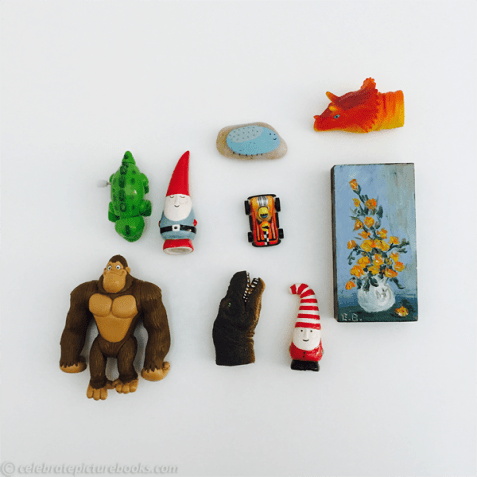
This fun and fabulous game combines memory building with just the right amount of suspense and spookiness. The game is best played at night or in a room that can become totally black when the lights are turned off. If you play in the daytime, just have the players leave the room while you take away objects.
celebrate-picture-books-picture-book-review-what's-missing-game

Rules

  1. Gather a number of small objects (the number will depend on the ages of the players. For younger players, gather 5 – 7 objects. For older players try 12 or more)
  2. Lay the objects on the ground or a blanket
  3. Tell the players to look at the objects for a certain amount of time. The time will depend on the ages of the players—a longer time for younger children, shorter for older kids (or to make the game more exciting)
  4. When the time is up, turn out the lights or send players out of the room.
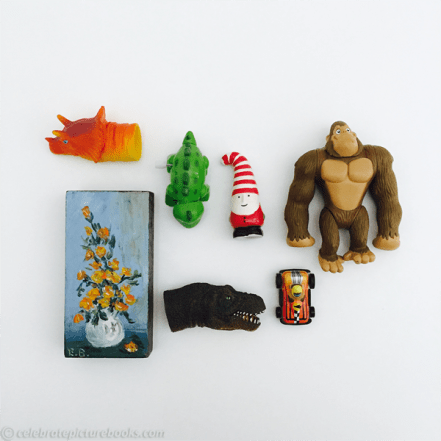
  5. Remove 1 – 3 objects. To make the game more difficult rearrange the remaining objects
  6. Turn the lights back on.
  7. Let children guess which objects have been removed.
  8. Repeat until all the objects are gone
  9. For an alternate game, instead of removing objects, add one or two

Picture Book Review

May 25 – National Photography Month

celebrate-picture-books-picture-book-review-pictures-from-our-vacation

About the Holiday

Established in 1987 by the United States Congress to commemorate the importance of photos to present and future generations, National Photography Month encourages photographers to really look at their subjects and become more intentional about making photos that will be meaningful in the future. Once you’ve taken your pictures, don’t just leave them on your phone, in the cloud, or on your hard drive. Print them and document the place, people, and time of each picture for future generations.

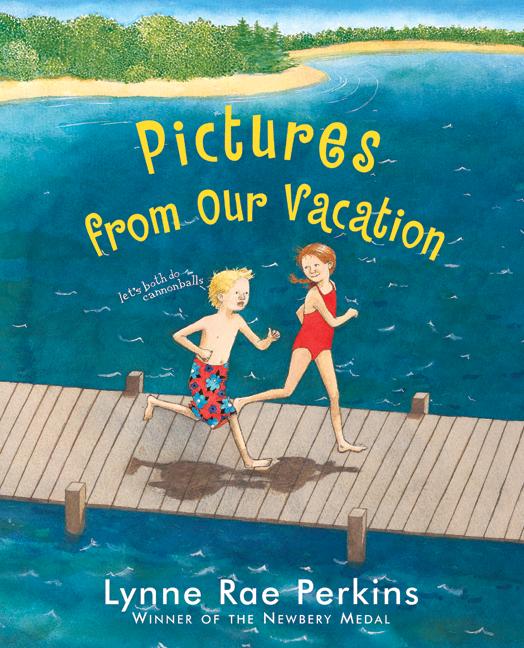
Pictures from Our Vacation

By Lynne Rae Perkins


Just before a family leaves on vacation, a girl and her brother each receive a Polaroid camera and a notebook from their mom so they can document their trip. The first picture the little girl takes is of her feet by mistake. During the two-day trip to the old farm where their dad grew up, the kids play with games from the activity bag and look out the window at the passing landscape. Her second photo taken through the car window reveals “there was not anything to look at out there,” although she does see an orange truck labeled “Yellow” and a motel with a red roof. 

She thinks that if she owned a motel it would be called the Blue Motel, and she begins to imagine in detail the accommodations she would offer. In the Jungle Cottage people would sleep in hammocks and shower under a waterfall. In the Sun Cottage, the bed would glow like the sun but turn off for sleeping. The floor of the Flower Garden Cottage would be real grass, and she thinks up many more.

Her reveries last until the family begins searching for a real motel. They stop at the Shangri-La, which advertises POOL, but as the girl’s photograph shows, “it didn’t have water in it.”

When the family reaches the farm, Dad sees happy memories everywhere. They find an old badminton set with warped racquets (shaped like potato chips, the girl says in her picture’s caption) and begin to play. But one minute into the game the rain comes down. It rains for days and the family spends the time playing cards, reading, and drawing.

After the rain stops, Dad takes the family to a hidden swimming spot. They forge their way through the now-overgrown secret path only to find a KEEP OUT sign and a guard dog.  They backtrack to the car and drive around and around, having trouble finding the lake. They stop at a park, where the girl takes a picture of hills that were built in ancient times to look like a snake from the air and one of a leftover Chinese food container where a squirrel was eating before it ran away.

At last they find the lake and run out to the end of the dock. But a boy warns them of an impending storm. Suddenly, the storm breaks and as the family shelters in the dock gazebo, the girl learns that tomorrow they are attending a memorial service. The next day the old farmhouse fills up with relatives who have traveled there for a memorial service for Great-aunt Charlotte.

At the service family members tell stories about Charlotte’s brave escapades and afterward the whole crew go back to the farmhouse to spend a several days. They eat dinner and tell more stories, and the cousins play. They roll down the hill, climb trees, and explore. That night as the kids sleep upstairs, murmurs of continued conversation float up through the grate. After a few days, the families disperse and only the girl and her brother and parents stay behind, but the memories and feeling of the full house remain.

Finally the girl’s family leaves too, and as they drive home she looks at the pictures she has taken. “‘These don’t remind me much of our vacation,’” she says. She snaps one last picture as they pass a row of huge electrical towers along the highway. When she looks at the photograph, however, the towers don’t look like the giant robots she imagined. She realizes that “it’s hard to take a picture of a story someone tells, or what it feels like when you’re rolling down a hill or falling asleep in a house full of cousins and uncles and aunts. There are a lot of things like that. But those kinds of pictures I can keep in my mind.”

Lynn Rae Perkins’ paean to formative old-fashioned vacations in which extended family members gathered to pass on history and traditions through stories told around the picnic table is a welcome reminder in this digital age that some “pictures” are better stored in one’s memory than on a device. Perkins’ choices of details seen on the two-day road trip, the incessant rain, and the changed landscape that lead to wrong directions are just the kinds of childhood events that often stick in a person’s memory for life. The story is charmingly told from a child’s point of view with realistic dialogue and a tone of heartfelt nostaligia.

Perkins’ realistic drawings of the family are homey and evocative. The kids lounge in the backseat of the car while the little girl conjures up the décor of her Blue Motel; the old house and fields of the family farm are rendered in warm golds and greens with humor and comfort; and you can almost hear the shouts and laughter of the family members gathered on the lawn at the reunion. This is a vacation kids will love to take.

Ages 4 – 8

Greenwillow Books, HarperCollins, 2007 | ISBN 978-0060850975

National Photography Month Activity

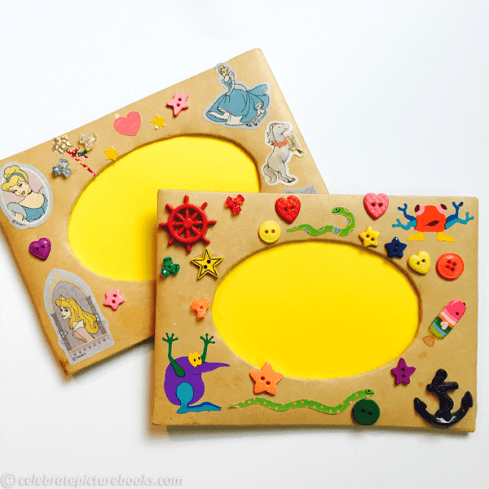
celebrate-picture-books-picture-book-review-frame

Fantastic Frame!


Your photographs show your unique personality, why shouldn’t the frame you put them in? Today, you can make a frame that perfectly suits your décor or snapshot!

Supplies

  • Cardboard or bare wood frame, available at craft stores
  • Stickers
  • Buttons
  • Jewels
  • Beads
  • Glue
  • Paint in your favorite color
  • Paint brush

Directions

  1. Paint the frame (optional), let dry
  2. Attach stickers, beads, buttons, or other objects
  3. Fill with your favorite picture

May 24 – Brother’s Day

celebrate-picture-books-picture-book-review-the-day-glo-brothers

About the Holiday

Brothers share a special bond built on mischief, inside jokes, shared experience, and love. If you have a brother—either by blood or friendship—spend some time with him, give him a call, or just text and say, “hi.”

The Day-Glo Brothers: The True Story of Bob and Joe Switzer’s Bright Ideas and Brand-New Colors

Written by Chris Barton | Illustrated by Tony Persiani


Before the Switzer brothers had their bright idea, the world was a much less colorful place. Bob Switzer, born in 1914, loved to work and saved his money for exciting plans. His younger brother Joe loved magic and had an inventive mind. When the family moved to Berkley, California, Joe developed a magic act that included “black art” in which an object that was painted half black and half white seemed to float and disappear in midair.

Joe loved this trick but thought it could be better. Meanwhile Bob planned to become a doctor. But during the summer before he began college, Bob had an accident that ended his plans. Because his injury effected his head, he had to recover in a darkened room. While Bob healed, Joe spent time in the basement with him studying the glow of fluorescence, hoping to use it in his magic show. Together the brothers built an ultraviolet lamp which they tested in their father’s pharmacy. When they shone it on a shelf full of bottles, a container of eyewash glowed yellow.

celebrate-picture-books-picture-book-review-the-day-glo-brothers-inventing

Image copyright Tony Persiani, text copyright Chris Barton. Courtesy of Charlesbridge

The brothers had an idea. They experimented with chemicals that could make paints glow in the dark. In regular light the paint looked normal, but under ultraviolet light it radiated attention-getting colors. That was great for Joe’s magic act, but Bob thought these paints could be used for other things too, such as store-window displays. Selling the paint could help pay for Bob’s medical bills too.

Bob and Joe searched through the university and other labs for other fluorescent materials. They then combined them with other ingredients in their mother’s mixing bowl to create glowing paints and even once—when the mixing bowl was not cleaned well enough—a very colorful cake!

celebrate-picture-books-picture-book-review-the-day-glo-brothers-inventing

Image copyright Tony Persiani, text copyright Chris Barton. Courtesy of Charlesbridge

Joe used these paints to major effect in one of his acts in which a dancing woman “lost her head” as Joe, unseen by the audience in the darkened theater, took off her headdress as she danced away. This trick brought Bob and Joe lots of customers for their original paints. But there was one problem: these colors only shone under ultraviolet light.

One day in 1935, however, one of Bob’s experiments resulted in a surprising innovation—a dye that glowed even in daylight. Bob didn’t know how exactly it had worked, so the brothers continued experimenting. Finally, they discovered the secret when an orange billboard they had created glowed as if it were on fire even in the daytime! The brothers then created reds, yellows, greens, and other colors that could do the same thing.

During World War II these glowing colors were used on fabric panels used to send signals from the ground to airplanes overhead, in lifeboats, on buoys, and on other safety products. After the war the colors continued to influence culture and are still part of our lives today.

celebrate-picture-books-picture-book-review-the-day-glo-brothers-final

Image copyright Tony Persiani, text copyright Chris Barton. Courtesy of Charlesbridge

Older kids with a penchant for science and history will love this biography. Chris Barton goes in-depth to reveal the Switzer brothers’ dreams and motivations that resulted in a most astounding discovery. Barton infuses the story with humor and interesting details that will fascinate curious minds.

Using a retro style, Tony Persiani sets this biography in its time while also giving the story a modern feel. Gray scale tones become dotted with florescent color as the brothers’ experiments bear fruit and give way to eye-popping spreads with the ultimate success of Day-Glo paints and dyes.

Ages 7 – 12

Charlesbridge, 2009 | ISBN 978-1570916731

Brother’s Day Activity

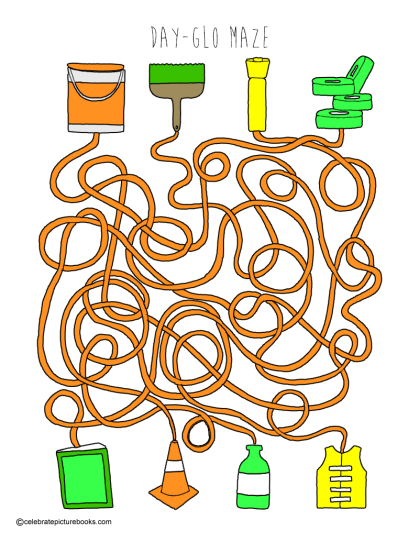
celebrate-picture-books-picture-book-review-day-glo-maze

Day-Glow Maze


Follow the twisty glowing paths to match the Day-Glo product to the object they color! Print the Day-Glo Maze puzzle here!

Picture Book Review

May 23 – World Turtle Day

celebrate-picture-books-picture-book-review-turtle-and-me

About the Holiday

American Tortoise Rescue founded World Turtle Day in 2000 to raise awareness and respect for turtles and tortoises and to promote conservation to help them survive. Celebrations take many forms, from fun activities where participants dress as turtles to educational programs that teach about this fascinating creature and how people can help turtles in danger.

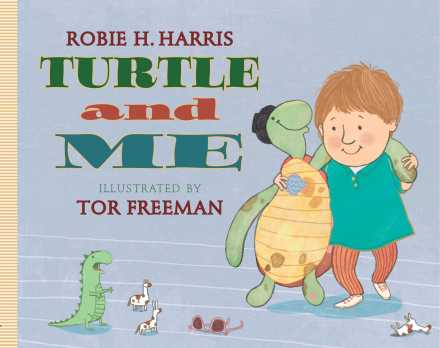
Turtle and Me

Written by Robie H. Harris | Illustrated by Tor Freeman


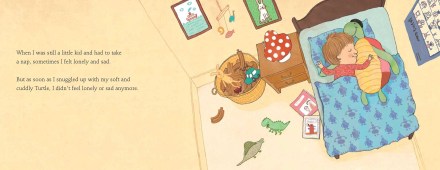
The little boy narrator of this story tells readers he met Turtle on the day he was born. Turtle was “way bigger” than he was. Now, the little boy is bigger than Turtle, but they are still best friends. When the boy was a baby he smiled and laughed every time he played with Turtle. As he grew he needed Turtle around to comfort him.

At naptime Turtle made him feel less sad and lonely and allowed him to sleep. Even now, when the boy is older, he still likes to play with Turtle even though his colors have faded, he’s ripped and raggedy, and some bad things have happened to him.

celebrate-picture-books-picture-book-review-turtle-and-me-sleeping

Image copyright Tor Freeman, 2015, text copyright Robie H. Harris, 2015. Courtesy of simonandschuster.com.

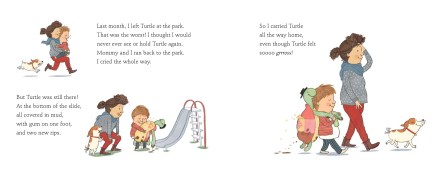
When bad things happened to Turtle the little boy felt terrible; sometimes he even cried and knew Turtle was sad too. But the boy always made sure that Turtle “gets sewn up, washed up, fixed up—and is okay again.” Once Turtle was left at the park. The little boy and his mom raced back and found Turtle covered in mud, sticky with gum, and with two new rips.  Even though Turtle felt gross the boy held him tight all the way home. At home Turtle received a very thorough wash and dry and an extra big hug. The little boy promised Turtle he would never let anything happen to him again.

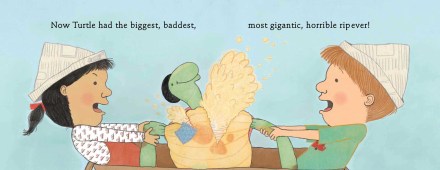
But then last Friday “the worst thing of all happened.” The boy and his friend were sailing around the world in a cardboard box. Turtle was the Captain. But the boy’s friend wanted to be Captain and steer the ship. She grabbed Turtle away, and the boy grabbed Turtle back. In the ensuing tug-of-war, Turtle suffered “the biggest, baddest, most gigantic, horrible rip ever!”

celebrate-picture-books-picture-book-review-turtle-and-me-playground

Image copyright Tor Freeman, 2015, text copyright Robie H. Harris, 2015. Courtesy of simonandschuster.com.

The boy shouted at his friend: “You ripped my Turtle!” Before leaving, the boy’s friend yelled back: “Having Turtle’s a BABY thing!” The little boy hugged Turtle tight and then looked at him. Turtle had lost almost all his stuffing. The boy quickly pushed the fluff back in and taped Turtle’s tummy back up.

But the boy had a change of heart. Suddenly Turtle looked ugly, and the little boy left him on the floor alone. At bedtime, when Daddy brought Turtle to his son, he said he didn’t want Turtle anymore, but sleep without Turtle was elusive. Finally, the boy shouted, “I can’t sleep!” and his dad asked, “Do you want Turtle?” “‘NO’”, the boy said. “‘Having Turtle’s a baby thing! And I’m BIG! And I’m getting bigger! So I don’t need Turtle ever again!’”

His dad thought about this and agreed. His son was getting bigger, but he’s not all big. Daddy picked up Turtle and played with him, making the little boy laugh. Then the boy copied his dad, making his dad laugh. The little boy realized that holding Turtle still felt good. He hugged him close and in no time was fast asleep.

celebrate-picture-books-picture-book-review-turtle-and-me-torn

Image copyright Tor Freeman, 2015, text copyright Robie H. Harris, 2015. Courtesy of simonandschuster.com.

Robie Harris’s sweet story of a little boy and his best friend Turtle reminds kids that no matter how big they get, it’s okay to find comfort in a favorite toy. The story has a deeper meaning for kids as well: things happen; sometimes bad things. But with love mistakes can be cleaned up, scrapes will heal, and scary situations will turn out all right. And when you need them, those who love you are there to help and help make you feel better.

The mishaps Turtle experiences are instantly recognizable and related in a gentile, honest way that will draw kids in. Near the end of the book, kids will root for the little boy and Turtle to patch things up and be best friends again.

Everyone wants a best friend as cool as Turtle! Tor Freeman’s vivid illustrations of the little boy and his plucky stuffed companion are adorable and full of emotion. The close family bonds are well depicted, and the images of the boy hugging Turtle will melt your heart. The looks of anguish on the little boy’s face as Turtle suffers stains and rips elicit sympathy and understanding and are followed up by comforting smiles when Turtle is fixed up.

Turtle and Me would be a terrific addition to home and classroom bookshelves for sweet story times and  when reassurance and a little extra love and comfort are needed.

Ages 3 – 8

little bee books, 2015 | ISBN 978-1499800463

World Turtle Day Activity

celebrate-picture-books-picture-book-turtle-shell-game

Follow the Turtles! Game


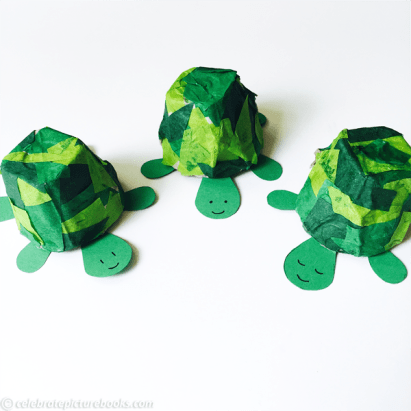
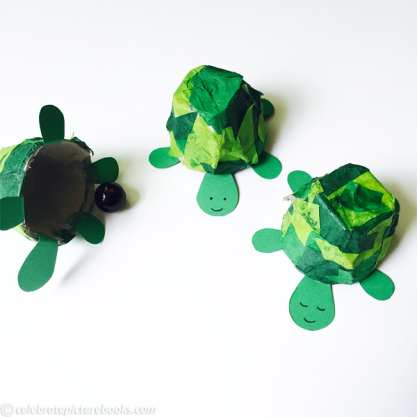
You can make this fun game from recycled materials and a little creativity! When you’re finished making the turtle shells, have fun guessing where the marble, bead or bean is hiding!

Supplies

  • Cardboard egg carton
  • Green tissue paper in different hues
  • Green construction or craft paper
  • A marble, bead, or bean
  • Glue
  • Scissors

celebrate-picture-books-picture-book-turtle-game

Directions

  1. Cut the egg carton apart into individual cups. You will need 3 cups for each game made.
  2. Cut the rims of the cups so they sit flat on a table.
  3. If the cups have open sides, fit two cups inside one another to fill the gaps
  4. Cut the tissue paper into small shapes
  5. Brush glue on a cup (I used a paper towel to apply glue)
  6. Cover the egg cup with pieces of tissue paper. Repeat with other cups.
  7. Let dry
  8. Cut a head and feet from the green craft paper
  9. Tape or glue the edges of head and feet to the inside of the cups
  10. Add a face to the head

To play the game:

  1. Line up the cups on a table
  2. Put a bead, bean, or marble under one of the cups
  3. Show the other player which cup the object is under
  4. Quickly move the cups around each other several times
  5. Ask the other player which cup they think the object is under
  6. Take turns playing

Extra Game: Make three more and play turtle tic-tac-toe! 

May 22 – National Maritime Day

celebrate-picture-books-picture-book-review-toy-boat

About the Holiday

National Maritime Day commemorates the day in 1819 that the steamship Savannah sailed from the United States to England. This event marked the first successful crossing of the Atlantic Ocean by steam propulsion. The US Congress proclaimed May 22 National Maritime Day in 1933. The day gives us an opportunity to honor the ships and seafarers who have served our country in peacetime and during war and to remember the benefits the maritime industry.

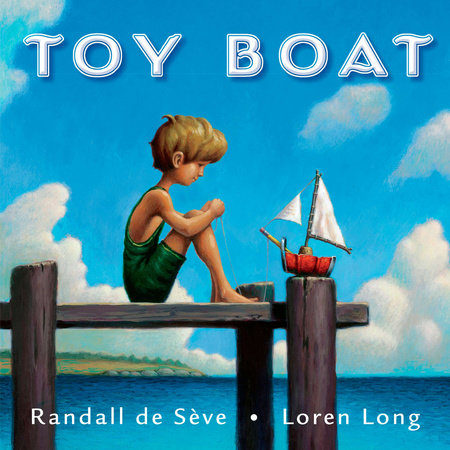
Toy Boat

Written by Randall de Sève | Illustrated by Loren Long


A little boy makes a toy boat from a can, a cork, a pencil and some white cloth. He loves his boat and carries it with him everywhere. Every day the boy takes his boat to the lake and sails it all afternoon. The boy always keeps his toy boat on a string so he won’t lose it. The boat feels secure, but sometimes it gazes out at the big sailboats gliding across the lake and wonders “what it would feel like to sail free.”

One afternoon a squall blows up on the lake, and the boy’s mother pulls him quickly from the edge of the thrashing water. Startled, the boy drops the string and his toy boat floats away. The boat is buffeted by the wind and rain and is carried into deep water where it rides the crests of the wind-whipped waves. As the storm subsides a tug chugs along, pushing the little boat further aside.

The tiny craft rights itself just in time to avoid being sunk by a ferry that blows its horn, warning, “Move Along!” But the tug and the ferry aren’t the only dangers on the water. A fierce speedboat roars past, its engine screaming, “Move Along!”, and its draft sending the little boat reeling. The toy boat feels small and scared as it drifts into the middle of a fleet of sailboats racing to port. For a moment the toy boat and a large sloop “cut through the choppy waves side by side. And the little toy boat felt big. Then the white boat tilted high on its side, spraying the little toy boat with water, warning, “Move along!”

Half drowned and its sail soaked, the little toy boat misses the boy. It bobs all night on the open water, “alone and scared.” As the sun rises an old fishing boat, dented and with peeling paint, put-puts by. It spies the little boat and, knowing how it feels to be pushed around, begins to circle the tiny craft. In the fishing boat’s wake, the toy boat turns and catches the wind in its sail. Soon it is sailing alongside the fishing boat.

“The little toy boat felt strong! ‘I am moving along,’ it shouted to the wind.” The little boat feels so good that it doesn’t realize it is now sailing alone or that it is nearing the shore, where the little boy is watching out for it. When the boy shouts, “Boat! Boat!” the now brave craft waves its sail excitedly and sees the boy wave back.

That night the little boat sails bathtub seas and sleeps on a soft mattress. The next day the boy takes the boat back to the lake, and while he still holds the boat by a string, every so often he lets go, and the little toy boat always comes back. “It knew just where it wanted to be.”

Randall de Sève’s tale of independence sought and found by both the little boat and the boy will resonate with both children and adults. The safety of the “string” set against the perceived freedom of older or bigger others is a universal and on-going rite of passage for every child and their parents and is treated by de Sève with gentleness and understanding. The various dangers and even personalities children meet with are introduced here allowing kids to see that while they may be buffeted by change or adversity, they will not sink.

Loren Long lends his well-known artwork to this story in beautiful two-page spreads that depict the security of first the small bathtub and then the calm lake as well as the storm-tossed waves that take the toy boat into unknown territory. The smallness of the toy boat compared with the size of the tug, ferry, speedboat, and racing sloops well reflects the experiences of children in the wider world. When the friendly face of the fishing trawler comes on the scene, kids will identify with the toy boat and realize help and support are out there and that they are always welcomed home with love.

Ages 3 and up

Philomel Books, Penguin Young Readers, 2014 (board book edition) | ISBN 978-0399167973

National Maritime Day Activity

celebrate-picture-books-picture-book-review-maritime-flag-puzzle


Show Your Colors! Word Puzzle


While ships can’t talk to each other, they can communicate using a system of flags. These colorful flags carrying different designs are recognized internationally as representing letters and symbols. Individual flags have specific meanings related to safety, emergency, or warning issues or they can be combined to form a code that only certain ships can understand.

Use the provided maritime flags code to decipher a special message! Print the Show Your Colors! word puzzle and get decoding! Here’s the Solution!

May 21 – It’s Get Caught Reading Month

celebrate-picture-books-picture-book-review-whoops

About the Holiday

Created by former Congresswoman Pat Schroeder, now president of the Association of American Publishers, Get Caught Reading Month promotes good reading habits and encourages people of all ages to take part in the fun of reading. Reading to young children is especially important as research indicates that early language experience stimulates a child’s brain to grow and gives kids a huge advantage when they start school. Whether you like fiction, non-fiction, poetry, graphic novels, or comics, there is an amazing book just waiting on a shelf for you!

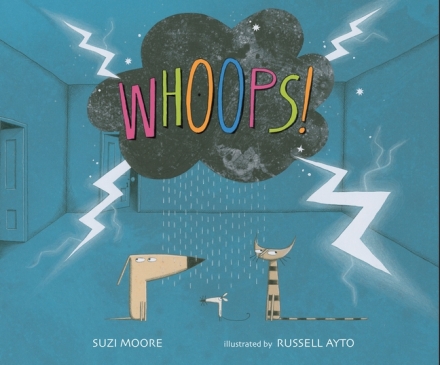
Whoops!

Written by Suzi Moore | Illustrated by Russell Ayto


This is the cat that can’t meow. And here’s the dog that can’t bowwow. And the little mouse when she tries to squeak? She opens her mouth but she just can’t squeak.

But the owl says to the three “‘Find the old lady in the tumbledown house. She’ll have a spell to make you all well.” So they go in search of the tumbledown house and find it in the middle of the woods. When they go inside, the little old lady doesn’t seem surprised to see them. In fact she’s heard of their problem and consults her spell book. She casts a spell “and the whole house shook, the wind blew in and the rain came down. Then the tumbledown house turned around and around.”

Now the cat says, “Cluck!” And the dog says, “Quack!” And the mouse says, “Cock-a-doodle-doo!” And the little old lady? She says, “Whoops!” Maybe the right spell is on page three. She casts a new spell and there’s a flash and a crash and the tumbledown house turns around and around. This time the cat says, “Baa!” and the dog says, “Neigh!” and the mouse says, “Moo!” And the little old lady? She says, “Whoops!”

The spell on page seven brings the three closer: the cat says, “Woof!” and the dog says, “Squeak!” and the mouse says, “Meow!” And the little old lady? She says, “Whoops!” That special spell to make them all well must be on page ten. The old lady waves her wand and the storm rages and the tumbledown house turns around and around. Finally, the cat says, “Meow!” and the dog says, “Woof!” and the mouse says, “Squeak!”” And the little old lady? She says, “CROAK!”

Whoops!

Suzi Moore’s laugh-out-loud, shout-out-loud tale of mistaken identity will have kids reading along during the first go-round. The catchy, repeated rhymes, cadence of the words and sentences, errant spells, and building storm create infectious silliness at its best. Kids will eagerly await what comes next for the dog and the cat and the mouse who have trouble speaking.

Russell Ayto accompanies this fun story with a crazy assortment of creatures drawn with maximum comic effect. The thin, angled shapes of the cat, dog, and mouse make for heroes kids will root for, and the little old lady with a cloud of blue hair sitting in the taaall-backed chair will make kids giggle. Who is she knitting three-legged stockings for? And what magic does her knitting-needle wand and maniacal grin possess in that narrow tumbledown house in the middle of the woods?

Ages 3 – 7

Templar Books, Candlewick Press, 2016 | ISBN 978-0763681807

Get Caught Reading Month Activity

celebrate-picture-books-picture-book-review-wand

Reading is Magic! Wand


When you read you are transported into another world—it’s like being under a magic spell! Make your own magic wand and conjure up spells to take you wherever you want to go!

Supplies

  • Wooden dowel
  • Wooden ball with a hole to match the size of the dowel
  • Paint in your favorite colors
  • Ribbon, jewels, or other material to decorate your wand
  • Glue gun or strong glue
  • Paintbrush

celebrate-picture-books-picture-book-review-wand

Directions

  1. Paint the dowel however you would like—one color, with dots or stripes, or multicolored
  2. Paint the wooden ball—you can even give it a mystical look with glow-in-the-dark paint or glitter
  3. Glue the wooden ball to the dowel with the hot glue gun or strong glue
  4. Decorate your wand with jewels, ribbon, or other material

May 19 – It’s National Photography Month

celebrate-picture-books-picture-book-review-dorothea's-eyes-cover

About the Holiday

National Photography Month was established in 1987 by the United States Congress to commemorate the importance of photos to present and future generations. National Photo month gives you an opportunity to consider what you photograph and how you can become more intentional about making photos that will be meaningful decades from now. Look at your subjects and see the colors, people, events, the culture—even the moment that you are documenting. Once you’ve taken your pictures, don’t just leave them on your phone, in the cloud, or on your hard drive. Print them and archive them for the future. Your inspiration, perspective, and opinions will live on in them.

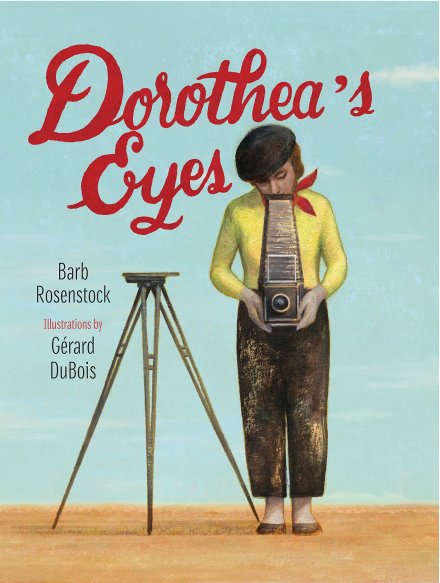
Dorothea’s Eyes: Dorothea Lange Photographs the Truth

Written by Barb Rosenstock | Illustrated by Gérard DuBois


When Dorothea Lange opens her green eyes, she sees things others miss. In the shadows, in patterns within the grain of wooden tables, in the repeated shapes of windows on a wall, and most especially in people’s faces. “Dorothea loves faces! When Dorothea looks at faces, it’s like she’s hugging the world.”

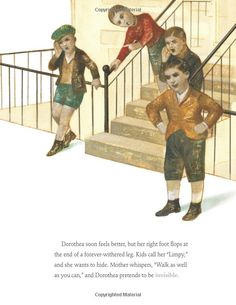
When Dorothea is seven she contracts polio. The disease withers her right leg and forever after she walks with a limp. Other kids tease her and make her want to hide. Her mother encourages her, but Dorothea pretends to be invisible. When her father leaves his family, her mother gets a job in New York and Dorothea goes to a new school. She is different and lonely.

celebrate-picture-books-picture-book-review-dorotheas-eyes-with-camera

Image copyright Gérard DuBois , text copyright Barb Rosenstock. Courtesy of Caulkins Creek

As Dorothea waits for her mother to finish work, she looks around her, spying “into crowded tenements where fathers, home from peddling, read newspapers, and mothers wash dishes, clothes, and babies in rusty sinks—happy and sad mixed together.” She begins to skip school to wander the city, gazing at it with her curious eyes and heart.

When Dorothea grows up she decides to become a photographer. Her family is surprised—it is not a ladylike profession. She works any job she can find in the photography industry, learning about cameras, darkrooms, negatives, and the printing process. “Alone in the darkroom’s amber glow, she studies the wet printing paper while faces appear in black and white. Dorothea loves faces!”

When she is 23 Dorothea travels west and when all her money is stolen in San Francisco, she stays, gets a job, and starts her own portrait studio. She becomes the sought-after photographer of the richest families in California. She makes money, gains friends, gets married, and starts a family of her own. But she always wonders, “Am I using my eyes and my heart?”

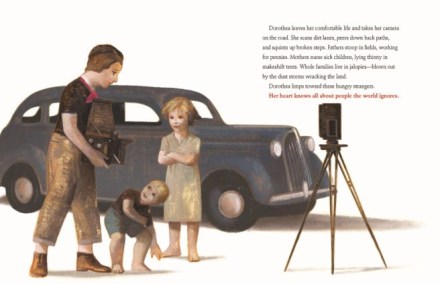
When the stock market crashes and the Great Depression sweeps the country, Dorothea focuses her camera on the desperate and the downtrodden. Her friends don’t understand, but Dorothea sees into these poor people’s hearts. She “knows all about people the world ignores.” For 5 years she goes out into the fields, peers into tents, documents families living in their cars, crouches in the dirt to reveal the stories of the people struggling with the devastation wrought by the Dust Bowl.

celebrate-picture-books-picture-book-review-dorotheas-eyes-with-car-and-camera

Image copyright Gérard DuBois , text copyright Barb Rosenstock. Courtesy of Caulkins Creek

Newspapers and magazines publish her pictures. “Her photographs help convince the government to provide parents with work, children with food, and families with safe, clean homes. “The truth, seen with love, becomes Dorothea’s art.” Dorothea’s photographs are still known today. Their subjects continues to help us see others with our hearts.

Six of Dorothea Lange’s most famous and recognizable photographs are reproduced on the last page—still as riveting today as they were in the 1930s. Further information on her life and work is provided as well as sources where her photographs can be viewed, resources for further study, and a timeline of her life.

celebrate-picture-books-picture-book-review-dorotheas-eyes-kids

Image copyright Gérard DuBois , text copyright Barb Rosenstock. Courtesy of Caulkins Creek

Barb Rosenstock brings Dorothea Lange’s vision to the page with love, honesty, and understanding in this excellent biography of a woman whose photographs defined the Great Depression and Dust Bowl era. Lange’s life-long connection to the poor and often overlooked people of the world is beautifully described and explained in a gentle, compassionate way that will resonate with children. Rosenstock’s language is lyrical with staccato sentences that echo the clicks of Lange’s shutter capturing life’s reality with her eyes and her heart.

Gérard DuBois’s illustrations are arresting and set Dorothea Lange’s story firmly in its historical and emotional landscape. Rendered in acrylic and digital imagery, they feature the muted colors and style of book illustrations from long ago. By placing the images of Dorothea, her family, and her photography subjects against white backgrounds, DuBois emphasizes Lange’s focus on the people she met and faces that inspired her. Distressed textures accentuate the troubled times and the anguish of both Dorothea and her subjects.

Ages 7 – 12

Calkins Creek, 2016 | ISBN 978-1629792088

Discover all the amazing books by Barb Rosenstock on her website!

View a portfolio of art and book illustration by Gérard DuBois on his website!

Here’s a snapshot of Dorothea’s Eyes!

National Photography Month Activity

CPB - New Professionals Picture

News Professionals Clothespin Figures


Make one of these clothespin figures that honors the men and women who work to keep the world informed.

Supplies

Directions

  1. Draw a face and hair on the clothespin
  2. Cut out the clothes you want your journalist or photographer to wear
  3. Wrap the clothes around the clothespin. The slit in the clothespin should be on the side.
  4. Tape the clothes together
  5. Cut out the camera
  6. Tape one end of a short length of thread to the right top corner of the camera and the other end of the thread to the left corner. Now you can hang the camera around the figure’s neck.

Idea for displaying the figures

  • Attach a wire or string to the wall and pin the figure to it
  • Pin it to your bulletin board or on the rim of a desk organizer


Picture Book Review