March 13 – National Earmuff Day

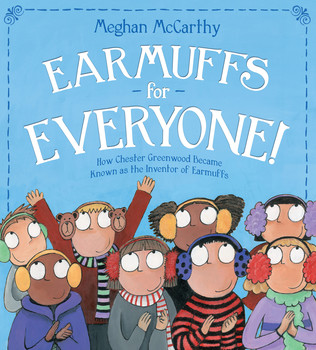
Earmuffs for Everyone! by Meghan McCarthy Picture Book Review

About the Holiday

On March 13, 1877 Chester Greenwood—a 19-year-old inventor—received a patent for “improvements in ear-mufflers” and forever sealed his place in history—as well as making winter more comfortable for millions of freezing ears! Today we honor Chester and his invention that brought attention to Farmington, Maine and jobs for many people in the area. So if you live in an area where the cold winds are still blowing, wear your earmuffs in pride!

Earmuffs for Everyone! How Chester Greenwood Became Known as the Inventor of Earmuffs

By Meghan McCarthy


In the mid-1800s inventors were trying to solve the problem of winter’s chill effects on tender ears. William Ware designed an “ear, cheek, and chin muff” that one wore somewhat like a false beard. Ear protecting hats, ear “slippers,” high collars, and other designs followed. But it wasn’t until Chester Greenwood and his sensitive protruding ears came along that earmuffs became practical. While the exact steps Chester took in creating his earmuffs aren’t known, he eventually perfected his invention and received a government patent on March 13, 1877—when he was only 19 years old!

Chester was no one-invention wonder, though. Always on the lookout for clever ways to make money, he went on to improve other products. He applied his foresight to the tea kettle, rounding the edges of the bottom to reduce wear; constructed an interchangeable-tooth rake; and built a collapsible, if cumbersome, tent.

His inventions brought him a comfortable life—a beautiful house for his family in Maine, the first steam car in his town, and a bicycle shop on the bottom floor of his workshop—that he shared with others. His wife, also a progressive thinker, worked for women’s suffrage, and inspired her husband to hire women in his workshops.

After Chester passed away, some people, most notably Mickey Maguire, thought he deserved more acclaim—even a day dedicated as Chester Greenwood Day. Maguire was so excited about this that he became a kind of inventor himself—an inventor of tall tales. Over time he told some whoppers and they were printed, making it hard to separate fact from myth. But even without the made-up stories, it’s easy to say that Chester Greenwood had a very remarkable life

Earmuffs for Everyone goes beyond the story of Chester Greenwood to include other inventors, a discussion of the patent system (using products well-known to today’s kids), and how an inventor’s legacy grows. Meghan McCarthy writes with verve and humor, making the story of Greenwood’s invention as well as others’ creations inviting, accessible, and fun. Her illustrations of the first attempts at earmuffs and other1800s products are sure to delight kids and make them curious about the time period.

In her author’s note at the back of the book, McCarthy expands on the story of Chester Greenwood and the process of applying for and earning a patent.

Ages 4 – 8

Simon & Schuster/Paula Wiseman Books, 2015 | ISBN 978-1481406376 

National Earmuff Day Activity

CPB - Earmuff Maze.png

Here’s to Warm Ears! Maze


One muff on each side of the head—Genius! But it took inventors a lot of trial and error to make the perfect warming headgear. Use your own creative thinking on this Here’s to Warm Ears!earmuff-shaped maze. Solution included.

March 6 – Dentist’s Day

Just Going to the Dentist by Mercer Mayer Picture Book Review

About the Holiday

Most of us visit our dentist twice a year, but amid all the whirring and brushing and spitting do we thank them for keeping our teeth healthy? March 6 is recognized world-wide as a time to remember all the things dentists do to make our teeth stronger and our smile prettier.

Just Going to the Dentist

By Mercer Mayer


Little Critter needs to go to the dentist even though he doesn’t think he does. In the office the nurse gives Little Critter a big smile (he thinks she’s showing off her teeth) and asks him and his mom to wait. Little Critter sees a girl with braces and thinks they’re so neat that he wants some. While he waits, he plays with the toys and reads a book.

When the nurse calls Little Critter’s name, he goes off with her somewhat bravely to a room that looks like the inside of a spaceship, with its lights, monitors, tools, and the funny dentist chair. The hygienist cleans his teeth, which leads to the best part of the visit—spitting into the sink. After Little Critter’s X-rays are taken, the dentist examines his teeth. The dentist tells him he has one cavity. Little Critter gets a shot to numb his mouth, and before he knows it the cavity is filled!

Little Critter leaves the office with a free gift and, tuckered out from his adventure. sleeps on the ride home.

Mercer Mayer’s Little Critter books are an excellent way to introduce children to the people and places that may at first seem scary or intimidating. Told from Little Critter’s point of view, this book can be comforting to children who may be wary of visiting the dentist as he voices opinions and questions that most kids probably have themselves. By giving Little Critter and his frog companion humorous comments and facial expressions, Mayer hits just the right tone.

Ages 3 – 7

Random House Books for Young Readers, New York, 2001 | ISBN 978-0307125835

Dentist’s Day Activity

CPB - Dentist's Day Word Search (2)

Smile for the Dentist Word Search


Dentists make our smile brighter with regular checkups and good advice. Can you find the words that help our teeth stay healthy? Have fun with this Smile for the Dentist Word Search! Solution included.

March 4 – It’s Umbrella Month

celebrate-picture-books-picture-book-review-the-umbrella-queen-cover

About the Holiday

Today I am celebrating a month-long holiday. As spring returns with its rainy weather, walkers everywhere appreciate the protection umbrellas give. The need for umbrellas has been recognized since earliest days, when palmetto fronds were used by ancient civilizations. The Chinese were the first to create waterproof umbrellas by waxing or lacquering their paper parasols. Parasols were a woman’s accessory until Jonas Hanway, a Persian travel writer, used one in public in England in the 1700s. English men took up the practice, calling their version a “Hanway.” The first collapsible umbrella was designed in 1710, and in 1928 the folding pocket umbrella appeared. Since then, umbrellas have become fashionable and necessary accessories

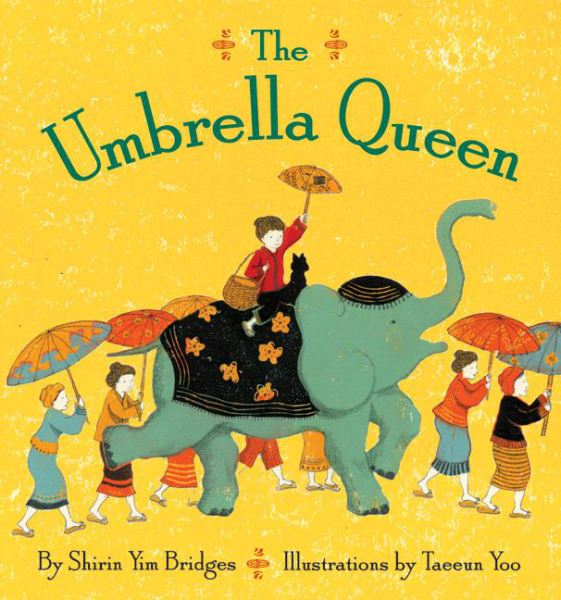
The Umbrella Queen

Written by Shirin Yim Bridges | Illustrated by Taeeun Yoo

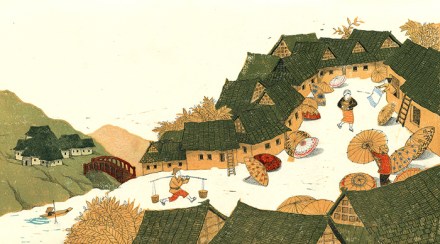
The residents of a small village in Thailand are well known for the beautiful paper umbrellas they make and sell in the local shops. The umbrellas are colorful, but always decorated with flowers and butterflies. Every New Year’s Day the villagers hold an Umbrella Parade, and the woman who has painted the most beautiful umbrella is chosen as the Umbrella Queen.

Noot is a little girl who longs to paint her own umbrellas and partake in the parade. One day her mother gives her an umbrella to paint and shows her how to copy her design. Noot is a natural artist, and her finished umbrella is nearly indistinguishable from her mother’s. She is given her own painting spot in the garden and five umbrellas to decorate.

celebrate-picture-books-picture-book-review-the-umbrella-queen-village

Image copyright Taeeun Yoo, courtesy of taeeunyoo.com

Noot paints the familiar butterflies and is about to start on the flowers when she is inspired to draw elephants instead. She covers all five umbrellas with elephants doing handstands, playing and squirting water, walking trunk-to-tail, and just being silly. When her mother sees these umbrellas, she is unhappy. Flowers and butterflies sell in the local shops, not elephants. Noot understands the importance of the money made from the umbrellas to her family. For the next year she paints the large umbrellas with the traditional design. At night, however, using bits and pieces, she fashions tiny umbrellas. These she paints with elephants, and displays them on her windowsill.

celebrate-picture-books-picture-book-review-the-umbrella-queen-emperor-visits

Image copyright Taeeun Yoo, courtesy of taeeunyoo.com

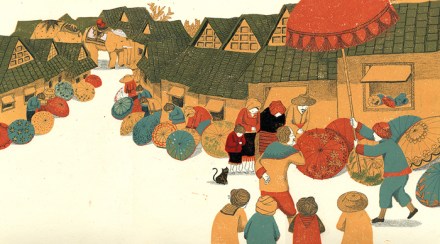
As New Year approaches there is much excitement in the village. It is rumored that the king will be visiting and will choose the Umbrella Queen himself. One day the villagers receive the message that the king will indeed arrive. The villagers spruce up their town and each woman displays her umbrellas in front of her home.

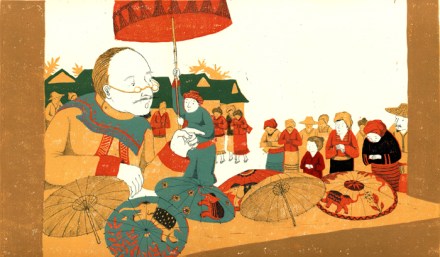
The king walks the length of the street, considering each umbrella until he comes to Noot’s house. He is very impressed with the umbrellas painted by Noot’s mother, but his gaze wanders to Noot’s windowsill, and he asks who painted the “strange” umbrellas.

celebrate-picture-books-picture-book-review-the-umbrella-queen-emperor-judges-umbrellas

Image copyright Taeeun Yoo, courtesy of taeeunyoo.com

A bit embarrassed by the attention, Noot shyly answers the king’s questions about the size of the small umbrellas and the unusual designs. In trying to explain herself, she forgets to look at the ground when talking to the king, and when her eyes meet his she realizes that, instead of judging her, he is charmed. “I like elephants,” she tells him, and he laughs.

The king takes Noot’s hand and names her the Umbrella Queen because “she paints from her heart.”

Shirin Yim Bridges has written a unique story that presents the often conflicting dilemma of responsibility to others while staying true to yourself effectively and engagingly. Noot’s journey from an observer in her family’s business to a valued artist is told straightforwardly and the familial love and support are clearly emphasized. The king’s recognition of Noot’s talent and heart will be highly satisfying for young readers or listeners.

Taeeun Yoo’s delicate illustrations in gold, red, black, and green set the story firmly in Thailand and perfectly demonstrate the close-knit village and relationships as well as the intricate beauty of the umbrellas and the pride the villagers take in them.

The Umbrella Queen is a wonderful story about family, discovering your talents, and self-expression that would find a welcome spot on any child’s bookshelf.

Ages 4 – 8

Greenwillow Books, Harper Collins, New York, 2008 | ISBN 978-0060750404

Learn more about Taeeun Yoo, her books, and her art on her website!

Umbrella Month Activity

CPB - Umbrella Matching Game

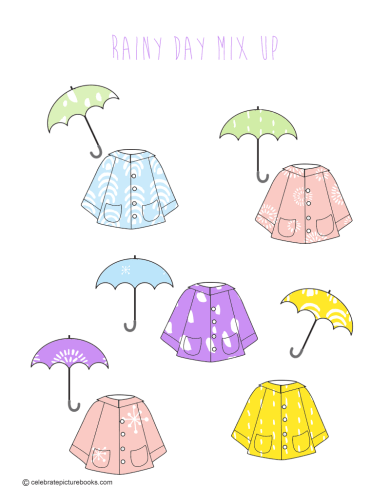
Rainy Day Mix Up Matching Game

A sudden storm scattered all the umbrellas and raincoats! Can you put the pairs together again? Draw a line to connect the umbrella and the raincoat that have the same pattern. Print the Rainy Day Mix Up Game here!


February 28 – Tooth Fairy Day

Throw Your Tooth on the Roof picture book review

About the Holiday

For hundreds of years losing baby teeth has conjured up stories, legends, and superstitions. The idea of paying for teeth may have come from the Vikings, who reportedly believed the teeth could make them better warriors and so paid their children for their teeth, which they fashioned into necklaces to wear in battle. Some people buried the teeth, wanting to hide them from witches and evil spirits. The first immaginary creature to actively search for and take teeth was perhaps a mouse, which is still taught in many countries today. From the mouse came the Tooth Fairy, who is one of those mysteries of childhood in America and other English-speaking lands.

Throw Your Tooth on the Roof: Tooth Traditions from Around the World

Written by Selby B. Beeler | Illustrated by G. Brian Karas


When children lose a tooth, it’s so exciting! They know it means they’re growing up. It also means they can participate in a tradition that is fanciful and fun. American kids put the tooth under their pillow, believing that while they sleep the Tooth Fairy will visit them, take the tooth, and leave them money. But what do kids in other countries do with their baby teeth?

In Throw Your Tooth on the Roof, Selby Beeler reveals traditions from 65 countries around the world. In many countries children are rewarded with money but the deliverer differs. El Ratón, a magic mouse, visits children in Mexico, Guatemala, Dominican Republic, Columbia, and other countries. A rabbit sneaks into homes in El Salvador, and in India, Korea, and Brazil birds take the tooth.

In some places what children do with their teeth doesn’t bring monetary riches, but the value of a beautiful smile. In Yellowknife Déné putting a lost tooth in a tree and dancing around it ensures that the new tooth grows in as straight as a tree. In many Asian countries upper teeth are placed in the ground and lower teeth are thrown on the roof in the belief that the new tooth will grow straight toward the old one.

Selby B. Beeler’s book offers children a fascinating way to learn about their counterparts in other countries through a common experience and rite of passage. Each description is accompanied by Brian Karas’ appealing illustrations of children in their native environment happily performing their tradition.

Ages 4 – 8

Houghton Mifflin Company, 2001 | ISBN 978-0618152384

Tooth Fairy Day Activity

CPB - Tooth Fairy Maze finished

Help the Tooth Fairy Find the Tooth Maze


The Tooth Fairy has a job to do, but she doesn’t know which way to go! Can you show her the right path? Print out the Help the Tooth Fairy Find the Tooth Maze and lead her to the tooth! The Solution is included.