June 24 – Take Your Dog to Work Day

celebrate-picture-books-picture-book-review-douglas-you-need-glasses

About the Holiday

In 1996 Pet Sitters International established Take Your Dog to Work Day as a time to raise awareness of the pets left home all day by themselves with no stimulation. The organization was also dedicated to promoting adoption from local and humane shelters. Over the years the idea of Take Your Dog to Work Day has grown in popularity. To celebrate talk to the people in your office or business about bringing in pets and find time during the day to spend more time with your faithful companion. Both you and your dog will enjoy it!

Douglas, You Need Glasses!

By Ged Adamson


Something may be amiss with Douglas. When Nancy and her playful pooch go out to chase squirrels, Douglas takes after a falling leaf while the squirrel escapes up a tree. It’s not the first time this has happened. You see, Douglas is a bit nearsighted. Sometimes he mistakes the stair post for Nancy, and his difficulty gets in the way of things (well, mostly Douglas gets in the way of things). He misses important signs—like the one that would have prevented him from tracking wet cement all over the skate park, where there are NO DOGS allowed—and he’s always causing something of a ruckus. Sometimes he even enters the wrong house! But when a game of fetch nearly creates a buuzzzz of disaster, Nancy decides something must be done.
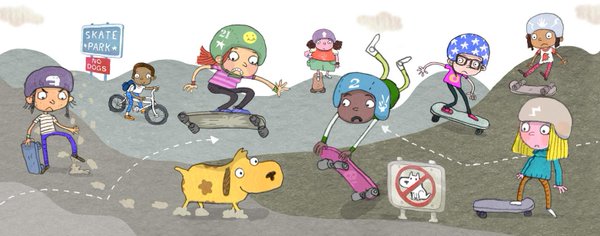
celebrate-picture-books-picture-book-review-douglas-you-need-glasses-skate-park-art

She takes Douglas to the eye doctor where he reads a most dog-friendly eye chart and discovers that he needs glasses. He peruses the shelves of Dog Glasses and puts some on. Each one makes him feel different. In one pair he’s a rock star; in another a scholar; and in yet another a hippy. He tries them all until he finds the perfect pair!

celebrate-picture-books-picture-book-review-douglas-you-need-glasses-interior-art

All images courtesy of Ged Adamson


On the way home he sees the world in a whole new way. “‘Wow! Everything looks amazing!’” Douglas says. And it is!

Ged Adamson’s funny look at a dog with an all-too-human malady will make kids laugh from the first page to the last. Earnest Douglas, going about his doggy days under a bit of a skewed perspective, is so endearing that readers will immediately take him to heart even as they giggle at his exploits. Adamson’s vibrant multi-hued trees, colorfully clothed kids, and vivid backgrounds with stylish, sketched-in details give the book a fresh, jaunty appeal for a lively, fun story time. Kids facing the prospect of wearing glasses will also find much to give them reassurance and confidence in this book. Douglas, You Need Glasses! is a great addition to any child’s bookshelf!

Ages 3 – 8

Schwartz & Wade, Random House Kids, 2016 | ISBN 978-0553522433

Visit Ged Adamson’s Website to see what other books and projects he’s working on!

Take Your Dog to Work Day Activity
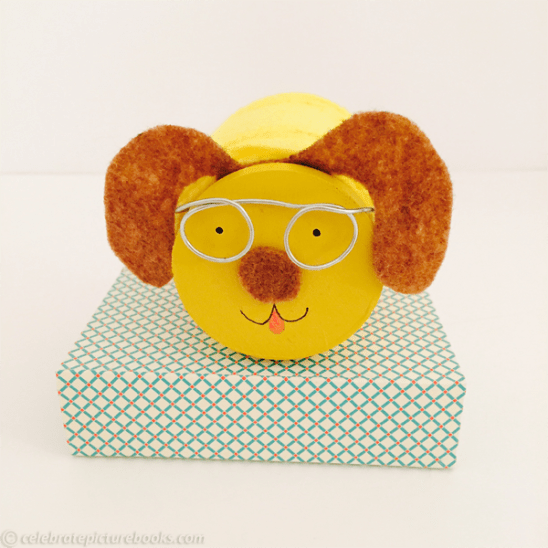
celebrate-picture-books-picture-book-review-spool-puppy-craft

Spool Puppy


No matter where you go and whether you have a real dog or not, you can take this little guy along with you. And just as you would pick out your favorite from an animal shelter, you can make this puppy look any way you’d like!

Supplies

  • Printable Ears and Nose Template
  • 2-inch round wooden spool, available at craft stores
  • 1 skein of yarn in the color you choose. Yardage needed will depend on the thickness of the yarn.
  • Felt
  • Thin gauge wire
  • Craft paint
  • Paint brush
  • Fabric or strong glue
  • Dowel or pencil to wrap wire around to make glasses
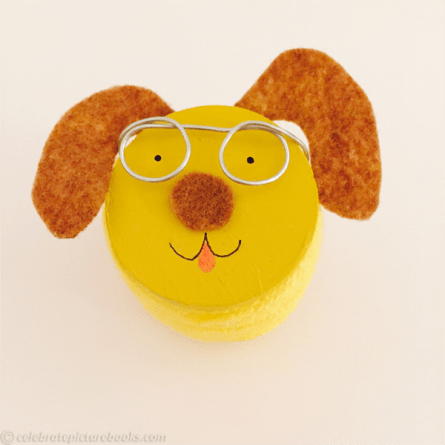
celebrate-picture-books-picture-book-review-spool-puppy-craft

Directions

  1. Paint the dowel the color you want your dog to be, let dry
  2. Trace the ears on the felt and cut out (or draw your own ears)
  3. Trace the nose on the felt and cut out
  4. When the spool is dry glue the ears to the body of the spool, allowing the ears to stick up from the top of the spool
  5. Wind the yarn around the spool back and forth until the dog’s body is the size you’d like
  6. Glue the yarn in place with fabric or strong glue

To make the face

  1. Glue the nose over the hole on one end of the spool
  2. Draw the mouth and tongue under the nose with a marker
  3. You will draw the eyes on after the glasses are in place

To make the glasses

  1. Wind the wire around a ½-inch dowel, thick pencil, or rounded handle to make two circles.
  2. Leave about two inches on either side of the circles for the ear pieces of the glasses.
  3. Adjust the size of the circles to fit the spool as glasses.
  4. Put the glasses on the face of the spool, tucking the ear pieces into the yarn on each side
  5. Draw eyes in the center of the glasses

To make the tail

  1. Cut a small square of felt and stuff the edges into the hole on the other end of the spool
  2. You can make the tail as long as you like
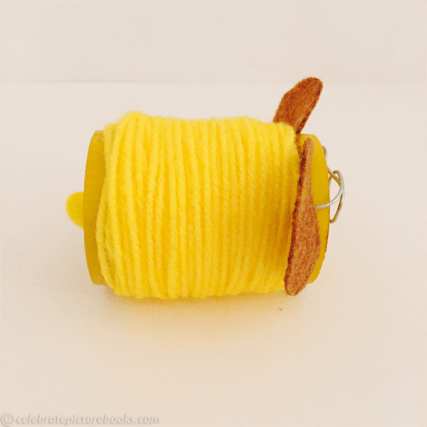
celebrate-picture-books-picture-book-review-spool-puppy-craft

Picture Book Review

June 23 – Let It Go Day

celebrate-picture-books-picture-book-review-it's-tough-to-lose-your-balloon

About the Holiday

No, this isn’t a day dedicated to re- re- re- re- re-watching that movie. It’s a day to take a step back and take stock of the feelings you’re keeping inside or the little irksome quirks that drive you crazy. Are they really worth all the stress? Today’s a day to find inner peace, make amends, or turn disadvantage into advantage.

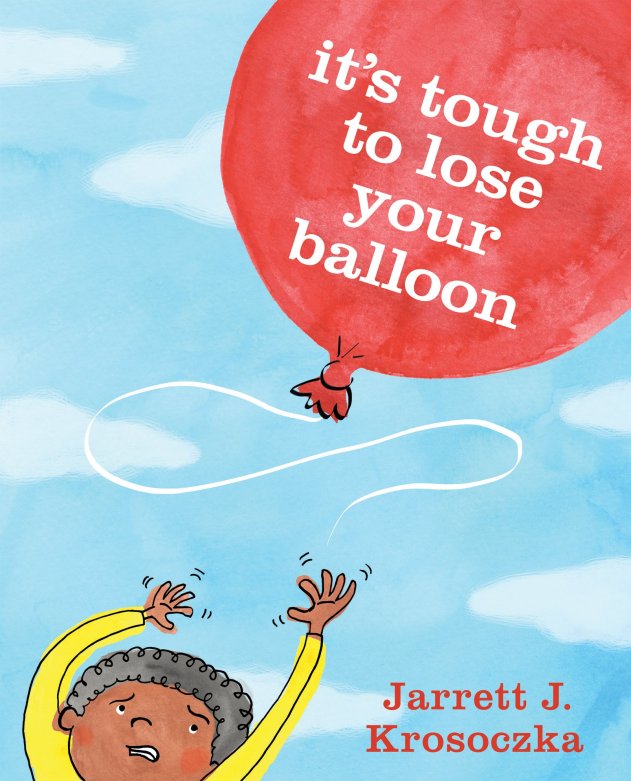
It’s Tough to Lose Your Balloon

By Jarrett J. Krosoczka


Most people wake up each morning with great ideas for a having good day, but sometimes things don’t work out the way they’re planned. For kids, small mistakes, accidental mishaps, and unexpected disappointments can loom large. Frustrations and perceived unfairness can elicit tears or anger, and it’s sometimes hard to know how to comfort an unhappy or upset child.

In It’s Tough to Lose Your Balloon Jarrett Krosoczka acknowledges that sometimes bad or sad things happen, but he reveals to kids how looking at the event from a different perspective or through someone else’s eyes can bring consolation and even happiness. As the title states, it’s hard for kids to watch a balloon suddenly slip through their fingers and float away, but imagining all the other people who will see it and smile can help. Having a picnic on the beach when the unthinkable happens? “It’s sad to drop your sandwich in the sand…but it’ll make some seagulls very happy.” And you know it will make you laugh to watch those crazy guys swooping, diving, and squawking over that now-crunchy snack.

The idea of sharing hurts with others to create a new scenario or a different kind of enjoyment while forming closer bonds is another positive way to turn disappointments into teachable moments that benefit all. As most kids know “it’s never fun when you break a toy…” but with a upbeat attitude they can have “fun fixing it with Grandpa.”

Wet shoes? Melting Ice-cream cone? Scraped knee or new baby sitter? In Jarrett Krosoczka’s hands these letdowns can lead to new freedom, innovation, distinction, and joyful experiences. It’s Tough to Lose Your Balloon can help anyone see “disaster” in a whole new light!

Krosoczka’s illustrations ingeniously depict the way an unexpected mishap or disappointing moment can make someone feel—alone, exposed, and vulnerable. Left-hand pages present the problem while the right-hand page shows the crestfallen child in full color on a black-and-white sketched background. The positive transformation becomes a two-spread, full-color of happy pride and fun abandon. Life can be full of little bumps in the road, keeping a copy of It’s Tough to Lose Your Balloon on the shelf can help smooth the way.

Ages 3 – 7

Knopf Books for Young Readers, 2015 | ISBN 978-0385754798

Visit Jarrett J. Krosoczka’s Website to see more of his books and discover fun activities!

Let It Go Day Activity

celebrate-picture-books-picture-book-review-worry-buddy-craft

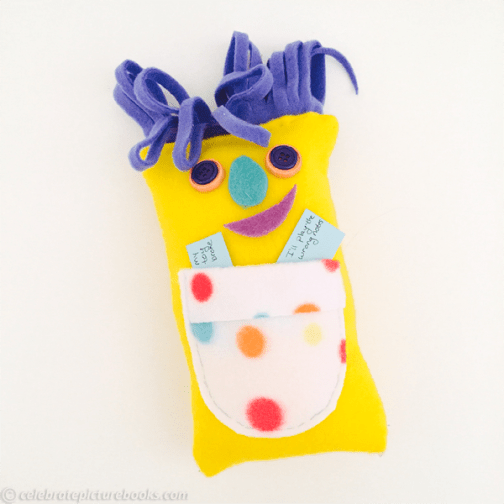
Worry Buddy


Sometimes worries don’t seem as bad when they are shared with someone else or to at least set aside for awhile. With this craft you can make a friend to help lesson worries, disappointments, fears, and anxieties. And it’s pretty good at hugs too. Older children may like to create this as a sewing project, while younger kids can make it easily with fabric glue. Make your Worry Buddy as unique as you are!

Supplies

  • Fleece or felt in different colors
  • Buttons, two larger in the same color and two smaller in a different color
  • Fiber fill
  • Fabric glue or thread
  • Paper
  • Pen or pencil

Directions

To Make the Body

  1. Cut a 16-inch piece of fleece
  2. Fold the fleece in half
  3. Glue the sides together (older children may enjoy sewing the sides together with simple straight stitches)
  4. Leave the top open
  5. Turn the body inside out
  6. Fill the body with fiber fill

To Make the Hair

  1. Cut a 5-inch piece of fleece or felt
  2. Fold the fleece or felt in half
  3. Glue or sew the folded fleece into the opening in the body
  4. Cut the fleece or felt in ¼-inch strips across the top

To Make the Face

  1. Glue one set of larger and smaller buttons together, repeat with the other set
  2. Glue or sew the buttons to the top part of the body
  3. Cut a nose and mouth out of fleece or felt
  4. Glue or sew the nose and mouth to the face

To make the pocket

  1. Cut a 5-inch piece of felt in the shape of a square-bottom or rounded bottom pocket
  2. Fold down an inch of the top
  3. Glue or sew the pocket to the middle of the body

To share problems with the Worry Buddy, write worries or fears on a slip of paper and put them in the Worry Buddy’s pocket. Your Buddy will keep those problems so you don’t have to.

June 22 – It’s Great Outdoors Month

celebrate-picture-books-picture-book-review-bringing-the-outside-in

About the Holiday

June, with its lazy feel and longer days, is the perfect month to spend time outdoors. Great Outdoors Week was established in 1998, but it quickly became apparent that only seven days were not nearly enough to enjoy everything nature has to offer. In 2004 the holiday was expanded to encompass the entire 30 days of June. So whether you enjoy activities on land or water, pack a picnic, grab some toys or equipment, and get out to play! Or if you just like quiet time, take a book and find a shady spot to read! Or if you love discovering new places, slip on your walking shoes and explore! Or…well, there’s just so much to choose from…!

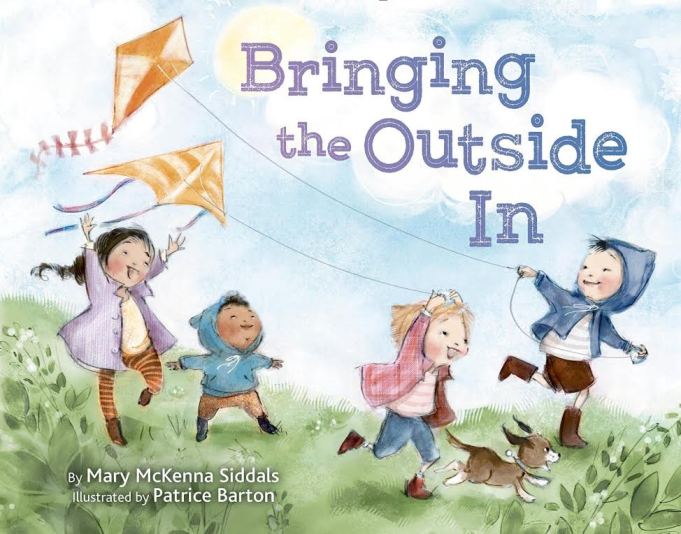
Bringing the Outside In

Written by Mary McKenna Siddals | Illustrated by Patrice Barton


For kids there’s something magical about an open door. Going out leads to unexpected adventures, blissful messiness, and astonishing discoveries. Coming in means comfort, encouragement, and that homey feeling of being wrapped in love. Bringing the Outside In is an exuberant celebration of this harmonious juxtaposition for every season of the year.

celebrate-picture-books-picture-book-review-bringing-the-outside-in-spring-art

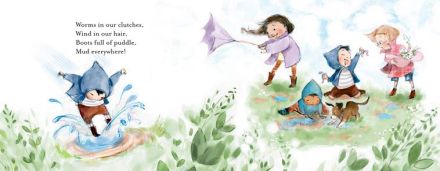
In springtime four children in jackets and boots and their adorable puppy race to play on a blue, blustering day. Under soft, billowing clouds they leap into puddles, dig in the dirt, pick wildflowers, and play tug-of-war with the wind. Happily sated and with “Worms in our clutches / Wind in our hair, / Boots full of puddle, / Mud everywhere!” the kids skip toward home. They are greeted with smiles, towels, hooks for their coats, and a mop for the drips. Even the puppy knows it’s time for “Wiping it off, / Mopping it up, / Dumping it / out again.”

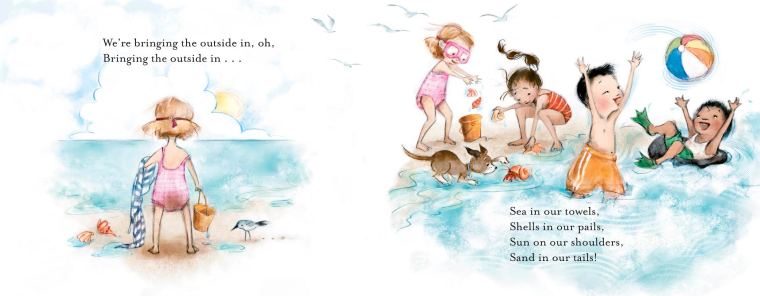
With the repeated chorus “We’re bringing the outside in, oh, / Bringing the outside in…” the spring turns to summer and the four kids are visiting the beach with pails, swim fins, goggles, float, and a ball to toss. With buoyant abandon they collect sea shells, meet hermit crabs, get properly soaked, and revel in the warm sunshine. The sun, sand, and sea follow them home, where they kick off their sandals, gather at the mudroom’s big double sink, and pin their suits on the clothes line while “Shaking it off, / Washing it up, / Drying it out again.”

celebrate-picture-books-picture-book-review-bringing-the-outside-in-summer-art

Autumn once again finds the kids outside amid its brilliant colors and “Bushels of apples, / Leaves stuck on clothes, / Acorns in pockets, / Smells in our nose!” Back inside the kids make art of some of the apples and leaves they’ve collected, untangle more leaves from hair, clothes, and the puppy’s ears, and sweep even more out the door. With the onset of winter the kids plop in the snow, build snowmen, sled, and eat icicles. After a fun-filled afternoon and with “Slush on our seats” and a “nip in our fingers,” they know it’s time for “Bringing the outside in, then…Brushing it off, / Warming it up, / Thawing out again.”

A full year has passed, but the enchantment of spring, summer, autumn, and winter have not been forgotten outside. As the kids, comfy in their matching pajamas, huddle on the round rug poring over a box of photographs and souvenirs of their escapades, they’re happily “…keeping the outside in, oh, / Keeping the outside in….” And whenever they want to relive the “Treasures collected, / Pictures in heaps, / Stories remembered, / Memories for keeps!” that box contains, all it takes is a quick “digging it up” and “dusting it off” and “bringing it out again!”

Mary McKenna Siddals’ effervescent tribute to the joy of outdoor play perfectly captures the bouncy wonder young children exhibit in the freedom of a natural environment. Using evocative, lyrical language, Siddals imbues simple childhood pleasures with poetic resonance. The repeated phrases make this a great read-along, read-aloud book, and the children’s actions could easily be turned into fun movement games for school or family story time.

Patrice Barton’s endearing illustrations of the adorable ethnically diverse children at play are inspired and inspiring. Vivid swirls and streaks create splashing water, wind-whipped hair, swinging tires, and plenty of drips, drops, and delight. Children will love seeing themselves so affectionately depicted and will want to linger over the details on every page. One wonderful aspect of Bringing the Outside In is that the children can represent friends or they could be siblings.

Bringing the Outside In is a must for school libraries and would be a wonderful, often-read addition to a family library.

Ages 3 – 8

Random House Books for Young Readers, 2016 | ISBN 978-0449814307

Visit Mary McKenna Siddals’ Website to discover more about her and her books! You’ll also find lots of hands-on and online activities for Bringing the Outside In and her other books as well as teachers’ resources, and lesson plans.

Join in the fun with Mary McKenna Siddals on the Bringing the Outside In Facebook Page!

Visit Patrice Barton’s Website to view more of her adorable artwork, books, and blog posts!

Great Outdoors Month Activity

celebrate-picture-books-picture-book-review-bringing-the-outside-in-painted-pails-craft

Personalized Painted Pail


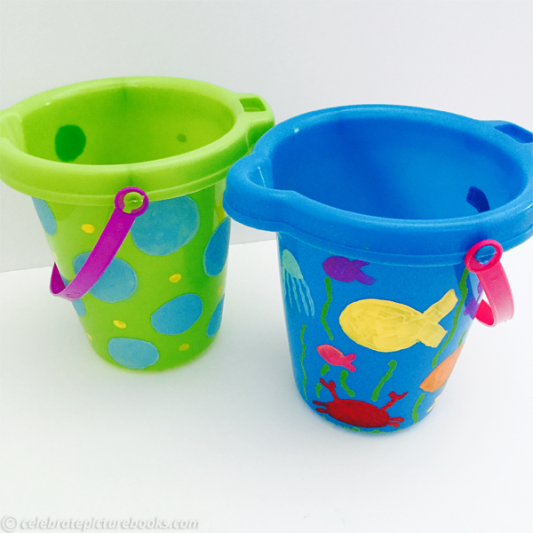
A trip to the beach or park isn’t complete without a pail to collect shells, seaweed, sea glass, pebbles, sticks, nuts, or other things in. But why should all the cool stuff be on the inside? With this craft you can decorate your pail to show your unique personality!

Supplies

  • Plastic or metal pail
  • Craft paint in various colors
  • Crystal Clear Acrylic Coating, for multi-surface use
  • Paint brush

Directions

  1. Paint designs on the pail
  2. When paint is dry spray with acrylic coating to set paint
  3. Let dry

June 19 – Father’s Day

celebrate-picture-books-picture-book-review-the-best-part-of-daddy's-day-cover

About the Holiday

While celebrations of Mother’s Day caught on very quickly after the first ceremony in 1908, proclaiming Father’s Day as a national institution took a little longer. On July 19, 1910 the governor of Washington State held the first Father’s Day event. In 1916 President Woodrow Wilson, trying to attract attention to the holiday with a little technology, unfurled a flag in Spokane, Washington by pushing a button in Washington DC. This clever ploy, however, did not convince the men of the time, who scoffed at a holiday dedicated to fathers as somehow too “domesticated” and “unmanly.” During World War II celebrating Father’s Day began to be seen as a way to honor American troops and to help the war effort. The holiday entered the mainstream, but it wasn’t until 1972, when President Richard Nixon signed a proclamation, that Father’s Day became a federal holiday.

The Best Part of Daddy’s Day

By Claire Alexander


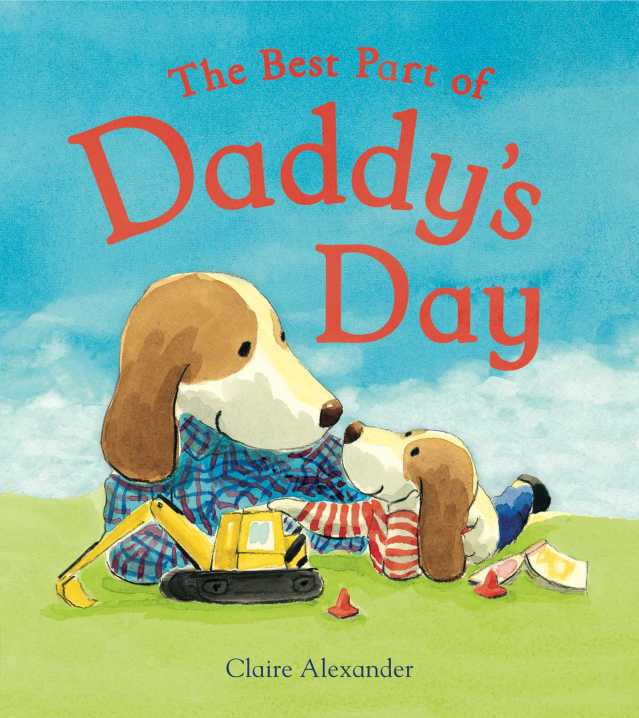
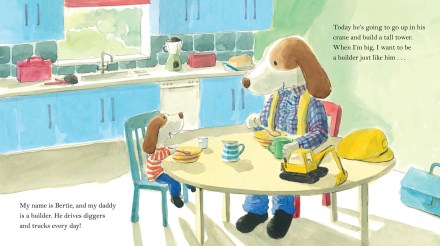
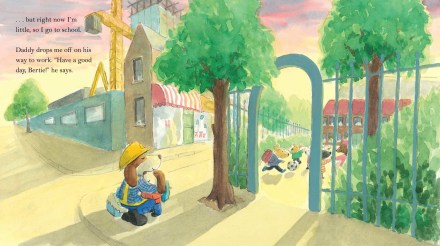
Little Bertie is proud to introduce his daddy to readers. His dad is a builder who drives diggers and trucks every day. Today he’s going to be in a crane high up in the sky working on a tall tower. “When I’m big,” Bertie says, “I want to be a builder just like him….” But right now Bertie’s dad is dropping him off at school. “‘Have a good day, Bertie!’” he says as he gives his son a hug.

With the BRRRIIING of the bell, Bertie runs into class, where he’s in for a surprise. “‘Today we’re going to be builders,’” his teacher tells her class, and Bertie knows it’s going to be a great day! First the teacher reads “an exciting story about a digger” then Bertie paints a picture of a crane like his daddy’s. But just as he’s finishing it, a classmate with paint on his shoes tracks green footprints across the paper.

celebrate-picture-books-picture-book-review-the-best-part-of-daddy's-day-interior-art

At lunchtime Bertie trips over his shoelace and spills his lunch. His great day is having some bumps along the way, and Bertie wishes he could see his daddy. He knows just what to do. He runs to the playground and climbs “up, up, UP…to the top of the jungle gym.” Bertie is so high up he “can see the top of Daddy’s tower!” Bertie can even see someone driving the crane and knows it must be his dad.

After lunch the class constructs an enormous tower. Bertie pretends to be a small crane, while his teacher, in her high-heeled shoes, is a big crane, able to place boxes higher and higher. The building they make is amazing! As the day progresses it begins to rain, but when Bertie’s dad picks him up he gives Bertie his hat to keep his ears dry. Bertie is excited to tell his dad about building the tower—it was the best part of his day, he says.

At home Bertie tells his dad “the not so good parts” of his day—about his spoiled painting and about tripping and falling. “‘I bet things like that never happen to you, Daddy,’” Bertie says. “‘Well, actually…they do sometimes!’” Bertie’s dad answers, and he tells his son about the bumps in his day—how someone walked across his new, wet cement floor and that he also tripped and fell over an untied shoelace, just like Bertie. But then, his dad says, he went back up in the crane and “‘finished my tower, and I think I saw you, Bertie, on the jungle gym!’”

celebrate-picture-books-picture-book-review-the-best-part-of-daddy's-day-interior-art

“‘It WAS me, Daddy!” Bertie exclaims. Then he asks his dad “if the best part of his day was finishing the tower.” His dad looks at his son, snuggled on his lap and answers, “‘Actually, the best part of my day is right now, being here with you, Bertie.” Bertie agrees. “‘I think this is the best part of my day, too.”

Claire Alexander hits all the right notes in her heartfelt tribute to loving father-son relationships. Brilliantly paced toward an emotional surprise twist, Alexander’s story is sweet and satisfying. The open communication between father and son adds poignancy, and the truth that while kids are inspired by their parents, parents are equally inspired by their kids may amaze children and will bring a lump to parents’ throats. This father and son aren’t just building towers, they’re building a life-long bond.

Alexander’s vivid, cheerful watercolor illustrations glow with the enthusiasm and love that Bertie and his dad feel for each other. Large two-page spreads invite kids into Bertie and his dad’s world as they eat breakfast together in the tidy kitchen, say goodbye outside the school gate, and read together in their comfy, overstuffed chair. Kids will love the view of Bertie’s playground with the gleaming glass tower and red crane rising above it and the sweeping vista of the city as seen by Bertie’s dad from atop the crane. A vertical spread of the tall tower Bertie’s class builds adds a fun element to the story and emphasizes the tower’s height for young children. 

The Best Part of Daddy’s Day  is an excellent addition to a child’s bookshelf and makes a wonderful gift. It will quickly become a favorite for bedtime or story time.

Ages 3 – 8

little bee books, 2016 | ISBN 978-1499801965

To see more of adorable books for children by Claire Alexander visit her website!

The Best Part of Daddy’s Day and more excellent books for children are available from little bee books!

Father’s Day Activity

celebrate-picture-books-picture-book-review-building-blocks-craft

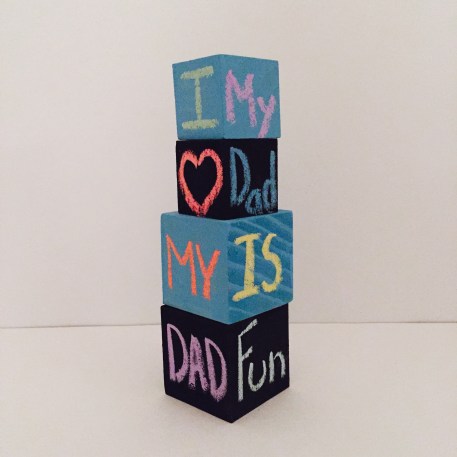
I Love Dad Building Blocks


This craft will stack up to be a favorite with kids! With wooden blocks and a little chalkboard paint, it’s easy to make unique building materials. They’re great for gifts, decorating, party favors, or when you just have a little time to play!

Supplies

  • Wooden blocks in various sizes, available from craft stores
  • Chalkboard paint in various colors
  • Paint brush
  • Chalk in various colors

Directions

  1. Paint the wooden blocks with the chalkboard paint, let dry
  2. Write words or draw pictures on the blocks
  3. Have fun!

June 17 – Flip-Flop Day

celebrate-picture-books-picture-book-review-at-the-beach-cover

About the Holiday

Nothing says “casual” like a pair of flip-flops! These open-toe, open-back, open-side (you can hardly call them shoes!) shoes have been trending since 4000 BC with no limits in sight! Flip-Flop Day was initiated by Tropical Smoothie Café. Customers wearing flip-flops receive a free smoothie and the Café also uses the day to raise money for Camp Sunshine, which offers respite and support to children with life-threatening illnesses and their families. Today if the weather’s warm slip on a pair of flip-flops and head out for a casual day at the beach or on the town!

At the Beach

Written by Anne Rockwell | Illustrated by Harlow Rockwell


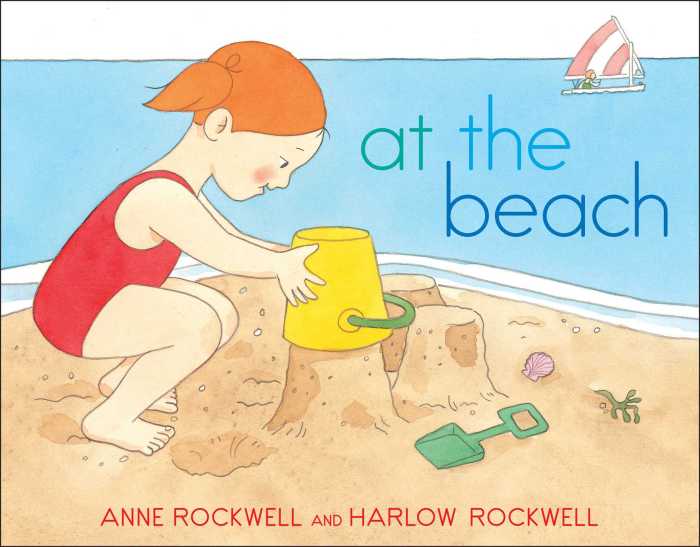
A little girl with a yellow pail and red swimsuit and her mom who’s carrying a tote and umbrella head out for a day at the beach. They find a spot to lay their striped and polka-dot towels and plant their blue-striped umbrella. Waiting in the tote is their lunch—two foil-wrapped sandwiches, two peaches, and a thermos of lemonade.

celebrate-picture-books-picture-book-review-at-the-beach-interior-art-sandpipers

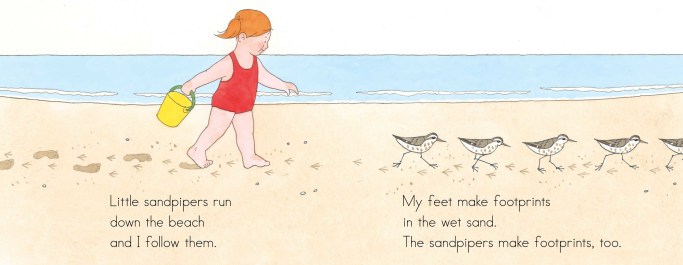
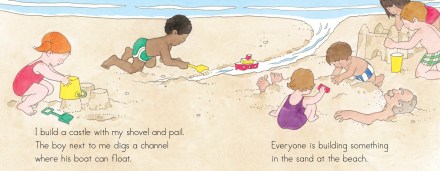
After the little girl is covered in nice-smelling sunscreen, she follows a line of sandpipers, adding her footprints to theirs in the wet sand. For her bucket she finds different types of seaweed and a variety of shells. She joins a group of kids playing among the dunes. “I build a castle with my shovel and pail. The boy next to me digs a channel where his boat can float,” the little girl says. The girl ventures out into the shallow water where “a little crab tweaks my toe” and “little silver fishes swim past me.”

The girl likes to “walk past the lifeguard station to the big brown rocks” to look for barnacles, snails, and muscles. She and her mom then swim in the waves near a drifting seagull. Back on land, the girl lies on her towel and lets the sunshine dry her off “until it is time for lunch.”

celebrate-picture-books-picture-book-review-at-the-beach-interior-art-kids-playing

Like the best laid-back days, Anne Rockwell’s classic At the Beach takes a tranquil, unhurried look at a mother-and-child seaside outing. For young children the straightforward, but lyrical text will evoke happy memories of their own beach experiences; for children who don’t live by the ocean the story will pique their interest in the shoreline environment.  This book, anchored in universal details yet inviting imagination, will soon become a favorite.

Harlow Rockwell’s sweet drawings of the little girl enjoying all a busy beach has to offer will captive young children. Scenes of a diverse group of children playing in the sand, a stalwart sea gull afloat on the current, a parade of scurrying sandpipers, and even the up- close look at scavenger hunt finds and the always welcome lunch engage all of a child’s senses. The clean lines and soft colors of the sand, sea, and sky contribute to a book as lovely as a sun-drenched beach.

Beach Day Scavenger Hunt Idea: At the Beach would be a wonderful take-along on any beach outing. Take a stroll along the shore and see if you and your child can find the shells, seaweed, sea creatures, and other seaside sights in the book.

Ages Birth – 8

Aladdin reissue edition, Simon & Schuster, 2016 | ISBN 978-1481411349

Flip-Flop Day Activity

celebrate-picture-books-picture-book-review-flip-flop-craft

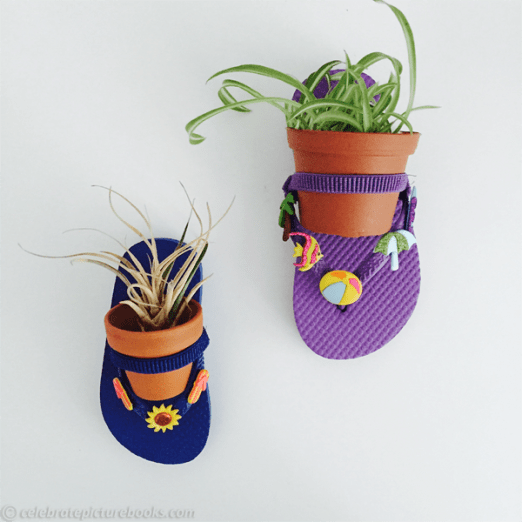
Flip-Flop Plant Holder


Flip-flops don’t only have to be for your feet! With this easy craft you can make a sandal-ightful way to hang succulents and other light plants on walls or even windows!

Supplies

  • Child’s flip-flops with elastic heel straps
  • Buttons or charms
  • Small plastic, terra cotta, or ceramic solid-bottom pot
  • Small plant
  • Dirt
  • Hot glue gun
  • Heavy duty mounting strips
  • Small shovel or spoon

Directions

  1. Place the flip-flop toe down on your work surface. With the hot glue gun, attach the buttons to the plastic toe straps of the flip-flops.
  2. Add dirt to the pot
  3. Add plant to the pot
  4. Slip the pot into the elastic strap and gently push down so it is also supported by the plastic toe straps
  5. To hang, use appropriate weight mountable strips.
  6. To make an interesting and attractive arrangement, use various sizes of flip-flops

June 13 – Sewing Machine Day

celebrate-picture-books-picture-book-review-sewing-school-2

About the Holiday

Patented in 1790 by Thomas Saint, the sewing machine revolutionized the textile industry. No longer did clothes and other fabric items need to be made by hand. The sewing machine made this job faster and less tedious. Long a favorite hobby for clothes makers and crafters of all types and ages, sewing is creative and fun! If you like to sew celebrate today by making something new or sharing your talent with a beginner. If you’ve never sewn, consider trying it—needle crafts, either by hand or using a sewing machine can become a life-long enjoyable activity!

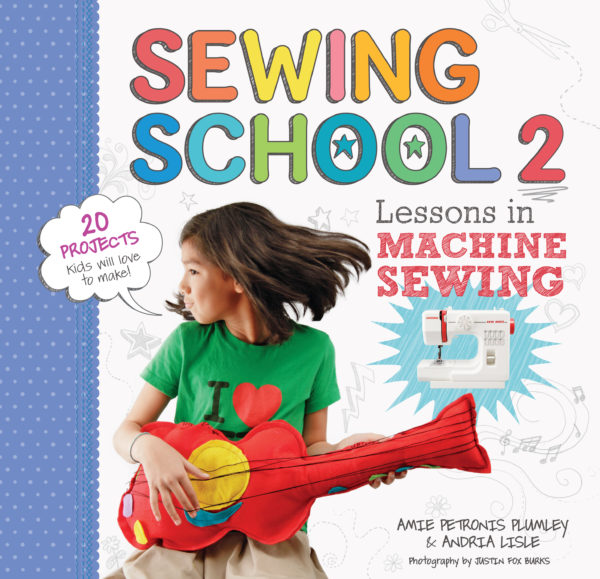
Sewing School 2: Lessons in Machine Sewing

By Amie Petronis Plumley & Andria Lisle | Photography by Justin Fox Burks


Sewing and crafting are popular hobbies shared between friends and family. Skills that were once passed down from generation to generation are being rediscovered by kids and adults alike through widely available craft and sewing chain stores and books like the Sewing School series. In this second edition, kids are taught everything they need to know to feel comfortable at a sewing machine and create awesome projects they can really use.

Divided into five sections, Sewing School 2 is easy to navigate and builds on skills presented in previous chapters. The first section “Getting Started” provides 13 lessons that cover choosing a sewing machine, the elements of a well-stocked sewing kit, learning about different fabrics, how to do basic stitches and techniques, and laying out and cutting patterns.

With clear photographs on every page, kids will easily be able to understand the concepts being described. “Anatomy of a Sewing Machine” points out each part of a machine, from the spool spindle to the take-up lever, presser foot, stitch selector, and more. The most common stitches are depicted here too—straight, reverse, stay, and reinforcement stitches share the page with short discussions of what a bodkin and pinking shears are for.

Budding sewers will learn about the right and wrong sides of fabrics, how to sew “right” sides together and turn the project inside out, and the way to stuff a pillow and finish the opening. One chapter is devoted to starting off right as well as tips on guiding the material through the machine.

After kids have been introduced to the basics, it’s time to try out those new skills! Four sections containing five projects each let kids make items for all the important aspects of their lives. “In My Room” shows them how to make a pillow with a space for secret messages, a welcome sign, a pocket organizer, a sleepy teddy bear, and a striped blanket. The “Let’s Go” section is perfect for kids on the run. Projects include a coin holder, a handy pouch for carrying extras, and a safe place for their electronic gadgets.

The projects in “Time to Play” prove that sewing results in plenty of fun! Things like stuffed guitars, microphones, backpacks, game boards, and decorative hangings are just a stitch away. Finally it’s time to take sewing outside with a section titled “The Great Outdoors.” Kids will wonder how they ever got along without their snack pouch, belt with pocket, water bottle carrier, scarf, and portable tree stump—huh? You’ll just have to get the book and see!

Each project comes with a one-to-three star difficulty rating, a list of all materials needed, a list of the skills used, how to personalize each project, and tips for adult helpers.

The final pages help kids out when things just don’t go as planned, how to do hand-sewn work, and tips for adults who are working with a group.

Amie Petronis Plumley and Andria Lisle have created a wonderful resource for anyone wanting to get in on the fun of sewing. The easy-to-understand directions and conversational tone of the book will put kids at ease, and Justin Fox Burks’ photographs of children using the concepts and happily displaying their work will make beginners excited to start sewing. Burks’ up-close photos of the parts of the sewing machine as well as each technique make Sewing School 2: Lessons in Machine Sewing a leader in its field.

Ages 7 and up

Storey Publishing, 2013 | ISBN 978-1612120492

Sewing School Takeaway Project

celebrate-picture-books-picture-book-review-sewing-school-t-shirt-project

Save-My-T-Shirt Pillow


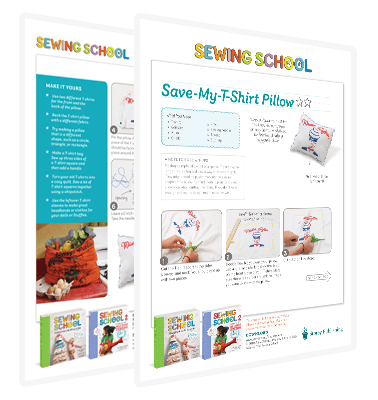
Sometimes it’s so hard to give away a favorite t-shirt! With this project from Sewing School you don’t have to! Use your hand-stitching skills to create a pillow that will make your room even more awesome! Click here for the Save-My-T-Shirt Pillow directions.

Sewing Machine Day Activity

celebrate-picture-books-picture-book-review-sewing-word-search

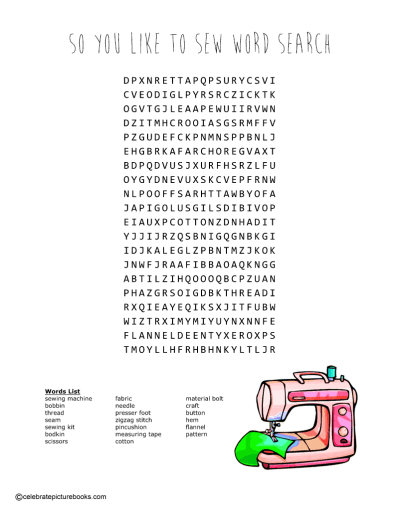
So You Like to Sew Word Search


Sewing has a vocabulary all its own! Find the words related to this fun hobby in this So You Like to Sew Word Search puzzle! And here’s the Solution!

June 11 – World Doll Day

celebrate-picture-books-picture-book-review-this-is-my-dollhouse

About the Holiday

World Doll Day came about through the efforts of Mildred Seeley, a doll collector and prolific author on doll-making and -collecting subjects and founder of Seeleys, the leading maker of porcelain dolls.Her collection of French dolls broke records when it sold in 2002. In 1986 she wrote an open letter to all media outlets and doll enthusiasts to join her in creating a special holiday about dolls on the second Saturday of June each year. Seeley envisioned World Doll Day as a time when dolls could be gifted to loved ones and strangers alike, promoting more universal understanding. She also hoped that museums, libraries, and stores would create interesting exhibits and that magazines and newspapers would run special editions. If you have a special doll collection, share it with others today, and if you know of a child or adult who would love a new or family heirloom doll, consider buying or giving them one!

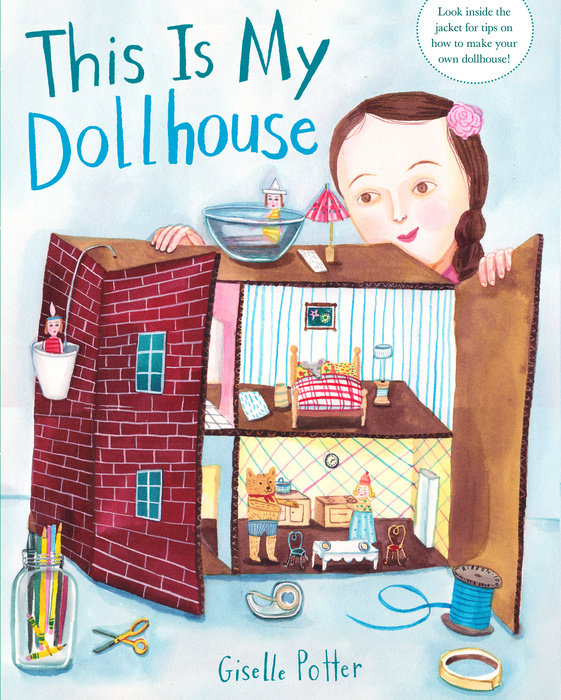
This Is My Dollhouse

By Giselle Potter


A little girl loves playing with her dollhouse every day. Her dollhouse began as a normal cardboard box, but the girl painted brick walls on the outside, divided the box into rooms, and drew wallpaper in each with her markers. Ingeniously, she filled the rooms with homemade furniture—a small box with a window cut out and a magazine picture placed inside became a TV; a wooden block decorated with burners and a door became an oven; a scrap of carpet became a rug, and the family eats pasta made from small bits of yarn served in a bottle cap.

Her diverse dollhouse family consists of Grandma Mousey, a toy mouse; Mommy, a doll with blond hair; Daddy, a stuffed teddy bear; and twins Lucy and Lola, two small dolls. Each morning Lucy and Lola dress in their fancy clothes made of ribbon. Mommy serves them fried eggs, which just moments ago were white circles of paper with colored yellow centers. After breakfast the twins ride the paper cup elevator to the cardboard box roof, where a bowl of water swimming pool awaits.

Later the pair relaxes in front of the TV while Daddy gives them tiny tissue-paper popcorn. When day fades into nighttime, the little girl tucks the whole family into the big bed and sings them a lullaby.

The girl has a friend named Sophie, who also has a dollhouse. Hers is store-bought and has perfect figures with painted on clothes, staring dot eyes, and plastic hair. All the furniture matches and the refrigerator comes stocked with plastic food. When the little girl visits Sophie they play with the dollhouse. The girl suggests various imaginative scenarios for the family—going on vacation, getting a new dog to walk, having the boy break his leg—but Sophie rejects her ideas. She doesn’t have an airplane for a vacation, the stuffed dog does not belong to the family, and the notion of a broken leg only elicits a look.

celebrate-picture-books-picture-book-review-this-is-my-dollhouse

The girls soon tire of their game and head outside. On the way home the little girl worries that if  Sophie came to play at her house she would hate the homemade dollhouse. Sophie does come over to play, however, and in preparation the girl hides her dollhouse under a pile of blankets. It doesn’t take Sophie long to uncover the dollhouse and want to play with it. The girl is so nervous about how Sophie will react to her “not perfect” toy that her knees begin to itch and a lump forms in her throat, but as they open the dollhouse, her fears are allayed.

The normal daily routine of the girl’s dollhouse family enchants Sophie, and she quickly takes up the whimsical scenarios she had rejected at her own house. All too soon Sophie’s mom arrives to pick her up. Given the promise that she can return tomorrow, Sophie heads home while the little girl makes plans for Lucy and Lola’s birthday party.

Doll and dollhouse lovers, crafters, artists, miniaturists and anyone with a fanciful bent will be charmed by Giselle Potter’s This Is My Dollhouse. The story of two friends from homes with different philosophies resonates beyond the subject of the two dollhouses. Being open to new experiences, allowing freedom of imagination, as well as having pride and confidence in one’s own talents and preferences are strong themes treated sensitively while set amid inspired creativity.

Potter’s folk-art-style illustrations are colorful and reinforce the homey appeal of handcrafted toys. Each page organically contains ideas for using recycled and common household items to make cute dollhouse furniture and objects. Inside the book jacket are more illustrated ideas for building a homemade dollhouse. Kids and adults will be inspired to save thread spools, corks, clothespins, ribbon, small bottles, and other items and will begin looking at common objects in a new light.

Ages 4 – 9

Schwartz & Wade Books, Random House, 2016 | ISBN 978-0553521535

World Doll Day Activity

celebrate-picture-books-picture-book-review-dollhouse-coloring-page


Dollhouse Coloring Page


Here’s a cute dollhouse that you can add to and color! So grab this printable Dollhouse Coloring Page and get creative!

Picture Book Review