April 16 – National Stress Awareness Month

About the Holiday

Stress Awareness Month has been held every April since 1992, when it was founded by the Health Resource Network. The holiday aims to help people identify the stress factors in their own life as well as to assess how all members of their family are handling various pressures. The goal is for everyone—either individually or together—to look for ways to manage their feelings while adding positive changes to their life. Talking about pressures with kids and doing simple activities with them can often help lessen the load. Sharing today’s book is a wonderful place to start!

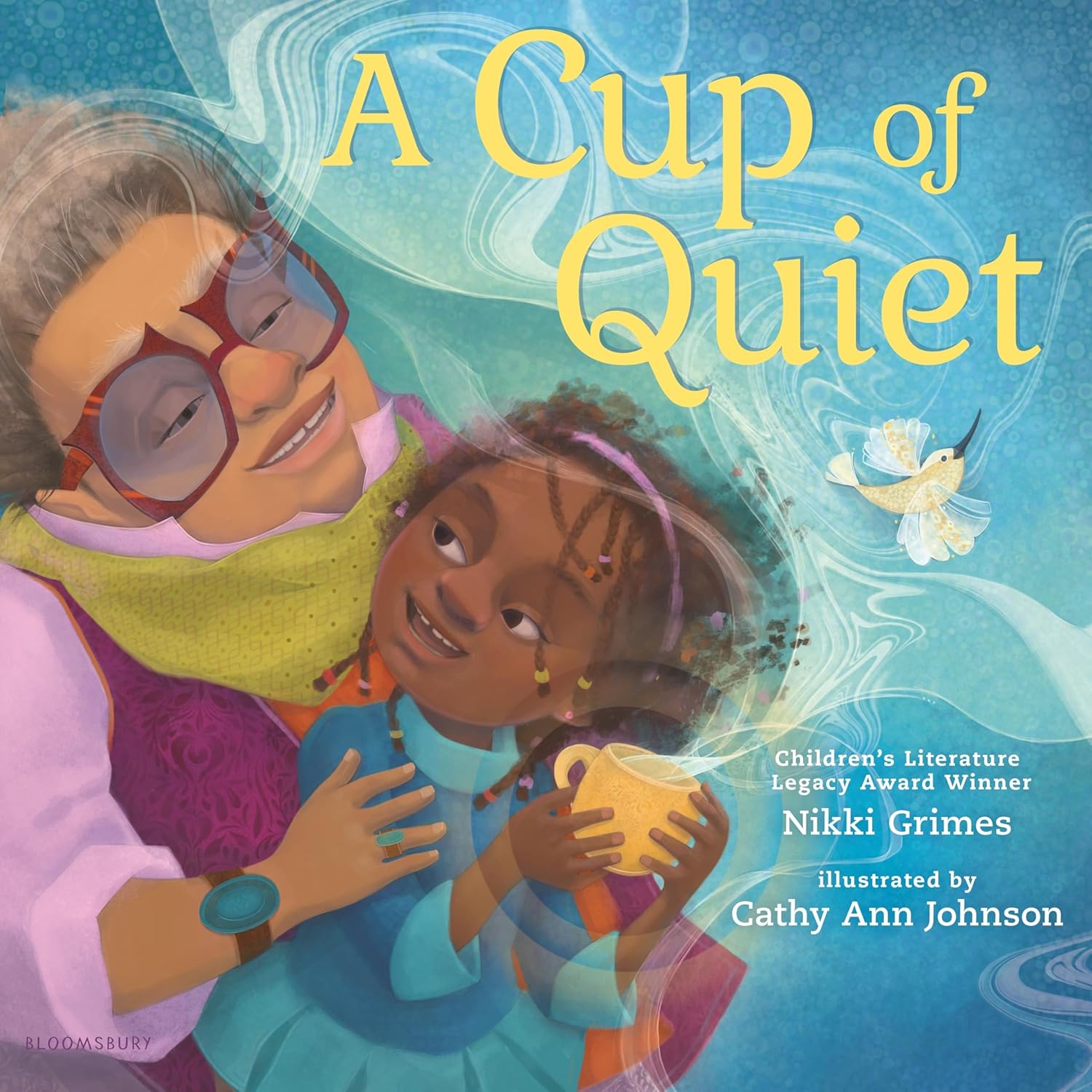
A Cup of Quiet

Written by Nikki Grimes | Illustrated by Cathy Ann Johnson

“You ever hear of smiles?” The young narrator’s talking about the two-week “summer camp” she gets to spend with her grandmother every June. In that breathless excitement of children, she reveals the visits give her and her Grandma time to “stitch sock puppets and put on shows, bake Martian Cake that tastes like banana bread and play tea party in the garden with my dolls.” But today, they’re acting out a story—that is until Grandpa’s hammering and loud music become just too much.
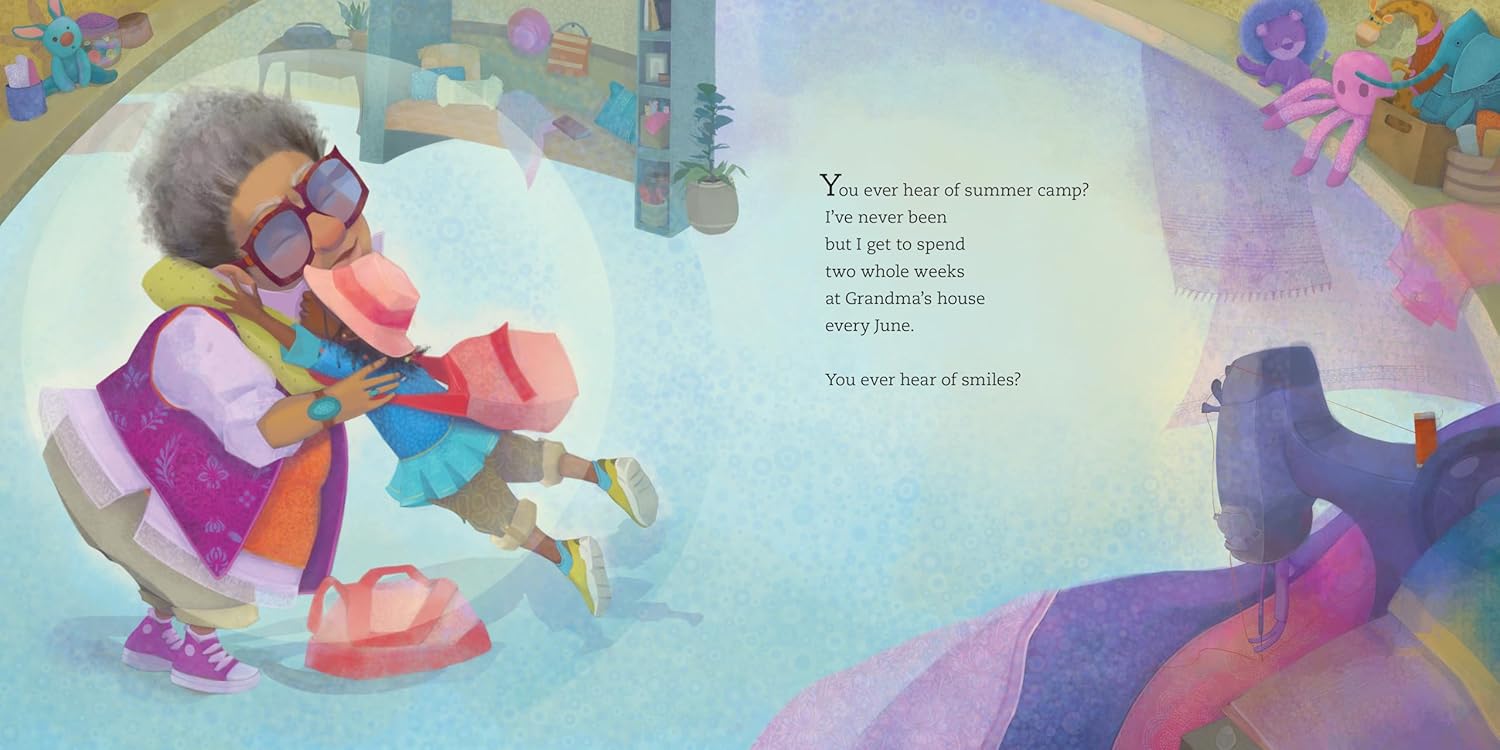
Illustration © 2025 by Cathy Ann Johnson, text © 2025 by Nikki Grimes. Courtesy of Bloomsbury Children’s Books.

Grandma flops into her chair with an “Ugh!” and tells her granddaughter she’s “thirsty for a cup of quiet.” This elicits a giggle and a bit of disbelief, but Grandma’s done with the noise and leads her granddaughter outside to the porch swing. But the city outside their house is just as noisy as Grandpa inside. A trip to the backyard garden is needed. Here, Grandma may be happy, but the narrator is getting fidgety.
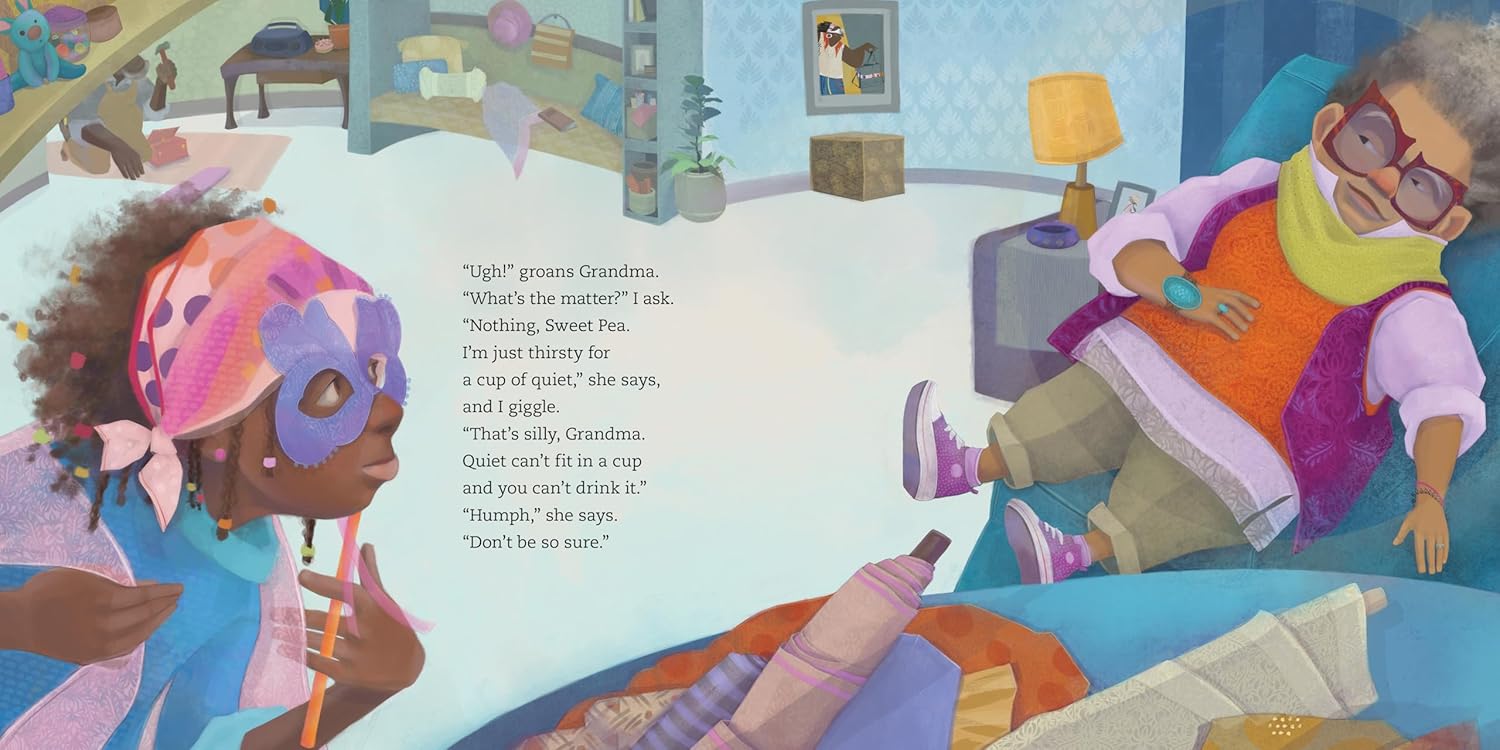
Illustration © 2025 by Cathy Ann Johnson, text © 2025 by Nikki Grimes. Courtesy of Bloomsbury Children’s Books.

Grandma gives her the side-eye and then hands her “an invisible cup” with instructions to “‘walk around the garden and fill this up with any sounds you hear.'” Up for this imaginative challenge, the girl first visits the rose bushes, where a bee is working and “snap[s] up a handful of his buzzing and drop[s] it in the cup.” On the ground below she sees a lizard and “spoon[s] up” the sound of its “scuttling across a dried leaf.” She begins paying more attention to the nature around her and listening harder to fill her cup.
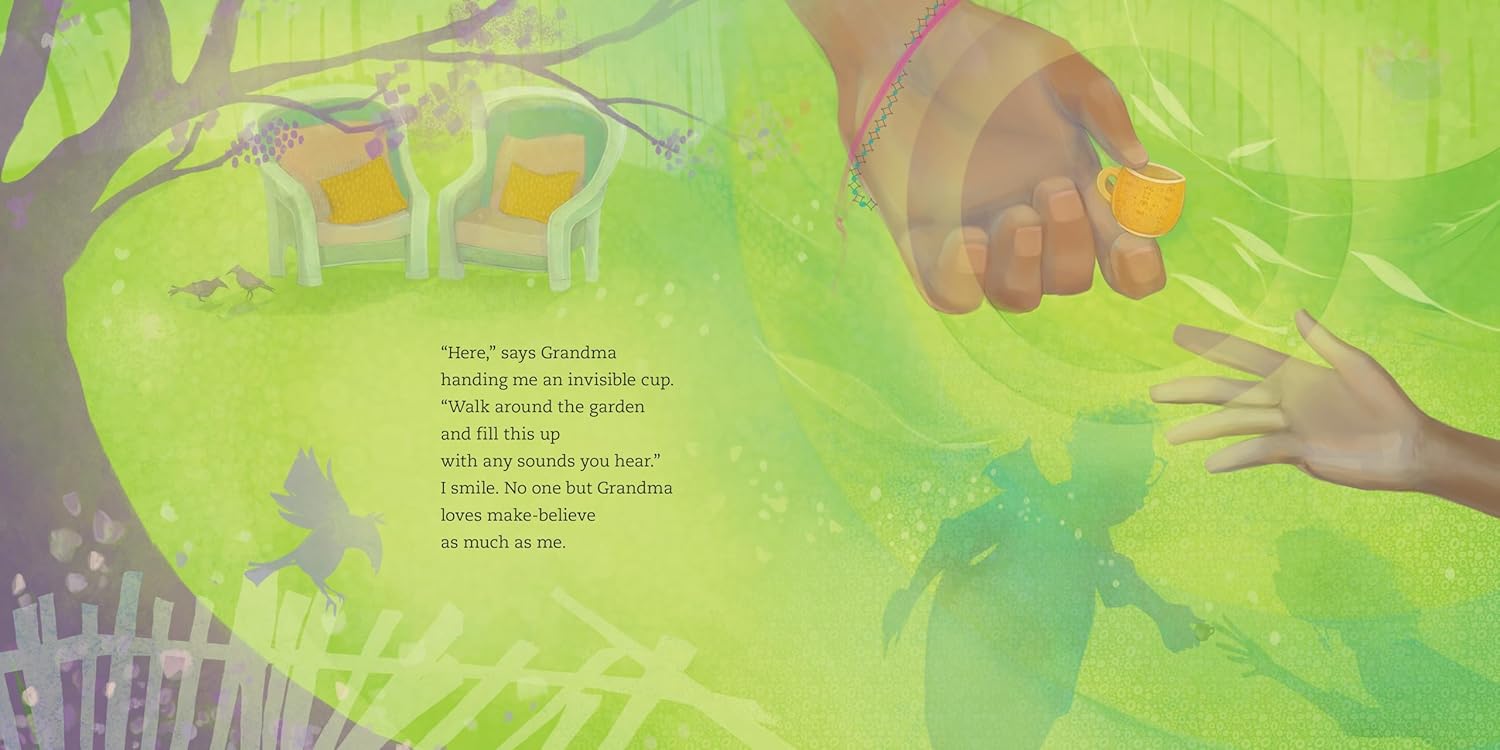
Illustration © 2025 by Cathy Ann Johnson, text © 2025 by Nikki Grimes. Courtesy of Bloomsbury Children’s Books.

A sudden thunderclap precipitates a downpour, but before she runs inside with Grandma, the narrator adds the first pings of raindrops on the roof to her nearly full cup. After drying off and changing, it’s finally time to enjoy a long sip from that make-believe cup. Ahhhh! So “‘refreshing!'” Her granddaughter thinks so too. Still, she has an observation: “‘… your quiet is awfully noisy!'” Grandma smiles and says, “‘I know, but Nature’s noise is peaceful, and I love that.'” Her granddaughter agrees—”You ever hear of perfect?”
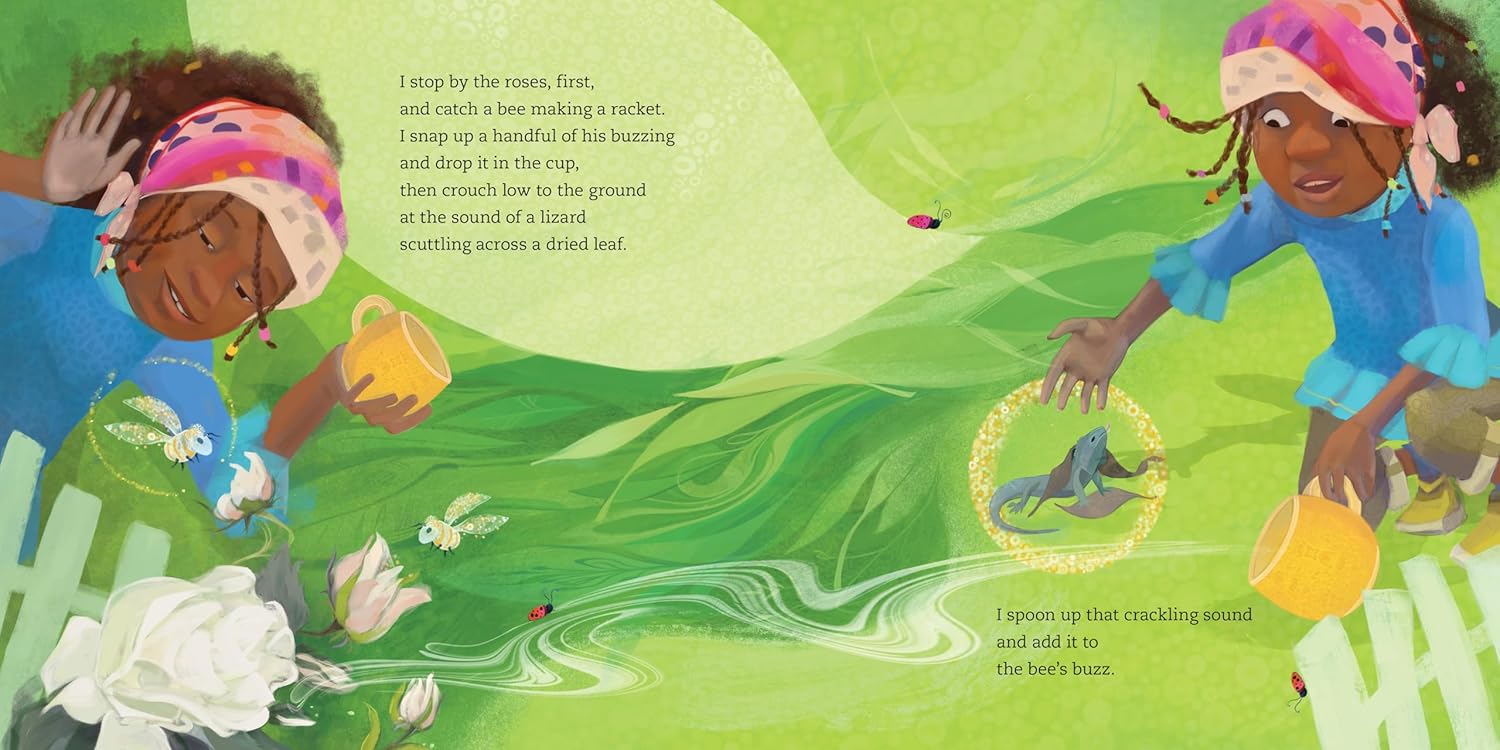
Illustration © 2025 by Cathy Ann Johnson, text © 2025 by Nikki Grimes. Courtesy of Bloomsbury Children’s Books.

Nikki Grimes invites readers to join in with a grandmother and granddaughter for a day of “summer camp” where love abounds. The easy banter between the two and affectionate gestures—such as Grandma’s playful tug on her granddaughter’s braid and the jump-into-her-arms hug the girl gives her grandma—immediately envelope both child and adult readers in this pair’s warm relationship. Grimes’ inventive call to interact with nature and find comfort there will have kids carrying their own imaginary cups to fill and spark other creative games and activities no matter where they live. 

Cathy Ann Johnson’s collage-style, mixed-media illustrations sweep readers into the creative and close-knit atmosphere of Grandma’s house during a week-long visit by her granddaughter. The vibrancy of the pair’s connection is shown through the colorful textures of the fabrics they use for crafting. The allure and importance of nature is likewise emphasized through the vivid greens and swirling motion in the grandmother’s back garden as well as the shimmering beauty of the creatures from which the girl collects sounds. The grandmother and granddaughter’s close bond is evident through their hugs, the way they sit close together (even touching hands while sitting in separate garden chairs), and the care Grandma provides after the rainstorm. The grandmother’s expressions are amusing in their honesty, and the look of wonder in the granddaughter’s eyes is inspirational.

Lyrical, playful, and full of love, A Cup of Quiet is a warm hug of a read aloud that adults and kids will love sharing again and again. The book is a must addition to school library, public library, and home collections.

Ages 3 – 7

Bloomsbury Children’s Books, 2025 | ISBN 978-1547610730

A Talk with Nikki Grimes
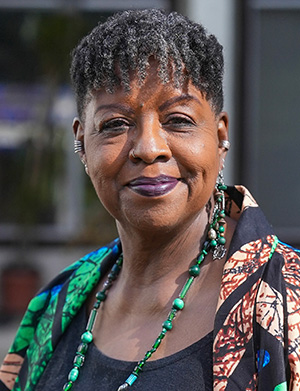
Photo Credit Marchel Hill

New York Times bestselling author Nikki Grimes was inducted into the Black Authors Hall of Fame in 2023. Her honors include the CSK Virginia Hamilton Lifetime Achievement Award, the ALAN Award for significant contributions to young adult literature, the Children’s Literature Legacy Medal, and the NCTE Award for Excellence in Poetry for Children. Author of the Coretta Scott King Award-winner Bronx Masquerade, and five Coretta Scott King Author Honors, she won the Printz Honor and Sibert Honofor her memoir Ordinary Hazards. Her latest titles include Garvey’s Choice:The Graphic Novel, a School Library Journal 2023 Best Book; Lullaby for the King, one of Book Riot’s 25 Best Christmas Books of All Time; and A Walk in the Woods, recipient of 8 starred reviews, and 11 Best Book listings for 2023, including the New York Times, NPR, and Smithsonian Magazine. Ms. Grimes lives in Corona, California. You can visit her at nikkigrimes.com.

Today, I’m honored to be talking with Nikki Grimes about the inspiration behind A Cup of Quiet, how she develops her characters, the joys and challenges of writing for multiple age groups, and much more!

A Cup of Quiet is a perfect book for adults and children to share, not only for outside noise but for times when life gets overwhelming.  Tell us about the inspiration for this story and a little about its journey to publication.

There’s a certain quality of quiet in nature that I’ve always found soothing. I need silence for my work because it allows me to concentrate fully when I write. But nature’s quiet is different. It’s rich with sound, but most of it requires you to pay close attention. To pick up the whir of a hummingbird’s wings, you have to be still, and you have to strain to hear it. The stillness that’s required is soothing, and the sounds you become attuned to are a healing balm. I wanted to write a story that celebrated those sounds, and the beauty of that kind of quiet.

In the early stages of the book, I’d go out to my garden and listen carefully, and I’d make mental notes of all that I heard that day. I’d jot everything down until I had a good list of sounds to play with.

My main character lived in the city and didn’t spend much time out in nature there, though she occasionally went to the park. But every summer, she’d travel out of the city for long visits with her grandmother who had a garden, and whose house was surrounded by trees, and greenery.

The story grew from there, and I knew immediately that I wanted Bloomsbury to publish the book, and I also knew intuitively who I wanted to illustrate—namely Cathy Ann Johnson. This teaming has proven to be perfect, all around.

If I had a cup to fill with quiet today, I’d add my cat’s little sleepy, dreamy purrs, the whoosh of cars passing my house, the rustle of squirrels in the trees, and a drop of water from my bubbling teapot. What would you put in your cup of quiet today?

I would put a bee’s buzz, the wind rustling leaves of a tree, the whir of a hummingbird’s wings—all the sounds I chose for A Cup of Quiet. Those are some of the sounds I listen for, and pay attention to, whenever I immerse myself in nature.

Cathy Ann Johnson’s mixed-media illustrations are a wonder of color, motion, humor, and the love between grandmother and granddaughter. What was your first impression when you saw her illustrations? Do you have a favorite spread?  Why is it a favorite?

First, I was over the moon for the grandmother! She had energy, and spunk, and style. I loved her!  And I loved her colors. Then, as I saw the book’s interiors, I was absolutely thrilled! Cathy Ann’s images, and their movements, were as lyrical as my own words. Our partnership on the page was the proverbial match made in heaven. I would be loath to choose a favorite spread.  Each one has its own magic.

A Cup of Quiet starts out “You ever hear of summer camp?”—a disarming introduction to the child narrator that’s so true to the way kids approach conversation. The dialogue in all of your work sings in this way with the kind of honesty, humor, emotion, and depth that makes your characters seem almost physically with the reader.  I’m curious about your process in developing your characters and stories.

My characters begin with a voice. I’ll hear a scrap of dialogue in my head—nothing extensive, just a few lines. The inspiration might come from the catalog of voices I’ve stored in memory over a lifetime of listening to people around me, or it might be the voice of a particular person in my life whose voice is special or one that has simply stayed with me for a long time. Either way, the voice feels familiar. I’ll jot down that scrap of dialogue as reference, then I’ll begin developing a character sketch and that character’s backstory. I never know how much or little of the backstory I’ll use, but that information guides me as I write. To nail the voice, I have to pay close attention. I climb into the character’s skin and look at the world from his or her perspective and write from that place, attuning myself to that character’s age, birth place, geographical region, quirks, fears—all of it guides me as I make decisions about what that character will say, how they’ll respond to various stimuli that shows up in the plot. If I step wrong, the character will bristle and call me out on it, almost audibly. “Do not put those words in my mouth! I would never say that!” or “I don’t speak like that!” It’s kind of eerie, actually. Characters can be very bossy!

You write books for all ages, from picture books to middle-grade to young adult. Can you talk a bit about the joys and challenges of each? What is one message you want readers in each age category to take away from your books? 

Each age format comes with its own set of limitations, constrictions, and also its own range of possibilities. I love mixing it up. Writing for different age groups keeps me on my toes. The picture book gives you very little room to develop character and plot, while, say, a young adult novel gives you so much unlimited space that you run the risk of overwriting, and of getting lost in the weeds of your plot, or tangled in the layers of your story. Being consistent with your tense or bookending your story in a way that is controlled and satisfying and that feels organic, is much more challenging in the long form of middle grade or YA storytelling.

Language choices are tricky, and different with each age group as well. You walk the line between accessibility and sophistication, between simplicity and complexity. The same variance is true of the emotional components appropriate for each age group as well. For those reasons, I think it’s wise to focus on one genre at a time until you work through the quirks of that genre and figure out a process that works for you. Then, by all means, go on and experiment with the next! It’s tough work, but I like that. For me, easy is boring!

As for your question about messages, I don’t write messages. I write stories. And a well-written story offers a number of ideas a reader might take away. It all depends on the particular reader. We bring ourselves to the page, as readers. Our own experiences, personalities, and what we need at a particular point in time, color what we see, what we notice, and what we ultimately take from a story. Of course, as the creator, I have a certain idea, or theme, I intend to weave into my story—and, by the way, it’s hard to know whether or not I’ve always succeeded—but I don’t worry about whether the reader will pick up on the specific note I had in mind. What matters to me is that, somewhere in the many layers of my story, readers find something valuable with which they resonate. Quite often, the things they find come as a surprise to me, but that’s okay. So long as they walk away with something of value to them, that’s all I can ask for.

While I read through your website, your generosity in sharing so much of your life really stood out.  I’m sure young readers and writers would love to know about when you first began writing and how you were recognized for your talent, having your first public reading when you were 13.  Could you share a little of our writing background with us?  What advice would you give to children and young adults who love to write and want to pursue it?

As I reference in my memoir Ordinary Hazards, and elsewhere, I started writing in earnest when I was six years old, and I did so because I would have burst, otherwise. I was so filled with the emotional and mental poison of anger, and pain, and confusion. I was desperate to get my feelings out, somehow. So, I began to pour those feelings onto a page. That’s how my writing began, but as I reached my teens, the idea of possibly pursuing writing as a career took root. I was encouraged by my father, by my sister, by the friends I dared share my poetry with, and later, by a couple of teachers.  At the same time, though, I also had peers who laughed me off the block for daring to dream of such a thing at all. But I decided early on to surround myself with other young people who nurtured dreams and goals of their own. Everyone else, I cut out of my circle. I refused to absorb the negativity of naysayers.

I encourage young people who have a heart for writing to read voraciously, and to read across genres.  Every genre has something to teach you, and the quality of your writing reflects the quality, variety, and breadth of your reading. So read, read, read.  

Next, write, write, write because writing is a muscle. You have to exercise that muscle if you want to become strong. There is no shortcut to excellence. And if you’re not going to pursue excellence, why even bother? Excellence is what your readers deserve. Remember: the world doesn’t need mediocrity, no matter what field you choose to pursue.

In addition to your many awards over the years, you received the Children’s Literature Legacy Award in 2017 and the Coretta Scott King-Virginia Hamilton Award for Lifetime Achievement Award in 2022. In 2023 you were inducted into the Black Authors Hall of Fame.  What does this recognition mean to you?

Recognition is affirmation, and who doesn’t appreciate that?  But an artist should never be satisfied to sit on their laurels. I use this recognition as fuel to keep pushing forward, to continue to stretch myself as an artist to try genres I’ve never attempted before, to explore forms of poetry I find challenging. Doing so keeps me alive, and grown, and excited about the work I’ve been doing professionally, now, for nearly 50 years. That way, even as I get old, my work never does!

What books of yours can readers look forward to next?

I have a new Dyamonde Daniel chapter book coming out in June.  It’s titled Loser, and it’s about healthy and unhealthy competition, and where to draw the line, especially when you’re competing with your best friend.

I also have a new picture book on the horizon, titled Stronger Than, a collaboration with Choctaw author, Stacy Wells and illustrated by E. B. Lewis, who I’ve worked with before. In this story, a Black Choctaw boy discovers the history of one ancestor who survived the Trail of Tears, and another ancestor who survived the Tulsa Race Massacre. Through their stories, he learns that he comes from stronger stock than he knew, and this knowledge helps him overcome one of his worst fears. I’m excited about both books, for very different reasons.

There are a few more books in production, as well, but it’s too soon to talk about those.

Is there a question I didn’t ask that you wish I had?  What would your answer be?

No. I think I’m about talked-out, for the moment!  This has been fun, though. And I hope you and the young readers in your life enjoy A Cup of Quiet.

Thank you so much, Nikki! It’s been terrific chatting with you! I wish you a wonderful spring and summer of nature’s refreshing quiet.
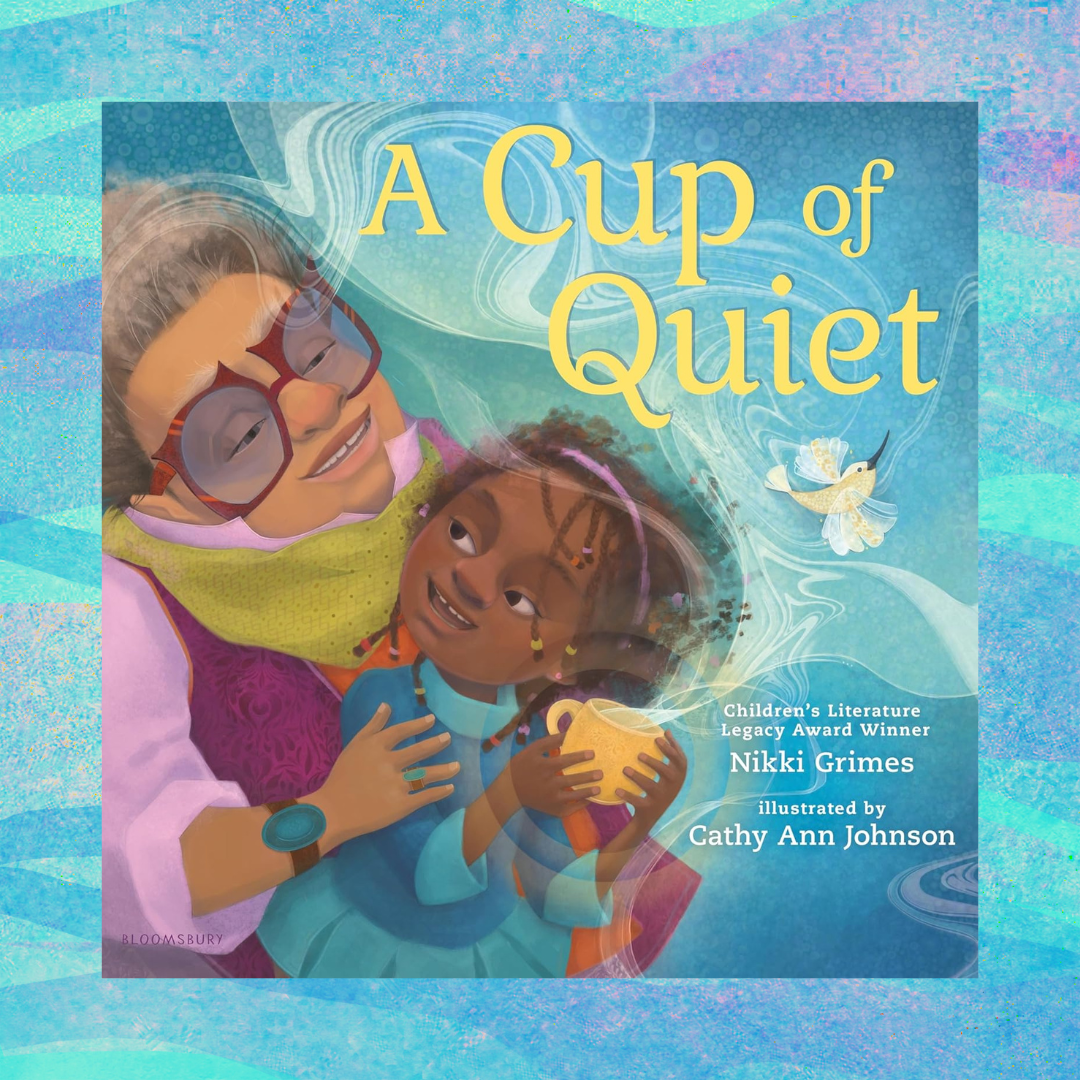
You can purchase A Cup of Quiet from these booksellers

Amazon | Barnes & Noble | Bookshop (discounted books and support for your local independent bookstore)

Picture Book Review

April 10 – National Wildlife Week

About the Holiday

National Wildlife Week, dating back to 1938, is the National Wildlife Federation’s longest-running education program. The celebration was designed to connect budding conservationists of all ages to the awesome wonders of wildlife. Each year, we pick a theme and provide fun educational materials and activities for educators and caregivers to use with kids. This year’s theme is Keep an Eye on the Wild. Conservationists and animal lovers are keeping a lookout for wildlife in the most unexpected places as we learn how we can keep their habitats safe and live in harmony with our incredible wild neighbors. Whether you keep your eyes out for the wildlife living near you with a “critter cam” or by walking around and paying attention to your backyard, neighborhood, and wider area, being aware of the creatures around you can help them survive for generations to come. To learn more about National Wildlife Week and find fun activities aimed at connecting kids with wildlife, visit the National Wildlife Week Kids Page!

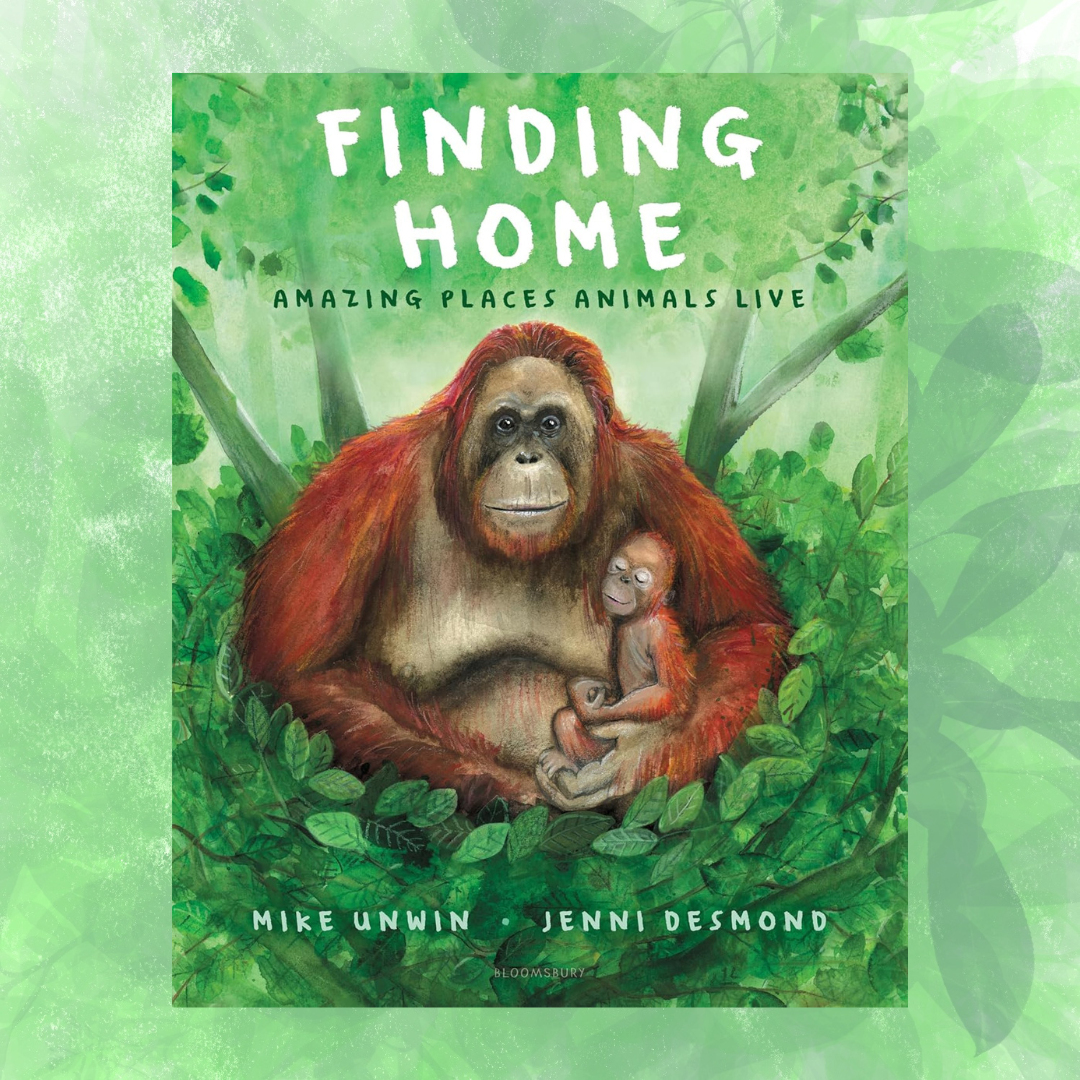
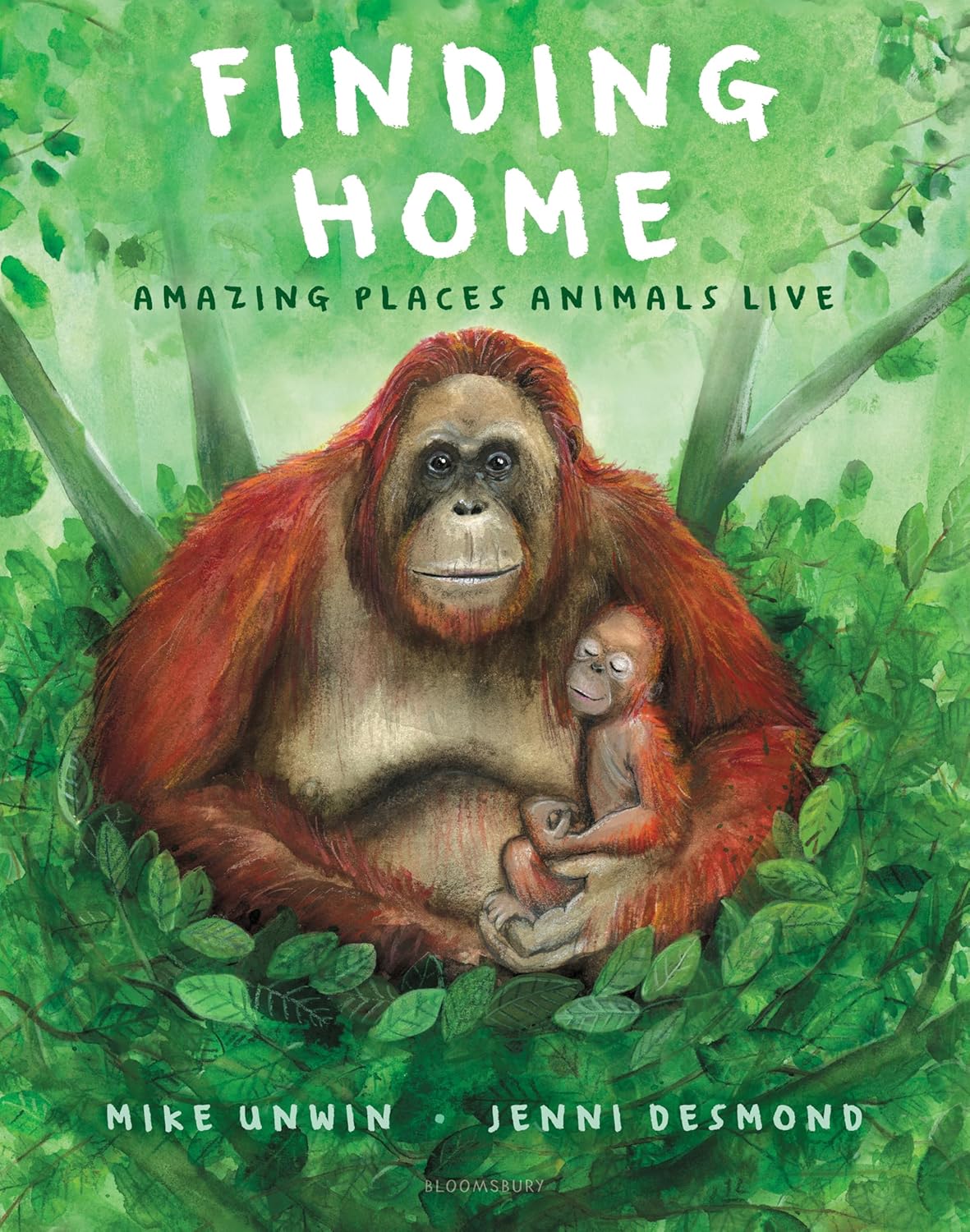
Finding Home: Amazing Places Animals Live

Written by Mike Unwin | Illustrated by Jenni Desmond


Finding Home begins: “Our planet is home to a mind-boggling number of different animals: at least 6,500 species of mammal, 10,000 species of reptile, 11,000 species of bird, and literally millions of insects. Every single one has its own home.” Just think of it! As your eye sweeps across any vista; as you walk across your yard, local playground, or favorite park, beach, or mountain trail, an untold number of creatures’ homes are within sight or underfoot. We know their names: Den. Nest. Burrow. Taxi (wait, what?). You’ll see, because in their astounding and gorgeous book, Mike Unwin and Jenni Desmond reveal that there is no such thing as a generic animal home.

Illustration © 2025 by Jenni Desmond, text © 2025 by Mike Unwin. Courtesy of Bloomsbury Children’s Books.

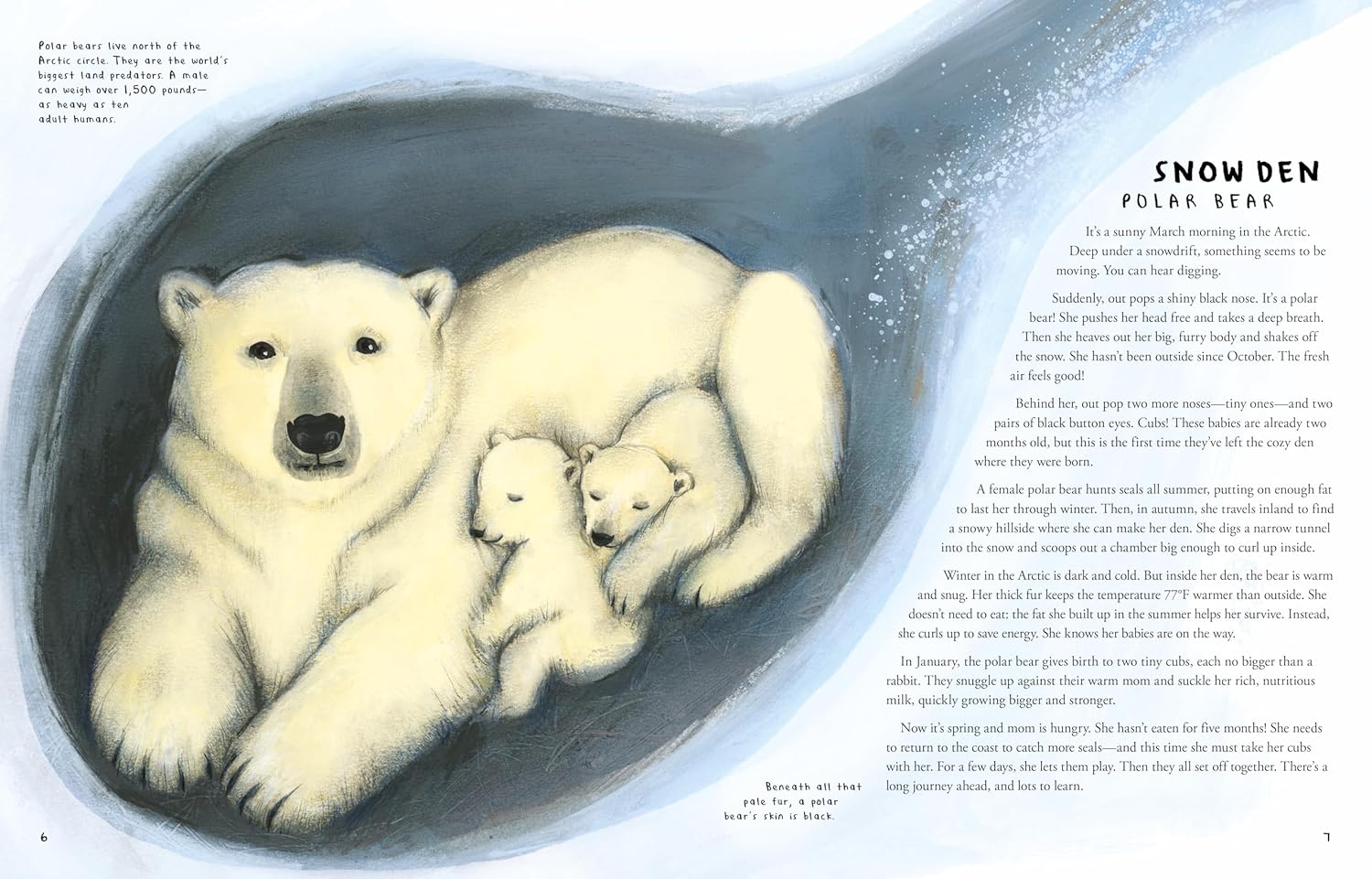
Take “den,” for instance—a polar bear’s snow den. Unwin and Desmond take you right inside this winter home, where a mother polar bear and her two cubs (born here in the cold of January) welcome you. As you squeeze inside, don’t worry about being cold. The polar bear’s “thick fur keeps the temperature 77°F warmer than outside.” 

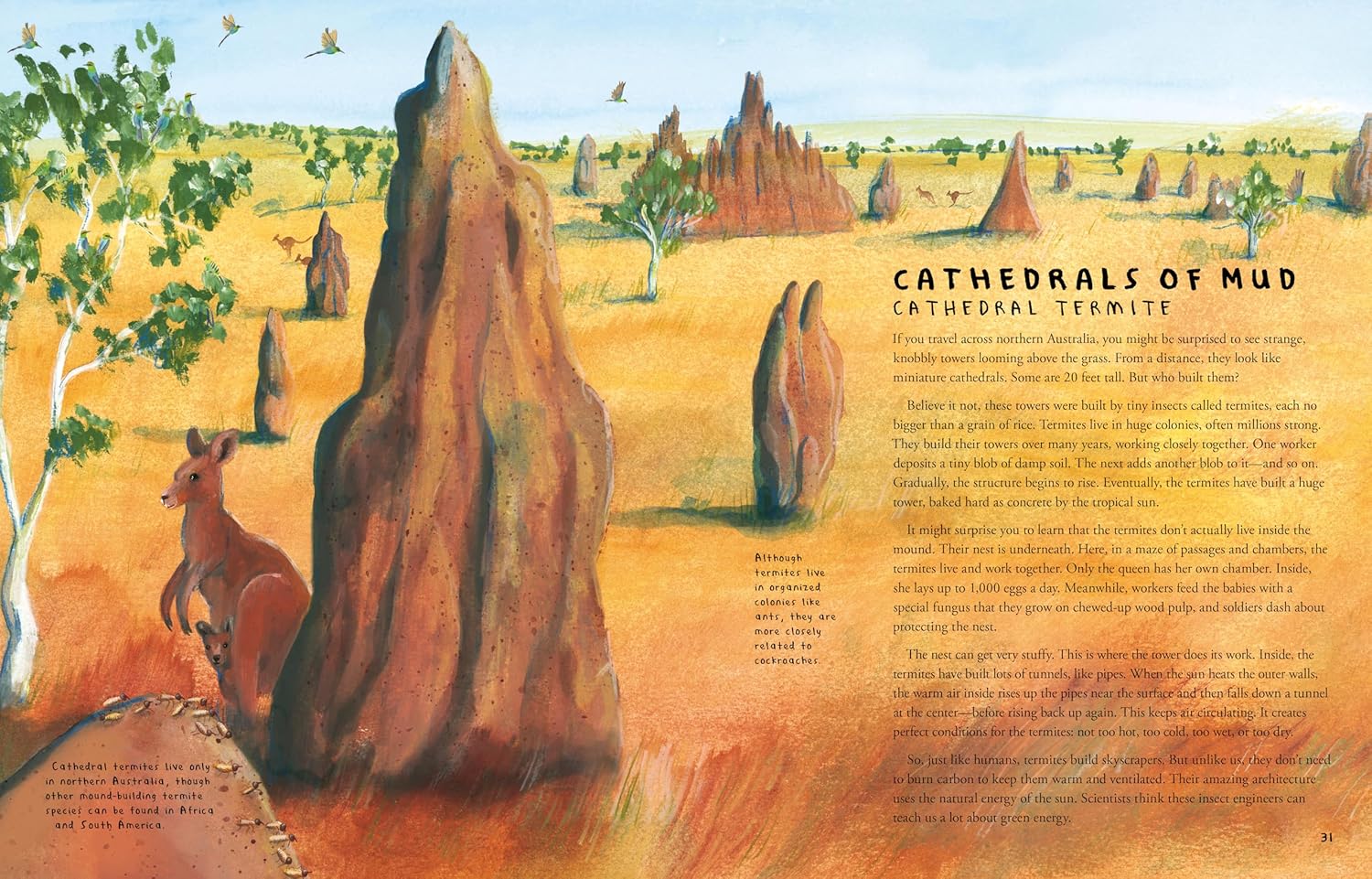
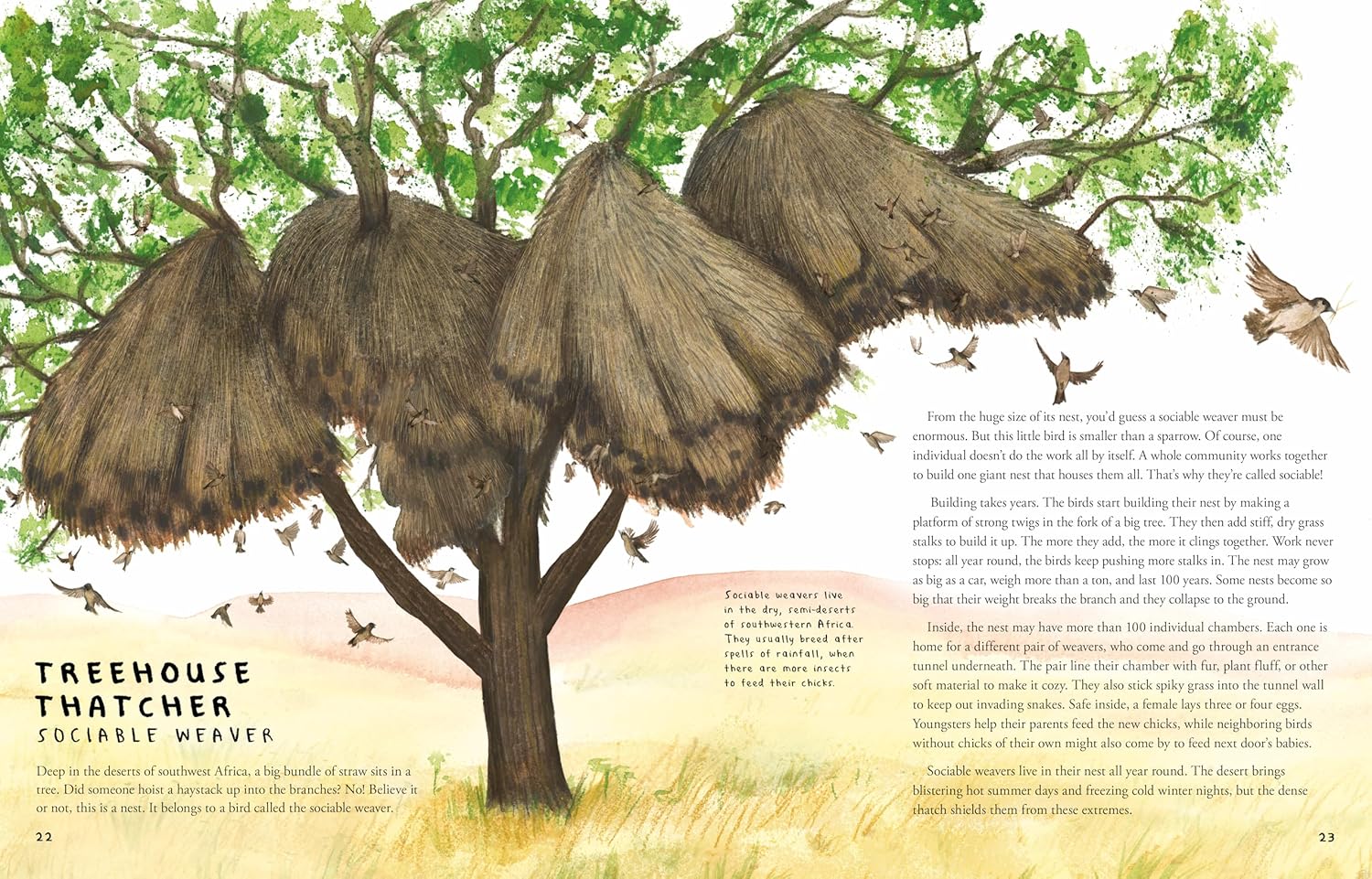
Next up is “nest.” These are bowls made from twigs, straw, and fluff and, sometimes, found objects like bits of paper or cloth, right? Well, yes—for some birds. But you won’t believe your eyes when you see what appears to be several haystacks lodged within a tree’s branches. This nest, constructed by a whole community of birds smaller than sparrows, can “grow as big as a car, weigh more than a ton, and last 100 years.” Like humans’ apartment buildings, the bird pairs that inhabit this nest look out for each other and help their neighbors. Kids will also be amazed by another type of bird that literally sews leaves together with “plant fiber and spider silk” to create their soft, deep nests.

Illustration © 2025 by Jenni Desmond, text © 2025 by Mike Unwin. Courtesy of Bloomsbury Children’s Books.

And how about “burrows?” Yep, Unwin and Desmond showcase a couple of pretty spectacular burrows too. Take the aardvark’s home. You won’t see an aardvark during the day. While the sun is up, they stay below ground, sleeping and tending to their young. It’s only after sunset that these unusual, ant-eating animals (including two-week-old babies) make an appearance topside. This is when they do what they do best: sniff out anthills and termite mounds, dig them up, and have dinner. It takes a hearty meal to satisfy an aardvark: “One aardvark can eat an amazing 50,000 ants and termites in a single night!”

Now, about that “taxi.” Children will be wowed by two, very different types of animals who prefer moving from one area to another by hitching a ride on another creature, from whom they can get food and other necessities of life while helping their hosts as well. Of course, the variety of animal homes don’t stop at these four. Every page transports readers to a different part of the globe to witness creatures of the air, sea, and land living in the home of their choice.

Unwin ends this fascinating travelogue with a map showing different ways some of the animals in the book tend to the environment, protecting it and keeping it growing for themselves and humans. He also includes a caution, reminding readers that “all these habitats . . . fit together like jigsaw pieces to make up planet Earth. And just like a jigsaw needs all its pieces, a healthy planet needs all its animals and their habitats.” Sadly, humans have not been good stewards of Earth’s bounty. “Today, scientists and conservationists are working hard to put things right.” But everyone is needed to make sure our environment is cared for the way we care for our own families. “Only then will planet Earth truly be home, sweet home.”

Illustration © 2025 by Jenni Desmond, text © 2025 by Mike Unwin. Courtesy of Bloomsbury Children’s Books.

Mike Unwin draws readers in with engaging storytelling that allows kids to easily understand how each animal goes about building their home and why it’s perfect for their lifestyle. Children also learn just as much about the animals as the homes they build, giving them deep and well-rounded knowledge of some of the most unusual birds, fish, mammals, and insects on our planet and how many of them benefit humankind. Unwin’s phrasing, vocabulary and conversational lilt make Finding Home a highly satisfying nonfiction read aloud for younger kids. Independent readers will eagerly dip into the book again and again to meet these intriguing creatures.

With the impact of a museum exhibit, Jenni Desmond’s rich, full-bleed illustrations will take your breath away with their stunning realism and personality. Some animals peek out at the reader, while others busily go about their work oblivious to outside interest. From grassy hillsides to treetop canopies to sunny Africa and the snowy Himalayas, Desmond takes readers on an around the world tour like no other.

Gorgeous, educational, and nature nonfiction at its best, Finding Home: Amazing Places Animals Live is a must for all classroom, school, and public libraries as well as for nature- and animal-loving kids and families.

Ages 5 – 8+

Bloomsbury Children’s Books, 2025 | ISBN 978-1547615100

About the Author

Mike Unwin has written more than 30 books for both adults and children, including the Encyclopedia of Birds and Migration. He is also a regular contributor to publications such as BBC Wildlife and RSPB Nature’s Home. In 2013 Mike was voted UK Travel Writer of the Year by the British Guild of Travel Writers. Follow Mike on Instagram @mikeunwin.wildtravel.

About the Illustrator

Jenni Desmond is the illustrator of more than 20 books, including MigrationThe Wolves of Yellowstone, and The Blue Whale. Her books have been translated into over a dozen languages. In 2016 she was made a Maurice Sendak Fellow and her book The Polar Bear became a New York Times Best Illustrated Children’s Book of the Year. When Jenni is not in her studio, you’ll find her cooking, cycling and looking for adventure. Visit her at jennidesmond.com and follow her on Instagram @jennidesmond.

National Wildlife Week Activity

celebrate-picture-books-picture-book-review-shark-fin-craft

Fintastic Shark Fun


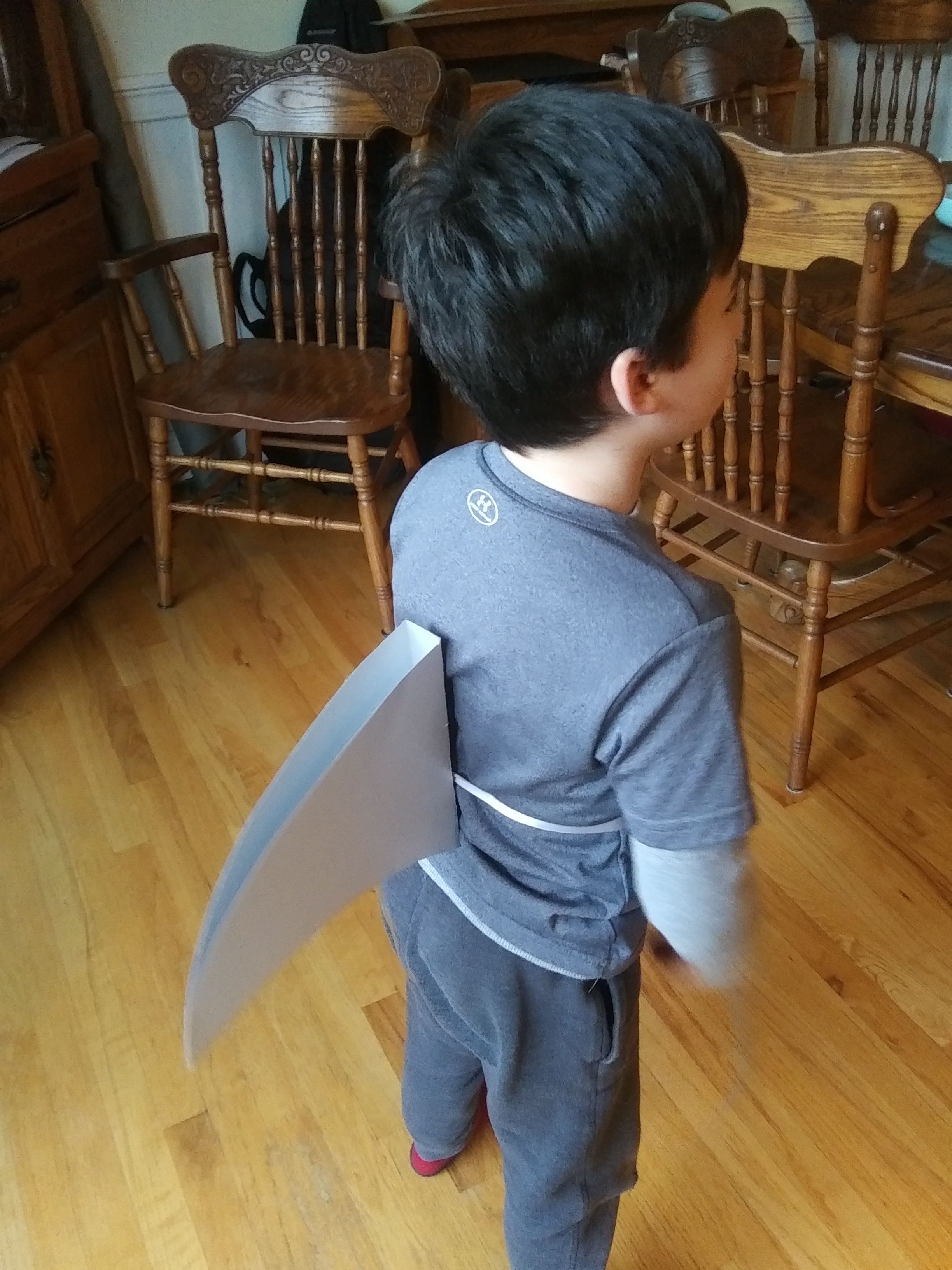
Sharks are awesome creatures and even feature as a home to another animal in today’s book! Follow the directions below and to make your own shark fin. 

Supplies

  • 2 pieces of 8.5 x 11 gray cardstock paper
  • Ribbon
  • Tape
  • Scissors
  • Pencil

fin outline white

celebrate-picture-books-picture-book-review-shark-fin

Directions

  1. Tape the top of the two pieces of paper together
  2. Fold them back together
  3. Measure an inch up from the bottom of the papers (the un-taped side) and trace a straight line across both papers
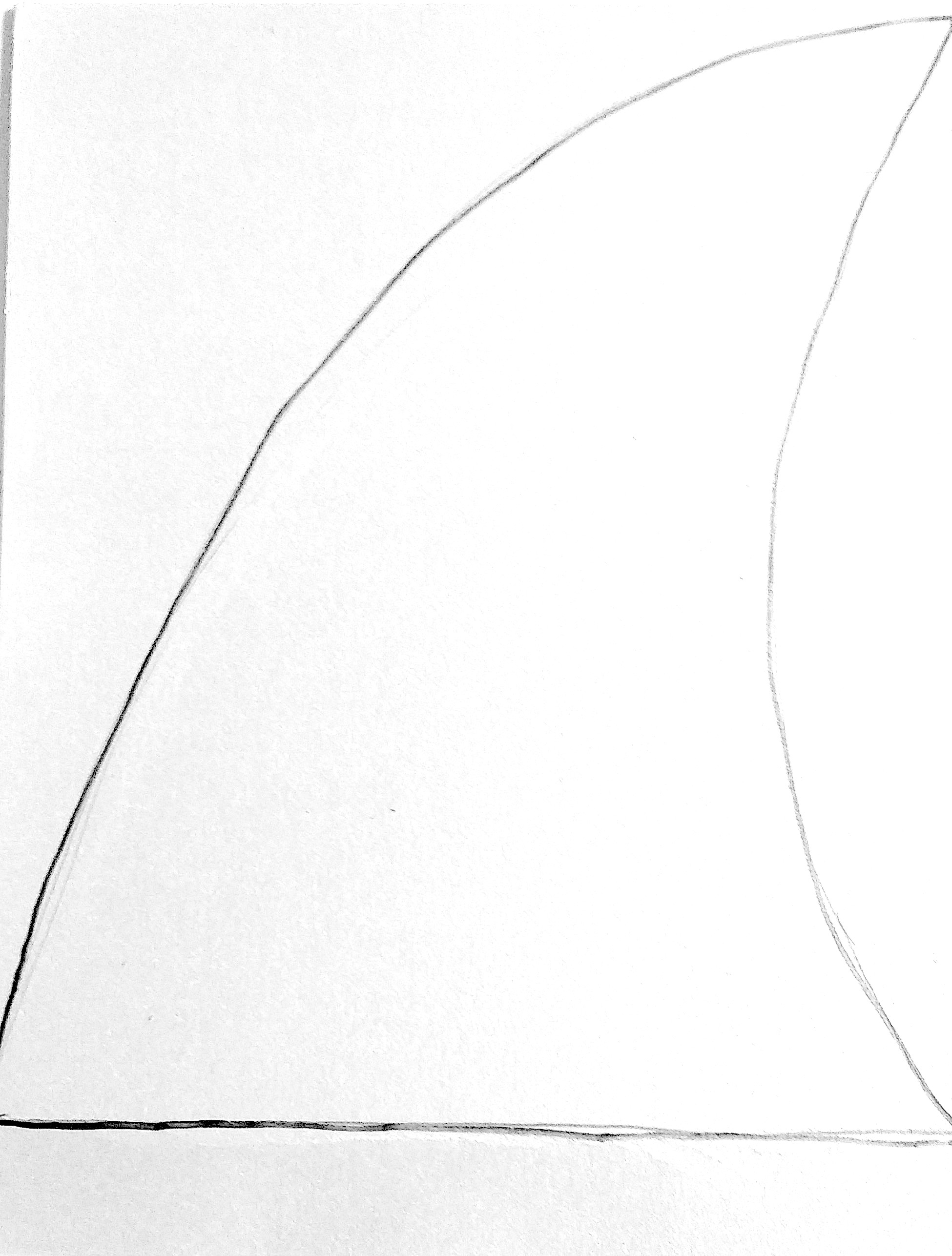
  4. Trace a shark fin outline onto your paper. The shark outline should stop an inch above the bottom
  5. Cut out the fin on both pieces of paper. If you should cut through the tape, re-tape the tops together
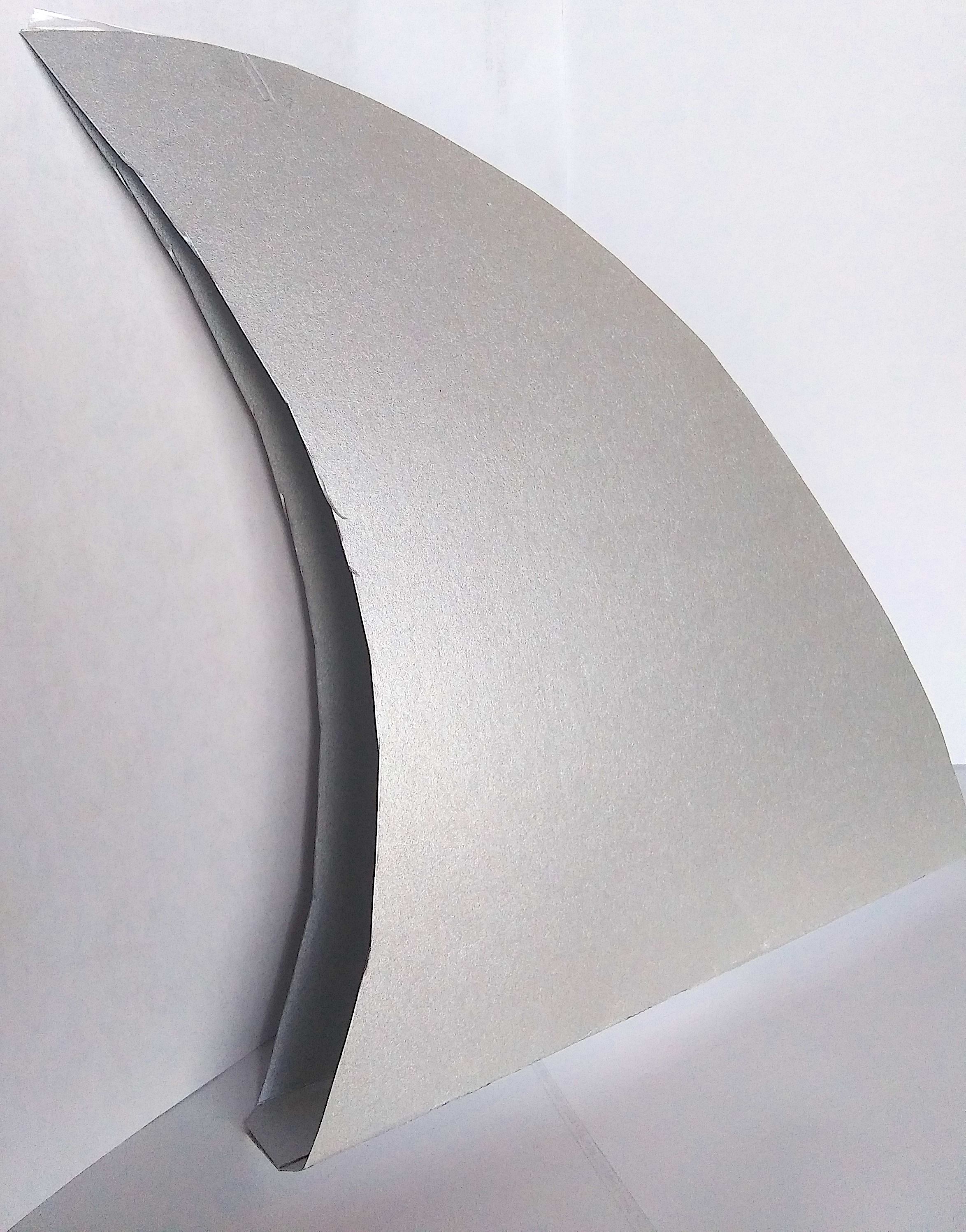
  6. Fold along the lines of both papers so the folds face towards each other.
  7. Tape the folds so the fin becomes a triangle
  8. Cut two slits parallel to the folded lines
  9. Thread ribbon through slits

You can purchase Finding Home: Amazing Places Animals Live from these booksellers

Amazon | Barnes & Noble | Bookshop (discounted books and support for your local independent bookstore)

Picture Book Review
April 1 – Reading Is Funny Day

About the Holiday

Funny stuff abounds on April 1st, so why not share funny books too? Books that elicit giggles are not only entertaining but contribute to a lifelong love of reading and help kids see the world in a new, positive, and even quirky way. To celebrate today, read some laugh-out-loud books with your kids and find new ones to add to your home, classroom, or library shelves. Today’s featured book is a perfect place to start!

Thank you to Bloomsbury Children’s Books for sending me a copy of We Are the Wibbly!: A Tadpole’s Tail for review.

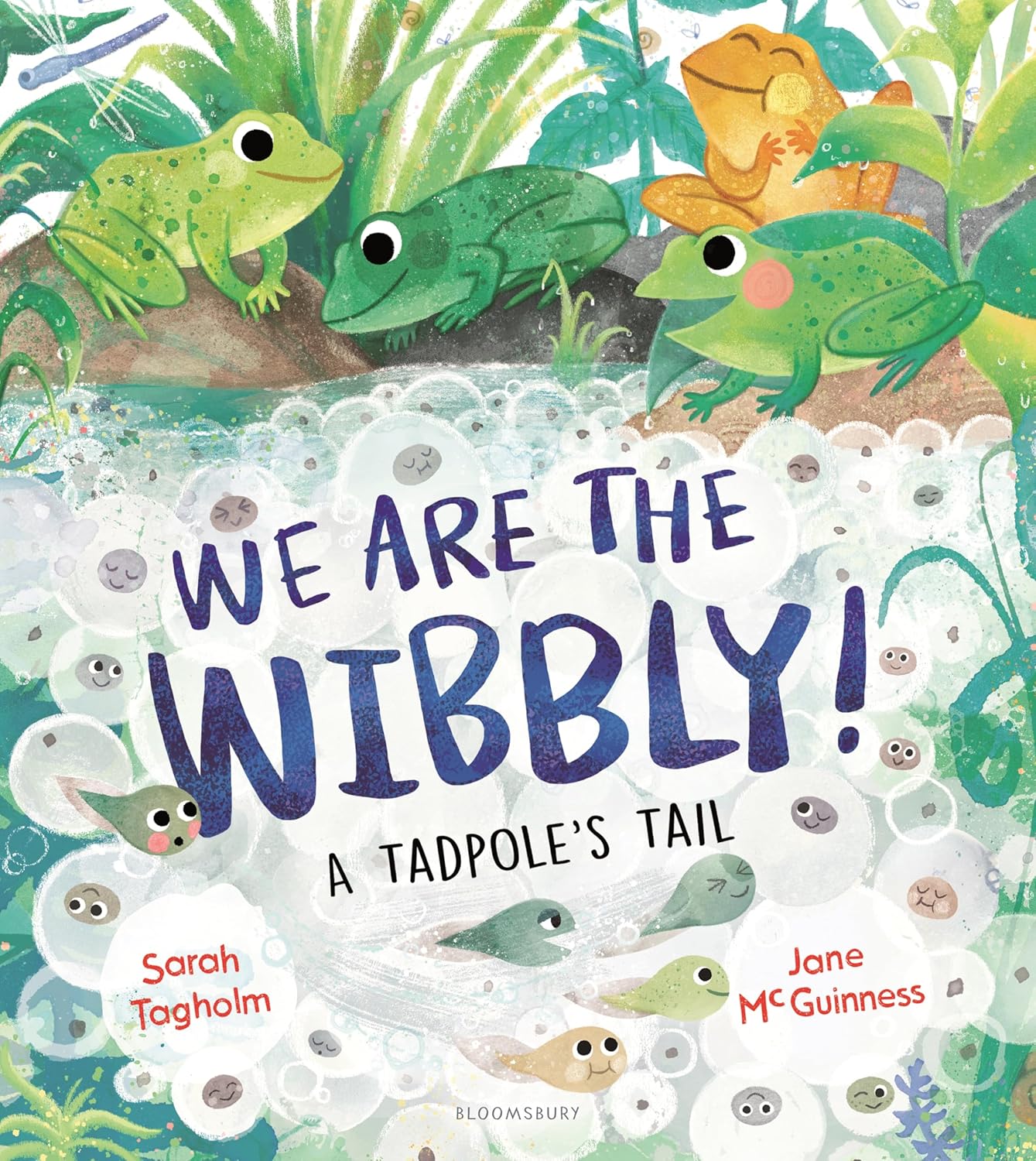
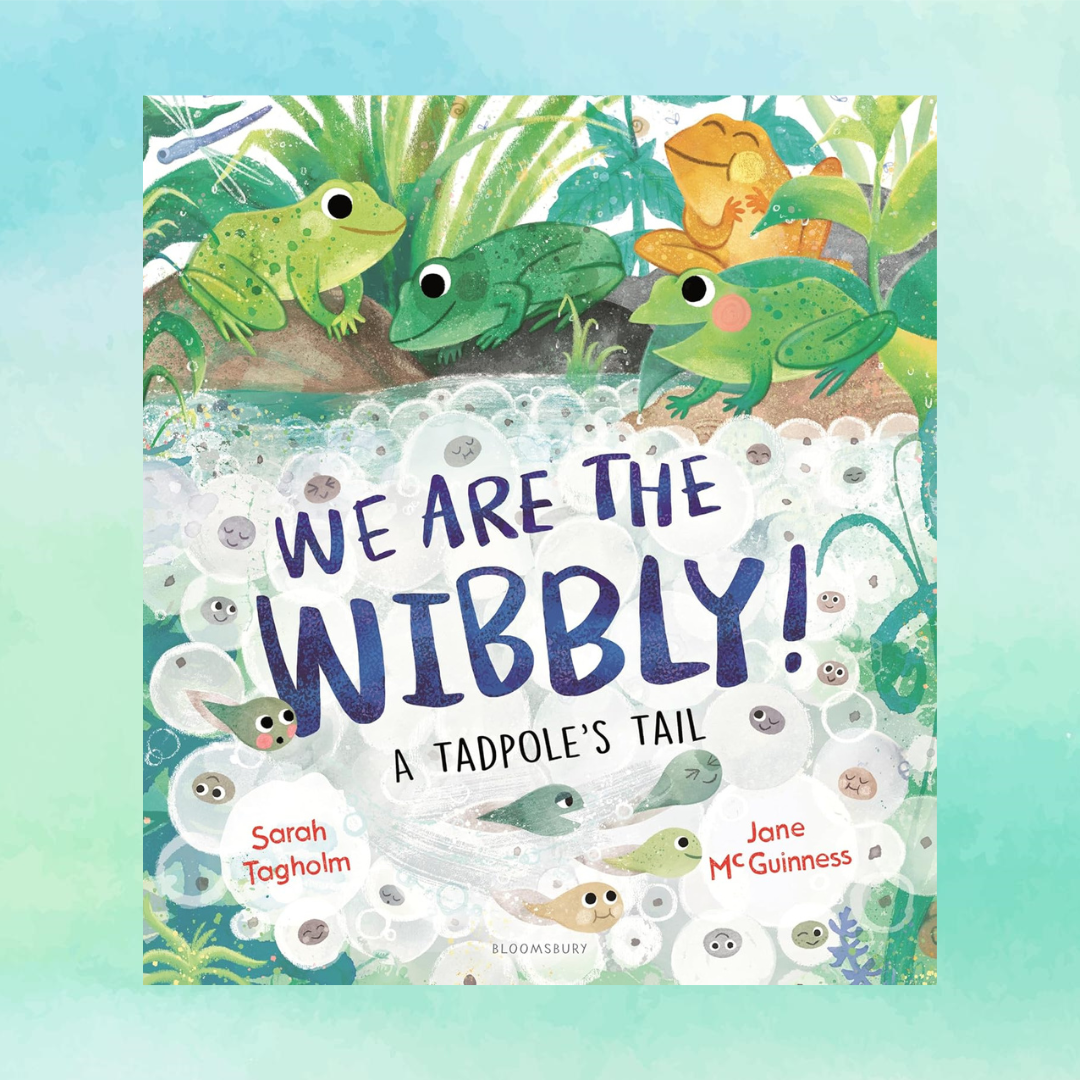
We Are the Wibbly!: A Tadpole’s Tail

Written by Sarah Tagholm | Illustrated by Jane McGuinness


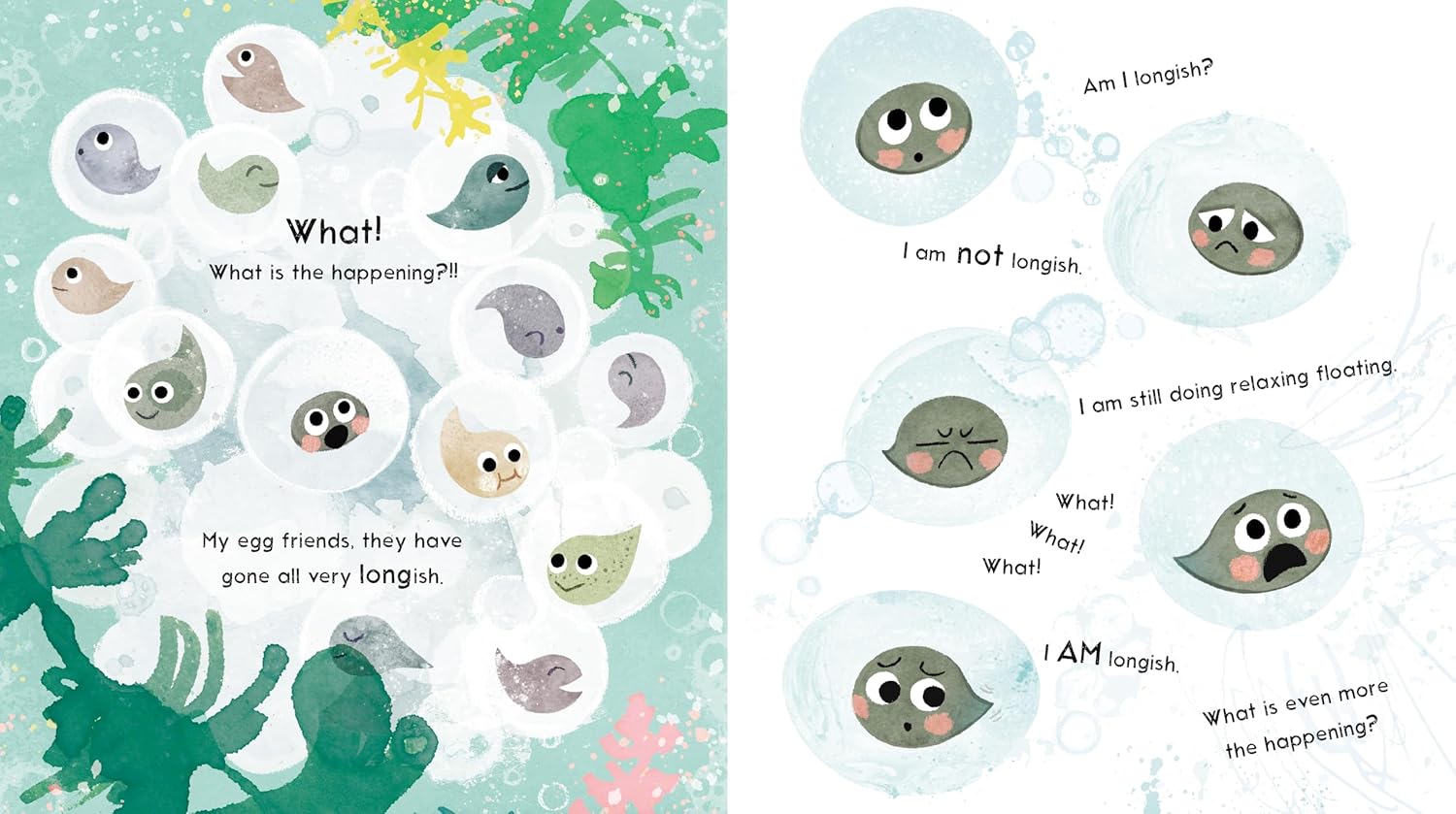
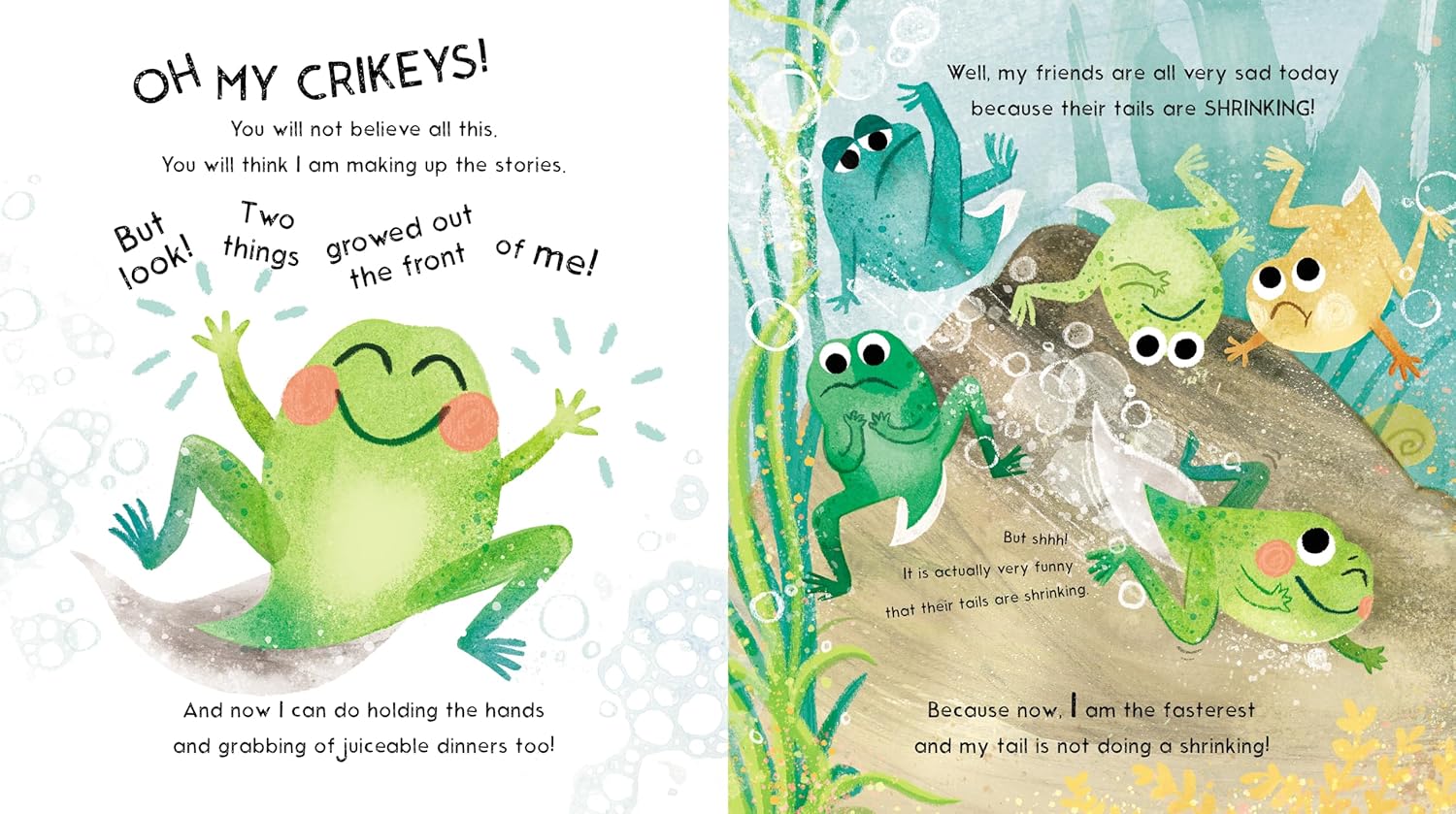
A sweet, pink-cheeked frog egg heartily addresses whoever is gazing down upon the frogspawn with a warm welcome: “We are eggs.” Then they add a little: “We are egg friends.”  They become loquacious: “We float and are all very relaxing. It is niceable.” You can feel it, right? Bobbing along within the pond grass? But suddenly confusion reigns. Our little egg watches the other eggs become “longish,” and then—”What! What! What!”—they become longish. And it’s not even a minute later that—”OH MY CRIKEYS!” everyone is “bursting out of the Wibbly” except them. 

Illustration © 2025 by Jane McGuinness, text © 2025 by Sarah Tagholm. Courtesy of Bloomsbury Children’s Books.

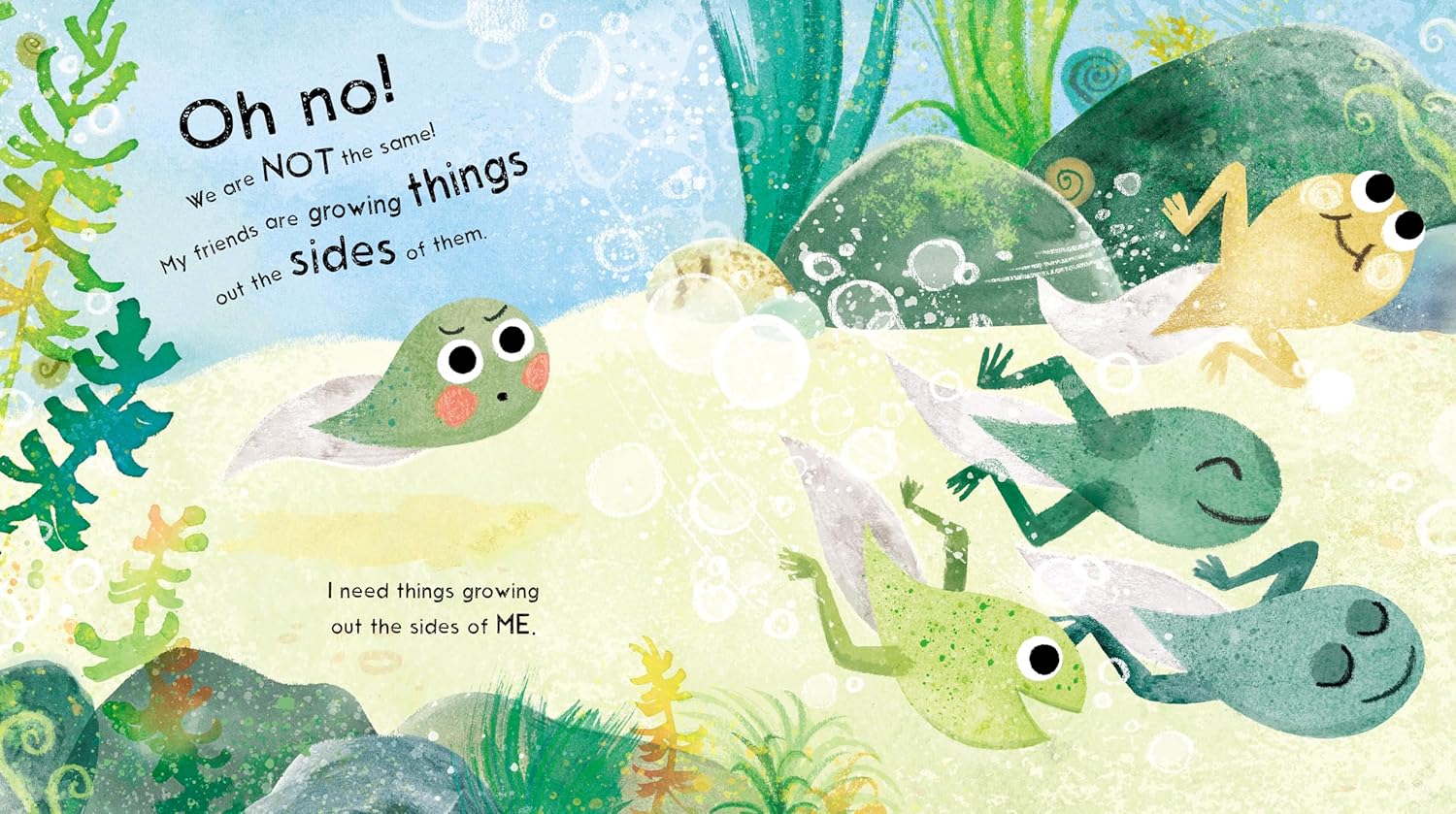
They try to call the others back, but it’s too late. Despite not wanting to, they break out of the wibbly too only to find that there’s so much more room now and, instead of relaxing, their friends are “water-flying.” They begin waggling their tale the same as everyone else and jet off too, only not as fast. Perhaps harkening back a moment or so to their younger self, they sharply regret the loss of doing relaxing: “We are too OLD for relaxing.” But they don’t have time for such reminiscences since a “hunger-muncher” is on the prowl. The extra impetus speeds up this little tadpole’s water-flying, and they’re happy to feel at last that “we are the same!” 

Always exceedingly alert if but a bit behind, the excitable tadpole suffers and then exults as the group and finally they themselves grow legs and arms. They become smug as they watch the others lose their tails “because now, I am the fasterest and my tail is not doing a shrinking!” They dart away, not realizing that they are also becoming a frog. 

Illustration © 2025 by Jane McGuinness, text © 2025 by Sarah Tagholm. Courtesy of Bloomsbury Children’s Books.

When a passing water beetle points the baby frog to “the Up” during their search for their friends, they break the surface of the water only to . . . “OH MY CRIKEYS! The Up is BAD!” . . . come face to face with a “furry danger-monster.” But this intrepid frog musters all their courage to “do a water-flying to get away” and discovers “air-swimming,” much to the astonishment of their friends who are watching nearby. The friends are all so impressed that they want to “do air-swimming” and beg to be taught. Leading the way, our newly minted, rosy-cheeked frog proudly proclaims, “Now we ARE the same! WE ARE FROGS!” 

A factual account of the four steps of the frog life cycle follows the story.

Illustration © 2025 by Jane McGuinness, text © 2025 by Sarah Tagholm. Courtesy of Bloomsbury Children’s Books.

Who knew kids and frogs have so much in common? Sarah Tagholm, that’s who! As Tagholm taps into the idiosyncrasies of a frog’s metamorphosis, she also reassures human youngsters that everyone grows and develops at their own pace while encouraging them to accept challenges and embrace new experiences. Tagholm’s quirky and playful language bounces and zips from one unexpected development to the next, compressing time into hilarious juxtapositions as the little egg/tadpole/frog tries to keep up. Both kids and adults will laugh out loud at this young hero’s endearing pronouncements and cheer their eventual full assimilation into the group.

Adorable, expressive, and comical, Jane McGuinness’s lovely mixed-media illustrations, punctuated by her dynamic typography, buoyantly captures all the silly fun of Sarah Tagholm’s story while also clearly and empathetically depicting the emotions of the lovable narrator. Readers will have a blast diving into each frothy page to witness the transformation of these little tadpoles along with the snails and other creatures that call the pond home.

A tremendously joyful and rewarding read aloud that will instantly become an often-requested favorite, We Are the Wibbly! A Tadpole’s Tail is combined entertainment and learning at its best and a must for all home, classroom, and library collections. 

Ages 2 – 6

Bloomsbury Children’s Books, 2025 | ISBN 978-1547615742

Reading is Funny Day Activity

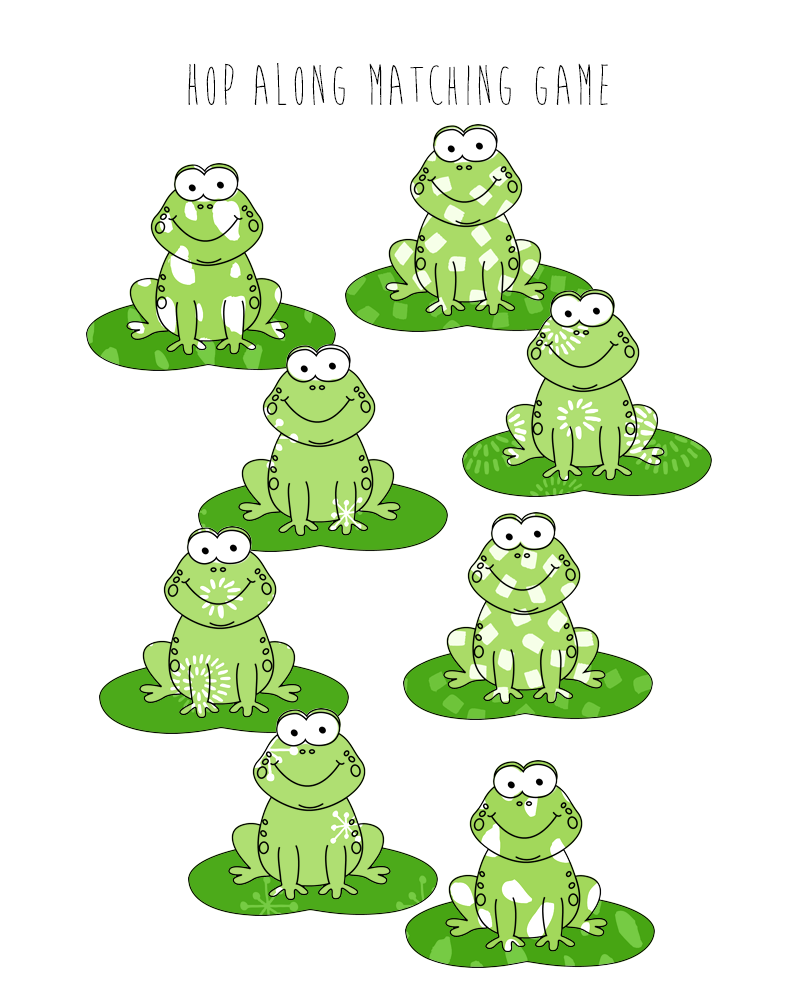
Hop Along Matching Game


Hop along now and help these frogs! Each of these fantastic frogs has a twin, but they’ve gotten separated. Can you spot the identical pairs? Print out the Hop Along Matching Game and draw a line between the pairs.

You can purchase We Are the Wibbly!: A Tadpole’s Tail from these booksellers

Amazon | Barnes & Noble | Bookshop (discounted books and support for your local independent bookstore)

Picture Book Review
March 7 – National Cereal Day

About the Holiday

Did you know that breakfast in a bowl actually began with an experiment that went wrong? Or just maybe it was right! John Harvey Kellogg and his brother Will Keith Kellogg were experimenting with boiled wheat in 1877 when they left some out overnight. In the morning the wheat was stale. The brothers decided to roll it out instead of throwing it away, and they found that each wheat berry created a flake. Boiled corn worked the same way, and from this process the Kellogg brothers invented Corn Flakes, the first dry cereal!

Today’s holiday celebrates all the varieties of your favorite cereal—whether it’s made of corn, wheat, bran, rice, or a mixture of flakes, fruit, and nuts. So pour yourself a big bowlful and enjoy!

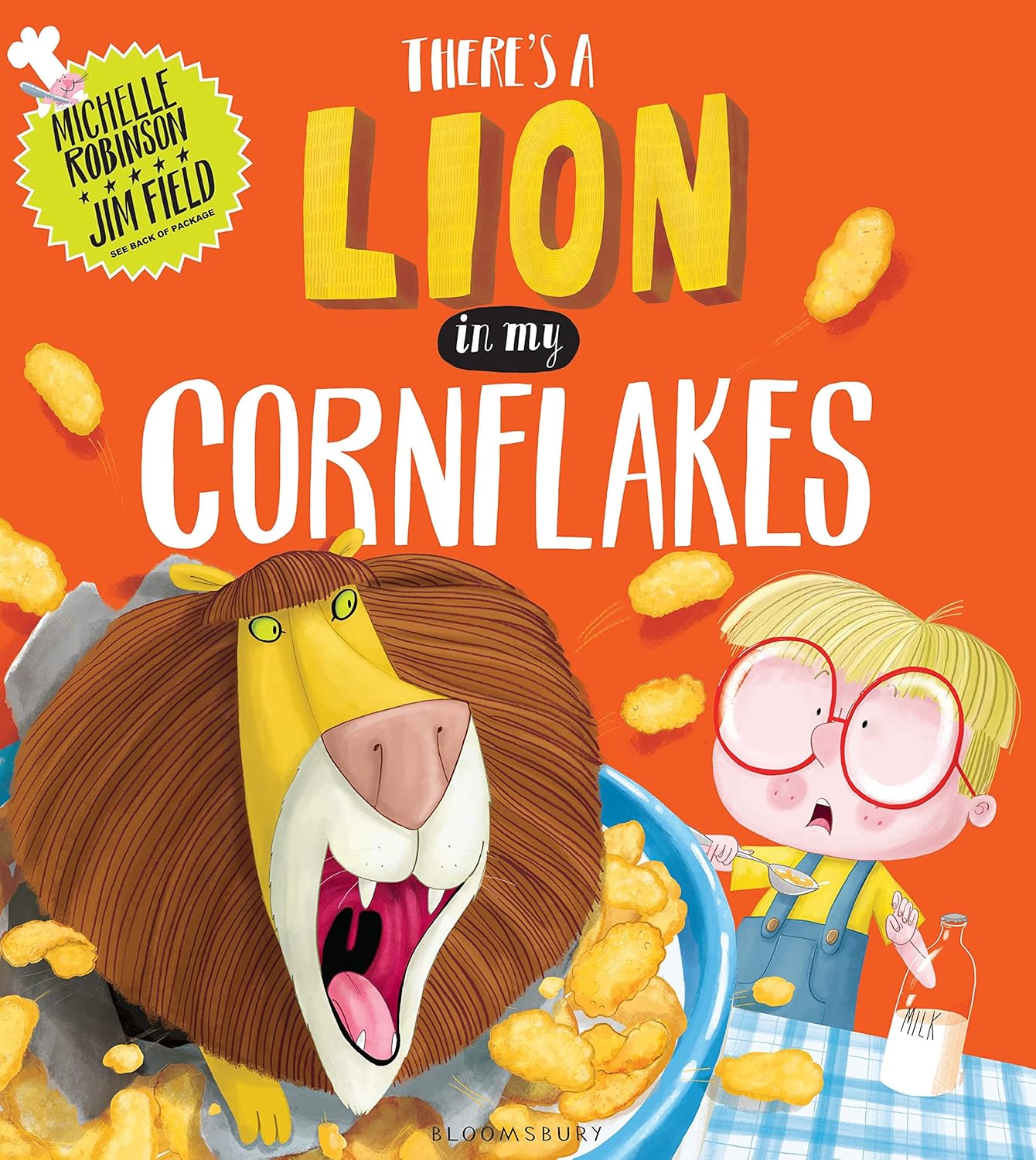
There’s a Lion in my Cornflakes

Written by Michelle Robinson | Illustrated by Jim Field

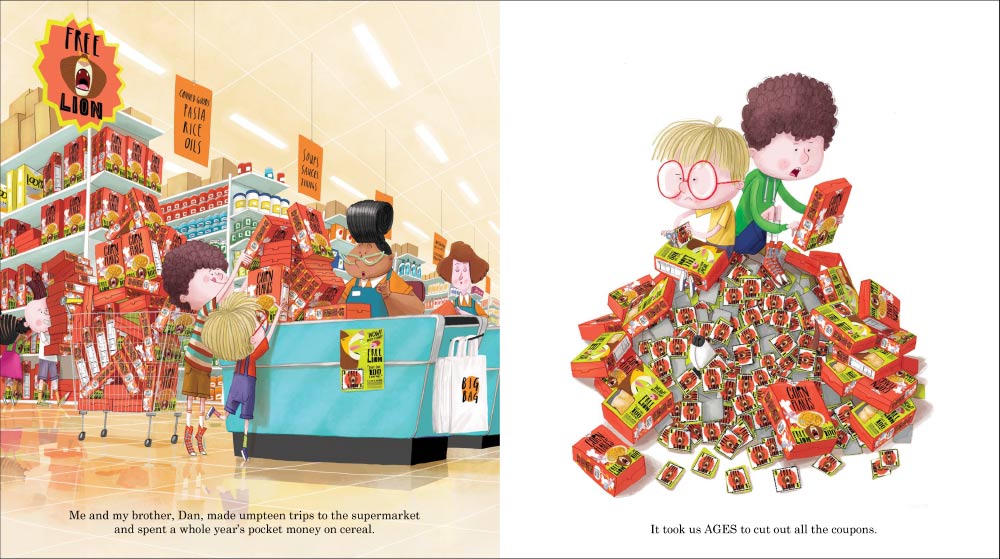
Who could resist clipping coupons to receive a free lion? Nobody, that’s who! I mean, it would be so cool, right? A lion to take on walks, ride to school, and open tin cans—awesome! So a little boy and his brother Dan take a year’s worth of their allowance, make “a million” trips to the grocery store, and start cutting.

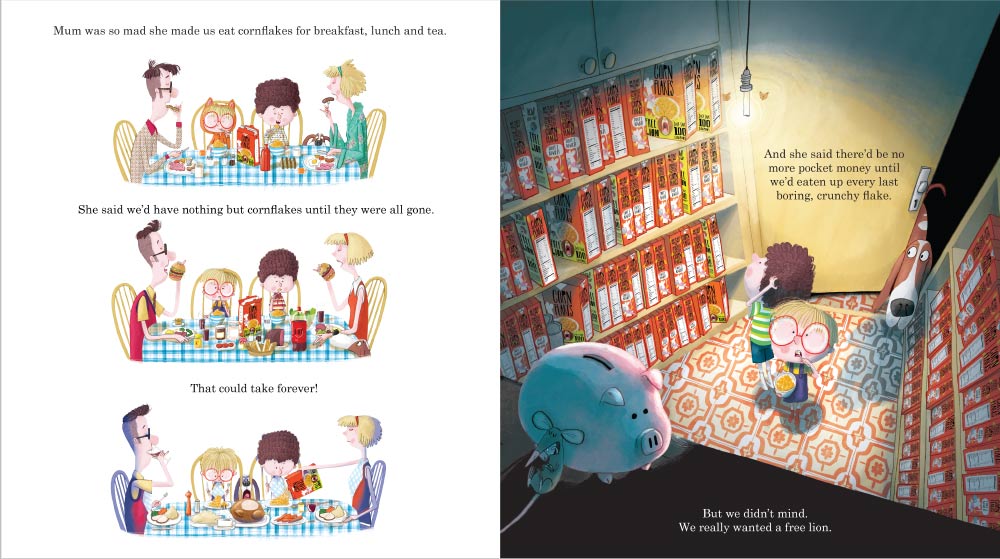
But all those boxes of cereal squeeze out the other food on the pantry shelves, so Mom says the boys have to eat cornflakes for breakfast, lunch, and dinner until it’s gone—and, oh yeah, they don’t get an allowance until then either. It’s all worth it, though, because they’re going to get a real live lion.

Illustration © 2015 Jim Field, text © 2015 Michelle Robinson. Courtesy of Jim Field and Bloomsbury Children’s Books.

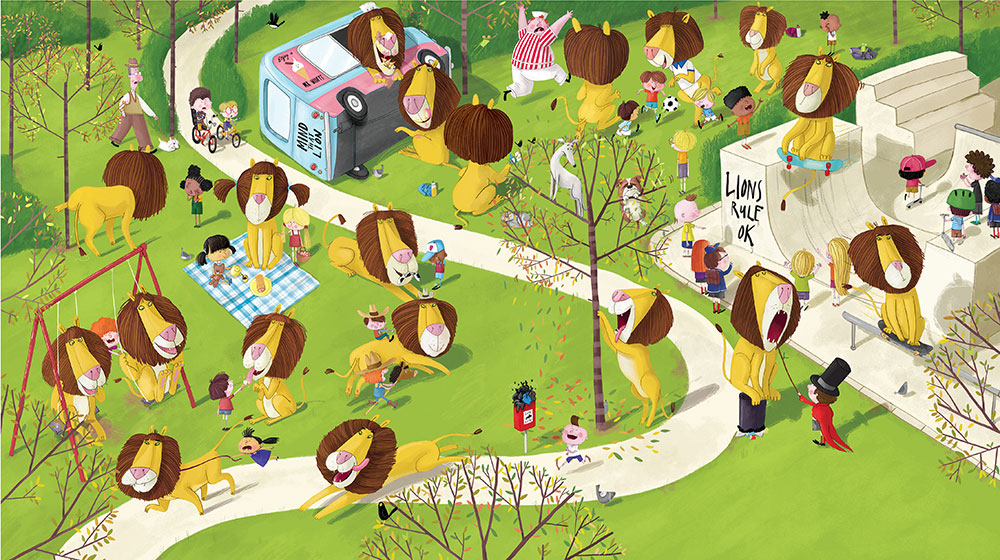
There’s just one hitch—every other kid in town has the same idea, and while the brothers wait for their lion to arrive, everyone else is out playing with their new pet. Finally, the delivery truck pulls up in front of the house, and out walks . . . a grizzly bear?! That’s not right, and it’s even delivered to the wrong house. Well, the bear’s not too crazy about the situation either. 

A letter of complaint to the cereal company brings resolution in the form of . . . a crocodile?! The crocodile spends all its time in the bathroom, and the grizzly bear is still causing havoc. Dad calls the cereal company and to make up for their mistake they send . . . a gorilla?! The gorilla stomps on Dad’s car and rips the door off. Still, the whole crew piles in so Dad can “give those cereal people a piece of my mind.”

Illustration © 2015 Jim Field, text © 2015 Michelle Robinson. Courtesy of Jim Field and Bloomsbury Children’s Books.

The cereal people sure are sorry for the mix-up. They make amends by letting the family keep the grizzly bear, the crocodile, and the gorilla, AND the company gives them…a lifetime’s supply of cornflakes! But really, what good are cornflakes? The boys can’t walk them or ride them or even open cans with them.

You know what, though? Mom’s discovered the crocodile has some pretty sharp, can-opening chompers. The grizzly bear can walk forever and even wear a fanny pack. And the gorilla makes a very cool chauffeur. Why bother having a lion when everyone else has one?

But what are those cereal people offering now—a free tiger?! Hmmm . . . .

Illustration © 2015 Jim Field, text © 2015 Michelle Robinson. Courtesy of Jim Field and Bloomsbury Children’s Books.

Michelle Robinson has taken the lure of free stuff to its ridiculous best. With comical flair she aptly portrays the consternation on all sides, from the earnest kids to the flummoxed parents, that grounds this story in the recognizable while also providing hilarious suspense. The silly, over-the-top scenario of There’s a Lion in My Cornflakes serves up the benefits of individuality and drawbacks of consumerism that will have kids laughing at every page and escalation of the brothers’ problem.

Jim Field’s bold, vibrant illustrations are the perfect accompaniment to this boisterous tale. The boxes of cornflakes and clipped coupons are piled high, the boys are excited, nonplussed, shocked, and finally accepting as day after day brings new and unexpected results of their actions, and the parents are perfectly perplexed. Kids will love the funny details on every page that highlight the story.

Ages 3 – 7

Bloomsbury Children’s, 2015 | ISBN 978-0802738363

About the Author

Michelle Robinson’s many picture books include bestsellers, The World Made a Rainbow and the Goodnight Tractor series. Her books are popular in homes and classrooms all over the world, and include Ten Fat Sausages, winner of the Laugh Out Loud Book Awards, and There’s a Lion in my Cornflakes, winner of the Sainsbury’s Children’s Book Award.

Her YouTube channel, MICHELLE ROBINSON – CHILDREN’S AUTHOR, is full of ideas to encourage young children to read, write and have fun. You can also download free teacher’s notes and activity sheets at: www.michellerobinson.co.uk.

About the Illustrator

Jim Field is an illustrator, character designer and animation director. He has won multiple awards for the children’s books he has illustrated; including the Lollies, The Roald Dahl Funny Prize, The Evening Standards Oscars Prize and The Sainsbury’s Award. He was the 4th bestselling children’s book illustrator of 2021. Jim now lives in Paris with his wife, daughter and a small grumpy cat. Visit him at jimfield.me.

There’s a Book Trailer in this Review!

National Cereal Day Activity

celebrate-picture-books-picture-book-review-wooden-spoon-lion-craft

Spoon Lion Puppet

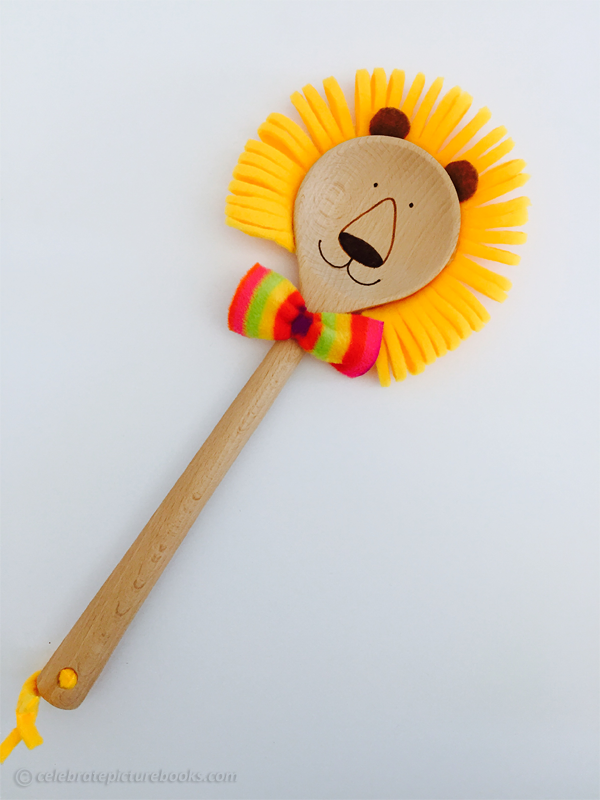
Spoons are just the thing for eating cereal! But with this craft you can make a ROARingly cute lion puppet!

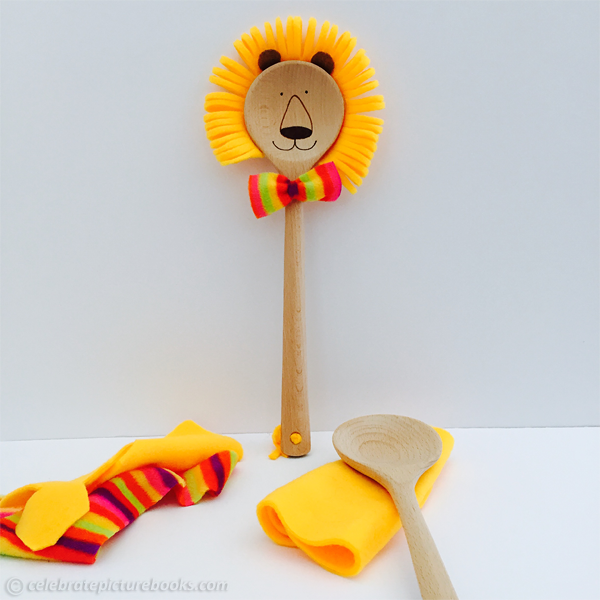
Supplies

  • Wooden mixing spoon
  • Yellow Fleece
  • Brown felt
  • Colorful Fleece or felt
  • Fabric glue
  • Light brown marker
  • Dark brown marker
  • Hot glue gun or super glue

CPB - Spoon Lion with stuff

Directions

To make the lion’s face

  1. Draw a nose, mouth, and eyes on the front/bowl of the spoon

To make the mane

  1. Measure the rim of the spoon from one side of the handle to the other
  2. Cut a strip of yellow fleece as long as rim measurement and 4 inches wide
  3. Fold the piece of fleece in half long-ways
  4. Glue the open edges of the fleece together
  5. Along the folded side cut a fringe, leaving the loops intact

To make the ears

  1. Cut round ears from the brown felt.

Assembling the lion

  1. Glue the ears to the back of the spoon
  2. Glue the mane to the back of the spoon

To make the bow

  1. Cut a 3-inch x 1 ½-inch piece of colorful fleece or felt
  2. Cut a long thin strip of fleece or felt
  3. Pinch the bow in the middle and tie with the longer piece of cloth. Trim as necessary
  4. Glue the bow to the handle

To make the tail

  1. Cut three thin 4-inch-long strips of yellow fleece
  2. With fabric glue, glue the tops of the strips together
  3. Braid the strips
  4. At the bottom, glue the strips together, leaving the ends free
  5. Fold the top of the tail and push it into the hole in the handle of the spoon

You can purchase There’s a Lion in My Cornflakes at Amazon Picture Book ReviewPicture Book Review

February 14 – Read to Your Child Day

About the Holiday

Today’s holiday is one one of the best days of the year for kids and adults who love to read together. Reading to children has many benefits from helping with language development to instilling in children a love of books and learning to building bonds that last a lifetime. Today, as it happens, is also Valentine’s Day, and there’s no better way to say “I Love You” than by spending time together with a grrrreat book like today’s! For neat ideas on how to make the most of Read to Your Child Day, visit Days of the Year

Thanks to Bloomsbury Children’s Books for sharing a copy of Little Lion Girl with me!

Review by Dorothy Levine

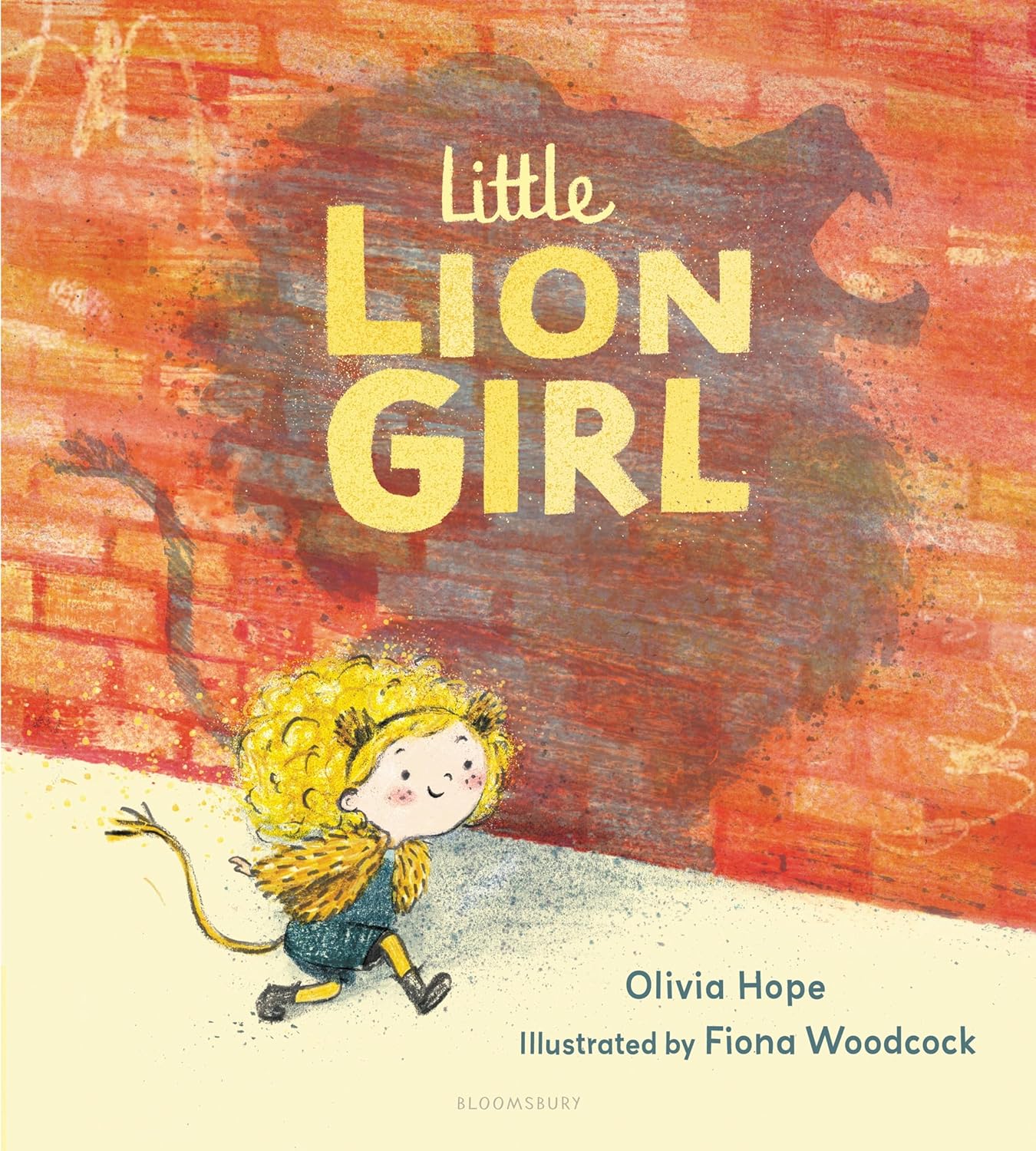
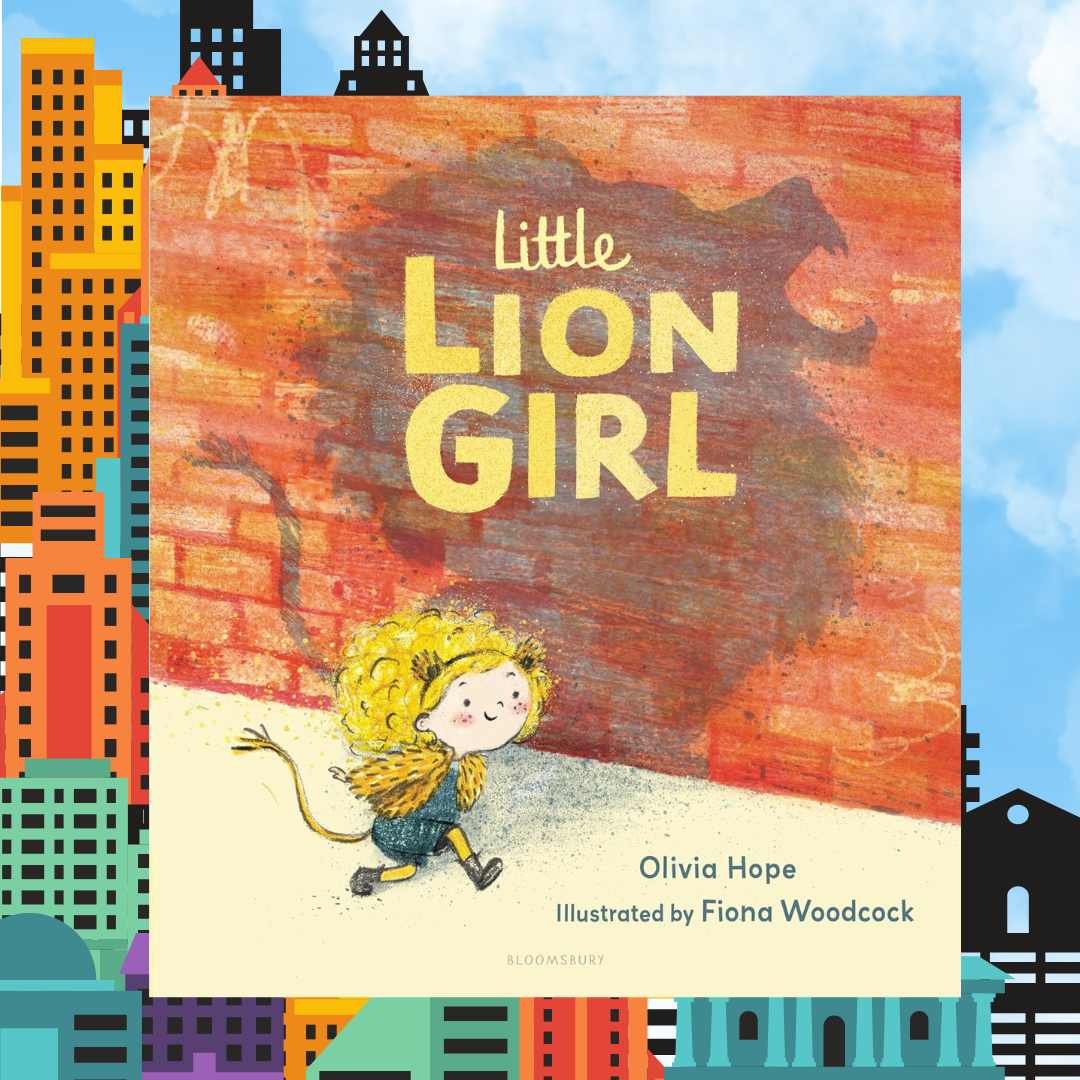
Little Lion Girl

Written by Olivia Hope | Illustrated by Fiona Woodcock

It’s time to line up for a copy of Little Lion Girl, a vibrant tale of mother and daughter taking on the roaring city.

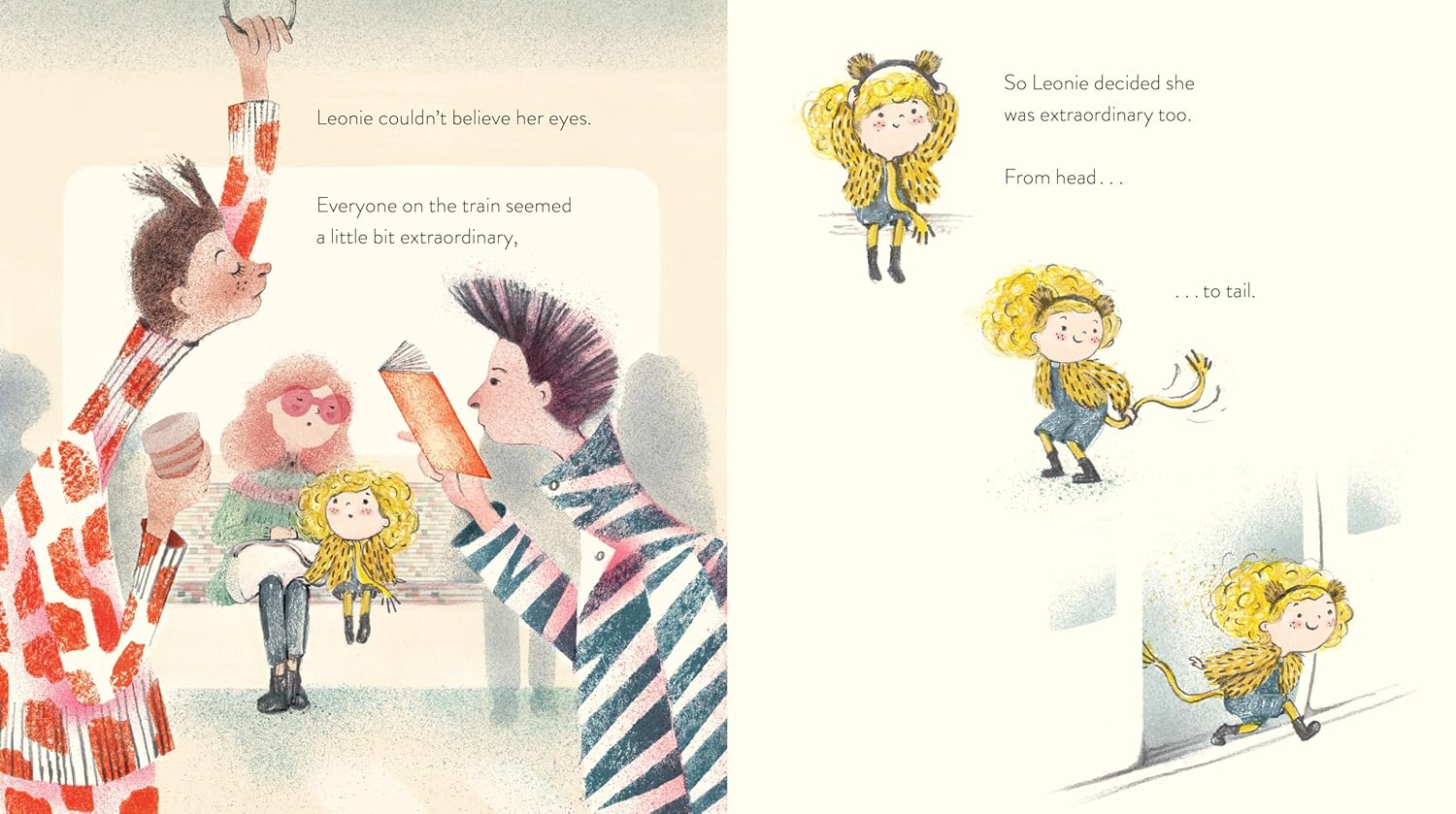
When Leonie spots the orange lights of the train coming to take her to the big city, she knows it’s time for an adventure. On the ride she notices unique characters around her and decides she too will meet the city with extravagance. With the help of a few accessories, Leonie cleverly transforms herself into a lion. When “the city roared like a jungle,” Leonie “roared back at the city. / She shook her mane and swished her tail. / She was lion girl.”

Illustration © 2025, Fiona Woodcook, text © 2025, Olivia Hope. Courtesy of Bloomsbury Children’s Books.

Lion girl spends the day stalking through bustling colorful streets, “through legs like trees between squawks, grunts, and shrieks” finding lions inside and out of a museum as she goes. In a cafe families sit in their “prides;” in the park she declares she is the king of the city.

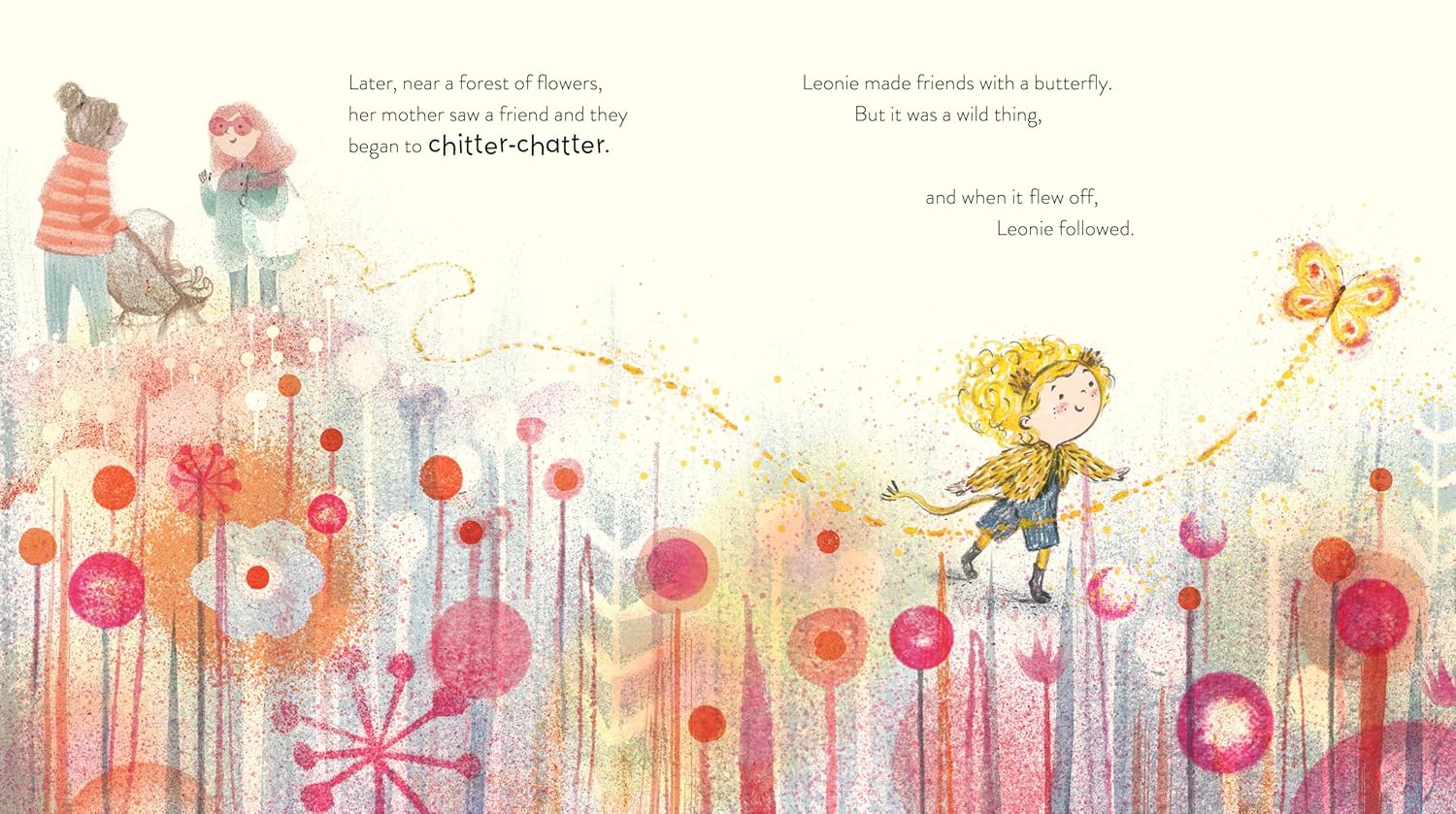
All is going lion-tastically when a butterfly—a real wild thing—causes her to wander a bit further from her mother. Without her mama lion, the city jungle starts to feel bigger, and lion girl curls up in fear. Just as she starts to lose her roar, her mother calls to her, and they reunite with a hug and a purr.

Illustration © 2025, Fiona Woodcook, text © 2025, Olivia Hope. Courtesy of Bloomsbury Children’s Books.

Olivia Hope’s upbeat tale will excite wild children and their animal-loving hearts. From barking engines to city bustle grunts and shrieks, Hope’s story is jam-packed with animal-based vocabulary to set the scene. As Leonie and her mother explore the city, the reader’s confidence will grow along with lion girl as she explores the feelings that come with each step of her journey. A sweet story that inspires children to venture out with bravery, while also offering a gentle reminder that staying close to the pack is important too. Little Lion Girl shows kids that it’s okay to feel scared sometimes and to receive comfort from adults.

Fiona Woodcock’s illustrations light up the city in soft primary color hues. Leonie’s cat ears and scarf-tail form an exciting shadow of a real lion as she prowls through the streets. Woodcock illustrates a wonderfully diverse range of characters, including two train passengers dressed to resemble a zebra and giraffe—one of whom is spotted again later at the park. Leonie’s detailed facial expressions reflect her awe, excitement, fear and ultimately comfort when she snuggles up against her mom.

Little Lion Girl would make a lovely addition to home and library collections. It’s the perfect read-aloud to take with you on a train ride or to read while gearing up for an adventure!

Ages 3 – 6

Bloomsbury Children’s Books, 2025 | ISBN 978-1547616688

About the Author

Olivia Hope is an Irish writer with a special love for fiction about wild children. Before becoming an author, she was a teacher, creative arts facilitator and even an international athlete. She currently lives in the wilds of Southwest Ireland with her family.

About the Illustrator

Fiona Woodcock is an illustrator and picture book author. She studied Graphic Communication at Glasgow School of Art and for many years worked in animation. Her debut book Hiding Heidi was nominated for the 2017 Kate Greenaway award. Look was the winner of the AOI World Illustration Awards 2019, and A Dot In The Snow by Corrinne Averiss was selected as one of ‘The Times Children’s Books of the Year 2016’ and nominated for the Kate Greenaway Award 2018. Fiona lives in London.

Read to Your Child Day Activity

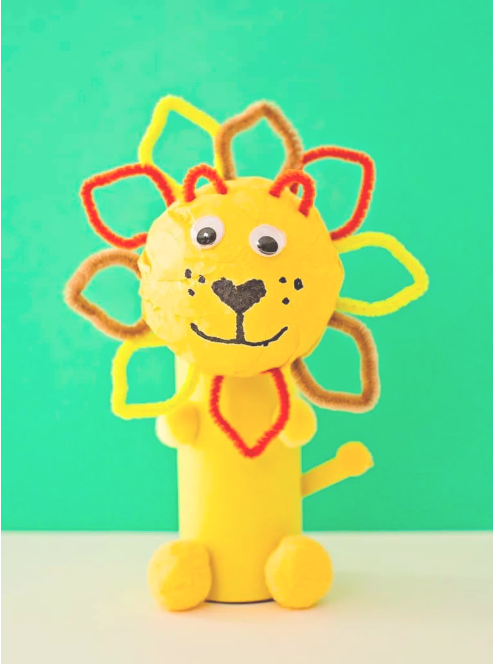
Image courtesy of Hello Wonderful

Paper Tube Lion

Kids can make and display this cute Paper Tube Lion from Hello Wonderful to remind themselves that they are as brave and confident as a lion.

You can purchase Little Lion Girl at these booksellers

Amazon | Barnes & Noble | Bookshop (to support your local independent bookstore)

Picture Book Review
December 17 – National Say It Now Day

celebrate-picture-books-picture-book-review-I'm-always-loving-you-cover

About the Holiday

This brand new holiday, established by National Day Calendar and Legacy+, a branding company, in honor of Walter Green, who was born on December 17 and on his 70th birthday decided to travel for a year to visit those who had been important to him and express his gratitude. For Walter, the result was a book—This is the Moment. For the rest of us, this holiday can inspire us to tell friends and loved ones how important they are and thanking them for all the ways they’ve impacted our lives.

Thank you to Bloomsbury Children’s Books for sharing a copy of I’m Always Loving You with me for review consideration. All opinions on the book are my own.

I’m Always Loving You

Written by Kathy Wolff | Illustrated by Acamy Schleikorn


When you tell your child “I love you,” tousle their hair and say, “love ya, kiddo,” or kiss them on the forehead and whisper, “Goodnight, sweet love,” the “always” of that feeling is understood. But there are times when—struck by a memory, catching sight of a flash of playfulness, or even sharing a struggle over a task or disappointment—you feel an extra squeeze of love come over your heart.

Often these moments go unexpressed; but they shouldn’t! Inherent in times like these is spontaneity, shared experiences, and the details of life. Kids love details, and in I’m Always Loving You Kathy Wolff gives parents and other adults a heartwarming way to share the particulars of those times when their heart bursts with love—from the seemingly mundane to the extra-special. 

celebrate-picture-books-picture-book-review-I'm-always-loving-you-rise-and-shine

Image copyright Acamy Schleikorn, 2024, text copyright Kathy Wolff, 2024. Courtesy of Bloomsbury Children’s Books.

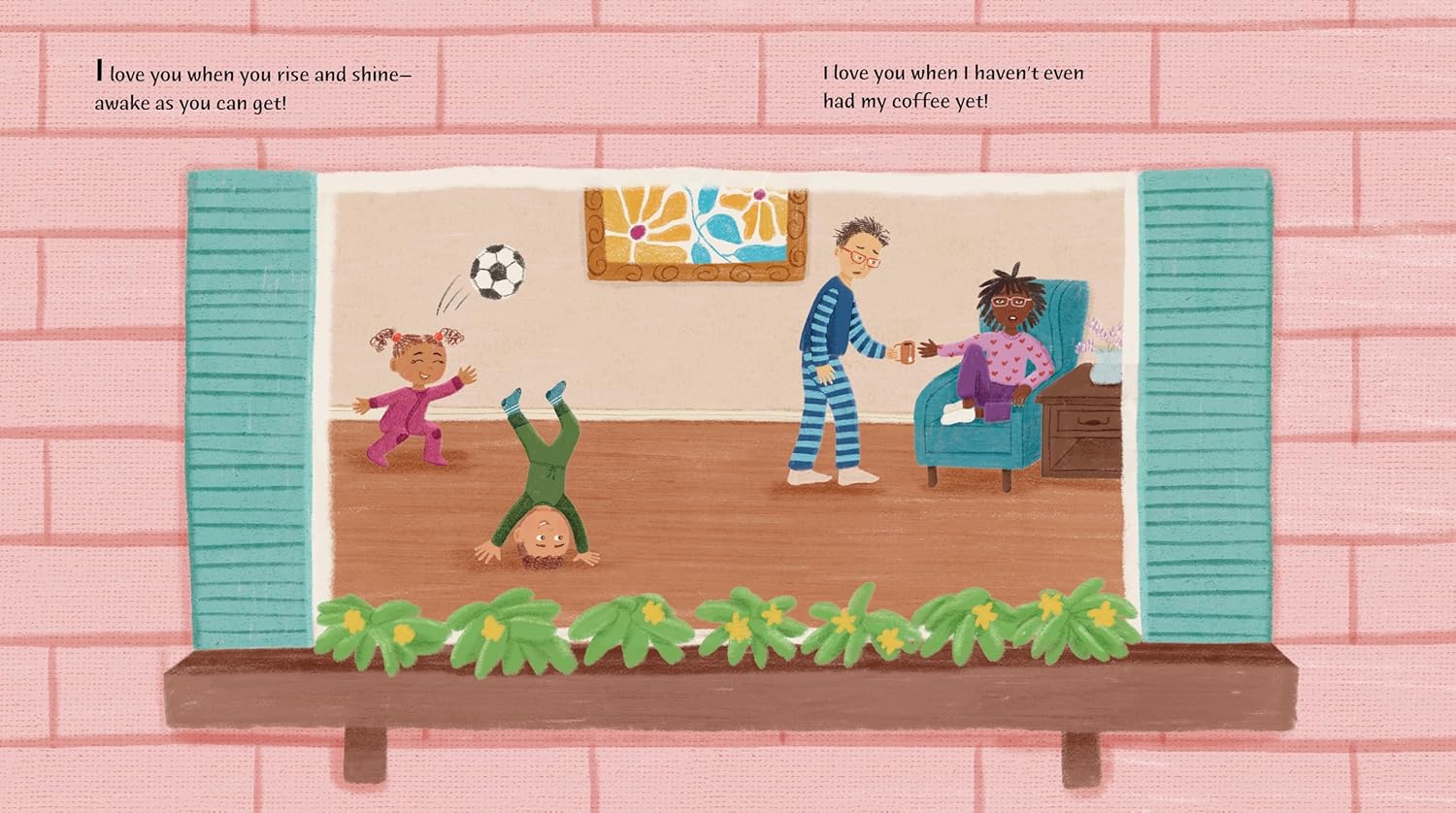
Wolff begins as the day starts: “I love you when you rise and shine—awake as you can get!” but includes a bit of humor with the adult’s perspective on morning—”I love you when I haven’t even had my coffee yet!” She highlights times of frivolity at home while also reassuring kids that parents, grandparents, and other caregivers are always thinking about and loving them when they’re out in the world—in the car, at the park, at the store, and even “in the longest line we’ve ever seen before!”

celebrate-picture-books-picture-book-review-I'm-always-loving-you-when-helping

Image copyright Acamy Schleikorn, 2024, text copyright Kathy Wolff, 2024. Courtesy of Bloomsbury Children’s Books.

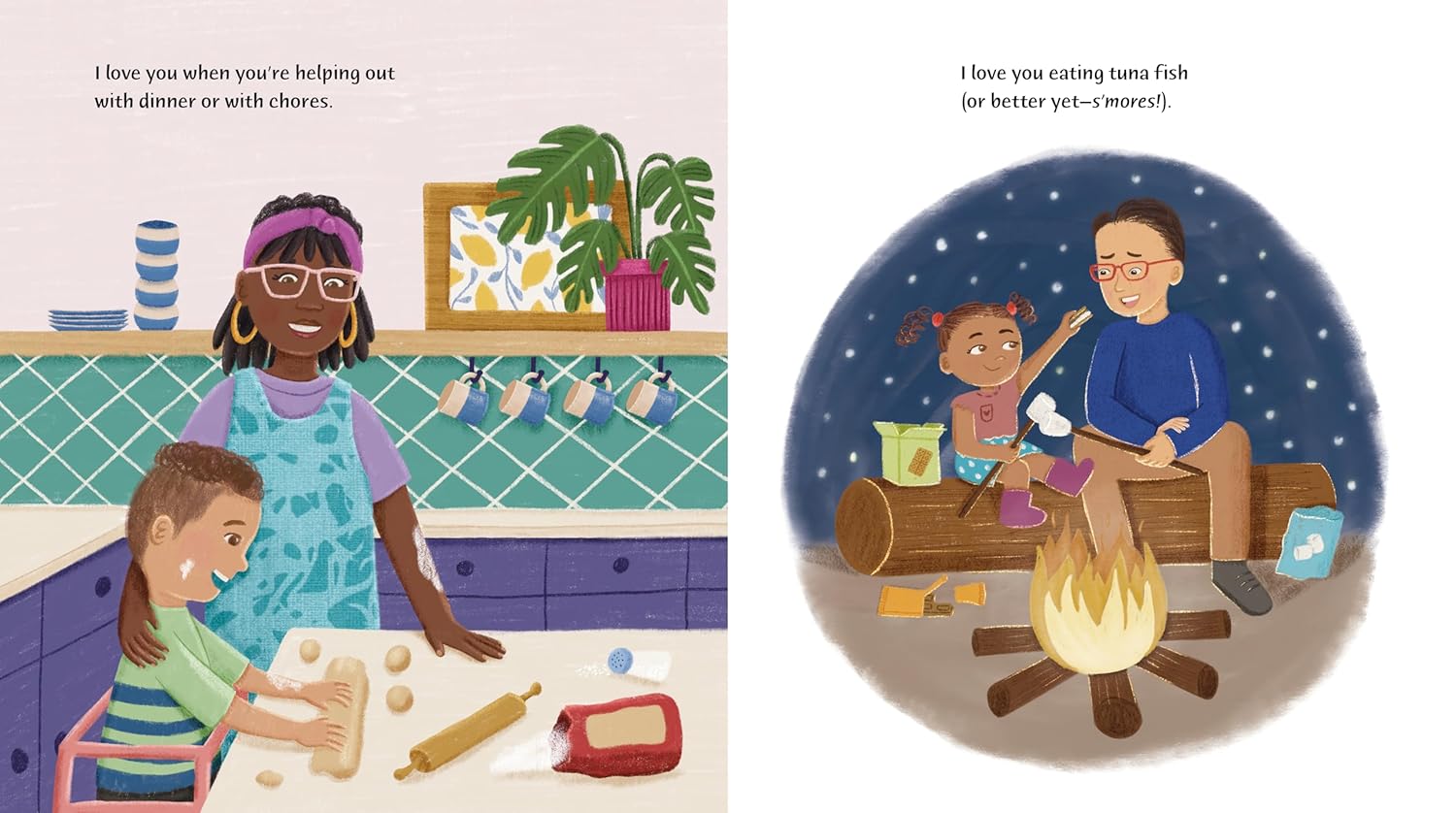
Children who are apprehensive about separation will find comfort in the words “I love you when you’re close to me, and also when you’re not, / and no matter what I’m doing, I sure think of you a lot!” Importantly, kids also hear that adults’ love extend to those times when their child is helping out around the house or doing chores, and—maybe more surprising—when the adult must tell them “no.”

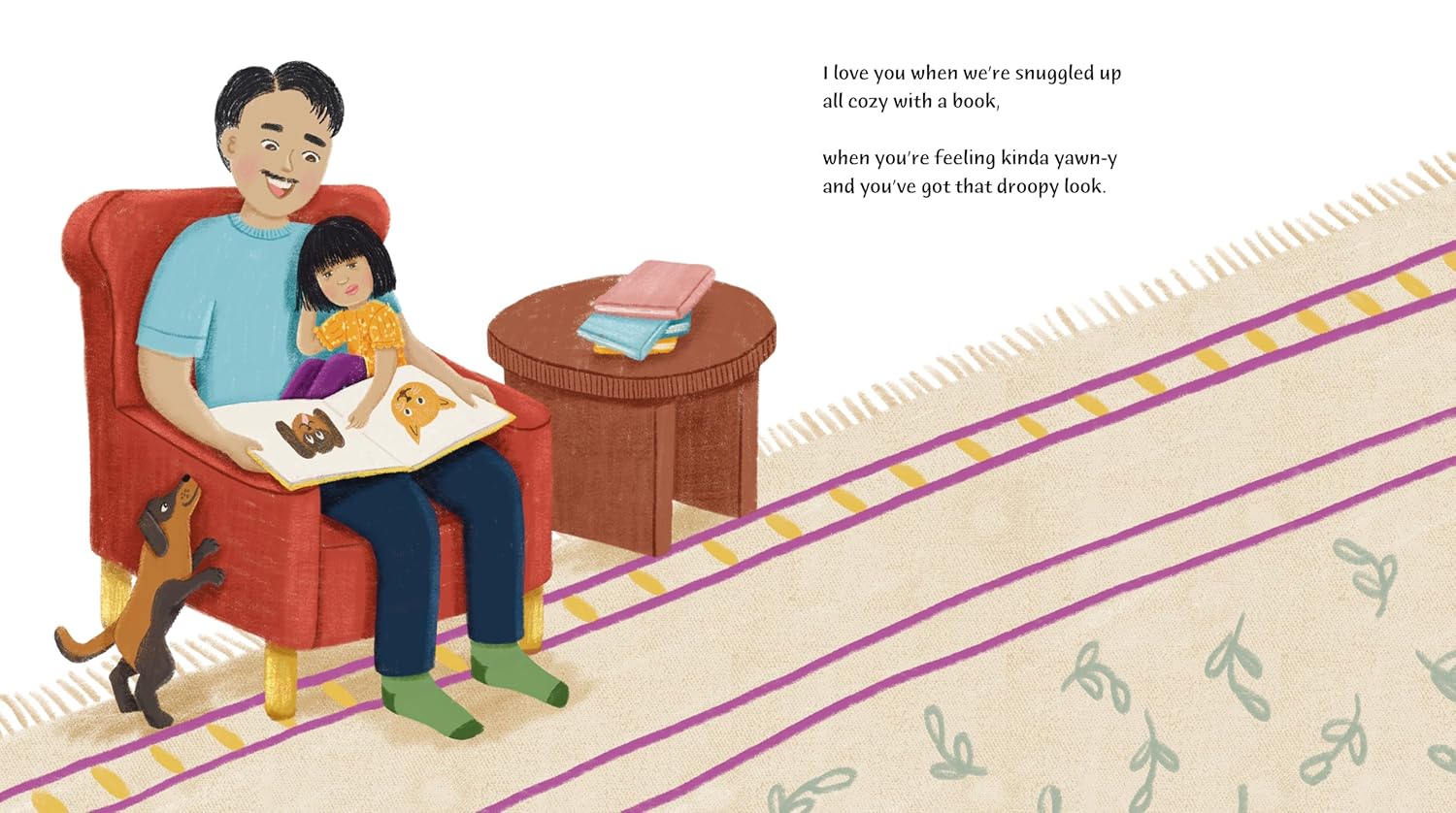
Just as adults love their kids at the beginning of the day, as the day wanes a dad reveals, “I love you when we’re snuggled up all cozy with a book, / when you’re feeling kinda yawn-y and you’ve got that droopy look.” Through changing into pajamas, goodnight kisses, and turning out the light, love prevails, allowing children to sleep soundly and awake to another day full of love.

celebrate-picture-books-picture-book-review-I'm-always-loving-you-snuggling-wth-book

Image copyright Acamy Schleikorn, 2024, text copyright Kathy Wolff, 2024. Courtesy of Bloomsbury Children’s Books.

Kathy Wolff’s jaunty rhymes that encapsulate so many parts of a child’s and parents’ or caregivers’ day are a joy to read aloud and are sure to lead to fun discussions about specifics in the readers’ lives. Many of the examples Wolff includes are equally applicable for children to say to the adults or siblings in their lives, from getting up in the morning to sharing silly, busy, or quiet moments to when they are near or far away.

Acamy Schleikorn’s bright, active illustrations allow kids to clearly see and recognize experiences and places as well as emotions, such as happy, silly, and serious, that are part of their everyday lives, reinforcing the idea that no matter where, when, or what’s happening they are always loved.

A perfect and reassuring book to snuggle up with, bring out when times are a little more challenging, and talk about all the times your family feels that glow of love, I’m Always Loving You would be an often-asked-for book on home bookshelves and a meaningful addition to school and library collections.

Ages 3 – 6

Bloomsbury Children’s Books, 2024 | ISBN 978-1547614202

About the Author

Kathy Wolff lives in Overland Park, Kansas with her husband and her two funny kids. She attempts to balance writing, mom-ing, and greeting-card making . . . all while trying to remember not to forget anything. Visit Kathy at kathywolffbooks.com.

About the Illustrator

Acamy Schleikorn is an illustrator from Las Vegas. She began drawing at a very young age and was encouraged by her grandma to keep going. As an adult, she discovered the magical world of children’s books, and became passionate about creating stories that make a difference in a child’s life and reflect the diverse world that we live in. Anytime she creates art, she wants it to bring some kind of good into a world filled with a lot of hurt. She is inspired by her two children to create work that they will love, enjoy, and see themselves in. Visit Acamy at acamydesigns.com.

National Say It Now Day Activity

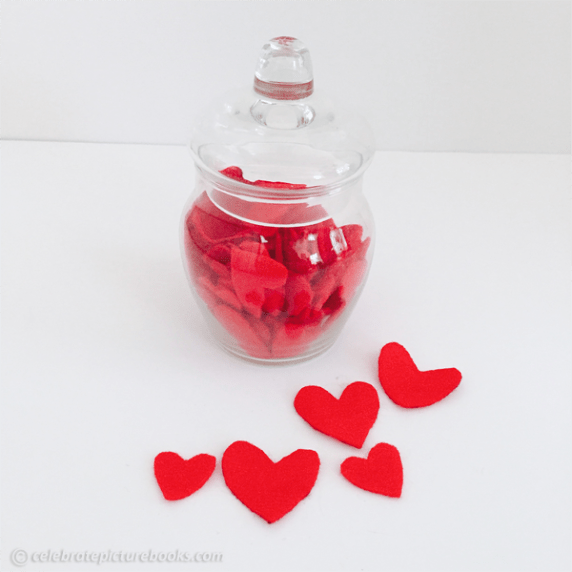
CPB - Heart Jar

Jar of Love


With this craft, kids can say “I love you” to parents, siblings, family members, friends, and anyone who fills their heart with joy by giving them a felt heart to express their feelings.

Supplies

  • A clear jar with a lid—you can up a jar from home, buy a mason jar, or find a decorative jar at a craft store
  • Red felt
  • Scissors

Directions

1. Cut red hearts from the felt and add them to the jar.

2. Whenever you feel that special burst of love toward someone, give them a heart to show it!

celebrate-picture-books-picture-book-review-I'm-always-loving-you-cover

You can purchase I’m Always Loving You at these booksellers

Amazon | Barnes & Noble | Bookshop

Picture Book Review
November 29 – National Family Literacy Month

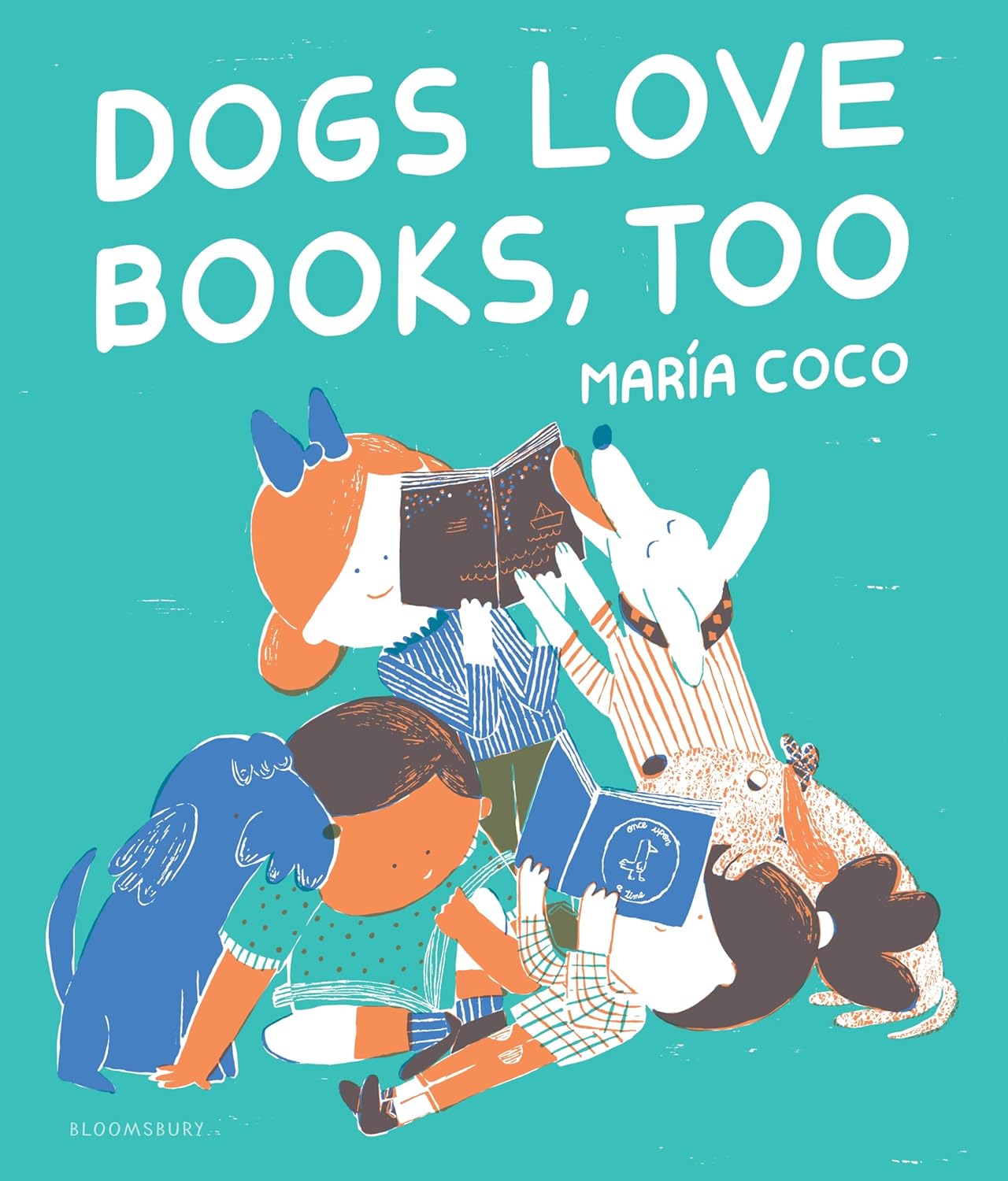
celebrate-picture-books-picture-book-review-dogs-love-books-too-cover

About the Holiday

National Family Literacy Month was established in 1994 to encourage parents and other adults to read together with the children in their life. Studies show that children who are read to are better prepared to read on their own and do better in school. Cuddling together before bedtime or during special story times with favorite books instills a love of reading that can last a lifetime. As children begin learning to read, they benefit from reading to family, friends, and even a pet or friendly therapy dog. To celebrate, plan some special reading-related activities and schedule extra reading time, especially with grandparents or other family members who may be visiting for the holidays. 

Dogs Love Books, Too

By María Coco


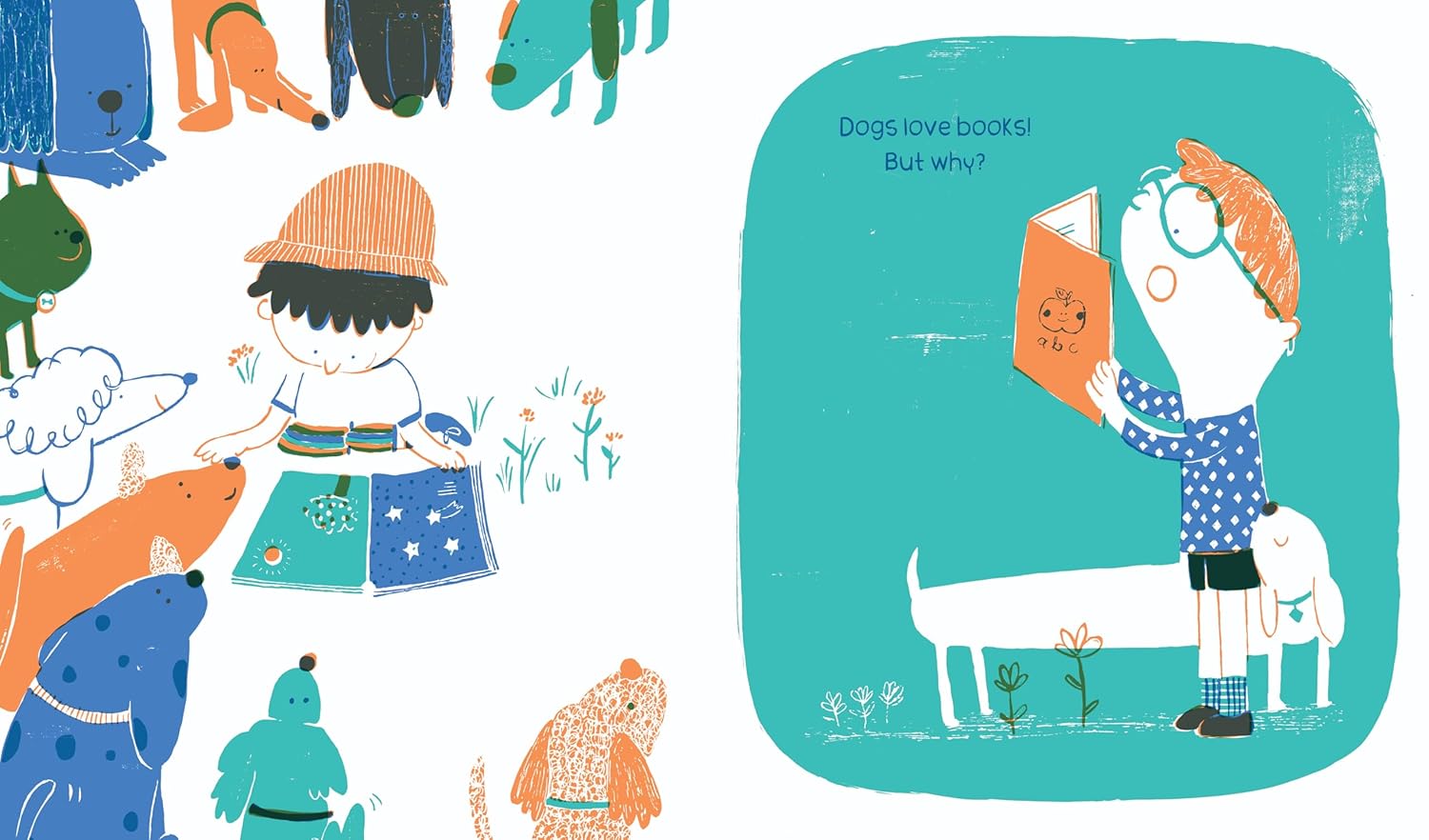
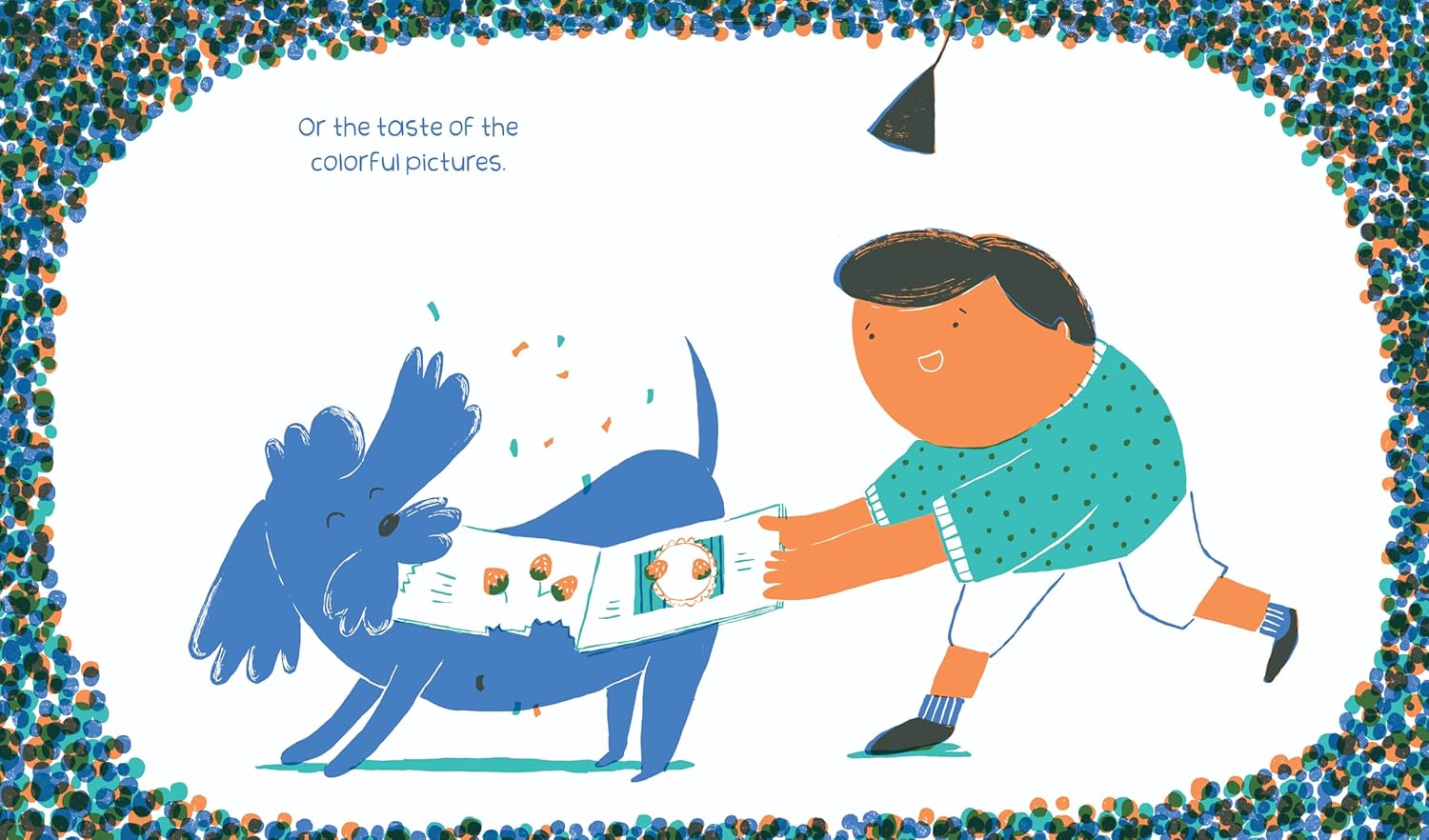
If your family has a dog (or two), you may have noticed that they become extra excited or, perhaps at bedtime, more snuggly when the books come out. As María Coco observes and then wonders, “Dogs love books! But why?” She proposes that it might have something to do with “the smell of the pages.” Or maybe for those dogs who like to take a chomp, the pages taste like fine cuisine.

celebrate-picture-books-picture-book-review-dogs-love-books-too-why-do-they

Copyright María Coco, 2024. Courtesy of Bloomsbury Children’s Books.

Could it be that they like hearing their people read aloud? Do they, too, like to imagine far-off places or drift into magical dreams? It could be one or all of these, but Coco thinks one reason stands above the rest: “I think dogs love books because they make us feel like we are not alone.” But does that feeling apply to dogs only? What do you think?

celebrate-picture-books-picture-book-review-dogs-love-books-too-tasty-pictures

Copyright María Coco, 2024. Courtesy of Bloomsbury Children’s Books.

María Coco’s short and evocative story, accompanied by engaging illustrations, is a perfect read for so many occasions and readers. With a single sentence written in a non-serif font created by Coco herself on each page or spread, the text invites emergent and new readers to join in on recognized sight words or read the story themselves. Hesitant readers will respond to the confidence-building inherent in the story. Coco also leaves the text open-ended to encourage readers of all ages to talk about why they love to read.
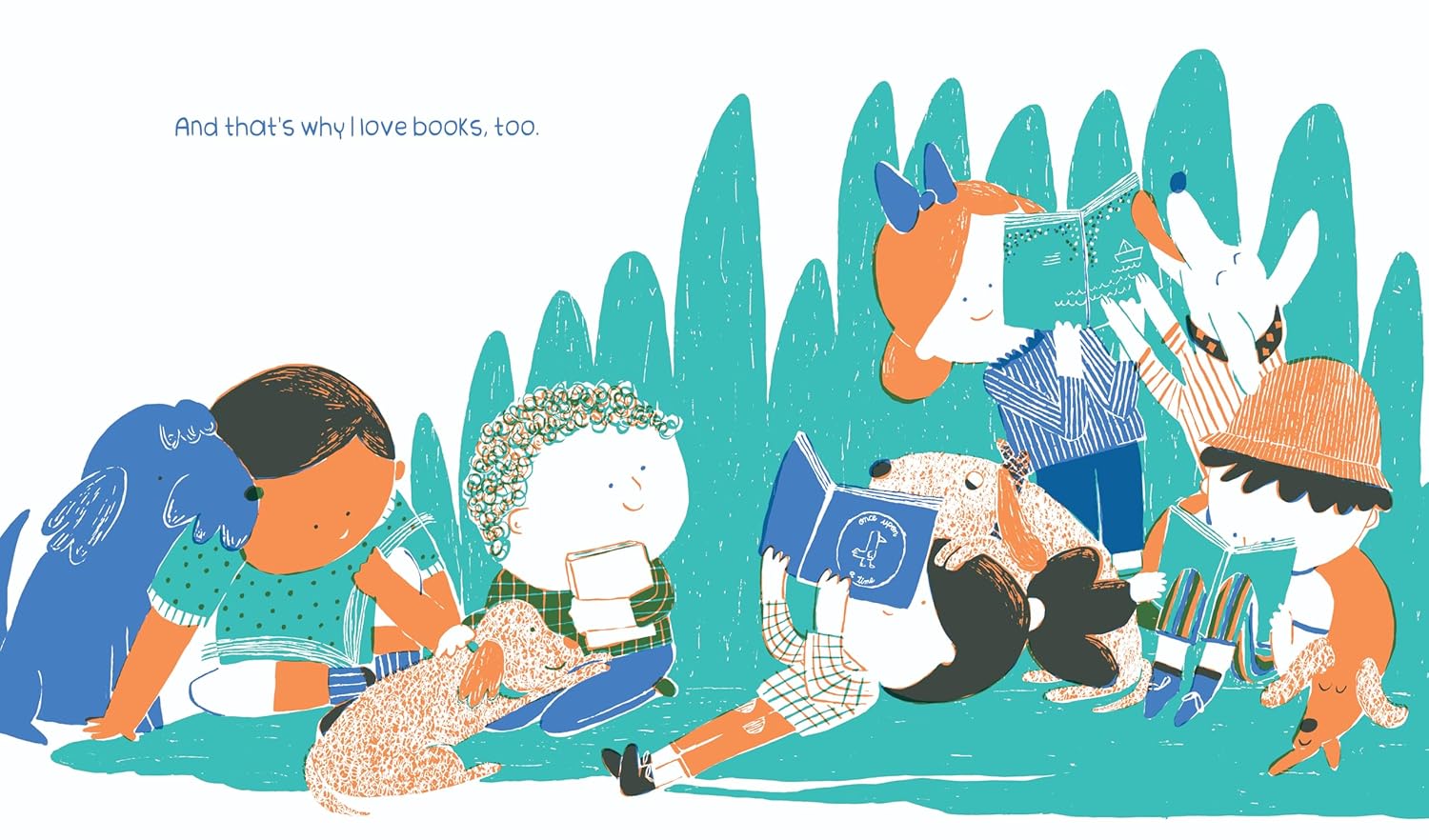
celebrate-picture-books-picture-book-review-dogs-love-books-too-final-page

Copyright María Coco, 2024. Courtesy of Bloomsbury Children’s Books.

Coco’s layered and textured illustrations are full of humor, imagination, and—in answer to the question Coco first poses—camaraderie. Images of children and their canine friends are warm and heartfelt, and the final spread, in which five kids from the story gather with their dogs to read, is a true picture of the contentment books can bring. 

Dogs Love to Read, Too is a natural choice for bedtime or other home story times as well as for any Read-to-a Dog program at schools, libraries, humane societies, or through other organizations.

Ages 2 – 5

Bloomsbury Children’s Books, 2024 | ISBN 978-1547613656

About the Author/Illustrator

Maria Coco is a Mexican designer, illustrator, and storyteller. She has a degree in Graphic Design and an MA in Children’s Book Illustration from the Cambridge School of Art. Her artwork has earned praise from The Templar Illustration Prize, The Macmillan Prize for Children’s Picture Book Illustration (UK), the Faber Andlyn BAME Prize, and the Salariya/Stratford Literary Festival Children’s Picture Book Prize. Connect with her on Instagram @mariacoco and at her website maria-coco.com.

National Family Literacy Month Activity

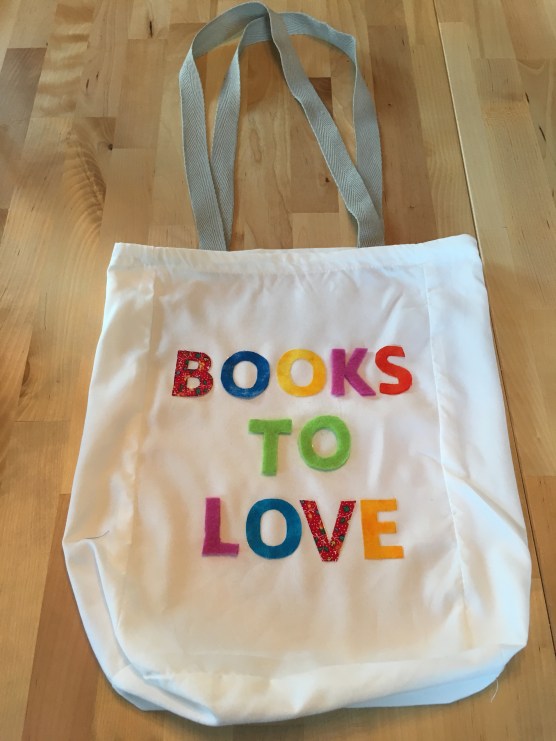
celebrate-picture-books-picture-book-review-book-bag-craft

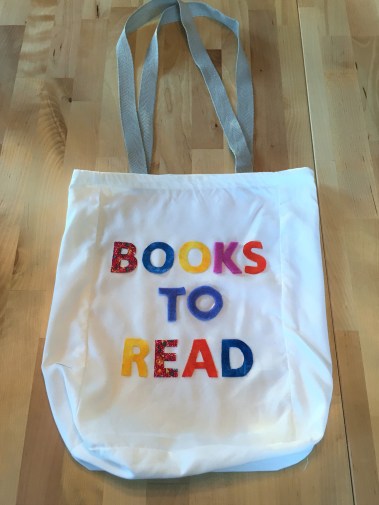
Books to Love, Books to Read Book Bag


True book lovers can’t go anywhere without a book (or two or three) to read along the way. With this easy craft you can turn a cloth bag into a kid-size book bag perfect for the car, the library, or anywhere you read!

Supplies

  • Printable Templates: Books to Read Template | Books to Love Template
  • Small cloth bag, available from craft or sewing stores—Recyclable Idea: I used the bag that sheet sets now come in
  • Cloth trim or strong ribbon, available from craft or sewing stores—Recyclable Idea: I used the cloth handles from shopping bags provided from some clothing stores
  • Scraps of different colored and patterned cloth. Or use quilting squares, available at craft and sewing stores
  • Pen or pencil for tracing letters onto cloth
  • Scissors
  • Small sharp scissors (or cuticle scissors) for cutting out the center of the letters
  • Fabric glue
  • Thread (optional)
  • Needle (optional)

celebrate-picture-books-picture-book-review-books-bag-craft

Directions

  1. Print the sayings and cut out the letters
  2. Trace letters onto different kinds of cloth
  3. Cut out cloth letters
  4. Iron cloth bag if necessary
  5. Attach words “Books to Read” to one side of bag with fabric glue
  6. Attach words “Books to Love” to other side of bag with fabric glue
  7. Cut cloth trim or ribbon to desired length to create handles
  8. Glue (or sew) handles onto the inside edge of bag

celebrate-picture-books-picture-book-review-dogs-love-books-too-cover

You can purchase Dogs Love Books, Too at these booksellers

Amazon | Barnes & Noble | Bookshop (to support your local independent bookstore)

Picture Book Review