March 29 – Niagara Falls Runs Dry Day

celebrate-picture-books-picture-book-review-queen-of-the-falls-cover

About the Holiday

March 29, 1848 was a cold day. How cold? It was so frigid that rivers feeding Niagara Falls turned to ice and reduced the flow of water to such an extent that Niagara Falls’ 3,160 tons of water per second came to a halt. Today, locals—and weather aficionados—remember this auspicious natural phenomenon.

Queen of the Falls

By Chris Van Allsburg


Niagara Falls, spanning the border of Canada and New York state, has always attracted crowds of visitors who come to marvel over the roaring avalanche of water as it “drops from a height that is as tall as a seventeen-story building” and sends “up an endless cloud of mist at it crashes onto the rocks and water below.” But on October 24, 1901 the crowd was there for a very different reason. What was it? Well, that story begins back in Bay City, Michigan, where Annie Edson Taylor, “a short, plump, and fussy sixty-two-year-old widow” had just closed her charm school and was worried about how she’d pay the bills.

celebrate-picture-books-picture-book-review-queen-of-the-falls-annie-thinks-what-to-do

Image and text copyright Chris Van Allsburg, courtesy of Houghton Mifflin Harcourt

She mulled and pondered, pondered and mulled her situation. Then she saw a newspaper article about Niagara Falls, and “like a cork popping from a champagne bottle” she had the idea to make her fame and fortune by going over the falls in a barrel. No one had ever tried a stunt like this before, but Annie seemed to know just how to do it. She designed a special barrel, but when she asked the barrel maker to build it, he refused. He told her that “if she wanted to kill herself, she’d have to do it on her own.”

When Annie went back three days later, though, she was able to convince him to build her barrel, and so construction began. The finished barrel was “four and a half feet high, with wire bands wrapped around it, and weighed more than one hundred and sixty pounds.” Inside there were handles and pillows and a leather belt that would strap her in tightly.
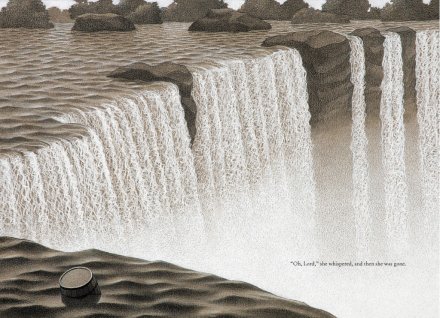
celebrate-picture-books-picture-book-review-queen-of-the-falls-niagara-falls

Image and text copyright Chris Van Allsburg, courtesy of Houghton Mifflin Harcourt

Annie had the mind of an engineer and also the genius of a public relations guru. She hired Frank Russell to be her manager and visit Niagara Falls ahead of her to whip up enthusiasm for her daredevil exploit. To sweeten the pot, she told him that she was 42, believing people would be more interested in a younger adventurer. Frank Russell saw money in his—and Annie’s—future. He went to Niagara falls to arrange for newspaper reporters and hired Fred Truesdale to put the barrel into the river that would take her over the falls.

When Annie stepped off the train, she did not look the way reporters had expected. Many “wondered if the promised trip over the falls was just some kind of hoax: the barrel might go over, but would it really carry Annie Taylor inside?” As Annie answered questions, however, the reporters began to think she really might “go where no man or woman had gone before.”

Annie’s plunge was set for 10 days later. This gave them time to stir up excitement among the locals and anyone else who wished to come and witness her daring feat. Her barrel was put on display in the hotel lobby, and articles appeared in the newspaper touting the intentions of “the fearless Mrs. Taylor.” On the established day, Annie arrived at the cottage of Fred Truesdale. Her barrel was waiting and a small crowd had gathered to see her off.

celebrate-picture-books-picture-book-review-queen-of-the-falls-barrel-in-falls

Image and text copyright Chris Van Allsburg, courtesy of Houghton Mifflin Harcourt

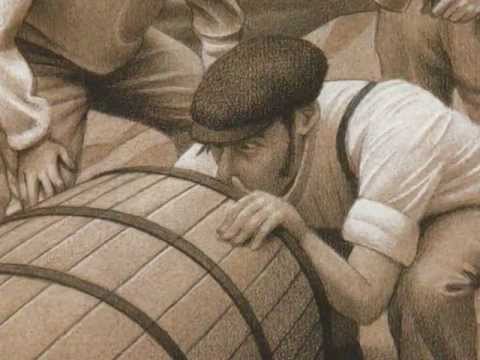
Fred and his assistant, Billy, rowed Annie and the barrel to a small island near the falls. There Annie took off her hat and jacket and crawled backwards into the barrel. She strapped herself in and packed the pillows around. Then Fred sealed the lid as Annie called, “‘So long, boys.’” Fred and Billy rolled the barrel into the river and secured it to the boat with a rope. The men rowed the boat near a spot in the river known as the “‘Point of No Return’” where the current was so strong that it would carry any boat over the falls. Fred “tapped on the barrel with his oar and told Annie he was going to cut the rope.” She answered back, “‘All righty.’” With a slice Annie’s barrel bobbed and spun in the raging river, “slamming against rocks and waves, sometimes disappearing entirely from sight, sucked beneath the surface.”

Annie held on for dear life. At the edge of the falls, Fred had told her, there would be a moment of calm. Suddenly, Annie felt this while at the same time hearing the roaring water. “‘Oh, Lord,’” she whispered, and then she was gone.” Some spectators screamed, some cheered, but most just stood still hunting for the barrel at the bottom of the falls.

“Suddenly, the barrel bobbed to the surface.” Still, everyone held their breath, wondering what had happened to Annie. When the barrel neared shore, men jumped in and dragged it onto the rocks. They removed the lid, and called her name. A weak “‘Where am I?’” answered back. Annie had survived the fall, although she was dizzy, bruised, and battered. Annie soon recovered from her injuries, and began traveling across the country to meet the hundreds of people who lined up for tickets in every city to see the ‘Queen of the Falls.’
celebrate-picture-books-picture-book-review-queen-of-the-falls-man-looks-in-barrel

Image and text copyright Chris Van Allsburg, courtesy of Houghton Mifflin Harcourt

When the people saw that Annie was an elderly widow instead of a dashing young adventurer, however, they lost interest. Fewer and fewer people came out to see her. When Fred Russell realized he would not be getting rich, he left Annie, taking her barrel with him. But Annie was not to be counted out. She recovered her barrel and hired a new manager named Billy Banks. Eventually, Billy also abandoned Annie and took her barrel for good.

Annie was down, but not out. She had a new barrel made and placed it in a park near Niagara Falls. She sat at a table nearby with postcards and a pamphlet about her amazing feat and invited passersby to buy them and meet the Queen of the Falls. Annie never did get rich and famous, but ten years after her wild ride she told a reporter that despite her disappointment on that point, she was proud to be able to say that she had done “the greatest feat ever performed.”

With his superb storytelling skills, Chris Van Allsburg reveals all the excitement and quirkiness of Annie Taylor’s wild idea and even wilder ride to readers. This true story of a bygone era and the utter audacity of a woman who tested her mettle against one of nature’s most formidable challenges will astound kids—and Annie’s nonchalance will make them (and adults) laugh. Perhaps more important than the facts of Annie’s stunt are the facts about Annie herself. Behind the etiquette teacher lay a smart, enterprising, and even scientific, woman who had the grit and self-confidence to attempt the “impossible.” Readers will also see that even when things don’t work out exactly as planned, they can be proud of their personal achievements. Van Allsburg’s sepia-toned photographic-style illustrations set readers in the early 1900s, catch Annie in the moment of her big idea and inside her barrel, and unveil the beauty of Niagara Falls.

Fascinating from beginning to end, Queen of the Falls is a wonderful book for kids interested in history, daredevils, and creative ideas.

Ages 6 – 9

Houghton Mifflin Harcourt, 2011 | ISBN 978-0547315812

Learn more about Chris Van Allsburg and his books as well as discover a gallery of illustrations, videos, and even a TED Talk on Queen of the Falls on his website!

Niagara Falls Runs Dry Day Activity

Eggs-citing Ride Experiment


Even though Annie Taylor’s barrel was strong on the outside, she knew that she needed to protect herself inside. She used pillows, a handle, and a leather strap to keep herself from getting hurt.

In this experiment I invite you to design a container that will protect a raw egg from breaking when it is dropped from different heights. I’ll let you ponder what materials you will use—because that’s the fun part!

So get your creative thinking caps on—and get cracking…Umm…I mean…get going!

Supplies

  • Raw egg
  • Some kind of small container
  • Materials to protect the egg

Directions

  1. Using a variety of materials and your scientific knowledge, create a container that will protect a raw egg from breaking
  2. Place the raw egg inside the container and seal it shut
  3. Drop the container from as high as you can, for example, from the top of the stairs or a treehouse.
  4. Be sure to ask for an adult’s help or permission when choosing where to drop your egg.

Picture Book Review

March 28 – It’s Women’s History Month

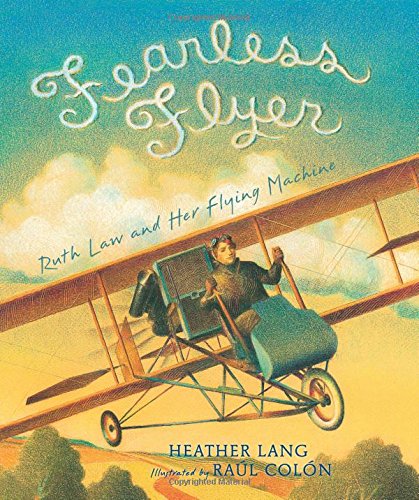
celebrate-picture-books-picture-book-review-fearless-flyer-cover

About the Holiday

Women have been inventing, discovering, questioning, challenging, and changing the world in the same ways and for just as long as men have—but often without recognition, the ability to take jobs in their fields of expertise, or equal (or even any) pay. This month’s observance serves to educate people on the amazing women who have blazed trails in the past and those who are continuing that tradition today.

Fearless Flyer: Ruth Law and Her Flying Machine

Written by Heather Lang | Illustrated by Raúl Colón


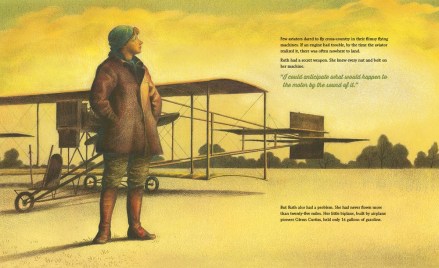
Entertained crowds knew Ruth Law for the loops, the spiral dives, and even the dip of death that she performed in her airshow. But for Ruth these stunts were like standing still. She “longed to fly to get somewhere…somewhere far away.” She decided to fly from Chicago to New York City. There weren’t too many aviators brave enough to attempt such a long flight in the type of biplane Ruth flew. They feared that if something went wrong with the engine, they’d never realize it in time to land. But Ruth knew her plane inside and out and figured she “could anticipate what would happen to the motor by the sound of it.”

A trip like the one Ruth envisioned posed another problem, though. Her small biplane held only 16 gallons of gasoline—not enough to make the journey. She asked Glenn Curtis, who built her plane, if she could buy his latest model. This much bigger plane held 205 gallons of gas and had already proven itself. But Curtis refused. He didn’t believe Ruth could handle the “powerful machine on such a long flight.”

celebrate-picture-books-picture-book-review-fearless-flyer-ruth's-plane

Image copyright Raúl Colón, text copyright Heather Lang. Courtesy of Calkins Creek.

Ruth was not to be deterred. She added three more gas tanks so the plane could hold 53 gallons of gas, installed a cover to protect her legs, and created a scrolling map of the route. Aviation experts said she would fail, but Ruth disagreed. “‘What those men can do a woman can do. I can do,’” she said. On a windy November 19, 1916, Ruth took to the cockpit to begin her nonstop flight. Although she was a little scared of what lay ahead, she took off, believing that “the scare is part of the thrill” of any experience.

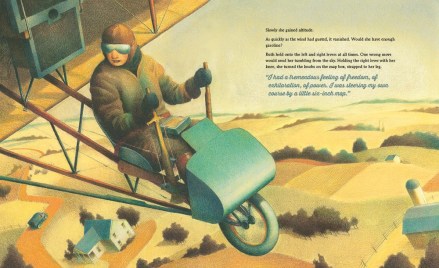
Ruth had counted on the strong wind to help push her farther faster, but just as quickly as it had blown up, it stopped. She wondered if she would have enough gasoline after all. As she flew over one landmark after another, Ruth felt exhilarated. As she passed over Cleveland, Ohio, though, “the oil gauge registered zero pressure. Something was wrong!” The sounds of her plane’s motors told Ruth a different story. She kept flying.

Soon she was passing over Erie, Pennsylvania—the site of the record-breaking flight by Victor Carlstrom. Even the icy stings of the frigid air couldn’t dispel her excitement. In a moment she was east of Erie and had broken Carlstrom’s record. The thrill of her achievement was tempered, however, by the sputtering of her engine. While there was still a little gas in the plane, it was “too low to feed into the engine.” Ruth tipped the plane forward to give it more gas. Two miles from Hornell, New York, the nearest landing spot, “the engine grumbled its last roar, leaving her with nothing but the silence of the wind.”

celebrate-picture-books-picture-book-review-fearless-flyer-arial-view

Image copyright Raúl Colón, text copyright Heather Lang. Courtesy of Calkins Creek.

Ruth steered the plane as it glided into Hornell—512 miles from Chicago. She was the new American nonstop flight record holder. Ruth’s original plan had been to fly to New York City, so after refueling and grabbing a bite to eat, she took off once again. Weighed down by the full gas tank, the plane barely made it over the hill and tall trees in her path. This was as close to crashing as Ruth ever was—or ever wanted to be.

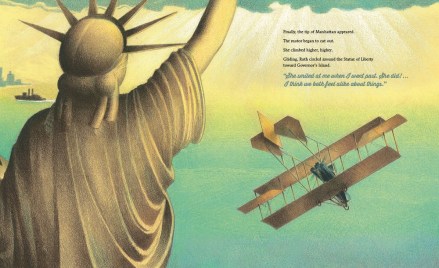
People had already heard about Ruth Law, and they came out to watch and wave. With darkness closing in, Ruth decided that she would have to land short of New York City. She touched down in Binghamton, NY and took up the rest of the flight the next morning. A thick blanket of fog obscured her view. She flew lower and lower to get her bearings and finally spied the tip of Manhattan. As she glided in, “Ruth circled around the Statue of Liberty toward Governor’s Island.” Of Lady Liberty, Ruth said, “‘She smiled at me when I went past. She did!…I think we both feel alike about things.’”

celebrate-picture-books-picture-book-review-fearless-flyer-statue-of-liberty

Image copyright Raúl Colón, text copyright Heather Lang. Courtesy of Calkins Creek.

Cheered by a crowd and a brass band, Ruth landed on the welcoming earth. Despite being numb with cold and the icicles that hung from her hair, Ruth smiled and waved. She realized then that not only had she broken an aviation record, she had made a point for all women. She later put her thoughts into words: “The sky was my limit and the horizon my sphere. It’s any woman’s sphere if she has nerve and courage and faith in herself.”

An Author’s Note about Ruth Law and her life, complete with photographs, follows the text.

Heather Lang’s thrilling account of Ruth Law’s record-breaking flight from Chicago to New York will have young aviators on the edge of their seat. Law’s flight was filled with suspense from its inception as an idea in a young woman’s mind to its final touchdown, and Lang deftly incorporates the facts as well as Law’s feelings into her well-rounded story. Along the way, readers learn about Ruth and also about early aviation. Ruth Law’s own words, included throughout the story, will inspire children as they see that even though she lived long ago, her thoughts and ideas still ring true today.

Young readers will be fascinated by Raúl Colón’s glowing illustrations of Ruth Law and her flying machine. His detailed drawings of Law’s biplane give children an excellent view of the open-air craft, fostering a true understanding of the courage it took for her to undertake such a flight. Images from Law’s viewpoint in the cockpit allow readers to vicariously travel her path to a record-breaking flight and also to self-realization.

Ages 5 – 8

Calkins Creek, 2016 | ISBN 978-1620916506

Check out Heather Lang’s website for more about her and her books. You’ll also find links to a video and photos about Ruth Law, a map of her route, and information about her plane as well as a Teacher’s Guide.

Fly along with Ruth in this Fearless Flyer book trailer!

Women’s History Month Activity

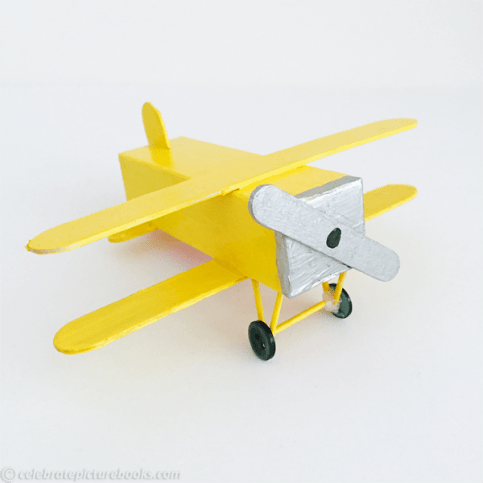
celebrate-picture-books-picture-book-review-biplane-craft

Head in the Clouds Biplane


If you love airplanes and flying, you’ll have fun making your own plane from recycled materials! Use your creativity to decorate your plane while you imagine yourself flying through the clouds on a beautiful day. Younger children will have fun sharing this activity with an adult or older sibling too!

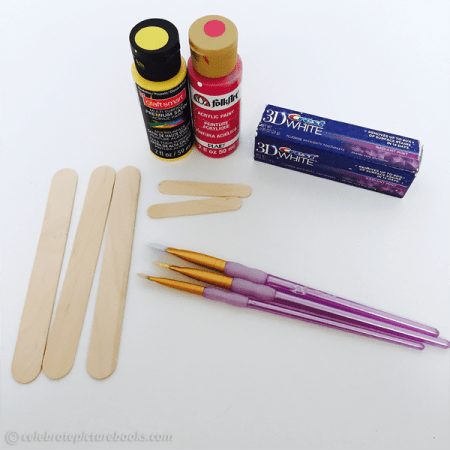
Supplies

  • Travel-size toothpaste box
  • 3 6-inch x 1/2-inch craft sticks
  • 2  2 1/2-inch x 7/8-inch mini craft sticks
  • 5 Round toothpicks, with points cut off
  • Paint in whatever colors you like for your design
  • 4 small buttons
  • 2 mini buttons
  • Paint brushes
  • Strong glue or glue gun

Directions

  1. Empty toothpaste box
  2. Paint toothpaste box and decorate it
  3. Paint the craft sticks and 5 toothpicks
  4. Paint one small craft stick to be the propeller
  5. Let all objects dry

To assemble the biplane

  1. For the Bottom Wing – Glue one 6-inch-long craft stick to the bottom of the plane about 1 inch from the end of the box that is the front of the plane
  2. For the Top Wing – Glue the other 6-inch-long craft stick to the top of the plane about 1 inch from the front of the plane
  3. For the Tail – Glue one mini craft stick to the bottom of the box about ¾ inches from the end that is the back of the plane
  4. For the Vertical Rudder – Cut the end from one of the painted 6-inch-long craft sticks, glue this to the back of the box, placing it perpendicular against the edge and half-way between each side

To assemble the front wheels

  1. Cut 4 painted toothpicks to a length of ¾-inches long
  2. Cut one painted toothpick to a length of 1-inch long
  3. Glue 2 of the 3/4-inch toothpicks to the back of 1 button, the ends of the toothpicks on the button should be touching and the other end apart so the toothpicks form a V
  4. Repeat the above step for the other wheel
  5. Let the glue dry
  6. Glue the 1-inch long toothpick between the wheels at the center of each wheel to keep them together and give them stability. Let dry

To make the back wheel

  1. Cut two ¼-inch lengths of painted toothpick and glue them together. Let dry
  2. Glue two mini buttons together to form the back wheel. Let dry
  3. Glue the ¼-inch toothpicks to the mini buttons. Let dry
  4. Glue these to the bottom of the plane in the center of the box directly in front of and touching the tail

Display your biplane!

Picture Book Review

March 27 – Quirky Country Music Song Titles Day

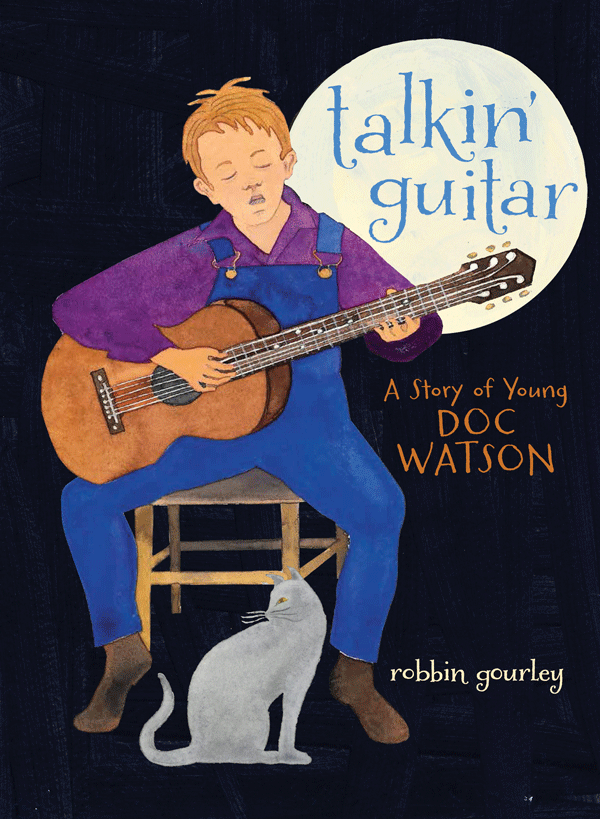
celebrate-picture-books-picture-book-review-talkin-guitar-cover

About the Holiday

Song titles can be evocative of so many emotions, and country song titles seem to take this fact to a whole nuther level. Sure, the travails of heartbreak may cause misery and despair, but I bet you can’t help smiling—just a little—when you read titles like this: I Would Have Writ You A Letter, But I Couldn’t Spell Yuck!, You Were Only A Splinter As I Slid Down The Bannister Of Life, and Did I Shave My Legs for This? So, today, celebrate by finding and listening to some quirky country songs that tickle your fancy.

Talkin’ Guitar: A Story of Young Doc Watson

By Robin Gourley

“Yonder, where blue mountains meet the sky, Arthel Watson was born into a world of music.” Music, for Arthel, was much more than his mama’s singing at the end of the day. It was the calls of animals and birds, the burbling river, the whistles of trains, and the clatter of farm machinery. He loved to listen to the rain and the wind and the silence between sounds too. “Arthel had ears like a cat. Maybe it was because he was blind.”

celebrate-picture-books-picture-book-review-talkin-guitar-rain

Image and text copyright Robbin Gourley, courtesy of robbingourley.com

Arthel just couldn’t help but make music whenever and wherever he could. Pots became drums, and cowbells rang like cymbals. Arthel even strung a steel wire across the barn door to strum. When Pappy gave him a harmonica, Arthel practiced until the screechy notes settled into a purr. When Pappy made him a banjo, he practiced until the “rusty door hinge” creak was replaced by spritely melody. One day when Arthel plinked out a few notes on his cousin’s guitar, his father made him a promise. “‘Son, if you can play a song by the time I git home from work, we’ll go into town and buy you your own guitar.’”

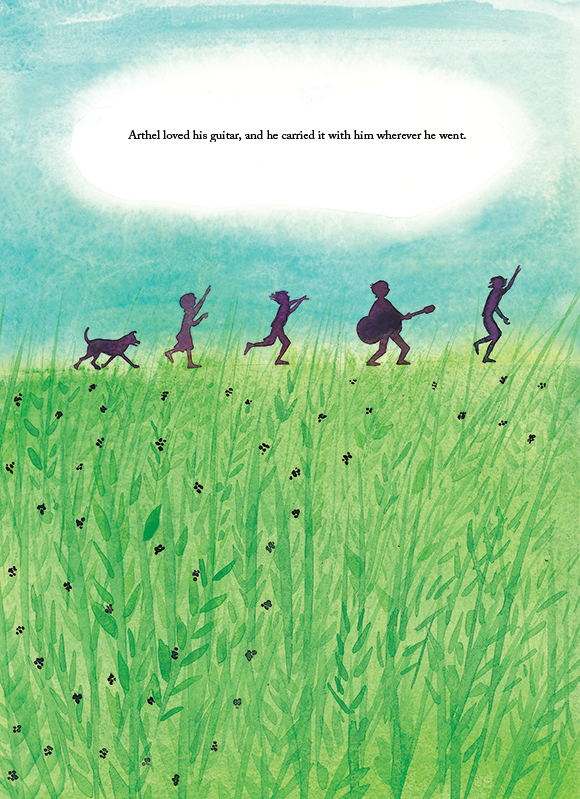
celebrate-picture-books-picture-book-review-talkin-guitar-played-guitar-everywhere

Image and text copyright Robbin Gourley, courtesy of robbingourley.com

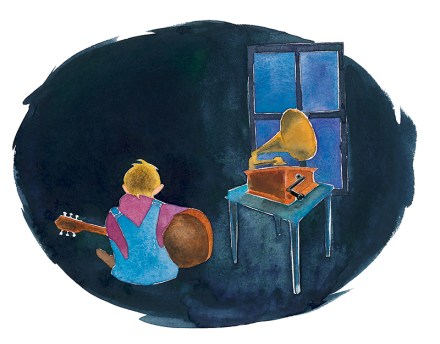
By the end of the day, Arthel had composed a “sweet, simple song” from the few chords he had learned. With a “belly full of butterflies,” he played it for his family and earned himself a guitar. From then on Arthel carried his guitar everywhere, learning from records at home and from songs on the radio. He memorized the rhythms of farm work and the songs of various animals, and between chores he practiced, practiced, practiced. “All those chores and all that practice made him sharp as a whittling knife and tough as a hickory.”

celebrate-picture-books-picture-book-review-talkin-guitar-listening-to-victrola

Image and text copyright Robbin Gourley, courtesy of robbingourley.com

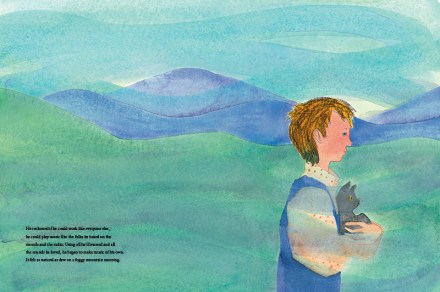
Arthel decided that if he could work just like everyone else, he could probably play music as well as the artists he listened to on records and on the radio. He began to compose his own music. “It felt as natural as dew on a foggy mountain morning.” Arthel played “what he couldn’t see. He could make his guitar sound like a muskrat or a groundhog or a ‘wooly boogie bee’” and sing the stories of the countryside he loved.

An Author’s Note following the text reveals more about Arthel’s life, the influences on his music, and how he earned the nickname “Doc.”

celebrate-picture-books-picture-book-review-talkin-guitar-inspired

Image and text copyright Robbin Gourley, courtesy of robbingourley.com

Robin Gourley’s heartening biography of Doc Watson is perfectly attuned to her young audience. Readers are introduced to Arthel as he soaks in the sounds of life around him and only learn several pages into the story that he was blind. His blindness is not mentioned again except for the subtle acknowledgement that “he reckoned if he could work like everyone else, he could play music like the folks he heard on the records and the radio”—which becomes universal inspiration for all. The emphasis that practice develops natural talent and pays off is also a great lesson for readers who may just be discovering their own talents.

Gourley’s soothing watercolors are suffused with the beautiful pastels of Appalachia, which was both home and muse to Anthel. Vignettes take readers inside Anthel’s home to discover the Victrola and the old radio that were his early teachers and introduce his family, who surrounded him with encouragement as he grew from a child to a young man—always with a guitar in his hands.

Ages 4 – 7

Clarion Books, 2015 | ISBN 978-0544129887

To discover more about Robbin Gourley, her books, and her art, visit her website!

Quirky Country Music Song Titles Day

celebrate-picture-books-picture-book-review-guitar-dot-to-dot

Musical Dot-to-Dot

When a musician follows notes, they create a song. What will you find when you follow the numbers on this printable Musical Dot-to-Dot?

Picture Book Review

March 24 – It’s Women’s History Month

celebrate-picture-books-picture-book-review-i-dissent-cover

About the Holiday

During the month of March we celebrate the roles and contributions of women throughout history. The theme for 2017 is “Honoring Trailblazing Women in Labor and Business.” From earliest times, women have participated in and influenced events, often without receiving recognition. This month encourages all women to stand up to discrimination and stand up for what they believe in. 

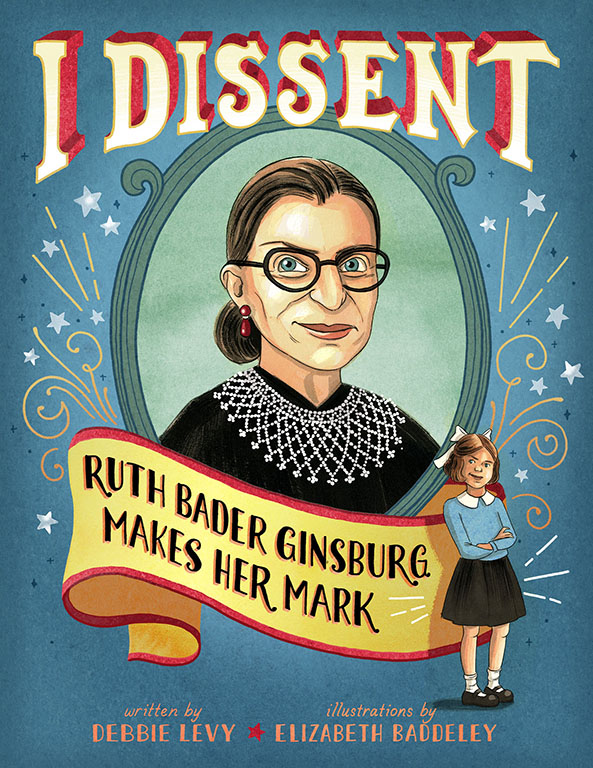
I Dissent: Ruth Bader Ginsburg Makes Her Mark

Written by Debbie Levy | Illustrated by Elizabeth Baddeley


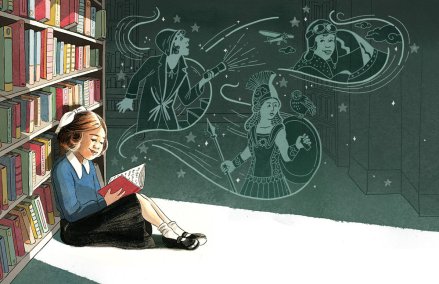
Ruth Bader grew up during the 1940s in Brooklyn, New York’s multicultural neighborhood. It was a time when boys were educated for jobs and bright futures while girls were expected to marry and raise children. Ruth’s mother, Celia Amster Bader, however, “thought girls should also have the chance to make their mark on the world.” She introduced Ruth to books in which she discovered women who used their strength, courage, and intelligence to do big things.

celebrate-picture-books-picture-book-review-i-dissent-in-the-library

Image copyright Elizabeth Baddeley, text copyright Debbie Levy. Courtesy of simonandschuster.com.

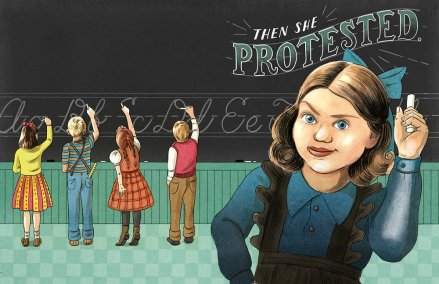
Ruth also saw and felt the sting of prejudice while growing up. Her family was Jewish, and at the time “hotels, restaurants, even entire neighborhoods” denied access to Jews, African Americans, Mexicans, and others. Ruth disagreed and never forgot. She was even discriminated against for being left-handed. In school she was instructed to write with her right hand, but her awkward penmanship earned a D. First, she cried; then she protested by only writing with her left hand—“it turned out she had quite nice handwriting!”

celebrate-picture-books-picture-book-review-i-dissent-in-the-left-handed

Image copyright Elizabeth Baddeley, text copyright Debbie Levy. Courtesy of simonandschuster.com.

During elementary school, Ruth was outstanding in some classes, such as history and English, and did not do so well in others, such as sewing and cooking. Music, especially opera, was another favorite subject—even though she did not have the voice to match her dreams. She excelled in high school and was even chosen as a graduation speaker. But Ruth had been hiding the fact that her mother was very ill. The day before graduation, her mother died. Ruth did not go to her graduation, but she did fulfill her mother’s wish and entered college.

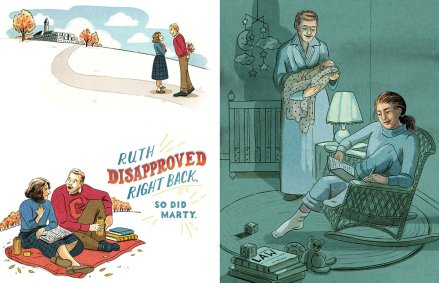
In college Ruth met Marty Ginsberg, and the two fell in love. They both decided to become lawyers to fight prejudice and unfairness in court. People thought this was a great idea for Marty, but disapproved of it for Ruth. “Ruth disapproved right back. So did Marty.” After college they got married, went to law school, and had a baby girl.

celebrate-picture-books-picture-book-review-i-dissent-college

Image copyright Elizabeth Baddeley, text copyright Debbie Levy. Courtesy of simonandschuster.com.

In law school Ruth was one of nine women in a class of 500. She worked hard and tied with another student as first in the class, but after graduation she couldn’t find a job. Employers objected because she was a woman, a mother, and Jewish. Finally, she found work with a judge. Her excellent work for him translated into jobs at one law school after another, and she became “one of the few female law professors in the whole country.”

All around her Ruth saw other women who were denied jobs or paid less than men. Women also had very little voice in courtrooms or in government. Rulings by the Supreme Court, the highest court in America, had helped maintain this inequality. The Court had stated that women were unfit for many jobs because of their “natural and proper timidity and delicacy.” Besides, the Supreme Court also said, “Woman has always been dependent upon man.”

celebrate-picture-books-picture-book-review-i-dissent-in-the-law-school

Image copyright Elizabeth Baddeley, text copyright Debbie Levy. Courtesy of simonandschuster.com.

“Ruth really, really disagreed with this!” So she began fighting in court for equal rights for women. But equal rights for women also meant equal rights for men: Ruth believed men should be able to stay home with children if they wanted to while women worked. “These were fresh ideas in the 1970s. Ruth did not win every case, but she won enough. With each victory, women and men and girls and boys enjoyed a little more equality.”

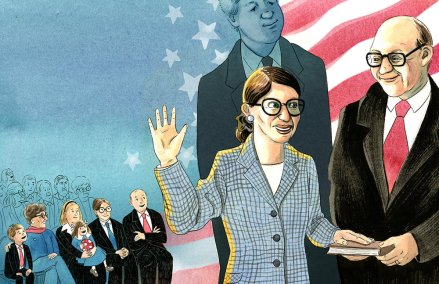
At home, Ruth’s own family agreed with her. Marty was a successful lawyer and also an accomplished chef who cooked the family’s meals. Ruth went on to become a well-known and well-respected lawyer. President Jimmy Carter asked her to be a judge in Washington DC. Then President Bill Clinton chose her to fill a vacancy on the Supreme Court. “Ruth agreed.

celebrate-picture-books-picture-book-review-i-dissent-family-life

Image copyright Elizabeth Baddeley, text copyright Debbie Levy. Courtesy of simonandschuster.com.

In 1993, Justice Ruth Bader Ginsburg became the first Jewish woman on the nation’s highest court.” When the nine justices decide a case, they listen to both sides and then vote. The winning side then writes an opinion explaining their ruling. When Justice Ginsburg votes with the winning side, she wears a special lace collar over her robe. When she does not agree with the ruling, she says, “I dissent” and writes an opinion explaining why. She has a special collar for dissenting too.

Some of her dissensions were influenced by her early experiences. She dissented when “the court wouldn’t help women or African Americans or immigrants who had been treated unfairly at work.” She dissented when the court did not protect voting rights for all citizens. She dissented when the court disagreed with schools that offered African Americans a better chance to go to college.” And once when she dissented, Congress and the president agreed with her and overturned the Supreme Court’s ruling.

celebrate-picture-books-picture-book-review-i-dissent-supreme-court

Image copyright Elizabeth Baddeley, text copyright Debbie Levy. Courtesy of simonandschuster.com.

Justice Ruth Bader Ginsburg is now the oldest member of the Supreme Court. Some people think she should retire, but she disagrees. She still has work to do. Over the years, she has “cleared a path for people to follow in her footsteps—girls in college, women in law school, and everyone who wants to be treated without prejudice….Step by step, she has made a difference…one disagreement after another.”

An extensive Author’s Note about Ruth Bader Ginsburg’s life, notes on Supreme Court Cases, and a selected bibliography follow the text.

Debbie Levy’s outstanding biography allows readers to journey with Ruth Bader Ginsburg as her experiences and beliefs lay the foundation for her life’s work. Well-chosen anecdotes from Ginsburg’s childhood make her accessible to kids and may even inspire them to look toward their own futures. Ginsburg’s trajectory from college student to lawyer to judge and finally to the Supreme Court is balanced and uplifting, emphasizing the positive impact of persistence and self-confidence.

Elizabeth Baddeley’s illustrations go hand-in-hand with Levy’s text to fully illuminate the life of Ruth Bader Ginsburg for children. Ginsburg’s intelligence, sense of humor, courage, and principles are evident as she matures from school girl to Supreme Court Justice. Dynamic typography highlights the theme of dissent and disagreement as a force for positive change. The color, expression, and spirit imbued in each page make I Dissent: Ruth Bader Ginsburg Makes Her Mark an exciting and eye-catching read for all children.

I Dissent: Ruth Bader Ginsburg Makes Her Mark is a superb and recommended book for girls and boys. The book’s focus on a woman who continues to make a difference will inspire children and even adult readers to speak up and act on their convictions.

Ages 5 – 9

Simon & Schuster Books for Young Readers, 2016

To learn more about Debbie Levy and her books for children and young adults, visit her website!

Discover a gallery of illustration by Elizabeth Baddeley on her website!

Women’s History Month Activity

celebrate-picture-books-picture-book-review-rosie-the-riveter-coloring-page

Rosie the Riveter Coloring Page


Rosie the Riveter became a symbol of strong women during World War II and continues to be an iconic figure today. Print and color this Rosie the Riveter Page then display it to always remember that women can do anything!

Picture Book Review
March 12 – It’s Women’s History Month

celebrate-picture-books-picture-book-review-to-the-stars-cover

About the Holiday

From its beginning as a single-day observance in 1911 , the celebration of women’s achievements and contributions throughout history grew to a week-long event in 1982 and finally to encompass the entire month of March in 1988. During this month we remember the trail-blazing women of yesteryear who used their creativity, intelligence, and perseverance to promote rights for women while contributing their own innovations to science, art, social reform, medicine, and other disciplines as well as today’s pioneers who carry on their legacy and make our world a better place. 

To the Stars! The First American Woman to Walk in Space

Written by Carmella Van Vleet and Dr. Kathy Sullivan | Illustrated by Nicole Wong


As a child Kathy Sullivan loved to explore. Her father designed airplanes, and when he brought home blueprints, she carefully studied every line and curve. When she saw airplanes in the sky she wished she were on them, flying to exciting locations all over the world. Maps and foreign languages fascinated her. “Their strange symbols, exotic tales, and musical sounds made her feel like the world was waiting for her.” Kathy wanted to see that whole world and thought maybe she’d like to be a spy or a diplomat, but her friends and other adults told her those weren’t jobs for women.

celebrate-picture-books-picture-book-review-to-the-stars-blueprints

Image copyright Nicole Wong, courtesy of nicole-wong.com

But Kathy always followed her heart. She loved going fishing with her dad and brother and finishing the day with a swim. She “delighted in how her arms and legs moved in slow motion underwater.” Kathy was still a teenager when she learned how to pilot a plane. At first the busy instrument panel made her nervous, but she quickly learned how to manage all the “dials, buttons, and numbers.”

Kathy got a taste for the thrill of space when she bravely jumped at the opportunity to ride in a Breezy—an open air framework plane. Sitting at the very tip of the airplane, in front of the pilot, Kathy had a bird’s eye view. “The wind rushed past her face so fast it pushed her cheeks back. Higher! Faster! Young Kathy looked at the ground below her feet. She felt like she could see the whole world.”

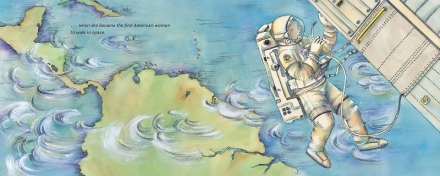
As an adult, Kathy put all of these experiences to good use as she studied complex science that would lead her to NASA. And when she became the first American woman to walk in space, she fulfilled her childhood dream to see the whole world!

celebrate-picture-books-picture-book-review-to-the-stars-spacewalk

Image copyright Nicole Wong, courtesy of charlesbridge.com

Carmella Van Vleet and Dr. Kathy Sullivan, have written a compelling biography of Dr. Sullivan that not only tells the story of her adult achievements, but also reveals the childhood and teenage motivations and influences that fostered her journey to the stars. As each event in Kathy’s young life is introduced, it is followed by an adult accomplishment: Kathy’s poring over her father’s aircraft blueprints leads to a spread of college-age Kathy studying charts in textbooks. Her enjoyment of swimming underwater is followed by an illustration showing her NASA training underwater. Her initial introduction to a plane’s instrument panel informs her later responsibilities inside the spacecraft. And the question she once asked herself as a child—what kind of job would allow her to see the whole world—is answered as the astronaut Kathy gazes down at Earth from space.

celebrate-picture-books-picture-book-review-to-the-stars-breezy

Image copyright Nicole Wong, courtesy of charlesbridge.com

Nicole Wong’s lovely, realistic watercolor and ink paintings clearly show readers Kathy Sullivan’s trajectory from curious girl to accomplished astronaut. The blueprints that Kathy studies are filled with schematics. The aqua water she swims in swirls and bubbles in the wake of her cannonball dive, and the crisscrossing fields lay like a mottled green quilt under the Breezy. Especially stunning and effective are the illustrations of Dr. Sullivan’s work with NASA. Kids will love the up-close view of the spacecraft’s instrument panel with its myriad buttons and dial. Likewise, they will find the gorgeous two-page spreads of the space shuttle’s launch, the view from the cockpit, and Kathy’s spacewalk particularly thrilling.

Following the text is a personal note from Kathy Sullivan to her young readers. More extensive biographical notes reveal how Dr. Sullivan discovered her love of science as well as information on the NASA missions she supported. Two more pages highlight the women of the first space-shuttle class, which included Kathy Sullivan, and other firsts by eight other women in space.

To the Stars is a wonderful book to teach children that following their own heart is the best path to future happiness and personal accomplishment. It’s a beautiful addition to any budding scientist’s or adventurer’s library!

Ages 5 – 9

Charlesbridge, 2016 | ISBN 978-1580896443

To find fun activities for To the Stars—including how to make space play dough—as well as other books by Carmella Van Vleet, visit her website!

To learn more about Nicole Wong and view a portfolio of her artwork, visit her website!

Women’s History Month Activity

celebrate-picture-books-picture-book-review-astronaut-coloring-page


Astronaut Coloring Page

Would you like to be an astronaut? Draw yourself in this spacesuit and then grab your crayons, pencils, or markers and have fun with this printable Astronaut Coloring Page!

Picture Book Review

March 8 – International Women’s Day

celebrate-picture-books-picture-book-review-swimming-with-sharks-cover

About the Holiday

The first International Women’s Day was celebrated in 1909 during a time of great change and increasing industrialization that saw more and more women demanding equality in working hours, pay, safety, voting rights and more with their male counterparts. Women across the globe are still fighting for these rights. This year’s theme is Be Bold For Change (#BeBoldForChange), and reminds us that we must always be vigilant in securing and keeping equal rights for all.

Swimming with Sharks: The Daring Discoveries of Eugenie Clark

Written by Heather Lang | Illustrated by Jordi Solano


When young Eugenie Clark pressed her face against the aquarium window at the sharks swimming by, she did not see “piercing eyes…rows of sharp teeth…vicious, bloodthirsty killers.” Instead she saw “sleek, graceful fish” and dreamed of being inside the tank to swim among them. She loved to spend Saturdays at the New York Aquarium sharing her knowledge of fish with visitors. She wished there was more information available about sharks and hoped for a day when she could learn more about them.

celebrate-picture-books-picture-book-review-swimming-with-sharks-at-aquarium

Image copyright Jordi Solano, courtesy of plumpuddingillustration.com

At home her mother bought Genie her own little fish tank, and soon the whole apartment was full of fish and reptiles. Genie kept careful notes on her pets as she tried to answer her many questions. William Beebe, a famous scientist who studied fish, was Genie’s hero. She too wished to explore the ocean like he did. But this was the 1930s and not many people “dared to study the depths of the sea, and none were women.” Eugenie’s mother suggested she study typing and try to become Beebe’s secretary. The life of a secretary was not what Genie had in mind.

Eugenie received a Master’s Degree in zoology, and when a well-known ichthyologist offered her a job as his research assistant and an opportunity to take oceanography classes, she moved to California. There she collected fish and water samples. The beauty of the underwater world astonished her. In the lab she was able to dissect a swell shark to learn “how and why it puffs up.” But Genie wanted to dive deeper—to swim with sharks.

celebrate-picture-books-picture-book-review-swimming-with-sharks-studying

Image copyright Jordi Solano, courtesy of plumpuddingillustration.com

One day, Genie’s professor allowed her to try helmet diving. Wearing the heavy metal helmet, Genie was able to descend into the cold, murky deep where kelp forests waved with the current. “In 1949 the US Navy hired Genie to study poisonous fish in the South Seas. As she collected fish, she came face to face with a shark. The shark swam closer and closer then suddenly dove and disappeared out of sight. Genie was thrilled by the encounter.

In 1955 Eugenie moved to Florida and opened the Cape Haze Marine Laboratory, becoming the first to study sharks in their natural environment. The more she studied sharks, the more she realized that they were intelligent creatures, not stupid “eating machines” as most people thought. She wondered if sharks could be trained.

Eugenie set up an experiment in which a shark needed to press a white board to receive a reward a short swim away. Soon, the female shark of the pair realized that if the male shark pressed the board, she could swim to retrieve the reward. The pair remembered the exercise even after a ten-week break. Soon, scientists from around the world wanted to work with Genie. 

celebrate-picture-books-picture-book-review-swimming-with-sharks-swimming-under-water

Image copyright Jordi Solano, courtesy of plumpuddingillustration.com

Word reached her about “‘sleeping sharks,’” off the coast of Mexico. Instead of swimming around, these sharks stayed on the ocean floor. Eugenie was determined to learn how they breathed without moving. She dived deep into their territory, finding a requiem shark in an ocean cave. Here, she was face-to-face with one of the most feared fish in the sea. Genie swallowed any worry and watched as the fish opened and closed its mouth, providing itself with oxygen as a remora fish cleaned its gills.

Genie took water samples and completed other tests that revealed astonishing facts about the ocean caves and the habits of sharks. But while Genie was learning the facts about these mysterious sea creatures, most people still feared them and considered them with suspicion and superstition. As time went by, Genie began seeing fewer and fewer sharks on her dives. They were being killed out of fear, for their fins, and because people thought it would make beaches safer.

celebrate-picture-books-picture-book-review-swimming-with-sharks-sunset

Image copyright Jordi Solano, courtesy of plumpuddingillustration.com

Genie began talking about her research, and people listened. “Dr. Eugenie Clark had become one of the most respected fish scientists in the world.” She taught people that there is always more to learn and “always more surprises.”

An extensive Author’s Note about the life and work of Eugenie Clark as well as more information on sharks follows the text.

Heather Lang delves into the life’s work of a woman who fearlessly challenged herself and the prevailing science to increase our knowledge of sharks and change people’s perspective on these beautiful creatures. Readers will love Lang’s comprehensive storytelling—beginning with young Genie’s fascination with fish and the sea—that reveals the pivotal events which led to her discoveries. Fascinating anecdotes from Eugenie’s research and personal encounters with sharks will enthrall children, and the idea that there is much more to discover will resonated with young scientists in the making.

celebrate-picture-books-picture-book-review-swimming-with-sharks-looking-at-shark

Image copyright Jordi Solano, courtesy of plumpuddingillustration.com

Jordi Solano takes readers to the depths of the ocean in his sea-green, atmospheric illustrations that beautifully mirror the world of sharks. Textured and layered images of marine plants and a variety of creatures give children an up-close view of Eugenie Clark’s work and the fish she encountered on her dives. Each type of shark is magnificently and realistically drawn, giving kids an idea of coloring, size, movement, and more. Children will also see Eugenie’s research facilities and the equipment she used in her studies.

For anyone interested in marine science, history, biographies, or the environment in general, Swimming with Sharks: The Daring Discoveries of Eugenie Clark is a can’t-miss book.

Ages 5 – 9

Albert Whitman & Company, 2016 | ISBN 978-0807521878

Discover more about Heather Lang and her books on her website!

View a gallery of artwork by Jordi Solano on Plum Pudding Illustration!

International Women’s Day Activity

celebrate-picture-books-picture-book-review-fascinating-sharks-word-scramble

Fascinating Sharks Word Scramble


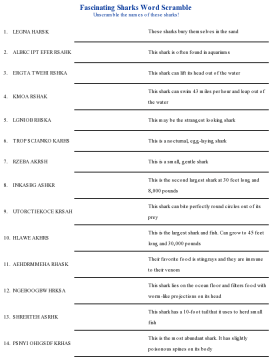
Read the clues and unscramble the names of 14 types of sharks in this printable Fascinating Sharks Word Scramble! Here’s the Solution!

Picture Book Review

March 6 – International Ideas Month

celebrate-picture-books-picture-book-review-the-secret-subway

About the Holiday

The onset of spring with its  wide-open sunny days seems to beckon to us to open our minds to all sorts of new possibilities. International Ideas Month also invites would-be inventors and clever folk alike to think differently and pay attention to your brainstorms. You never know – there may be a book, a work of art, a new invention, or a solution to a need inside you just waiting to be let out! 
The Secret Subway

Written by Shana Corey | Illustrated by Red Nose Studio (Chris Sickels)


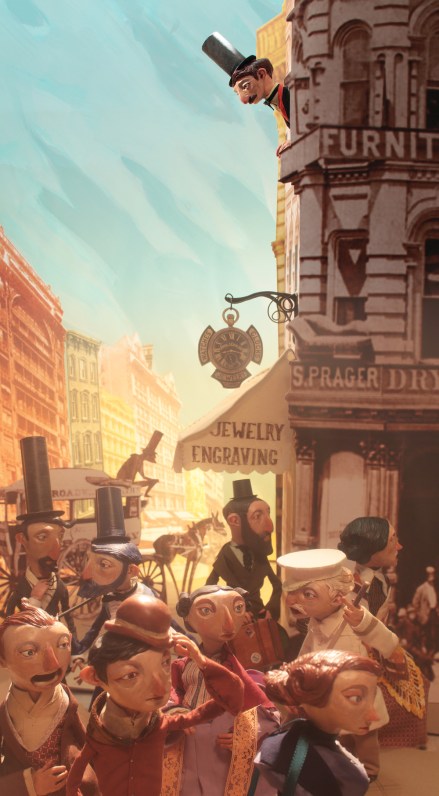
In the 1860s the streets of New York were…well, not to put too fine a point on it…disgusting. Made of cobblestone and filled with trash, waste, horse manure, dust, dirt, and throngs of people, the roads made for rough travel. Many people had ideas about what could be done to make the streets safer and cleaner. Some thought a moving sidewalk would work, others talked about double-decker roads or an elevated train system. But while there was a lot of talk, nothing ever got done.

celebrate-picture-books-picture-book-review-the-secret-subway-city

Image copyright Chris Sickles, courtesy of rednosestudio.com

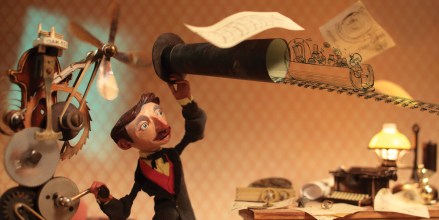
Alfred Ely Beach, however, peered down from his high office room and studied the street below him. Alfred Beach was a thinker, a publisher, and an inventor. He put his clever mind to work and came up with a solution. He envisioned a train powered by an enormous fan that would travel underground. “People would get where they needed to go as if by magic!” he thought. He couldn’t wait to start building. There was just one problem—he didn’t own the streets. And getting permission to dig them up would be hard. “So Beach hatched a sneaky plan. He would propose building an underground tube to carry mail instead.” As he had imagined, no one objected to this project when he proposed it—not even Boss Tweed, who unofficially ran the city.

celebrate-picture-books-picture-book-review-the-secret-subway-designing

Image copyright Chris Sickles, courtesy of rednosestudio.com

Given the okay, Beach rented the basement of Devlin’s Clothing Store. Every day he sent in workers to dig and every night wagons took away the debris. For 58 days and nights Beach’s men tunneled under the city, moving forward 8 feet each day. At last the tunnel was finished. It was 8 feet across and 294 feet long—large enough to hold a train full of people.

Beach then decorated the basement to be a beautiful, welcoming waiting room. Gaslight lamps and paintings dotted the walls, flowers added color, and a grandfather clock rang out the time. There was even a fountain with goldfish, a man playing a grand piano, and a delicious lunch. When everything was ready, Beach invited reporters, government officials, and distinguished citizens to join him on February 26, 1876 at the “Beach Pneumatic Transit Company.”

celebrate-picture-books-picture-book-review-the-secret-subway-designing

Image copyright Chris Sickles, courtesy of rednosestudio.com

That first day Alfred Beach’s guests only admired the train, but they gave it glowing praise. Soon Beach opened his train to the public. With a WHOOSH from a gigantic fan, the train zipped down the track and then back again. “Beach’s train was a SENSATION! All winter while wagons slipped and slid on the slushy streets above, people poured into Devlin’s for the twenty-five-cent ride.”

While riders loved it, some people objected. Shop keepers didn’t want potential buyers underground. Property owners were afraid the digging would hurt their buildings, and some felt Beach wanted too much power. Even Boss Tweed no longer supported it since some of his friends had their own ideas on building a subway. When the governor of New York refused to let Beach expand his train, the project came to a halt.

celebrate-picture-books-picture-book-review-the-secret-subway-invites-riders

Image copyright Chris Sickles, courtesy of rednosestudio.com

The idea didn’t die, however, and “many years later drilling could be heard once again under the streets of New York City” as a train system powered with electricity was being built. Diggers discovered many unusual things buried under the city. Perhaps the most surprising was a brick wall behind which stood a little railroad car rusting in its tracks, a memorial to innovation and the future.

Alfred Ely Beach was one clever man, and Shana Corey tells his story with historical perspective, wit, and suspense. Corey’s language crackles with evocative alliteration, stealth, and action. Kids will be excited to learn of the intrigue and imagination that led to this remarkable snippet of America’s history.

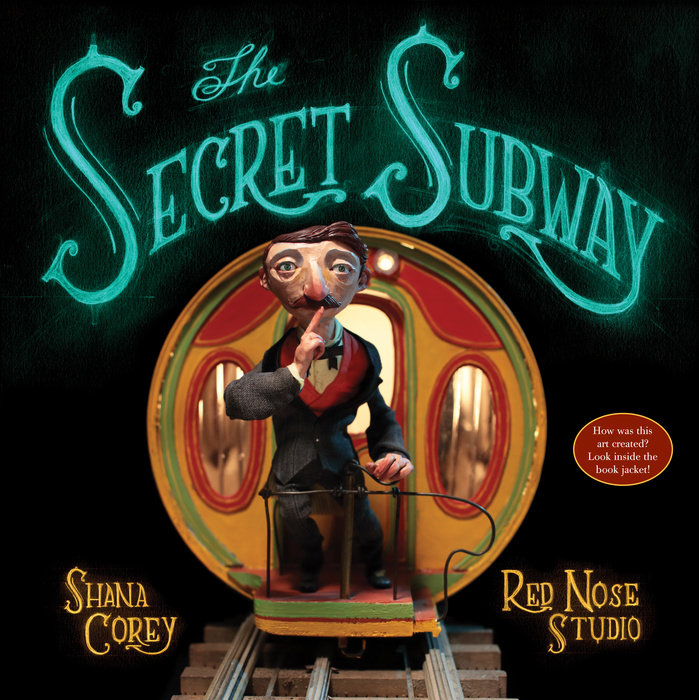
Fans of Claymation will love Chris Sickels’ multimedia artwork that combines sculpted characters, specially built props, photographs, and illustration. Sickels’ characters are nothing short of astounding. Their period clothing, hairstyles, and expressive faces lend an engaging and realistic dimension to the vintage scenes. Sickels cleverly depicts early New York City and people’s alternative ideas to the traffic problem with sketched in schemetics. His use of color and lighting sets the perfect tone for this highly entertaining and educational picture book. Kids will want to linger over each page to catch all the details of The Secret Subway.

For kids interested in transportation, history, inventions, and claymation and other arts, The Secret Subway would be a wonderful addition to their home library.

Ages 4 – 10

Schwartz & Wade, Random House Kids, 2016 | ISBN 978-0375870712

Discover more about Shana Corey and her books for kids on her website!

You will be amazed by the art, books, and animation by Chris Sickels on his Red Nose Studio website!

This Secret Subway book trailer is just the ticket!

International Ideas Month Activity

celebrate-picture-books-picture-book-review-the-secret-subway-chris-sickels-craft

Chris Sickels’ Secret Subway

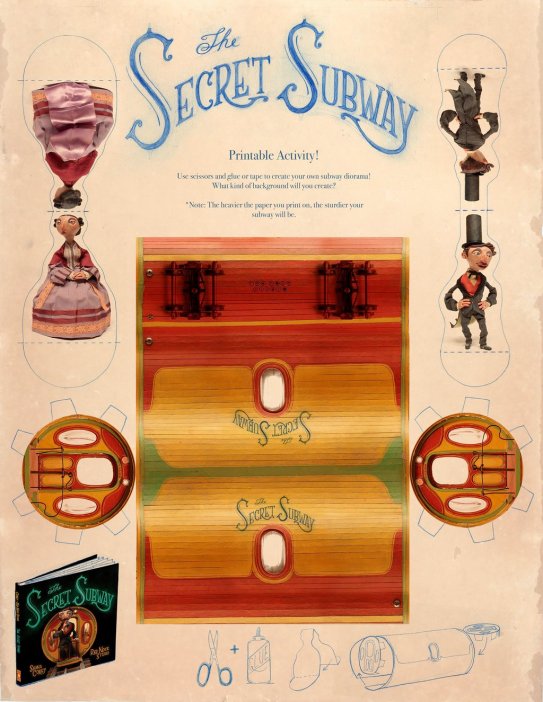
Chris Sickels of Red Nose Studio invites you to build your own Secret Subway with this printable play set, complete with Alfred Ely Beach and a passenger! Click here to download your printable Secret Subway Activity!

Build a Super Subway Car

celebrate-picture-books-picture-book-review-subway-car

Every day, millions of people all over the world travel to work, school, and other activities by subway. Here’s an easy and fun way to build your own subway train from recycled materials. You can make just one car or make a few and connect them to create a long train worthy of any big city!

Supplies

  • Printable Subway Car Template
  • Medium or long toothpaste box
  • Silver paint
  • Glue
  • Paintbrush
  • Scissors

Directions

  1. Paint the toothpaste box with the silver paint, let dry
  2. Cut out the windows, doors, and stripe templates
  3. Trim the stripes to fit your box
  4. To make the little sign near the door, trim a small aquare from one of the stripes
  5. Glue the templates to the box

Picture Book Review