June 8 – National Best Friends Day

celebrate-picture-books-picture-book-review-painting-pepette

About the Holiday

What would we do without our best friends? They’re the ones we go on adventures with, laugh with, commiserate with, even cry with. And no matter what, we know they’ll always be there for us. Best friends can be people we’ve known all our lives or ones we’ve just met; they can live far away or in our own home. Best friends don’t even have to be people—beloved pets or favorite toys are sometimes just what we need. Today is the perfect time to celebrate your best buddy. Get together with them, call, or text. Relive some favorite memories or make some new ones!

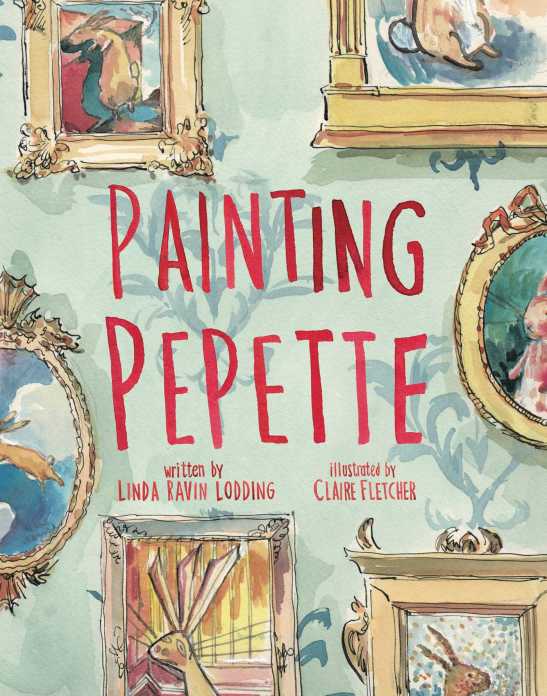
Painting Pepette

Written by Linda Ravin Lodding | Illustrated by Claire Fletcher


If you peek in the great room window of the grand yellow house at #9 Rue Laffette in Paris, you will most likely see cuddled on the comfortable seat Josette Bobette and her beloved stuffed rabbit Pepette. It’s their favorite place. Looking past them you will see that the great room is filled with fine art. On the walls hang portraits of the family—Josette’s mother is there as well as grand-mère and grand-père, the three Bobette sisters, and even their schnoodle Frizette.
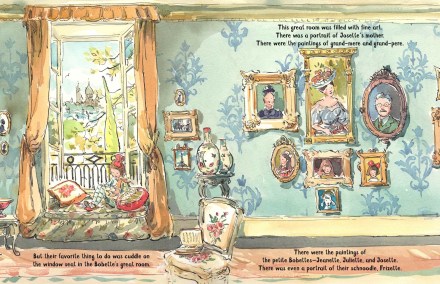
celebrate-picture-books-picture-book-review-painting-pepette-great-room

“One day Josette noticed something strange. There was no portrait of Pepette!” Josette determines to find an artist to paint a special portrait of her best friend. The pair heads out to Montmartre, where the all the best artists set up their easels to paint and sell their work. It doesn’t take long for a man in a striped shirt to stop them.

“‘Those ears!’” he cries. “‘Never have I seen such majestic ears. I must paint this rabbit’s portrait!’” Pepette blushes at such an effusive compliment, and Josette exclaims, “‘Magnifique!’” It appears Josette has found just the artist to create Pepette’s portrait. The painter waves his brush with a flourish, declares his painting a “masterpiece,” and holds it up for inspection. Josette gazes at a Pepette with two noses and three ears. Diplomatically, she proclaims the picture “nice” but not quite Pepette. Her best friend agrees.

Just then a man with a thin, curved handlebar mustache spies the pair. Admiring Pepette’s whiskers, the artist begs to capture “the very essence of her rabbitness!” He immediately sets to work, and in no time a most unusual portrait emerges. Pepette seems to melt from a tall red wall. Josette considers it and her reaction carefully. “‘It’s imaginative,’” she says. “‘But you’ve painted Pepette quite, well, droopy.’” Pepette agrees.

As Josette and Pepette enjoy a Parisian snack on the curb of Montmartre, a rakish young man happens along. He is arrested by Pepette’s nose, which he likens “‘a faint star twinkling in a misty, velvet night.’” Josette has a good feeling about this artist and follows him across the square to his easel. Pepette poses on a red tufted stool as the artist paints a rabbit soaring through the clouds. He proclaims the finished portrait “‘one of my best works’” as he displays it to the crowd. Josette likes the clouds but tells the painter that Pepette is afraid of heights and not fond of flying. Pepette agrees.

By now Pepette is the most sought-after model in Paris, and another artist rushes up, captivated by her beauty. The balding man in a dapper suit and round spectacles peers at Pepette. “‘What a colorful lady—balloon blue, pansy pink, and radish red!’” A little suspicious of his vision, Josette allows him to paint Pepette. “‘Ta da!’” the man exclaims, revealing the magic of his brush. Josette studies the canvas with its vibrant dots, dashes, and splashes. While she admires the colors, she reminds the artist that Pepette isn’t pink.

“‘Ah, yes,’” nods the painter. “‘But through art we can see the world any way we want.’”
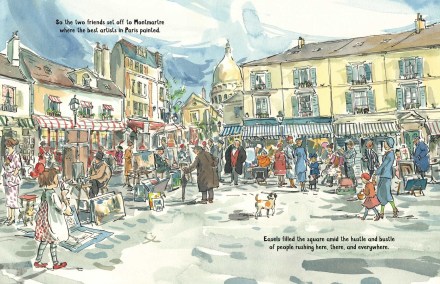
celebrate-picture-books-picture-book-review-painting-pepette-montmartre

With the sun setting low in the sky, Josette politely says thank-you and goodbye to the artists. She and Pepette have enjoyed their day, but it’s time to go home. Curled up once more on the window seat, Josette sighs. She had so hoped to have the perfect portrait of Pepette—one that showed her velvety grey listening ears, her heart-shaped nose, and her soft arms that give tight hugs. Suddenly, Josette has an idea! Gathering all her art supplies, she creates the perfect likeness—as special as Pepette herself!

An author’s note on the last page describes the creative atmosphere of 1920s Paris, home to writers, artists, musicians, and fashion designers, that gives a frame to her story. The artists that Josette meets are inspired by Pablo Picasso, Salvador Dalí, Marc Chagall, and Henri Matisse.

In Painting Pepette Linda Ravin Lodding has written a multi-layered story of love, friendship, and unique vision. Through the sweet relationship between Josette and Pepette and with a sprinkling of humorous self-congratulation on the part of the artists, Lodding nudges readers to appreciate that while art can reveal and obscure, reflect and transcend reality, ultimately the success of a piece—complex or simple—lies within the viewer’s heart. Lodding’s lyrical language trips off the tongue and is a joy to read—it’s like following Josette as she skips happily through Paris.

Claire Fletcher’s striking pen and ink illustrations pay delicate homage to cityscapes of a bygone Paris. Adorable Josette in her white pinafore over red-dotted dress, red shoes, and big red bow along with her enchanting rabbit are the perfect tour guides through crowded Montmartre and an introduction of art history. Soft tones of yellow, rose, and green illuminate the apartments and cafes of the square where colorful shoppers and artists mingle. Fletcher’s renderings of Pepette’s various portraits will not only make kids giggle, but entice them to learn more about each artistic style. The final endpapers reveal that the four fine-art portraits now hang in the Muse of Paris, while readers already know that Josette’s perfectly perfect portrait of her well-loved friend has taken its rightful place on the wall in the Bobette great room!

Painting Pepette is a beautiful addition to any child’s bookshelf and a lovely way for teachers to initiate a discussion of art history and get kids excited about artists and different art styles.

Ages 4 – 9

little bee books, 2016 | ISBN 978-1499801361

Follow Josette through Paris as she searches for just the right artist to paint a portrait of her best friend Pepette and comes to a surprising discovery in this beautiful trailer:

Discover more books by author Linda Ravin Lodding on her website.

Illustrator Clair Fletcher invites you to find more of her artwork by visiting her online gallery.

Best Friends Day Activities
celebrate-picture-books-picture-book-review-painting-pepette-activity-guide

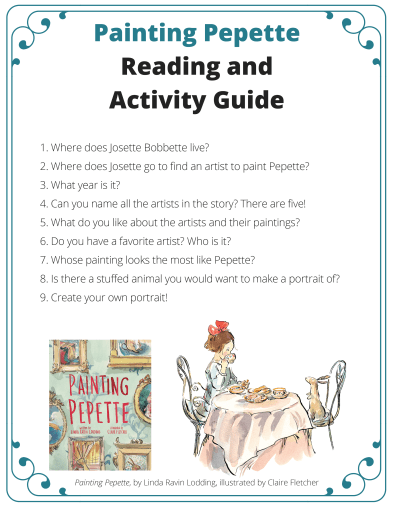
Painting Pepette Reading and Activity Guide


little bee books has created an interactive activity so you can continue exploring Josette’s world and your own artistic talent! Just click here—Painting Pepette Reading and Activity Guide—to start having fun!

Stuck on You Magnets or Picture Hanger


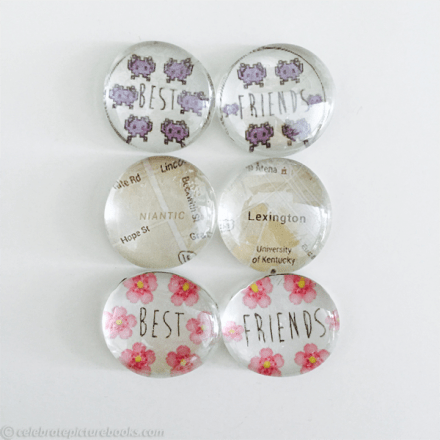
Best friends stick together whether they’re near or far, right? Here’s a fun craft that you and your friends can make to show how magnetic personalities attract each other! If your best friend or friends are far away, why not make them one too? Or make the alternate picture hanger! Be creative—use inside jokes, favorite characters, or shared experiences to make these  crafts personal!
celebrate-picture-books-picture-book-review-friends-magnets-craft

For Magnets

Supplies

  • To get you started, here are two printable Best Friends Templates! Template 1 Template 2
  • Poster board
  • Large, 1 ½-inch clear glass stones (decorative fillers), available in craft stores
  • Markers or colored pencils OR find images online to print out
  • Medium to large flexible magnets, available in craft stores
  • Super glue
  • Toothpicks
  • Scissors

Directions

  • Place the glass stone on the poster board and trace around it
  • Draw your design in the circle on the poster board
  • Cut out the circle
  • With the toothpick, apply glue around the very edge of the design side of the circle
  • Attach the circle to the flat side of the stone, let dry
  • Trim the cardboard circle if needed
  • Attach the magnet to the back of the cardboard with glue

celebrate-picture-books-picture-book-review-friends-picture-hanger-craft

For Map Picture Holder

Supplies

  • Use a mapping program to find a map of your town and your friend’s town
  • Poster board
  • Large, 1 ½-inch clear glass stones (decorative fillers), available in craft stores
  • Twine
  • Super Glue
  • Toothpicks
  • Scissors
  • Heavy duty mounting squares

Directions

  1. Find maps of your and your friend’s towns
  2. Zoom in so the name of your and your friend’s towns are displayed well. You will be using about a 1-inch area around the towns’ names.
  3. Take a screen shot of the maps
  4. Print the maps
  5. Place the glass stone on the map and trace around it
  6. Place the glass stone on the poster board and trace around it
  7. Cut out the circles on the map and poster board
  8. With the toothpick, glue the map to the poster board, let dry
  9. With the toothpick, apply glue around the very edge of the map side of the circle
  10. Attach the circle to the flat side of the glass stone, let dry
  11. Trim the cardboard circle if needed
  12. Repeat with the other map
  13. Attach a length of twine to the back of each glass stone
  14. Attach heavy duty mounting squares to the back of each glass stone
  15. Attach stones to the wall and hang pictures on the twine

June 5 – Hot Air Balloon Day

celebrate-picture-books-picture-book-review-because-you-are-my-teacher

About the Holiday

People have always endeavored to create flying machines that give them a bird’s eye view, speed travel, and take them higher and farther from Earth. One of the earliest innovations was the hot air balloon, which offered the first manned flight in 1783. Today’s holiday celebrates the ingenuity and beauty of hot air balloons. Now that summer is here, taking in a balloon festival and going for a ride are fun ways to spend a day.

Because You Are My Teacher

Written by Sherry North | Illustrated by Marcellus Hall


Now that the school year is winding down, it’s a good time to remember everything teachers do inside and outside of the classroom to get kids excited about the world and its wonders. In Because You Are My Teacher a child narrator presents various scenarios and alternatives to the usual classroom: “If we had a schooner, we would have our class at sea / And study the Atlantic, where the great blue whales roam free.”

Other appealing rhymes follow the intrepid class as the kids try out different modes of transportation. They could study from camelback, traversing deserts and exploring the pyramids; peer from a whirling helicopter as it hovers over an erupting volcano; and ski past baby penguins gobbling down their first fish. From their river raft on the Amazon, the children could listen to howler monkeys “growl their spooky song.”

A submarine would be the perfect place to learn about the ocean depths and its unique creatures, while from an off-road truck the class “would ride savanna trails, / Where Africa’s young elephants hold on to mothers’ tails.” These adventurous kids would love having school in a kayak on a Grand Canyon river, soaring with hang gliders over the Australian outback, afloat on an airboat in the Everglades, polling through Venice on a gondola, and in a rocket ship for an out-of-this-world experience.

What about a hot-air balloon, you ask? It is hot-air balloon day, after all. That’s here too: “If we had hot-air balloons, we would set out on a quest / To study China’s Great Wall from the east end to the west.”

But the child narrator and the class are happy right where they are: “Our classroom is our vessel, / always headed someplace new. / Because you are our teacher, / We’ll explore the world with you.

Sherry North’s exuberant ride of discovery honors all teachers and their students who daily adventure into new worlds together. North’s clever rhymes and superb turns of phrase combine with uncommon experiences to entice readers to join these exciting field trips. The last pages are a nice reminder that teachers bring the universe into their classrooms no matter where they are.

Marcellus Hall brings readers up close to the world of the sea, the vast sands of the desert, a slippery ice floe, the lush rainforest, and more exotic environments with his bold, vibrant artwork. The denizens of these world landmarks nearly walk off the page into a child’s reading area, and kids will love searching for the little mouse that is the class’s constant companion on their journey.

This book would make a perfect gift for a teacher or education student.

Ages 5 – 8

Scholastic, 2014 | ISBN 978-0545768887

Hot Air Balloon Day Activity

celebrate-picture-books-picture-book-review-hot-air-balloon-planter-craft

Hot Air Balloon Planter


Hot air balloons love to reach for the sky just as plant do! With this activity you can make a unique pot for your favorite plant.

Supplies

  • Plastic or terra cotta pot
  • Wooden paddle ball paddle, available at toy or craft stores
  • Paint or markers
  • Paint brush
  • Dirt
  • Clay (optional)
  • Plant or seeds

Directions

  1. Draw six crescent shapes on the globe part of the paddle
  2. Paint the crescent shapes in alternating colors, let dry
  3. Draw lines for the cables on the handle of the paddle
  4. Fill the pot with dirt (or if you don’t want to use this craft as a planter, you can add clay to the pot to hold the paddle upright)
  5. Add your plant or seeds
  6. Carefully push the paddle into the dirt or clay

May 27 – It’s National Family Month

celebrate-picture-books-picture-book-review-brothers-at-bat

About the Holiday

National Family Month was established by KidsPeace and is observed in the weeks between Mother’s Day and Father’s Day to encourage families to spend time together. Now that the school year is coming to a close, it’s the perfect time to plan some fun activities!

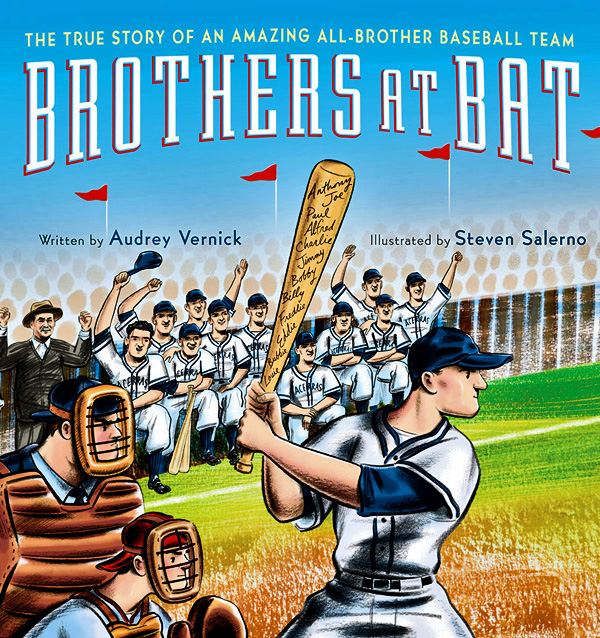
Brothers at Bat: The True Story of an Amazing All-Brother Baseball Team

Written by Audrey Vernick | Illustrated by Steven Salerno


When the weather warms and kids’ thoughts turn to sports, the afternoon air rings with the sounds of slamming doors as players race from home to the baseball diamond. Back in the 1920s and ‘30s, the same door slammed not once or twice, not three or four times, not even eight or nine! The door shut behind 12 brothers! Anthony, Joe, Paul, Alfred, Charlie, Jimmy, Bobby, Billy, Freddie, Eddie, Bubbie, and Louie Acerra. These 12 boys also had 4 sisters—but this is a story about baseball, and back then girls didn’t play ball.

It could be said that “baseball set the rhythm of their lives.” Neighbors couldn’t remember a time when Acerra boys weren’t throwing or hitting a ball or running the bases at the local park. And there was an Acerra on the high school baseball team for 22 years in a row!

In 1938 the nine oldest brothers formed a semi-pro team and competed against other New Jersey teams and teams from New York and Connecticut. Their dad was their coach. The brothers all had different skills—Anthony could hit homeruns, and even hit a couple into the Atlantic Ocean from a seaside park; Charlie was a slow runner; and Jimmy had a knuckleball that was unhittable and uncatchable.

But playing had its dangers too. In one game Alfred was going to bunt, but the ball bounced badly off the bat and hit him in the face. He was rushed to the hospital, but the accident caused him to lose an eye. Everyone thought he would never play again. But after he healed, his brothers helped him recover his skills and his courage.

During World War II six of the brothers joined the war effort and spent years apart. Far from home they dreamed of the days when they played together on warm afternoons. When the war ended all the Acerra boys came home to their very happy mother. The brothers got back to what they loved doing best. Now Anthony was their coach, and from 1946 to 1952 they won the Long Branch City Twilight Baseball League championship four times—much to the pleasure of the crowds that came out to watch the Acerras play.

As time went on the Acerras got jobs, married, and had families of their own. In 1952 the brothers played their last game as a team, having made history as the longest-playing, all-brother baseball team ever. Even though the Acerras played many, years ago, people have not forgotten them. In 1997 they were honored by the Baseball Hall of Fame. The surviving seven brothers made the trip along with one sister and more than a hundred relatives. Now Jimmy Acerra’s uniform and glove are on display alongside exhibits about Babe Ruth, Ty Cobb, and Willie Mays. If you visit the Baseball Hall of Fame, you can see them too!

Interesting and personal author’s and artist’s notes follow the text.

Baseball fans will love Audrey Vernick’s exciting, true story of this most unusual team. Her focus on the close relationship of the Acerra brothers elevates the tale from merely a sports story to one that reveals deep affection and support during difficult times. The different personalities of the brothers shine through in Vernick’s easy, conversational tone, and the inclusion of the Acerra brothers’ induction into the Baseball Hall of Fame shows that this story lives on for all generations.

Steven Salerno’s evocative illustrations will transport readers into a past where neighborhood leagues enjoyed the same level of loyalty as the majors. Capturing the brushed style, colors, and portraiture of pictures of the period, Salerno shows kids not only what it meant to be a baseball player in the 1930s and 40s, but what it meant to be a family.

Ages 4 – 9

Clarion Books, 2012 | ISBN 978-0547385570

National Family Month Activity

celebrate-picture-books-picture-book-review-we-are-all-family-word-search

We Are All Family English – Spanish Word Search


This month is all about family! Find the words for special relatives in this English – Spanish dual language word search! Print the We Are All Family word search puzzle here! And here’s the Solution!

May 14 – International Astronomy Day

celebrate-picture-books-picture-book-review-star-stuff

About the Holiday

Instituted by Doug Berger in 1973, International Astronomy Day is held twice a year—in spring and fall—to raise awareness of the benefits and wonder of studying the stars. Museums, observatories, universities and astronomy clubs around the world provide public access to astronomical instruments and hold special programs about this interesting and ancient science. To celebrate, attend an International Astronomy Day event, take time tonight to gaze at the sky and pick out the constellations you recognize, or read about the stars and their importance to history and the future.

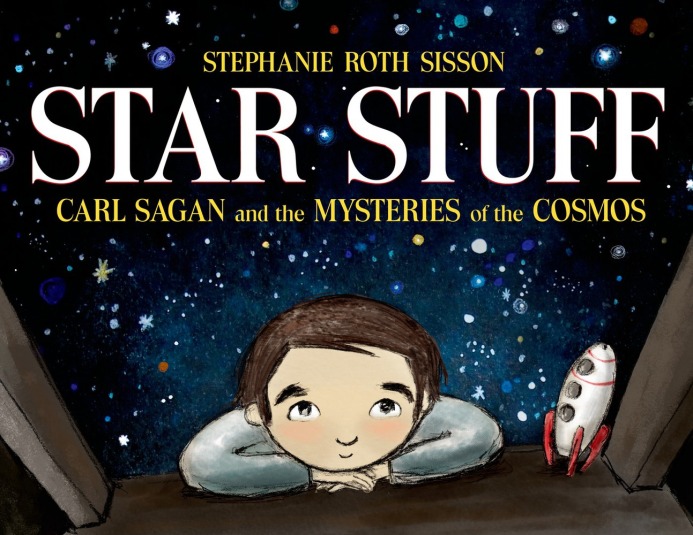
Star Stuff: Carl Sagan and the Mysteries of the Cosmos

By Stephanie Roth Sisson


A boy named Carl Sagan may have lived in a small apartment in Brooklyn, New York, but he was part of so much more—a large city on the third planet from the sun in a “neighborhood of stars” which are part of the Milky Way galaxy. Growing up, Carl marveled at the connections. He had an innate curiosity and was astonished by everything he saw; his imagination was out of this world!

When he attended the 1939 World’s Fair as a young child, he experienced things he had never seen before; he saw a robot, new inventions, and a time capsule filled with messages for the future. At night he looked up at the stars and wondered; he thought they looked like lightbulbs on long black wires. He went to the library to read about the stars.At first the librarian thought he meant movie stars, but soon he got the book he wanted. Reading it made his heart beat fast.

Carl imagined what kinds of creatures and sights he might discover if he were able to travel through space. He tried standing with his arms outstretched and wishing he was on Mars like his favorite science fiction character, John Carter, but nothing happened. He decided he would have to make his “life in space” a reality himself so he went to college and became an astronomer, cosmologist, astrophysicist, astrobiologist, and so much more.

Dr. Carl Sagan then worked with other scientists to develop the exploratory crafts Mariner 2, Mariner 9, and Pioneer 10 that have gone into space to investigate Mars, Venus, and Jupiter. When they sent back pictures, Carl analyzed them and learned more about our solar system

Carl wanted everyone to know and understand Space. He created a television program that explained in easy terms what the stars, planets, and other celestial bodies are made of, how they came to be, and how we are connected to them. The Earth and every living thing are made of star stuff, Carl told his audience. The show – Cosmos: A Personal Voyage – was a hit, watched by millions of people.

Scientists have long wanted to know if life exists on other planets, and as time went on they had the technology to explore the possibilities. Carl worked with other engineers to create Voyager 1 and Voyager 2 to tour the outer solar system and beyond. Remembering that time capsule he saw so long ago at the World’s Fair, Carl had a marvelous idea! He recorded messages and sounds from Earth and made a Golden Record that was carried on each Voyager mission.

Carl Sagan, that boy made of star stuff who grew up to be so many things—astrophysicist, explorer, educator, philosopher, writer, and more—changed the world through the power of his imagination.

Stephanie Roth Sisson’s biography of Carl Sagan wonderfully honors the dreamer and scientist whose imagination went into Space and brought it down to Earth for others to understand and enjoy. The story begins in Sagan’s neighborhood and home, where illustrations depict the curiosity that fueled his passion. Just as the mysteries of Space quickly captured his attention, the pages fill with the night sky and its twinkling lights and celestial bodies. A most ingenious page takes advantage of a two-page vertical spread that transforms Carl’s bedroom window into a space capsule that blasts him into the cosmos as he ponders the stuff of stars.

His work as an adult collaborating with scientists and engineers to develop deep space exploration craft is clearly drawn with pages containing multiple panels of his job and accomplishments up close and from the distance of outer space. A particularly arresting three-page fold-out spread reveals the moment Carl discovered his love of the stars and Earth’s sun (holding a flashlight behind the depiction of the fiery sun would be a show-stopper, especially during a night-time read).

Kids familiar with today’s space travel and the awe-inspiring images sent back to Earth will love this book. To quote Carl Sagan, Star Stuff will definitely elicit a “Wowie!” from readers.

Ages 4 – 8

Roaring Brook Press, 2014 | ISBN 978-1596439603

International Astronomy Day Activity

celebrate-picture-books-picture-book-glow-stars

Make a Room Observatory


If you like gazing at the stars before going to sleep, why not bring them inside? With adhesive glow-in-the-dark stars, available at craft and toy stores, you can create a night sky full of celestial bodies that stay lit long after you’ve said goodnight. You can add planets, rocket ships—even your favorite constellation! This can be a nice alternative to a night light or transition children from a full night light to a gentle, comforting glow in their room.

Picture Book Review

May 13 – Fintastic Friday: Giving Sharks, Skates, and Rays a Voice

celebrate-picture-books-picture-book-review-discovering-sharks

About the Holiday

Fintastic Friday was established by Whale Times to bring awareness to and promote advocacy about conservation efforts to save some of the ocean’s most magnificent creatures. Whale Times, Inc. was created in 1995 to provide kids with easy access to marine science information. Their mission is to create a connections between the ocean, ocean research, researchers, and students through formal and informal educational programs. Respected by educators, marine scientists, and other scientific organizations, Whale Times inspires students to consider careers in marine science and work toward solutions for protecting our ocean environments. Whale Times invites kids all over the world to get involved to save sharks through three activities:

  • Zone It! Help make the entire ocean a shark conservation zone by making others aware of the dangers to shark populations and printing out the special poster found at whaletimes.org.
  • Thank Them in a Big Way! Through letters or personal conversations, thank the scientists and conservationists working to protect sharks
  • Sharks in the Park Rally! Consider holding a shark rally or party to make others aware of shark and ocean related conservation issues

Discovering Sharks

Written by Donna Parham | Illustrated by Julius T Csotonyi


When you pick up Discovering Sharks, you’ll immediately know you’re reading a unique book. The cover, with the texture and heft of shark skin, features a great white, teeth bared, eye glinting, bearing down on you, the reader! But don’t be afraid—open this book to pages filled with incredible illustrations and information on one of the most fascinating species to swim the seas. Here are just a few:

Carcharocles Megalodon: living during the Miocene and Pliocene Periods, this mammoth shark grew to 50 feet in length and had serrated teeth, some of which were 7 inches tall! These sharks dwarfed the whales, sea turtles, other sea creatures that made up its meals. Even land animals that were unfortunate enough to swim into it’s path were gobbled up.

Cladoselache: This smaller shark grew to a length of 4 to 6 feet and lived during the Devonian Period. It’s a good thing dentists weren’t around back then because this shark would have been their worst nightmare! With a mouth at the tip of its snout and ragged, jagged teeth, this shark was great at grabbing food, but not so good at chewing it.

Whorl-Tooth Shark: With a tooth shaped like the blade of a circular saw growing vertically from the shark’s lower jaw, the Whorl-tooth is perhaps one of the oddest sea creatures to ever live. No amount of orthodontia could ever fix those teeth!

A section on Fearsome Sharks comes next. While you may think that all sharks look scary, very few actually pose danger to people. If you see any of these, however, you better get out of the way!

Tiger Shark: Sporting dark vertical stripes along its back and sides, this 20-foot long monster doesn’t talk trash—he eats it! Scarfing up ocean waste such as “plastic bags, barrels, cans, and pieces of coal,” they are not adverse to snacking on “chickens, pigs, donkeys, and monkeys that fall off boats or go for a swim.” It actually seems there is nothing these sharks won’t eat!

The Great Hammerhead: With its distinctive hammer-shaped snout, this shark hunts prey in a most unusual fashion. Along its wide head are tiny sensors that pick up the small electrical pulses emitted by every kind of creature—even you! Once the shark senses the electrical field, it’s probably too late!

Blacktip Shark: If this whole shark gig doesn’t work out, this unusual giant may find a place in a ballet troupe. While feeding, this quick swimmer “sometimes…leaps free of the water and spins in the air—once, twice, or three times—before falling back into the sea.” Quite a performance!

A chapter on Endangered Sharks are up next. Nearly one-third of shark species are considered endangered or threatened due to environmental and human causes. Sharks are captured for food, for their tough skin, and for the oils and vitamins in their liver. In some places shark fin soup is a delicacy, served for special occasions. Huge trawlers also catch sharks in their fishing nets and on lines. This “bycatching” is a major reason behind the decline of shark populations. Here are two of the species on that list:

Daggernose Shark: With its flat, razor-sharp nose this sleek, 5-foot-long beauty cuts through the shallow waters off the Northern South African coast. It is currently on the Critically Endangered list, which means it will likely become extinct in your lifetime.

Whitespotted Izak: Tiny by the standards of fiercer sharks, this Izak is only 12 inches long. Its name comes from the white spots on its body whose only purpose seem to be breaking up its brown spots. Now on the Endangered list, this striking species has nearly vanished.

Deepwater Sharks may be some of the most unusual sharks of all. Sporting eye-popping adaptations to their forbidding environments, these sharks are like nothing you’ve ever seen before! Here are a couple:

Bahamas Sawshark: Carrying its own double-edged saw in front of it, this shark found in the waters near Cuba, Florida, and the Bahamas strikes with stunning force.

Viper Dogfish: You might wonder where this shark’s fins went! The stubby body on this shark makes it look more like a torpedo than a shark. Only recently discovered in 1990, the Dogfish swims the depths off the coasts of Japan and Hawaii

The last section is reserved for “Superlatives”—sharks that demonstrate unique qualities: most warm-blooded, biggest, most likely to get stepped on, most unusual feeding method, most mysterious, and more.

This is just a small sampling of the absorbing facts and species found in Discovering Sharks. Donna Parham offers statistics, scientific data, and trivia about each shark in a conversational, riveting way that will keep kids glued to this book and wanting to return again and again.

The incredible work of natural history illustrator Julius T Csotonyi will take your breath away anew with each page. The vivid colors and textures of the sharks reefs, sea plants, and other fish are so intricately mastered that you will feel as if you’re snorkeling in the depths as well. Lit with the sun, the clear ocean waters show off the beautiful markings of each species, and the murky sea bottom holds unfathomable mystery.

Shark lovers, dinosaur aficionados, monster mavens, and more creature enthusiasts will want Discovering Sharks in their library.

Ages 5 and up

Cider Mill Press, 2016 | ISBN 978-1604336047

Gardening for Wildlife Activity

celebrate-picture-books-picture-book-review-find-differences-puzzle

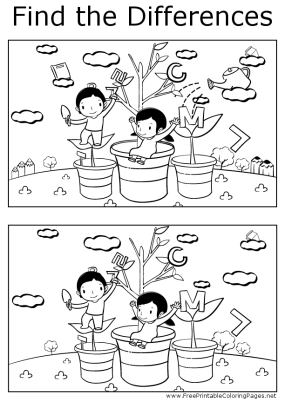
Guess the Garden Differences


No two gardens are exactly alike. Can you find the differences in the two pictures of kids having fun in their gardens? Print out the Guess the Garden Differences puzzle and have fun!

May 7 – National Train Day

celebrate-picture-books-picture-book-review-locomotive

About the Holiday

Falling at the end of National Tourism Week, National Train Day honors the history of train travel and its importance to the opening of new frontiers as well as its continued  use for pleasure and business transportation. Train museums and train enthusiasts across the country celebrate with special events, rides, and educational opportunities for all ages. Some celebrations occur today, while others are held on May 14.

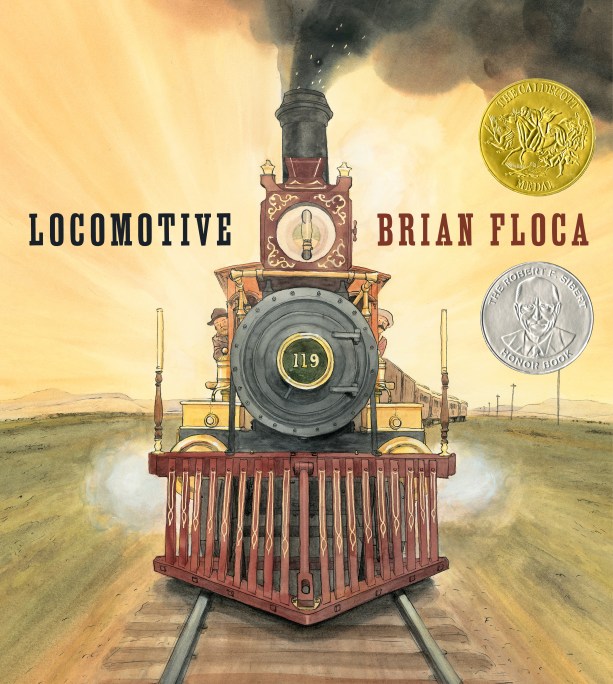
Locomotive

By Brian Floca


“Here is a road made for crossing the country, a new road of rails made for people to ride.” So begins Brian Floca’s sprawling paeon to the locomotive and its influence on America and the Old West. Amid the Clank Clank Clank of hammers on iron spikes, men from all over toiled from coast to coast to build the rail lines that carried the trains across the country: “Three strokes to the spike, ten spikes to the rail!”

Families who have sold all their possessions to pay for tickets for the week-long trip west stand on the platform in Omaha, Nebraska watching for the approaching train. Suddenly, they hear the clang of the bell and “see a puff from her stack—a puff of smoke, a smudge in the sky.” The awesome train pulls up at the station huffing “like a beast.”

Her crew—the brakeman, fireman, engineer, and conductor—make the train ready. They gather the passengers, stoke the firebox, push forward the Johnson bar, and get the train underway. The passengers sit back, ready for the long journey. The engineer “is the master of his machine, he knows her moods and tempers, where to set her bars and levers….Westward, westward runs the train, through the prairies, to the Great Plains, on to the frontier.”

In the cars the travelers read, play games, meet their neighbors. In winter they are warmed by a coal stove in one corner, while in the other corner a “modern” convenience is provided. Eventually, the train must stop to refuel. The passengers scramble to the railroad restaurant at the station. They have 20 minutes to eat what the menu offers: buffalo steak, antelope chops, or chicken stew (which tastes suspiciously like prairie dog).

As night falls a new engine is carefully attached to the cars by the switchman, who has learned to be quick to avoid the rolling, jumping cars that can take a finger. “Through the night the engine runs. Those up late hear her whistle, her wild and lonesome cry. It echoes on far hills and homes, it sounds in distant dreams.”

By morning the train has reached the mountains. The going is steep and slow. A second engine must be attached to give the train power enough to climb. On the other side of the mountains the terrain is rugged, and the train must traverse long, rickety wooden bridges. Days pass as the train travels through beautiful, mysterious country, skirting land formations such as Castle Rock, The Witches, Devil’s Slide, and the 1000 Mile Tree.

In Utah at Promontory Summit, the train comes to the meeting place of the tracks built from the East and the tracks built from the West. The passengers disembark and change trains, changing train companies also, from the Union Pacific that brought them here to the Central Pacific who will take them the rest of the way. Now the train passes through desolate, dry country, home to the Paiute and the Shoshone.

The mighty Sierra Nevada rises up ahead. A second engine is again required. If the tracks are slick, the “engineers can pull a handle to drop some sand down a tube, onto the tracks. The wheels hit the grit, the traction does the trick!” Closer and closer the train comes to its final destination, puffing through long wooden sheds that keep the tracks clear in winter and into dark tunnels blasted through the mountain rock.

Down, down the train progresses to the end of the line. The weary but excited travelers jump from the train to meet their friends or family or to start a new life in San Francisco!

If you love trains, American history, or the Old West, or if you are simply enamored of travel, you will want to read Brian Floca’s Caldecott Medal Winning and Silbert Honor book, Locomotive. Floca’s lyrical language makes poetry of the steam train’s inception, from the laying of the rails to the inner workings of the engine to the long journey westward. Fascinating facts of the train crews’ work, conditions for the passengers, and the territory crossed make this a page turner that any age will enjoy.

Readers can almost hear the sounds of the clanging bell and huffing engine, as these sounds are represented in a variety of typefaces and sizes, growing larger and larger as the train approaches the station. Every page is a joy. As the train chugs across the country, the paintings are swept in rushing brush strokes and the train whooshes into view from the edges, filling the page. The vast empty plains nearly dwarf the locomotive, and the mountainous regions pose chilling challenges for the iron horse. The nighttime scenes are beautifully lit by starlight and the single headlight of the train, reflecting the dreams of a new nation.

Although Locomotive is a longer picture book, its rhythms, depth of description, and gorgeous language will appeal to even very young children. Make some tea and hot chocolate and settle in for a cozy read of wonderful book!

Ages 4 – 12 and up (adults will also enjoy this book)

Atheneum Books for Young Readers, 2013 | ISBN 978-1416994152

National Train Day Activity

celebrate-picture-books-picture-book-review-all-aboard-maze

All Aboard Maze!


Trains travel over intricate terrain, over mountains, across vast plains, and through exciting cities. It’s a little like finding your way through a maze! Have fun completing this printable All Aboard Maze! Here’s the Solution. Choo choo!

April 28 – Workers’ Memorial Day

celebrate-picture-books-picture-book-review-brave-girl

About the Holiday

Some jobs are so dangerous that workers get hurt or even die doing them. Around the world organizations have been established to help industries provide safer working environments for their employees by establishing standard rules and regulations for buildings, machinery, working hours, and more. Unions and other groups have also been founded that represent workers to ensure their rights are upheld and their needs are met. Today we honor the sacrifices of workers in dangerous professions and raise awareness for safe working conditions.

Brave Girl: Clara and the Shirtwaist Maker’s Strike of 1909

Written by Michelle Markel | Illustrated by Melissa Sweet


Among the immigrants sailing to New York, stands five-foot-tall Clara Lemlich. She may not know it now, but she’s going to change her new city. While her father can’t find work, Clara gets a job in the garment industry, which hires school-age girls to make women’s clothing. Instead of going to school, Clara spends her days hunched over her sewing machine in a dark, smelly factory with many other girls, making clothes as fast as she can.

The rules of the factory are severe. For minor mistakes workers can be fined or worse—fired, leaving their families without an income. The doors are locked so the girls can’t leave without being inspected to ensure they haven’t stolen anything. And the workers must toil long into the night. Despite it all Clara is determined to get an education even though it means walking to the library after work and missing sleep to read her lessons. 

At the factory the girls become friends and reveal stories and secrets. The working conditions make Clara angry. She hears that the men at the factory want to form a union. If all the workers team up, they can hold a strike and force the management to treat them better, the men say. But they don’t think the girls are tough enough.

Clara knows what the girls are capable of. Every day she talks to her friends and the other women, urging them to fight for their rights—and they do! But it’s not as easy as the men predicted. The bosses don’t want to give in. In fact Clara’s life is in danger! She is beaten and arrested. Despite the intimidation she continues to picket. These small strikes make little difference, however—the bosses just hire new girls and the work continues.

Clara and other union leaders think only a huge strike by all workers in every garment factory in New York will cause the bosses to listen and make changes. At a union meeting workers pack the seats to listen to leaders from across the country. Not one of them recommends such a large strike. Clara can keep silent no more. She moves to the front of the hall and calls out. People lift her to the stage. Shouting “Unity is strength” she rallies the crowd and begins the largest strike of women workers ever in United States history.

The next morning thousands of women take to the sidewalks, leaving their sewing machines empty and silent. New York is stunned! Newspapers call the strike a “revolt,” and the girls an “army.” But this is really an army of children—the girls range in age from only 12 to 25 years old. Clara knows how to lead and motivate the girls. She gives rousing pep talks, sings, and stands up to thugs sent to harass them.

All winter the girls join the men strikers. They are starving and cold and become the inspiration for newspaper articles and fundraising. Many wealthy women donate to their cause and join them on the picket lines. Finally the bosses relent. They agree to the formation of unions in their factories, raise salaries, and shorten the work week. Factory workers in Philadelphia and Chicago take heart from Clara’s work and improve conditions in their cities.

Even though Clara is young and small, she proves that anyone can right wrongs and make a difference.

The final pages include more information about the garment industry in the early 1900s as well as a bibliography.

Michelle Markel’s Brave Girl is a spirited biography of Clara Lemlich, clearly outlining the life and working conditions of immigrants in the early 1900s—especially industries’ use of children to fill low-paying, oppressive jobs. This true-life story of a girl who wouldn’t give up or give in is told with pride and balance, touching on the dangers Clara faced in a sensitive manner appropriate for children. Overall, the idea that one person can make a difference no matter how big or how old shines through, making this not only a tale of the past, but an inspiration for today’s children and the future.

Melissa Sweet cleverly combines watercolor and gouache paintings with colorful fabric, ribbon, sewing pattern paper, and ledger pages to create illustrations fitting to the story. The pictures appear sewn onto the pages with straight, zigzag, and embroidery stitches, and the vibrant colors depict the fiery nature of Clara and all the workers who strove for better lives.

Ages 4 – 9 (and up as Brave Girl makes a wonderful teaching text)

Balzar + Bray, Harper Collins, 2013 | ISBN 978-0061804427

Workers’ Memorial Day Activity

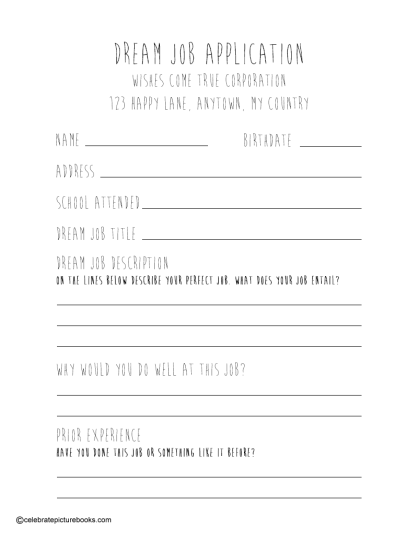
celebrate-picture-books-picture-book-review-dream-job-application

Dream Job Application


Work isn’t working when you love your job—it’s fun! What is your perfect job? Is it working with animals? Playing a sport? Being an artist, scientist, entrepreneur? Fill out this application and get started on following your dreams! Print the Dream Job Application below!

Dream Job Application