April 12 – National Big Wind Day

When the Wind Blows by Linda Booth Sweeney and Jana Christy picture book review

About the Holiday

Hold onto your hats—maybe even your hair! On April 12, 1934 three weather surveyors at the Mount Washington Observatory registered the highest wind gusts ever recorded—231 miles per hour! Mount Washington is located in New Hampshire and at 6,288 feet is the highest peak in the Northeast United States and east of the Mississippi River. Since that blustery event, big wind day has been celebrated on this day.

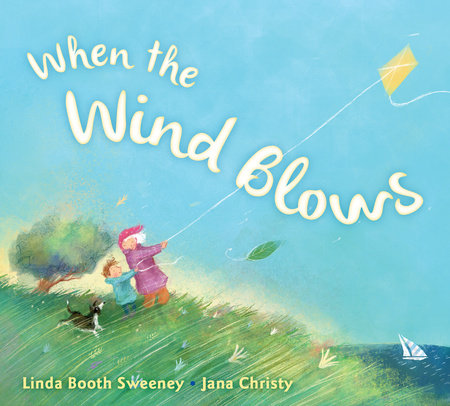
When the Wind Blows

Written by Linda Booth Sweeney | Illustrated by Jana Christy


A little boy peeks out his rattling window as the wind sends chimes ringing and doors creeaaaking. Jumbled into their jackets the boy’s mom, baby sister, and grandmother go out to enjoy the day. They fly a kite while nearby bells clang and walkers stroll hand in hand. In the sweeping wind “Trees dance. / Spiders curl. / Mice shiver. / Leaves swirl.”

When the wind snatches the kite, the boy and his grandma chase after it amid clouds racing across the sky and seeds scattering to and fro. Running after the kite through waving beach grass, the family sees “Sails puff. / Boats wobble. / Gulls float. / buoys bobble.” Their pursuit takes them into town where they track down their kite lying on a sidewalk. When the wind blows on these narrow seaside village lanes, “Signs shake. / Lights jiggle. / Puddles splosh. / We giggle.”

With the kite safely in hand the foursome ventures to the park for some rolling, swaying, whirling play. But the day is graying—“Skies darken. / Thunder BOOMS. / Rain falls. / We zoom!” Back at home all is cozy as the family dries off and the little boy takes a bath. Tucked into bed the little boy and his mom cuddle while their pets curl up on the blankets. As they sleep, “Skies clear. / Stars gleam. / Earth sleeps. / We dream.”

Linda Booth Sweeney’s charming tale of a day spent in the midst of a windy day perfectly captures the sights and sounds of such a gusty natural event. Sweeney’s eye for detail and talent for evocative verbs elevate the two-word lines in these short verses, letting readers fully experience the effects of a wild squall. Kids will appreciate the original imagery and love repeating the lyrical lines.

The blustery wind is evident in Jana Christy’s vibrant pastel illustrations, where clouds swirl in scribbles, flowers bow, and buffeted grasses protect small creatures. Everywhere, the wind flutters head scarves and clothing, bends signs, and tears hats and kites from unsuspecting hands. As rain approaches Christy’s skies acquire a gray, gauzy texture, and when the family again reaches home, the colors turn warm and bright, as comforting as a cup of tea or hot chocolate. Readers will be rewarded for lingering over the beautiful pages by seeing details and people carried over from page to page, uniting the story.

Ages 3 – 6

G. P. Putnam’s Sons, Penguin Group, 2015 | ISBN 978-0399160158

National Big Wind Day Activity
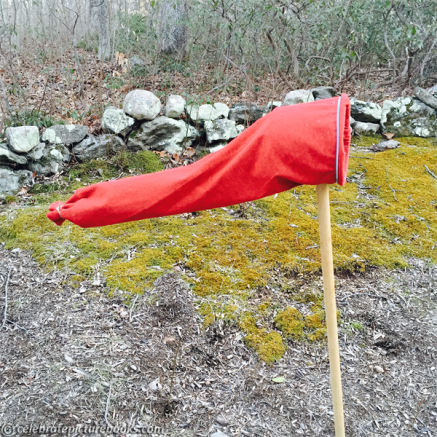
CPB - Windsock

Catch the Wind! Windsock


You can feel the wind in your hair and see it blowing through the trees, but can you actually catch it? You can with this easy-to-make windsock!

Supplies

  • 1 large yogurt container (32 oz) or 1-pound deli salad container
  • 1 long-sleeve T-shirt
  • Strong glue
  • Dowel, 5/8 diameter x 48-inches long or longer
  • String
  • Rubber band
  • sewing seam ripper or cuticle scissors
  • X-acto knife
  • Scissors

Directions

  1. Remove the sleeve from a long-sleeve t-shirt with the seam ripper or cuticle scissors
  2. Cut the shoulder off the sleeve by cutting straight across from the underarm seam
  3. Cut 2 inches from the bottom of the yogurt container OR cut the bottom out of the deli container with the x-acto knife or scissors
  4. With the x-acto knife or scissors, make a hole a little smaller than the diameter of the dowel about 1 inch from the rim of the container
  5. Slide the container into the large opening of the sleeve
  6. Fold about a ¾ -inch edge over the rim of the container and attach all along the rim with strong glue
  7. Put the rubber band around the outside edge of the opening
  8. Tie the bottom of the sleeve’s cuff together with the string
  9. To attach the dowel: Option 1: leaving the t-shirt in place, push the dowel and material through the hole in the container. The t-shirt material will hold the dowel in place (I used this option).  Option 2: cut a small hole in the t-shirt at the location of the hole in the container. Push the dowel through this hole and the hole in the container. Secure with strong glue
  10. Stick your windsock in the ground in an open area where it can catch the wind. As the wind changes direction, you can turn your windsock so the opening faces the wind.

April 10 – National Sibling Day

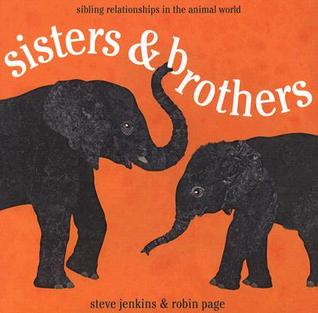
sisters & brothers by Steve Jenkins and Robin Page picture book review

About the Holiday

Brothers and sisters, huh? Sometimes you can’t live with them—but you’d never really want to live without them! Sure the bad part is that they know all your secrets and your quirks and you vie for that last cookie, but the good part is that they know all your secrets and your quirks and you didn’t really want that last cookie anyway.

Today do something fun with your sibling or siblings or tell them you love them—or both!

Sisters & Brothers: Sibling Relationships in the Animal World

By Steve Jenkins and Robin Page


You know that most animals are born in a litter or with one or two other siblings, but do you really consider that they are brothers and sisters just like human siblings? You might wonder if they have the same kind of relationship with each other that people do. How do they get along? How do they communicate? Do they stay together or go their separate ways? Sisters & Brothers: Sibling Relationships in the Animal World reveals the answers to these questions and more about 21 animals from around the world.

Would you like to be a clone of your brother or sister? Maybe not so much. If you were a nine-banded armadillo, though, you’d have no choice. These armadillos are always born four at a time—all females or all males—and are identical in every way! They stay with their mother until they are four months old and then set off on their own adventures.

If there are a lot of women and girls in your family, you may feel as if you’ve been born into a community of whiptail lizards. In the world of whiptails, there are no males! While their unusual reproduction method may avoid some battles, the identical traits of these creatures leaves them vulnerable to disease or changes in their environment.

Are you the youngest in your family? If you were a naked mole rat, you’d have to lie on the floor of your narrow tunnel and let your older siblings walk over you to pass. Mole rats aren’t the only ones who have worked out a hierarchical system. Brother bears fight fierce battles until the weaker one leaves to find his own territory, and black widow spiders even eat their weaker brothers and sisters!

Many animal siblings get along, however, and even help each other grow strong and develop important traits. Two of the fastest animals on earth—cheetahs and peregrine falcons—practice hunting techniques on each other, acquiring speed and accuracy along the way. There are even wildlife families that include adopted members, such as the cichlid fish and myna birds.

These are just a few of the intriguing animals readers will discover in this unique look at the world’s wild kingdom. Each animal is beautifully rendered through large cut or torn paper collages that enhance the short text, perfect for a child’s attention span. The final pages offer more information on each creature, and a list for further reading is also included.

Ages 4 – 8

Houghton Mifflin Harcourt, 2008 | ISBN 978-0547727387

National Sibling Day Activity

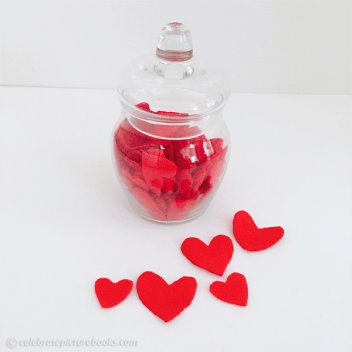
CPB - Heart Jar

I Heart You! Jar


Sometimes it’s hard to say “I love you” (or even “I like you”) to siblings. But sisters and brothers like to know they’re important to each other. Here’s a gift you can make to give them that will tell them what is in your heart.

Supplies

  • A clear jar with a lid—you can use a recyclable jar or buy a mason jar or other decorative jar at a craft store
  • Red felt
  • Scissors

Directions

1. Cut red hearts from the felt

2. Add hearts to the jar—you can add as many as you like and continue to fill the jar after you’ve given it to your sibling. Here are some ideas:

  • Add one heart for each year you have known your sibling
  • Add one heart for each thing you love about your sibling (write those traits on the hearts)
  • Give a new heart whenever your sibling does something nice for you

3. Give your I Heart You! jar to your sister(s) and/or brother(s)

April 6 – April is National Poetry Month

When Green Becomes Tomatoes by Julie Fogliano and Julie Morstad

About the Holiday

The Academy of American Poets established National Poetry Month in 1996 to promote the enjoyment and awareness of poetry. Over the 20 years since its beginning, National Poetry Month has become the largest literary event in the world. Schools, poets, booksellers, and publishers all hold special events to honor the vital place of this well-loved art form in our culture.

Celebrate the month by attending poetry readings, reading poems by your favorite author or discovering a new poet, and creating your own poetry!

When Green Becomes Tomatoes: Poems for All Seasons

Written by Julie Fogliano | Illustrated by Julie Morstad


Sometimes you wish for just the right words to express a moment in time, a skip of the heart, or a glimpse of color that truly captures the elation, sadness, or awe you feel. Those words live on every page of When Green Becomes Tomatoes: Poems for All Seasons. Each season omonth of the year is represented by three to five dated poems that expose a nugget of inspiration or a spark of recognition about the natural world and our place in it.

Spring is revealed as chilly, rainy, and blooming with early flowers:

march 26: “shivering and huddled close / the forever rushing daffodils / wished they had waited”

Summer brings swimming, tomatoes, and deep dark nights:

september 10

“a star is someone else’s sun / more flicker glow than blinding / a speck of light too far for bright / and too small to make a morning”

Fall is a time for sweaters, pumpkins, and falling leaves:

november 2

“more silent than something / much noisier than nothing / the last leaf / when it landed / made a sort of sound / that no one knew they heard”

Winter  is quiet, cozy fireplaces, and snow, snow, snow:

december 21

“as if one day, the mountain decides / to put on its white furry hat / and call it winter”

december 29

“and i woke / to a morning / that was quiet / and white / the first snow / (just like magic) came / on tiptoes / overnight”

The volume begins and ends with a poem dated the same day—March 20, the vernal equinox—giving this book a cyclical form that echoes the passing of time. To accompany Julie Fogliano’s beautiful poems, Julie Morstad has created gorgeous watercolors of children experiencing each day and the changes they bring. The soft, matte pages enhance the colors of each season and the quiet reflections these poems offer.

Ages 6 and up (adults will enjoy these poems too)

Roaring Brook Press, 2016 | ISBN 978-1596438521

National Poetry Month Activity

Grow a Poem

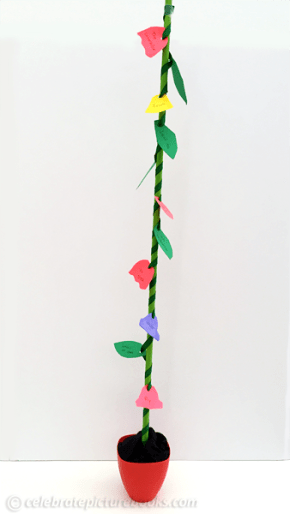
CPB - Plant Poem

A poem often grows in your imagination like a beautiful plant—starting from the seed of an idea, breaking through your consciousness, and growing and blooming into full form. With this craft you can create a unique poem that is also an art piece!

Supplies

  • Printable Leaves Template, available here and on the blog post
  • Printable Flower Template, available here and on the blog post
  • Wooden dowel, ½-inch diameter, available in craft or hardware stores
  • Green ribbon
  • Green craft paint
  • Green paper if leaves will be preprinted
  • Colored paper if flowers will be preprinted
  • Flower pot or box
  • Oasis, clay, or dirt
  • Hole punch
  • Glue
  • Markers or pens for writing words
  • Crayons or colored pencils if children are to color leaves and flowers

Directions

  1. Paint the dowel green, let dry
  2. Print the leaves and flower templates
  3. Cut out the leaves and flowers
  4. Punch a hole in the bottom of the leaves or flowers
  5. Write words, phrases, or full sentences of your poem on the leaves and flowers (you can also write the poem after you have strung the leaves and flowers)
  6. String the leaves and flowers onto the green ribbon (if you want the poem to read from top to bottom string the words onto the ribbon in order from first to last)
  7. Attach the ribbon to the bottom of the pole with glue or tape
  8. Wrap the ribbon around the pole, leaving spaces between the ribbon
  9. Gently arrange the leaves and flowers so they stick out from the pole or look the way you want them to.
  10. Put oasis or clay in the flower pot or box
  11. Stick your poem pole in the pot
  12. Display your poem!

March 27 – Easter

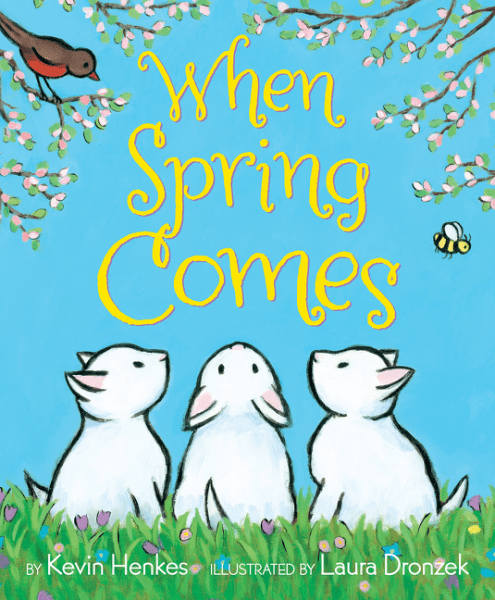
When Spring Comes by Kevin Henkes and Laura Dronzek Picture Book Review

About the Holiday

On this day we celebrate renewal—both personal and seasonal. Spring is officially here and new life is beginning. All around trees are budding, flowers are blooming, and baby animals and birds are being born and learning to make their way in the world. As the sun rises on warmer days, be inspired to discover new happiness.

When Spring Comes

Written by Kevin Henkes | Illustrated by Laura Dronzek


This beautiful tribute to spring is as surprising as new buds pushing through the earth or tiny hatching eggs. Using repeated phrasing, lyrically expressed facts, and poetic rhythms, When Spring Comes echoes the anticipation that sunnier days bring after a long winter. The book opens with a simple, evocative sentence: “Before Spring comes the trees look like black sticks against the sky.” Children will immediately agree—they see trees in this way out their windows and draw them like this in art class.

The following sentence is equally as true: “But if you wait Spring will bring leaves and blossoms.” The book’s contrasting lines that explore conditions “before Spring comes” and “If you wait” gradually reveal more and more of springtime’s wonder, like the melting snows that usher in rainy days: “Spring comes with sun and it comes with rain and more rain and more rain. Do you like mud? Do you like puddles? I hope you like umbrellas.”

As Spring wakes more fully, it takes on a personality of its own: “Spring will call out the pussy willows and new kittens too. Spring can come quickly or slowly. It changes its mind a lot. But when Spring is finally here to stay, you will know it…There will be buds and bees and boots and bubbles.”  And there is much more to discover about this season of rebirth as well as the future within these pages.

When Spring visits it brings many wonderful smells, sounds, activities, and creatures, all of which are gorgeously depicted in Laura Dronzek’s radiant illustrations. The early gardens, blooming cherry trees, frolicking kittens, and profusions of flowers are as bright and welcome as the springtime sun. As the sweet-faced boy and girl in the book play, they are surrounded by birds, bunnies, dogs and kittens, and even ponder a little worm poking its head from the garden. Brilliant blues, pinks, greens meld with lush browns to create a joyful celebration of the newness of the season.

When Spring Comes is not only a book about a particular season or even for a particular age. It is a wonderfully gentile and uplifting way to introduce or discuss the idea of waiting for good things to happen. Everyone, even the smallest child, has “winter days” when life doesn’t look so bright. But if you wait, spring comes with new life and surprises.

Ages 4 – 8

Greenwillow Books, HarperCollins, 2016 | ISBN 978-0062331397

Easter Activity

CPB - Paper Flowers

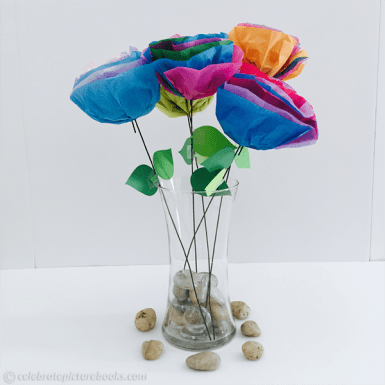
Paper Flowers


These paper flowers will brighten any room and come in a rainbow of colors. Make a bouquet for yourself or share them with a special friend.

Supplies

  • Tissue paper in many colors
  • Green paper
  • Green wire for stems
  • Scissors
  • Tape or glue
  • Pliers

CPB - Paper Flowers II

Directions

To make the stem

  1. Bend a 1 ½ -inch loop in the top of the wire
  2. Squeeze the wire together so it will fit tightly over the tissue paper

To make a flower

  1. Cut 6 or more 7-inch squares from tissue paper, mixing colors (you can make various sizes of flowers by making the squares larger or smaller and adding more squares)
  2. Gather all the squares together and fold them together accordion-style in 1-inch folds
  3. Slide the folded tissue paper under the wire loop, and tighten the wire
  4. Gently fan the tissue paper out on each side
  5. Beginning on one side, gently pull each sheet of tissue paper up toward the center
  6. Repeat step 5 on the other side

To make leaves

  1. Cut leaves from green paper, leaving a stem to wrap around the wire flower stem
  2. Fold the leaf stem around the wire and tape or glue


March 21 – World Poetry Day

Nasty Bugs by Lee Bennett Hopkins and Will Terry Picture Book Review

About the Holiday

World Poetry Day, an initiative of the United Nations Educational, Scientific, and Cultural Organization, recognizes the important role poetry plays in people’s lives across the world and over time. The day promotes small publishers of poetry as well as oral poetry traditions and works to strengthen the connection between poetry and other forms of expression. Another objective is to “support linguistic diversity thorough poetic expression and to offer endangered languages the opportunity to be heard within their communities.”

Celebrations on this day include poetry readings, school lessons focused on poetry and poets, poetry writing sessions, and poetry readings by professional and amateur poets in schools and other venues.

Nasty Bugs

Poems Selected by Lee Bennett Hopkins | Illustrated by Will Terry


Who in the world can resist bugs? They’re in every country, every city, every town, even every house! And they have so much going for them—lots of legs, pincher mouths, transparent wings, amazing survival skills, and so much general creepy-crawliness! Bugs may be a little (or a lot) icky, but you can’t deny that they’re fascinating.

Nasty Bugs brings together 16 poets to turn the traits of all kinds of insects, from stink bugs to chiggers to water bugs and more, into creative odes that tickle the funny bone as well as teach. Readers learn from Cynthia S. Cotton’s “Stink Bug” that “Some spread their wings in flight, / Some look scary, / some taste bad, / some use camouflage / to blend in just right.”

Rebecca Kai Dotlich exposes the boll weevil: “I am an evil weevil, / a cotton-craving beetle / whose reputation’s rotton / ‘cause I gobble crops of cotton, / yes I do.” And the Colorado Potato Beetle? Among other quirks, X. J. Kennedy reveals its name is a bit of a misnomer: “His other name’s Potato Bug. / This munching desperado / infests our gardens coast to coast. / Not just in Colorado.”

April Halprin Wayland gives voice to the fire ants’ tribal cry “All for one and one for all!” as they jump into action when “Flood waters rise! / Quick, form a ball—/ our larvae, pupae, eggs, and Mother Queen inside! / We roll this writhing globe, / take turns on top / so all breathe air, so all survive.”

“Spoiled Rotton” by J. Patrick Lewis may make grammarians squirm with this pointed description: “I’m a comma / in a drama / of disgusting devastation.” while readers will be itchin’ to know more in Rebecca Andrew Loescher’s “Ode to Chigger” with lines such as “You hatch with six small legs for running, / then grow two more—for leaps most stunning,” Poems about flies (Ann Whitford Paul), wasps (Michele Krueger), fleas (Marilyn Singer), lice (Amy Ludwig VanDerwater), ticks (Kami Kinard), termites (Alice Schertle), cockroaches (Fran Haraway), and bedbugs (Kristine O’Connell George) also contribute to the buzzzzz of this anthology.

But if bugs, well…bug you, you may find these lines in Lee Bennett Hopkins’ “Ode to a Dead Mosquito” most satisfying: “You of little brain / didn’t you know / I felt your sting / the instant you / began to drain? / So— / I whacked you. / SMACK! / You dropped.”

Will Terry lends his distinctive talent to making this book as colorful, bold, and eye-popping as nature itself. Each insect, depicted in its favorite milieu, nearly flies, creeps, or chomps it’s way off the page. Brilliant greens, reds, yellow, oranges, and blues give life to these most prolific pests, and their prominent features – whether pinchers, stingers, gnawing mandibles, or even stinky odor – are inspiringly drawn.

More facts about each bug are given in the back of the book, and are a must read. Whether insects make you squirm with discomfort or squeal with delight, Nasty Bugs is fun.

Ages 5 – 9

Paperback: Puffin, Penguin Group, 2016 | ISBN 978-0147519146

Hardcover: Dial Books for Young Readers, Penguin Group, 2012 | ISBN 978-0803737167

World Poetry Day Activity

CPB - Nasty Bugs magnet II (2)

Rockin’ Bug Magnet or Paperweight


On World Poetry Day it’s fun to write a poem of your own. Whether your creation is long or short, you can proudly display it using one of these Rockin’ Bug Magnets.

Supplies

Rocks, small and flat work best for magnets. Larger rocks are great for paperweights. You can find rocks in your yard, at the beach or park, or buy them from craft stores or nurseries.

  • Paint in your favorite colors
  • Paint brush
  • Small to medium round magnets, available at craft and hardware stores
  • Googly eyes
  • Strong glue

CPB - Nasty Bugs magnet (2)

Directions

  1. Wash rocks and let them dry
  2. Create your own creepy, crawly bug on the front of the rock
  3. Paint your bug
  4. Let the paint dry
  5. If you want to give your insect buggy eyes, glue googly eyes to the rock.
  6. Glue a magnet to the back of the rock
  7. Hang it on the refrigerator or any metal surface


If you love books, you must have caught the reading bug! Check out another great book and craft on March 2—Read Across America Day and make an “I’ve Got the Reading Bug” Bookplate for your favorite books!

CPB - Reading Bug Book Plate (2)


March 12 – National Plant a Flower Day

MIss Maple's Seeds by Eliza Wheeler Picture Book Review

About the Holiday

It’s March—that funny month when some people are basking in 80-degree sunshine and others are still shoveling snow. But no mater where we live, we’re thinking about the same thing—Spring! Spring brings new green leaves, gentle rains, and little shoots that will grow to be trees, vegetable and fruit plants, and flowers. Whether you live somewhere warm and can already plant outside or somewhere that’s still a little chilly and requires indoor propagation, planting flower seeds is a perfect way to beautify your home and your life.

Miss Maple’s Seeds 

By Eliza Wheeler


Late in the summer, Miss Maple hurries to prepare for some very special guests. She has searched all summer for unplanted “orphan” seeds, and baskets full of them are winging their way to her home on the backs of bluebirds. Once they arrive she “learns each seed by heart.” There are poppy, wild rice, maple, water lily, pine, impatiens, apple raspberry, sunflower, acorn, pea, fern seeds, and as many more as make up our world.

As she lovingly tends to each one, she says, “Take care, my little ones, for the world is big and you are small.” Miss Maple takes them on field trips and shows them the world they will inhabit—the muddy soil along riverbanks, grassy fields, and thick forests. She cautions them about “weedy characters” who can show up even in a “bustling garden.”

At night Miss Maple snuggles each seed into a comfy bed and reads to them by the light of fireflies. During the winter Miss Maple entertains other guests—woodland creatures who gather in her maple tree home and share food, stories, and songs. With the spring come rains and new lessons on burrowing into the ground.

May ushers in another summer, and Miss Maple knows it’s time for her little ones to “find roots of their own.” She sends them out into the world, knowing that she has prepared them well for what they will become. Her seeds say goodbye and sail off to begin their futures, and Miss Maple is left alone. But soon another summer day comes, and Miss Maple sets off to gather more orphan seeds, because “the world is big and they are small.”

Eliza Wheeler’s Miss Maple’s Seeds is a triumph—as comforting as a warm blanket and as empowering as a master key. Wheeler’s beautiful language floats quietly and unhurried like the flight of a leaf on a gentle breeze. The metaphor of seeds and children is so sweetly made, and Miss Marple’s wish for her little charges can bring a tear to the eye of any caretaker.

Wheeler’s luminous artwork is breathtaking in its fully realized details of the wide world Miss Maple’s seeds and all of us inhabit. Each season is gorgeously rendered in soft blues, roses, browns, and yellows, and she imbues the little seeds with personality without making them anthropomorphic. The reader may wish they could be friends with these future beauties and Miss Maple as well.

Miss Maple’s Seeds would be a wonderful gift for high school graduates, teachers, and anyone who loves taking care of children.

Ages 3 – 7, all ages

Nancy Paulsen Books, an imprint of Penguin Group | ISBN 978-0399257926

Plant a Flower Day Activity

CPB - Flower Pot

Decorated Flower Pot


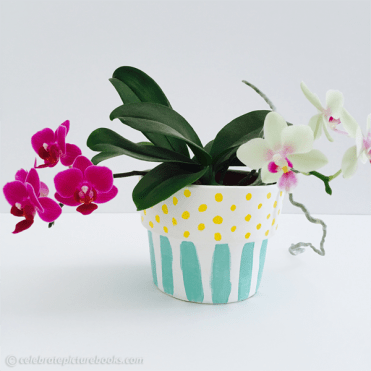
Spring is almost here, and that means flowers will soon be blooming. If you want to beautify your home plant your favorite flower seeds in a pot you’ve decorated yourself!

Supplies

  • Terra cotta pot in any size
  • Acrylic multi-surface paint in various colors
  • Flower seeds
  • Soil

Directions

  1. Paint your terra cotta pot—be creative!
  2. Let paint dry
  3. Fill pot with soil
  4. Plant flower seeds

March 3 -World Wildlife Day

Actual Size by Steve Jenkins Picture Book Review

About the Holiday  

Sponsored by the United Nations, World Wildlife Day celebrates the many varieties of wild animals and plants that make up our earth. It is also a day to raise awareness of the ways in which conservation of natural resources and sustainable development benefits people and all the world’s species. The theme this year is “The future of wildlife is in our hands.” African and Asian elephants are the main focus of the 2016 global campaigns.

Secretary-General Ban Ki-moon says: “On this World Wildlife Day, I call on all citizens, businesses and governments to play their part in protecting the world’s wild animals and plants.  The actions taken by each of us will determine the fate of the world’s wildlife.  The future of wildlife is in our hands!”

For more information on World Wildlife Day 2016 and to see what events are taking place in cities around the world visit wildlifeday.org

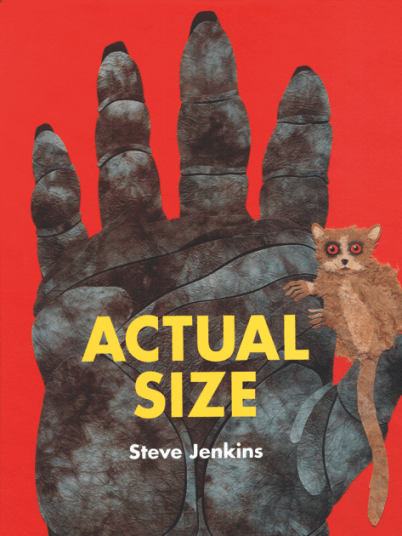
Actual Size

By Steve Jenkins


We know wildlife is all around us, but apart from our pets and the occasional mosquito we swat or bumble bee we avoid, we tend to see it from a distance. We watch birds flutter at feeders through a window, we see exotic animals at the zoo, aquarium, or wildlife parks, and point out cows and horses while driving. If asked how big the chickadee or elephant is, we’d say small and huge! But how small? How huge?

What makes Steve Jenkins’ book Actual Size so fascinating is that he shows readers on the page exactly how big or how tiny with scale drawings of each creature. The Atlas Moth on page 1 is so large part of one wing dips into page 2, where you hardly notice the dwarf goby—at a minuscule 1/3 inch long—in the bottom corner. As you turn the page you almost catch your breath to find the enormous 12-inch-wide eye of a giant squid staring back at you.

An ostrich with its egg and the whip-like tongue of the giant anteater are also here. And if you’re at all squeamish about spiders, you might want to avoid pages 12 and 13! The snout of the saltwater crocodile and the Goliath frog are both so long that they require a fold-out page! Kids will love putting their tiny hand against the gorilla’s and their foot on the African elephant’s.

Actual Size features 18 of the world’s well-known and unusual creatures, each described in more detail, including weight, habitat, diet, behavior, defenses, and more, at the end of the book.

Steve Jenkins’ striking collages, created from cut and torn paper, beckon readers to look closer at these awesome creatures.

Ages 4 – 9

Houghton Mifflin Books, 2004 | ISBN 978-0547512914

World Wildlife Day Activity

CPB - Wildlife Day Elephant Print (2)

Hands Down Best Elephant Print


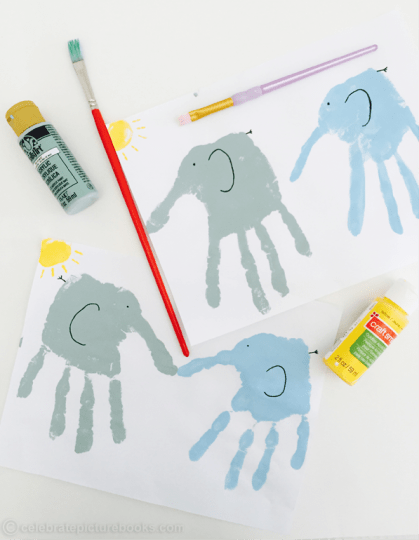
A way to make the cutest elephant print ever is right in your hands! With a little paint and paper, you can create a wildlife print that’s as unique as you are. This is a fun activity to do with a child and parent or two siblings. Working with different size hands can make your print more interesting.

Supplies

  • Paper, any color
  • Paint, any color you would like your elephants to be
  • Paint brush
  • Black marker

Directions

In this print your palm creates the body of the elephant, your four fingers create the legs, and your thumb becomes the trunk.

1. Make the right-facing elephant:

  • Paint your left hand. Make sure to fill in all the creases on your palm and fingers.
  • Press your hand onto the left side of the piece of paper

 2. Make the left-facing elephant:

  • Paint your right hand. Make sure to fill in all the creases on your palm and fingers.
  • Place your hand on the right side of the paper so that your thumb touches the end of the thumb on the left hand print. Press your hand onto the right side of the piece of paper

3. You can fill in any thin or open spaces with the paintbrush if you like

4. Let the handprints dry

5. Turn the page so that the four fingers that create the legs of the elephant are facing down.

6. Draw a dot for an eye at the base of the thumb, an ear in the palm, and a tail at the back of the hand.

7.  To make the sun, dip your thumb in yellow paint and press it into the corner of the paper. Make little rays with the edge of the paintbrush.

8. Hang your print with or without a frame.