March 9 – Learn What Your Name Means Day

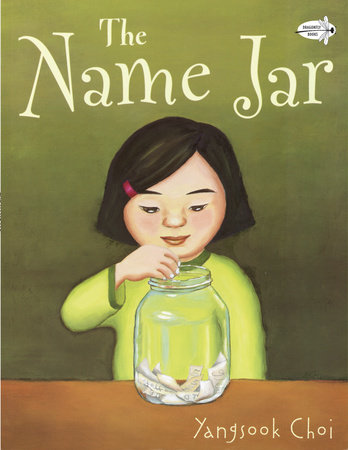
The Name Jar by Yangsook Choi Picture Book Review

About the Holiday


American onomotology enthusiast Jeffery Hill established Clelbrate Your Name Week in 1997. Each day of the first ful week of March is dedicated to self discovery and the fun of learning more about names and your name in particular. Today’s holiday encourages people to learn not only what your name means, but also to reach out to parents or other and discover why you were given the name you have. 

The Name Jar

By Yangsook Choi


Unhei has recently moved to the United States from Korea. Although Unhei is excited about the first day of school, on the bus ride she misses her former home and looks at the wooden name stamp her grandmother gave her. A boy sitting behind Unhei notices the unfamiliar object and asks about it. Then other kids notice Unhei. They ask what her name is, and when she answers, they mispronounce it, laughing and making jokes.
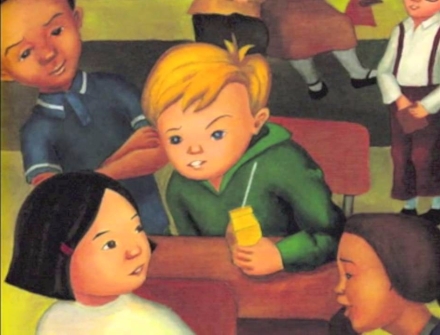
celebrate-picture-books-picture-book-review-the-name-jar-on-the-bus

Image copyright Yangsook Choi, courtesy of Random House

Unhei is embarrassed and glad that those kids head to a different classroom than hers. As Unhei enters her own room, her classmates smile and greet her—it is obvious that their teacher has prepared them for a new student, and they are excited.

Of course, they first question her about her name, and remembering the experience on the bus, Unhei is reluctant to answer. She quickly says that she hasn’t picked a name yet, but will tell them next week. At home, Unhei tells her mother that she wants an American name, a name that is easy to pronounce.

Her mother is dismayed; Unhei’s name was chosen by a master so that it would describe her uniqueness. But Unhei doesn’t want to be different, she just wants to fit in. Later while she and her mother are at a Korean grocery store, she introduces herself to the owner, who exclaims that her name is beautiful and means “grace” in English. 

celebrate-picture-books-picture-book-review-the-name-jar-mom

Image copyright Yangsook Choi, courtesy of Random House

At home Unhei tries out American names in front of the mirror—Amanda, Laura, Susie—but they don’t feel or sound right. The next day at school Unhei finds a jar on her desk with pieces of paper in it. On each piece of paper is a name—suggestions from each of her classmates. Her new friends have chosen these names thoughtfully. Daisy is the nickname of one girl’s baby sister; Tamela is a smart and brave heroine from a story; and Wensdy is the day Unhei joined their class.

At the end of the school day, a classmate named Joey comes to her. He knows she actually does have a name, and Unhei, while not wanting to say it out loud, shows him the characters on her wooden stamp. Joey thinks it is beautiful and asks to keep the paper. Day by day the glass jar fills up with names. Unhei will have to choose soon.

One Saturday Unhei returns to the Korean grocery store. When Mr. Kim calls her by name, the one other customer turns around. It’s Joey! Carefully and slowly he says Unheis name until he gets it right. On Monday when Unhei enters the classroom, she discovers that the jar is missing. It’s all right, though, Unhei has chosen her name.

celebrate-picture-books-picture-book-review-the-name-jar-friend

Image copyright Yangsook Choi, courtesy of Random House

She walks to the chalkboard and writes her real name in English and Korean. She tells the class that her name means “grace.” Other kids reveal the meaning of their names, and they all practice saying Unhei’s name. That evening Joey comes to visit. He explains that he took the jar because he wanted Unhei to keep her original name. He suggests putting Korean nicknames into the jar for their classmates to pick—just as he already has. Mr. Kim helped him choose the prefect nickname: Chinku, which means “friend.”

Ages 3 – 8

Random House, Dragonfly Books,  New York, 2003 | ISBN  978-0440417996

Discover more about Yangsook Choi, her books, and her art on her website!

Yangsook Choi’s The Name Jar is as timely now as when it was first written. Through compelling and detailed storytelling, Choi explores the themes of identity, empathy, family, friendship, and more  with sometimes heartbreaking honesty. Unhei’s varied experiences at school, at home, and at the market provide an opportunity for adults and children to discuss and embrace the diversity of our multicultural world. Choi’s warm-toned illustrations reveal the conflicts that Unhei encounters and her growing confidence as she makes friends with Mr. Kim and Joey who accepts her as she is. 

Learn What Your Name Means Day Activity
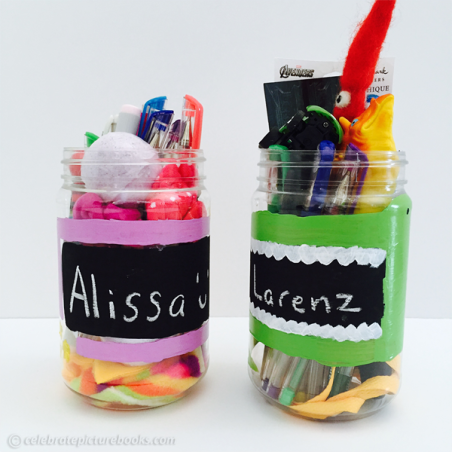
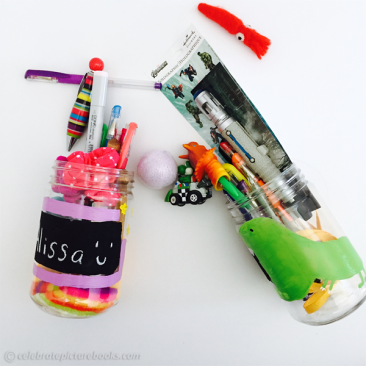
CPB - Name Jars standing

Love Your Name Organizer Jar


Everyone needs a place to store their special stuff! Here’s a way to recycle a plastic jar and make a cool organizer jar with your or your friend’s name on it.

Supplies

  • A large plastic jar, such as a peanut butter jar or mayonnaise jar with the label removed
  • Acrylic multi-surface paint or markers
  • Chalkboard paint
  • Paint brush
  • Chalk

CPB - Name Jars on sides

Directions

  1. Paint a rectangle on the front of the jar with chalkboard paint
  2. Decorate the rest of the jar with paint, markers, or paper


March 8 – International Women’s Day

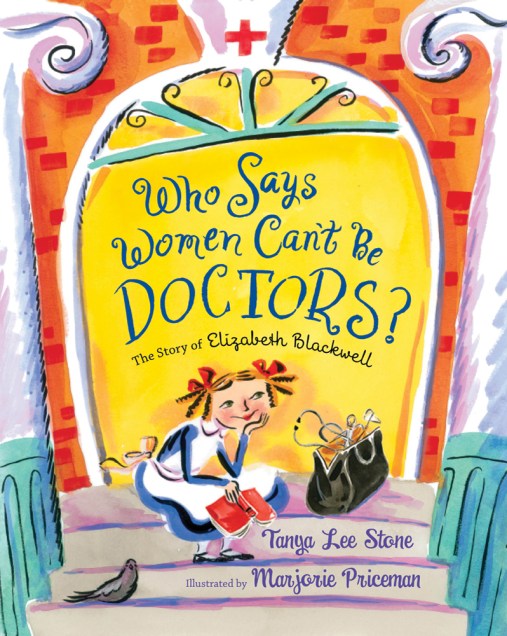
Who Says Women Can't Be Doctors by Tanya Lee Stone and Marjorie Priceman picture book review

About the Holiday

When the United States celebrated International Women’s Day in 1911, it paved the way for more extensive recognition of the contributions of women. Women’s Day stretched to a week officially in 1981 when Republican Senator Orin Hatch of Utah and Democratic Representative Barbara Mikulski of Maryland co-sponsored a Joint Congressional Resolution that established Women’s History Week. Six years later Congress named March as Women’s History Month.

March is a great time to discover and learn about the women who have shaped our country in all fields of endeavor from the arts to education to the sciences and beyond. Today we celebrate a woman who changed the medical profession forever.

Who Says Women Can’t be Doctors? The Story of Elizabeth Blackwell

Written by Tanya Lee Stone | Illustrated by Marjorie Priceman


Once upon a time there were no women doctors. Women weren’t even allowed to be doctors. Sounds like a fairy tale, doesn’t it? Fortunately, this one-time fact has entered the realm of fiction—all thanks to Elizabeth Blackwell. Elizabeth was not like other girls of the 1830s. She loved to explore and take on challenges. She could lift her brother over her head, and to toughen herself up she slept on the hard wood floor. To get a better look at the world she climbed to the roof of her house and leaned waaaaay out with a spyglass. What did she see? Maybe she saw her future. But it wasn’t what she imagined at the time. Blood made her queasy, dissection was disgusting, and being sick just made her want to hide from all the fussing.

But a comment by a sick friend, puts a bee in her bonnet. Mary Donaldson tells Elizabeth that she would much rather have been examined by a woman than her male doctor. “You should be a doctor, Elizabeth,” Mary says.

What a crazy notion, right? Well… Elizabeth can’t stop thinking about it. She asks around. Some people think it’s a good idea, but impossible; others just think it’s impossible. They believe women aren’t strong enough or smart enough and they laugh at her. By this time, though, Elizabeth is determined.

She applies to 28 medical schools, and they all say, “No.” But one day a “Yes” arrives in the mail. Elizabeth packs her bags. The townspeople all come out to see this new medical student, but they aren’t outside to welcome Elizabeth; they just want to whisper and point and stare. Surely, Elizabeth thinks, the students will be happy to see her.

But she receives the same reception on the college campus. In fact, she learns, the only reason she was accepted is because the men voted to let her in as a joke! Elizabeth knows how to handle it. She studies hard and gives her opinions, and soon she wins the respect of her fellow students—even if the townspeople still don’t accept her.

On January 23, 1849 Elizabeth Blackwell graduates from medical school with the highest grades in the class. She has become the first woman doctor in America! Many people hope that she would be the last. But as we know…she was Not!

Tanya Lee Stone magnificently imbues this short biography of Elizabeth Blackwell with enough mystery, conflict, and history for even the youngest readers to understand the type of girl and woman Elizabeth was as well as the challenges she faced. The details of Blackwell’s life that Stone includes are deftly chosen, and make her instantly recognizable and relatable to children. One line in the text written in the present tense amid the historical past transforms this biography into a universal story for all generations. Blackwell may have started out as a reluctant dreamer, but once she dared to believe she accomplished more than she or anyone could have imagined. It is what we want for all our children.

Marjorie Priceman’s illustrations, swirling with words, angled on the page and floating in white space, are as topsy-turvy as the world Elizabeth Blackwell created. Blackwell’s boldness is echoed in the rich colors and strong lines of the gouache and India-ink paintings, and the emotions she stirred in others—from derision to horror to admiration—are cleverly and exceptionally drawn in a minimal style on the characters’ faces.

Ages 5 – 9

Christy Ottaviano Books, Henry Holt and Company | ISBN 978-0805090482

International Women’s Day Activity

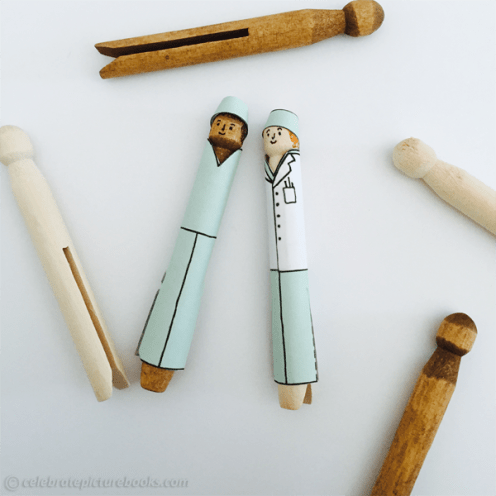
CPB - Doctors Clothespins

Doctor Clothespin Figure


Make one of these clothespin figures that honors International Women’s Day and Women’s History Month as well as everything doctors do to help us stay healthy.

Supplies

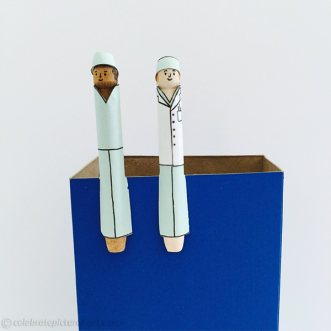
CPB - Doctors Clothespins on box

Directions

  1. Draw a face and hair on the clothespin
  2. Cut out the outfit you want your doctor to wear (color pants on your clothespin if you choose the lab coat)
  3. Wrap the coat or scrubs around the clothespin. The slit in the clothespin should be on the side.
  4. Tape the clothes together
  5. Wrap the cap around the head and tape it.
  6. If you’d like to display your clothespin doctor on a wire, string, or the edge of a box or other container, cut along the dotted lines of the clothes template.


February 14 – Frederick Douglass Day

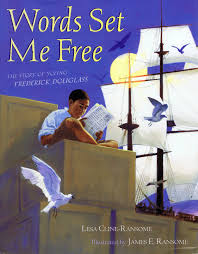
CPB - Words Set Me Free

About the Holiday

Although the exact date is not known, history records Frederick Douglass’ birthday as around Valentine’s Day in 1818, so February 14 was chosen to honor this most unique and influential man. Born into slavery, Frederick Bailey (he later changed his last name to Douglass) learned how to read and write when still a child. As a young man he used his intellect and courage to secure his freedom. He became a compelling speaker, writer, leader of the abolition movement, and statesman. His writings, especially his autobiography Narrative of the Life of Frederick Douglass, an American Slave, are among the most powerful accounts of the slave experience and are still widely read today.

Words Set Me Free

Written by Lesa Cline-Ransome | Illustrated by James E. Ransome


Born into slavery and separated from his mother in infancy, Frederick Bailey is raised by his Grandmama while his mother works on a separate plantation. When she is able Harriet Bailey walks the 12 miles between plantations to spend a few short hours with her son, watching him sleep, before making the long journey back. While Frederick is still a very young child, his mother falls ill and dies. Douglass recalls never seeing his mother’s face in daylight.

At the age of six, Frederick is moved from his Grandmama’s cabin to the plantation house. At eight, he is sent to the master’s brother in Baltimore, Maryland. Here, the master’s wife, Sophia Auld, treats Frederick more like a paid servant then as a slave. When Frederick says he wants to learn how to read and write, she immediately begins teaching him the alphabet. Frederick is always mindful, however, that he may be punished for these lessons, and he has only memorized the letters and a few words before his master puts an end to his education. Angrily, the master explains to his wife, “If you teach him how to read…it would forever unfit him to be a slave.”

These words are perhaps Frederick’s greatest lesson. He never forgets them, and they fuel his resolve to pursue an education. He makes clever use of the few resources he has and slowly learns to read and write. From the newspapers he discovers that the North offers freedom, and Frederick decides to escape. It’s many long years, however, before he can fulfill his dreams. At last, he sees an opportunity to leave the South behind, and using his talent for writing makes his escape a reality.

Lesa Cline-Ransome has written a compelling biography of Frederick Douglass for children in Words Set Me Free. In straightforward language and through first-person point of view, Cline-Ransome reveals the brutal truth of Douglass’s life as a slave and his fight against injustice. As the title suggests, the book focuses on Frederick’s desire to become educated and the obstacles he overcame to succeed. This universally important message continues the work Douglass engaged in long ago.

James Ransome’s stirring paintings highlight pivotal scenes of Frederick’s story. Readers witness the tender moments with his mother, the cruel contrast of slavery and his blossoming intellect, and Frederick’s growing resolve to educate himself and escape.

Ages 5 and up                                                                                                            

Simon & Schuster, New York, 2012 | ISBN 978-1416959038

Frederick Douglass Day Activity

CPB - Words Set Me Free word search

Words Set Me Free word search


Words were so important to Frederick Douglass that he risked everything to learn how to read and write. In this printable Words Set Me Free Word Search Puzzle you will find words about the man we honor today. Solution

February 10 – Library Lovers Day

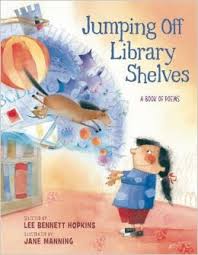
CPB - Jumping Off Library Shelves

About the Holiday

Today I’ve chosen to celebrate a month-long holiday. February is Library Lovers Month! Chances are if you’re reading this, you also love libraries! For readers there’s no better place than standing in the stacks, surrounded on all sides by shelves and shelves of books. In those pages you meet new friends, defeat the bad guys, discover poetry, laugh, sometimes cry, see astonishing art, find new hobbies, and learn fascinating facts about…wow! Anything and everything!

What’s your favorite library or thing about libraries? Mine is the East Lyme Public Library in Connecticut, where they have a fantastic selection of books and awesome librarians who feel like family! Tell me about your special library in the Comments section below.

Jumping Off Library Shelves: A Book of Poems

Poems selected by Lee Bennett Hopkins | Illustrated by Jane Manning


From morning, which “pours spoons of sun through tall windows” of a library in Rebecca Kai Dotlich’s poem “Breakfast between the Shelves,” to night, when shadowed mice huddle to read a mystery in Dotlich’s closing poem “Midnight in a Library,” kids can enjoy a full day of poems in this delightful collection. Many of today’s best-loved poets for children are represented here, celebrating the power of a library card, the kindness of librarians, and the enchantment of reading.

Jane Manning’s soft, dreamy illustrations swirl with imagination, shimmer with the warm glow of a reading nook, and enchant with the smiles of children thrilled with the pleasures of reading.

Library Lovers Day Activity

CPB - Bookworm Book (2)


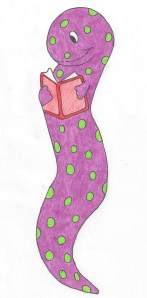
Bookworm Bookmark

For all you bookworms out there who love to read, here’s your very own Bookworm Bookmark to color and put between the pages of your favorite story!

Supplies

Directions

  1. Print out the Bookworm Bookmark template
  2. Color the bookworm
  3. Cut out the Bookworm
  4. Cut the Bookworm’s mouth at the dotted line. The top part of the bookworm’s mouth hangs over the page and marks your place!