June 8 – National Best Friends Day

celebrate-picture-books-picture-book-review-painting-pepette

About the Holiday

What would we do without our best friends? They’re the ones we go on adventures with, laugh with, commiserate with, even cry with. And no matter what, we know they’ll always be there for us. Best friends can be people we’ve known all our lives or ones we’ve just met; they can live far away or in our own home. Best friends don’t even have to be people—beloved pets or favorite toys are sometimes just what we need. Today is the perfect time to celebrate your best buddy. Get together with them, call, or text. Relive some favorite memories or make some new ones!

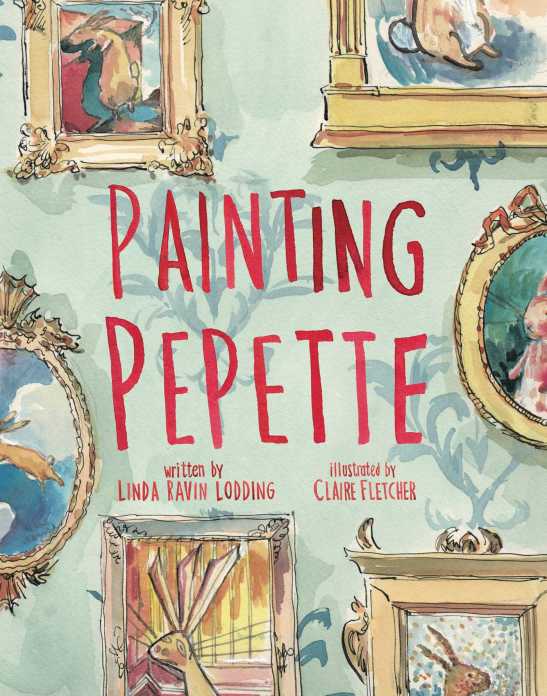
Painting Pepette

Written by Linda Ravin Lodding | Illustrated by Claire Fletcher


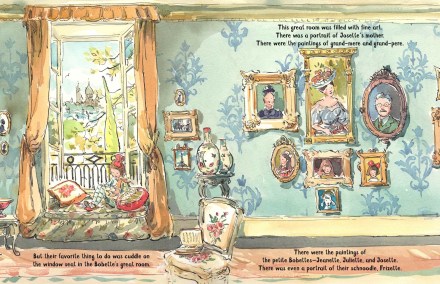
If you peek in the great room window of the grand yellow house at #9 Rue Laffette in Paris, you will most likely see cuddled on the comfortable seat Josette Bobette and her beloved stuffed rabbit Pepette. It’s their favorite place. Looking past them you will see that the great room is filled with fine art. On the walls hang portraits of the family—Josette’s mother is there as well as grand-mère and grand-père, the three Bobette sisters, and even their schnoodle Frizette.
celebrate-picture-books-picture-book-review-painting-pepette-great-room

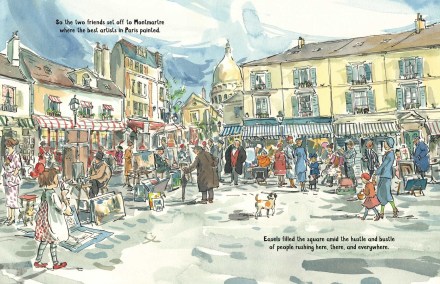
“One day Josette noticed something strange. There was no portrait of Pepette!” Josette determines to find an artist to paint a special portrait of her best friend. The pair heads out to Montmartre, where the all the best artists set up their easels to paint and sell their work. It doesn’t take long for a man in a striped shirt to stop them.

“‘Those ears!’” he cries. “‘Never have I seen such majestic ears. I must paint this rabbit’s portrait!’” Pepette blushes at such an effusive compliment, and Josette exclaims, “‘Magnifique!’” It appears Josette has found just the artist to create Pepette’s portrait. The painter waves his brush with a flourish, declares his painting a “masterpiece,” and holds it up for inspection. Josette gazes at a Pepette with two noses and three ears. Diplomatically, she proclaims the picture “nice” but not quite Pepette. Her best friend agrees.

Just then a man with a thin, curved handlebar mustache spies the pair. Admiring Pepette’s whiskers, the artist begs to capture “the very essence of her rabbitness!” He immediately sets to work, and in no time a most unusual portrait emerges. Pepette seems to melt from a tall red wall. Josette considers it and her reaction carefully. “‘It’s imaginative,’” she says. “‘But you’ve painted Pepette quite, well, droopy.’” Pepette agrees.

As Josette and Pepette enjoy a Parisian snack on the curb of Montmartre, a rakish young man happens along. He is arrested by Pepette’s nose, which he likens “‘a faint star twinkling in a misty, velvet night.’” Josette has a good feeling about this artist and follows him across the square to his easel. Pepette poses on a red tufted stool as the artist paints a rabbit soaring through the clouds. He proclaims the finished portrait “‘one of my best works’” as he displays it to the crowd. Josette likes the clouds but tells the painter that Pepette is afraid of heights and not fond of flying. Pepette agrees.

By now Pepette is the most sought-after model in Paris, and another artist rushes up, captivated by her beauty. The balding man in a dapper suit and round spectacles peers at Pepette. “‘What a colorful lady—balloon blue, pansy pink, and radish red!’” A little suspicious of his vision, Josette allows him to paint Pepette. “‘Ta da!’” the man exclaims, revealing the magic of his brush. Josette studies the canvas with its vibrant dots, dashes, and splashes. While she admires the colors, she reminds the artist that Pepette isn’t pink.

“‘Ah, yes,’” nods the painter. “‘But through art we can see the world any way we want.’”
celebrate-picture-books-picture-book-review-painting-pepette-montmartre

With the sun setting low in the sky, Josette politely says thank-you and goodbye to the artists. She and Pepette have enjoyed their day, but it’s time to go home. Curled up once more on the window seat, Josette sighs. She had so hoped to have the perfect portrait of Pepette—one that showed her velvety grey listening ears, her heart-shaped nose, and her soft arms that give tight hugs. Suddenly, Josette has an idea! Gathering all her art supplies, she creates the perfect likeness—as special as Pepette herself!

An author’s note on the last page describes the creative atmosphere of 1920s Paris, home to writers, artists, musicians, and fashion designers, that gives a frame to her story. The artists that Josette meets are inspired by Pablo Picasso, Salvador Dalí, Marc Chagall, and Henri Matisse.

In Painting Pepette Linda Ravin Lodding has written a multi-layered story of love, friendship, and unique vision. Through the sweet relationship between Josette and Pepette and with a sprinkling of humorous self-congratulation on the part of the artists, Lodding nudges readers to appreciate that while art can reveal and obscure, reflect and transcend reality, ultimately the success of a piece—complex or simple—lies within the viewer’s heart. Lodding’s lyrical language trips off the tongue and is a joy to read—it’s like following Josette as she skips happily through Paris.

Claire Fletcher’s striking pen and ink illustrations pay delicate homage to cityscapes of a bygone Paris. Adorable Josette in her white pinafore over red-dotted dress, red shoes, and big red bow along with her enchanting rabbit are the perfect tour guides through crowded Montmartre and an introduction of art history. Soft tones of yellow, rose, and green illuminate the apartments and cafes of the square where colorful shoppers and artists mingle. Fletcher’s renderings of Pepette’s various portraits will not only make kids giggle, but entice them to learn more about each artistic style. The final endpapers reveal that the four fine-art portraits now hang in the Muse of Paris, while readers already know that Josette’s perfectly perfect portrait of her well-loved friend has taken its rightful place on the wall in the Bobette great room!

Painting Pepette is a beautiful addition to any child’s bookshelf and a lovely way for teachers to initiate a discussion of art history and get kids excited about artists and different art styles.

Ages 4 – 9

little bee books, 2016 | ISBN 978-1499801361

Follow Josette through Paris as she searches for just the right artist to paint a portrait of her best friend Pepette and comes to a surprising discovery in this beautiful trailer:

Discover more books by author Linda Ravin Lodding on her website.

Illustrator Clair Fletcher invites you to find more of her artwork by visiting her online gallery.

Best Friends Day Activities
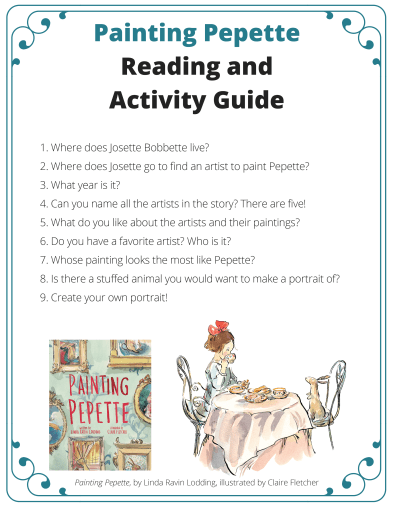
celebrate-picture-books-picture-book-review-painting-pepette-activity-guide

Painting Pepette Reading and Activity Guide


little bee books has created an interactive activity so you can continue exploring Josette’s world and your own artistic talent! Just click here—Painting Pepette Reading and Activity Guide—to start having fun!

Stuck on You Magnets or Picture Hanger


Best friends stick together whether they’re near or far, right? Here’s a fun craft that you and your friends can make to show how magnetic personalities attract each other! If your best friend or friends are far away, why not make them one too? Or make the alternate picture hanger! Be creative—use inside jokes, favorite characters, or shared experiences to make these  crafts personal!
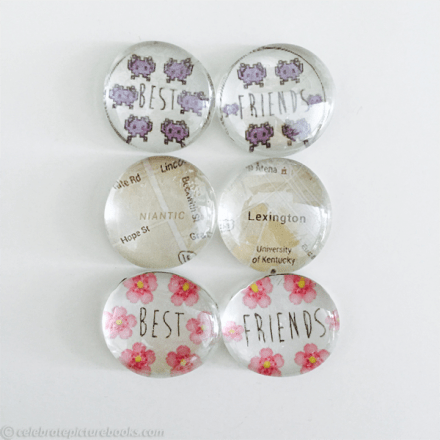
celebrate-picture-books-picture-book-review-friends-magnets-craft

For Magnets

Supplies

  • To get you started, here are two printable Best Friends Templates! Template 1 Template 2
  • Poster board
  • Large, 1 ½-inch clear glass stones (decorative fillers), available in craft stores
  • Markers or colored pencils OR find images online to print out
  • Medium to large flexible magnets, available in craft stores
  • Super glue
  • Toothpicks
  • Scissors

Directions

  • Place the glass stone on the poster board and trace around it
  • Draw your design in the circle on the poster board
  • Cut out the circle
  • With the toothpick, apply glue around the very edge of the design side of the circle
  • Attach the circle to the flat side of the stone, let dry
  • Trim the cardboard circle if needed
  • Attach the magnet to the back of the cardboard with glue

celebrate-picture-books-picture-book-review-friends-picture-hanger-craft

For Map Picture Holder

Supplies

  • Use a mapping program to find a map of your town and your friend’s town
  • Poster board
  • Large, 1 ½-inch clear glass stones (decorative fillers), available in craft stores
  • Twine
  • Super Glue
  • Toothpicks
  • Scissors
  • Heavy duty mounting squares

Directions

  1. Find maps of your and your friend’s towns
  2. Zoom in so the name of your and your friend’s towns are displayed well. You will be using about a 1-inch area around the towns’ names.
  3. Take a screen shot of the maps
  4. Print the maps
  5. Place the glass stone on the map and trace around it
  6. Place the glass stone on the poster board and trace around it
  7. Cut out the circles on the map and poster board
  8. With the toothpick, glue the map to the poster board, let dry
  9. With the toothpick, apply glue around the very edge of the map side of the circle
  10. Attach the circle to the flat side of the glass stone, let dry
  11. Trim the cardboard circle if needed
  12. Repeat with the other map
  13. Attach a length of twine to the back of each glass stone
  14. Attach heavy duty mounting squares to the back of each glass stone
  15. Attach stones to the wall and hang pictures on the twine

June 3 – Repeat Day

celebrate-picture-books-picture-book-review-follow-follow

About the Holiday

Remember how your brother or sister or friend used to repeat everything you said? Everything you said? Well, that has been made into a holiday! Today gives you the perfect excuse to do your favorite things twice! Go ahead, have two lattes, watch your favorite show twice, listen to an album over again! Whatever you do, just remember to double up on it!

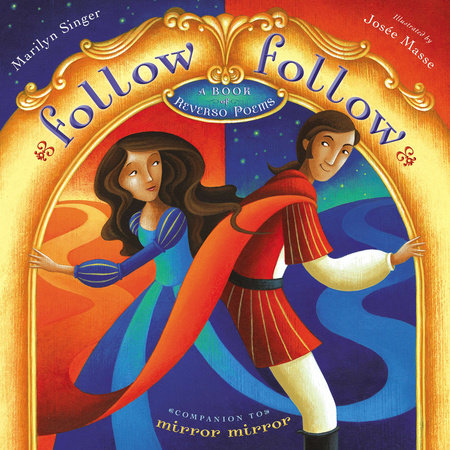
Follow Follow: A Book of Reverso Poems

Written by Marilyn Singer | Illustrated by Josée Masse


When you ask someone, “Can you repeat that?” they often use the exact same words so you understand what they want to tell you. But what if the exact same words could have completely different meanings? That’s the brilliant concept behind Follow Follow. In this ingenious book, 17 classic fairy tales are told in verse (and reverse) from two opposing points of view that will forever change the way you think about exchanges of ideas and dialogue.

In Your Wish Is My Command, Aladdin and the Jinni trade wishes and their view of what freedom means. Six lines from this clever poem read from Aladdin’s perspective: “I no longer wish to be a slave / to lords, magicians, merchants, other urchins. / Jinni of the Lamp, / I am just a poor / young knave. / Give me all I crave.”

And then from the Jinni’s perspective: “Give me all I crave, / young knave. / I am just a poor / Jinni of the Lamp. / To lords, magicians, merchants, other urchins, / I no longer wish to be a slave.”

The Emperor’s New Clothes loses none of its impact in Birthday Suit, a humorous abbreviated telling from the King’s ego-centric thoughts and the little boy’s stunning revelation.

Just as the original tale of The Golden Goose presents a princess who can’t help but laugh at the ridiculous parade going by her window, Silly Goose reveals both sides of the princess’s personality.

Ready, Steady, Go! gets into the heads of both the too-clever-for-his-own-good rabbit and his persevering competitor of The Tortoise and the Hare. The lounging hare thinks: “That ridiculous loser! / I am not / a slowpoke. / Though I may be / the smallest bit distracted, / I can’t be / beat. / I’ve got rabbit feet to / take me to the finish line.” While the tortoise urges himself: “Take me to the finish line! / I’ve got rabbit feet to / beat. / I can’t be / the smallest bit distracted. / Though I may be / a slowpoke, / I am not / that ridiculous loser.”

Will the Real Princess Please Stand Up? peeks into two bedrooms where would-be brides to the prince slumber. One exclaims, “This bed rocks! / I feel like I’m sleeping on feathery flocks,…” but the other complains, “feathery flocks? / I feel like I’m sleeping on / rocks.” Who will win the heart of the prince?

The Little Mermaid, Puss in Boots, The Pied Piper of Hameln, Thumbelina, The Three Little Pigs, The Nightingale, and The Twelve Dancing Princesses are also touched with Marilyn Singer’s magic wand of poetry. Under her spell the perfect choice and placement of words combined with a simple change of punctuation can send the verse swirling in the opposite direction with surprising results. As readers encounter each fairy tale, they’ll wonder, “How does she do it?” But there’s no time to ponder—another terrific tale follow follows!

Like being on the cusp of competing realities, Josée Masse’s vibrant illustrations deftly represent the viewpoints of the mirrored verses. On either side of a subtly split page, the opposing characters tell their side of the story amid contrasting color schemes and flowing lines that bridge the divide. In Your Wish Is My Command, Aladdin dreams in his rooftop window of riches and freedom while the Jinni floats away from his lamp over golden rooftops. On with the Dance makes clever use of the half-page design as the king ponders the condition of his daughters’ shoes while they are pictured dancing in a regal hall that doubles as the king’s crown.

Follow Follow would be a welcome addition to any fairy tale or poetry lover’s bookshelf. And since Marilyn Singer and Josée Masse really know what Repeat Day is all about, you’ll want to check out their other books: Mirror Mirror: A Book of Reverso Poems and their newest, Echo Echo: Reverso Poems about Greek Myths.

English and language arts teachers will also find these volumes to be a wonderful way to teach point of view.

Ages 5 – 11 and up (anyone who loves fairy tales will want to read this book)

Dial Books, Penguin Group, 2013 | ISBN 978-0803737693                                                         

Repeat Day Activity

celebrate-picture-books-picture-book-bookmark-craft

Book Jacket Bookmark


When a book is long, you can’t always finish it in one sitting. If you forget where you left off, you can often find yourself reading the same section twice. That’s okay—especially on Repeat Day!—but this bookmark will help you remember your place and get you reading again in style!

Supplies

  • Printable Book Jacket bookmark 
  • Colored pencils or markers
  • Poster board
  • Scissors
  • Glue

Directions

  1. Color your bookmark in your own unique style
  2. Cut the bookmark out
  3. Glue it to poster board if you’d like to make it more durable

May 14 – International Astronomy Day

celebrate-picture-books-picture-book-review-star-stuff

About the Holiday

Instituted by Doug Berger in 1973, International Astronomy Day is held twice a year—in spring and fall—to raise awareness of the benefits and wonder of studying the stars. Museums, observatories, universities and astronomy clubs around the world provide public access to astronomical instruments and hold special programs about this interesting and ancient science. To celebrate, attend an International Astronomy Day event, take time tonight to gaze at the sky and pick out the constellations you recognize, or read about the stars and their importance to history and the future.

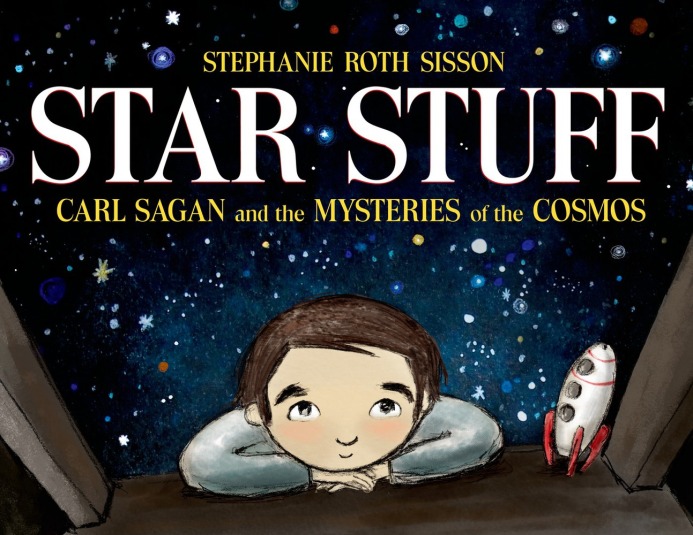
Star Stuff: Carl Sagan and the Mysteries of the Cosmos

By Stephanie Roth Sisson


A boy named Carl Sagan may have lived in a small apartment in Brooklyn, New York, but he was part of so much more—a large city on the third planet from the sun in a “neighborhood of stars” which are part of the Milky Way galaxy. Growing up, Carl marveled at the connections. He had an innate curiosity and was astonished by everything he saw; his imagination was out of this world!

When he attended the 1939 World’s Fair as a young child, he experienced things he had never seen before; he saw a robot, new inventions, and a time capsule filled with messages for the future. At night he looked up at the stars and wondered; he thought they looked like lightbulbs on long black wires. He went to the library to read about the stars.At first the librarian thought he meant movie stars, but soon he got the book he wanted. Reading it made his heart beat fast.

Carl imagined what kinds of creatures and sights he might discover if he were able to travel through space. He tried standing with his arms outstretched and wishing he was on Mars like his favorite science fiction character, John Carter, but nothing happened. He decided he would have to make his “life in space” a reality himself so he went to college and became an astronomer, cosmologist, astrophysicist, astrobiologist, and so much more.

Dr. Carl Sagan then worked with other scientists to develop the exploratory crafts Mariner 2, Mariner 9, and Pioneer 10 that have gone into space to investigate Mars, Venus, and Jupiter. When they sent back pictures, Carl analyzed them and learned more about our solar system

Carl wanted everyone to know and understand Space. He created a television program that explained in easy terms what the stars, planets, and other celestial bodies are made of, how they came to be, and how we are connected to them. The Earth and every living thing are made of star stuff, Carl told his audience. The show – Cosmos: A Personal Voyage – was a hit, watched by millions of people.

Scientists have long wanted to know if life exists on other planets, and as time went on they had the technology to explore the possibilities. Carl worked with other engineers to create Voyager 1 and Voyager 2 to tour the outer solar system and beyond. Remembering that time capsule he saw so long ago at the World’s Fair, Carl had a marvelous idea! He recorded messages and sounds from Earth and made a Golden Record that was carried on each Voyager mission.

Carl Sagan, that boy made of star stuff who grew up to be so many things—astrophysicist, explorer, educator, philosopher, writer, and more—changed the world through the power of his imagination.

Stephanie Roth Sisson’s biography of Carl Sagan wonderfully honors the dreamer and scientist whose imagination went into Space and brought it down to Earth for others to understand and enjoy. The story begins in Sagan’s neighborhood and home, where illustrations depict the curiosity that fueled his passion. Just as the mysteries of Space quickly captured his attention, the pages fill with the night sky and its twinkling lights and celestial bodies. A most ingenious page takes advantage of a two-page vertical spread that transforms Carl’s bedroom window into a space capsule that blasts him into the cosmos as he ponders the stuff of stars.

His work as an adult collaborating with scientists and engineers to develop deep space exploration craft is clearly drawn with pages containing multiple panels of his job and accomplishments up close and from the distance of outer space. A particularly arresting three-page fold-out spread reveals the moment Carl discovered his love of the stars and Earth’s sun (holding a flashlight behind the depiction of the fiery sun would be a show-stopper, especially during a night-time read).

Kids familiar with today’s space travel and the awe-inspiring images sent back to Earth will love this book. To quote Carl Sagan, Star Stuff will definitely elicit a “Wowie!” from readers.

Ages 4 – 8

Roaring Brook Press, 2014 | ISBN 978-1596439603

International Astronomy Day Activity

celebrate-picture-books-picture-book-glow-stars

Make a Room Observatory


If you like gazing at the stars before going to sleep, why not bring them inside? With adhesive glow-in-the-dark stars, available at craft and toy stores, you can create a night sky full of celestial bodies that stay lit long after you’ve said goodnight. You can add planets, rocket ships—even your favorite constellation! This can be a nice alternative to a night light or transition children from a full night light to a gentle, comforting glow in their room.

Picture Book Review

April 28 – Workers’ Memorial Day

celebrate-picture-books-picture-book-review-brave-girl

About the Holiday

Some jobs are so dangerous that workers get hurt or even die doing them. Around the world organizations have been established to help industries provide safer working environments for their employees by establishing standard rules and regulations for buildings, machinery, working hours, and more. Unions and other groups have also been founded that represent workers to ensure their rights are upheld and their needs are met. Today we honor the sacrifices of workers in dangerous professions and raise awareness for safe working conditions.

Brave Girl: Clara and the Shirtwaist Maker’s Strike of 1909

Written by Michelle Markel | Illustrated by Melissa Sweet


Among the immigrants sailing to New York, stands five-foot-tall Clara Lemlich. She may not know it now, but she’s going to change her new city. While her father can’t find work, Clara gets a job in the garment industry, which hires school-age girls to make women’s clothing. Instead of going to school, Clara spends her days hunched over her sewing machine in a dark, smelly factory with many other girls, making clothes as fast as she can.

The rules of the factory are severe. For minor mistakes workers can be fined or worse—fired, leaving their families without an income. The doors are locked so the girls can’t leave without being inspected to ensure they haven’t stolen anything. And the workers must toil long into the night. Despite it all Clara is determined to get an education even though it means walking to the library after work and missing sleep to read her lessons. 

At the factory the girls become friends and reveal stories and secrets. The working conditions make Clara angry. She hears that the men at the factory want to form a union. If all the workers team up, they can hold a strike and force the management to treat them better, the men say. But they don’t think the girls are tough enough.

Clara knows what the girls are capable of. Every day she talks to her friends and the other women, urging them to fight for their rights—and they do! But it’s not as easy as the men predicted. The bosses don’t want to give in. In fact Clara’s life is in danger! She is beaten and arrested. Despite the intimidation she continues to picket. These small strikes make little difference, however—the bosses just hire new girls and the work continues.

Clara and other union leaders think only a huge strike by all workers in every garment factory in New York will cause the bosses to listen and make changes. At a union meeting workers pack the seats to listen to leaders from across the country. Not one of them recommends such a large strike. Clara can keep silent no more. She moves to the front of the hall and calls out. People lift her to the stage. Shouting “Unity is strength” she rallies the crowd and begins the largest strike of women workers ever in United States history.

The next morning thousands of women take to the sidewalks, leaving their sewing machines empty and silent. New York is stunned! Newspapers call the strike a “revolt,” and the girls an “army.” But this is really an army of children—the girls range in age from only 12 to 25 years old. Clara knows how to lead and motivate the girls. She gives rousing pep talks, sings, and stands up to thugs sent to harass them.

All winter the girls join the men strikers. They are starving and cold and become the inspiration for newspaper articles and fundraising. Many wealthy women donate to their cause and join them on the picket lines. Finally the bosses relent. They agree to the formation of unions in their factories, raise salaries, and shorten the work week. Factory workers in Philadelphia and Chicago take heart from Clara’s work and improve conditions in their cities.

Even though Clara is young and small, she proves that anyone can right wrongs and make a difference.

The final pages include more information about the garment industry in the early 1900s as well as a bibliography.

Michelle Markel’s Brave Girl is a spirited biography of Clara Lemlich, clearly outlining the life and working conditions of immigrants in the early 1900s—especially industries’ use of children to fill low-paying, oppressive jobs. This true-life story of a girl who wouldn’t give up or give in is told with pride and balance, touching on the dangers Clara faced in a sensitive manner appropriate for children. Overall, the idea that one person can make a difference no matter how big or how old shines through, making this not only a tale of the past, but an inspiration for today’s children and the future.

Melissa Sweet cleverly combines watercolor and gouache paintings with colorful fabric, ribbon, sewing pattern paper, and ledger pages to create illustrations fitting to the story. The pictures appear sewn onto the pages with straight, zigzag, and embroidery stitches, and the vibrant colors depict the fiery nature of Clara and all the workers who strove for better lives.

Ages 4 – 9 (and up as Brave Girl makes a wonderful teaching text)

Balzar + Bray, Harper Collins, 2013 | ISBN 978-0061804427

Workers’ Memorial Day Activity

celebrate-picture-books-picture-book-review-dream-job-application

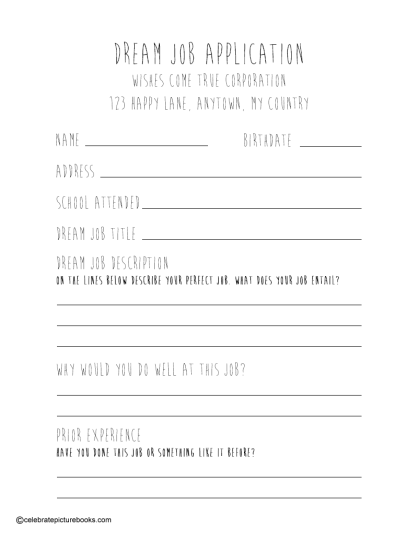
Dream Job Application


Work isn’t working when you love your job—it’s fun! What is your perfect job? Is it working with animals? Playing a sport? Being an artist, scientist, entrepreneur? Fill out this application and get started on following your dreams! Print the Dream Job Application below!

Dream Job Application 

April 27 – Tell a Story Day

celebrate-picture-books-picture-book-review-one-day-the-end-cover

About the Holiday

Are you a raconteur? Do you love to weave a tale so intricate and intriguing that your listeners are on the edge of their seats? Or are you the one leaning forward, all ears, feeling the tingling thrill of that story? Either way—this day is for you! So take some time to tell or listen to a story—or even write your own!

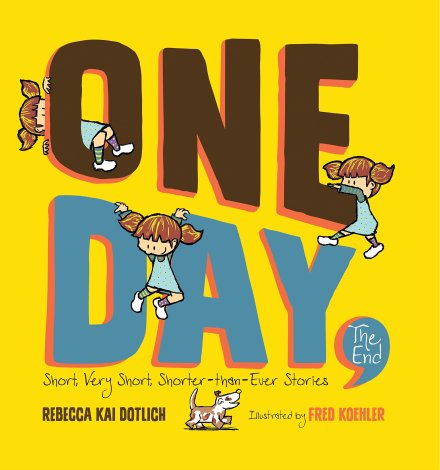
One Day, The End: Short, Very Short, Shorter-than-Ever Stories

Written by Rebecca Kai Dotlich | Illustrated by Fred Koehler


Hey! I have a fantastic story to tell you! Ya gotta minute? Ok! See… “One day I went to school. I came home. The End” What do you mean, “Is that it?” Don’t you get it?  So many things happened—funny, messy, worrisome, happy. It was an amazing day! I didn’t say that? But it’s all right there! Where? In the middle. In the pictures!

celebrate-picture-books-picture-book-review-one-day-the-end-tree

Image copyright Fred Koehler, 2015, text copyright Rebecca Kai Dotlich, 2015. Courtesy of Boyds Mills Press.

On other days the little girl who went to school in the story above becomes a detective to find her lost dog, invents ingenious ways to hide from her brother, and creates something awesome for her mom. She also runs away from home, but of course comes back, and shadows her cat to a surprising discovery. On yet another day she just feels like stomping. And on still another she  relents to a much-needed bath…and shares it with her dog!

And what does she want to do after all these adventures? She wants to write a book…and does!

celebrate-picture-books-picture-book-review-one-day-the-end-school

Image copyright Fred Koehler, 2015, text copyright Rebecca Kai Dotlich, 2015. Courtesy of Boyds Mills Press.

Rebecca Kai Dotlich’s One Day…The End is such an ingenious concept that readers will keep turning the pages just to see what clever idea comes next. Each story consists of a first sentence that introduces a plot and the last line that wraps it up. Sure Dotlich could have fleshed out the characters, detailed the setting, added dialogue, and symbolized a theme, but sometimes pictures are worth a thousand words, and this is where Fred Koehler comes in.

Koehler takes these kid-centric tales and fills in the exploding science experiments, ice-cream trucks, accidental oopsies, distractions, clues, and more that make up each day’s adventure. With humor and an eye for real-kid emotions and actions (the little girl pours glue from the bottle held above her head), Koehler creates a unique plot for each story.

celebrate-picture-books-picture-book-review-one-day-the-end-write

Image copyright Fred Koehler, 2015, text copyright Rebecca Kai Dotlich, 2015. Courtesy of Boyds Mills Press.

In “One day I felt like stomping” the little girl doesn’t stomp for no reason: her cat eats her pizza lunch, she splatters herself with purple paint, and her fishing pole breaks. She just feels like…! The word STOMP grows bigger across the page and even gets stomped on itself as the girl vents her frustration in a puddle, on a pile of leaves, and—almost—on a flower. But seeing the daisy saves her day and she saves the daisy. Haven’t we all been there?

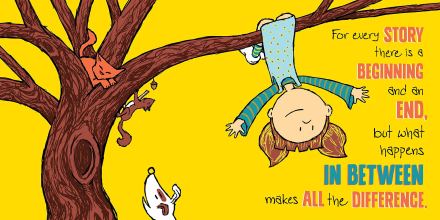
One Day…The End is a joy to share with kids. They’ll love to spend time pointing out the humorous details and depth of story each page holds, and may even like to “tell” the story as they read. This book would be a fantastic jumping off point for kids wanting to write their own stories or for teachers wanting to demonstrate the elements of active, detailed story writing. As Dotlich says on the first page: “For every story there is a beginning and an end, but what happens in between makes all the difference.”

Ages 4 – 8

Boyds Mills Press, 2015 | ISBN 978-1620914519

Discover more about Rebecca Kai Dotlich and her books on her website.

To learn more about Fred Koehler, his books, and his art, visit his website.

Tell a Story Day Activity

celebrate-picture-books-picture-book-review-tell-a-story-maze

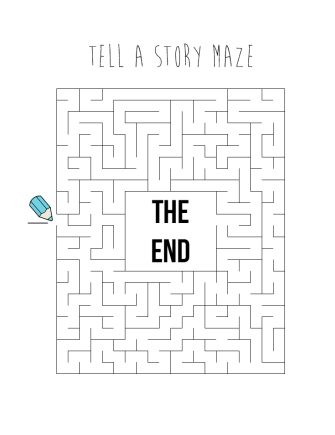
Tell a Story Maze


This puzzle may look like a regular maze, but there’s a secret to it! Within this maze is any story you’d like to make up. Why do you go left instead of right? Are you avoiding a zombie or a rain shower? Why do you go up instead of down? Is it because you can you float? What lurks in that dead end you’ve entered? There are as many cool stories as you can imagine right in those little pathways. And when you find your way to The End, you’ll have written a story with this printable puzzle!

Tell a Story Maze | Tell a Story Maze Solution 

picture book review

April 19 – It’s Mathematics Awareness Month

The Boy Who Loved Math: The Improbable Life of Paul Erdős by Deborah Heiligman and LeUyen Pham picture book review

About the Holiday

If you think numbers are numero uno then Math Awareness Month is for you! During April mathematicians, engineers, and all techie types are honored for their contributions to the advancements in science, medicine, computer technology, environmental concerns, and other areas. It’s also a great time to explore and experiment and discover all the benefits of being a numbers-oriented person. This year’s theme is “The Future of Prediction.” Activities will explore how math and statistics are the future of prediction, providing insight and driving innovation. 

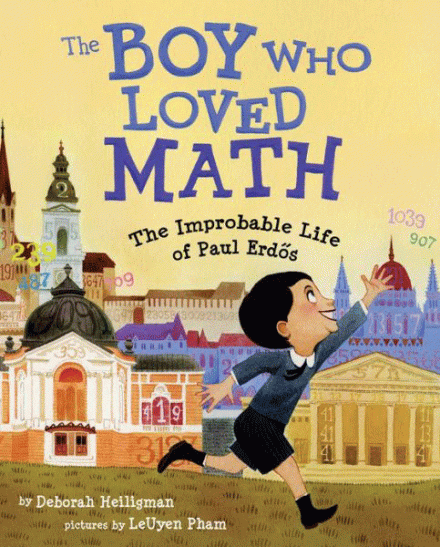
The Boy Who Loved Math: The Improbable Life of Paul Erdős

Written by Deborah Heiligman | Illustrated by LeUyen Pham


In Budapest, Hungary a boy is born who loves math. His name is Paul Erdős and he lives with his mother, who loves him “to infinity” just as Paul loves her. When she goes back to work as a math teacher, she leaves Paul with Fräulein, his nanny. Fräulein loves rules and tries to get Paul to sit still, eat all his lunch, take a nap—to obey. But Paul hates rules.

At three years of age he teaches himself to count the days until his mother will be home with him 100 percent of the time. Knowing the number makes Paul feel better as his head is constantly full of numbers and what they can do. One day when he is four years old, he meets a woman and asks her two questions—what year she was born and at what time. When the woman tells him, it only takes him a moment to reveal how many seconds she has been alive.

He continues to play with numbers, learning more and more about the various types. He decides he will be a mathematician when he grows up. When Paul is old enough to go to school, he once again encounters rules he can’t abide. His mother decides he will be schooled at home, and even though this means more time with Fräulein, Paul considers it the better option.

There’s just one thing – while Paul thinks about numbers, Fräulein and his mother do everything for him. At meals they cut his meat and butter his bread; they dress him, and tie his shoes. When he becomes a teenager, he goes to high school and meets other kids who love math. He and his friends spend all their time doing math and by the time Paul is 20 he is famous around the world for his math equations.

There’s just one problem – even as an adult, Paul is so focused on numbers and math that he still doesn’t know how to do basic things for himself. When he is 21 he’s invited to go to England to work. At his first dinner there he stares at his bread and he stares at his meat. What is he supposed to do? With a little experimentation, he figures it out, but he also figures out that he sees the world in a different way.

He doesn’t want a normal life with a family and a house and a regular job. He designs for himself a very unusual lifestyle. Everything he owns fits into two suitcases, and with a little money in his pocket he flies from city to city to do math. He knows so many mathematicians that wherever he goes they invite Paul to stay with them. These families take care of Paul just as his mother and Fräulein had! They do his laundry, cook his meals, and pay his bills.

But even so, everyone loves “Uncle Paul!” He brings people together and shares his knowledge. His work in mathematics has given the world better computers, better search engines, and better codes for our spies to use. He was so admired that even now people represent their relationship with Paul by giving it a number – the “Erdős number.” Paul was a unique person who counted numbers and people as his best friends and experienced the world in a way that added up to a very special life.

Reading Deborah Heiligman’s The Boy Who Loved Math is a liberating experience. Her biography reveals not just what Paul Erdős did, but the quirky genius he was. It also honors all the people around the world who embraced his personality, allowing Erdős to focus on the work he was born to do. Heiligman’s engaging patter, full of interesting anecdotes, humor, and personality, is storytelling at its best and provides an absorbing look at a very unique life.

LeUyen Pham’s illustrations perfectly complement the text, exposing Erdős’s chafing under rules, his delight in math, and his development from youth to old age. Each fascinating page cleverly represents the way Erdős saw the world as numbers, equations, and geometric shapes appear on buildings, domes, and even in the very air! The text too is infused with numerals and mathematical symbols (“Paul loved Mama to ∞, too!), making this a prime book for any math lover!

Ages 5 – 9

Roaring Brook Press, 2013 | ISBN 978-1596433076

Mathematics Awareness Month Activity

CPB - Math Mystery Phrase


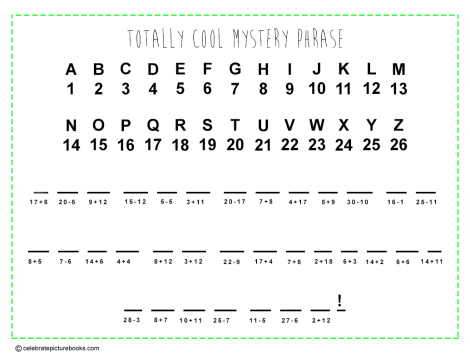
Totally Cool Mystery Phrase! Puzzle


What plus what equals an equation that can’t be beat? You and numbers, of course! Complete this Printable Totally Cool Mystery Phrase! puzzle to discover a coded sentence! Here’s the Solution!

April 18 – It’s National Inventor’s Month

The Most Magnificent Thing by Ashley Spires picture book review

About the Holiday

Perhaps April was chosen as Inventor’s Month because the blossoms of early spring echo the flourish of ideas that come from fertile minds. This month honors all the men and women throughout history who dared to think differently and changed the world. Today, that proud tradition continues in the excitement of school labs and classrooms, through online courses and computer technology, and in private homes where people of all ages are pondering and creating the next big thing. If you have a knack for innovation or invention, take time to sit down and work on your ideas today.

The Most Magnificent Thing

By Ashley Spires


A little pony-tailed girl and her puppy do everything together. They race, eat, explore, and relax. When she makes things, her best friend unmakes them. One day the girl has a brilliant idea—she is going to make “the most MAGNIFICENT thing!” In her mind it’s going to be “easy-peasy.” She knows exactly how it will look and how it will work.

With her faithful assistant following at her heels, the girl gathers materials and goes to work on the sidewalk outside her home. The girl “tinkers and hammers and measures” while her assistant “pounces and growls and chews.” When the little invention is finished, they stand back to examine it. Hmmm…it doesn’t look quite right. It doesn’t feel quite right either. In fact it is all wrong! The girl tries again.

She “smooths and wrenches and fiddles” while her assistant “circles and tugs and wags.” It still turns out wrong. Determined to make her vision reality, she gives it another go…and another…and another. She makes her invention different shapes, gives it various textures, measures out assorted sizes. One attempt even smells like stinky cheese! But none of these creations are MAGNIFICENT.

People stop by and offer encouraging—even admiring—remarks, but the little girl just gets mad. Can’t they see how wrong her invention is? In her anger the little girl works at a fevered pitch, shoving parts together, her brain fogged by “all the not-right things.” In her haste she hurts her finger. This is the last straw. She explodes and declares that she QUITS!

The ever-watchful assistant suggests a bit of fresh air. The girl takes her puppy for a walk and at first her feelings of defeat stay with her. Little by little, though, she pays attention to the world around her and her mind clears. Coming home, she encounters all the wrong things she has made lined up on the sidewalk. Her disappointment threatens to return, but then she notices something surprising—there are parts of each iteration that she likes!

After studying each earlier attempt, she knows just what to do! Slowly and carefully she once more begins to tinker. At the end of the day she and her assistant stand back to look. The machine may lean a bit, and be a little heavy, and it may need a coat of paint…but as the girl and her puppy climb aboard, they both agree that “it really is THE MOST MAGNIFICENT THING!”

You are never too young or too old for Ashley Spires’ inspiring and inspired story. The journey from idea to realization—so often fraught with disaster (or apparent disaster)—is depicted here honestly and with humor as the on-going process it is. Step-by-step the little girl thinks, gathers materials, tinkers, discovers, tinkers some more, and triumphs. It is this last step that is so “magnificently” presented—it’s only by not giving up that success can be achieved.

Spires’ tale is a delight of language—the girl “smooths, wrenches, fiddles, twists, tweaks, and fastens, pummels, jams, and smashes.” Likewise, her illustrations wonderfully depict the changing emotions of this thoughtful, steely-eyed, shocked, and ultimately thrilled young inventor. Her faithful puppy is a charming companion and foil, and kids will love examining the early inventions that lead up to the final product.

The Most Magnificent Thing is a fabulous book to keep on any child’s or adult’s bookshelf for those times when inspiration hits but achievement seems elusive.

Ages 3 – 7 and up (creative types of all ages will enjoy this book)

Kids Can Press, 2014 | ISBN 978-155453704

National Inventor’s Month Activity

CPB - Inventor's Tool Kit II (2)

Inventor’s Tool Kit


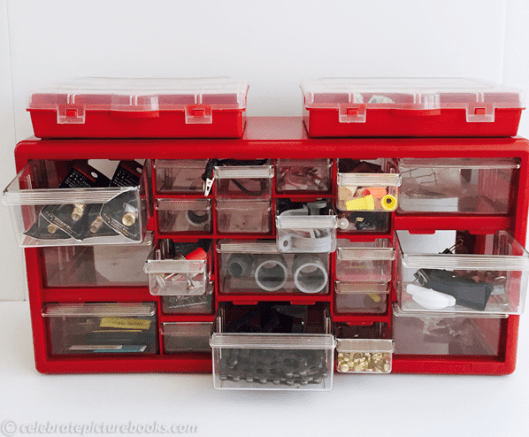
Every idea begins as a jumble of seemingly unrelated parts. Gathering whatever types of material inspires you and keeping it in a box ready to go when inspiration hits is a great way to support innovation and spark experimentation.

Supplies

  • Small parts organizer with drawers or compartments, available at hardware stores and craft stores
  • A variety of parts or craft materials that can be combined, built with, or built on
  • Some hardware ideas—pulleys, wheels, small to medium pieces of wood, wire, nuts, bolts, screws, hooks, knobs, hinges, recyclable materials
  • Some craft ideas—clay, beads, wooden pieces, sticks, paints, pipe cleaners, string, spools, buttons, glitter, scraps of material, recyclable materials

Directions

  1. Fill the organizer with the materials of your choice
  2. Let your imagination go to work! Build something cool, crazy, silly, useful—Amazing!