June 26 – National Canoe Day

celebrate-picture-books-picture-book-review-can-you-canoe?

About the Holiday

June is the perfect month to explore the great outdoors up close through camping. Whether you enjoy pitching a tent or renting a cabin, all the enjoyment of hiking, fishing, swimming, and of course toasting marshmallows and singing around the campfire await!

Can You Canoe? And Other Adventure Songs

Written by The Okee Dokee Brothers—Joe Mailander and Justin Lansing Illustrated by Brandon Reese


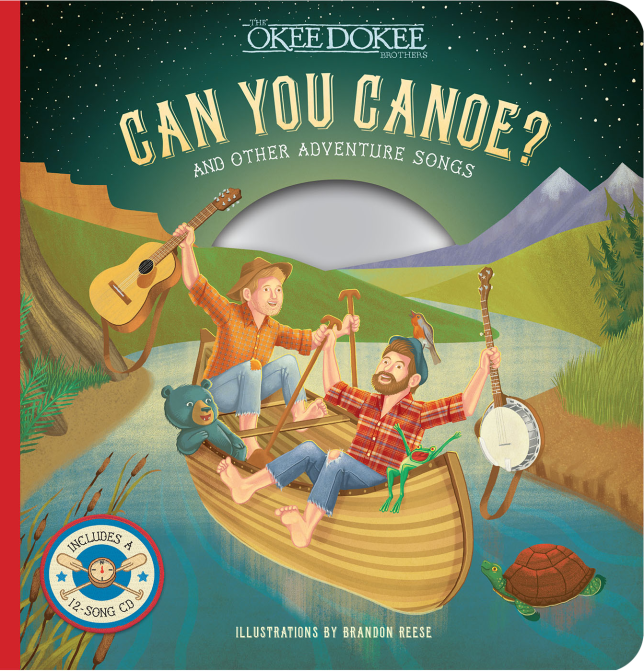
Is it possible to sing a picture book? It is when the book is Can You Canoe?! These twelve humorous, rip-roaring tunes take readers and singers deep into the fun of what it means to spend time enjoying nature. Wild animals, tall tales, legendary characters, and all the sounds and flavors of country livin’ are represented in these catchy original songs that will have you singing and laughing along in no time.

Through the Woods introduces the line-up with an apt question: “I’m wondering if you’d go wandering with me / Through the wilderness and woods / To where the winds are blowin’ free…” But even the speaker realizes there might be doubts—“You’re wondering if I go wandering with you / what kind of trouble we’ll get ourselves into. / Would it be wrong to tag along / With a band of vagabonds?”—and assuages them in the end.
celebrate-picture-books-picture-book-review-can-you-canoe?

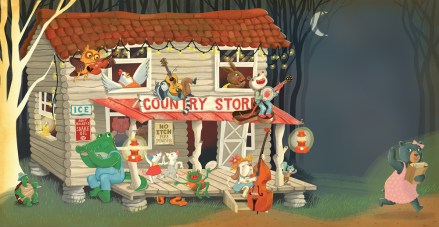
Jamboree takes readers to a country store where there’s dancing every Friday night to a song called “Jamboree” that’s played with abandon and just a little off key. But all you need is to “grab you a partner / And hold on tight / ‘Cause we ain’t stoppin’ / Until we see the light.”

In Black Bear Mama a couple learns there’s no arguing with a mother bear on the lookout for food for her cubs, and Echo Echoooo reassures that nothing, not even the widest valley, can keep true love apart. Can You Canoe? is a celebration of the simple life out on the water without distractions: “Can you canoe on a little boat built for two? Can You Canoe?…I wanna float down a river with you.”

Mr. & Mrs. Sippy can take you by surprise as this isn’t a tune about straws or baby cups. Instead, this is a rambling life story that starts like this: “Mr. and Mrs. Sippy / Got married in the fall. / They left the church that very same day / For their honeymoon in St. Paul, / Singin’ M-I-double-S-double-S-I-P-P-I / M-I-double-S-double-S-I-P-P-I. The couple roams on down to St. Louis to make themselves a home, then raises children in ‘good old Memphis Town.” When they have no place left to go, “they drift down past New Orleans / To the Gulf of Mexico.” Then you’re invited to sing the chorus backwards and forwards once again!

The Legend of Tall Talkin’ Sam echoes some of the great legends of the American West, such as Paul Bunyan and Babe the Blue Ox. Samantha Rosie-Anna, aka Sam, was “born to a pioneer woman and a Rocky Mountain mountain man” and “come out ridin’ a panther and ropin’ a twister outta the sky.” Sam’s so big that when she sleeps under a blanket of snow, she lays her “hat down in Montana and my boots in Colorado.” But even though this girl is “half horse, half mountain lion and half grizzly bear,” she admits there are things she doesn’t know—“like how some little stream / Carved out one big ol’ canyon, / Or how a fire’s angry flame / Can be your best companion.”
celebrate-picture-books-picture-book-review-can-you-canoe?

Can You Canoe? images courtesy of Brandon Reese (www.brandonreese.com)

Jackalope addresses one of the greatest American myths—that of a creature of mixed jack rabbit and antelope blood that roams the plains of the West. With tongue in cheek, the mysterious whereabouts of the Jackalope is exposed in the chorus: “Well I’ve seen ‘em in books and in taxidermy shops. / I’ve seen ‘em hangin’ on the wall. / But I ain’t never seen one in the livin’ light of day— / It’s almost like they don’t exist at all.” But the last verse reveals that perhaps this odd apparition has a purpose after all: “So when you’re searchin’ for the truth / And you’re at the end of your rope, / You might find you don’t need no proof / To believe in the thing that gives you hope— / And for me that’s the jackalope.”

These and a few other rollicking, gold-nugget songs will make any camp out—or even camp in—a knee-slappin’ good time. Can You Canoe comes with a CD so you can sing along to all your favorites—and I have no doubt each song will become a favorite in no time!

Joe Mailander and Justin Lansing have known each other all their lives and know a thing or two about adventures and how to make them more fun for friends and families. This Grammy-winning duo conjure up catchy tunes and compelling stories to make their songs unforgettable. These poems/songs have as much heart and wonder as a new frontier and invite readers and singers to explore!

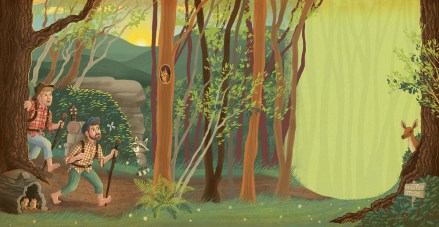
Brandon Reese lends his distinctive talent to each song, creating animated scenes loaded with the kinds of details and drama kids love. Barefoot travelers with their packs on their backs and strong walking sticks in hand pad through woods populated with friendly wildlife. The country store is alive with animal musicians and dancers on the porch, on the roof, and hanging out every window while broadsides for Aunt Malady’s Snake Oil and No Itch Flea Powder hang on the walls. A cozier camping tent you’ll never find, and canoe paddlers are accompanied by a raccoon poling a crocodile boat while a rabbit floats along on the belly of a turtle. Each picture invokes the great outdoors in all its glory.

Can You Canoe is a must for any trip, whether you’re traveling far or just down the road!

Ages 4 and up

Sterling Children’s Books, 2016 | ISBN 978-1454918035

National Canoe Day Activity
celebrate-picture-books-picture-book-review-canoe-maze

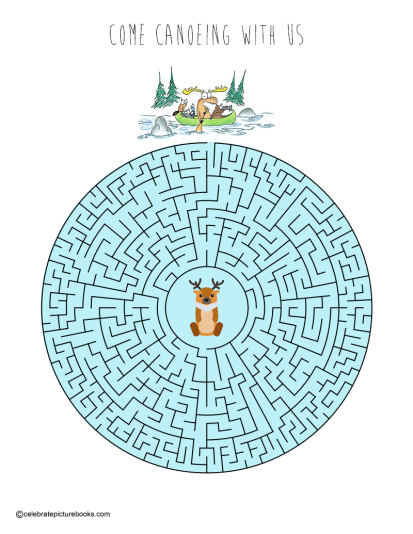
Come Canoeing With Us Maze


These friends want to canoe together but first they must pick up little deer at the center of the lake. They need your help navigating their way in this printable Come Canoeing With Us maze! Here’s the Solution!

June 3 – Repeat Day

celebrate-picture-books-picture-book-review-follow-follow

About the Holiday

Remember how your brother or sister or friend used to repeat everything you said? Everything you said? Well, that has been made into a holiday! Today gives you the perfect excuse to do your favorite things twice! Go ahead, have two lattes, watch your favorite show twice, listen to an album over again! Whatever you do, just remember to double up on it!

Follow Follow: A Book of Reverso Poems

Written by Marilyn Singer | Illustrated by Josée Masse


When you ask someone, “Can you repeat that?” they often use the exact same words so you understand what they want to tell you. But what if the exact same words could have completely different meanings? That’s the brilliant concept behind Follow Follow. In this ingenious book, 17 classic fairy tales are told in verse (and reverse) from two opposing points of view that will forever change the way you think about exchanges of ideas and dialogue.

In Your Wish Is My Command, Aladdin and the Jinni trade wishes and their view of what freedom means. Six lines from this clever poem read from Aladdin’s perspective: “I no longer wish to be a slave / to lords, magicians, merchants, other urchins. / Jinni of the Lamp, / I am just a poor / young knave. / Give me all I crave.”

And then from the Jinni’s perspective: “Give me all I crave, / young knave. / I am just a poor / Jinni of the Lamp. / To lords, magicians, merchants, other urchins, / I no longer wish to be a slave.”

The Emperor’s New Clothes loses none of its impact in Birthday Suit, a humorous abbreviated telling from the King’s ego-centric thoughts and the little boy’s stunning revelation.

Just as the original tale of The Golden Goose presents a princess who can’t help but laugh at the ridiculous parade going by her window, Silly Goose reveals both sides of the princess’s personality.

Ready, Steady, Go! gets into the heads of both the too-clever-for-his-own-good rabbit and his persevering competitor of The Tortoise and the Hare. The lounging hare thinks: “That ridiculous loser! / I am not / a slowpoke. / Though I may be / the smallest bit distracted, / I can’t be / beat. / I’ve got rabbit feet to / take me to the finish line.” While the tortoise urges himself: “Take me to the finish line! / I’ve got rabbit feet to / beat. / I can’t be / the smallest bit distracted. / Though I may be / a slowpoke, / I am not / that ridiculous loser.”

Will the Real Princess Please Stand Up? peeks into two bedrooms where would-be brides to the prince slumber. One exclaims, “This bed rocks! / I feel like I’m sleeping on feathery flocks,…” but the other complains, “feathery flocks? / I feel like I’m sleeping on / rocks.” Who will win the heart of the prince?

The Little Mermaid, Puss in Boots, The Pied Piper of Hameln, Thumbelina, The Three Little Pigs, The Nightingale, and The Twelve Dancing Princesses are also touched with Marilyn Singer’s magic wand of poetry. Under her spell the perfect choice and placement of words combined with a simple change of punctuation can send the verse swirling in the opposite direction with surprising results. As readers encounter each fairy tale, they’ll wonder, “How does she do it?” But there’s no time to ponder—another terrific tale follow follows!

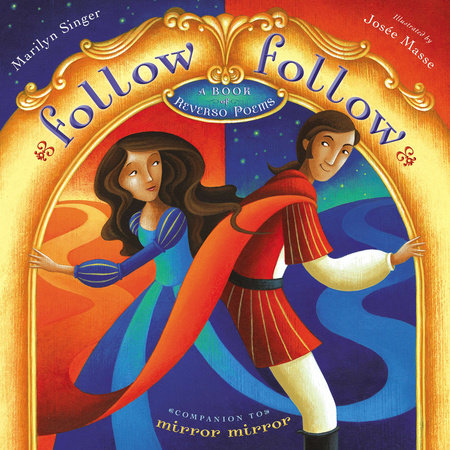
Like being on the cusp of competing realities, Josée Masse’s vibrant illustrations deftly represent the viewpoints of the mirrored verses. On either side of a subtly split page, the opposing characters tell their side of the story amid contrasting color schemes and flowing lines that bridge the divide. In Your Wish Is My Command, Aladdin dreams in his rooftop window of riches and freedom while the Jinni floats away from his lamp over golden rooftops. On with the Dance makes clever use of the half-page design as the king ponders the condition of his daughters’ shoes while they are pictured dancing in a regal hall that doubles as the king’s crown.

Follow Follow would be a welcome addition to any fairy tale or poetry lover’s bookshelf. And since Marilyn Singer and Josée Masse really know what Repeat Day is all about, you’ll want to check out their other books: Mirror Mirror: A Book of Reverso Poems and their newest, Echo Echo: Reverso Poems about Greek Myths.

English and language arts teachers will also find these volumes to be a wonderful way to teach point of view.

Ages 5 – 11 and up (anyone who loves fairy tales will want to read this book)

Dial Books, Penguin Group, 2013 | ISBN 978-0803737693                                                         

Repeat Day Activity

celebrate-picture-books-picture-book-bookmark-craft

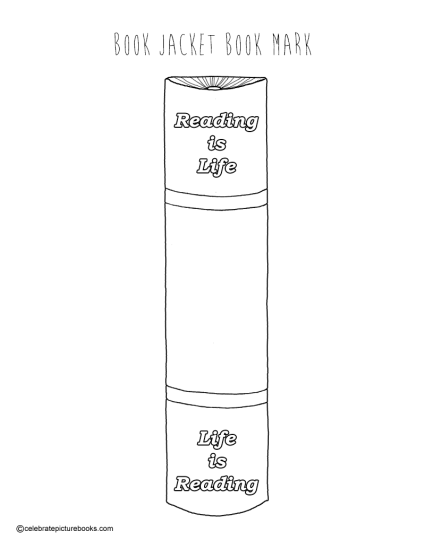
Book Jacket Bookmark


When a book is long, you can’t always finish it in one sitting. If you forget where you left off, you can often find yourself reading the same section twice. That’s okay—especially on Repeat Day!—but this bookmark will help you remember your place and get you reading again in style!

Supplies

  • Printable Book Jacket bookmark 
  • Colored pencils or markers
  • Poster board
  • Scissors
  • Glue

Directions

  1. Color your bookmark in your own unique style
  2. Cut the bookmark out
  3. Glue it to poster board if you’d like to make it more durable

April 21 – Poem in Your Pocket Day

Wet Cement: A Mix of Concrete Poems by Bob Raczka picture book review

About the Holiday

Poem in Your Pocket Day has become one of the favorite events of National Poetry Month. Requiring nothing but a pocket and a treasured poem, the day is a perfect way for poets, non-poets, and poetry lovers of all types to interact with this beloved art form. Originally enacted in 2002 by the Office of the Mayor in conjunction with the New York City Departments of Cultural Affairs and Education, the holiday was embraced as a national observance by the Academy of American Poets in 2008.

Here are some suggestions from the Academy of American Poets on how to spend the day. So clean the lint, coupons, old receipts, tissues, and loose change out of your pockets and replace them with a poem! Those crumpled bits may even inspire your own poem—try it!

  • Post pocket-sized verses in public places
  • Create and distribute bookmarks with your favorite lines of poetry
  • Start a “poems for pockets” giveaway at school or work
  • Add a poem to your email footer
  • Post lines from your favorite poem on your Twitter, Tumblr, Instagram, Facebook, or Snapchat
  • Send a poem to a friend

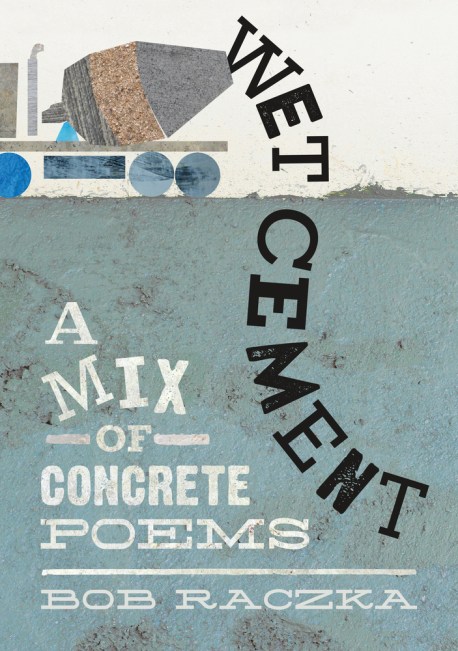
Wet Cement: A Mix of Concrete Poems

By Bob Raczka


When you envision a poem in your head, what do you see? A block of lines? A square or a rectangle? Well, sweep that image from your mind because in Bob Raczka’s Wet Cement: A Mix of Concrete Poems, verses become actions, objects, puzzles, and natural phenomena. Not only are the poems shaped to illustrate their theme, the titles use clever imagery as well.

As you encounter the poem hanger you’ll see that “han” has broken away and is dangling from the hook of g in “ger.” The words of the poem itself are shaped like a hanger and contain a giggle-invoking twist: “I hang out in blue jeans and comfy old shirts. I hang out in blouses and long frilly skirts. I hang out in sport coats and sweaters and shawls. I even hang out with no clothes on at all!”

You might want to get your baseball mitt out before you read homer, in which the first line zooms straight as a pitch and the second—written backwards and at an upward angle—soars like a homerun hit: “The pitcher hurls his hummer toward the slugger squeezing lumber CRA / CK! The slugger slams the hummer toward the bleachers for a homer.”

But don’t put that mitt away just yet! You may need to catch the o, which has escaped from the title p p-up. And if you’ve ever played t-ball, baseball, softball, or even wiffleball, you’ll cringe in recognition of this short but pointed poem.

The sky darkened by night in Dipper and by clouds in Lightning holds two poems expressing very different thoughts. In the title Dipper, the second p has floated to the top of the page where it hangs like a miniature reflection of the dipper-shaped poem, which reads: “Way down there on earth you hold firefly jars, filled up to their lids with light. Up here in the sky, I’m a vessel of stars, my brim overflowing with night.” In the title LIGHTNING, the L strikes the I to create the familiar jagged crack echoed in the shape of the verse: “from a bad mood sky, / tears, / then a jag- / ged slash- / ing flash of anger, / ear- / splitting, / obnoxious, / a cloud tantrum”

Any writer will love poeTRY which is such a clever take on the word as well as the revision and editing process:

“poetry is about taking away the words you don’t need

poetry is taking away words you don’t need

poetry is words you need

poetry is words

try”

Put simply, Bob Raczka’s concrete poems will make you smile. Even more than that, you’ll find yourself wanting to carry this book around, saying “Look at this!” to everyone you meet. Raczka calls these poems “word paintings”—because a poet “uses words like colors to paint pictures inside your head.” If creativity is the talent to present the world in new and surprising ways, making connections that enhance life, then Wet Cement is artistry at its best!

Ages 5 – 9 and up (adults will enjoy these poems as much as kids)

Roaring Brook Press, 2016 | ISBN 978-1626722361

Poem in Your Pocket Day Activity

CPB - Pocket Poem Craft

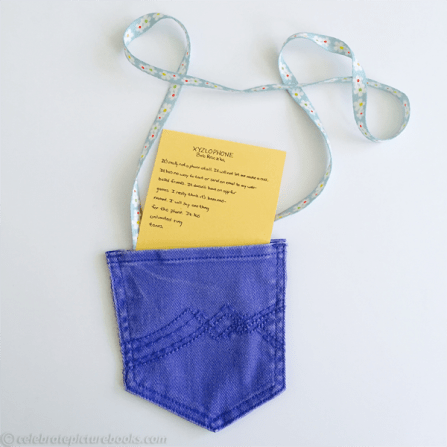
Pocket Poem Carrier


Sometimes you just need a little more inspiration in your day. Here’s a cute way to carry your favorite poem—today and every day!

Supplies

  • An old pair of pants or shorts with back pockets
  • A decorative shoelace
  • Thread or fabric glue
  • Needle
  • Paper
  • Your favorite poem or a poem you write yourself
  • Pen

Directions

  1. Cut one back pocket off an old pair of pants or shorts
  2. Use the shoelace at its full length or cut to desired length
  3. Inside each edge of the pocket sew or glue the ends of the shoelace to make a strap
  4. Print your favorite poem on the paper
  5. Insert the poem into the pocket poem carrier
  6. Take your poem with you and share it with your friends!

March 21 – World Poetry Day

Nasty Bugs by Lee Bennett Hopkins and Will Terry Picture Book Review

About the Holiday

World Poetry Day, an initiative of the United Nations Educational, Scientific, and Cultural Organization, recognizes the important role poetry plays in people’s lives across the world and over time. The day promotes small publishers of poetry as well as oral poetry traditions and works to strengthen the connection between poetry and other forms of expression. Another objective is to “support linguistic diversity thorough poetic expression and to offer endangered languages the opportunity to be heard within their communities.”

Celebrations on this day include poetry readings, school lessons focused on poetry and poets, poetry writing sessions, and poetry readings by professional and amateur poets in schools and other venues.

Nasty Bugs

Poems Selected by Lee Bennett Hopkins | Illustrated by Will Terry


Who in the world can resist bugs? They’re in every country, every city, every town, even every house! And they have so much going for them—lots of legs, pincher mouths, transparent wings, amazing survival skills, and so much general creepy-crawliness! Bugs may be a little (or a lot) icky, but you can’t deny that they’re fascinating.

Nasty Bugs brings together 16 poets to turn the traits of all kinds of insects, from stink bugs to chiggers to water bugs and more, into creative odes that tickle the funny bone as well as teach. Readers learn from Cynthia S. Cotton’s “Stink Bug” that “Some spread their wings in flight, / Some look scary, / some taste bad, / some use camouflage / to blend in just right.”

Rebecca Kai Dotlich exposes the boll weevil: “I am an evil weevil, / a cotton-craving beetle / whose reputation’s rotton / ‘cause I gobble crops of cotton, / yes I do.” And the Colorado Potato Beetle? Among other quirks, X. J. Kennedy reveals its name is a bit of a misnomer: “His other name’s Potato Bug. / This munching desperado / infests our gardens coast to coast. / Not just in Colorado.”

April Halprin Wayland gives voice to the fire ants’ tribal cry “All for one and one for all!” as they jump into action when “Flood waters rise! / Quick, form a ball—/ our larvae, pupae, eggs, and Mother Queen inside! / We roll this writhing globe, / take turns on top / so all breathe air, so all survive.”

“Spoiled Rotton” by J. Patrick Lewis may make grammarians squirm with this pointed description: “I’m a comma / in a drama / of disgusting devastation.” while readers will be itchin’ to know more in Rebecca Andrew Loescher’s “Ode to Chigger” with lines such as “You hatch with six small legs for running, / then grow two more—for leaps most stunning,” Poems about flies (Ann Whitford Paul), wasps (Michele Krueger), fleas (Marilyn Singer), lice (Amy Ludwig VanDerwater), ticks (Kami Kinard), termites (Alice Schertle), cockroaches (Fran Haraway), and bedbugs (Kristine O’Connell George) also contribute to the buzzzzz of this anthology.

But if bugs, well…bug you, you may find these lines in Lee Bennett Hopkins’ “Ode to a Dead Mosquito” most satisfying: “You of little brain / didn’t you know / I felt your sting / the instant you / began to drain? / So— / I whacked you. / SMACK! / You dropped.”

Will Terry lends his distinctive talent to making this book as colorful, bold, and eye-popping as nature itself. Each insect, depicted in its favorite milieu, nearly flies, creeps, or chomps it’s way off the page. Brilliant greens, reds, yellow, oranges, and blues give life to these most prolific pests, and their prominent features – whether pinchers, stingers, gnawing mandibles, or even stinky odor – are inspiringly drawn.

More facts about each bug are given in the back of the book, and are a must read. Whether insects make you squirm with discomfort or squeal with delight, Nasty Bugs is fun.

Ages 5 – 9

Paperback: Puffin, Penguin Group, 2016 | ISBN 978-0147519146

Hardcover: Dial Books for Young Readers, Penguin Group, 2012 | ISBN 978-0803737167

World Poetry Day Activity

CPB - Nasty Bugs magnet II (2)

Rockin’ Bug Magnet or Paperweight


On World Poetry Day it’s fun to write a poem of your own. Whether your creation is long or short, you can proudly display it using one of these Rockin’ Bug Magnets.

Supplies

Rocks, small and flat work best for magnets. Larger rocks are great for paperweights. You can find rocks in your yard, at the beach or park, or buy them from craft stores or nurseries.

  • Paint in your favorite colors
  • Paint brush
  • Small to medium round magnets, available at craft and hardware stores
  • Googly eyes
  • Strong glue

CPB - Nasty Bugs magnet (2)

Directions

  1. Wash rocks and let them dry
  2. Create your own creepy, crawly bug on the front of the rock
  3. Paint your bug
  4. Let the paint dry
  5. If you want to give your insect buggy eyes, glue googly eyes to the rock.
  6. Glue a magnet to the back of the rock
  7. Hang it on the refrigerator or any metal surface


If you love books, you must have caught the reading bug! Check out another great book and craft on March 2—Read Across America Day and make an “I’ve Got the Reading Bug” Bookplate for your favorite books!

CPB - Reading Bug Book Plate (2)


March 20 – International Day of Happiness

Double Happiness by Nancy Tupper Ling Picture Book Review

About the Holiday

In 2011, the UN General Assembly adopted a resolution stating that happiness is a “fundamental human goal” and called for a more inclusive, equitable and balanced approach to economic growth that promotes the happiness and well-being on all peoples.” March 20 was chosen by all 193 United Nations member states as the day to remember and honor this goal. The holiday was first celebrated in 2013.

Today you get a free pass to spend the day doing what makes you and others happy—so enjoy! If you’d like to learn more about the holiday visit the International Day of Happiness organization.

Double Happiness

Written by Nancy Tupper Ling | Illustrated by Alina Chau


This quiet, thoughtful picture book tells the story of a family’s move from China to America in a series of unrhymed verses that reveal the experience honestly from alternating viewpoints of a brother, Jake, and his sister, Gracie. Each page is dedicated to one or the other sibling with the boy’s poems written in blue and the girl’s in purple. In several poems the children interact with each other, the blue and purple lines acting as dialog tags.

In the first poem, The Move, Gracie stand on her doorstep surrounded by boxes and suitcases and thinks, “I won’t go! / I won’t move / away / from our city house / by the trolley tracks….” Jake is already imagining his new room in the second poem,Train. After considering different décor, he decides what he really wants is something familiar, something outside—“just one long train / that rocks and wobbles / my bed each night. /I can’t fall asleep until the train passes by.”

The siblings are each given a happiness box by their Nai Nai inGrandmother, who wisely challenges her grandchildren to “Find four treasures each, / leading from this home / to your new.” The search is taken up in the next poems—Treasure, Lucky, and Leaf—in which the kids find objects for their happiness boxes. The train and treasures for the happiness boxes are threads that unite many of the poems and the children’s experiences.

In keeping with the long hours of travel from China to the United States, the next 6 poems chronicle the brother and sister’s experience in the airport, waiting for their plane, and during the flight.

In Here the children wake up to see their new city far below them and wonder, “can I found our house / from the sky?” Marble andSadness juxtapose Jake’s happiness at finding a treasure for his box with the apprehension of Gracie.

At last the family reaches their new home by taxi. Gracie seems only to see the “piles of snow,” but Jake likes the “windy roads, lots of trees, and the curvy driveway.” In Explore Gracie and Jake walk around the countryside, and while Gracie still determines that she won’t like it, Jake hears a train and is happy. My Roomand Dinner see the kids settling in, with a photograph of the family they’ve left behind accompanying them on the table while they eat. In A Surprise, Gracie finds that her grandmother is still with her through a special scarf, and Paints resolves the move as Jake and Gracie paint their happiness boxes: Jake decorates his with a dragon and a train, while Gracie depicts her and her brother walking in the snow and “they look very, / very / happy.”

While Double Happiness tells the story of a family’s distant move, Nancy Tupper Ling’s gentle verses are appropriate for any situation involving change or uncertainty. She reminds children that happiness can be found wherever they are and all around them if they look for it. The unrhymed poems flow as freely as thoughts, fears, and unguarded moments. As Gracie and Jake resolve their feeling, readers or listeners will also see that feelings of apprehension are common, and that happiness is waiting for them.

Alina Chau’s soft, lovely watercolor illustrations are beautiful representations of Gracie and Jake’s move from the familiar surroundings of their home in China to a new home in a snowy countryside. The children’s emotions resonate as they alternate between sadness and happiness and between concrete places and their own imagination.

Ages 5 – 8

Chronicle Books, 2015 | ISBN 978-1452129181

International Day of Happiness Activity

CPB - Happiness typography

Happiness Is…Game


Happiness is all around you! Grab one or more friends to play a game that reveals what things make you happy. Here are two ways to play:

  1. Like the “Geography” game: the first player names something that makes them happy, the next player must think of something that starts with the last letter of the word the previous player said. The game continues with each player continuing the pattern. Players drop out as they cannot think of a word. The last player left is
  2. Within a certain time limit (depending on age), players must think of something that makes them happy. Players drop out if they cannot think of a word within the time limit. The last player left is the winner.

March 10 – National Pack Your Lunch Day

Lunch Money and Other Poems About School by Carol Diggory Shields and Paul Meisel picture book review

About the Holiday

When you pack your own lunch, you can’t wait for the clock to strike lunchtime! Today is a day to celebrate the joy of a midday meal featuring your favorite foods and snacks. So if you usually just eat what the cafeteria offers, think outside the tray and create a lunch that’s delicious, nutritious, and even fun!

Lunch Money and Other Poems About School

Written by Carol Diggory Shields | Illustrated by Paul Meisel


Ask a kid what their favorite part of school is and they’re likely to say, “Lunch!” So it’s appropriate that this poetry collection about the fun and foibles of school contains several poems scrutinizing that special half hour out of the classroom. In “Decisions” a boy contemplates the school menu stuck to the refrigerator. Tacos, pizza, burger, nachos? Buy it! Beef stew, baked beans, tuna-cabbage crunch, mushroom-chicken bake? Bag it!

“Lunch Money” finds a boy asking first Dad, then Grandma, and finally Mom for cash. But who can he rely on? Only his own piggy bank. “Swap” is a rollicking round robin rhyme of traded sandwiches, swapped fruit, bought and sold drinks, bartered cookies, exchanged bagels, and great deals made. But does the result on the plate look oddly familiar?

Lunch isn’t the only subject in this delightful collection, though. In “Eight-Oh-Three” a boy “Legs pumping, heart thumping, / Running down the drive,” and late for the bus—“A moaning-growning, blinking-winking / Yellow dinosaur”—asks the ironic question: “How come I have to run so fast / To catch a bus so slow?”

“Code” is medical code for “cold” in a short poem about the linguistic acrobatics of a stuffy nose. “And the Answer Is…?” offers an impassioned debate between one student who likes to answer the teacher’s questions and another who just wants to hide under the table. And “Whew!” is a delight in which a student who isn’t prepared for the day finds a substitute standing at the front of the class. Other topics that make an appearance are the school mischief maker, the class pet, recess rules, homework, recess, and the inevitable school nightmare that follows you into adulthood.

Carol Diggory Shields understands school—the moments of camaraderie, embarrassment, mayhem, wishful thinking, and more—that make up each day. Her flowing, easy-to-read rhythms and humorous twists makes this poetry collection enchanting and an excellent addition to any home library.

Paul Meisel’s illustrations are populated with all kinds of kids you’d want to meet. With curly hair or straight, pony tails or bows, wearing stripes or polka dots, shorts or pants, each child is given his or her own personality as they romp through the scenario of their accompanying poem. Whether the kids are in a classroom or at home or on the playground, the details of their environment are richly drawn. The counters are lined with science projects, the clock moves so slowly a spider has spun a web on its hands, and the kindergarten play as well as the lunch room are humorously chaotic. There is so much to see on each page that kids will recognize, but experience anew.

Ages 4 – 8

Puffin Books, 1998 | ISBN 978-0140558906

National Pack Your Lunch Day Activity

CPB - Bento Box (2)

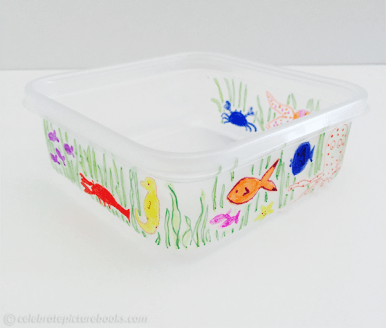
Decorated Sandwich or Snack Container


Who says your snack or sandwich container has to be boring? Take your lunch to school in a container you decorate yourself! It’s easy with a few colored markers and your imagination!

Supplies

  • Disposable plastic food containers with lids
  • Colorful markers

Directions

  1. Decorate sandwich or snack size containers with your favorite designs or characters

February 10 – Library Lovers Day

CPB - Jumping Off Library Shelves

About the Holiday

Today I’ve chosen to celebrate a month-long holiday. February is Library Lovers Month! Chances are if you’re reading this, you also love libraries! For readers there’s no better place than standing in the stacks, surrounded on all sides by shelves and shelves of books. In those pages you meet new friends, defeat the bad guys, discover poetry, laugh, sometimes cry, see astonishing art, find new hobbies, and learn fascinating facts about…wow! Anything and everything!

What’s your favorite library or thing about libraries? Mine is the East Lyme Public Library in Connecticut, where they have a fantastic selection of books and awesome librarians who feel like family! Tell me about your special library in the Comments section below.

Jumping Off Library Shelves: A Book of Poems

Poems selected by Lee Bennett Hopkins | Illustrated by Jane Manning


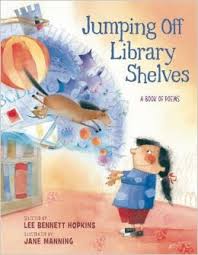
From morning, which “pours spoons of sun through tall windows” of a library in Rebecca Kai Dotlich’s poem “Breakfast between the Shelves,” to night, when shadowed mice huddle to read a mystery in Dotlich’s closing poem “Midnight in a Library,” kids can enjoy a full day of poems in this delightful collection. Many of today’s best-loved poets for children are represented here, celebrating the power of a library card, the kindness of librarians, and the enchantment of reading.

Jane Manning’s soft, dreamy illustrations swirl with imagination, shimmer with the warm glow of a reading nook, and enchant with the smiles of children thrilled with the pleasures of reading.

Library Lovers Day Activity

CPB - Bookworm Book (2)


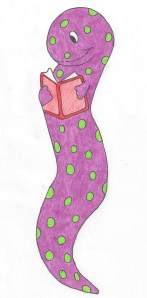
Bookworm Bookmark

For all you bookworms out there who love to read, here’s your very own Bookworm Bookmark to color and put between the pages of your favorite story!

Supplies

Directions

  1. Print out the Bookworm Bookmark template
  2. Color the bookworm
  3. Cut out the Bookworm
  4. Cut the Bookworm’s mouth at the dotted line. The top part of the bookworm’s mouth hangs over the page and marks your place!