April 7 – International Beaver Day

celebrate-picture-books-picture-book-review-the-skydiving-beavers-cover

About the Holiday

Two species of today’s honored animal are found across America, Canada, and Eurasia. Known primarily for building dams in rivers and streams, the beaver is a fascinating animal in many ways. Perhaps one of the greatest natural conservationists, beavers use all parts of the trees they fell. The buds, bark, and leaves are consumed as food, and the rest is gnawed into smaller bits to be used as building materials. The dams, themselves, are helpful in preventing droughts and floods, restoring wetlands, and keeping the water clean. The beaver population has seen a decline for several decades, and today’s holiday aims to promote awareness of this beneficial animal in order to protect it.

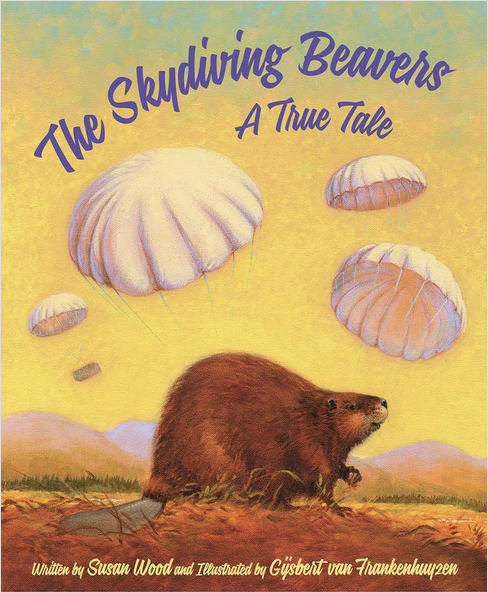
The Skydiving Beavers: A True Tale

Written by Susan Wood | Illustrated by Gijsbert van Frankenhuyzen


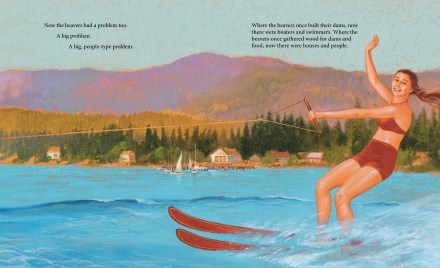
The time was post-World War II and families were eager to build homes and enjoy life again. In McCall, Idaho this meant that people moved to the shore of the beautiful lake, where they could fish, sail, waterski, and have fun. So roads were constructed, docks built, and land cleared. “Trouble was, that lakeside land had already been claimed. For decades—centuries, even—beavers had been the only ones doing the building there.”

Now, though, there was a turf war, of sorts. “Where the beavers once gathered wood for dams and food, now there were houses and people. And where the people tried to drive their cars, now water flooded the roads because of the dams.” Trees were also being “toppled left and right” by those busy beavers. Something needed to be done.
celebrate-picture-books-picture-book-review-the-skydiving-beavers-a-true-tale-water-skiing

Image copyright Gijsbert van Frankenhuyzen, text copyright Susan Wood. Courtesy of Sleeping Bear Press

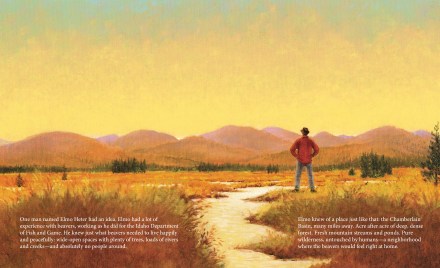
Elmo Heter had an idea. Elmo had experience with beavers from his job with the Idaho Department of Fish and Game. He knew that beavers needed open areas with lots of trees, rivers, and creeks—and no people. There was a place just like this many miles away. The Chamberlain Basin would be perfect for the beavers, but there was a problem—how could he move all those beavers “to a place with no roads, no railway, no airport, and no bus station?”

Elmo thought about loading them into boxes carried by horses or mules, but the rough trip would be too hard on both the beavers and the pack animals. Then Elmo remembered that there were piles of parachutes left over from the war going unused. “What if he dropped the beavers from a plane? Skydiving beavers? Well, why not?” Elmo decided.

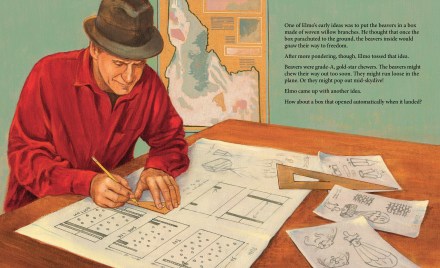
Elmo went to work to design a crate that could hold the beavers safely. His first idea was to build a box of woven willow branches. Once the boxes hit the ground, the beavers could gnaw their way out. But then Elmo feared that those champion chewers might escape before the box touched down. Next, he came up with the idea for a box that opened automatically when it hit the ground. After he created his box, Elmo found a beaver to test it.
celebrate-picture-books-picture-book-review-the-skydiving-beavers-a-true-tale-sunset

Image copyright Gijsbert van Frankenhuyzen, text copyright Susan Wood. Courtesy of Sleeping Bear Press

He found his daredevil and named him Geronimo. Geronimo, cozy in his box, was loaded onto a plane, and as the plane flew low over the test field the box was dropped. “The chute bloomed like a buttercup, then caught the breeze….The box fell as gently as a mountain snowflake, landing softly on the grass.” Just as it was designed to do, the box opened and Geronimo scrambled out.

Elmo wanted to make sure his invention would work every time, so he tested it again and again.  All this flying and skydiving seemed to agree with Geronimo. He soon began to treat it like a game, shuffling out of the box when the door opened and then crawling “right back in for another go.” Now that Elmo knew the plan would work, he gathered the beavers from McCall, put them in their special traveling crates, and headed for the Chamberlain Basin.

When they found the perfect spot, Elmo and his team prepared the chutes and let the beavers go. One by one the parachutes opened, and the beavers “wafted like falling leaves on the autumn wind to their new woodsy patch of paradise.” And who was the first pioneer? Why Geronimo, of course!
celebrate-picture-books-picture-book-review-the-skydiving-beavers-a-true-tale-plans

Image copyright Gijsbert van Frankenhuyzen, text copyright Susan Wood. Courtesy of Sleeping Bear Press

An Author’s Note following the text reveals more about this true story. It also discusses what scientists have since learned about the benefits of beavers to the environment and how communities now work with and around them. A list of interesting facts about beavers is also included.

Susan Wood’s story of a little-known event is a thought-provoking glimpse into early conservation efforts. Her conversational tone and lyrical phrasing enhance the tale, lending it suspense and personality that will draw readers in. Wood’s detailed descriptions allow children to understand the problems for the community as well as the concern for the animals that led to this historical event. 

Gorgeous paintings by Gijsbert van Frankenhuyzen uncover the beauty of Idaho’s backcountry with its sparkling lakes and tree-covered mountains. Glorious sunsets fill the two-page spreads, turning the rolling hills pink and gold as beavers scurry near the shore building their dams. Readers will be intrigued by the clear and close-up views of Elmo Heter as he works on his plans to relocate the beavers. A table strewn with publications and photographs from World War II, set children in the time period, and his schematics of the box he designs as well as his workshop are plainly displayed. Kids can ride along with Geronimo as he climbs into his crate, travels by plane over wide-open vistas, and floats into the Chamberlain Basin at the end of a parachute.

The Skydiving Beavers would be a fresh addition to classroom environmental units to spur discussions on past, present, and future conservation science and will delight young readers interested in the natural sciences.

Ages 6 – 9

Sleeping Bear Press, 2017 | ISBN 978-1585369942

Learn more about Susan Wood and her books on her website!

View a portfolio of artwork by Gijsbert van Frankenhuyzen on his website!

International Beaver Day Activity
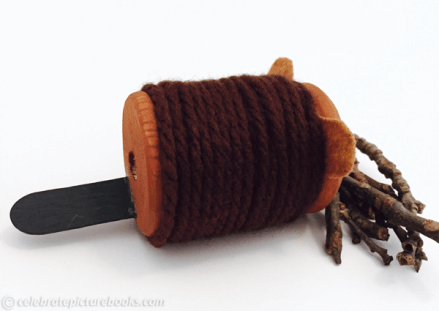
CPB - Beaver craft picture (2)

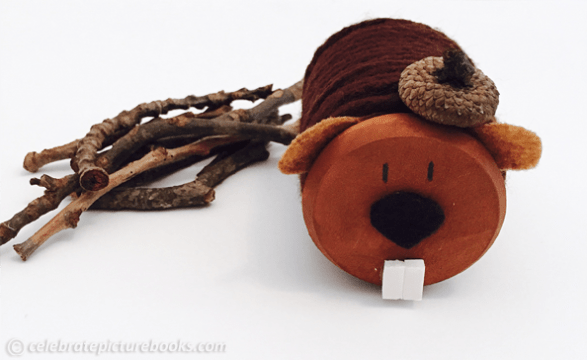
Make a Spool Beaver


Do you have a gnawing need to have a beaver of your own? Make one with this Spool Beaver craft!

Supplies

  • Printable Ears and Nose Template
  • 2-inch wooden spool, available at craft stores
  • 1 6-inch long x ¾ inch wide craft stick
  • Small piece of foam board
  • Brown “chunky” yarn
  • Brown felt, small piece for ears and tail
  • Black felt, small piece for nose
  • Acorn top for hat (optional)
  • Brown craft paint
  • Black craft paint
  • Black marker
  • Strong glue
  • Paint brush
  • Scissors

CPB - Beaver craft picture with tail

Directions

  1. Print the Ears and Nose template
  2. Paint the spool with the brown paint, let dry
  3. Cut the ears from the brown felt
  4. Cut the nose from the black felt
  5. Cut a piece from the end of the craft stick
  6. Paint the craft stick brown or black, let dry
  7. Cut two small pieces from the foam board, ½-inch long x 3/8 inch wide
  8. When the spool is dry, glue the ears to the spool, leaving the ears sticking up over the rim of the spool
  9. Glue one end of the yarn to the spool
  10. Holding the spool horizontally, wind the rest of the yarn around the spool back and forth from front to back. Glue the end to the body of yarn. This will be the bottom of the beaver.
  11. Glue the nose over the hole in the spool
  12. Glue the teeth below the nose
  13. Glue the flat edge of the craft stick to the back of the spool to make the tail

Picture Book Review

March 22 – World Water Day

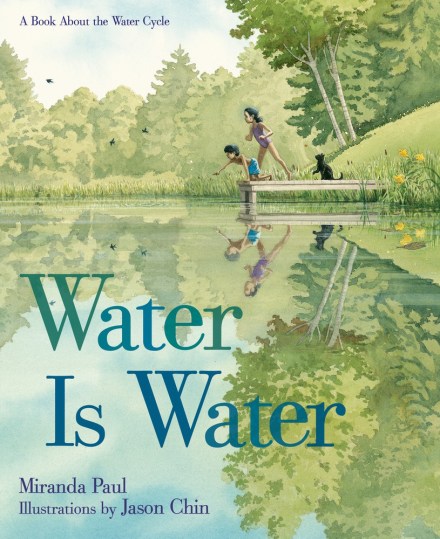
celebrate-picture-books-picture-book-review-water-is-water-cover

About the Holiday

March 22 was designated as World Water Day by the United Nations to bring awareness to the important issue of fresh water for the world’s citizens. Today, 1.8 billion people use sources of water that are contaminated, posing a constant risk of deadly diseases. The Sustainable Development Goals, instituted in 2015, have targeted a deadline of 2030 to provide access to clean water for everyone. This year’s theme is “Wastewater,” and revolves around the development of science and engineering solutions that would allow wastewater to be recycled and used in gardens, green spaces, cooling systems, and irrigation. Now more than ever, we all have a responsibility to keep the environment clean and safe. To celebrate today’s holiday find out how you can help!

Water Is Water: A Book About the Water Cycle

Written by Miranda Paul | Illustrated by Jason Chin


On a soaking rainy day a sister and brother run up to the house with a turtle they’ve caught in the pond out back. They drink glasses of water and offer a bowlful for the turtle too. “Drip. Sip. Pour me a cup.” Out on the porch Dad is ready with warm mugs of hot chocolate. The ghostly steam tickles their noses. “Whirl. Swirl. Watch it curl by. Steam is steam unless…it cools high.” As the kids return the turtle to the pond they watch a dragon and an eagle play across the sky. “Clouds are clouds unless…they form low.”

celebrate-picture-books-picture-book-review-water-is-water-rain-at-school

Image copyright Jason Chin, text copyright Miranda Paul. Courtesy of us.macmillan.com

Through the misty fog the school bus rumbles up the hill as a little garter snake wriggles in the fallen leaves at the end of the children’s driveway. By the time the bus drops the kids off at school the fog has turned to rain. It plinks on the sidewalks and pounds the earth, creating puddles just in time for recess. “Slosh in galoshes. Splash to your knees! Puddles are puddles unless…puddles freeze.”

celebrate-picture-books-picture-book-review-water-is-water-snowman

Image copyright Jason Chin, text copyright Miranda Paul. Courtesy of us.macmillan.com

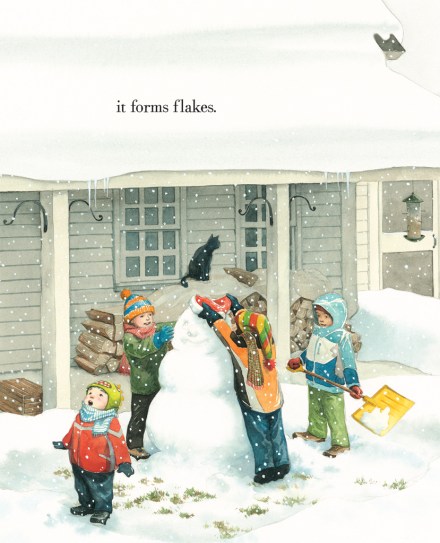
The turtle is hiding now that winter’s come, and a group of friends slip and speed across the pond, some playing hockey, some figure skating, and a couple just learning the ropes. Then suddenly it’s snowing! A brilliant red cardinal watches from the birdfeeder as three sneaky kids with snowballs spy on their friends who are building a snowman. With a “smack!” the snowball fight begins. Soon, however, spring is back with rushing streams and “Creep. Seep. Squish in your boots” mud. And that “mud is mud unless…there are roots.”

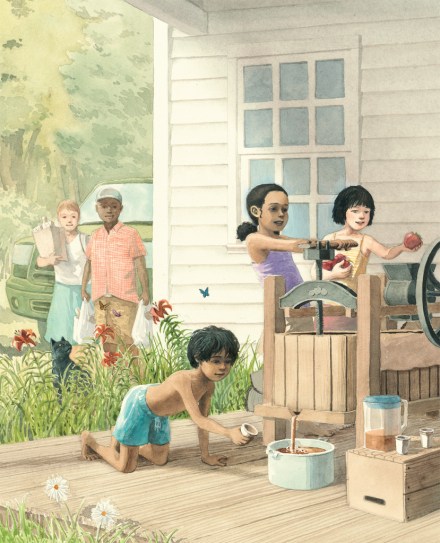
The apple trees in the backyard soak up the spring rains that feed the red, plump apples that are apples “unless…they get pressed. Drip. Sip. Pour me a cup. Cider is cider…until we drink it up!”

More information about water, including illustrated definitions of water-related terms, percentages of water in a variety of plants and creatures, and its importance to the world as well as suggestions for further reading, follow the text.

celebrate-picture-books-picture-book-review-water-is-water-making cider

Image copyright Jason Chin, courtesy of us.macmillan.com

Miranda Paul’s lyrical journey through a year of our interactions with water is a beautiful reminder of all the forms water takes. From life-filled ponds to pouring rains to glasses of refreshment, water sustains every creature and plant on earth. Paul’s transitional “unless…” elegantly introduces each transformation in the natural water cycle in a way that children recognize and appreciate. Her rich rhyming and rhythmical language is a joy to read and makes Water an active character in the story.

celebrate-picture-books-picture-book-review-water-is-water-drinking-cider

Image copyright Jason Chin, courtesy of us.macmillan.com

Jason Chin’s superb artwork is as lush and dynamic as the world around us. Each two-page spread is a masterpiece of atmosphere and details that bring not only water’s cycle to life but also that of the children, growing and playing in and around water throughout the year. As the children shelter from the rain at the beginning of the book, a bushel of apples sits snug against the cider press in the corner of the porch foreshadowing the final pages where fresh cider fuels summer fun. Chin’s children are real kids—joyful and playful, enthusiastically and humorously interacting with nature and each other with the kind of abandon that makes hearts sing. Young readers and adults will love lingering over each page.

Water is Water: A Story of the Water Cycle is the kind of book that can get kids excited about one of the quieter aspects of science—but one that is so important to our daily lives. It would make a wonderful accompaniment to elementary school lesson plans and a gorgeous addition to library and home bookshelves.

Ages 5 – 10

Roaring Brook Press, 2015 | ISBN 978-1596439849

Discover more about Miranda Paul and her books plus resources for teachers and writers on her website!

View a portfolio of artwork by Jason Chin and learn more about him and his books on his website!

World Water Day Activity

celebrate-picture-books-picture-book-review-water-words-word-search

A Sprinkling of Water Words Word Search


This tree grew tall and strong by soaking up water through its roots. Can you find the 20 water-related words that are hidden inside this printable tree-shaped A Sprinkling of Water Word Word Search Puzzle? Here’s the Solution.

Picture Book Review

February 28 – National Women Inventors Month

celebrate-picture-books-picture-book-review-look-up-henrietta-leavitt-cover

About the Holiday

This month we celebrate women inventors, both past and present, who have changed our lives and the world for the better through their intelligence, creativity, unique vision, and perseverance.

Look Up! Henrietta Leavitt, Pioneering Woman Astronomer

Written by Robert Burleigh | Illustrated by Raúl Colón       


Henrietta Leavitt loves the stars. Every night she sits on the front porch and asks herself what were—in the early 1900s—unanswerable questions. How high is the sky? How far away are the stars? She traces the form of the Big Dipper to the North Star and feels that the stars are trying to tell her something.

celebrate-picture-books-picture-book-review-look-up-henrietta-leavitt-student

Image copyright Raúl Colón, text copyright Robert Berleigh. Courtesy of simonandschuster.com

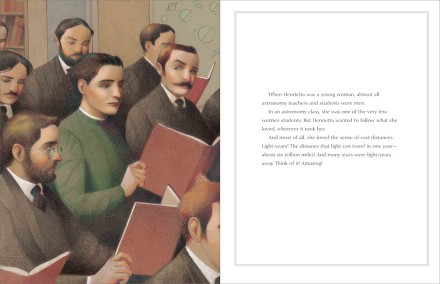
As a young woman she takes an astronomy class—one of the few women to do so. She learns about light years, planets, and the vast distances that fascinate her. After graduation she takes a job at an observatory, and while it houses a large telescope to study the sky, Henrietta is not allowed to use it. She and the other woman who work at the observatory are only there to record, measure, and calculate data, not to have new ideas.

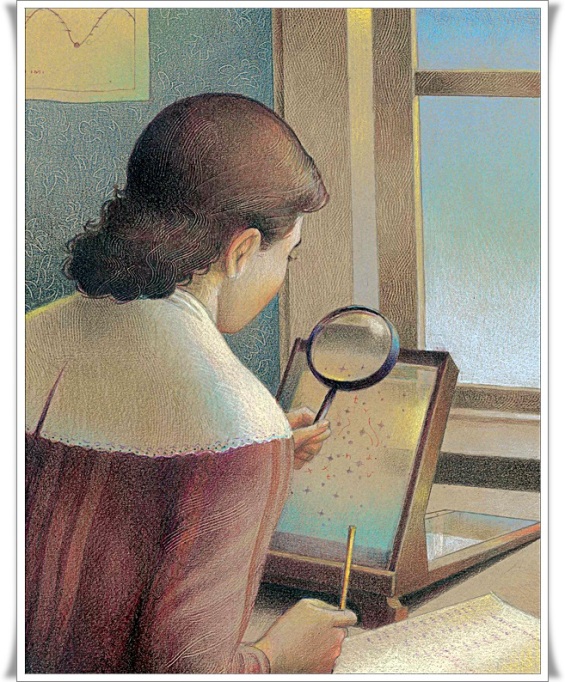
celebrate-picture-books-picture-book-review-look-up-henrietta-leavitt-studies-star-map

Image copyright Raúl Colón, courtesy of Simon & Schuster

But in doing her job, Henrietta begins to notice a pattern in the brightness of certain stars. She discovers new “blinking” stars. Taking careful measurements, Henrietta finds that a star with a slower “blink” time—the time it takes for a star to go from dim to bright, or from off to on—contains more light power than stars with faster blink times. But what does this mean? After more study she realizes that the blink time can determine the true brightness of any blinking star, even those far, far away.

celebrate-picture-books-picture-book-review-look-up-henrietta-leavitt-makes-notes

Image copyright Raúl Colón, courtesy of Simon & Schuster

Henrietta has made a breakthrough in astronomy! By knowing the true brightness of a star, astronomers can figure out the star’s distance from Earth. Henrietta publishes her star chart in a magazine, and it helps other astronomers measure first the Milky Way and then galaxies they didn’t even know existed! Henrietta is an astronomer–one who advances her beloved science! Even as she grows older Henrietta continues to look to the sky, to ask questions and dream.

More information about Henrietta Leavitt and her discoveries, Internet and print resources on astronomy and other women astronomers, a glossary, and more are provided on the final pages.

celebrate-picture-books-picture-book-review-look-up-henrietta-leavitt-sees-stars-in-sleep

Instead of first presenting Henrietta Leavitt as an adult already working as an astronomer, Robert Burleigh chooses to introduce her as a child, when all she had were questions and dreams about the sky and the stars. It’s a fitting emphasis for a picture book aimed at children who themselves are only just discovering the questions that will guide their lives.  Burleigh’s style is simple and straightforward, revealing pertinent facts about the working conditions of a woman scientist in the early 1900s, but emphasizing Henrietta’s internal contemplations that led to her important discoveries. It’s good for children to see that one does not always need to be the “astronaut” rocketing to the Space Station to contribute— the life of the mind is just as noble and needed a pursuit.

Raúl Colón’s watercolor and ink illustrations echo the theme of dreams and contemplation with soft muted colors and antique, sepia tones. Brightness on the pages comes from the points of light that fill the skies and Henrietta’s mind. As a child and young woman, Henrietta sits and stands in the glow of the stars and, one can imagine, her own thoughts.

Ages 4 – 8

Simon & Schuster, 2013 | ISBN 978-1416958192

Discover more about Robert Burleigh and his many, many books in the categories of science, art, poetry, adventure, sports, and more for children and adults on his website!

National Women Inventors Month Activity

CPB - Star Coloring Page

Be the Star You Want to Be Coloring Page


Everyone has “stars in their eyes”—dreams and hopes for what they will accomplish in life. Decorate this printable Be the Star You Want to Be coloring page to show what’s in your imagination and in your heart.