April 30 – Save the Frogs Day

celebrate-picture-books-picture-book-review-i-dont-want-to-be-a-frog

About the Holiday

Frogs and other amphibians are some of the most threatened species on our planet. Pollution, loss of habitat, climate change, and invasive species are just some of the causes of amphibian extinctions. Save the Frogs Day aims to educated the public and raise awareness of the declining frog and amphibian populations and to promote conservation of their environments to ensure their survival.

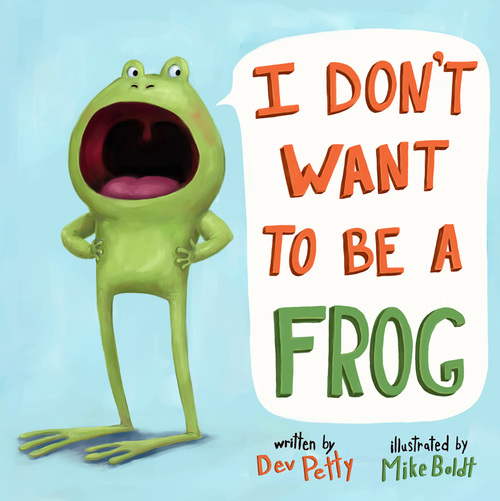
I Don’t Want to be a Frog

Written by Dev Petty | Illustrated by Mike Boldt


“I want to be a cat,” a little frog announces to his father. “You can’t be a cat,” his dad answers, which elicits the inevitable “Why not?” from his son. His dad isn’t quite ready for this conversation and gives him the standard “because you’re a frog” response.

Well, it turns out the little frog would rather be almost anything other than what he is. As he rattles off a list of alternatives that he considers much better, his dad warms to the game and counters each of his son’s suggestions with the realities of life (at least their life).

When little frog opines that he’d like to be a rabbit, his dad points out that he doesn’t have long ears. Being a pig seems like an attractive option, but little frog’s dad tells him he doesn’t have a curly tail or eat garbage. His son thinks garbage for dinner sounds okay, but his dad disagrees.

While both son and father believe being an owl would be “the greatest thing ever,” three things are standing in the way: Frogs don’t have wings, they don’t look wise, and they can’t spin their heads around.

So what’s so bad about being a frog? It’s “too wet,” “too slimy,” and there’s “too much bug eating,” little frog complains. Just then a wolf sneaks up on the father-son duo and wants to know why the little guy is so glum. Without turning around to see who he’s talking to, the frog reveals his plight.

Well, says the wolf, I’ll tell you a secret. With glee he explains that he revels in eating cats, rabbits, pigs, and owls. In fact, just talking about it makes him hungry. But “guess the one thing I never eat,” the wolf urges. “Badgers?” guesses the little frog. But no, the answer is “frogs.” And why? Because they are “too wet and slimy and full of bugs.”

Wiser for this fresh perspective, the young frog sends the wolf off with a hearty, “I guess you can’t fight nature. We are what we are. You are a fierce hunter.” 

As the wolf walks away all’s well that ends well—except not so much for the creature who next happens upon the scene!

Dev Petty’s sassy-in-a-good-way young frog’s identity crisis is pure fun! The notion of self-acceptance and that each person is built, has talents, and embodies skills just right for who they are is playfully presented by Petty’s sweet father-and-son team. The humorous, escalating dialogue will keep kids laughing, and the surprise ending is a perfect twist.

Mike Boldt’s olive green frogs are a delight as they trade off assurance and skepticism in their life-lesson conversation. The dad, initially mystified by his son’s pronouncements, discusses the issue with patience and genuine curiosity, his eyes registering cunning and understanding behind oversized glasses. His son, wide-eyed and vocal, displays the honesty of children with questions. Boldt’s illustrations of the rabbit, pig, and owl that so captivate the young frog juxtaposed with the father’s objections are comical joy, as are the frogs’ looong legs and expressive faces. And the final scenes with the enlightening wolf, whose head spans two pages, offer more laughs as the father and son resolve their differences.

Adult readers should be prepared—and will be happy—to read I Don’t Want to be a Frog again and again!

Ages 3 – 7

Doubleday Books for Young Readers, 2015 | ISBN 978-0385378666

Save the Frogs Day Activity

celebrate-picture-books-picture-book-review-frog-matching

Hop Along Matching Game


Hop along now and help these frogs! Each of these fantastic frogs has a twin, but they’ve gotten separated. Can you spot the identical pairs? Print out the Hop Along Matching Game and draw a line between the pairs.

picture book review

April 24 – It’s National Garden Month

picture-book-review-up-in-the-garden-and-down-in-the-dirt

About the Holiday

April is the month when the earth comes alive again after a long winter! Flowers bloom in brilliant colors, trees bud and blossom with pale, green leaves, and the birds and animals prepare for new life to come. Today enjoy the warmer weather, plan a garden or flower bed, or visit a nursery or park and take in the sights and smells of spring!

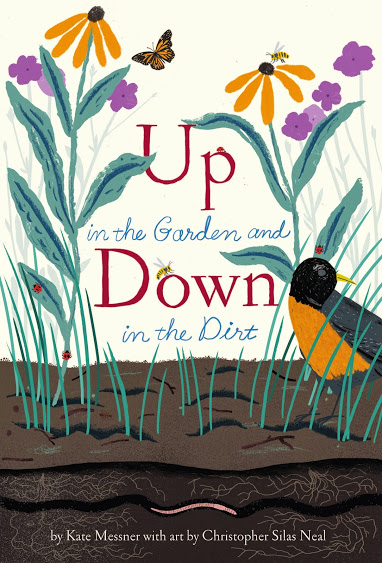
Up in the Garden and Down in the Dirt

Written by Kate Messner | Illustrated by Christopher Silas Neal


Snow still blankets the ground as a little girl and her Nana survey their garden plot. The girl’s head is full of dreams of the bounty to come. As the days warm and the wind whistles, the girl and her Nana dig in the mud. “’It’s not quite time,’” says Nana. “’Down in the dirt, things need to dry out and warm up.’” Her granddaughter is curious about what’s below.

Down in the dirt, Nana tells her, a whole world of insects are already working. Up above, the two gardeners are working too—gathering scattered twigs, removing weeds, and spreading compost.

Down in the dirt, pill bugs chew dead leaves, rolling into tight balls when poked. Up in the garden planting is taking place, the seeds carefully snuggled into beds and watered. As peas and other early plants sprout, bees pollinate and wasps hover.

Down in the dirt earthworms tunnel, enjoying the cool soil. Up in the garden the girl and her Nana rest in the shade then play in a sprinkled shower. Down in the dirt the water soaks deep, feeding the squash plants’ roots.

The summer is progressing and up in the garden tomatoes and beans are ripe for eating. Down in the dirt a robin finds a meal too. Up in the garden there’s so much to harvest. Nana and her granddaughter work until dark, sharing the garden with bats and June bugs. With nightfall a skunk finds grubs and cutworms down in the dirt.

The air is turning cooler up in the garden. Pumpkins turn orange under towering sunflowers while down in the dirt a spider weaves her sticky web. As Autumn wanes it’s time for the final garden harvest. Down in the dirt the insects know it too; they scurry to gather food.

Up in the garden and down in the dirt everything is prepared for winter. As snow once again blankets the garden plot, the girl and her Nana, the earthworms and pill bugs, the bees, and the skunk are all waiting for spring to come again.

Kate Messner’s lyrical paean to gardening is a wonderful way to introduce children to the changing seasons and how nature works together. Comparing and contrasting what gardeners do up above as they plant, tend, and harvest their crops to the work insects and animals perform down below emphasizes the interconnectedness contained in even a small plot of land. Messner’s language is beautifully evocative—the snow is sleepy, brittle stalks snap and are rustly when gathered, chickens squabble and scratch, newly planted seeds snuggle in the dark, pumpkins blush orange, and sunflowers bow to September.

Christopher Silas Neal illustrates the changing garden with striking up-close, ground view images of the plants and creatures that call the garden home. Vibrant green grasshoppers, brilliant yellow sunflowers, deliciously red tomatoes, soft pink worms, scruffy backyard animals, and more join a sprightly Nana and her curious granddaughter in soil so dark and fertile that any gardener would be envious.

The final pages include more information on the creatures found in the book, a list for further reading, and an author’s note. Up in the Garden and Down in the Dirt would be a welcome and special addition to any budding gardener’s or outdoor lover’s library.

Ages 5 – 9

Chronicle Books, 2015 | ISBN 978-1452119366

National Garden Month Activity

celebrate-picture-books-picture-book-reviews-garden-word-search


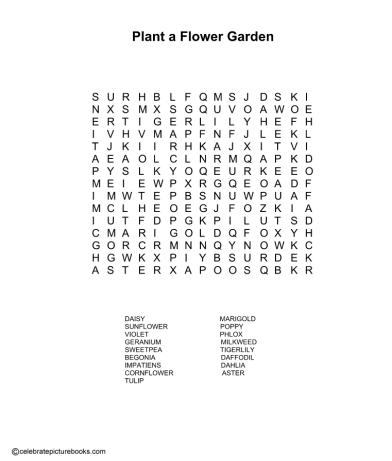
Plant a Flower Garden! Word Search


Whether you like to plant your flower bed in horizontal or vertical rows or just scatter the seeds for a wild burst of color, you’ll love this word search planted with favorite spring and summer blooms. Print your Plant a Flower Garden! word search and the Solution here!

April 22 – Earth Day

picture-book-review-green-city-allan-drummond

About the Holiday

In 1970 the first Earth Day was celebrated to bring awareness to environmental issues and begin a dialogue about how governments, corporations, communities, and individuals could create change that would benefit the Earth and all her inhabitants. Forty-six years later, we are working toward solutions to problems like pollution, climate change, renewable energy, and more. Today look around your home, office, school, or community and see how you can better support our Mother Earth.

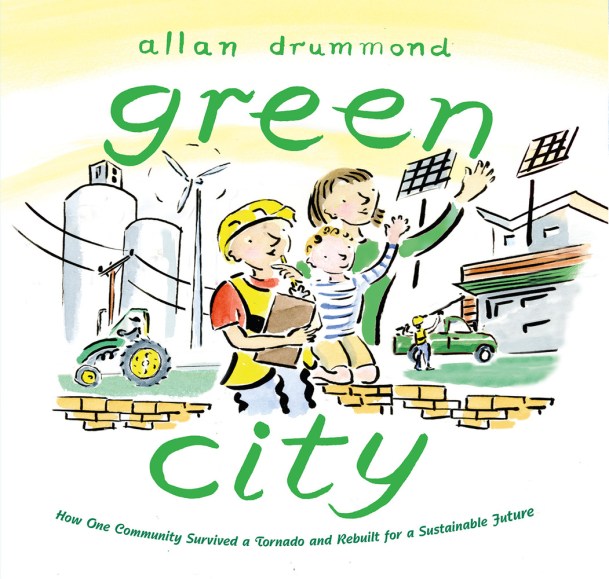
Green City: How One Community Survived a Tornado and Rebuilt for a Sustainable Future

By Allan Drummond


On May 4, 2007 a devastating tornado hits Greensburg, Kansas, destroying the town in 9 minutes. When the residents of the town climb from their shelters, they emerge into a world completely changed. There are no more homes, no school, no hospital, no grocery store or other shops. No banks, theater, churches, or water tower. Even the trees have been shredded. Only three buildings remain.

The citizens are urged to move away. Rebuilding will be impossible, some say, and what’s the point anyway when the wind could destroy it all again? But others see opportunity to construct a different kind of town. With the help of volunteers and donations from around the world, Greensburg begins the Herculean task of designing and building a new town.

After clearing away 388,000 tons of debris and moving into a community of trailer homes, the people begin to envision a unique, green town. Individuals design sustainable houses of different shapes and materials to work with the environment. Businesses, too, incorporate sustainability into their offices, retail centers, and hotels as do the hospital and the water tower. A wind farm large enough to provide energy for the entire town is built on the edge of this innovative city.

A new school is central to the town’s survival, and for three years the teachers hold class in small trailers. Along with their regular studies, the kids become experts in environmental science. After several years Greenburg is now thriving—a testament to conservation and sustainability that is an example for global communities now and in the future.

Allan Drummond tells this fascinating story of a community that would not give up in an honest and sensitive way that highlights the courage and pride of a town amid devastating loss. Told from a child’s point of view, the story has extra impact for readers who are growing up amid an era of environmental awareness and activism. The sustainable construction of homes and other buildings is effectively explained and clearly depicted in Drummond’s colorful illustrations.

The images also demonstrate the process of negotiation and cooperation among townspeople that went into designing and building a new Greensburg. The final two-page spread of the town’s layout will interest kids as well as adults who have followed this story in the news.

Ages 5 – 9

Farrar, Straus and Giroux, 2016 | ISBN 978-0374379995

Earth Day Activity

celebrate-picture-book-review-caterpillar-planter-craft

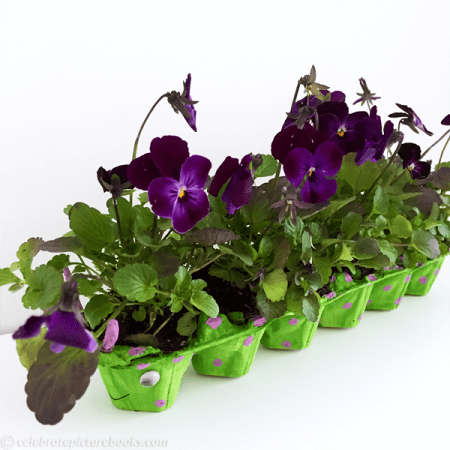
Hatch a Caterpillar Planter


As spring days grow warmer, it’s fun to start growing your own garden. Propagating plants from seed on a windowsill or sun room gives you an up-close view as the seeds develop roots, sprout, and flourish!

Supplies

  • Egg carton made from recycled paper
  • Seeds for your favorite veggies or flowers
  • Potting soil
  • Spoon or small shovel
  • Craft paint or markers in the colors you’d like for your caterpillar
  • Pipe cleaners or wire
  • Googly eyes
  • Marker

Directions

  1. Carefully cut the egg carton into two rows lengthwise, you may need to trim the cardboard between cups
  2. If the cups have low openings on one side, place the second row of cups inside the first facing the opposite way.
  3. Paint or color the carton, let dry
  4. Push pipe cleaners or wire through the edge of the egg carton on one end to form antennae (I used wrapped wire and painted it)
  5. Attach googly eyes and draw a smile on the front of the carton
  6. Fill cups with soil
  7. Plant seeds according to package directions
  8. Place caterpillar planter in a sunny spot

Picture Book Review

April 12 – National Big Wind Day

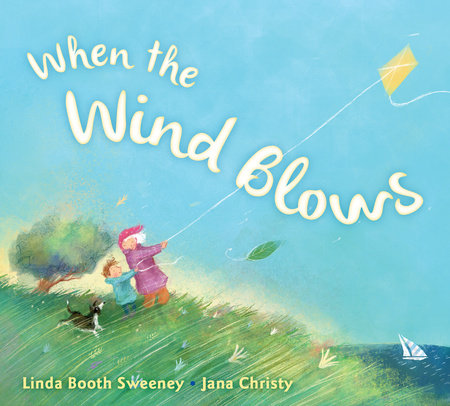
When the Wind Blows by Linda Booth Sweeney and Jana Christy picture book review

About the Holiday

Hold onto your hats—maybe even your hair! On April 12, 1934 three weather surveyors at the Mount Washington Observatory registered the highest wind gusts ever recorded—231 miles per hour! Mount Washington is located in New Hampshire and at 6,288 feet is the highest peak in the Northeast United States and east of the Mississippi River. Since that blustery event, big wind day has been celebrated on this day.

When the Wind Blows

Written by Linda Booth Sweeney | Illustrated by Jana Christy


A little boy peeks out his rattling window as the wind sends chimes ringing and doors creeaaaking. Jumbled into their jackets the boy’s mom, baby sister, and grandmother go out to enjoy the day. They fly a kite while nearby bells clang and walkers stroll hand in hand. In the sweeping wind “Trees dance. / Spiders curl. / Mice shiver. / Leaves swirl.”

When the wind snatches the kite, the boy and his grandma chase after it amid clouds racing across the sky and seeds scattering to and fro. Running after the kite through waving beach grass, the family sees “Sails puff. / Boats wobble. / Gulls float. / buoys bobble.” Their pursuit takes them into town where they track down their kite lying on a sidewalk. When the wind blows on these narrow seaside village lanes, “Signs shake. / Lights jiggle. / Puddles splosh. / We giggle.”

With the kite safely in hand the foursome ventures to the park for some rolling, swaying, whirling play. But the day is graying—“Skies darken. / Thunder BOOMS. / Rain falls. / We zoom!” Back at home all is cozy as the family dries off and the little boy takes a bath. Tucked into bed the little boy and his mom cuddle while their pets curl up on the blankets. As they sleep, “Skies clear. / Stars gleam. / Earth sleeps. / We dream.”

Linda Booth Sweeney’s charming tale of a day spent in the midst of a windy day perfectly captures the sights and sounds of such a gusty natural event. Sweeney’s eye for detail and talent for evocative verbs elevate the two-word lines in these short verses, letting readers fully experience the effects of a wild squall. Kids will appreciate the original imagery and love repeating the lyrical lines.

The blustery wind is evident in Jana Christy’s vibrant pastel illustrations, where clouds swirl in scribbles, flowers bow, and buffeted grasses protect small creatures. Everywhere, the wind flutters head scarves and clothing, bends signs, and tears hats and kites from unsuspecting hands. As rain approaches Christy’s skies acquire a gray, gauzy texture, and when the family again reaches home, the colors turn warm and bright, as comforting as a cup of tea or hot chocolate. Readers will be rewarded for lingering over the beautiful pages by seeing details and people carried over from page to page, uniting the story.

Ages 3 – 6

G. P. Putnam’s Sons, Penguin Group, 2015 | ISBN 978-0399160158

National Big Wind Day Activity

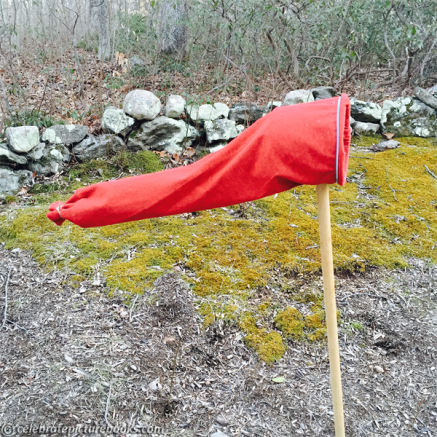
CPB - Windsock

Catch the Wind! Windsock


You can feel the wind in your hair and see it blowing through the trees, but can you actually catch it? You can with this easy-to-make windsock!

Supplies

  • 1 large yogurt container (32 oz) or 1-pound deli salad container
  • 1 long-sleeve T-shirt
  • Strong glue
  • Dowel, 5/8 diameter x 48-inches long or longer
  • String
  • Rubber band
  • sewing seam ripper or cuticle scissors
  • X-acto knife
  • Scissors

Directions

  1. Remove the sleeve from a long-sleeve t-shirt with the seam ripper or cuticle scissors
  2. Cut the shoulder off the sleeve by cutting straight across from the underarm seam
  3. Cut 2 inches from the bottom of the yogurt container OR cut the bottom out of the deli container with the x-acto knife or scissors
  4. With the x-acto knife or scissors, make a hole a little smaller than the diameter of the dowel about 1 inch from the rim of the container
  5. Slide the container into the large opening of the sleeve
  6. Fold about a ¾ -inch edge over the rim of the container and attach all along the rim with strong glue
  7. Put the rubber band around the outside edge of the opening
  8. Tie the bottom of the sleeve’s cuff together with the string
  9. To attach the dowel: Option 1: leaving the t-shirt in place, push the dowel and material through the hole in the container. The t-shirt material will hold the dowel in place (I used this option).  Option 2: cut a small hole in the t-shirt at the location of the hole in the container. Push the dowel through this hole and the hole in the container. Secure with strong glue
  10. Stick your windsock in the ground in an open area where it can catch the wind. As the wind changes direction, you can turn your windsock so the opening faces the wind.

April 6 – April is National Poetry Month

When Green Becomes Tomatoes by Julie Fogliano and Julie Morstad

About the Holiday

The Academy of American Poets established National Poetry Month in 1996 to promote the enjoyment and awareness of poetry. Over the 20 years since its beginning, National Poetry Month has become the largest literary event in the world. Schools, poets, booksellers, and publishers all hold special events to honor the vital place of this well-loved art form in our culture.

Celebrate the month by attending poetry readings, reading poems by your favorite author or discovering a new poet, and creating your own poetry!

When Green Becomes Tomatoes: Poems for All Seasons

Written by Julie Fogliano | Illustrated by Julie Morstad


Sometimes you wish for just the right words to express a moment in time, a skip of the heart, or a glimpse of color that truly captures the elation, sadness, or awe you feel. Those words live on every page of When Green Becomes Tomatoes: Poems for All Seasons. Each season omonth of the year is represented by three to five dated poems that expose a nugget of inspiration or a spark of recognition about the natural world and our place in it.

Spring is revealed as chilly, rainy, and blooming with early flowers:

march 26: “shivering and huddled close / the forever rushing daffodils / wished they had waited”

Summer brings swimming, tomatoes, and deep dark nights:

september 10

“a star is someone else’s sun / more flicker glow than blinding / a speck of light too far for bright / and too small to make a morning”

Fall is a time for sweaters, pumpkins, and falling leaves:

november 2

“more silent than something / much noisier than nothing / the last leaf / when it landed / made a sort of sound / that no one knew they heard”

Winter  is quiet, cozy fireplaces, and snow, snow, snow:

december 21

“as if one day, the mountain decides / to put on its white furry hat / and call it winter”

december 29

“and i woke / to a morning / that was quiet / and white / the first snow / (just like magic) came / on tiptoes / overnight”

The volume begins and ends with a poem dated the same day—March 20, the vernal equinox—giving this book a cyclical form that echoes the passing of time. To accompany Julie Fogliano’s beautiful poems, Julie Morstad has created gorgeous watercolors of children experiencing each day and the changes they bring. The soft, matte pages enhance the colors of each season and the quiet reflections these poems offer.

Ages 6 and up (adults will enjoy these poems too)

Roaring Brook Press, 2016 | ISBN 978-1596438521

National Poetry Month Activity

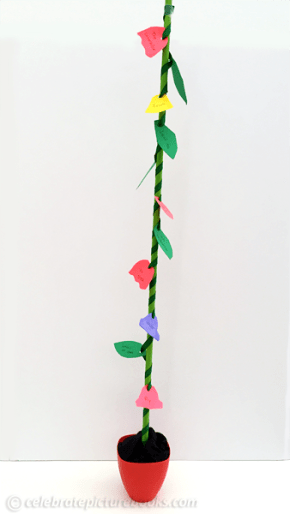
Grow a Poem

CPB - Plant Poem

A poem often grows in your imagination like a beautiful plant—starting from the seed of an idea, breaking through your consciousness, and growing and blooming into full form. With this craft you can create a unique poem that is also an art piece!

Supplies

  • Printable Leaves Template, available here and on the blog post
  • Printable Flower Template, available here and on the blog post
  • Wooden dowel, ½-inch diameter, available in craft or hardware stores
  • Green ribbon
  • Green craft paint
  • Green paper if leaves will be preprinted
  • Colored paper if flowers will be preprinted
  • Flower pot or box
  • Oasis, clay, or dirt
  • Hole punch
  • Glue
  • Markers or pens for writing words
  • Crayons or colored pencils if children are to color leaves and flowers

Directions

  1. Paint the dowel green, let dry
  2. Print the leaves and flower templates
  3. Cut out the leaves and flowers
  4. Punch a hole in the bottom of the leaves or flowers
  5. Write words, phrases, or full sentences of your poem on the leaves and flowers (you can also write the poem after you have strung the leaves and flowers)
  6. String the leaves and flowers onto the green ribbon (if you want the poem to read from top to bottom string the words onto the ribbon in order from first to last)
  7. Attach the ribbon to the bottom of the pole with glue or tape
  8. Wrap the ribbon around the pole, leaving spaces between the ribbon
  9. Gently arrange the leaves and flowers so they stick out from the pole or look the way you want them to.
  10. Put oasis or clay in the flower pot or box
  11. Stick your poem pole in the pot
  12. Display your poem!

March 27 – Easter

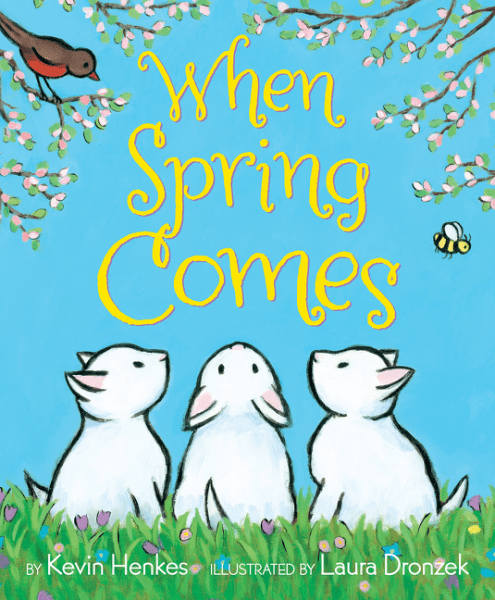
When Spring Comes by Kevin Henkes and Laura Dronzek Picture Book Review

About the Holiday

On this day we celebrate renewal—both personal and seasonal. Spring is officially here and new life is beginning. All around trees are budding, flowers are blooming, and baby animals and birds are being born and learning to make their way in the world. As the sun rises on warmer days, be inspired to discover new happiness.

When Spring Comes

Written by Kevin Henkes | Illustrated by Laura Dronzek


This beautiful tribute to spring is as surprising as new buds pushing through the earth or tiny hatching eggs. Using repeated phrasing, lyrically expressed facts, and poetic rhythms, When Spring Comes echoes the anticipation that sunnier days bring after a long winter. The book opens with a simple, evocative sentence: “Before Spring comes the trees look like black sticks against the sky.” Children will immediately agree—they see trees in this way out their windows and draw them like this in art class.

The following sentence is equally as true: “But if you wait Spring will bring leaves and blossoms.” The book’s contrasting lines that explore conditions “before Spring comes” and “If you wait” gradually reveal more and more of springtime’s wonder, like the melting snows that usher in rainy days: “Spring comes with sun and it comes with rain and more rain and more rain. Do you like mud? Do you like puddles? I hope you like umbrellas.”

As Spring wakes more fully, it takes on a personality of its own: “Spring will call out the pussy willows and new kittens too. Spring can come quickly or slowly. It changes its mind a lot. But when Spring is finally here to stay, you will know it…There will be buds and bees and boots and bubbles.”  And there is much more to discover about this season of rebirth as well as the future within these pages.

When Spring visits it brings many wonderful smells, sounds, activities, and creatures, all of which are gorgeously depicted in Laura Dronzek’s radiant illustrations. The early gardens, blooming cherry trees, frolicking kittens, and profusions of flowers are as bright and welcome as the springtime sun. As the sweet-faced boy and girl in the book play, they are surrounded by birds, bunnies, dogs and kittens, and even ponder a little worm poking its head from the garden. Brilliant blues, pinks, greens meld with lush browns to create a joyful celebration of the newness of the season.

When Spring Comes is not only a book about a particular season or even for a particular age. It is a wonderfully gentile and uplifting way to introduce or discuss the idea of waiting for good things to happen. Everyone, even the smallest child, has “winter days” when life doesn’t look so bright. But if you wait, spring comes with new life and surprises.

Ages 4 – 8

Greenwillow Books, HarperCollins, 2016 | ISBN 978-0062331397

Easter Activity

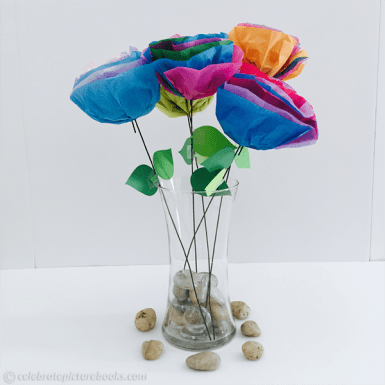
CPB - Paper Flowers

Paper Flowers


These paper flowers will brighten any room and come in a rainbow of colors. Make a bouquet for yourself or share them with a special friend.

Supplies

  • Tissue paper in many colors
  • Green paper
  • Green wire for stems
  • Scissors
  • Tape or glue
  • Pliers

CPB - Paper Flowers II

Directions

To make the stem

  1. Bend a 1 ½ -inch loop in the top of the wire
  2. Squeeze the wire together so it will fit tightly over the tissue paper

To make a flower

  1. Cut 6 or more 7-inch squares from tissue paper, mixing colors (you can make various sizes of flowers by making the squares larger or smaller and adding more squares)
  2. Gather all the squares together and fold them together accordion-style in 1-inch folds
  3. Slide the folded tissue paper under the wire loop, and tighten the wire
  4. Gently fan the tissue paper out on each side
  5. Beginning on one side, gently pull each sheet of tissue paper up toward the center
  6. Repeat step 5 on the other side

To make leaves

  1. Cut leaves from green paper, leaving a stem to wrap around the wire flower stem
  2. Fold the leaf stem around the wire and tape or glue


March 12 – National Plant a Flower Day

MIss Maple's Seeds by Eliza Wheeler Picture Book Review

About the Holiday

It’s March—that funny month when some people are basking in 80-degree sunshine and others are still shoveling snow. But no mater where we live, we’re thinking about the same thing—Spring! Spring brings new green leaves, gentle rains, and little shoots that will grow to be trees, vegetable and fruit plants, and flowers. Whether you live somewhere warm and can already plant outside or somewhere that’s still a little chilly and requires indoor propagation, planting flower seeds is a perfect way to beautify your home and your life.

Miss Maple’s Seeds 

By Eliza Wheeler


Late in the summer, Miss Maple hurries to prepare for some very special guests. She has searched all summer for unplanted “orphan” seeds, and baskets full of them are winging their way to her home on the backs of bluebirds. Once they arrive she “learns each seed by heart.” There are poppy, wild rice, maple, water lily, pine, impatiens, apple raspberry, sunflower, acorn, pea, fern seeds, and as many more as make up our world.

As she lovingly tends to each one, she says, “Take care, my little ones, for the world is big and you are small.” Miss Maple takes them on field trips and shows them the world they will inhabit—the muddy soil along riverbanks, grassy fields, and thick forests. She cautions them about “weedy characters” who can show up even in a “bustling garden.”

At night Miss Maple snuggles each seed into a comfy bed and reads to them by the light of fireflies. During the winter Miss Maple entertains other guests—woodland creatures who gather in her maple tree home and share food, stories, and songs. With the spring come rains and new lessons on burrowing into the ground.

May ushers in another summer, and Miss Maple knows it’s time for her little ones to “find roots of their own.” She sends them out into the world, knowing that she has prepared them well for what they will become. Her seeds say goodbye and sail off to begin their futures, and Miss Maple is left alone. But soon another summer day comes, and Miss Maple sets off to gather more orphan seeds, because “the world is big and they are small.”

Eliza Wheeler’s Miss Maple’s Seeds is a triumph—as comforting as a warm blanket and as empowering as a master key. Wheeler’s beautiful language floats quietly and unhurried like the flight of a leaf on a gentle breeze. The metaphor of seeds and children is so sweetly made, and Miss Marple’s wish for her little charges can bring a tear to the eye of any caretaker.

Wheeler’s luminous artwork is breathtaking in its fully realized details of the wide world Miss Maple’s seeds and all of us inhabit. Each season is gorgeously rendered in soft blues, roses, browns, and yellows, and she imbues the little seeds with personality without making them anthropomorphic. The reader may wish they could be friends with these future beauties and Miss Maple as well.

Miss Maple’s Seeds would be a wonderful gift for high school graduates, teachers, and anyone who loves taking care of children.

Ages 3 – 7, all ages

Nancy Paulsen Books, an imprint of Penguin Group | ISBN 978-0399257926

Plant a Flower Day Activity

CPB - Flower Pot

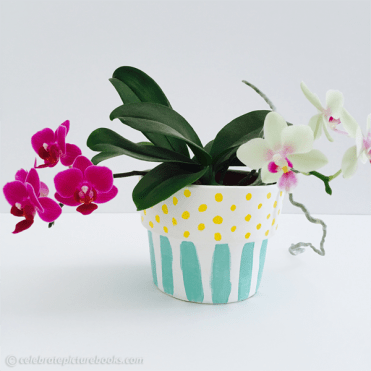
Decorated Flower Pot


Spring is almost here, and that means flowers will soon be blooming. If you want to beautify your home plant your favorite flower seeds in a pot you’ve decorated yourself!

Supplies

  • Terra cotta pot in any size
  • Acrylic multi-surface paint in various colors
  • Flower seeds
  • Soil

Directions

  1. Paint your terra cotta pot—be creative!
  2. Let paint dry
  3. Fill pot with soil
  4. Plant flower seeds