March 27 – Quirky Country Music Song Titles Day

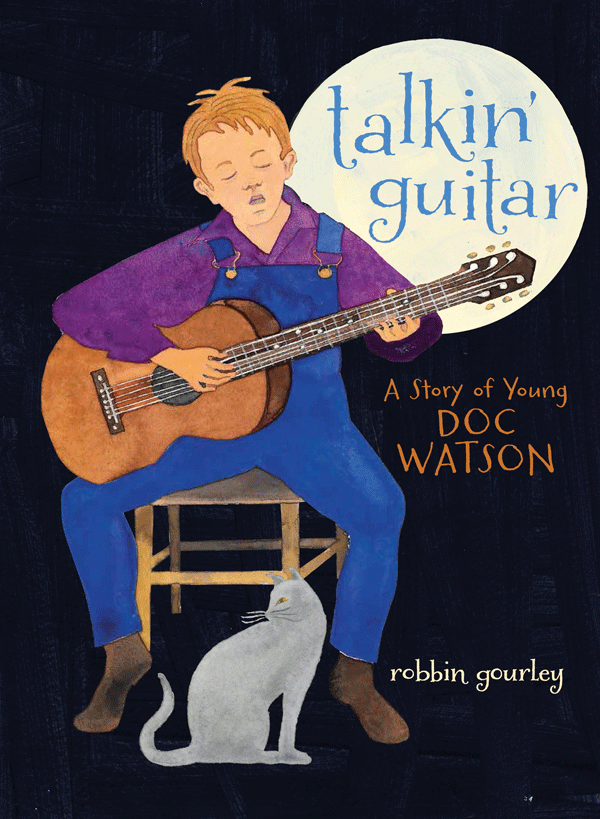
celebrate-picture-books-picture-book-review-talkin-guitar-cover

About the Holiday

Song titles can be evocative of so many emotions, and country song titles seem to take this fact to a whole nuther level. Sure, the travails of heartbreak may cause misery and despair, but I bet you can’t help smiling—just a little—when you read titles like this: I Would Have Writ You A Letter, But I Couldn’t Spell Yuck!, You Were Only A Splinter As I Slid Down The Bannister Of Life, and Did I Shave My Legs for This? So, today, celebrate by finding and listening to some quirky country songs that tickle your fancy.

Talkin’ Guitar: A Story of Young Doc Watson

By Robin Gourley

“Yonder, where blue mountains meet the sky, Arthel Watson was born into a world of music.” Music, for Arthel, was much more than his mama’s singing at the end of the day. It was the calls of animals and birds, the burbling river, the whistles of trains, and the clatter of farm machinery. He loved to listen to the rain and the wind and the silence between sounds too. “Arthel had ears like a cat. Maybe it was because he was blind.”
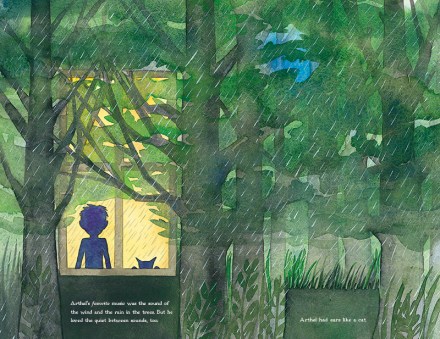
celebrate-picture-books-picture-book-review-talkin-guitar-rain

Image and text copyright Robbin Gourley, courtesy of robbingourley.com

Arthel just couldn’t help but make music whenever and wherever he could. Pots became drums, and cowbells rang like cymbals. Arthel even strung a steel wire across the barn door to strum. When Pappy gave him a harmonica, Arthel practiced until the screechy notes settled into a purr. When Pappy made him a banjo, he practiced until the “rusty door hinge” creak was replaced by spritely melody. One day when Arthel plinked out a few notes on his cousin’s guitar, his father made him a promise. “‘Son, if you can play a song by the time I git home from work, we’ll go into town and buy you your own guitar.’”
celebrate-picture-books-picture-book-review-talkin-guitar-played-guitar-everywhere

Image and text copyright Robbin Gourley, courtesy of robbingourley.com

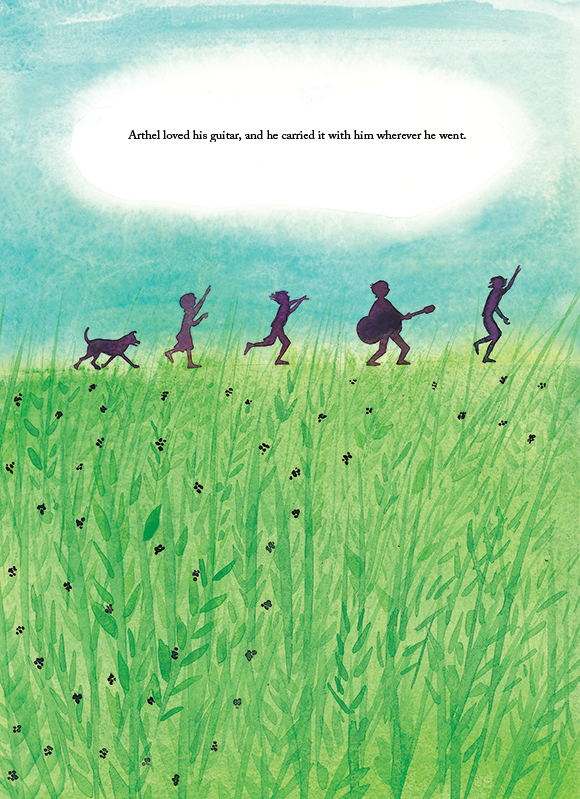
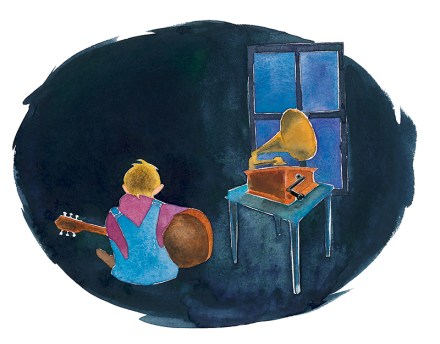
By the end of the day, Arthel had composed a “sweet, simple song” from the few chords he had learned. With a “belly full of butterflies,” he played it for his family and earned himself a guitar. From then on Arthel carried his guitar everywhere, learning from records at home and from songs on the radio. He memorized the rhythms of farm work and the songs of various animals, and between chores he practiced, practiced, practiced. “All those chores and all that practice made him sharp as a whittling knife and tough as a hickory.”
celebrate-picture-books-picture-book-review-talkin-guitar-listening-to-victrola

Image and text copyright Robbin Gourley, courtesy of robbingourley.com

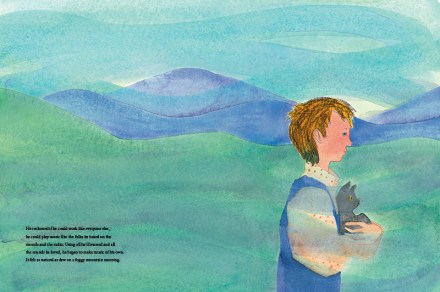
Arthel decided that if he could work just like everyone else, he could probably play music as well as the artists he listened to on records and on the radio. He began to compose his own music. “It felt as natural as dew on a foggy mountain morning.” Arthel played “what he couldn’t see. He could make his guitar sound like a muskrat or a groundhog or a ‘wooly boogie bee’” and sing the stories of the countryside he loved.

An Author’s Note following the text reveals more about Arthel’s life, the influences on his music, and how he earned the nickname “Doc.”
celebrate-picture-books-picture-book-review-talkin-guitar-inspired

Image and text copyright Robbin Gourley, courtesy of robbingourley.com

Robin Gourley’s heartening biography of Doc Watson is perfectly attuned to her young audience. Readers are introduced to Arthel as he soaks in the sounds of life around him and only learn several pages into the story that he was blind. His blindness is not mentioned again except for the subtle acknowledgement that “he reckoned if he could work like everyone else, he could play music like the folks he heard on the records and the radio”—which becomes universal inspiration for all. The emphasis that practice develops natural talent and pays off is also a great lesson for readers who may just be discovering their own talents.

Gourley’s soothing watercolors are suffused with the beautiful pastels of Appalachia, which was both home and muse to Anthel. Vignettes take readers inside Anthel’s home to discover the Victrola and the old radio that were his early teachers and introduce his family, who surrounded him with encouragement as he grew from a child to a young man—always with a guitar in his hands.

Ages 4 – 7

Clarion Books, 2015 | ISBN 978-0544129887

To discover more about Robbin Gourley, her books, and her art, visit her website!

Quirky Country Music Song Titles Day
celebrate-picture-books-picture-book-review-guitar-dot-to-dot

Musical Dot-to-Dot

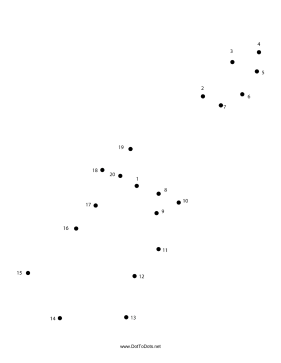
When a musician follows notes, they create a song. What will you find when you follow the numbers on this printable Musical Dot-to-Dot?

Picture Book Review

July 31 – Uncommon Instrument Awareness Day

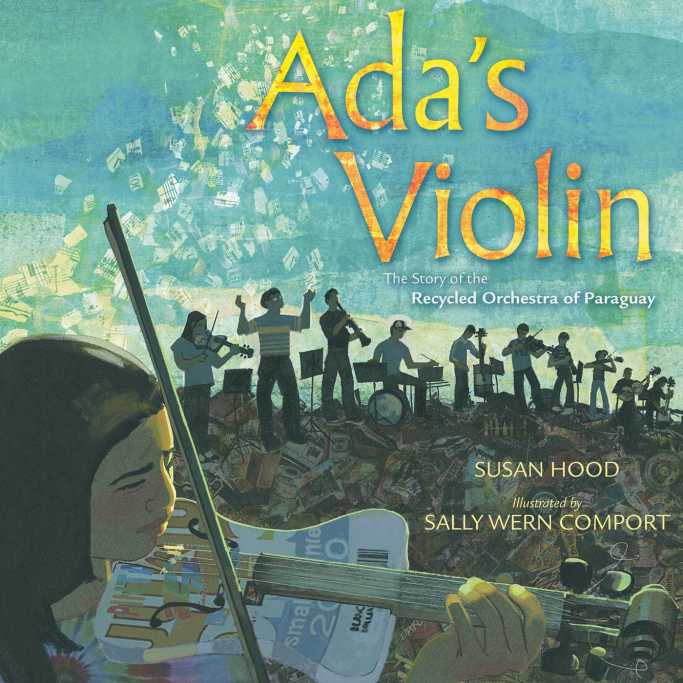
celebrate-picture-books-picture-book-review-ada's-violin-cover

About the Holiday

Today is the day to be musically experimental. Intriguing, inventive instruments that make a wide variety of sounds exist in every corner of the world. From Russia comes the contrabass balalaika, a triangular stringed instrument. The cimbalom, a concert hammered dulcimer, originated in Hungary. And only the Welsh could give us an instrument with no vowels: the crwth. Glass, water, and lightning are also used to make beautiful sounds, and the Holophonor—a musical instrument and hologram projector all in one—is perfect for Elvis sightings wherever he is! So, play a different instrument or research one, and read the inspiring story in today’s book!

Ada’s Violin: The Story of the Recycled Orchestra of Paraguay

Written by Susan Hood | Illustrated by Sally Wern Comport


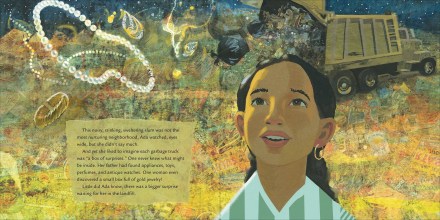
Ada Ríos is growing up in Cateura, a town built of trash as the main garbage dump for the capital city of Paraguay. Every morning the refuse trucks rumble into town to deposit their loads—1,500 tons of trash every day. The citizens of Cateura—gancheros or recyclers—go to work sifting through the mounds and tearing into bags looking for anything valuable enough to recycle or sell. Cardboard is worth 5 cents a pound, plastic 10 cents a pound.

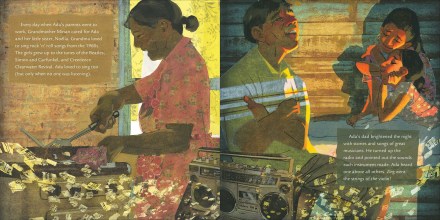
Ada knows the landfill can hold surprises—“Her father, a ganchero, had found appliances, toys, perfumes, and antique watches.”—but she can never imagine what it holds for her. When Ada and her sister were little, their grandmother watched them while their parents worked. They loved to listen to music, to sing, and to learn stories of musicians and the sounds of different instruments. Ada fell in love with the violin.

celebrate-picture-books-picture-book-review-ada's-violin-making-singing

Image copyright Sally Wern Comport, courtesy of simonandschuster.com

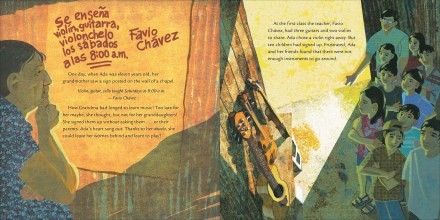
As the girls grow older and go to school, they venture farther into town, but there is little to fill their time. Many kids join gangs or get into fights. When Ada is 11 her grandmother signs her and her sister up for music lessons being offered by a new man in town named Favio Chávez. “Ada’s heart sang out” when she hears the news. On the first day ten children show up to play the five instruments available. But a bigger problem looms: the three guitars and two violins cannot be taken home for practicing as they are magnets for thieves. In Cateura a violin is worth more than a house.

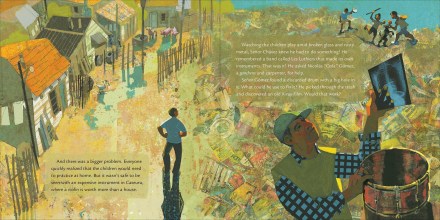
But Favio Chávez has an idea. With help from Nicolás Gómez, a ganchero and carpenter, they pull bits and pieces from the landfill. An old broken drum and an X-ray film become a workable drum, water pipes become flutes, packing crates become guitars and violins, and oil drums become cellos. “Ada chose a violin made from an old paint can, an aluminum baking tray, a fork, and pieces of wooden crates. Worthless to thieves, it was invaluable to her. It was a violin of her very own.”

celebrate-picture-books-picture-book-review-ada's-violin-making-instruments

Image copyright Sally Wern Comport, courtesy of simonandschuster.com

The children practice tirelessly outside in 100-degree heat until the initial “screeches, twangs, and tweets hit all the right notes. Their class became ‘a small island’ where Chávez taught them to respect themselves and one another.” They become known as The Recycled Orchestra. Music now fills the air, adding a soundtrack of beauty to the grueling work. The orchestra is soon invited to play concerts in Cateura and the capital city of Asunción. When word spreads of their talent, they receive offers to play from other cities and even other countries.

When Ada is 16 The Recycled Orchestra is invited to tour with a world-famous rock band. As Ada takes the stage in front of 35,000 people in Bogotá, Colombia, she is afraid, but the audience cheers for them and sings along as they play. On that night the children discover a new life. “Buried in the trash was music. And buried in themselves was something to be proud of.”

celebrate-picture-books-picture-book-review-ada's-violin-lessons

Image copyright Sally Wern Comport, courtesy of simonandschuster.com

An extensive author’s note plus a photograph of The Recycled Orchestra, websites, and videos follow the text, as well as a list of sources.

Ada’s Violin is also available in a Spanish edition—El violín de Ada: La Historia de la Orquesta de Instrumentos Reciclados del Paraguay.

Susan Hood has brought to light an incredible story of perseverance, hope, and the ability of music and other arts to provide opportunities and self-confidence that change lives. Told with unstinting honesty and sensitivity, Hood’s biography of Ada Ríos, Favio Chávez, and The Recycled Orchestra will inspire all who read it. The well-paced text offers revealing details on every page and flows with a lyrical quality that enhances the effect of the story and its impact. From the first sentence to the last, both children and adults will be riveted to The Recycled Orchestra.

celebrate-picture-books-picture-book-review-ada's-violin-hope

Image copyright Sally Wern Comport, courtesy of simonandschuster.com

Sally Wern Comport’s paintings beautifully capture the human spirit that shines through and drives people to astonishing achievements even in the most adverse conditions. With intricately created collages of rich hues, Comport depicts the town of Cateura and the mountains of trash the citizens work and play on. Warm lighting illuminates faces full of dreams and love, and readers will linger over depictions of the instruments workshop and cheer along with the concert audience as the children receive recognition. The full-bleed, two-page spreads echo the expanded world music gave to the children in the orchestra and the adults who heard them as music score confetti flutters throughout.

Both school classrooms and home libraries will benefit from the stirring message of Ada’s Violin.

Ages 4 and up

Simon & Schuster Books for Young Readers, 2016 | ISBN 978-1481430951 (English edition); 978-1481466578 (Spanish edition)

Discover more about Susan Hood and her books, plus fun activities for kids and information for teachers and parents on her website!

View a gallery of Sally Wern Comport’s artwork on her website!

Uncommon Instrument Awareness Day Activity

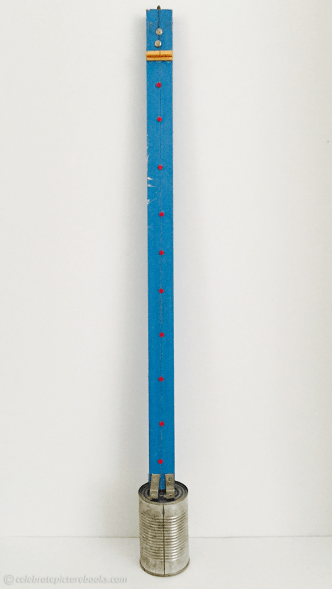
celebrate-picture-books-picture-book-review-homemade-musical-instrument


Make Your Own Musical Instrument


Inspiration for sound can come from almost any object! Look around your house or classroom and discover the music in boxes, cans, blocks of wood, plastic egg cartons or deli containers, and more. Add string or wire for plucking, sticks for drumming, or beans for shaking. With a little glue, tape, or hardware and some creativity, you’ll be making your own rhythms in no time!

Supplies for the instrument shown in the picture above

  • Tin can
  • Two small L brackets
  • Piece of wooden molding, 2 1/2 feet by 1 1/2 inches by 3/4 inches
  • Five small strips of wood to raise the wire off the neck of the instrument. I used long wooden fireplace matches cut into 1 1/2″ sections 
  • Thin wire
  • Small circular hook screw or regular screw
  • Two tacks
  • A nail, screw, or piece of wood that will fit horizontally in the mouth of the can
  • a small nail to make a hole in the can
  • Hammer
  • Strong Glue
  • Paint
  • Foam decorative dots

Directions

  1. Paint the wood and let dry
  2. Paint the small strips of wood and let dry
  3. Decorate the can with paint, sticker, duct tape, or paper
  4. With the hammer and small nail, make a hole in the center of the bottom of the can
  5. Wrap one end of the wire around the nail and glue so it is firmly in place
  6. Feed the other end of the wire through the hole in the bottom of the can
  7. Screw or glue two L brackets to one end of the wood molding so that the bottom of the L is flush with the bottom of the wood molding and there is space between the brackets. This makes the neck of the instrument
  8. Screw the circular or regular screw into the top, center of the wooden molding
  9. When the wooden strips are dry, glue three side by side 3 inches from the top of the molding. Glue two more matches, one on top of the other on the center strip.
  10. When the L brackets are dry, glue them (and the neck of the instrument) to the can, making sure the brackets are on either side of the hole in the can. Make sure the wire is out of the hole. 
  11. When the brackets are firmly attached to the can, pull the wire to the top of the neck. Settle it in the center of the small pieces of wood, so that the wire is not touching the neck.
  12. Wrap the wire around the screw at the top of the molding until it is firmly in place and the wire is taut. 
  13. Secure the wire to the neck with the tacks
  14. Mark the “frets” with the foam dots

Picture Book Review