March 15 – National Shoe the World Day

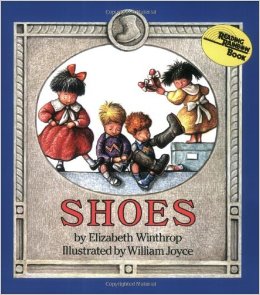
Shoes by Elizabeth Winthrop Illustrated by William Joyce Picture Book Review

About the Holiday

Today’s observance was begun in 2014 by Donald Zsemonadi and the United Indigenous People in Fontana, California to raise awareness of the more than 500 million people around the world who have no shoes to wear. These children, teenagers, and adults must walk barefoot wherever they go, enduring harsh terrain and long distances without relief or protection. Such conditions lead to further problems, which can be lifelong and life-threatening.

Some national and international organizations and companies provide ways you can help by donating new and gently worn shoes or through buy one/give one programs.

Shoes

Written by Elizabeth Winthrop | Illustrated by William Joyce

Kids love shoes—especially if their squeaky new or completely destroyed. In this classic picture book by Elizabeth Winthrop and William Joyce, an incredible array of feet coverings are introduced in a jaunty, bubbling perfectly rhymed poem that makes the reader look at shoes in a new and appreciative way.

Kids who are often stuck behind tall adults or seemingly sky-high counters will recognize “shoes too low.” And all kids know that wearing “Shoes to skate in, shoes to skip in, shoes to turn a double flip in” or “shoes for fishing, shoes for wishing, rubber shoes for muddy squishing” means the day is going to be awesome.

A fun-to-read rhyme at the end of the book sprints to an unexpected and completely satisfying twist.

Interpreting all of these shoes is William Joyce in his inimitable style. The rakish children ponder tangled laces; tower over friends with stilts; tumble, jump, and turn somersaults; skate, climb, and perform for an audience all while shod in the finest of shoes. Joyce’s adorable children make this a book kids will want to read and/or hear again and again.

Ages 4 – 8

Harper Collins, 1988 | ISBN 978-0064431712

National Shoe the World Day Activity

CPB - Shoe Day Maze

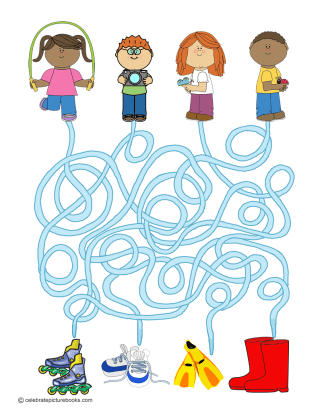
Tangled Laces Shoe Match

Four kids think today’s a perfect day to go swimming, stomping in the mud, roller skating, and climbing trees. But they can’t find the right shoes for their favorite activity! Can you untangle the shoelaces and help each kid have a fantastic day? Print the Tangled Laces Shoe Match puzzle and get started!

March 14 – National Pi Day

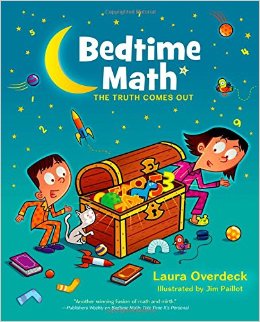
Bedtime Math The Truth Comes Out Picture Book Review

About the Holiday

What would we do without pie, huh? The flaky crust, the delicious filling….What? Oh, how embarrassing! It’s Pi Day! Well, what would we do without pi, huh? All those circles would go unmeasured, the world just wouldn’t fit together quite right…

Pi Day recognizes the usefulness of the mathematical constant Pi, the first three numbers of which are 3.14. In 1988 Larry Shaw noticed the correlation to March 14 and organized the first Pi Day celebration at the Exploratorium in San Francisco, California. In 2009 The U.S. House of Representatives officially named March 14 as National Pi Day. The day is celebrated by schools and other organizations with math projects, pie-eating contests, and other fun events.

Bedtime Math: The Truth Comes Out

Written by Laura Overdeck | Illustrated by Jim Paillot


Bedtime has never been so numerical! Oh sure, kids might count the stars out their window or sheep leaping a fence, but how about flavors of astronaut ice cream or towns named for food? Wouldn’t it be fun to figure out how far a marshmallow shot from a rubber band will go? Or how to stop a charging rhino? Or whether a snake can lose its tongue? You bet it would! And that’s the genius behind the Bedtime Math series, which also includesBedtime Math: A Fun Excuse to Stay up Late and Bedtime Math: This Time It’s Personal.

Bedtime Math goes way beyond simply presenting math problems for kids to solve. Each problem begins with fascinating facts or trivia about topics kids care about, such as space, animals, food, themselves, and the world they live in. Adults will find as much to like about these revealing tidbits as kids.

Reluctant math students will respond to this series, as the presentation is light-hearted, humorous, and educational in the best way. They may not even realize they’re doing higher math as they try to solve these brain ticklers.

Each mind boggler comes with three difficulty levels—Wee Ones, Little Kids, and Big Kids—plus a bonus question that’s more advanced so that everyone can join in the fun. An extensive introduction gives tips and suggestions for using the book and answers any questions readers may have about the approach.

Of course, these cool calculations don’t have to wait for bedtime. They’re a smart way to fill those “I’m bored” moments or to just spend time together no matter when it is. Bedtime Math has expanded to include its own website and a nation-wide afterschool math club, Crazy 8s.

Author Laura Overdeck began using this technique to math learning with her own children and with a BA in astrophysics is well-qualified to take your child’s math skills to the stars and beyond!

Jim Paillot enhances each page with colorful exaggerated and humorous takes on the math teaser at hand, which increase kids’ interest in and even understanding of the concepts being “taught.”

Ages 3 – 8

Feiwell & Friends Publishers, 2015 | ISBN 978-1250047755

National Pi Day Activity

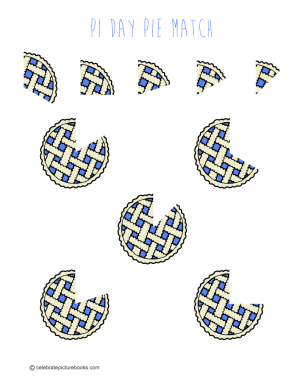
CPB - Pi Day Pie Match


Pi Day Pie Match


All this talk about math has made me hungry! You too? Well, just put these pies together and then you can enjoy a snack! Print the Pi Day Pie Match game here.

March 13 – National Earmuff Day

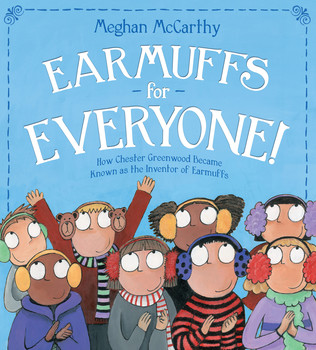
Earmuffs for Everyone! by Meghan McCarthy Picture Book Review

About the Holiday

On March 13, 1877 Chester Greenwood—a 19-year-old inventor—received a patent for “improvements in ear-mufflers” and forever sealed his place in history—as well as making winter more comfortable for millions of freezing ears! Today we honor Chester and his invention that brought attention to Farmington, Maine and jobs for many people in the area. So if you live in an area where the cold winds are still blowing, wear your earmuffs in pride!

Earmuffs for Everyone! How Chester Greenwood Became Known as the Inventor of Earmuffs

By Meghan McCarthy


In the mid-1800s inventors were trying to solve the problem of winter’s chill effects on tender ears. William Ware designed an “ear, cheek, and chin muff” that one wore somewhat like a false beard. Ear protecting hats, ear “slippers,” high collars, and other designs followed. But it wasn’t until Chester Greenwood and his sensitive protruding ears came along that earmuffs became practical. While the exact steps Chester took in creating his earmuffs aren’t known, he eventually perfected his invention and received a government patent on March 13, 1877—when he was only 19 years old!

Chester was no one-invention wonder, though. Always on the lookout for clever ways to make money, he went on to improve other products. He applied his foresight to the tea kettle, rounding the edges of the bottom to reduce wear; constructed an interchangeable-tooth rake; and built a collapsible, if cumbersome, tent.

His inventions brought him a comfortable life—a beautiful house for his family in Maine, the first steam car in his town, and a bicycle shop on the bottom floor of his workshop—that he shared with others. His wife, also a progressive thinker, worked for women’s suffrage, and inspired her husband to hire women in his workshops.

After Chester passed away, some people, most notably Mickey Maguire, thought he deserved more acclaim—even a day dedicated as Chester Greenwood Day. Maguire was so excited about this that he became a kind of inventor himself—an inventor of tall tales. Over time he told some whoppers and they were printed, making it hard to separate fact from myth. But even without the made-up stories, it’s easy to say that Chester Greenwood had a very remarkable life

Earmuffs for Everyone goes beyond the story of Chester Greenwood to include other inventors, a discussion of the patent system (using products well-known to today’s kids), and how an inventor’s legacy grows. Meghan McCarthy writes with verve and humor, making the story of Greenwood’s invention as well as others’ creations inviting, accessible, and fun. Her illustrations of the first attempts at earmuffs and other1800s products are sure to delight kids and make them curious about the time period.

In her author’s note at the back of the book, McCarthy expands on the story of Chester Greenwood and the process of applying for and earning a patent.

Ages 4 – 8

Simon & Schuster/Paula Wiseman Books, 2015 | ISBN 978-1481406376 

National Earmuff Day Activity

CPB - Earmuff Maze.png

Here’s to Warm Ears! Maze


One muff on each side of the head—Genius! But it took inventors a lot of trial and error to make the perfect warming headgear. Use your own creative thinking on this Here’s to Warm Ears!earmuff-shaped maze. Solution included.

March 12 – National Plant a Flower Day

MIss Maple's Seeds by Eliza Wheeler Picture Book Review

About the Holiday

It’s March—that funny month when some people are basking in 80-degree sunshine and others are still shoveling snow. But no mater where we live, we’re thinking about the same thing—Spring! Spring brings new green leaves, gentle rains, and little shoots that will grow to be trees, vegetable and fruit plants, and flowers. Whether you live somewhere warm and can already plant outside or somewhere that’s still a little chilly and requires indoor propagation, planting flower seeds is a perfect way to beautify your home and your life.

Miss Maple’s Seeds 

By Eliza Wheeler


Late in the summer, Miss Maple hurries to prepare for some very special guests. She has searched all summer for unplanted “orphan” seeds, and baskets full of them are winging their way to her home on the backs of bluebirds. Once they arrive she “learns each seed by heart.” There are poppy, wild rice, maple, water lily, pine, impatiens, apple raspberry, sunflower, acorn, pea, fern seeds, and as many more as make up our world.

As she lovingly tends to each one, she says, “Take care, my little ones, for the world is big and you are small.” Miss Maple takes them on field trips and shows them the world they will inhabit—the muddy soil along riverbanks, grassy fields, and thick forests. She cautions them about “weedy characters” who can show up even in a “bustling garden.”

At night Miss Maple snuggles each seed into a comfy bed and reads to them by the light of fireflies. During the winter Miss Maple entertains other guests—woodland creatures who gather in her maple tree home and share food, stories, and songs. With the spring come rains and new lessons on burrowing into the ground.

May ushers in another summer, and Miss Maple knows it’s time for her little ones to “find roots of their own.” She sends them out into the world, knowing that she has prepared them well for what they will become. Her seeds say goodbye and sail off to begin their futures, and Miss Maple is left alone. But soon another summer day comes, and Miss Maple sets off to gather more orphan seeds, because “the world is big and they are small.”

Eliza Wheeler’s Miss Maple’s Seeds is a triumph—as comforting as a warm blanket and as empowering as a master key. Wheeler’s beautiful language floats quietly and unhurried like the flight of a leaf on a gentle breeze. The metaphor of seeds and children is so sweetly made, and Miss Marple’s wish for her little charges can bring a tear to the eye of any caretaker.

Wheeler’s luminous artwork is breathtaking in its fully realized details of the wide world Miss Maple’s seeds and all of us inhabit. Each season is gorgeously rendered in soft blues, roses, browns, and yellows, and she imbues the little seeds with personality without making them anthropomorphic. The reader may wish they could be friends with these future beauties and Miss Maple as well.

Miss Maple’s Seeds would be a wonderful gift for high school graduates, teachers, and anyone who loves taking care of children.

Ages 3 – 7, all ages

Nancy Paulsen Books, an imprint of Penguin Group | ISBN 978-0399257926

Plant a Flower Day Activity

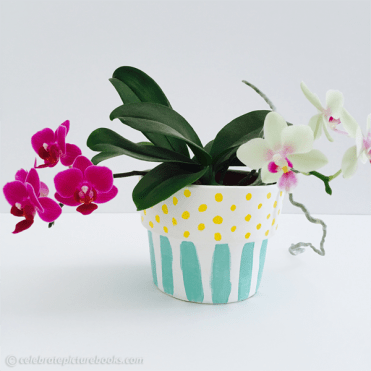
CPB - Flower Pot

Decorated Flower Pot


Spring is almost here, and that means flowers will soon be blooming. If you want to beautify your home plant your favorite flower seeds in a pot you’ve decorated yourself!

Supplies

  • Terra cotta pot in any size
  • Acrylic multi-surface paint in various colors
  • Flower seeds
  • Soil

Directions

  1. Paint your terra cotta pot—be creative!
  2. Let paint dry
  3. Fill pot with soil
  4. Plant flower seeds

March 11 – Johnny Appleseed Day

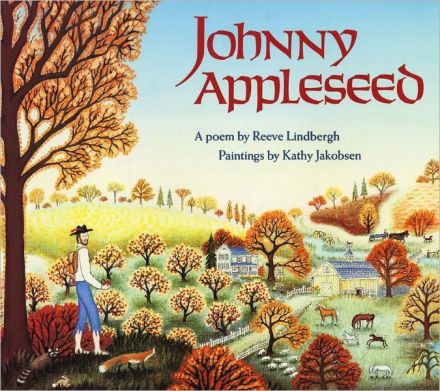
celebrate-picture-books-picture-book-review-johnny-appleseed-cover

About the Holiday

If you love apples, apple pie, applesauce, and all things apple, you probably have John Chapman to thank. John Chapman was a remarkable man who lived his values of kindness and generosity as he journeyed across the newly opened American frontier in the early 1800s. He is most commonly known as Johnny Appleseed for the apple seeds he planted and nurseries he founded across the country. Apples were a welcome crop—easily grown and stored for consumption throughout the year. He was well loved by the people he met on his travels, respected by the Native Americans, and gentle with all animals. Today we remember his contributions to the growth of America and his inclusive beliefs.

Johnny Appleseed

Written by Reeve Lindbergh | Illustrated by Kathy Jakobsen


As the poem opens, John Chapman approaches the simple Goodwin cabin in the woods. “Young Hannah Goodwin saw him first, / A stranger lean and lorn, / His face was thin, his feet were bare, / His clothing old and worn.”

Hannah first meets Johnny Appleseed when she is a little girl and he accepts the family’s invitation to dinner. He is an engaging source of entertainment, news, and stories about the American frontier, but he cannot stay long as he must continue his mission to plant apple trees across the country. Although John Chapman’s work takes him far away, Young Hannah heard the tales of him / All through her growing years / As he brought apples, sharp and sweet, / To other pioneers.

celebrate-picture-books-picture-book-review-johnny-appleseed-kathy-jakobsen-across-the-wild-frontier

Image copyright Kathy Jakobsen, courtesy of kathyjakobsen.com

The stories are exciting and comforting. Johnny Appleseed walks through any weather, is trusted by Native Americans, and lives peacefully with all animals, all the while scattering seeds along his path.

As an old man John Chapman returns to the Goodwin house, now nestled among a mature apple orchard. “Old Hannah Goodwin saw him last / when many years had gone. / He came in by the orchard gate / A quiet hour past dawn.”

Again, he regales Hannah with stories of his adventures and how the trees he had planted helped families thrive and make America strong. “There was spicy apple cider now / Out on the western plain. / There was applesauce in Iowa / and apple pie in Maine.

Although Hannah never sees John Chapman again, she passes down his legacy to her children, just as we still do today.

celebrate-picture-books-picture-book-review-johnny-appleseed-kathy-jakobsen-in-an-apple-orchard

Image copyright Kathy Jakobsen, courtesy of kathyjakobsen.com

The format of Reeve Lindbergh’s rhythmic and rhyming poem is a fitting tribute to the life of Johnny Appleseed. The lyrical lines flow as smoothly as the reader might imagine John Chapman tread across the Midwest plains and rugged West. With evocative language and a straightforward delivery, Lindbergh echoes the philosophy of simplicity and steadfastness that guided John Chapman’s life.

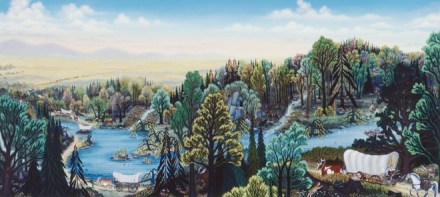
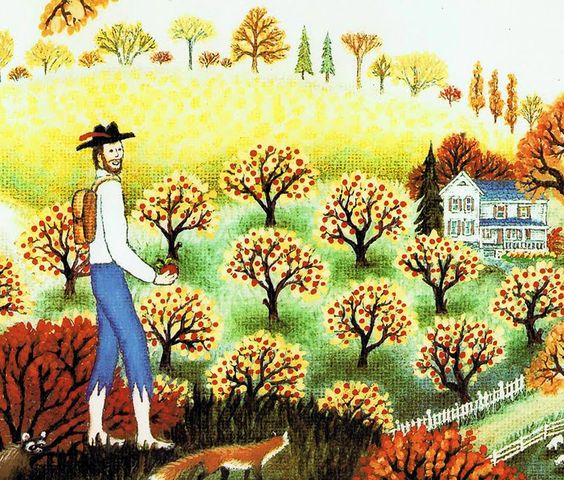
Kathy Jakobsen, one of America’s premiere folk artists, has embraced the story of Johnny Appleseed in stunning paintings of an America at her beginning. Depictions of rolling hills dotted with farms and trees, stone mills, horse-drawn carts loaded with apples, families at home and on the move in Conestoga wagons, as well as lush scenes of John Chapman interacting with nature and Native Americans portray the grandeur of America and the singularity of Johnny Appleseed. A quilt of small paneled scenes surround the text on each left-hand page, while the right page is fully dedicated to Jakobsen’s work.

Ages 5 – 8

Little Brown Books for Young Readers, 1998 | ISBN 978-0316526340

Johnny Appleseed Day Activity

CPB - Cinnamon Apples (2)

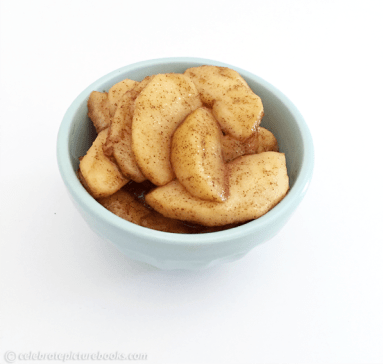
Cinnamon Apples Recipe


Cinnamon apples are a delicious side dish to any meal! This tasty recipe is fun for kids and adults to make together.

Ingredients

  • 4 cups of apples, Macintosh or Granny Smith apples are good choices
  • 2 tablespoons brown sugar
  • 1 teaspoon cinnamon
  • 1/4 teaspoon lemon juice

CPB - Cinnamon Apples ingredients (2)

Directions

  1. Mix brown sugar and cinnamon
  2. Peel and core 2 large apples
  3. Thinly slice apples
  4. Combine apples and cinnamon sugar/brown sugar mixture
  5. Stir until well combined
  6. Drizzle with lemon juice and stir again
  7. Cook apples on the stove at medium heat for 8 to 10 minutes or until desired texture


March 10 – National Pack Your Lunch Day

Lunch Money and Other Poems About School by Carol Diggory Shields and Paul Meisel picture book review

About the Holiday

When you pack your own lunch, you can’t wait for the clock to strike lunchtime! Today is a day to celebrate the joy of a midday meal featuring your favorite foods and snacks. So if you usually just eat what the cafeteria offers, think outside the tray and create a lunch that’s delicious, nutritious, and even fun!

Lunch Money and Other Poems About School

Written by Carol Diggory Shields | Illustrated by Paul Meisel


Ask a kid what their favorite part of school is and they’re likely to say, “Lunch!” So it’s appropriate that this poetry collection about the fun and foibles of school contains several poems scrutinizing that special half hour out of the classroom. In “Decisions” a boy contemplates the school menu stuck to the refrigerator. Tacos, pizza, burger, nachos? Buy it! Beef stew, baked beans, tuna-cabbage crunch, mushroom-chicken bake? Bag it!

“Lunch Money” finds a boy asking first Dad, then Grandma, and finally Mom for cash. But who can he rely on? Only his own piggy bank. “Swap” is a rollicking round robin rhyme of traded sandwiches, swapped fruit, bought and sold drinks, bartered cookies, exchanged bagels, and great deals made. But does the result on the plate look oddly familiar?

Lunch isn’t the only subject in this delightful collection, though. In “Eight-Oh-Three” a boy “Legs pumping, heart thumping, / Running down the drive,” and late for the bus—“A moaning-growning, blinking-winking / Yellow dinosaur”—asks the ironic question: “How come I have to run so fast / To catch a bus so slow?”

“Code” is medical code for “cold” in a short poem about the linguistic acrobatics of a stuffy nose. “And the Answer Is…?” offers an impassioned debate between one student who likes to answer the teacher’s questions and another who just wants to hide under the table. And “Whew!” is a delight in which a student who isn’t prepared for the day finds a substitute standing at the front of the class. Other topics that make an appearance are the school mischief maker, the class pet, recess rules, homework, recess, and the inevitable school nightmare that follows you into adulthood.

Carol Diggory Shields understands school—the moments of camaraderie, embarrassment, mayhem, wishful thinking, and more—that make up each day. Her flowing, easy-to-read rhythms and humorous twists makes this poetry collection enchanting and an excellent addition to any home library.

Paul Meisel’s illustrations are populated with all kinds of kids you’d want to meet. With curly hair or straight, pony tails or bows, wearing stripes or polka dots, shorts or pants, each child is given his or her own personality as they romp through the scenario of their accompanying poem. Whether the kids are in a classroom or at home or on the playground, the details of their environment are richly drawn. The counters are lined with science projects, the clock moves so slowly a spider has spun a web on its hands, and the kindergarten play as well as the lunch room are humorously chaotic. There is so much to see on each page that kids will recognize, but experience anew.

Ages 4 – 8

Puffin Books, 1998 | ISBN 978-0140558906

National Pack Your Lunch Day Activity

CPB - Bento Box (2)

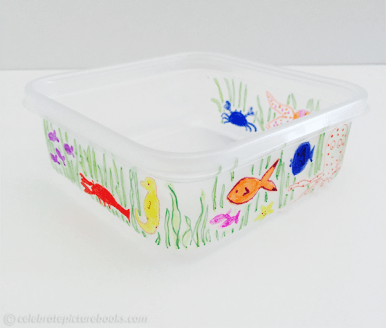
Decorated Sandwich or Snack Container


Who says your snack or sandwich container has to be boring? Take your lunch to school in a container you decorate yourself! It’s easy with a few colored markers and your imagination!

Supplies

  • Disposable plastic food containers with lids
  • Colorful markers

Directions

  1. Decorate sandwich or snack size containers with your favorite designs or characters

March 9 – Learn What Your Name Means Day

The Name Jar by Yangsook Choi Picture Book Review

About the Holiday


American onomotology enthusiast Jeffery Hill established Clelbrate Your Name Week in 1997. Each day of the first ful week of March is dedicated to self discovery and the fun of learning more about names and your name in particular. Today’s holiday encourages people to learn not only what your name means, but also to reach out to parents or other and discover why you were given the name you have. 

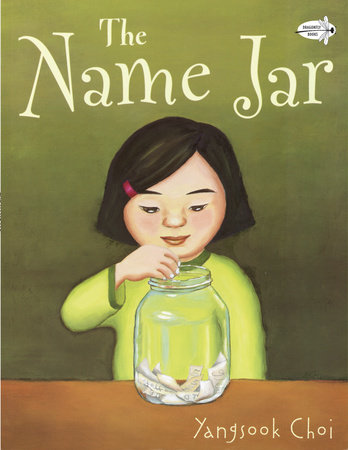
The Name Jar

By Yangsook Choi


Unhei has recently moved to the United States from Korea. Although Unhei is excited about the first day of school, on the bus ride she misses her former home and looks at the wooden name stamp her grandmother gave her. A boy sitting behind Unhei notices the unfamiliar object and asks about it. Then other kids notice Unhei. They ask what her name is, and when she answers, they mispronounce it, laughing and making jokes.
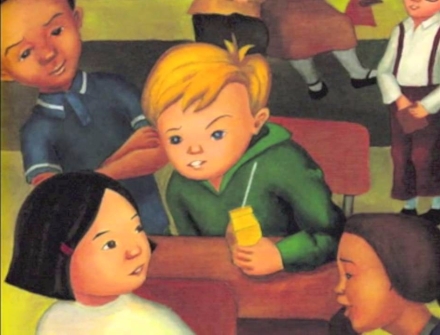
celebrate-picture-books-picture-book-review-the-name-jar-on-the-bus

Image copyright Yangsook Choi, courtesy of Random House

Unhei is embarrassed and glad that those kids head to a different classroom than hers. As Unhei enters her own room, her classmates smile and greet her—it is obvious that their teacher has prepared them for a new student, and they are excited.

Of course, they first question her about her name, and remembering the experience on the bus, Unhei is reluctant to answer. She quickly says that she hasn’t picked a name yet, but will tell them next week. At home, Unhei tells her mother that she wants an American name, a name that is easy to pronounce.

Her mother is dismayed; Unhei’s name was chosen by a master so that it would describe her uniqueness. But Unhei doesn’t want to be different, she just wants to fit in. Later while she and her mother are at a Korean grocery store, she introduces herself to the owner, who exclaims that her name is beautiful and means “grace” in English. 

celebrate-picture-books-picture-book-review-the-name-jar-mom

Image copyright Yangsook Choi, courtesy of Random House

At home Unhei tries out American names in front of the mirror—Amanda, Laura, Susie—but they don’t feel or sound right. The next day at school Unhei finds a jar on her desk with pieces of paper in it. On each piece of paper is a name—suggestions from each of her classmates. Her new friends have chosen these names thoughtfully. Daisy is the nickname of one girl’s baby sister; Tamela is a smart and brave heroine from a story; and Wensdy is the day Unhei joined their class.

At the end of the school day, a classmate named Joey comes to her. He knows she actually does have a name, and Unhei, while not wanting to say it out loud, shows him the characters on her wooden stamp. Joey thinks it is beautiful and asks to keep the paper. Day by day the glass jar fills up with names. Unhei will have to choose soon.

One Saturday Unhei returns to the Korean grocery store. When Mr. Kim calls her by name, the one other customer turns around. It’s Joey! Carefully and slowly he says Unheis name until he gets it right. On Monday when Unhei enters the classroom, she discovers that the jar is missing. It’s all right, though, Unhei has chosen her name.

celebrate-picture-books-picture-book-review-the-name-jar-friend

Image copyright Yangsook Choi, courtesy of Random House

She walks to the chalkboard and writes her real name in English and Korean. She tells the class that her name means “grace.” Other kids reveal the meaning of their names, and they all practice saying Unhei’s name. That evening Joey comes to visit. He explains that he took the jar because he wanted Unhei to keep her original name. He suggests putting Korean nicknames into the jar for their classmates to pick—just as he already has. Mr. Kim helped him choose the prefect nickname: Chinku, which means “friend.”

Ages 3 – 8

Random House, Dragonfly Books,  New York, 2003 | ISBN  978-0440417996

Discover more about Yangsook Choi, her books, and her art on her website!

Yangsook Choi’s The Name Jar is as timely now as when it was first written. Through compelling and detailed storytelling, Choi explores the themes of identity, empathy, family, friendship, and more  with sometimes heartbreaking honesty. Unhei’s varied experiences at school, at home, and at the market provide an opportunity for adults and children to discuss and embrace the diversity of our multicultural world. Choi’s warm-toned illustrations reveal the conflicts that Unhei encounters and her growing confidence as she makes friends with Mr. Kim and Joey who accepts her as she is. 

Learn What Your Name Means Day Activity
CPB - Name Jars standing

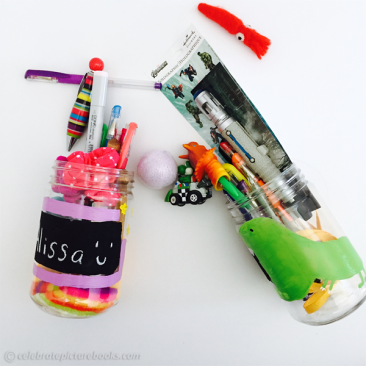
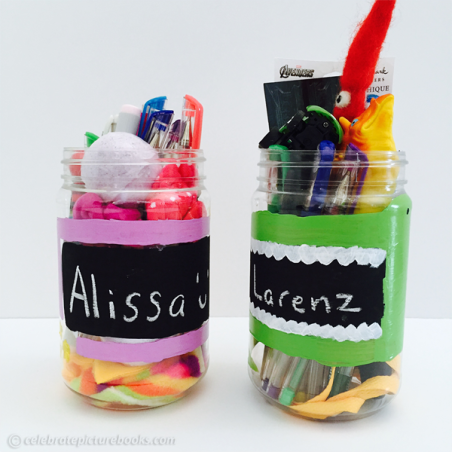
Love Your Name Organizer Jar


Everyone needs a place to store their special stuff! Here’s a way to recycle a plastic jar and make a cool organizer jar with your or your friend’s name on it.

Supplies

  • A large plastic jar, such as a peanut butter jar or mayonnaise jar with the label removed
  • Acrylic multi-surface paint or markers
  • Chalkboard paint
  • Paint brush
  • Chalk

CPB - Name Jars on sides

Directions

  1. Paint a rectangle on the front of the jar with chalkboard paint
  2. Decorate the rest of the jar with paint, markers, or paper