July 20 – National Moon Day

celebrate-picture-books-picture-book-review-to-the-stars-cover

About the Holiday

Today’s holiday celebrates the astounding technological achievement that saw men land—and walk—on the moon. On July 20, 1969 Apollo 11 with astronauts Neil Armstrong, Buzz Aldrin, and Michael Collins touched down on the moon. Six hours after landing, Armstrong made the first “small step for man, one giant leap for mankind” when he descended the ladder of the space craft to the moon’s surface. He spent two and a half hours exploring our nearest neighbor. Aldrin also made a lunar walk. Between them, the two astronauts brought 47.5 pounds of material back to Earth. Millions of people watched live coverage of the moon landing on television, cheering along with NASA at this amazing feat.

To the Stars! The First American Woman to Walk in Space

Written by Carmella Van Vleet and Dr. Kathy Sullivan | Illustrated by Nicole Wong


As a child Kathy Sullivan loved to explore. Her father designed airplanes, and when he brought home blueprints, she carefully studied every line and curve. When she saw airplanes in the sky she wished she were on them, flying to exciting locations all over the world. Maps and foreign languages fascinated her. “Their strange symbols, exotic tales, and musical sounds made her feel like the world was waiting for her.” Kathy wanted to see that whole world and thought maybe she’d like to be a spy or a diplomat, but her friends and other adults told her those weren’t jobs for women.

celebrate-picture-books-picture-book-review-to-the-stars-blueprints

Image copyright Nicole Wong, courtesy of nicole-wong.com

But Kathy always followed her heart. She loved going fishing with her dad and brother, finishing the day with a swim. She “delighted in how her arms and legs moved in slow motion underwater.” Kathy was still a teenager when she learned how to pilot a plane. At first the busy instrument panel made her nervous, but she quickly learned how to manage all the “dials, buttons, and numbers.”

Kathy got a taste for the thrill of space when she bravely jumped at the opportunity to ride in a Breezy—an open air framework plane. Sitting at the very tip of the airplane, in front of the pilot, Kathy had a bird’s eye view. “The wind rushed past her face so fast it pushed her cheeks back. Higher! Faster! Young Kathy looked at the ground below her feet. She felt like she could see the whole world.”

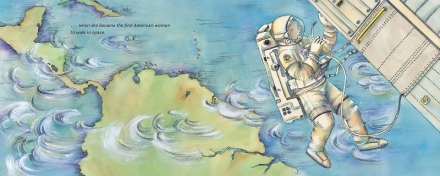
Later, as the first American woman to walk in space, she did!

celebrate-picture-books-picture-book-review-to-the-stars-spacewalk

Image copyright Nicole Wong, courtesy of charlesbridge.com

Carmella Van Vleet and Dr. Kathy Sullivan, have written a compelling biography of Dr. Sullivan that not only tells the story of her adult achievements, but also reveals the childhood and teenage motivations and influences that fostered her journey to the stars. As each event in Kathy’s young life is introduced, it is followed by an adult accomplishment: Kathy’s poring over her father’s aircraft blueprints leads to a spread of college-age Kathy studying charts in textbooks. Her enjoyment of swimming underwater is followed by an illustration showing her NASA training underwater. Her initial introduction to a plane’s instrument panel informs her later responsibilities inside the spacecraft. And the question she once asked herself as a child—what kind of job would allow her to see the whole world—is answered as the astronaut Kathy gazes down at Earth from space.

celebrate-picture-books-picture-book-review-to-the-stars-breezy

Image copyright Nicole Wong, courtesy of charlesbridge.com

Nicole Wong’s lovely, realistic watercolor and ink paintings clearly show readers Kathy Sullivan’s trajectory from curious girl to accomplished astronaut. The blueprints that Kathy studies are filled with schematics. The aqua water she swims in swirls and bubbles in the wake of her cannonball dive, the crisscrossing fields lay like a mottled green quilt under the Breezy. Especially stunning and effective are the illustrations of Dr. Sullivan’s work with NASA. Kids will love the up-close view of the spacecraft’s instrument panel with its myriad buttons and dials, and find the gorgeous two-page spreads of the space shuttle’s launch, the view from the cockpit, and Kathy’s spacewalk particularly thrilling.

Following the text are a personal note from Kathy Sullivan to her young readers, as well as more extensive biographical notes on how Dr. Sullivan discovered her love of science and the NASA missions she supported. Two more pages highlight the women of the first space-shuttle class, which included Kathy Sullivan, and other firsts by eight other women in space.

To the Stars is a wonderful book to teach children that following their own heart is the best path to future happiness and personal accomplishment. It’s a nice addition to any budding scientist’s or adventurer’s library!

Ages 5 – 9

Charlesbridge, 2016 | ISBN 978-1580896443

To find fun activities for To the Stars—including how to make space play dough—as well as other books by Carmella Van Vleet, visit her website!

To learn more about Nicole Wong and view a portfolio of her artwork, visit her website!

National Moon Day Activity

celebrate-picture-books-picture-book-review-moon-and-earth-coloring-page

Out of this World Coloring Page


The view of the Moon from Earth or of Earth from the Moon is spectacular! Have fun coloring this printable Out of this World Coloring Page!

Picture Book Review

June 6 – Russian Language Day

celebrate-picture-books-picture-book-review-mussorgsky's-pictures-at-an-exhibition

About the Holiday

Established in 2010 by the United Nations Educational, Scientific, and Cultural Organization, Russian Language Day honors the music, art, and other unique aspects of this intriguing country. The observance coincides with the 1799 birthday of Alexander Pushkin, a Russian poet who is considered the father of Russian literature. Celebrations include concerts, readings, and other cultural events. Today, listen to the music of a Russian composer, read a novel or short story, or learn a few Russian words!

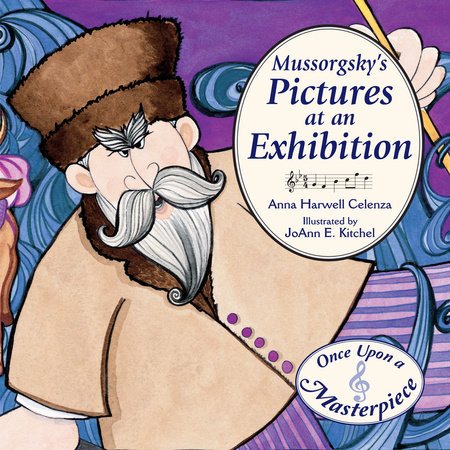
Mussorgsky’s Pictures at an Exhibition (Once Upon a Masterpiece Series)

Written by Anna Harwell Celenza | Illustrated by JoAnn E. Kitchel


It’s the 1870s and Russian culture is enjoying a resurgence. Young musicians and artists are excited to be recognized by the world. Three friends—Modest Mussorgsky, a musician; Victor Hartmann, an artist and architect; and Vladimir Stasov, an art critic—have big plans for their work. Victor, especially, has dreams of designing the new City Gate in Kiev. But on July 23, 1873 Victor suffers an aneurysm and dies. Modest is devastated. He feels that Victor’s death is his fault because he had dismissed Victor’s complaints about a headache only days before. Although Vladimir tries to comfort his friend, Modest pushes him away.

Modest stops going out, he stops being happy, and he stops writing music. Meanwhile Vladimir organizes an exhibition of Victor’s art so everyone will remember him. Vladimir and other friends think that seeing Victor’s work displayed will help Modest come to terms with his friend’s death. When the exhibit is ready, Vladimir visits Modest to invite him to come. When Modest refuses, Vladimir locks the door, puts the key in his pocket, and tells Modest he had two choices: either go to the exhibition or have a new roommate in Vladimir. Modest reluctantly agrees to go.

When they reach the gallery, Modest reluctantly enters. He is awestruck. “Every inch was filled with Victor’s hopes and dreams, his fears, and his greatest triumphs.” Slowly Modest wanders through each room, gazing at the paintings that bring back such vivid memories. He sees familiar faces, costume designs, children, couples, peasants, even Baba-Yaga, a witch from Victor’s favorite fairy tale.

Modest stops in front of Victor’s picture “The Great Gate of Kiev.” Tears fill his eyes and he thinks, “This was to be your greatest achievement…now it will never be more than a dream. If only I could build it for you.” He studies the picture for a long time, and suddenly an idea comes to him—“Maybe I can build it for you!” He dashes from the gallery straight to his piano.

As Modest thinks about Victor’s art, “one by one the spirit of each picture filled the room.” The images rise from the piano and Modest follows them from one theme to another, note by note. Some passages he plays are slow and sad, others clear and quick, while still others flutter or whisper. Even Baba-Yaga makes an appearance. With each chord special parts of Victor came to life until the last majestic strains built the Great Gate of Kiev in music. Modest calls his composition Pictures at an Exhibition.

With the spirit of his friend Victor in his heart. Modest Mussorgsky goes on to compose operas and visit with friends. Vladimir Stasov also follows his dreams to travel far and wide, and wherever he goes he tells people about Victor and Modest’s Pictures at an Exhibition

Anna Harmann Celenza relates the heartfelt story of the origins of Modest Mussorgsky’s great work with sensitivity and honors the emotional origins and effect of his Pictures at an Exhibition. The hopes of the three friends as well as the details of Victor’s artwork are evocatively described, allowing children to easily picture the feelings and objects that influenced Mussorgsky’s music.

Both the colorful architecture of Russia and the soaring notes of Mussorgsky’s music are beautifully depicted in JoAnn E Kitchel’s illustrations. Each one-and-a-half-page spread depicting scenes of St. Petersburg, Modest’s apartment, the art gallery, musical imagery, and the theater is framed in lovely floral borders, tying together the themes of art and music. Rich purples, regal blues, fiery reds, and glowing yellows makes this book a feast for the eye as well as the mind.

The book is accompanied by a CD of Mussorgsky’s work, making Pictures at an Exhibition a must have for music lovers of all ages.

Ages 6 – 10 and up

Charlesbridge, 2016 | ISBN 978-1580895286

Russian Language Day Activity

celebrate-picture-books-picture-book-review-russia-word-search

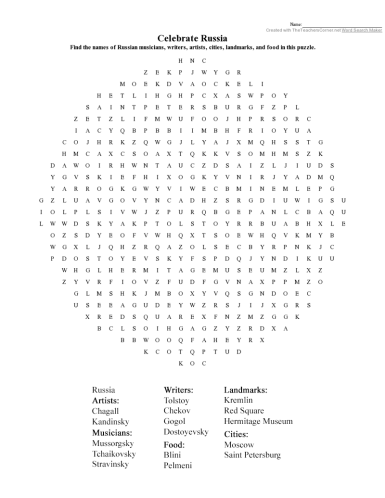
Celebrate Russia Word Search


Find the names of Russian musicians, artists, writers, cities, and more in this circular word search. Print your Celebrate Russia Word Search here! And here’s the Solution!

Picture Book Review

May 24 – Brother’s Day

celebrate-picture-books-picture-book-review-the-day-glo-brothers

About the Holiday

Brothers share a special bond built on mischief, inside jokes, shared experience, and love. If you have a brother—either by blood or friendship—spend some time with him, give him a call, or just text and say, “hi.”

The Day-Glo Brothers: The True Story of Bob and Joe Switzer’s Bright Ideas and Brand-New Colors

Written by Chris Barton | Illustrated by Tony Persiani


Before the Switzer brothers had their bright idea, the world was a much less colorful place. Bob Switzer, born in 1914, loved to work and saved his money for exciting plans. His younger brother Joe loved magic and had an inventive mind. When the family moved to Berkley, California, Joe developed a magic act that included “black art” in which an object that was painted half black and half white seemed to float and disappear in midair.

Joe loved this trick but thought it could be better. Meanwhile Bob planned to become a doctor. But during the summer before he began college, Bob had an accident that ended his plans. Because his injury effected his head, he had to recover in a darkened room. While Bob healed, Joe spent time in the basement with him studying the glow of fluorescence, hoping to use it in his magic show. Together the brothers built an ultraviolet lamp which they tested in their father’s pharmacy. When they shone it on a shelf full of bottles, a container of eyewash glowed yellow.

celebrate-picture-books-picture-book-review-the-day-glo-brothers-inventing

Image copyright Tony Persiani, text copyright Chris Barton. Courtesy of Charlesbridge

The brothers had an idea. They experimented with chemicals that could make paints glow in the dark. In regular light the paint looked normal, but under ultraviolet light it radiated attention-getting colors. That was great for Joe’s magic act, but Bob thought these paints could be used for other things too, such as store-window displays. Selling the paint could help pay for Bob’s medical bills too.

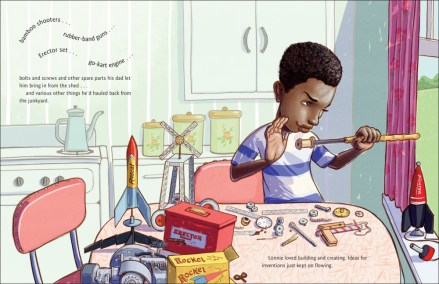
Bob and Joe searched through the university and other labs for other fluorescent materials. They then combined them with other ingredients in their mother’s mixing bowl to create glowing paints and even once—when the mixing bowl was not cleaned well enough—a very colorful cake!

celebrate-picture-books-picture-book-review-the-day-glo-brothers-inventing

Image copyright Tony Persiani, text copyright Chris Barton. Courtesy of Charlesbridge

Joe used these paints to major effect in one of his acts in which a dancing woman “lost her head” as Joe, unseen by the audience in the darkened theater, took off her headdress as she danced away. This trick brought Bob and Joe lots of customers for their original paints. But there was one problem: these colors only shone under ultraviolet light.

One day in 1935, however, one of Bob’s experiments resulted in a surprising innovation—a dye that glowed even in daylight. Bob didn’t know how exactly it had worked, so the brothers continued experimenting. Finally, they discovered the secret when an orange billboard they had created glowed as if it were on fire even in the daytime! The brothers then created reds, yellows, greens, and other colors that could do the same thing.

During World War II these glowing colors were used on fabric panels used to send signals from the ground to airplanes overhead, in lifeboats, on buoys, and on other safety products. After the war the colors continued to influence culture and are still part of our lives today.

celebrate-picture-books-picture-book-review-the-day-glo-brothers-final

Image copyright Tony Persiani, text copyright Chris Barton. Courtesy of Charlesbridge

Older kids with a penchant for science and history will love this biography. Chris Barton goes in-depth to reveal the Switzer brothers’ dreams and motivations that resulted in a most astounding discovery. Barton infuses the story with humor and interesting details that will fascinate curious minds.

Using a retro style, Tony Persiani sets this biography in its time while also giving the story a modern feel. Gray scale tones become dotted with florescent color as the brothers’ experiments bear fruit and give way to eye-popping spreads with the ultimate success of Day-Glo paints and dyes.

Ages 7 – 12

Charlesbridge, 2009 | ISBN 978-1570916731

Brother’s Day Activity

celebrate-picture-books-picture-book-review-day-glo-maze

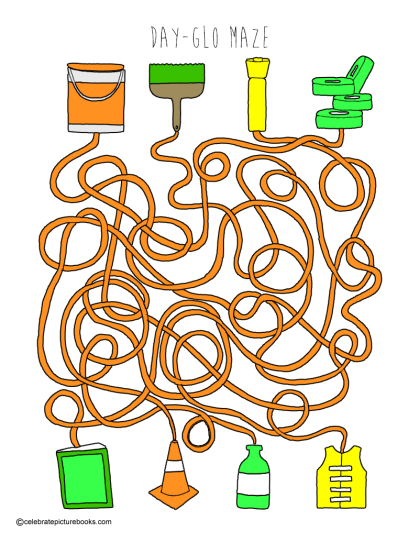
Day-Glow Maze


Follow the twisty glowing paths to match the Day-Glo product to the object they color! Print the Day-Glo Maze puzzle here!

Picture Book Review