About the Holiday
Established in 1998 by the United Inventors Association of the USA, the Academy of Applied Science, and Inventors’ Digest magazine, this month-long holiday celebrates the imagination and talent of individuals who dare to think differently and create new products, services, and ways of doing things that make a positive contribution to the world. To join in, enjoy your favorite new inventions, and if you harbor dreams of being an inventor—on a large or small scale—look for opportunities to share your ideas.
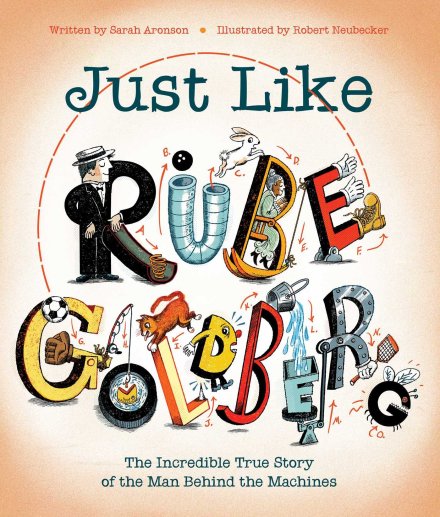
Just Like Rube Goldberg: The Incredible True Story of the Man Behind the Machines
Written by Sarah Aronson | Illustrated by Robert Neubecker
Famous inventors usually get that way by creating something new—something that people can’t live without, right? Well, it kind of was and wasn’t this way for Rube Goldberg—as you’ll see. Even as a very young boy, Rube Goldberg loved to draw. As a four-year-old he traced the cartoons in the newspaper and when he got older, he took art lessons. His dream was to be a cartoonist for a major newspaper.

Image copyright Robert Neubecker, 2019, text Sarah Aronson, 2019. Courtesy of Beach Lane Books.
Rube’s family was not so supportive, though. His father—who had moved to America from Germany so that his family could have a better life—believed his son would end up as a beggar if he pursued his art. So, Rube went to college and became an engineer for the Department of Water and Sewers in San Francisco—for six months. He gave up his good-paying job for a job as an errand boy at the San Francisco Chronicle at eight dollars a week. In between cleaning, emptying trash cans, and filing photographs, “Rube drew. And drew. And drew.”
Rube submitted his cartoons to the editor and most of the time they were rejected. When the editor “said yes, Rube sometimes got paid, but other times he just got out of the office tasks he didn’t like to do.” A year went by, and finally Rube was hired by the San Francisco Bulletin sports department, where he drew cartoons and wrote a column too. Then in 1906, the great earthquake hit San Francisco. Homes were lost, as were jobs. In the broken city, people couldn’t focus on their future or even feel hopeful. Rube “did the only thing he could do: He drew comics to cheer people up.”

Image copyright Robert Neubecker, 2019, text Sarah Aronson, 2019. Courtesy of Beach Lane Books.
Rube also decided to move to New York—the place he considered the “‘front row,’ the cartoon capital of the country.” For twelve days he showed his art to newspaper after newspaper and was finally hired by the New York Evening Mail as a cartoonist. “Right off the bat, Rube became a celebrity. People couldn’t wait to see what he had to say about all kinds of things.” He drew comics about sports, politics, and “the silliness of everyday life,” but the comics people loved the best were drawn by his alter ego, Professor Lucifer Gorgonzola Butts. The professor was known for his intricately complex inventions that made even the simplest action a “surreal and ridiculous” multi-step wonder that often defied physics.

Image copyright Robert Neubecker, 2019, text Sarah Aronson, 2019. Courtesy of Beach Lane Books.
He invented a machine that employed a carrot-eating goat, a ghost, an egg-laying chicken, an archer, a target with a mechanical hand, an upright-shooting canon, and dough that cooked in the smoke of the cannon as a cannonball shot through the middle of it. Turning off the light, might just require the pull of a cord, but in Professor Butts’ world, it also required a banana-laden fishing pole, a monkey bouncing on a balloon, a fan that turned a bicycle wheel, a jack-in-the-box, a bucket, a bowling ball, and seesaw. Perhaps one of the silliest was a contraption for cutting your own hair.
Of course, these gizmos weren’t designed to really work—only to make people “look closer. And question logic. And tickle the imagination.” At a time when new discoveries were being made all around, Rube Goldberg’s cartoons “challenged people to use the most amazing machine in the universe: the brain!” Do you have aspirations, thoughts, and dreams that seem out of the mainstream and wonder if this same kind of success is still possible? The answer is: “You bet it is.” So “figure out what you want” then work hard and “have a great time getting there…. Just like Rube Goldberg!”
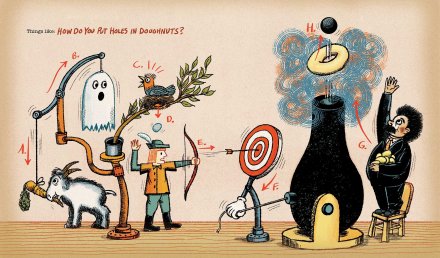
Image copyright Robert Neubecker, 2019, text Sarah Aronson, 2019. Courtesy of Beach Lane Books.
The book’s endpapers depict eight of Rube Goldberg’s original invention cartoons, and an Author’s Note following the text reveals more about Goldberg’s amazing life as a cartoonist, artist, and political observer. The awards he won and the children’s game inspired by his contraptions are also mentioned.
For Rube Goldberg fans, young inventors and artists, and anyone with a dream, Sarah Aronson’s story of this beloved cartoonist’s life is a fast-paced trip into the past and the fine tradition of lampoonery. Goldberg’s one-of-a-kind imagination and unstoppable confidence in his dream are on full display as he quits a lucrative job for the uncertainty of an artist’s life. His success and long career is a tribute not only to Goldberg himself, but to all the employers and consumers who recognize innovation and embrace it.
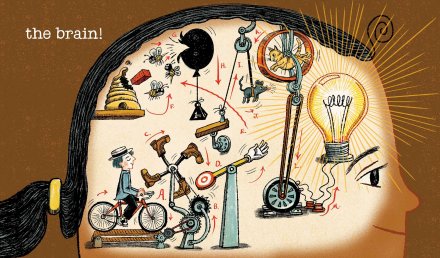
Image copyright Robert Neubecker, 2019, text Sarah Aronson, 2019. Courtesy of Beach Lane Books.
Robert Neubecker’s stylized and entertaining illustrations take inspiration from and honor Rube Goldberg while also transporting readers to the early 1900s. Kids will particularly enjoy the clever design that takes text through underground maze of the San Francisco Department of Water and Sewers and the busy newsroom—complete with carrier pigeon—where Goldberg found a home as a cartoonist. In two-page spreads, three of Goldberg’s cartoons are rendered in color, giving readers plenty to linger over and giggle at, and the final images are sure to spark a new appreciation for the imagination and its power.
Sure to create new fans of Rube Goldberg’s work, Just Like Rube Goldberg would be an exciting addition to home, school, and public libraries for all of those unique thinkers out there.
Ages 3 – 8
Beach Lane Books, 2019 | ISBN 978-1481476683
Discover more about Sarah Aronson and her books on her website.
To learn more about Robert Neubecker, his books, and his art on his website.
National Inventor’s Month Activity
Inventor’s Tool Kit
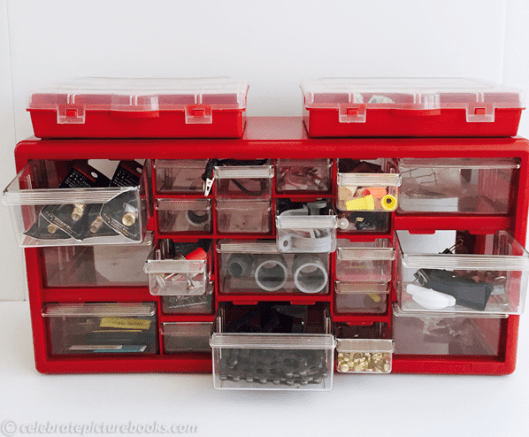
Every idea begins as a jumble of seemingly unrelated parts. Gathering whatever types of material inspires you and keeping it in a box ready to go when inspiration hits is a great way to support innovation and spark experimentation.
Supplies
- Small parts organizer with drawers or compartments, available at hardware stores and craft stores
- A variety of parts or craft materials that can be combined, built with, or built on
- Some hardware ideas—pulleys, wheels, small to medium pieces of wood, wire, nuts, bolts, screws, hooks, knobs, hinges, recyclable materials
- Some craft ideas—clay, beads, wooden pieces, sticks, paints, pipe cleaners, string, spools, buttons, glitter, scraps of material, recyclable materials
Directions
- Fill the organizer with the materials of your choice
- Let your imagination go to work! Build something cool, crazy, silly, useful—Amazing!

You can find Just Like Rube Goldberg at these booksellers
Amazon | Barnes & Noble | Books-a-Million | IndieBound
Picture Book Review