April 29 – It’s National Humor Month

celebrate-picture-books-picture-book-review-meet-the-dullards

About the Holiday

The whole month can’t go by without celebrating one of the most fantastic things about life—humor! Whether you’re laughing at a funny joke, your favorite comedian or comic strip, a silly mistake, or even yourself, a chuckle is good for you! Today, take time to relax and enjoy the absurd—and give a few hearty “Ha! Ha! Ha’s!” along the way.

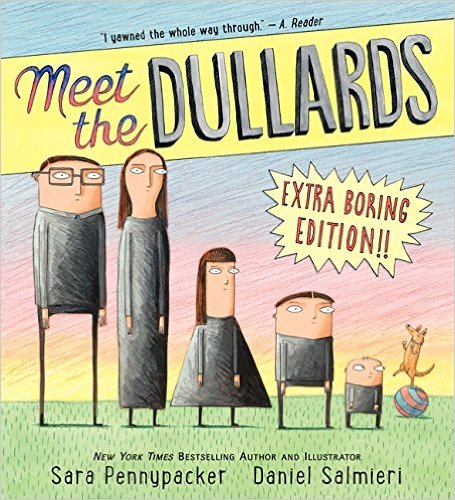
Meet the Dullards

Written by Sara Pennypacker | Illustrated by Daniel Salmieri


Gray—that’s what the Dullards are. Gray and happily extra boring. Their life is going on in its monotonous way until one day when Mr. and Mrs. Dullard happen upon a most disturbing sight. Their three children are reading—and not only that, they are reading books about befriending lions, juggling, and walking a tightrope. The elder Dullards do what any self-respecting dullard would do. They retrieve the books and hand their children blank pieces of paper to read instead.

The children are definitely becoming a problem. They want to go to school and have been playing outside. It’s not our fault bemoan the parents; it must be the town where last fall some leaves actually turned color and there’s that unruly snail in the driveway. In fact the whole atmosphere is like a circus! There’s only one thing to do. The Dullards pack up their house and Blanda, Borely, and Little Dud and move away.

Immediately upon moving into their new home, they are bombarded by the neighbor lady bringing exclamation marks and chunky applesauce cake into their perfectly dull new home. The kids are sent to watch the (unplugged) TV, but instead their eyes are drawn to the window. While unpacking Mr. and Mrs. Dullard discover a sight so shocking that Mrs. Dullard faints into the arms of her distressed husband. It’s yellow flowered wallpaper. (An exclamation mark would be appropriate here, but you know…)

On the way to the paint store the family stops to get ice-cream cones, and with 90,000 flavors to choose from they pick vanilla. Plain cone or sugar cone? No cone, of course. At the paint store Mr. Dullard suggests medium gray, but Mrs. Dullard deems it too risky. Its similarity to highways could make the kids think of travel. Beige? Mrs. Dullard counters. Too much like clay, says Mr. Dullard which can be used to create stuff. They come to a compromise and go home to—you’ve got it—watch the paint dry.

While their parents are mesmerized the kids sneak away and out the window that so enthralled them before. The sight of Blanda, Borely, and Little Dud juggling, teaching a dog tricks, and somersaulting on the clothesline, ushers in another move—back to where they came from just in time for the kids to join the circus.

With dry wit and laugh-out-loud dialogue Sara Pennypacker delivers a spot-on family story. While seen through the eyes of Mr. and Mrs. Dullard, this funny tale is all about the kids. What kids don’t think their parents are dull and conventional? And can parents really understand what’s going on in those little minds? Both children and adults will love the Dullards, and after reading you may be inspired to go out for vanilla chocolate ice-cream (ok, you can still hold the cone!)

Daniel Salmieri’s Dullards are comic genius! With their oval bodies and gray attire they blend with their oatmeal-hued walls to perfect effect. Identical square houses give way to identical triangular houses as the Dullards move to avoid catastrophic enthusiasm. The kids’ facial expressions as they adhere to boooring rules are priceless as are the parents’ reactions to the slightest excitement. Details such as a yellow snail in the driveway, the elder Dullards’ looks of horror when discovering the bright wallpaper, the signs on the ice-cream kiosk, and the name of the moving van make provide humorous jokes on each page.

Ages 4 – 8

Balzar + Bray, Harper Collins, 2015 | ISBN 978-0062198563

National Humor Month Activity
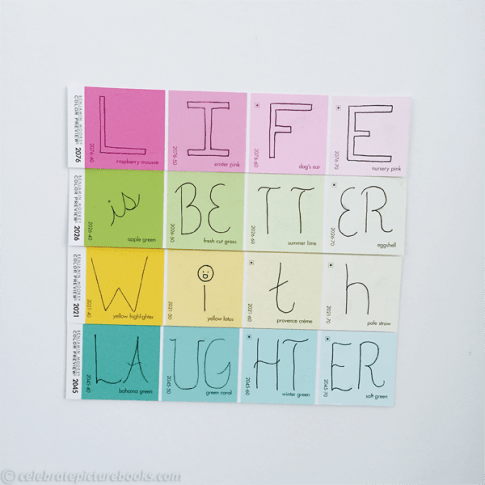
celebrate-picture-books-picture-book-review-paint-strip-craft

Paint Strip Inspiration


Do you like to laugh? Do you like to watch paint dry? It is kind of cool how it changes color a bit as it dries….Oh, sorry! Where was I? Oh yeah—this craft. Paint sample strips make brilliant backdrops to your thoughts about love, life, laughter—anything! You can mix and match your favorite colors and arrange them any way you like to decorate your wall. Frame them for a more put-together look!

Supplies

  • 4 -5 paint strips from a hardware store OR You could also make your own color stips with poster board and craft paint
  • Poster board
  • Craft paint
  • Paint brush
  • Markers or adhesive letters
  • Scissors
  • Mounting squares
  • Frame (optional)

Directions

  1. If you are making your own paint strip, cut poster board into strips 9 inches long by 2 inches wide, or to desired size
  2. Paint squares of color to fill the strip, leaving a 1/8-inch-wide stripe between colors
  3. Think of a phrase that expresses your thoughts on life and laughter OR use a favorite quote
  4. Print the words on the squares of color OR use adhesive letters. You can print one letter per square or multiple letters or even whole words. Mix styles of print to give it your own unique look.
  5. Mount or frame your paint strip phrase

April 28 – Workers’ Memorial Day

celebrate-picture-books-picture-book-review-brave-girl

About the Holiday

Some jobs are so dangerous that workers get hurt or even die doing them. Around the world organizations have been established to help industries provide safer working environments for their employees by establishing standard rules and regulations for buildings, machinery, working hours, and more. Unions and other groups have also been founded that represent workers to ensure their rights are upheld and their needs are met. Today we honor the sacrifices of workers in dangerous professions and raise awareness for safe working conditions.

Brave Girl: Clara and the Shirtwaist Maker’s Strike of 1909

Written by Michelle Markel | Illustrated by Melissa Sweet


Among the immigrants sailing to New York, stands five-foot-tall Clara Lemlich. She may not know it now, but she’s going to change her new city. While her father can’t find work, Clara gets a job in the garment industry, which hires school-age girls to make women’s clothing. Instead of going to school, Clara spends her days hunched over her sewing machine in a dark, smelly factory with many other girls, making clothes as fast as she can.

The rules of the factory are severe. For minor mistakes workers can be fined or worse—fired, leaving their families without an income. The doors are locked so the girls can’t leave without being inspected to ensure they haven’t stolen anything. And the workers must toil long into the night. Despite it all Clara is determined to get an education even though it means walking to the library after work and missing sleep to read her lessons. 

At the factory the girls become friends and reveal stories and secrets. The working conditions make Clara angry. She hears that the men at the factory want to form a union. If all the workers team up, they can hold a strike and force the management to treat them better, the men say. But they don’t think the girls are tough enough.

Clara knows what the girls are capable of. Every day she talks to her friends and the other women, urging them to fight for their rights—and they do! But it’s not as easy as the men predicted. The bosses don’t want to give in. In fact Clara’s life is in danger! She is beaten and arrested. Despite the intimidation she continues to picket. These small strikes make little difference, however—the bosses just hire new girls and the work continues.

Clara and other union leaders think only a huge strike by all workers in every garment factory in New York will cause the bosses to listen and make changes. At a union meeting workers pack the seats to listen to leaders from across the country. Not one of them recommends such a large strike. Clara can keep silent no more. She moves to the front of the hall and calls out. People lift her to the stage. Shouting “Unity is strength” she rallies the crowd and begins the largest strike of women workers ever in United States history.

The next morning thousands of women take to the sidewalks, leaving their sewing machines empty and silent. New York is stunned! Newspapers call the strike a “revolt,” and the girls an “army.” But this is really an army of children—the girls range in age from only 12 to 25 years old. Clara knows how to lead and motivate the girls. She gives rousing pep talks, sings, and stands up to thugs sent to harass them.

All winter the girls join the men strikers. They are starving and cold and become the inspiration for newspaper articles and fundraising. Many wealthy women donate to their cause and join them on the picket lines. Finally the bosses relent. They agree to the formation of unions in their factories, raise salaries, and shorten the work week. Factory workers in Philadelphia and Chicago take heart from Clara’s work and improve conditions in their cities.

Even though Clara is young and small, she proves that anyone can right wrongs and make a difference.

The final pages include more information about the garment industry in the early 1900s as well as a bibliography.

Michelle Markel’s Brave Girl is a spirited biography of Clara Lemlich, clearly outlining the life and working conditions of immigrants in the early 1900s—especially industries’ use of children to fill low-paying, oppressive jobs. This true-life story of a girl who wouldn’t give up or give in is told with pride and balance, touching on the dangers Clara faced in a sensitive manner appropriate for children. Overall, the idea that one person can make a difference no matter how big or how old shines through, making this not only a tale of the past, but an inspiration for today’s children and the future.

Melissa Sweet cleverly combines watercolor and gouache paintings with colorful fabric, ribbon, sewing pattern paper, and ledger pages to create illustrations fitting to the story. The pictures appear sewn onto the pages with straight, zigzag, and embroidery stitches, and the vibrant colors depict the fiery nature of Clara and all the workers who strove for better lives.

Ages 4 – 9 (and up as Brave Girl makes a wonderful teaching text)

Balzar + Bray, Harper Collins, 2013 | ISBN 978-0061804427

Workers’ Memorial Day Activity

celebrate-picture-books-picture-book-review-dream-job-application

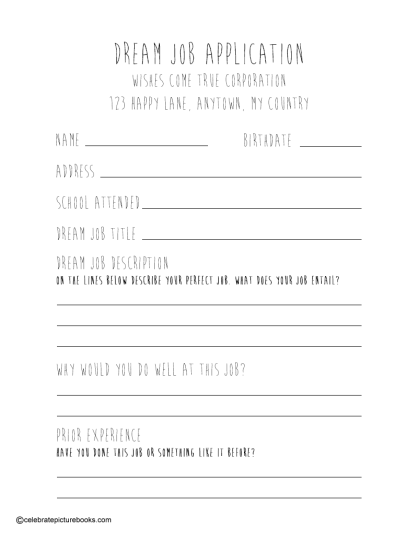
Dream Job Application


Work isn’t working when you love your job—it’s fun! What is your perfect job? Is it working with animals? Playing a sport? Being an artist, scientist, entrepreneur? Fill out this application and get started on following your dreams! Print the Dream Job Application below!

Dream Job Application 

April 26 – Hug an Australian Day

celebrate-picture-books-picture-book-review-alfies-lost-sharkie

About the Holiday

Hug an Australian Day was initiated by Ruth and Thomas Roy of Wellcat.com. It’s a perfect time to celebrate all things from the land Down Under—like the people’s sunny personalities and the awesome (or should I say aussieome?) wildlife. Today, listen to your fav Australian music, watch an Australian movie, and if you have friends or relatives who are Australian, send them good wishes.

Alfie’s Lost Sharkie

By Anna Walker


It’s Alfie’s bedtime, but Alfie is lodged headfirst in his toy basket searching for Sharkie. He’s quite distinctive, Alfie tells his dad. with “white fins, sharp teeth, and scary eyes.” Oh, yeah, and “he’s blue.” Could he be outside? Alfie’s dad relents and lets him look while he runs water in the tub.

Outside in a tall tree Alfie hangs from a branch and asks a bug, a bird, and a cat if they’ve seen Sharkie. Come down now, his dad calls, it’s bath time. Alfie dives to the depths of the bathtub to look for Sharkie, but all he finds is a jellyfish. Pajama time, says his dad.

Like quicksand the pajama drawer sucks Alfie in. “I’m okay,” he says, struggling to the top only to see his cat wearing his pajama bottoms. Alfie looks under the chair and in his jack-in-the-box. A tear rolls down Alfie’s nose as he stares longingly out the window. It’s story time, says his dad.

While his dad reads, Alfie stands on his head contemplating the whereabouts of Sharkie. Why is his dad making him brush his teeth and pick out a toy to sleep with when he’s obviously so not tired? Reluctantly Alfie chooses a toy—in fact all his toys—and marches toward bed.  And who should he find? The armful of toys goes flying as Alfie leaps onto the covers. He’s so happy to see Sharkie!

Dad tucks Alfie and all the toys under the blankets, and Alfie closes his eyes hugging Sharkie tight. But a new thought strikes Alfie—“Where’s Bunny?”

In Alfie’s Lost Sharkie, Melbourne-based Anna Walker has created a picture book that will have kids and adults laughing at the familiar bedtime scenario. The story’s spare text echoes the rhythms of the nighttime routine with a child trying to wring just a few more minutes out of the day.

The sweetly drawn illustrations are equal parts humorous and cute as Alfie wrangles time under the curious gaze of his toys and mischievous cat. The final picture of Alfie tossing Sharkie aside will make adults nod their heads in recognition while kids will probably think, “Yeah! That’s a good point!” Funny visual details and the loving relationship between Alfie and his patient dad will make Alfie’s Lost Sharkie a book kids will want to read again and again.

Ages 3 – 7

Clarion Books, 2016 | ISBN 978-0544586567

Hug an Australian Day Activity

celebrate-picture-books-picture-book-review-australian-puzzle

Awesome Aussie Word Scramble


A cute koala invites you to unscramble the names of Animals found in Australia and discover the secret phrase!  Print your Awesome Aussie Animals Word Scramble here!

April 25 – World Penguin Day

celebrate-picture-books-picture-book-review-little-penguin-gets-the-hiccups

About the Holiday

As Antarctica’s Adelie Penguins begin their northern migration today, we should remember that conservation of the environment is crucial to the survival of this and all 17 living species of penguins. Eleven species are listed as vulnerable or endangered. Why not learn a little more about the various kinds of penguins today? Or it would be a perfect day to visit a local aquarium and watch these waddling wonders dive and frolic in the water!

Little Penguin Gets the Hiccups

By Tadgh Bentley


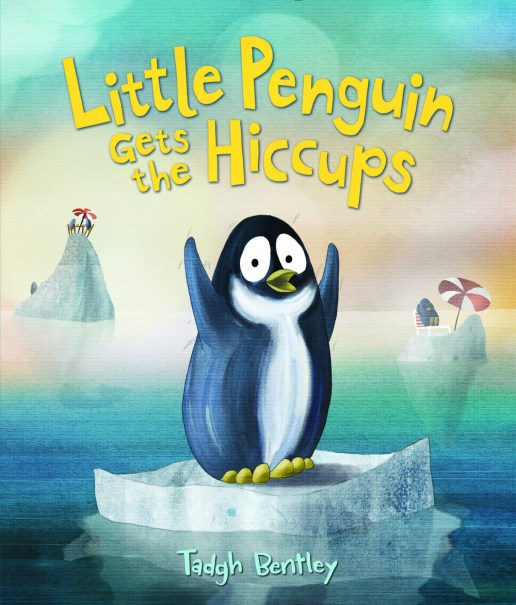
“Oh, hello. It’s so nice to HIC! meet you,” the little penguin greets readers from his ice floe on the first page. The penguin’s been expecting you and he’s so glad you’re here. You see, he has a HIC! problem and needs your help. Ever since last week when he ate a bowl of chili, he’s had the worst hiccups!

His friend Frederick—the one who told the penguin you were coming—suggested he stand on his head. Chester said to drink backward from a cup. And Albert thought a combination of the two would do the trick. But nothing works. Franklin came up with another idea, and that’s where you come in.

The penguin needs someone to scare him. Unfortunately the little guy doesn’t like being scared, so he’s ready for you to say “Boo!” on the count of three. Ready? “One – two – three.”

“boo”

“Hic!”

Well, that didn’t work. How about louder? “Boo!” Nope. Will nothing cure the hiccups? The disappointed penguin lies on the ice wondering if he’ll have the hiccups forever, but he’s willing to give it another go. This time shout, go crazy! Ready? “One – two – three.”

“ROAR!”

Was that you? No? Oh! It was Franklin! “What are you doing, Franklin?” the very scared penguin says, climbing out of the ocean. Now his feathers are all wet and his mom is NOT going to be happy because she just washed them and…wait a minute! His hiccups are gone, and he wants to celebrate! But, wait—with tacos? Hmmm…this could be a problem…

Tadgh Bentley’s adorable penguin with a problem of hicstorical proportions is sure to get kids giggling and shouting “Boo!” in this interactive picture book. The conversational tone and hiccup-interrupted story will have kids empathizing with and rooting for the little penguin in the throes of a very familiar condition. Bentley’s illustrations of the cute, plump penguin are full of angst, action, and humor. As little penguin greets readers, his friends play cards, fish, eat chili, and frolic on other ice floes. Kids will laugh out loud at the penguin’s attempts to banish the hiccups, and roar along with Franklin when he makes his dramatic appearance.

Ages 3 – 8

Balzar + Bray, Harper Collins, 2015 | ISBN 978-0062335364

World Penguin Day Activity

celebrate-picture-books-picture-book-review-penguin-puzzle

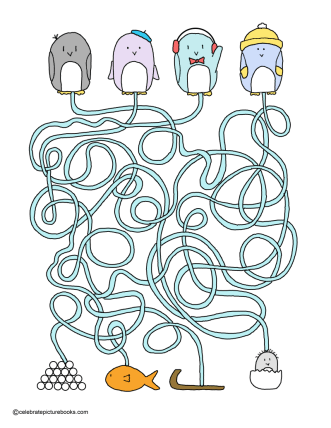
Puzzled Penguin Puzzler


These four penguins have lost their stuff! Can you untangle the paths that will lead the right penguins to the snowballs, sled, fish, and baby? Print the Puzzled Penguin Puzzler here!

April 24 – It’s National Garden Month

picture-book-review-up-in-the-garden-and-down-in-the-dirt

About the Holiday

April is the month when the earth comes alive again after a long winter! Flowers bloom in brilliant colors, trees bud and blossom with pale, green leaves, and the birds and animals prepare for new life to come. Today enjoy the warmer weather, plan a garden or flower bed, or visit a nursery or park and take in the sights and smells of spring!

Up in the Garden and Down in the Dirt

Written by Kate Messner | Illustrated by Christopher Silas Neal


Snow still blankets the ground as a little girl and her Nana survey their garden plot. The girl’s head is full of dreams of the bounty to come. As the days warm and the wind whistles, the girl and her Nana dig in the mud. “’It’s not quite time,’” says Nana. “’Down in the dirt, things need to dry out and warm up.’” Her granddaughter is curious about what’s below.

Down in the dirt, Nana tells her, a whole world of insects are already working. Up above, the two gardeners are working too—gathering scattered twigs, removing weeds, and spreading compost.

Down in the dirt, pill bugs chew dead leaves, rolling into tight balls when poked. Up in the garden planting is taking place, the seeds carefully snuggled into beds and watered. As peas and other early plants sprout, bees pollinate and wasps hover.

Down in the dirt earthworms tunnel, enjoying the cool soil. Up in the garden the girl and her Nana rest in the shade then play in a sprinkled shower. Down in the dirt the water soaks deep, feeding the squash plants’ roots.

The summer is progressing and up in the garden tomatoes and beans are ripe for eating. Down in the dirt a robin finds a meal too. Up in the garden there’s so much to harvest. Nana and her granddaughter work until dark, sharing the garden with bats and June bugs. With nightfall a skunk finds grubs and cutworms down in the dirt.

The air is turning cooler up in the garden. Pumpkins turn orange under towering sunflowers while down in the dirt a spider weaves her sticky web. As Autumn wanes it’s time for the final garden harvest. Down in the dirt the insects know it too; they scurry to gather food.

Up in the garden and down in the dirt everything is prepared for winter. As snow once again blankets the garden plot, the girl and her Nana, the earthworms and pill bugs, the bees, and the skunk are all waiting for spring to come again.

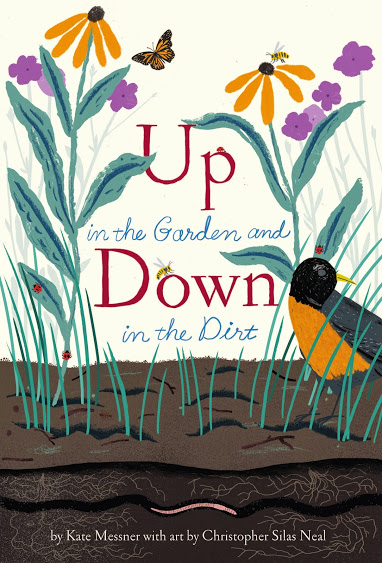
Kate Messner’s lyrical paean to gardening is a wonderful way to introduce children to the changing seasons and how nature works together. Comparing and contrasting what gardeners do up above as they plant, tend, and harvest their crops to the work insects and animals perform down below emphasizes the interconnectedness contained in even a small plot of land. Messner’s language is beautifully evocative—the snow is sleepy, brittle stalks snap and are rustly when gathered, chickens squabble and scratch, newly planted seeds snuggle in the dark, pumpkins blush orange, and sunflowers bow to September.

Christopher Silas Neal illustrates the changing garden with striking up-close, ground view images of the plants and creatures that call the garden home. Vibrant green grasshoppers, brilliant yellow sunflowers, deliciously red tomatoes, soft pink worms, scruffy backyard animals, and more join a sprightly Nana and her curious granddaughter in soil so dark and fertile that any gardener would be envious.

The final pages include more information on the creatures found in the book, a list for further reading, and an author’s note. Up in the Garden and Down in the Dirt would be a welcome and special addition to any budding gardener’s or outdoor lover’s library.

Ages 5 – 9

Chronicle Books, 2015 | ISBN 978-1452119366

National Garden Month Activity

celebrate-picture-books-picture-book-reviews-garden-word-search


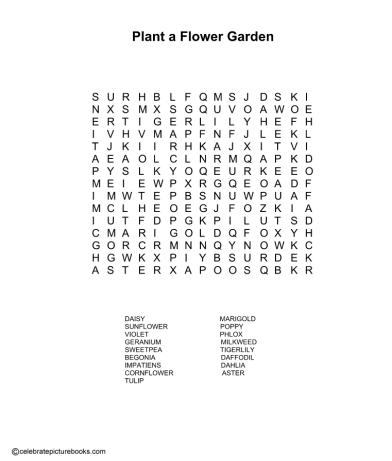
Plant a Flower Garden! Word Search


Whether you like to plant your flower bed in horizontal or vertical rows or just scatter the seeds for a wild burst of color, you’ll love this word search planted with favorite spring and summer blooms. Print your Plant a Flower Garden! word search and the Solution here!

April 23 – Talk Like Shakespeare Day

picture-book-review-will's-words

About the Holiday

To read or not to read—is that even a question?! Of course “to read!” And who produced literature containing some of the most excitement ever? William Shakespeare! Not only did Shakespeare write astounding plays and poems, he coined words and phrases that are still part of our everyday speech 400 years after his death in 1616. In recognition, the Chicago Shakespeare Theater initiated Talk Like Shakespeare Day in 2009. To honor Shakespeare’s legacy today, read or reread one of his famous plays, attend a performance, or watch a film adaptation of his work, and for goodness sake – use some of the terms he so cleverly invented.

*Italicized words were invented by William Shakespeare

Will’s Words: How William Shakespeare Changed the Way You Talk

Written by Jane Sutcliffe | Illustrated by John Shelley


“In 1606 London was a bustling, jostling, clanging, singing, stinking, head-chopping, pickpocketing wonder of a city.” With that phenomenal sentence Jane Sutcliffe begins this fascinating and ingenious look at the Globe Theatre and the experience of attending a play in William Shakespeare’s time.

In addition to all the qualities of London mentioned above, the town was also a “play-going city.” Every day of the week except Sunday, a play—or maybe even two or three—was performed, and as many as 18,000 (!) people attended plays every week! They just couldn’t get too much of a good thing!” And everyone loved the plays written by William Shakespeare!

How did a day at the theater begin? Well, at 1:00 a banner was raised from the roof of the playhouse, and men, women, and children streamed through the streets toward the Globe. It cost a penny to get in, but if you paid more you got a chair, and if you paid a little more than that you were seated in the Lord’s Rooms. The Lord’s Rooms were actually for fashionable people who wanted to be seen but didn’t really care what they were seeing.

All the actors were…well…actors. There were no actresses in those days. Men played women’s parts as well as men’s. And if you think phones and talking are problematic in today’s theaters, you would have been aghast at the audiences back then! They were not well behaved at all!

There were plays to please all tastes—comedies, tragedies, histories, and romances—all full of complicated plots and plenty of twists and turns. While the stories may have been intricate, the sets were not. But the bare-bones sets were made up for in gorgeous costumes and even some special effects accomplished with trap doors and ceiling holes. Sounds full of amazement, right? Good thing too because these plays could go on for hours, and most people stood through the whole thing, rain or shine!

William Shakespeare’s plays didn’t end when the last line was spoken. In fact theatre-goers repeated the lines they’d heard long after they left the Globe. They used Will’s words so much that his new phrases became part of the common language, and we still use them today!

Jane Sutcliffe inserts a tongue-in-cheek apology before the main text, explaining how she wanted to tell the world about the Globe Theatre in her own words, but that William Shakespeare’s words kept getting in the way. Yes, using another writer’s words is a no-no—but if they’re Shakespeare’s words? Words we use every day? Hmmm…Sutcliff’s lively history of the Globe Theatre and Old London’s theater culture is conversational, humorous, and highly informative.

The left-hand page tells the story of the Globe with phrases and words coined by William Shakespeare sprinkled throughout and set in bold type. On the right-hand page readers learn the meaning of those words and phrases (some have changed a bit since Will’s time) and which play they come from. A final note from Sutcliffe at the end of the book reveals a bit more about the playwright. A timeline of Shakespeare’s life and a bibliography are also included.

John Shelley’s incredible illustrations of London and the Globe Theatre will take your breath away. The streets teem with vendors, knights, shoppers, kids, Ladies, and Lords. If you look closely at the intricate paintings you’ll also spy the seamier side of Old London—a pickpocket, a criminal in the stocks, a tavern brawl, a cat snatching a free meal, a woman about to empty a chamber pot on her unsuspecting downstairs neighbor’s head, and…could that be a dead rat?— and that’s only on the first page!!

Subsequent pages show the waterfront with its sailing vessels, a peek into Shakespeare’s study and a look at the printing press, an aerial view of London, the Globe Theatre with its thatched awning, the actors donning wigs and costumes, and the audiences enjoying the plays and the fun of a day out. Each illustration is alive with color and movement, texture and design, expressive faces, and all the sights, sounds, and aspects of Old London. Kids will love lingering over each page picking out the funny events going on in the lanes, in the theatre seats, and on stage.

So hurry to get your own copy of Will’s Words and enjoy it to your heart’s content! You will definitely get your money’s worth!

Ages 6 – 10 and up (Anglophiles and Shakespeare lovers will enjoy this book)

Charlesbridge, 2016 | ISBN 978-1580896382

Talk Like Shakespeare Day Activity

picture-book-reviews-quill-pen-craft

Fashion a Quill Pen


William Shakespeare didn’t have a laptop to compose his great plays; he didn’t even have a desktop or a typewriter or a ballpoint pen! Shakespeare wrote all of those intrigues, characters, settings, sonnets and words with a feather!! (Plus a little ink!) Try your hand at making a quill pen—you may not be able to write with it, but it sure will look cool on your desk!

Supplies

  • Medium to large size feather with quill, available at craft stores
  • Clay, oven-bake or air-dry, in various colors if desired
  • Wire, beads, paint, and/or markers for decorating     
  • Scissors
  • Baking pan for oven-bake clay

Directions

  1. Roll clay 2 ½ inches to 4 inches long 
  2. Push the quill end of the feather into the clay
  3. Add bits of clay or roll sections of the clay between your fingers to give the clay shape
  4. To make the twisted shape pen, twist the length of clay around itself before adding the feather
  5. Shape the end or cut it with scissors to make the pointed writing nib
  6. If using air-dry clay: Add beads and/or wire and let clay dry around feather
  7. If using oven-bake clay: Add beads and other layers of clay before baking then carefully remove feather. Bake clay according to package directions
  8. Add wire and other decorations after clay has baked and cooled
  9. Reinsert feather into clay

April 21 – Poem in Your Pocket Day

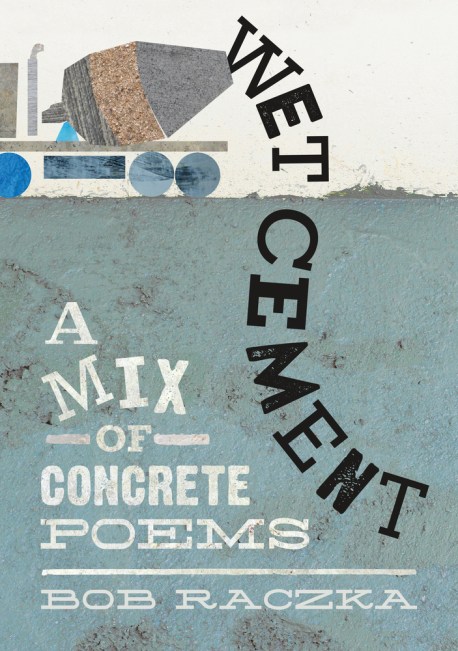
Wet Cement: A Mix of Concrete Poems by Bob Raczka picture book review

About the Holiday

Poem in Your Pocket Day has become one of the favorite events of National Poetry Month. Requiring nothing but a pocket and a treasured poem, the day is a perfect way for poets, non-poets, and poetry lovers of all types to interact with this beloved art form. Originally enacted in 2002 by the Office of the Mayor in conjunction with the New York City Departments of Cultural Affairs and Education, the holiday was embraced as a national observance by the Academy of American Poets in 2008.

Here are some suggestions from the Academy of American Poets on how to spend the day. So clean the lint, coupons, old receipts, tissues, and loose change out of your pockets and replace them with a poem! Those crumpled bits may even inspire your own poem—try it!

  • Post pocket-sized verses in public places
  • Create and distribute bookmarks with your favorite lines of poetry
  • Start a “poems for pockets” giveaway at school or work
  • Add a poem to your email footer
  • Post lines from your favorite poem on your Twitter, Tumblr, Instagram, Facebook, or Snapchat
  • Send a poem to a friend

Wet Cement: A Mix of Concrete Poems

By Bob Raczka


When you envision a poem in your head, what do you see? A block of lines? A square or a rectangle? Well, sweep that image from your mind because in Bob Raczka’s Wet Cement: A Mix of Concrete Poems, verses become actions, objects, puzzles, and natural phenomena. Not only are the poems shaped to illustrate their theme, the titles use clever imagery as well.

As you encounter the poem hanger you’ll see that “han” has broken away and is dangling from the hook of g in “ger.” The words of the poem itself are shaped like a hanger and contain a giggle-invoking twist: “I hang out in blue jeans and comfy old shirts. I hang out in blouses and long frilly skirts. I hang out in sport coats and sweaters and shawls. I even hang out with no clothes on at all!”

You might want to get your baseball mitt out before you read homer, in which the first line zooms straight as a pitch and the second—written backwards and at an upward angle—soars like a homerun hit: “The pitcher hurls his hummer toward the slugger squeezing lumber CRA / CK! The slugger slams the hummer toward the bleachers for a homer.”

But don’t put that mitt away just yet! You may need to catch the o, which has escaped from the title p p-up. And if you’ve ever played t-ball, baseball, softball, or even wiffleball, you’ll cringe in recognition of this short but pointed poem.

The sky darkened by night in Dipper and by clouds in Lightning holds two poems expressing very different thoughts. In the title Dipper, the second p has floated to the top of the page where it hangs like a miniature reflection of the dipper-shaped poem, which reads: “Way down there on earth you hold firefly jars, filled up to their lids with light. Up here in the sky, I’m a vessel of stars, my brim overflowing with night.” In the title LIGHTNING, the L strikes the I to create the familiar jagged crack echoed in the shape of the verse: “from a bad mood sky, / tears, / then a jag- / ged slash- / ing flash of anger, / ear- / splitting, / obnoxious, / a cloud tantrum”

Any writer will love poeTRY which is such a clever take on the word as well as the revision and editing process:

“poetry is about taking away the words you don’t need

poetry is taking away words you don’t need

poetry is words you need

poetry is words

try”

Put simply, Bob Raczka’s concrete poems will make you smile. Even more than that, you’ll find yourself wanting to carry this book around, saying “Look at this!” to everyone you meet. Raczka calls these poems “word paintings”—because a poet “uses words like colors to paint pictures inside your head.” If creativity is the talent to present the world in new and surprising ways, making connections that enhance life, then Wet Cement is artistry at its best!

Ages 5 – 9 and up (adults will enjoy these poems as much as kids)

Roaring Brook Press, 2016 | ISBN 978-1626722361

Poem in Your Pocket Day Activity

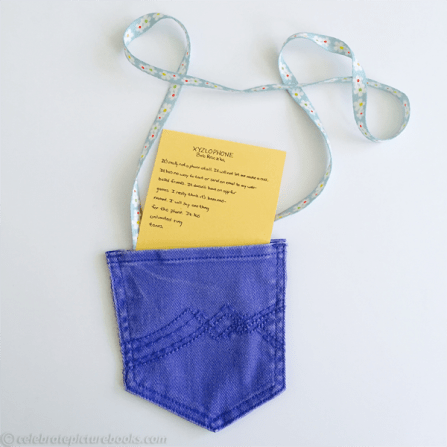
CPB - Pocket Poem Craft

Pocket Poem Carrier


Sometimes you just need a little more inspiration in your day. Here’s a cute way to carry your favorite poem—today and every day!

Supplies

  • An old pair of pants or shorts with back pockets
  • A decorative shoelace
  • Thread or fabric glue
  • Needle
  • Paper
  • Your favorite poem or a poem you write yourself
  • Pen

Directions

  1. Cut one back pocket off an old pair of pants or shorts
  2. Use the shoelace at its full length or cut to desired length
  3. Inside each edge of the pocket sew or glue the ends of the shoelace to make a strap
  4. Print your favorite poem on the paper
  5. Insert the poem into the pocket poem carrier
  6. Take your poem with you and share it with your friends!