Founded in 2005 National Wildlife Day was established to celebrate the diversity of nature and promote the awareness of endangered species worldwide. To celebrate visit an animal sanctuary, zoo, or aquarium—or think about donating your time to a worthy animal cause.
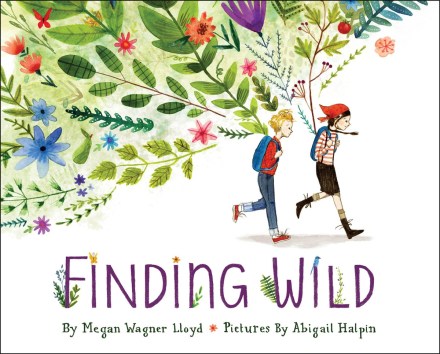
Finding Wild
Written by Megan Wagner Lloyd | Illustrated by Abigail Halpin
A girl and a boy stand with their backs to the stairs leading to the subway contemplating the jungle of growth in front of them. A single floating leaf seems to lead the way. They follow along the path, leaving the city behind and enter the wild. Here “Wild is tiny and fragile and sweet-baby new. It pushes through cracks and crannies and steals back forgotten places.” Wild comes in many guises—some obvious, some not.
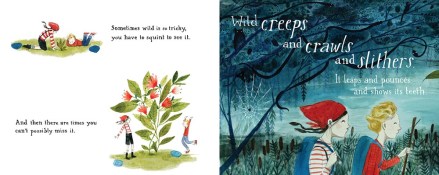
Wild also moves in various ways. As the boy and girl continue on the path passing a spider’s web and shadowy shapes with glowing eyes, wild “creeps and crawls and slithers. It leaps and pounces and shows its teeth.” Everywhere the pair ventures, wild has a distinct smell—fresh or musty, sharp or sweet, tangy or arid. They discover wild can be as hot as a forest fire or as cold as an icicle. Running through a field of flowers and climbing a rocky cliff the two find that wild is “as smooth as the petals of poppies, and as rough as the fierce face of a mountain.” They also find that wild can hurt in so many ways.
Image copyright Abigail Halpin, courtesy of Alfred A. Knopf
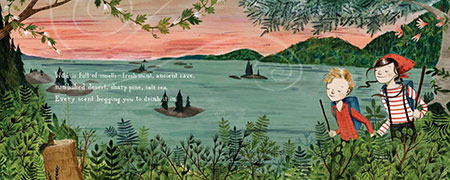
Plunging deeper into the wild the boy and girl uncover more secrets—delicious and quenching. The sounds of wild chill and soothe them. Suddenly, though, the girl and the boy find themselves outside of the wild, back in front of a subway entrance. The wild, now seems far away, invisible and unknown, as if “the whole world is clean and paved, ordered and tidy.” As the pair gaze upward the tall buildings and skyscrapers block the sky. But the girl points to a leaf swirling through the air. They follow it through an open door that leads to a most surprising discovery.
Image copyright Abigail Halpin, courtesy of Alfred A. Knopf
Megan Wagner Lloyd entreats readers to rediscover the wild no matter where they live. Her lyrical descriptions of the splendor of nature in all its incarnations—from gentle to intense, quiet to loud, mysterious to open—delightfully capture the way children interact with the environment. Lloyd reminds readers that tasting a single juicy blackberry, thrilling to a coyote’s howl on a dark night, even feeling the prick of a cactus needle connect them to the greater world and that searching for and finding the wild—especially in the midst of an “ordered and tidy” world—brings peace and happiness.
Abigail Halpin’s lush illustrations of the wild environment gorgeously depict the vibrant colors, sometimes chilling shadows, and refreshing water the two children discover in the middle of their city. The thick vegetation rendered in a palette of greens is a riot of ferns, pines, flowering trees, and vines that hide small birds and animals. As the children huddle in a tent, the indigo night crackles with lightning and the songs of coyotes. A two-page scrapbook-type spread displays various plants and insects that sting, burn, or cause itching. When the boy and girl reenter the city, buildings—old and new—billboards, and traffic meet their eyes, but they keep their gaze on the leaf leading them on. That leaf invites readers, also, to get outside and explore the wild.
Ages 3 – 8
Alfred A. Knopf, Random House Books for Young Readers, 2016 | ISBN 978-1101932810
Discover more about Megan Wagner Lloyd, the world of Finding Wild, and news on her upcoming book on her website!
View a gallery of artwork by Abigail Halpin on her website!
Wildlife Day Activity
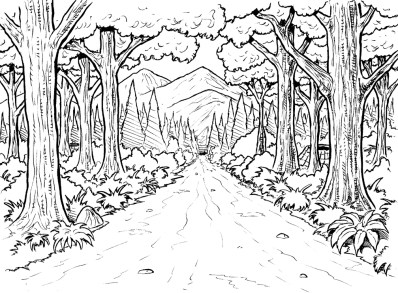
Explore the Forest Coloring Page
Take the path on this printable Forest Coloring Page to explore all nature has to offer. Add your own animals or birds to the picture—and maybe even yourself!
With their bald pink heads and dusty brown feathers vultures and turkey vultures may not be the peacocks of the bird kingdom, but they play a crucial role in the environmental cycle. These scavengers live on carrion, clearing away and “recycling” the carcasses of dead animals. Because of the vulture’s appearance and stereotypical depictions, their plight as an endangered species goes largely unnoticed. Environmental groups in South Africa and England established today’s holiday (also known as International Turkey Vulture Day) to promote awareness f the declining number of vultures, a cause that has been picked up by zoos and other conservation groups around the world.
Vulture View
Written by April Pulley Sayre | Illustrated by Steve Jenkins
In the clear blue morning sky the vultures soar. “Wings stretch wide / to catch a ride / on warming air / Going where?” One turkey vulture scans the ground, dipping and tilting as it searches for its breakfast. A snake rattles and hisses in the rocks. The vulture passes it by. A golden fox gazes silently into the distance, but the vulture flies away. A bear half-way up a tree would be easy prey, but the vulture lets him continue his climb.
Image copyright Steve Jenkins, courtesy of us.macmillan.com
The turkey vultures are searching for a particular meal. They “smell the air. / They sniff, search, seek / for foods that… / REEK! The aromas of the landscape rise to the vultures. Are they attracted by the “fragrant flowers? / No, no.” “That spicy smoke? No, no.” Maybe “that stinky dead deer? Yes, yes!”
The vultures descend to dine on their “rotten” meal. Afterward they clean themselves in the nearby water and preen their feathers. Still hungry, “they hop, flap, soar / to look for more.” As the sun sets the vultures’ “wings glide, wings ride / through cooling air.” They come from all over to vulture trees—beautiful, bare silhouettes on the sky—to “settle and sleep, like families.”
Image copyright Steve Jenkins, courtesy of us.macmillan.com
With the rising sun and the warmer air, the vultures take to the sky again in search of their singular meal.
Intriguing facts about how vultures fly, the seven species of vultures, why and how vultures feed on carrion, nesting behaviors, and vulture festivals around the United States follow the text.
In this Theodor Seuss Geisel Honor Book, April Pulley Sayre brings a poet’s sensibility to the misunderstood vulture. In her lyrical lines the sights and smells of the vulture’s terrain and the vulture’s flight patterns are elevated to educate young readers of the actual beauty of this distinctive species. The benefits vultures provide to the environment as well as their familial attachments make these birds some of the most fascinating animals in the wild kingdom. Who among us doesn’t look up at the circling majesty of birds of prey? Sayre’s text gives readers the bird’s eye Vulture View.
Image copyright Steve Jenkins, courtesy of us.macmillan.com
With his signature cut-paper collage illustrations, Steve Jenkins gives shape to the vulture’s world. The mottled dark body and the wings and tail fringed with white meet layers of pink that form the vulture’s wrinkled head. The rattlesnake is a smooth combination of greens and browns while the fox is brilliantly orange and soft. Hills and mountains jut from the bottom of pages, and a bony carcass lays amid tall grass, decaying and attracting a vulture. As the birds streak through wispy fiber clouds to descend upon the vulture tree in the shadowy evening, readers will come to appreciate the life and role of the vulture.
Ages 4 – 8
Henry Holt and Company, 2007 | ISBN 978-0805075571
Wow! You will find a wealth of information on April Pulley Sayre‘s website which includes her many books, educators’ resources, and much more information on natural history topics.
Even just hovering over the icon links on Steve Jenkins‘ website is fun—and there’s so much more to discover once you click on them!
International Vulture Awareness Day Activity
Valuable Vultures Coloring Page
Vultures are a valuable part of our ecosystem. Here’s a printable Valuable Vultures Coloring Page for you to enjoy. Why not try your hand at using cut or torn paper like Steve Jenkins does in Vulture View to fill in the design?
As kids go back to school and interact with other students, teachers, coaches, group leaders, and others, this month is dedicated to the kinds of manners that promote good relationships and cohesive gatherings. Thinking about others and how your actions will affect them is part of being a great friend, teammate, or participant in any activity. Family life with parents and siblings is also better when everyone treats each other with good manners. So this month (and afterward) remember to say “please, thank you, you’re welcome, may I” and all the rest of the polite words!
Interrupting Chicken
By David Ezra Stein
It’s time for a certain little red chicken to go to sleep, and Papa is about to plunk his chick into bed when the subject of a bedtime story comes up. Papa agrees to read one of his daughter’s favorites—after being reassured that she won’t interrupt the story tonight. “‘Oh no, Papa. I’ll be good,’” she says.
So Papa opens Hansel and Gretel and begins to read. He’s related that Hansel and Gretel were very hungry and that while out in the woods they found a house made of candy. “Nibble, nibble, nibble; they began to eat the house, until the old woman who lived there came out” and invited the children in. “They were just about to follow her when—”… the little chicken can’t help herself: “Out jumped a little red chicken, and she said, ‘DON’T GO IN! SHE’S A WITCH!’ So Hansel and Gretel didn’t. THE END!”
Image copyright David Ezra Stein, courtesy of Candlewick Press
Papa peers over the top of his story book and he and his daughter give each other a long look. “‘Chicken.’” “‘Yes, Papa?’” “‘You interrupted the story. Try not to get so involved.’” “‘I’m sorry, Papa. But she really was a witch.’” Papa understands, but he also tells little chicken that she should relax and try to fall asleep. His daughter agrees to be good if he reads another story.
Papa turns the page to Little Red Riding Hood. He reads about how Little Red Riding Hood’s mother gave her a basket of goodies to take to Grandma and warns her about the dangers in the woods. “By and by she met a wolf who wished her ‘Good Morning.’ She was about to answer when—”…the little avid reader can’t help herself again! “Out jumped a little red chicken, and she said, ‘DON’T TALK TO STRANGERS!’ So little Red Riding Hood didn’t. THE END!”
Papa puts the story book down and gazes into his daughter’s wide-awake eyes. She apologizes for interrupting a second time and suggests “one more little story” and promises to behave. Papa picks a most appropriate story for the third go-around: Chicken Little. He starts off with the unfortunate event when Chicken Little is hit on the head by an acorn and mistakenly thinks that the sky is falling. “She was about to run off and warn Goosey Loosey, Ducky Lucky, Henny Penny, and everyone on the farm the sky was falling when—”…the little chicken loses control yet again. “Out jumped the little red chicken, and SHE said, ‘DON’T PANIC! IT WAS ONLY AN ACORN.’ So Chicken Little didn’t. THE END!”
Image copyright David Ezra Stein, courtesy of Candlewick Press
Papa is now flat out tired and—even though his little chick hugs him and vows that with only one more story she’ll fall asleep—out of stories. Little chicken exclaims, “‘Oh no, Papa. I can’t go to sleep without a story!’” Yawning, Papa suggests that his daughter tell him a story. She grabs her notebook and crayons and begins. “Bedtime for Papa by CHiKn Once there was a little red chicken who put her Papa to bed. She read him a hundred stories. She even gave him warm milk, but nothing worked: he stayed wide awake all—”
Suddenly, the sounds of snoring interrupt her storytelling. She looks up from her page to find her father fast asleep in her bed. She pats him on the head “‘Good night, Papa.’” she whispers before finally falling asleep herself.
David Ezra Stein’s Caldecott Honor book is a hilarious retelling of the nightly bedtime story scene in so many households. One story just isn’t enough, and familiar stories just beg to be finished by excited little voices. The father/daughter relationship in Interrupting Chicken is sweet and endearing, as the day-weary dad reads story after story and his daughter chimes in. Any parent or caregiver has gazed at their little charge in just the way Papa does, and they have all received the same knowingly innocent eyes back.
Stein’s glowing blue, green, and red illustrations of the adorable little chicken with her very tall comb tucked into bed and her father’s equally as long comb and waddles, cozy bathrobe and slippers will make kids fall in love with this duo. The stories Hansel and Gretel, Little Red Riding Hood, and Chicken Little are cleverly depicted in vintage black, brown, and white hues that are brilliantly interrupted by the little chicken and her well-timed warnings. In each even the original stories’ characters react to being so “rudely interrupted” and are left with dubious expressions as our little heroine saves the day.
Animated readings (there’s no way you’ll get away with just one!) will make Interrupting Chicken one of the favorite books on your child’s bookshelf.
Ages 4 – 8
Candlewick Press, 2010 | ISBN 978-0763641689
Don’t’ interrupt this funny book trailer!
Children’s Good Manners Month Activity
Good Manners Matter! Word Search
Using good manners makes you and those around you smile! Find the 20 manners-related word in this Printable Good Manners Matter! smiley-faced-shaped puzzle! Here’s the Solution!
Remember the thrill of receiving a letter—a real letter full of exciting news, lovey-dovey stuff, photos, or a highly anticipated answer to some inquiry or application? The footsteps of the postal carrier on the stoop, the creak and small bang of the mailbox lid opening and closing, and the view of a long envelope sticking out the top could all set the heart racing. Or perhaps you were the letter writer, pouring your experiences, heart, and hopes onto a piece of paper that might have been colored or even scented. World Letter Writing Day celebrates those missives that allow for the development of higher vocabulary and story-telling skills and provided physical souvenirs of a life well lived.
Dear Dragon
Written by Josh Funk | Illustrated by Rodolfo Montalvo
In a bit of cross-curriculum creativity, the teachers in two distinct school districts have combined the annual poetry units and pen pal projects. Not only do the kids get to make new friends, they must write their letters in rhyme. George Slair has been matched up with Blaise Dragomir. What George doesn’t know—but readers do—is that Blaise is a dragon; and what Blaise doesn’t know—but readers do—is that George is a boy.
In his first missive, George begins boldly and honestly: “Dear Blaise Dragomir, / We haven’t met each other, and I don’t know what to say. / I really don’t like writing, but I’ll do it anyway. / Yesterday my dad and I designed a giant fort. / I like playing catch and soccer. What’s your favorite sport? / Sincerely, George Slair”
As Blaise reads the letter he interprets George’s cardboard box, blanket, and umbrella fort as a medieval stone fortress with an iron gate and whittled-to-a-point log fencing. Blaise writes back: “Dear George Slair, / I also don’t like writing, but I’ll try it, I suppose. / A fort is like a castle, right? I love attacking those. / My favorite sport is skydiving. I jump near Falcor Peak. / Tomorrow is my birthday, but my party is next week. / Sincerely, Blaise Dragomir”
In his next letter, dated October 31, more earth-bound George tells Blaise that parachuting is awesome, that his dog destroyed his fort, and that he is trick-or-treating as a knight—a revelation to which Blaise has a visceral response. But what is scary to one pal is tame to the other. On November 14th Blaise relates: “Knights are super scary! I don’t like trick-or-treat. / Brushing teeth is such a pain, I rarely eat a sweet. / My pet’s a Bengal Kitten and tonight she needs a bath. / What’s your favorite class in school? I’m really into math!”
Image copyright Rodolfo Montalvo, courtesy, Viking Books for Young Readers
Reading December’s letter Blaise learns that George likes art and imagines George’s table-top volcano science project as a roaring, lava-spewing mountain while in January George is impressed to learn that Blaise’s father is a fire-breather. He conjures up images of a dad in a fancy, caped costume creating fire out of nothing while the truth is a lot more explosive. February brings word that there is a pen pal picnic planned for June, and in March Blaise tells George about a special outing with his dad: “Soon he’s gonna take me flying, once it’s really spring. / It’s such a rush to ride the air that flows from wing to wing.”
Springtime also sees the two becoming better friends. The formal “Sincerely, George” or “Sincerely, Blaise” sign-off of the first letters has evolved into “Your friend” as George expresses his wonder at Blaise’s parents: “Hi, Blaise! / Skydiving and flying? Wow, your parents rock! / I’m lucky if my father lets me bike around the block.” Then it appears that this project has been a success in all areas as George asks, “Once the school year’s over and this project is complete, / should we continue writing? ‘Cause it could be kind of neat….”
Blaise is all in. In his May letter, he writes, “Hey, George! / I’m psyched about the picnic and I can’t wait to attend. / Who’d have thought this pen pal thing would make me a new friend? / Writing more sounds awesome. I was gonna ask you, too! / I’ve never liked to write as much as when I write to you.”
Image copyright Rodolfo Montalvo, courtesy of Viking Books for Young Readers
With a growing sense of anticipation, readers know that with a turn of the page June will come, and that June brings the long-awaited picnic. How will George and Blaise react when they see each other? As the kids approach the Pen Pal Picnic spot, their mouths hang open and their eyes grow wide. One even has his hands to his face. And as the dragons peek out from behind the trees, their mouths hang open and their eyes grow wide. One even has her hand to her face.
“‘Blaise?’” George ventures, as a slice of tomato drops from his hamburger. “‘George?’” Blaise presumes, although he wrings his tail. “‘My pen pal is a dragon?’”… “‘My pen pal is a human?’”
These two-page spreads say it all—or do they? Well, not quite…
Huge grins burst out as George and Blaise exchange high fives (and fours). The other kid- and-dragon pals are having a blast too! And the teachers? “‘Our plan was a success, my friend, or so it would appear!’ / ‘The Poetry and Pen Pal Project! Once again next year?’”
With his usual aplomb, Josh Funk charms with rhyme and reason in this clever tribute to friendship, diversity, and writing (on paper!). The letters between the two pen pals are endearingly kid-like, full of the subjects that are important in a child’s life, including pets, school, hobbies, and parents, and that can be brilliantly open to interpretation—or misinterpretation. Blaise Dagomir and George Slair’s names are similarly inspired, and may introduce kids to the ancient legends of Saint George and the Dragon and the poem by Alfred Noyes, St George and the Dragon. Kids will enjoy seeing how George and Blaise’s friendship grows over the school year, evidenced in the openings and closings of their letters. The letters are a joy to read aloud as the rhymes swoop and flow as easily as Blaise soars through the air.
Following the alternating sequence of the letters, Rodolfo Montalvo depicts each pen pal’s perception of the message along with the reality in his illustrations that are—as George exclaims—“as awesome as it gets.” Both characters are sweet and earnest, and while surprised by what they think the other’s life is like, happily supportive. The full-bleed pages and vibrant colors dazzle with excitement and humor and ingenious details. Kids will love the juxtaposition of George’s idea of Blaise’s Bengal “kitten” and the reality of a nearly full-grown tiger. The two views of fire-breathing will also bring a laugh, and readers will enjoy picking out features of the two homes. The final spreads build suspense as to how George and Blaise will react to each other, and the resolution is a delight.
One striking aspect of both the text and the illustrations is the similarity between the two pen pals. While their activities and experiences may be on different scales, they are comparable and understandable to each child. Likewise, everywhere in the paintings, Montalvo uses complementary colors to unite George and Blaise. This cohesiveness beautifully represents the theme of inclusiveness.
Dear Dragon is released September 6 and is certain to be a book children treasure. The fun dual meaning rhymes and endearing illustrations make Dear Dragon a must for kids’ (and dragon’s) bookshelves.
Ages 4 – 9
Viking Books for Young Readers, 2016 | ISBN 978-0451472304
From more books to activities for kids, there’s so much to see and do on Josh Funk’s website!
Discover the world of Rodolfo Montalvo’s books and artwork on his website!
Dear Reader, check out this blazing hot book trailer!
World Letter Writing Day Activity
Dependable Dragon Pencil Case
U-knight-ing all your pens, pencils, and other supplies in this Dependable Dragon Pencil Case will fire up your imagination! Have a blast making this fun craft!
Supplies
Printable Dragon Pencil Case Template – Wings | Face
Sheets of felt, 8 ½-inch by 11-inch
2 Dark green
1 Light green
1 white
1 black
1 yellow
1 purple
Fabric Glue
Glitter glue or Fabric paint (optional)
Scissors
Velcro
Green Thread (optional if you would like to sew instead of glue your case)
Needle (optional, needed if sewing)
Directions
Print the Dragon Templates
Cut out alternating rows of scales from the dark and light green felt (7 each). For one row, cut a rounded top (instead of straight across) to make the top of the head (see picture). (One row of scales is longer so you can tile them. You will trim them later: see the double row of scales on the template for how the scales should look)
Cut the eyes from the white felt, pupils and nostrils from the black felt, horns from the yellow felt, and wings from the purple felt. Set aside.
To make the head
Fold one dark piece of felt in half lengthwise
Cut a wavy line along the bottom of the felt to make lips (see picture)
Glue a ½-inch-wide strip along open side and along bottom (or you can sew it)
To add the scales
Starting at the bottom, lay on row of scales a little above the wavy bottom. Glue the top to the base.
Overlap an alternating green row of scales on the first row, glue the top
Continue alternating dark and light green scales until you reach 9 inches
Use the rounded row of scales for the top of the head (see how to insert horns before attaching top of head)
To insert the horns
On the rounded row of scales, mark where you want the horns to be
Cut two small slices in the felt where the horns will go
Insert the bottoms of the horns into the slits
To finish the head
Glue the top of the head to the base
Trim any longer rows of scales to meet the edges of the base
Add the eyes and nostrils to the face
To make the closure for the case
Cut the base following the line of the rounded row of scales
Glue or sew strips of Velcro along the inside edges
To attach the wings
Turn the dragon case to the back
Glue or sew the wings to the center of the back, attaching them at the center edge
From the time that darkness falls on August 27 until the sun rises on August 28, people in more than 30 countries organize walks, talks, and all kinds of educational and fun activities related to bats and their conservation. Why not find an event in your neck of the woods—or cave—and celebrate this most unusual and beneficial animal!
Bats in the Band
By Brian Lies
Huddled together a colony of bats sleeps through the winter, but as the icy weather warms they stretch their wings and take flight to find food. As they swoop through the air chasing the echoes they hear, these animals that live by echolocation sense “that something’s not right. / And then when a bugle blast shatters the night, / that one lonely note tells us just what is wrong: / We’re hungry for sound—we’ve been silent too long.”
The bats swarm to a summertime theater now quiet and dark except for a small glow that invites them inside. They enter the building—passing hawkers of T-shirts, posters, and hats—and set up the stage and the lights. Some bats have brought their own instruments while others improvise with the leftovers of last season’s concertgoers. “Behind the stage curtain, they’re getting in tune, / making up things out of straws, out of spoons.”
Image copyright Brian Lies, courtesy of Houghton Mifflin Harcourt (hmhco.com)
Finally, the conductor lifts his baton, and the concert begins. “We sing together as one voice. / It seems the very walls rejoice! / All together, rafters ringing… / it’s as though our souls are singing.” Then the strings “change the mood to sweet and mellow” before a one-bat band takes over. “Next up, there’s a country song—/ some lonesome bat done someone wrong. / He’s gone and broken someone’s heart. / Now everything has come apart.”
There’s even an entertainer for children far off in a corner where the pups can run and play. Now on stage a blues singer “cries of lonely days and empty skies” that make the bats cry. “It’s hard to figure—eyes get wetter, / …so how is it that we feel better?” There’s not much time for reflection though as a hard-rock band begins “blazing,” “pumping,” and “jumping.”
Image copyright Brian Lies, courtesy of Houghton Mifflin Harcourt (hmhco.com)
While everyone is dancing to the beat, the sun begins to rise signaling that it’s time for the bats to go. But in one last blast, all the musicians jam together. “The music soars. Finale’s here, the ending of the song. / It builds and builds—now here it comes! / It’s going…/ going…/ GONG!” With that last bang of the cymbal the bats, “worn out, wrung out, half asleep,” fly from the theater and out into the dawning day. In the air they discover the music in everything from “the roar of a car, or the bark of a pup—/ the sound of the rest of the world waking up.” As they fall into slumber up in their cozy rafters, the bats continue to sway unconsciously. “It’s not our intention, but you understand. / We’re dreaming of being the bats in the band.”
Brian Lies “Bat” books are well-known and well-loved. Bats in the Band continues the excellent storytelling and poetry of his other titles, this time to a rock-n’-roll beat. The idea of bats needing to hear sound after a long winter’s silence is brilliant, and these bats play almost as many different styles of music as there are species of bat. The rhyme scheme is true and musical, carrying the story well through its words and rhythm.
Image copyright Brian Lies, courtesy of Houghton Mifflin Harcourt (hmhco.com)
Lies’ illustrations remain as clever as ever. The two-page spread of the bats choosing and tuning up their instruments is a joy. Bats make a xylophone from keys hanging on a peg board and two nails for mallets. Instead of a harp, a bat plucks the tines of a plastic comb, and a bendy straw serves as a fine wind instrument. The string section plays while hanging upside down (of course!). The pups’ entertainer will bring a smile to readers’ faces, and the blues singer performs under cool blue lights.
Kids and adults will love lingering over the detailed pages, where allusions to actual concert atmospheres abound. Look for the bats holding aloft lightning bugs in a tribute to a long-held tradition.
Bats in the Band is a rockin’ addition to Brian Lies collection and will be welcome on any child’s shelf—whether they are completing the set or just starting it!
Ages 4 – 8
Houghton Mifflin Harcourt, 2014 | ISBN 978-0544105690
Visit Brian Lies‘ website to learn more about him, view his many books, and see a gallery of his artwork.
International Bat Night Activity
Spiraling Bats Word Search
Find the bat related words in this printable Spiraling Bats Word Search that dips and soars like the flight of a bat! Here’s the Solution.
Photography is all about providing information through images. A picture really can be worth a thousand words in capturing a moment of surprise, joy, danger, or even sadness. Well-placed photographers, videographers, and cinematographers have given voice to some of society’s pivotal moments, allowing the whole world to witness change, sometimes as it happens. Today we celebrate photographers who often put themselves in danger to get the story as well as those who bring us much-needed lighter moments.
Breaking News: Bear Alert
By David Biedrzycki
Jean Louis, a television host on Our Furry Planet looks out from the screen at a little boy and his teddy bear watching from their family room. He’s brought the video camera into a bear’s den “somewhere in North America.” With a pointy stick he motions towards a sleeping bear as he explains the facts about hibernation. “Look,” he says, poking his stick into the bear’s nose, “even when prodded they don’t wake up. But spring is a busy time for brown bears. Soon they will emerge from their den, hungry for food, hungry for adven—AAAAAAAAAAH!!!” The bear grabs the reporter’s stick as the screen goes dark.
The Skycam 3 News Helicopter takes over as two bears escape into the wider community. They catch a ride on the top of the Our Furry Planet truck carrying the reporter who scans the area and is relieved to find they have outrun the bears. Close observers will notice a pair of suspicious-looking characters first seen out the boy’s window now riding a motorcycle with a sidecar.
The bears are next spotted by the Main Street traffic camera. In an inset the Our Furry driver describes his encounter with the bears as the cameraman stands disheveled behind him: “Well, that big ol’ bear came at us with his claws out like this. I told him to scoot and chased both of them away!” But is this bragging warranted? The reality may be more that the driver and cameraman ran away screaming while the bears peacefully took in the sights.
Image copyright David Biedrzycki, courtesy of charlesbridge.com
The bears are later found on security video at Teddy’s Diner, where the sign specifically states that “No Bare Feet” are allowed. The diner’s owner and head chef, Teddy Bahr, reveals that he’ll “cook for anyone as long as they’re not barefoot and that the bears were barefoot.” According to the scrolling alert, the bears “demanded to be fed” and indeed are shown gulping down a bowl of porridge at the counter. The golden-haired waitress, Mrs. Locks exclaims for the camera, “I almost had a heart attack…Those bears had no manners, and they paid me with acorns.”
Hmmm…the diner’s TV is relating a story about cat burglars that seem awfully familiar. And is that them again entering an electronics store at Pooh Street and Main Street, where the bears have just turned the corner? A boy yells for his mom as the bears take over his kiddie ride, but she’s too busy on her phone and discovering she’s on TV to pay attention. The scrolling alert warns parents to be on the lookout as the bears “are wild and could be extremely dangerous.”
The bears continue their journey through town, dancing to street a performer while a “cat burglar” raids the band’s donation box, taking their pictures in a photo booth, and watching all the commotion as agents of Animal Control sprea through the streets. The Paddington Department Store spies the bears on the escalator, but does it also catch something—or someone—else at the jewelry department?
Image copyright David Biedrzycki, courtesy of charlesbridge.com
Suddenly, a police officer bursts out of the department store door to chase the robbers as the Breaking News report declares that there has been a burglary at the store. Skycam 3 spots the suspects fleeing on foot! And in a moment the perpetrators have been caught! Breaking News: “Bears nab burglars.” Once the scourge of the town, the bears are now heroes. The Breaking News reports “Crowd applauds departing bear heroes. We now return you to your regularly scheduled story.”
There’s so much going on in David Biedrzycki’s Breaking News: Bear Alert, that the minimal text doesn’t begin to hint at all the hidden surprises and silliness that kids will love on each page. Bear puns and other jokes abound on every page and in nearly every illustrated detail. Characters’ names, menu items, framed pictures, street names, and more offer up humorous allusions to other bear-related people, books, and entertainment for adults and kids.
Readers of all ages will want to linger over every vivid, full-bleed page to catch all the hilarious happenings and allusions, and especially to follow the subplot that is cleverly inserted along the way. The frame of an animal discovery television show is a sly wink at the genre and one that kids and adults will be familiar with and enjoy.
Bear in mind that kids may be clawing to read this book again and again, and not having Breaking News: Bear Alert on the shelf may pose a very hairy situation indeed!
Ages 4 – 10
Charlesbridge, 2014 | ISBN 978-1580896634
To learn more about David Biedrzycki and his books and to view a gallery of his artwork, visit his website!
Don’t hbernate! Watch this beary funny book trailer!
World Photography Day Activity
Picture Perfect Bear Coloring Page
Imagine you’re taking a picture of this bear in a tree. What else do you see? Draw in the details and then color your printable Picture Perfect Bear Coloring Page.
Because black cats have become associated with bad luck, they are more likely to end up in animal shelters and less likely to be adopted. Today’s holiday was established to raise awareness of this fact and assure people that black cats are just as loveable, cuddly, and purr-fect as other cats. If you’re thinking of adopting a new pet, why not consider a black cat like the subject of today’s book!
Splat the Cat and the Late Library Book
By Rob Scotton
Splat’s toy box and closet are overflowing with stuff Splat doesn’t use anymore. His mom suggests that they give some of it away to kids who need it more. While Splat likes the idea, he’s a little afraid to open his closet door, because whenever he does…SPLAT! Splat recovers from being covered, though, and separates his things into three piles: Trash, Keep, and Donate.
Image copyright Rob Scotton, courtesy of HarperCollins
Splat has fun showing Seymour his mouse friend his old clothes and toys until he comes upon an old library book—a very old library book—a way, way overdue library book! Suddenly, Splat’s dad comes in to see how things are progressing. He thinks Splat is doing a great job and starts gathering up the clothes for the local shelter, the toys for the children’s hospital, and the books for the downtown library. “‘Not the library!’” Splat shouts. “‘Why not?’” asks his dad. “‘They’re having a book drive today to get more books. People don’t always return the ones they check out.’”
Poor Splat! His tail wiggles wildly as he imagines how ginormous the fine will be. Maybe he’ll be sent to jail. Or perhaps he’ll have to walk the plank. Splat grabs his piggy bank, hoping to find enough money for the fine, but only a thin quarter rolls from the slot. All too soon, the family is headed out to deliver their donations. At the shelter Splat tries to help carry in boxes, but maybe he’s too distracted because everything just goes SPLAT! Things go better at the hospital where the kids love getting all the new toys.
Image copyright Rob Scotton, courtesy of HarperCollins
As his parents wheel the pile of books into the library, Splat tries to run the other way but his mom catches him by the tail. Inside Mrs. Sardino, the librarian, is very impressed with their donation. She rattles on and on about how hard it is to give away books and how many she has at her own house and…Splat can’t take it anymore. “‘I did it!’” he confesses. “‘My library book is WAY overdue. I didn’t mean to. I just loved the book so much I didn’t want to return it. And I loved it so much I hid it in my closet. And then I forgot that I’d hid it.’”
He’s ready to take his punishment when Mrs. Sardino interrupts him. “‘Um, Splat,’” she says. “‘It’s only a week overdue. You owe twenty-five cents.’” Splat reaches into his pocket and pulls out his quarter. “‘That’s okay,’” Mrs. Sardino tells him. “‘This time I think we can let it go. Besides, your generous donation more than makes up for it.’”
Image copyright Rob Scotton, courtesy of HarperCollins
Fans of Splat the Cat will love this new adventure that addresses common concerns of kids who not only forget to return a library book but are remiss in any other number of required actions—homework, permission slips, housework, etc. Splat the Cat and the Late Library Book reveals that often the perceived infraction and it’s “punishment” far outweigh the reality. Relief from fear and worry is only a conversation away.
New readers will find that Splat is endearing, Seymour a faithful best friend, and his parents and other adults loving and understanding. They will want to explore the whole series. Each vividly colored page provides plenty of giggles as Splat contends with his overstuffed closet, tries on way-too-small clothes, envisions his prison and pirate punishments, tries to run away, and of course goes SPLAT in the process. The fast-paced action and comical scenarios make this a perfect read for story times or bedtime. Discovering this black cat is very good luck indeed!
Ages 3 – 8
Harper Festival, Harper Collins, 2016 | ISBN 978-0062294296
Enter the world of Splat the Cat on Rob Scotton‘s website!