
About the Holiday
In 2008, after more than 20 years of discussion and planning, The Svalbard Global Seed Vault in Svalbard, Norway, opened its doors to deposits of seeds from around the world. The vault’s mission is one that encompasses both history and the future as the facility safeguards both heirloom and modern varieties of seeds for future planting in the event that farmland, plants, and seeds are lost due to natural and/or human-created events. Each year, the seed vault typically accepts deposits during a few days in February (around its anniversary date), June, and October. Today’s book brings the story of this important global resource to children.
Thank you to Charlesbridge and Barbara Fisch of Blue Slip Media for sending me this book for review!
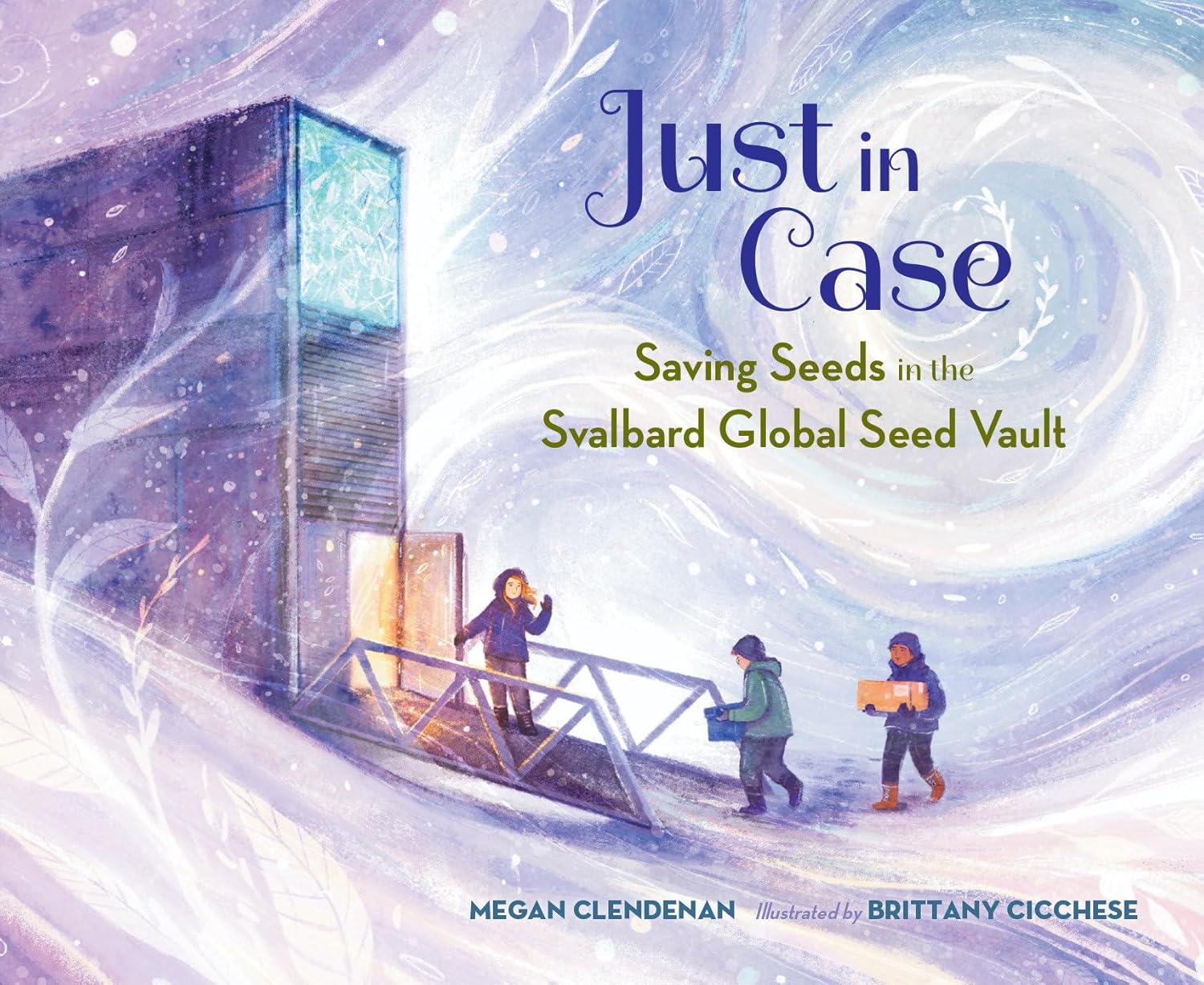
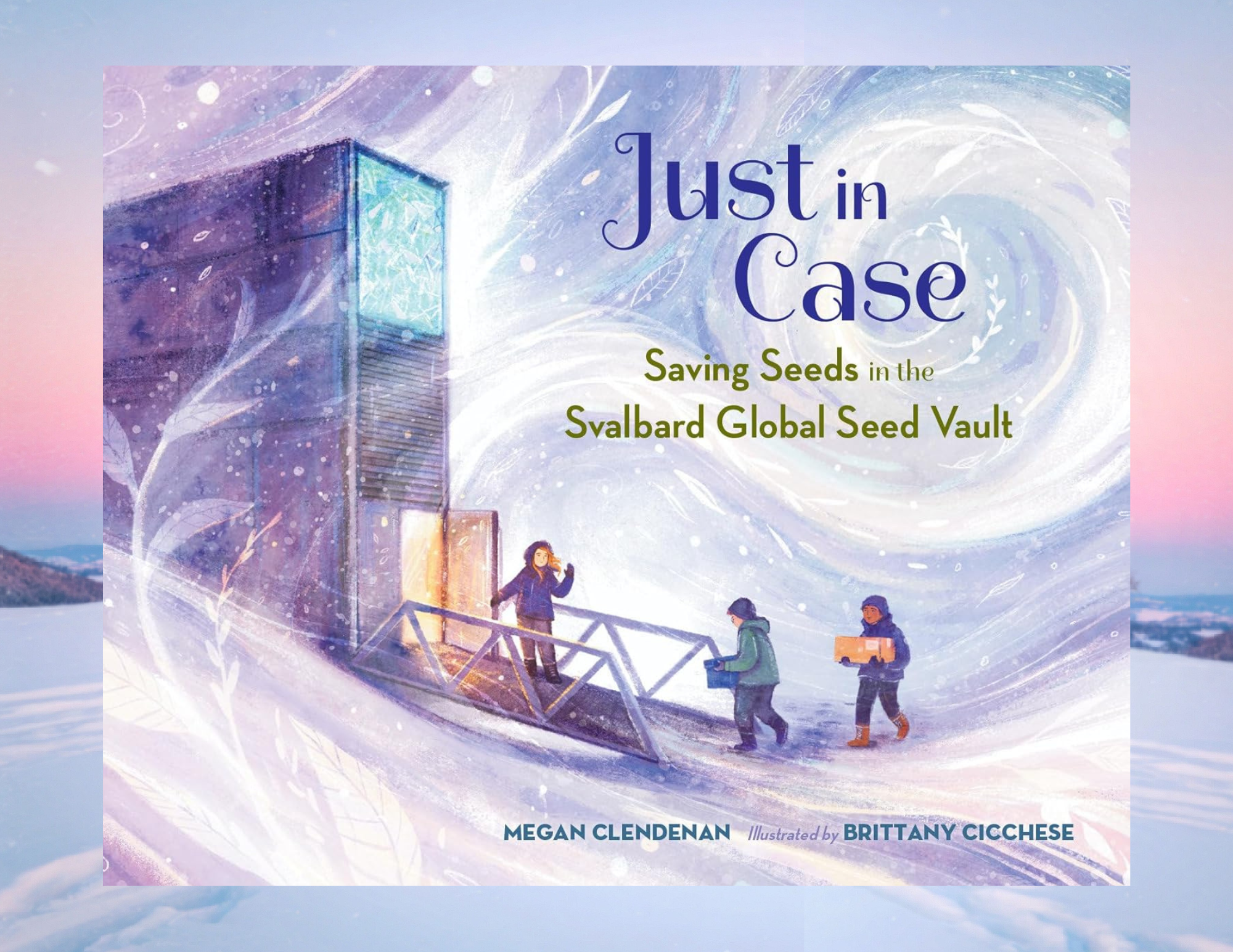
Just in Case: Saving Seeds in the Svalbard Global Seed Vault
Written by Megan Clendenan | Illustrated by Brittany Cicchese
Imagine a vast vault carved into the heart of an arctic mountain where priceless treasure is kept safe from dangers like fire, floods, storms, war, and climate change. Sounds like a movie plot, doesn’t it? But there is such a vault—the Svalbard Global Seed Vault that protects perhaps the world’s most valuable resource: seeds.
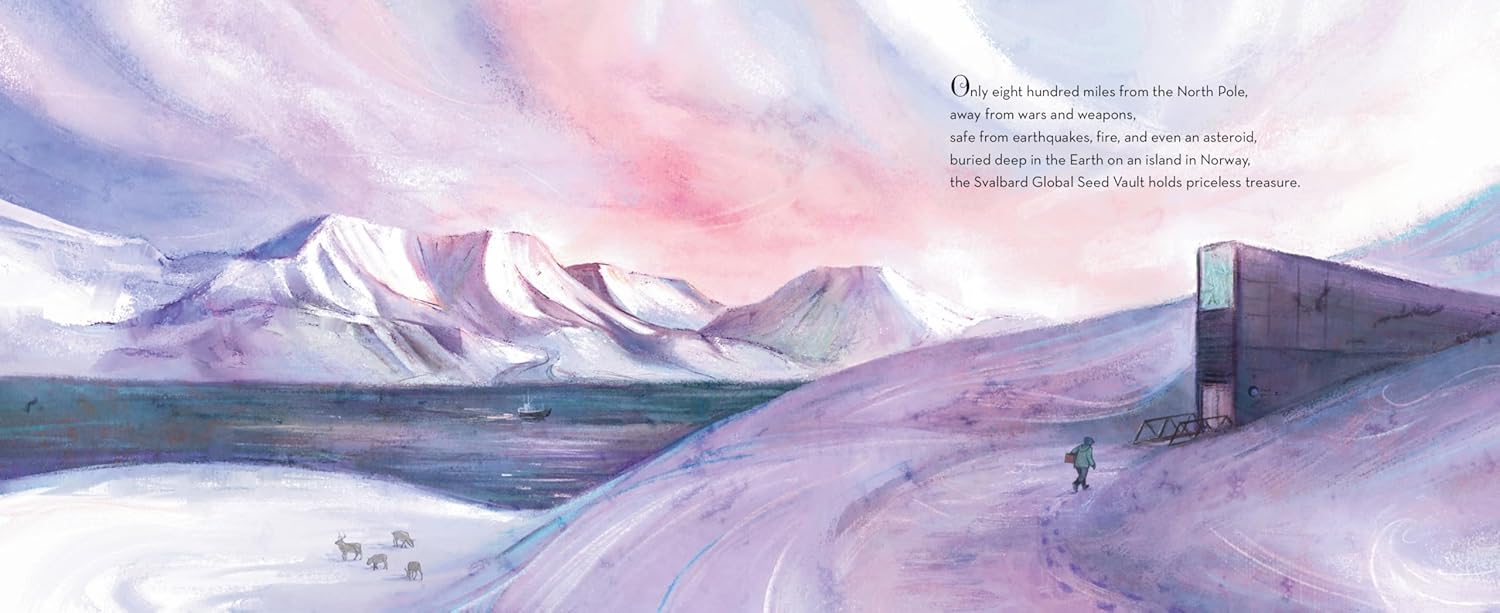
Illustration © 2025 by Brittany Cicchese. Text © 2025 by Megan Clendenan. Courtesy of Charlesbridge.
Before Megan Clendenan and Brittany Cicchese take children on a tour of the Svalbard Seed Vault, they plant a wide range of knowledge about seeds themselves. Kids learn world-wide traditions for saving local crop seeds, in both fortress-like seed banks and “simple community spaces with jars of seeds on shelves,” that each variety of seed has a “unique genetic code” that determines everything about it, and why some seeds may face extinction.
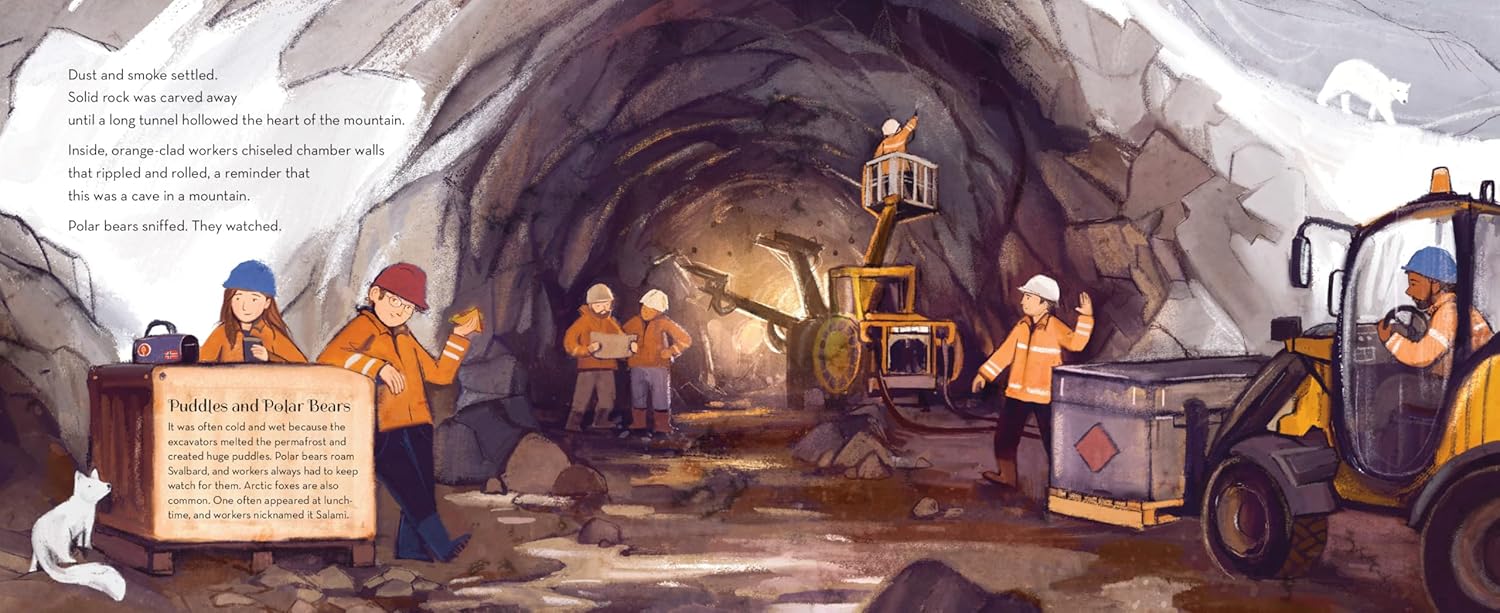
Illustration © 2025 by Brittany Cicchese. Text © 2025 by Megan Clendenan. Courtesy of Charlesbridge.
Then it’s off to Norway to see where a group of engineers, scientists, and architects designed the vault that was to be built “in the middle of a frozen mountain.” Step by step, kids join the crew to see equipment arrive, hear the blast that facilitated the digging and carving of the tunnel, and even meet a hungry arctic fox they befriended.
Readers learn about security at the vault, witness the care with which farmers, gardeners, and collectors from around the world contribute seeds to the vault’s shelves, and discover that in the vault’s “first five years, 80,000 unique crop varieties arrived . . . !” They also see how crucial the seed vault is through the story of the first withdrawal of seeds from the bank that helped a war-torn country recover their crops. Today, “inside the vault, a walk down the aisles becomes a walk through the world” with “more than 580 million seeds. / For you, for me / for everybody. / Just in case.”
Back matter extends the discussion of some issues presented in the text, including the difficulty of keeping seeds safe, the vault itself, the need to continually update crop seeds to reflect evolutionary changes, and an author’s note.
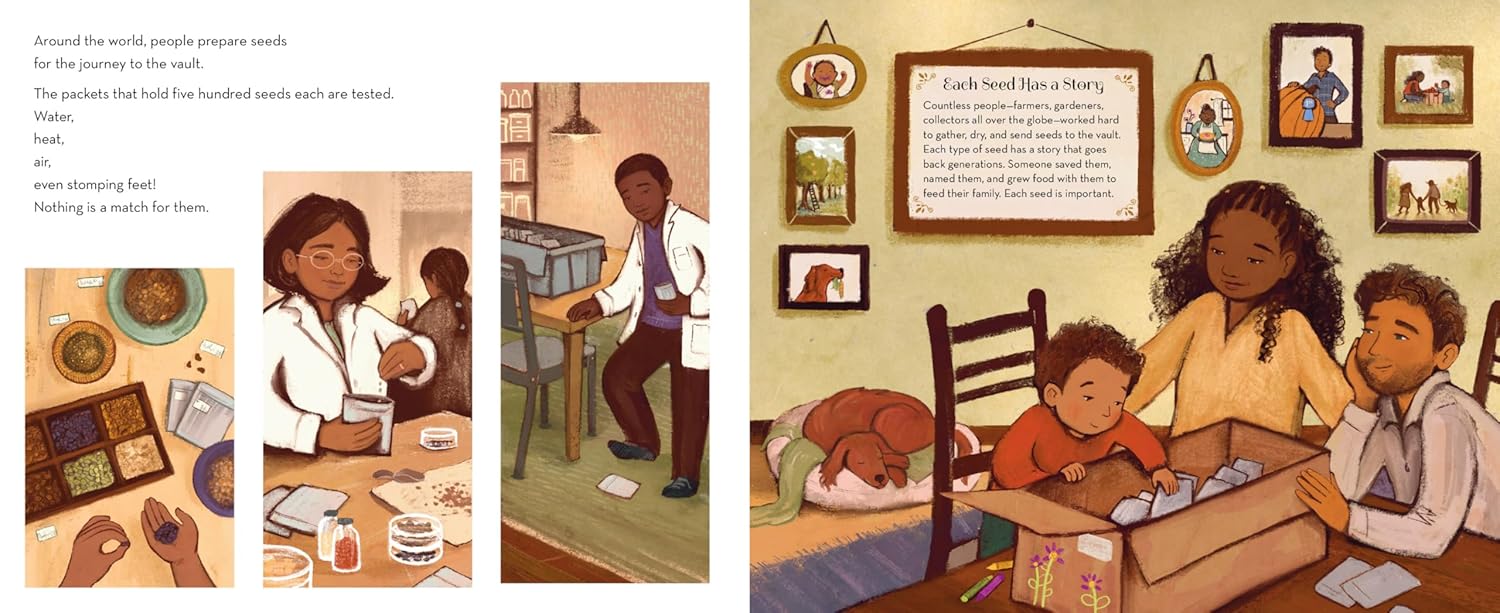
Illustration © 2025 by Brittany Cicchese. Text © 2025 by Megan Clendenan. Courtesy of Charlesbridge.
With the allure and story-building of an adventure about hidden treasure, Megan Clendenan draws readers into the frozen, underground world of the Svalbard Global Seed Vault, where the survival of crucial food crops is protected. Her clear and lyrical text (“steel doors open and beckon into the belly of a mountain,” “walls of ice shine like stars.”) keeps readers riveted to the historical and current facts about farming, seed harvesting, and this global facility that may be unknown to many. Easy-to-understand sidebars illuminate particular aspects of Clendenan’s subject, including, information on local seed banks around the world, varietal differences and the threat of extinction of some seeds, vault design and construction, seed storage conditions, and the first seed withdrawal.
Brittany Cicchese’s lovely illustrations take children to the arctic north to view the Svalbard Global Seed Vault, with it’s ethereal sculptural entrance, and its shelves lined with boxes of seeds before transporting them to various farms, gardens, markets, and seed repositories around the world. Cicchese’s detailed and realistic depictions clearly connect readers to those who grow and sell food, the design and construction of the vault from the meeting room to the mountain tunnel, the scientists and families who provide the seeds, and the plants that grow to feed us all.
An absorbing look at one of the world’s most important resources that also offers a sense of hope in its example of global collaboration, Just in Case: Saving Seeds in the Svalbard Global Seed Vault is a must for school, classroom, and public libraries as well as for children who love gardening, farming, science, and food.
Ages 5 – 8
Charlesbridge, 2025 | ISBN 978-1623544805
Megan Clendenan studied sociology, English, and environmental planning and has worked for nonprofit organizations focused on environmental law, women’s empowerment, mental health, and urban food security. As a children’s book author, she loves writing nonfiction that explores the connections between history, society, and the environment. She is the author of Design Like Nature: Biomimicry for a Healthy Planet, Fresh Air, Clean Water: Our Right to a Healthy Environment, and Cities: How Humans Live Together. She lives near Vancouver, British Columbia, with her family and two fuzzy orange cats. This is her first picture book. You can visit her at meganclendenan.com.
Brittany Cicchese enjoys capturing emotion above all else, from expressive portraits to moody illustrations. She is the illustrator of The Kitten Story: A Mostly True Tale and No More Señora Mimí. When Brittany isn’t sketching or writing, you can find her working at the library, reading a good fantasy or sci-fi book, or hiking around the beautiful Rocky Mountains. Brittany lives in Denver, Colorado. Visit her at brittanycicchese.com.
Anniversary of the Svalbard Global Seed Vault Opening Activity
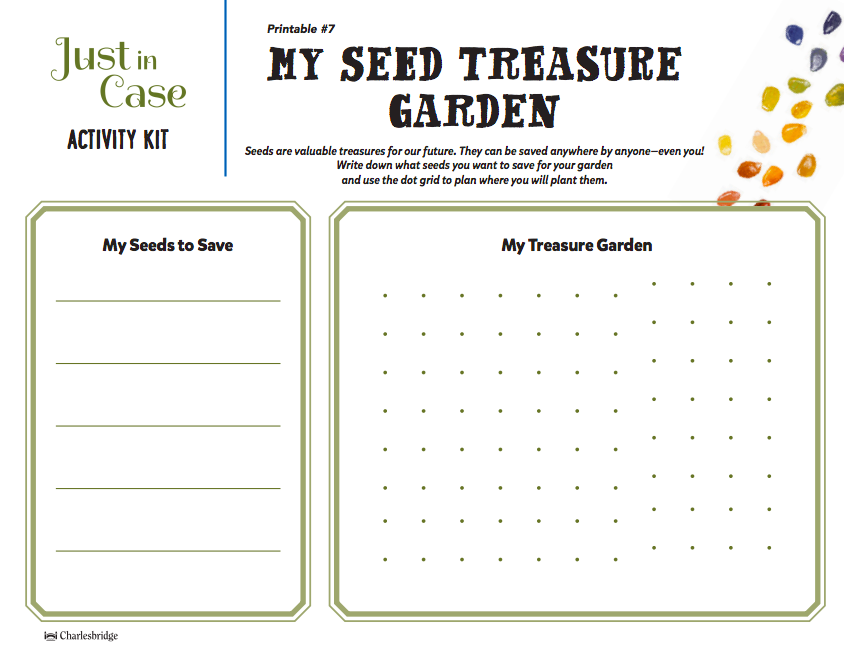
Just in Case Activity Kit
Educators and families will enjoy using the comprehensive Just in Case Activity Kit from Charlesbridge, Megan Clendenan, and Brittany Cicchese! It includes Connection Activities for English Language Arts, Social Studies, and Science; Discussion Questions; Tips to help children harvest seeds from their own fruit and vegetable plants; a garden planner; and a list of further resources. You can find the Just in Case Activity Kit on Megan Clendenan’s website and from Charlesbridge.
You can purchase Just in Case: Saving Seeds in the Svalbard Global Seed Vault from these booksellers
Amazon | Barnes & Noble | Bookshop
Picture Book Review


 celebratepicturebooks.com