April 16 –National Orchid Day

celebrate-picture-books-picture-book-review-flower-talk-cover

About the Holiday

National Orchid Day was established to celebrate one of the world’s most intricate and diverse flowering plants. With over 25,000 recognized species each, the orchid and the sunflower families of flowers vie for the title of largest as new species are discovered every year. Orchids range in size from a tiny 2.1mm flower with transparent petals only one cell thick to the grammatophyllum speciosum or Queen of Orchids, which grows to nearly 10 feet tall. Vivid coloring and striking patterns make the petals of each species things of wonder and prized plants for homes and botanical gardens. To celebrate today, learn how flowers use their colors and other features with today’s book!

I received a copy of Flower Talk: How Plants Use Color to Communicate from Millbrook Press to check out. All opinions are my own.

Flower Talk: How Plants Use Color to Communicate

Written by Sara Levine | Illustrated by Masha D’yans


A little purple prickly pear has something he wants to get off his spines. He shouts up at the reader holding the book. “Pssst! Down here! That’s right—I’m a plant, and I’m talking to you!” Once the reader is all attention, he goes on: “I want to clear up some of your crazy ideas about what the colors of our flowers mean.” You’ve got it all wrong if you think “red roses stand for love and white ones are good for weddings.” The prickly pear may see that the reader feels a bit confused, even a little embarrassed, so he softens his tone a bit and explains that while we may interpret a flower’s colors in certain ways, that’s not what they’re really for.

celebrate-picture-books-picture-book-review-flower-talk-cactu

Image copyright Masha D’yans, 2019, text copyright Sara Levine, 2019. Courtesy of Millbrook Press.

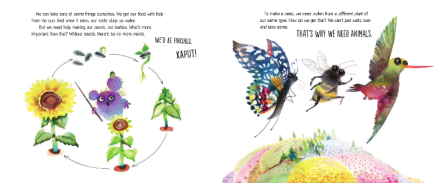
He then continues to reveal “we use our flowers to talk to the animals” so that we can make seeds and more plants. To do that each plant needs pollen from another plant of the same kind. Flowers are like big ads, the prickly pear explains, that attract just the right birds, bees, or butterflies to help them out. Often, if they’re hungry, they fly from flower to flower and bring pollen along with them.
celebrate-picture-books-picture-book-review-flower-talk-insects

Image copyright Masha D’yans, 2019, text copyright Sara Levine, 2019. Courtesy of Millbrook Press.

But how does each bird, butterfly, or bee know which flowers to pollinate? That’s where a flower’s colors come in, the prickly pear says. “A flower’s color invites specific animals to visit.” Then he lets children in on their conversations. Hear the red flowers talking? They’re calling out to birds, offering hummingbirds a bit of nectar in exchange for carrying pollen. Insects can’t see the color red. Blue and other vibrant flowers whisper sweet nothings to bees, inviting them to take along some pollen – to their hives and also to other flowers, thanks! White flowers are perfectly hued to attract pollinators at a particular time of day. Brown flowers may not be showy, but they appeal to certain insects too. And green flowers? Well they don’t need to talk at all. The prickly pear encourages kids to guess why.
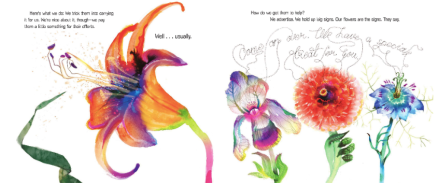
celebrate-picture-books-picture-book-review-Flower-talk-ads

Image copyright Masha D’yans, 2019, text copyright Sara Levine, 2019. Courtesy of Millbrook Press

Colors aren’t the only trick that flowers have either. Most emit a scent and some are just the right shape. But now, the prickly pear excuses himself with an abrupt “Go take a hike.” Why the brush off? It seems he’s making a new flower and is just about done with it. When you see it, you’ll think it’s the bee’s knees!

Back matter includes an illustrated step-by-step look at how pollination works, information on how to protect pollinators, and a list of other books for further reading.
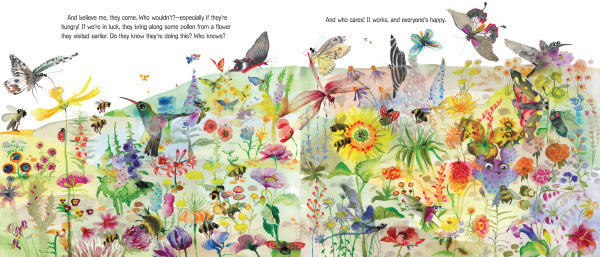
celebrate-picture-books-picture-book-review-flower-talk-field

Image copyright Masha D’yans, 2019, text copyright Sara Levine, 2019. Courtesy of Millbrook Press.

With an impish attitude, Sara Levine’s hilarious and knowledgeable prickly pear narrator engages kids in witty banter while taking them on a colorful garden tour. As the cactus explains a plant’s growing cycle and the need for pollinators, the information it imparts is eye-opening for children and adults. Why and how each flower’s color and scent attract just the right pollinator is clearly described in conversational language that kids will laugh along with and learn from. Every page contains an “ah-ha” moment that will spark discussion and an excitement to plant a colorful garden and watch nature at work.

Like a riotous field of wildflowers, Masha D’yan’s dazzling illustrations put colors on glorious display as the flowers lure insects and animals to them. D’yan’s detailed images provide a great place for young naturalists to start researching the various plants introduced. Depictions of the prickly pear, birds, and bees match the humor of Levine’s text. Kids will love lingering over the two-page spreads to point out the various animals and insects and how they interact with the plants. They’ll also like following the growth of the prickly pear’s bud as it grows bigger and blossoms.

A superb book for teaching children about this fascinating feature of flowers and plants as well as providing a guide for gardeners interested in attracting a variety of pollinators, Flower Talk: How Plants Use Color to Communicate would be an outstanding addition to home, classroom, and public libraries.

Ages 7 – 11

Millbrook Press, 2019 | ISBN 978-1541519282

Discover more about Sara Levine and her books on her website.

To learn more about Masha D’yans, her books, and her art, visit her website.

National Plant a Flower Day Activity

celebrate-picture-books-picture-book-review-flower-pot-stake-craft

Flower Garden Stakes


It’s fun to start a garden from seeds, but how do you remember what you’ve planted where? With these easy to make garden stakes, you can mark your pots with style! 

Supplies

  • Wide craft sticks
  • Chalkboard paint in various colors
  • Colorful chalk
  • Paint brush

Directions

  1. Paint the stakes with the chalkboard paint, let dry
  2. With the chalk, write the name of the different flowers or plants
  3. After planting your seeds, stick the stake in the pot 
  4. Wait for your seeds to grow!

celebrate-picture-books-picture-book-review-flower-talk-cover

You can find Flower Talk: How Plants Use Color to Communicate at these booksellers

Amazon | Barnes & Noble | Books-a-Million | IndieBound

Picture Book Review

March 19 – The Spring Equinox

celebrate-picture-books-picture-book-review-winged-wonders-cover

About the Holiday

Today, we celebrate the first day of spring! What makes the equinox so special? On this date, day and night are equally long around the globe. With longer days and warmer weather, thoughts turn to nature and renewal. For many this means gardening for ourselves and for the returning bees and butterflies. Today’s book takes a look at one of nature’s most inspiring creatures – the monarch butterfly. 

I received a copy of Winged Wonders from Sleeping Bear Press for review of consideration. All opinions about the book are my own.

Winged Wonders: Solving the Migration Mystery

Written by Meeg Pincus | Illustrated by Yas Imamura


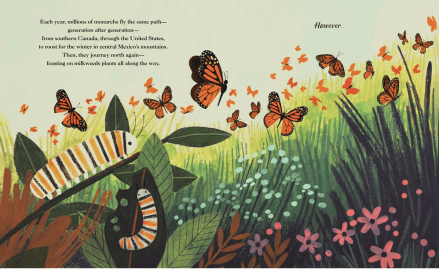
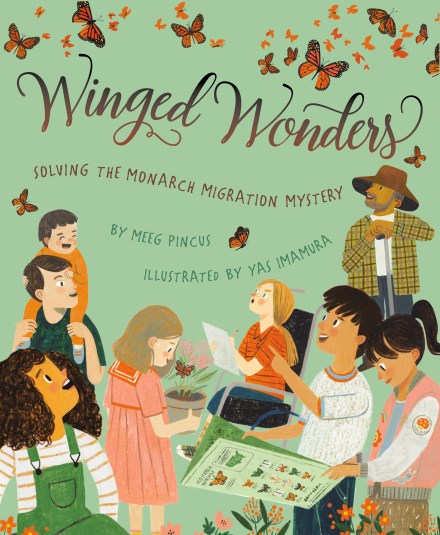
For centuries people pondered the mystery of the monarch butterflies that “swooped in for a spell, like clockwork” from who-knew-where and fluttered off to some unseen destination. People all along their route, “from southern Canada…through the middle of the United States…and all the way to central Mexico” wondered about this annual event. The mystery was finally solved in 1976. What was it that set these butterflies soaring? The newspapers called it “The Great Monarch Migration.”

celebrate-picture-books-picture-book-review-winged-wonders-citizen-scientists

Image copyright Yas Imamura, 2020, text copyright Meeg Pincus, 2020. Courtesy of Sleeping Bear Press.

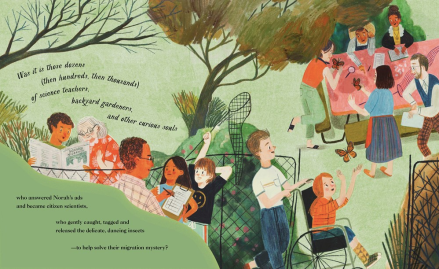
You might wonder who the person was who “tracked these winged wonders from one end of the continent to the other” and “found their secret roosting place, a marvel of nature.” Perhaps it was Fred, a scientist from Canada, who spent thirty years studying the monarchs and tagging their wings. Or maybe it was his wife, Norah, who sought help in tagging monarchs’ wings from volunteers across the country and “logged and mapped every tidbit of information they sent in to the lab.”

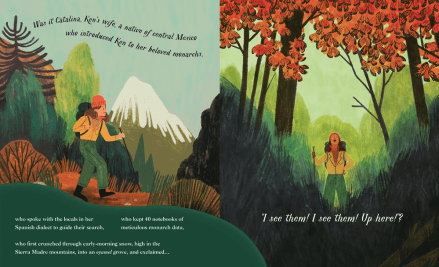
Could it have been the thousands of “science teachers, backyard gardeners, and other curious souls” who answered Norah’s plea? Or you might want to consider Ken and Catalina, a couple in Mexico who spent two years “trying to track the butterflies’ twisting trail” with the help of villagers and farmers. You might even say that it was Jim, a science teacher in Minnesota, who caught and tagged a very particular one-among-millions monarch.

celebrate-picture-books-picture-book-review-winged-wonders-catalina

Image copyright Yas Imamura, 2020, text copyright Meeg Pincus, 2020. Courtesy of Sleeping Bear Press.

So who was it? Who made that 1976 discovery? If you say all of them, you’re right! Communities across the North American countries of Canada, America, and Mexico came together to solve the mystery of one of nature’s most astounding phenomena. But now, another question concerning monarchs looms: “How will they survive?” Since that first discovery, the monarch population has dropped from “at least a billion to millions—a handful now to each hundred then” due to pesticides, pollution, and habitat destruction. Who do you think can help solve this monarch question? “The answer is really no mystery at all.”

An extensive Author’s Note following the text offers more information about the monarch migration discovery as well as ideas and projects for helping the monarch population grow and thrive.

celebrate-picture-books-picture-book-review-winged-wonders-caterpillars

Image copyright Yas Imamura, 2020, text copyright Meeg Pincus, 2020. Courtesy of Sleeping Bear Press.

Mirroring the flight of the monarchs, Meeg Pincus entices readers along the route of her story with fascinating facts about the personalities and eager citizen scientists who dedicated their lives and contributed their time to catching, tagging, and tracking these beautiful butterflies. Surprising details reveal the commitment in time and effort of so many people who enthusiastically answered Norah’s call for help. Her questioning format builds this same feel of excitement and community as page-by-page more people are added for readers to learn about and consider. Pincus’s lyrical storytelling is as buoyant and lovely as her subject while providing readers with a depth of knowledge about the process and experiences of the people along the way.

Yas Imamura’s delicate butterflies flutter above multi-hued green hills, busy downtown shops, and a golden desert before congregating like autumn leaves on a solitary tree as a deer looks on. Readers then begin to meet the scientists & participants: Fred and Norah in their well-packed car awed at spotting a monarch along their route, experimenting with wing tags, and mapping monarch sightings; a diverse group of kids and adults catching, tagging, and releasing butterflies; Ken and Catalina and the people of central Mexico, who share their colorful Día de los Muertos celebrations with these winged visitors; and finally Jim and his students.

Imamura’s glorious color palette complements the orange monarchs with soft pinks, corals, yellows, and reds while dramatically highlighting them against dark green backgrounds. Show-stopping scenes of the monarchs gathered on tree trunks and branches and the final spread of a butterfly garden are awe-inspiring and will spark children’s interest in helping to protect and help these unique creatures.

Winged Wonders: Solving the Monarch Migration Mystery is a must for home, school, and public library collections for nature lovers, citizen scientists, and any child who is a budding environmentalist as well as for lessons on science and community engagement.

Ages 7 – 10

Sleeping Bear Press, 2020 | ISBN 978-1534110403

Discover more about Meeg Pincus and her books on her website.

To learn more about Yas Imamura, her books, and her art, visit her website.

You can download an Educational Guide with activities for Winged Wonders on the Sleeping Bear Press website.

Spring Equinox Activity

celebrate-picture-books-picture-book-review-flower-garden-game

Plant a Flower Garden Game


With this fun game you and your family and friends can grow gardens inside! Roll the dice to see whose garden will fully blossom first!

Supplies

Directions

Object: The object of the game is for each player to fill their garden or garden row with flowers. Depending on the ages of the players, the game can be adjusted to fill all of the rows, some or all rows, or just one. 

Options:

  • Players can “plant” each of the six rows with multiple flowers of the same type
  • Each player can be assigned a single row and “plant” one each of the six types of flowers 
  1. Print number of Game Boards needed 
  2. Print one or more sets of Flower Playing Cards for each player, depending on how many of each flower the players want to put in each row (For example: fewer for younger children, more for older). For sturdier playing items, print on card stock.
  3. Cut the playing cards apart
  4. Print one Flower Playing Die and assemble (for a sturdier die, print on card stock)
  5. Color the “dirt” on the Garden Plot (optional)
  6. Choose a player to go first
  7. The player rolls the die and then “plants” the flower rolled in a row on the game board
  8. Play moves to the person on the right
  9. Players continue rolling the die and “planting” flowers until each of the number of determined rows have been filled with flowers or one row has been filled with all six flowers.
  10. The first person to “grow” all of their flowers wins!

celebrate-picture-books-picture-book-review-winged-wonders-cover

You can find Winged Wonders: Solving the Monarch Migration Mystery at these booksellers

Amazon | Barnes & Noble | Books-a-Million | IndieBound

Picture Book Review
April 22 – Earth Day

celebrate-picture-books-picture-book-review-soar-high-dragonfly-cover

About the Holiday

By 1970 awareness was growing worldwide about the damage that industrialization, pollution, and pesticides were causing people and the environment. On April 22, 1970, millions of people demonstrated for change. In response, in July President Nixon and the US Congress created the Environmental Protections Agency and enacted laws such as the Clean Water Act and the Endangered Species Act among others. Earth Day is now celebrated around the globe as a day for political action and civic participation.

Today, it’s more important than ever for citizens to participate in the protection of the environment so that the advances we have made are not rolled back or lost. This year the theme of Earth Day is Protect Our Species. To learn more about endangered and threatened species—from plants to animals to insects, including the Hines emerald dragonfly, and how you can help, visit the Earth Day Network. To celebrate today’s holiday, join an action group in your community dedicated to protecting natural resources.

I received a copy of Soar High, Dragonfly! from Sleeping Bear Press for review consideration. All opinions are my own. I’m happy to be teaming with Sleeping Bear Press for a giveaway of the book. See details below.

Soar High, Dragonfly!

Written by Sheri Mabry Bestor | Illustrated by Jonny Lambert


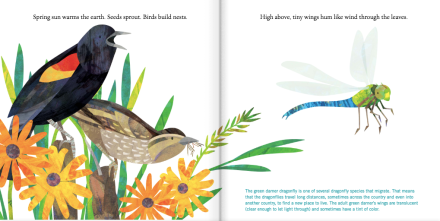
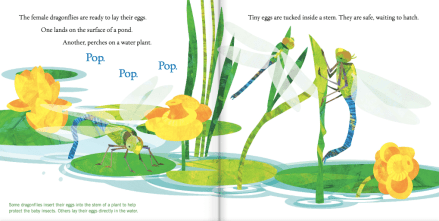
As winter turns to spring, flowers bloom, baby birds hatch, and “high above, tiny wings hum like wind through the leaves.” The sound comes from dragonflies. In the warm air, the females are looking for places to lay their eggs. They find a pond, where they can lay eggs in the water or within the stem of a plant. While some eggs are eaten, many others hatch into nymphs. Underwater, the nymphs have a special way of swimming that propels them to find food to eat.

celebrate-picture-books-picture-book-review-birds

Image copyright Jonny Lambert, 2019, text copyright Sheri Mabry Bestor, 2019. Courtesy of Sleeping Bear Press.

As a nymph “he eats, he grows. As he grows, he sheds his casing. Squirt. Gulp! Squirt. Gulp!” At last the nymph is ready to leave the water. During the night, he climbs the stem of a water reed and waits for daylight. The nymph has undergone many casing changes, but finally, his last casing grows too tight. “It cracks. He wiggles and squiggles. Out he crawls!” Although his wings are free, he is too tired to fly.

celebrate-picture-books-picture-book-review-soar-high-dragonfly-nymph

Image copyright Jonny Lambert, 2019, text copyright Sheri Mabry Bestor, 2019. Courtesy of Sleeping Bear Press.

In the warmth of the sun, the dragonfly’s wings dry. “They hum in the morning light.” When he is ready, he takes off into the sky… “he’s flying! Soar high, dragonfly!” Without practice, the dragonfly can fly forward, backward, and even hover. Using his large eyes, he scans for predators, darting away at the last moment.

The dragonfly is a marvel, moving his wings and changing his body to keep warm day and night. Summer brings mating season, and with the autumn the dragonflies migrate to warmer climates to lay their eggs and begin their life cycle again.

celebrate-picture-books-picture-book-review-soar-high-dragonfly-laying-eggs

Image copyright Jonny Lambert, 2019, text copyright Sheri Mabry Bestor, 2019. Courtesy of Sleeping Bear Press.

Sheri Mabry Bestor’s lyrical text is accompanied by equally engaging factual information about dragonflies, and the green darner dragonfly in particular. Each page contains a sentence or two of fascinating description about egg laying, life stages, feeding customs, movement (“Nymphs squirt water out of their back ends to propel themselves forward.”), body regulation (“Dragonflies have special ways to keep warm. They can capture the heat of the sun by adjusting their four wings just right.”), and migratory habits of these favorite insects.

For young readers interested in insects and nature, Bestor’s captivating storytelling, which uses short sentences that echo the quick, darting movement of dragonflies, will keep them absorbed as they learn about this most intriguing creature.

celebrate-picture-books-picture-book-review-soar-high-dragonfly-pond

Image copyright Jonny Lambert, 2019, text copyright Sheri Mabry Bestor, 2019. Courtesy of Sleeping Bear Press.

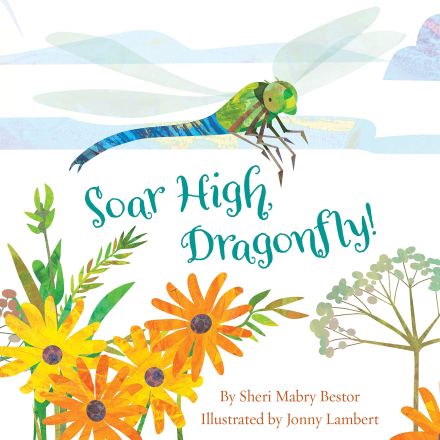
Jonny Lambert brings his talent as a paper engineer to the vibrant, collage-style illustrations that will wow kids with their beauty. The iridescent brilliance of the green darner dragonfly is represented through a green and yellow-mottled head and thorax that gives way to a blue striped abdomen. Light-sage-colored wings mirror the dragonfly’s delicate appearance. A stunning palette of greens and blues usher children into the underwater world of the pond where the nymphs grow among fish, frogs, snails, and other creatures. Each stage and change the dragonfly experiences is clearly shown and enhances learning.

A superb book for general story times as well as STEM learning, Soar High, Dragonfly! would find eager readers at home as well as in classroom and public libraries. Check out the first gorgeous collaboration between Sheri Mabry Bestor and Jonny Lambert, Good Trick, Walking Stick!, too! You can read my review of that book here.

Ages 5 – 8

Sleeping Bear Press, 2019 | ISBN 978-1585364107

Discover more about Sheri Mabry Bestor and her books on her website.

Earth Day Activity

celebrate-picture-books-picture-book-review-dragonfly-craft-3

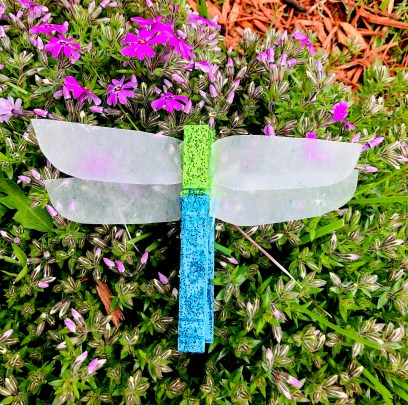
Dragonfly Decoration


Your kids can bring the beauty of nature inside with this easy-to-make dragonfly craft.

Supplies

  • Wooden clothespin
  • Wax paper
  • Bright green craft paint
  • Bright blue craft paint
  • Green glitter
  • Blue glitter
  • Paint brush
  • Thread or fishing line (optional)
  • Adhesive magnet (optional)

celebrate-picture-books-picture-book-review-dragonfly-craft

Directions

To Make the Body

  1. Paint the top part of the clothespin (to the point where the metal hinge crosses the wood) green
  2. Sprinkle green glitter on the wet paint, let dry
  3. Paint the bottom part of the clothespin blue
  4. Sprinkle blue glitter on the wet paint, let dry
  5. If the glitter doesn’t completely stick, apply a thin layer of glue with a toothpick and add more glitter

To Make the Wings

  1. Cut two 5-inch-by-3/4-inch strips from the wax paper
  2. Cut a curved edge at each end of the wax paper strips, cutting straight down from the top and curving around the bottom corner
  3. Cut curved notches in the center, top and bottom, of each wing to allow the wings to fit into the clothespin
  4. Open the clothespin and slip the wings in, curved edge down and allowing the top wing to overlap the bottom wing slightly

Attach the thread or fishing line to the dragonfly to hang, or to make a refrigerator magnet, attach an adhesive magnetic strip to the back.

celebrate-picture-books-picture-book-review-soar-high-dragonfly-cover

You can find Soar High, Dragonfly! at these booksellers

Amazon | Barnes & Noble | Books-a-Million | IndieBound

Picture Book Review