
About the Holiday
Poem in Your Pocket Day has become one of the favorite events of National Poetry Month. Requiring nothing but a pocket and a treasured poem, the day is a perfect way for poets, non-poets, and poetry lovers of all types to interact with this beloved art form. Originally enacted in 2002 by the Office of the Mayor in conjunction with the New York City Departments of Cultural Affairs and Education, the holiday was embraced as a national observance by the Academy of American Poets in 2008.
Here are some suggestions from the Academy of American Poets on how to spend the day. So clean the lint, coupons, old receipts, tissues, and loose change out of your pockets and replace them with a poem! Those crumpled bits may even inspire your own poem—try it!
- Post pocket-sized verses in public places
- Create and distribute bookmarks with your favorite lines of poetry
- Start a “poems for pockets” giveaway at school or work
- Add a poem to your email footer
- Post lines from your favorite poem on your Twitter, Tumblr, Instagram, Facebook, or Snapchat
- Send a poem to a friend
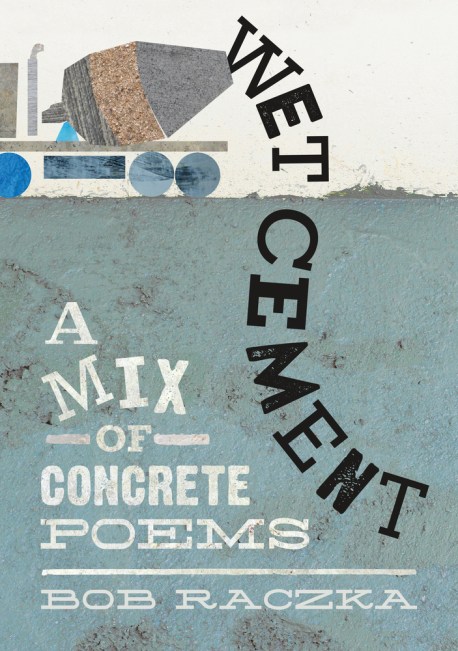
Wet Cement: A Mix of Concrete Poems
By Bob Raczka
When you envision a poem in your head, what do you see? A block of lines? A square or a rectangle? Well, sweep that image from your mind because in Bob Raczka’s Wet Cement: A Mix of Concrete Poems, verses become actions, objects, puzzles, and natural phenomena. Not only are the poems shaped to illustrate their theme, the titles use clever imagery as well.
As you encounter the poem hanger you’ll see that “han” has broken away and is dangling from the hook of g in “ger.” The words of the poem itself are shaped like a hanger and contain a giggle-invoking twist: “I hang out in blue jeans and comfy old shirts. I hang out in blouses and long frilly skirts. I hang out in sport coats and sweaters and shawls. I even hang out with no clothes on at all!”
You might want to get your baseball mitt out before you read homer, in which the first line zooms straight as a pitch and the second—written backwards and at an upward angle—soars like a homerun hit: “The pitcher hurls his hummer toward the slugger squeezing lumber CRA / CK! The slugger slams the hummer toward the bleachers for a homer.”
But don’t put that mitt away just yet! You may need to catch the o, which has escaped from the title p p-up. And if you’ve ever played t-ball, baseball, softball, or even wiffleball, you’ll cringe in recognition of this short but pointed poem.
The sky darkened by night in Dipper and by clouds in Lightning holds two poems expressing very different thoughts. In the title Dipper, the second p has floated to the top of the page where it hangs like a miniature reflection of the dipper-shaped poem, which reads: “Way down there on earth you hold firefly jars, filled up to their lids with light. Up here in the sky, I’m a vessel of stars, my brim overflowing with night.” In the title LIGHTNING, the L strikes the I to create the familiar jagged crack echoed in the shape of the verse: “from a bad mood sky, / tears, / then a jag- / ged slash- / ing flash of anger, / ear- / splitting, / obnoxious, / a cloud tantrum”
Any writer will love poeTRY which is such a clever take on the word as well as the revision and editing process:
“poetry is about taking away the words you don’t need
poetry is taking away words you don’t need
poetry is words you need
poetry is words
try”
Put simply, Bob Raczka’s concrete poems will make you smile. Even more than that, you’ll find yourself wanting to carry this book around, saying “Look at this!” to everyone you meet. Raczka calls these poems “word paintings”—because a poet “uses words like colors to paint pictures inside your head.” If creativity is the talent to present the world in new and surprising ways, making connections that enhance life, then Wet Cement is artistry at its best!
Ages 5 – 9 and up (adults will enjoy these poems as much as kids)
Roaring Brook Press, 2016 | ISBN 978-1626722361
Poem in Your Pocket Day Activity
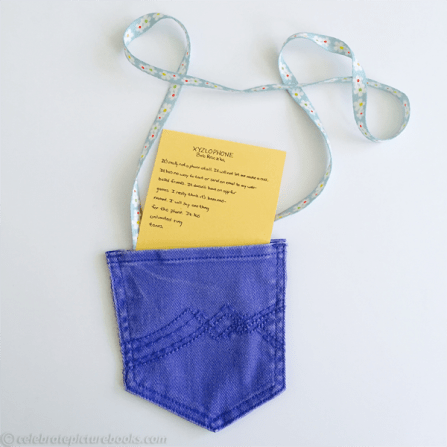
Pocket Poem Carrier
Sometimes you just need a little more inspiration in your day. Here’s a cute way to carry your favorite poem—today and every day!
Supplies
- An old pair of pants or shorts with back pockets
- A decorative shoelace
- Thread or fabric glue
- Needle
- Paper
- Your favorite poem or a poem you write yourself
- Pen
Directions
- Cut one back pocket off an old pair of pants or shorts
- Use the shoelace at its full length or cut to desired length
- Inside each edge of the pocket sew or glue the ends of the shoelace to make a strap
- Print your favorite poem on the paper
- Insert the poem into the pocket poem carrier
- Take your poem with you and share it with your friends!



 celebratepicturebooks.com