

About the Holiday
You can find rocks almost everywhere you go—from tiny pebbles to imposing boulders. Most of the time we may not pay much attention to the pebbles under our feet or the rock formations we pass frequently, but today’s holiday encourages people to really take a look at the variety of sizes and colors that make each rock unique. Rock collecting can be a fun and educational hobby as each type of stone has its own fascinating history and science to learn about. Why not get outside, do a bit of rock hunting, and start your collections today?!
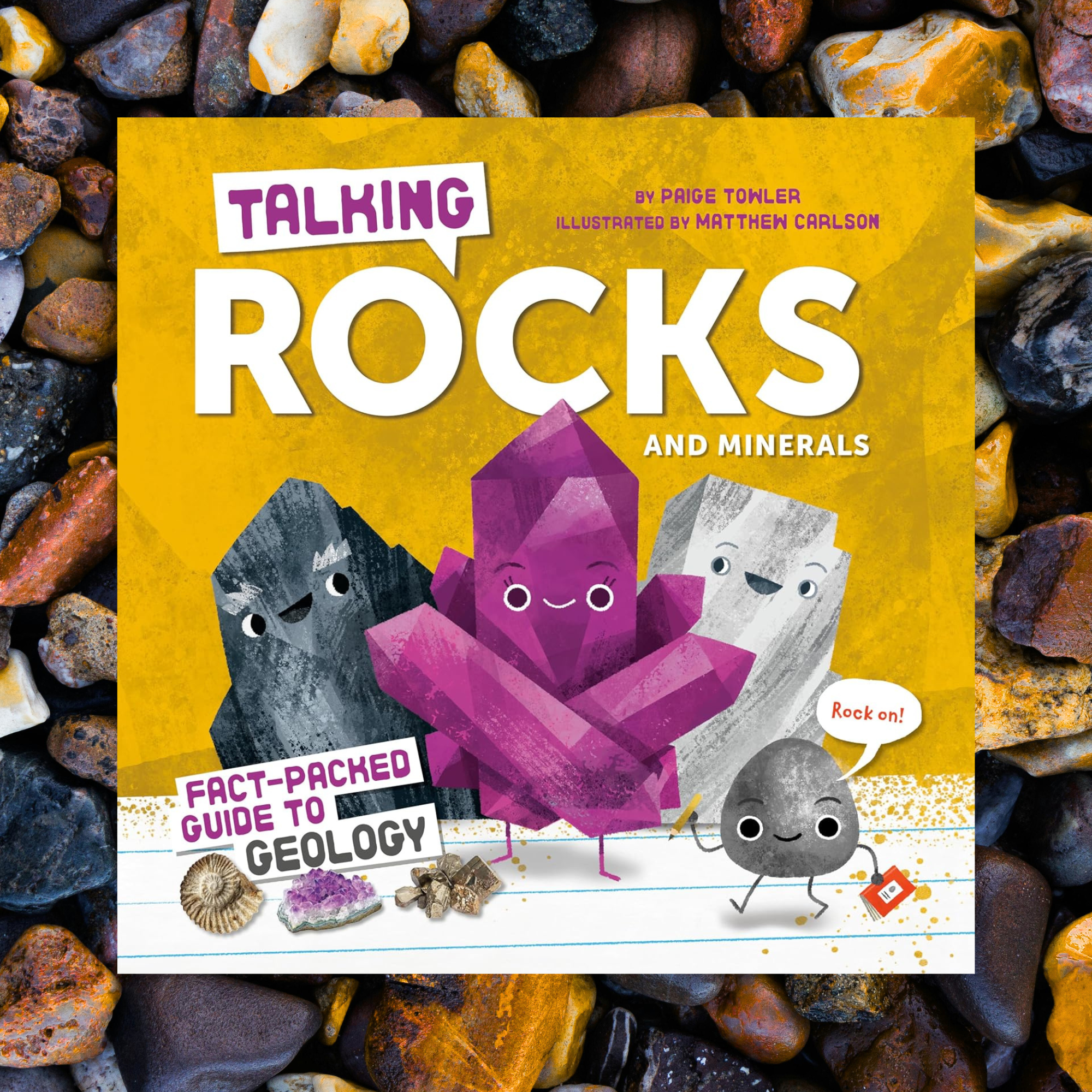
Talking Rocks and Minerals: Fact-Packed Guide to Geology
Written by Paige Towler | Illustrated by Matthew Carlson
In Talking Rocks and Minerals, readers meet ace reporter Pebble, whose resume boasts, “I’m in constant conversation with the gems of geology. The rock stars of rocking the rock world. The minerals making the mentions.” And he’s not kidding! A quick scan of his notebook reveals interviews scheduled with all the big names in rock, and he’s sent an open invitation for kids to come along and hear what they have to say. First up, readers meet an igneous rock, who regales them with memories of long, long, long ago when he started out as magma then cooled to become granite, “one of the strongest stones on earth.”
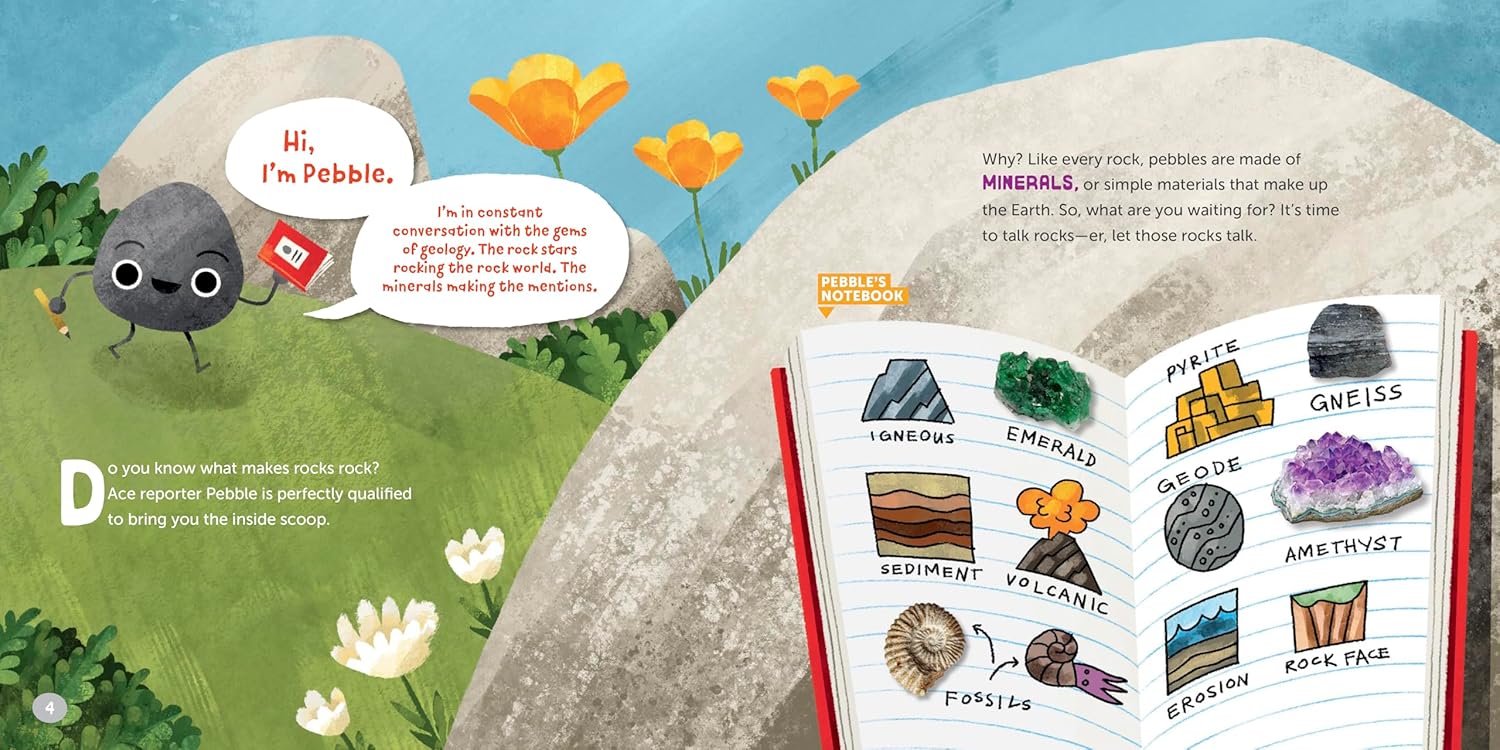
Illustration © 2025 by Matthew Carlson. Text © 2025 by Paige Towler. Courtesy of Grosset & Dunlap.
From there, Pebble moves on to talk to Coal and Limestone and discovers the layered story of what it’s like being a sedimentary rock. A couple of geodes then roll by to give kids a peek of the secrets they hold inside and make their story “crystal clear.” Amethyst gives an exclusive, showing how this royal gem developed, from when “a volcano blew its top” to the gamma rays that turned it purple. Pebble then introduces kids to two types of metamorphic rock—Marble and Gneiss—that start out as one kind of stone but under pressure and heat become another.
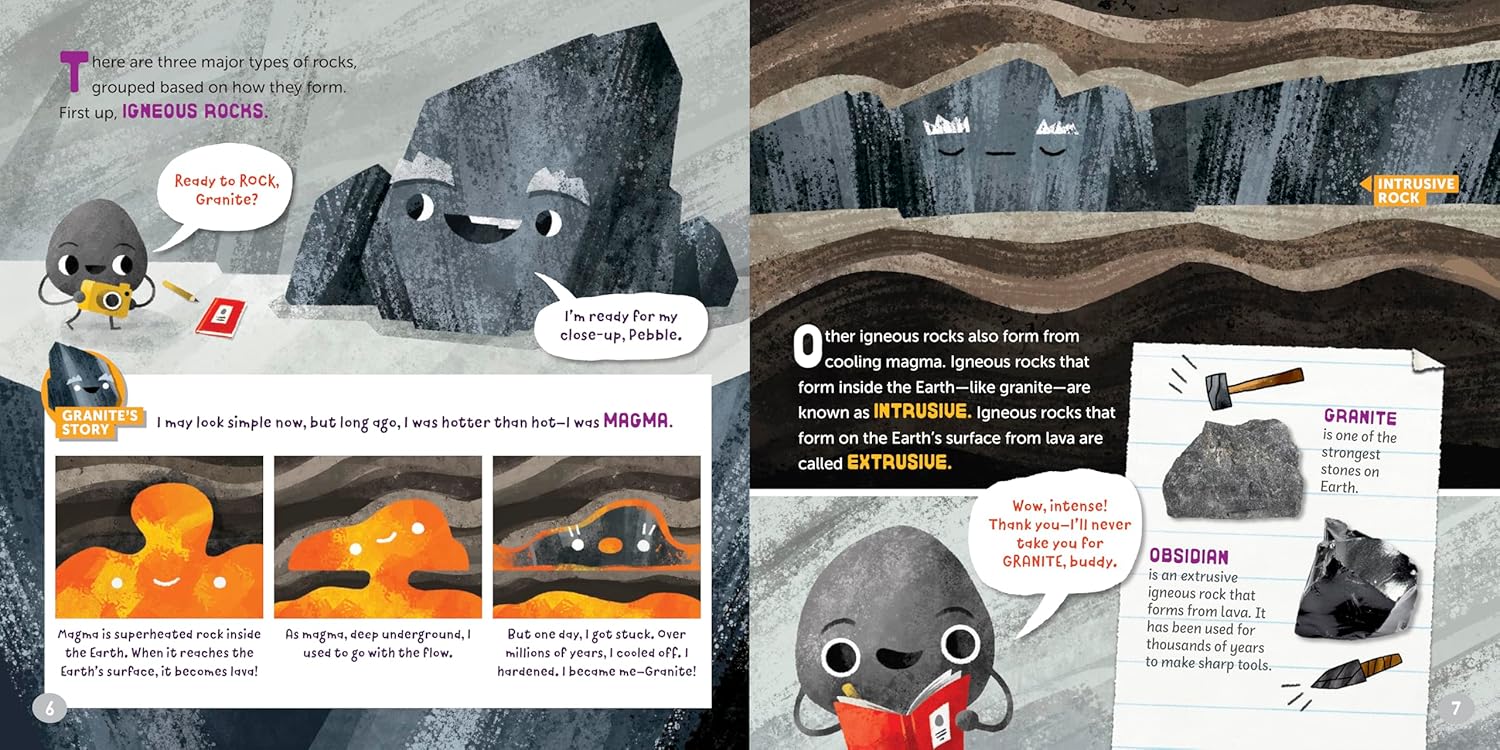
Illustration © 2025 by Matthew Carlson. Text © 2025 by Paige Towler. Courtesy of Grosset & Dunlap.
After learning the steps to the rock cycle, kids go deep underground to meet Diamond and learn how diamonds are formed from carbon and how they appear before they’re polished to a shine. Pebble interviews other gems too, like Emerald, Sapphire, and Ruby, who shine a light on how different minerals create such a variety of colorful and valuable stones.
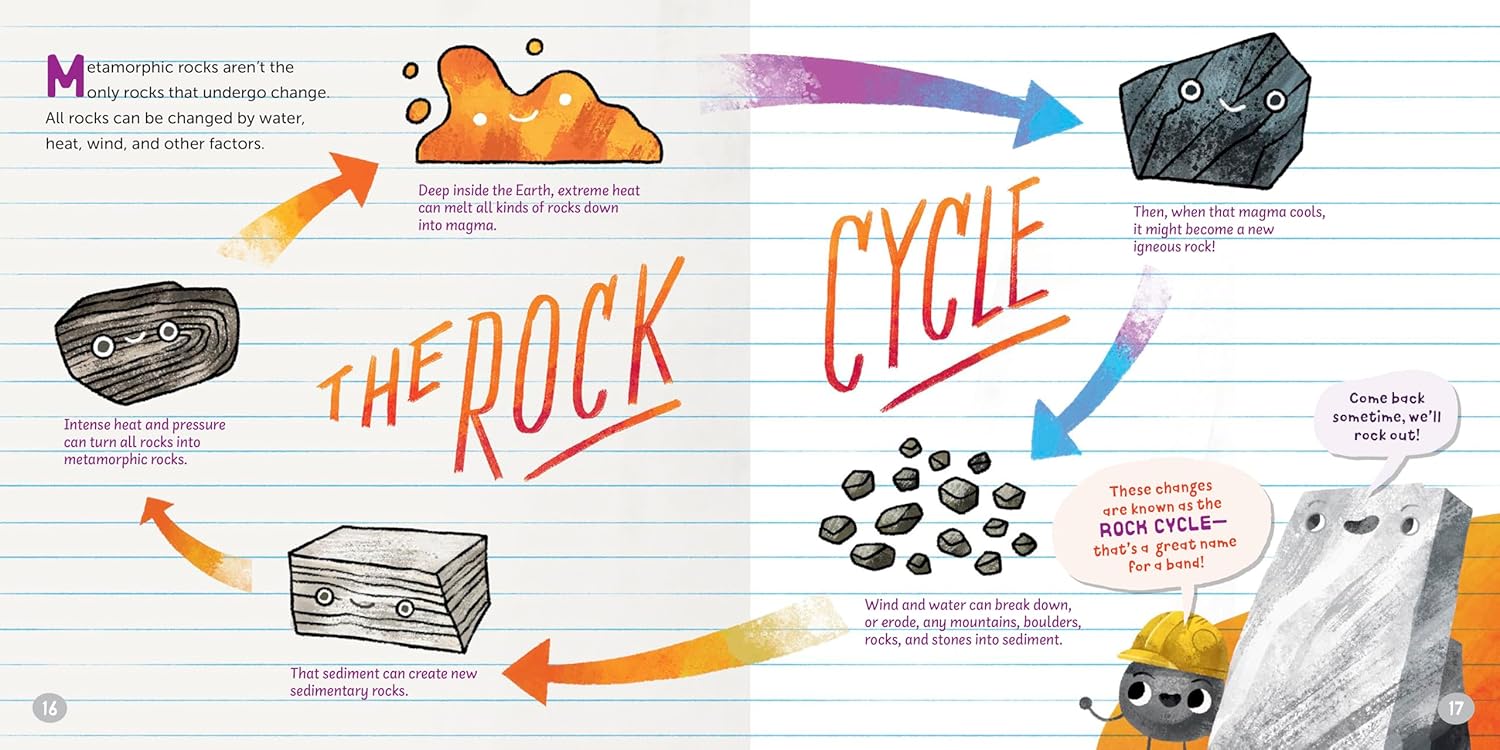
Illustration © 2025 by Matthew Carlson. Text © 2025 by Paige Towler. Courtesy of Grosset & Dunlap.
Emerging from underground, Pebble talks with pyrite, a shiny, golden mineral that often fooled prospectors during California’s gold rush, who has a surprising revelation to share. Continuing his walk, Pebble encounters a dinosaur fossil, who recounts how bones, leaves, and footprints become fossilized, leaving evidence of creatures and plants from eons ago. Speaking of eons ago, a trio of space rocks drop in—assuring Pebble “We come in pieces.”—to contrast asteroids from meteorites and tell how meteorites come to Earth.
Surrounded by all of his new friends, Pebbles signs off, but the learning continues. Back matter includes a glossary, a note from a geologist, a list of ideas on how kids can become rock hounds, and a bibliography of more books to check out.
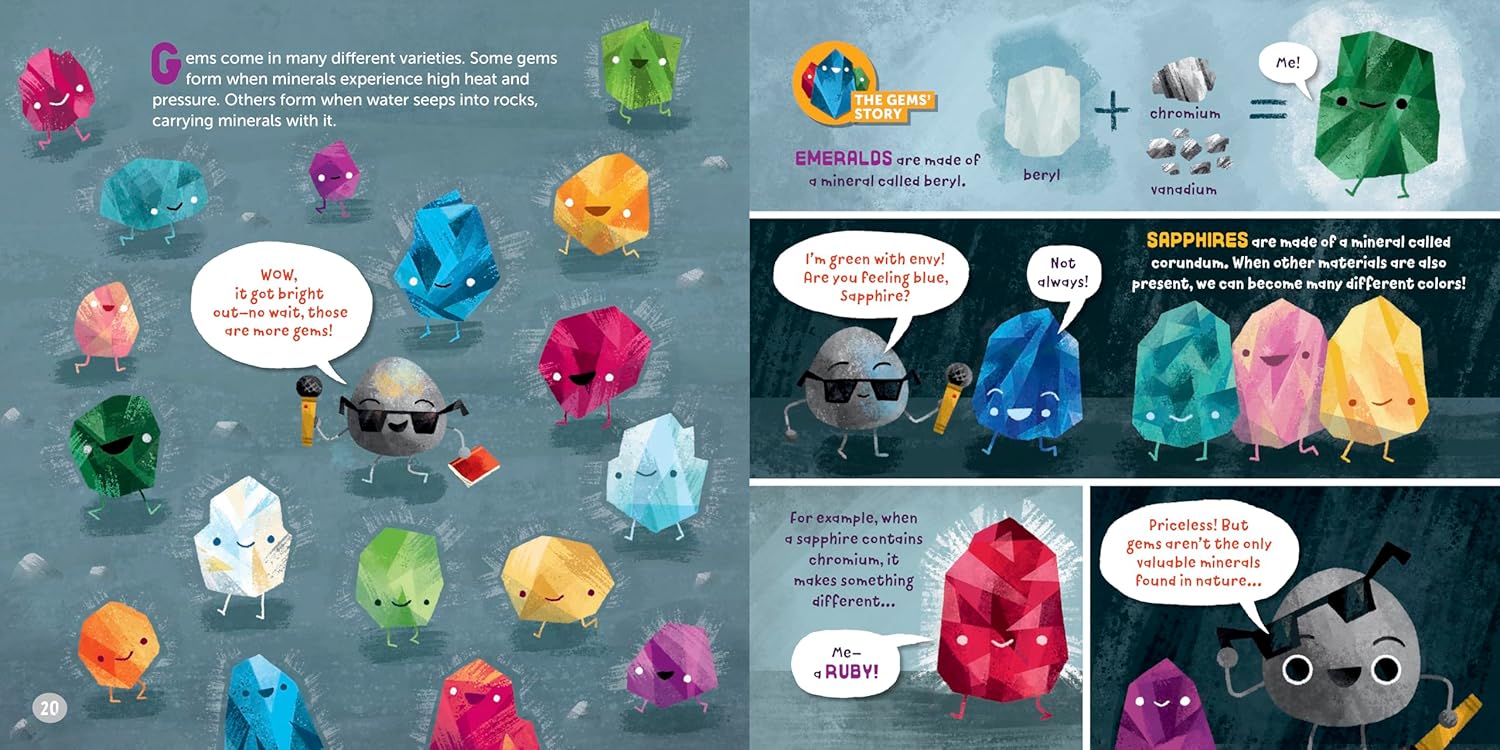
Illustration © 2025 by Matthew Carlson. Text © 2025 by Paige Towler. Courtesy of Grosset & Dunlap.
Gem-packed with puns, jokes, and hard-core facts, Paige Towler’s Talking Rocks and Minerals will excite kids already enthralled with geology and spark enthusiasm in those unfamiliar with the science, variety, and history of rocks we see every day as well as the stones we prize as valuable. Towler’s accessible text will appeal to all learners, making the book an excellent resource for educators. Her conversational delivery draws children in, creating a personal connection between them and the subject that will continue as they grow in their scientific studies.
Matthew Carlson’s eye-catching pages reflect how children learn today, offering adorable interacting characters, separate panels or full-page spreads that illustrate particular facts or scientific processes, and a wealth of detail that allows children to see the layers in sedimentary rock, look inside a geode, follow the rock cycle and the preservation of prehistoric creatures in fossils, and watch an asteroid plummet through Earth’s atmosphere to become a meteorite, among so many other elements.
A brilliant teaming of author and illustrator, Talking Rocks and Minerals: Fact-Packed Guide to Geology is an enriching and enlightening STEM book that is a must for all elementary classrooms, geology-loving children, science educators, and library collections.
Ages 6 – 9
Grosset & Dunlap, 2025 | ISBN 978-0593890950
About the Author
Paige Towler is a children’s book author and poet living in Washington, DC. She loves writing scary stories, tales about animals, and nonfiction facts about the weird and wonderful world around us. Her previous picture books include Mysterious, Marvelous Octopus! (National Geographic Kids), Baby Bat Bedtime (Smithsonian Institution/Sleeping Bear Press), Yoga Animals (National Geographic Kids), and more. Visit her at paigetowler.com.
About the Illustrator
Matthew Carlson is an illustrator, game designer, and graphic designer in Northern California. He studied art and English literature at the University of California, Berkeley. He’s illustrated projects for Robert Mondavi Wines, Facebook, and Twitter, and is currently the director of UX Design for Education, Fonts, and Drawing & Painting at Adobe. Originally from Seattle, Washington, Matthew now lives in Marin, California, with his partner, two kids, two dogs, and a growing collection of rocks.
You can purchase Talking Rocks and Minerals: Fact-Packed Guide to Geology from these booksellers:
Amazon | Barnes & Noble | Bookshop
Picture Book Review

 celebratepicturebooks.com