March 3 – World Wildlife Day

About the Holiday

In December of 2013 the United Nations General Assembly proclaimed March 3rd as World Wildlife Day to promote awareness of our environment and the dangers to it. Every year a different theme is chosen to spotlight an area of the world, a particular species, or a group of activists. This year’s theme is “Wildlife Conservation Finance: Investing in People and Planet” and focuses on innovative ideas for financing can contribute to halting biodiversity loss, raising the interest of private sector stakeholders to invest in wildlife conservation, and creating a sustainable future. The day also celebrates successful conservation and sustainability initiatives. To learn more about the day, special events, and how you and your kids can get involved today and throughout the year, visit the World Wildlife Day website.

Thanks to Eerdman’s Books for Young Readers for gifting us a copy of Kingdoms of Life for review.

Reviewed by Dorothy Levine

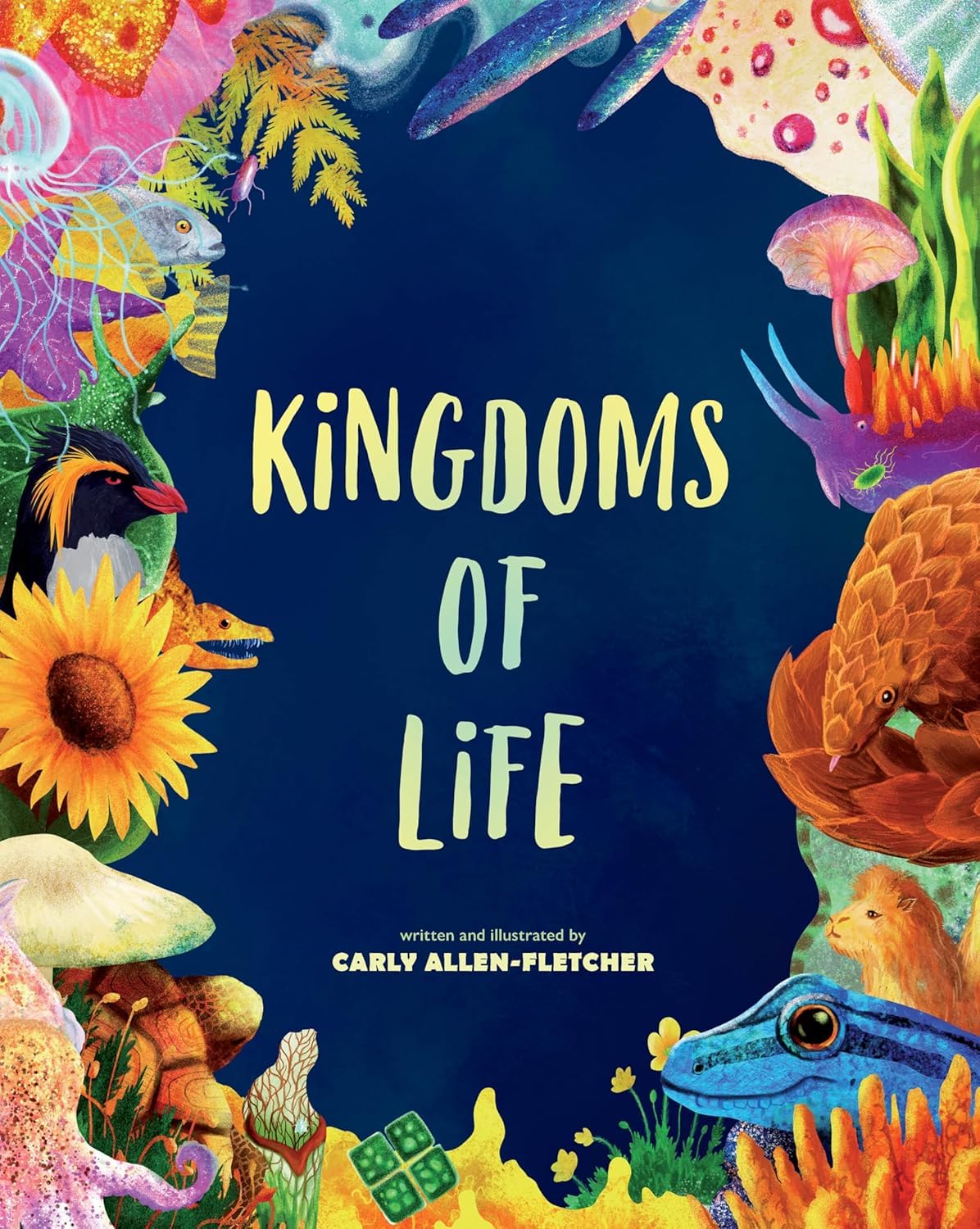
Kingdoms of Life

By Carly Allen-Fletcher


“Life is all around us…In the sky, the sea, and the soil, life exists in millions of different incredible ways.” 

Jump into Carly Allen-Fletcher’s vibrant fact-filled guidebook for kids for a deep-dive exploration of the kingdoms of life. Each Kingdom rules over its own color-coded section, jam-packed with information on how the classified organisms feed, grow, and reproduce. Information also includes the ways in which the organisms across Kingdoms are related or work together with other lifeforms. The pages are royally packed with vibrant illustrations that appear to burst out from the very edges of the book. 

Allen-Fletcher begins with an explanation of how all life is formed—from tiny building blocks called cells. These cells can join to create complex multicellular life forms or just exist on their own as unicellular forms of life. She then zooms out to examine the six biggest categories of life. Allen-Fletcher makes sure to note that these categories are not fixed; they change as scientists learn more and arrange beings in different ways. 
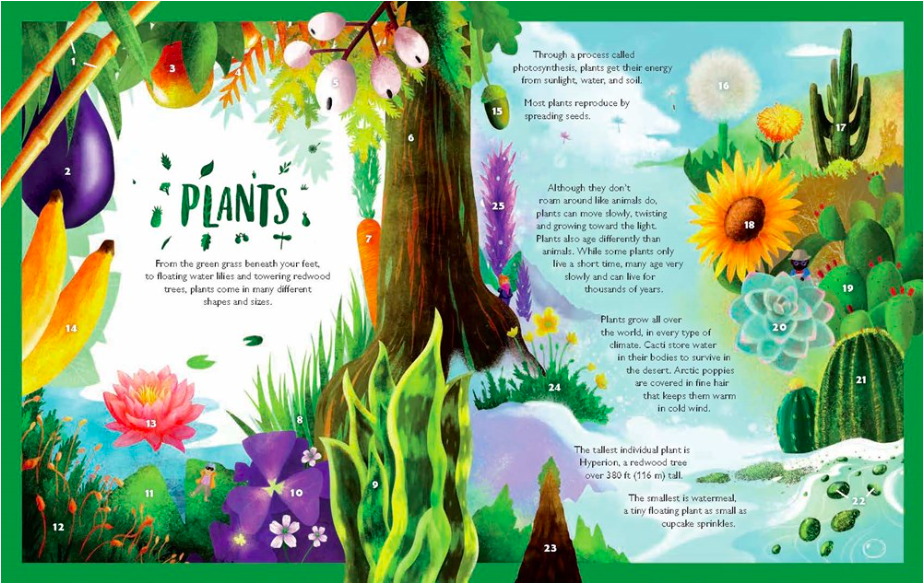
Illustration and text © 2025 Carly Allen-Fletcher. Courtesy of Eerdmans Books for Young Readers.

The first category investigated in depth is the most complex of the life-form groups—animals. The animal pages are filled with a diverse range of species, each numerated to a corresponding key at the back. Allen-Fletcher shows the wide range of animals by comparing the smallest species (fairy wasps) to the largest (blue whales), while also explaining how even within one species (dogs) there can be glorious variety. Examples of animals that don’t quite fit in the animal category, such as a sea slug that can make energy from the sun, as well as animals that can survive extreme conditions or are thought to be practically immortal, are also discussed.

In addition to the animals, plants, fungi, protists, bacteria, and archaea are each given equal attention in their respective kingdom sections. From protists like giant kelp and slime mold to bacteria in our gut and bioluminescent bacteria found in squid, each kingdom is filled with fascinating examples of life and interesting facts on specific organisms. 
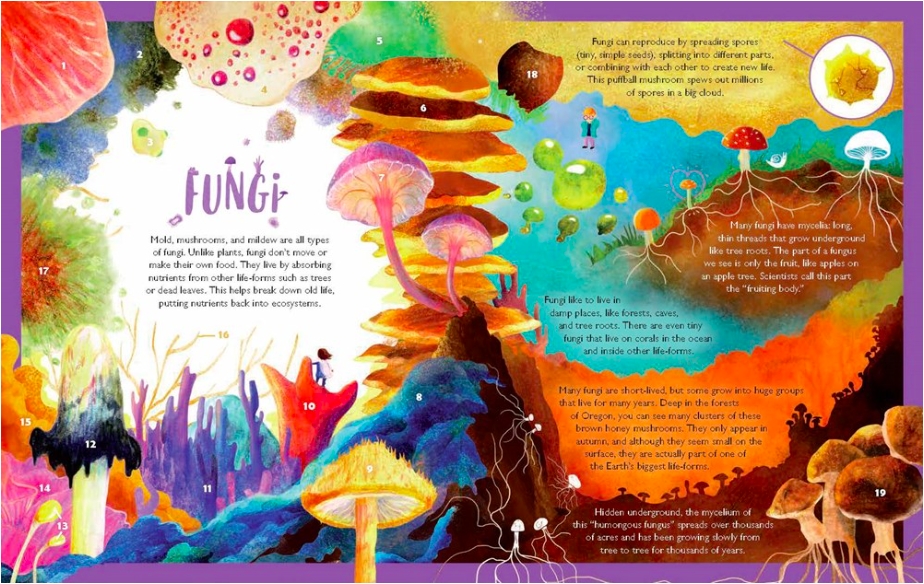
Illustration and text © 2025 Carly Allen-Fletcher. Courtesy of Eerdmans Books for Young Readers.

Kingdoms, Allen-Fletcher explains, can also be broken down further, into smaller and smaller groups such as family, genus, and species. A few taxonomists (scientists who study and sort lifeforms into categories) from around the world and throughout many different centuries are highlighted for their contributions to the field.

The book ends with a last dose of wonder: “We know more about the moon than we do about the deepest parts of our oceans. / Every year, we learn more about our home and the incredible life-forms we share it with. / What will we discover next?” The inclusion of “we” in this ending invites readers to feel welcome in this process of study and discovery. Taxonomy need not be only for adult scientists, but anyone who shares a passion for nature and careful observation. 

Back matter features each of the categories taxonomists use to sort life into groups as well as all the names of the featured life-forms throughout the book. The science is detailed while also distributed into easy-to-read bite-sized chunks.
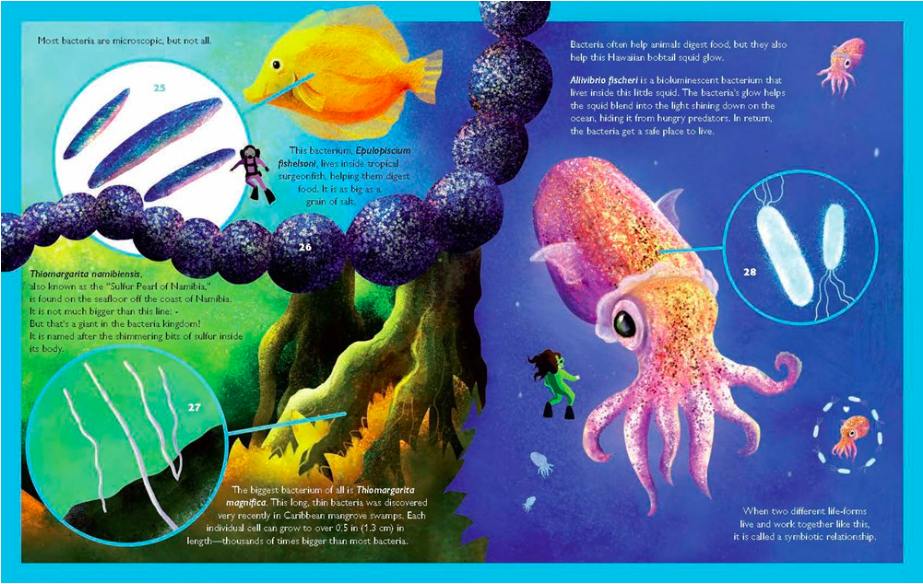
Illustration and text © 2025 Carly Allen-Fletcher. Courtesy of Eerdmans Books for Young Readers.

Carly Allen-Fletcher illuminates a topic that is usually reserved for upper-level biology courses making it accessible and intriguing for young learners. The facts from her book will inspire a passion for all species—large or small, animal or bacteria—and help children to understand where in this big wide world we as humans stand and the symbiotic relationships that exist between creatures. Mini scientists dot the lusciously illustrated pages, comically examining life-forms in all the kingdoms up close.

Kingdoms of Life would make a valuable addition to home, school and library collections.

Ages 6 – 10

Eerdmans Books for Young Readers, 2025 | ISBN 978-0802855916

About the Author/Illustrator

Carly Allen-Fletcher is a British illustrator and author whose books include Goodnight Forest (Muddy Boots), Beastly Biomes (Creston), and Animal Antipodes (Creston). Inspired by nature and science, she creates her art by combining hand-drawn elements, painted textures, and graphic shapes. Carly loves reading about the latest biological discoveries, and if she hadn’t become a professional illustrator, she would have become a scientist instead. Follow Carly on Instagram or visit her website at carlydraws.com.

World Wildlife Day Activity
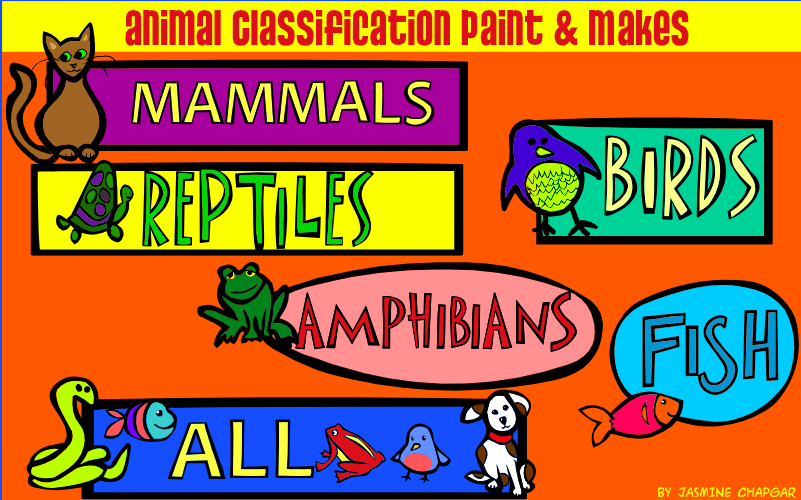
It Takes All Kinds game illustration courtesy of Science Trek.


Kingdoms of Life Fun


Watch a Kingdoms of Life Classification Video with Science Trek

  • As Allen-Fletcher notes in Kingdoms of Life, scientists are constantly evolving the categories for living organisms as they learn more. Do you notice any differences between the book and video kingdom categories? Since this video was published, scientists have started using the kingdom names bacteria and archaea instead of the previously used term, monera!

You can also explore their Online Games on kingdoms of life and animal classification, and practice sorting with Generation Genius’s Candy Classification Activity
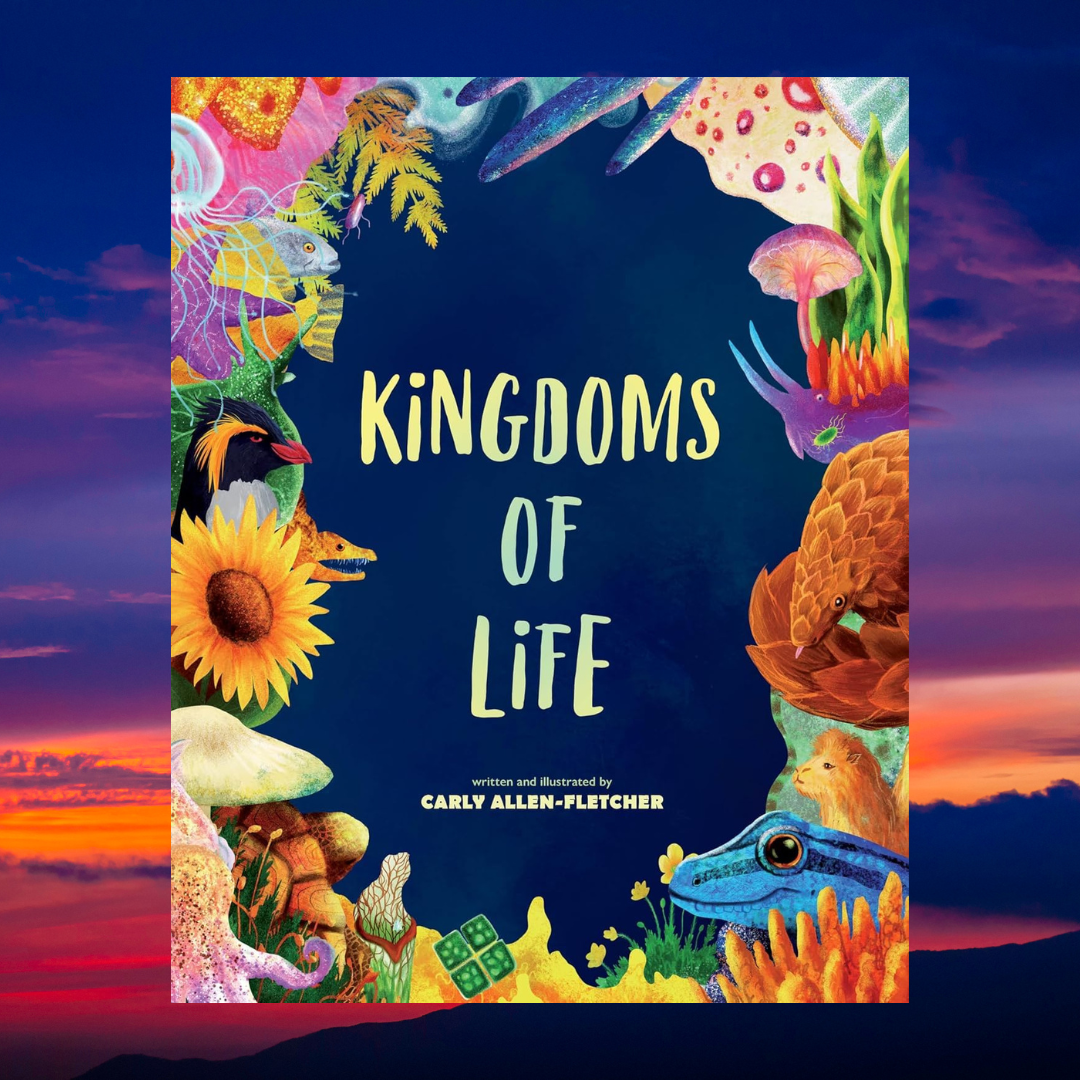
You can purchase Kingdoms of Life at these booksellers

Amazon | Barnes & Noble | Bookshop (to support your local independent bookstore)

Picture Book Revie

November 7 – It’s Picture Book Month

celebrate-picture-books-picture-book-review-when-you-find-a-rock-cover

About the Holiday

November is Picture Book Month, a month to remind us of the importance of picture books as a source of learning, growing and connecting for adults and children alike. While every day is a day to remember and celebrate our love for picture books, we challenge you this November to check out a few new titles, to share a book with a loved one, and keep on reading! To celebrate this month, we highlight a story that draws children and adults together in a meditation on the importance of connection, exploration, play and time for contemplation—all tied together by rocks!

I’m thrilled to welcome back Dorothy Levine, who has recently graduated from college and always lends a fresh, astute, and thoughtful perspective to her reviews. To learn more about Dorothy see our Welcome page.

Review by Dorothy Levine

When You Find the Right Rock 

Written by Mary Lyn Ray | Illustrated by Felicita Sala


Calling all collectors, connectors, climbers, and thinkers. Find a seat to get cozy in as we mosey our way through the narrative of When You Find the Right Rock. Some of us tend to walk with our eyes cued into the scenery around us. Perhaps you are one to scan the ground for treasures as you walk or skim the skyline for birds. In a world of go-go-go, children and adults alike are often discouraged from taking the time to pause and ground themselves in place, to notice the details of the wide world that connect us all.

One of these connectors is rocks, particularly the biggest rock of all, the one that lives “far under grass and trees / and houses and schools,” the rock that Lyn Ray describes as “one big enough for / everyone to stand on.”

celebrate-picture-books-picture-book-review-when-you-find-a-rock-bolders

Image copyright Felicita Sala, 2024, text copyright Mary Lyn Ray, 2024. Courtesy of Chronicle Books.

The story begins as a continuation of the title sentence: “You may try to go around it, / Or to just keep thinking whatever / you were thinking.” Told from the second person “you” view, readers are immediately able to place themselves in this story. Artist Felicita Sala depicts a young child staring out at us, grasping hands with an adult and, facing forward, in a rush toward their destination.

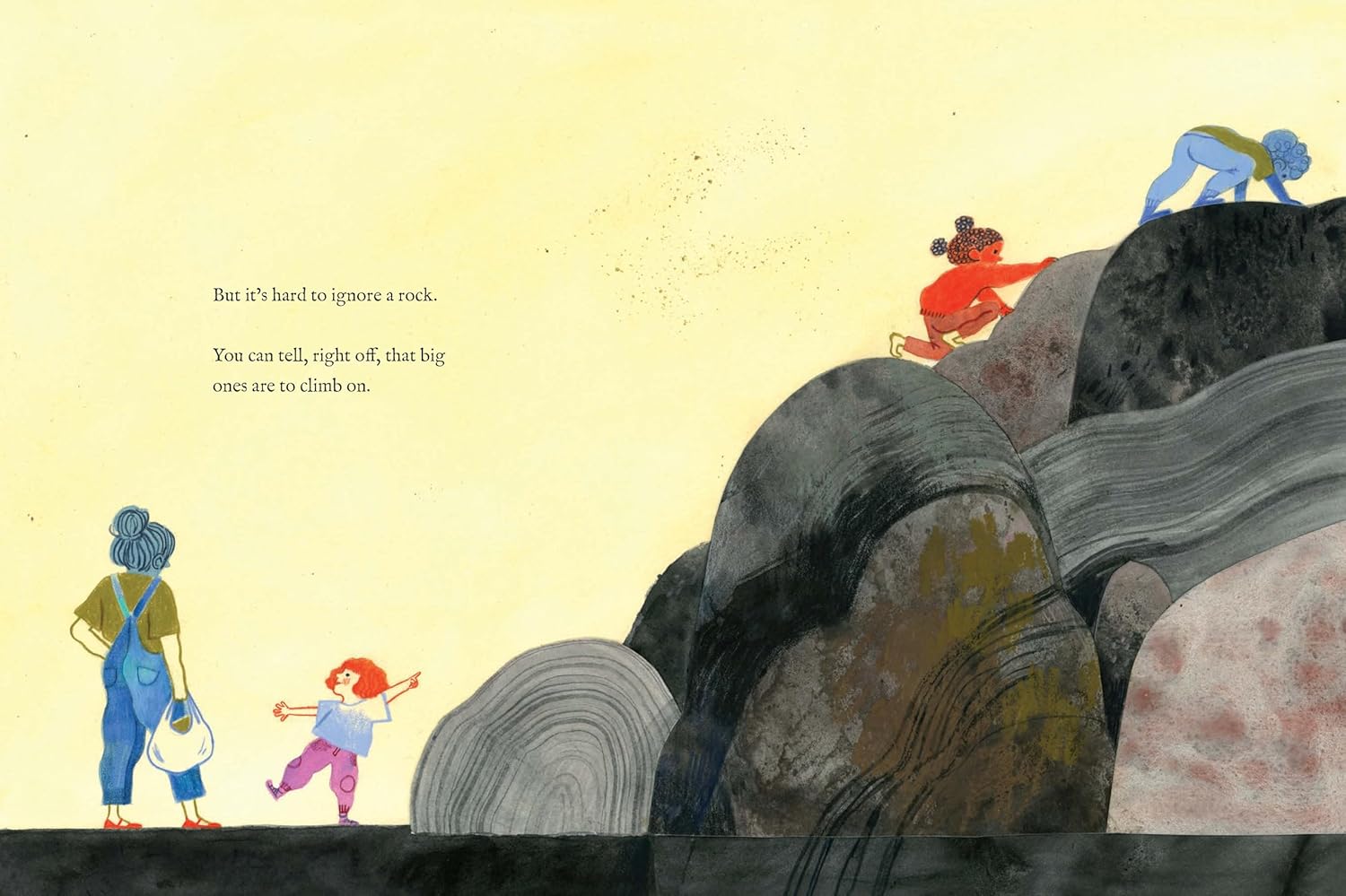
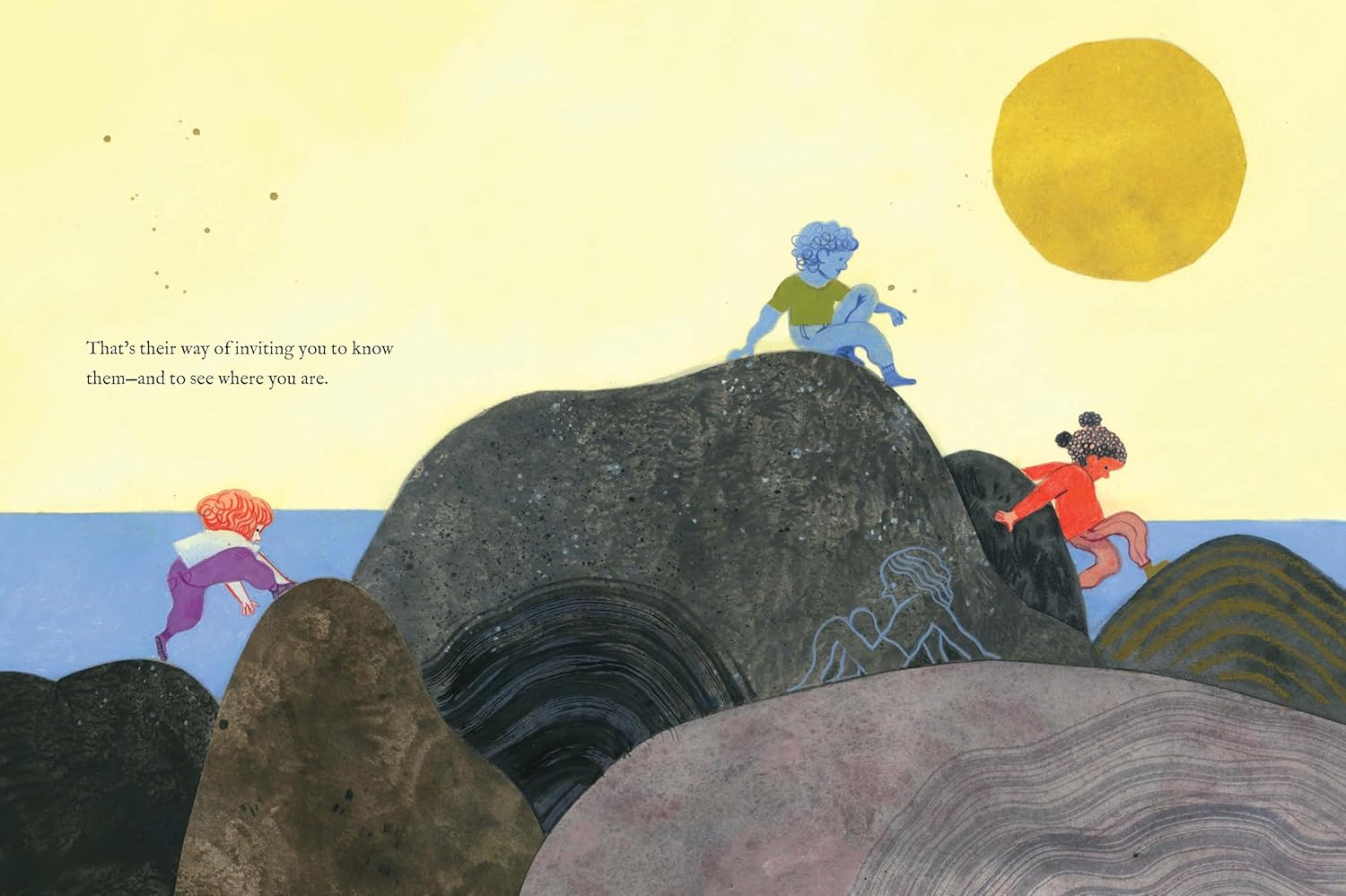
“But it’s hard to ignore a rock. You can tell, right off, that big ones are to climb on. That’s their way of inviting you to know them—and to see where you are.” When the child gestures to a large group of boulders, her adult puts a hand on her hip. Regardless, the child begins to climb and is met by others halfway up the rock. As the children climb, readers are lifted onwards and outwards from the original illustrated narrative, as Lyn Ray takes us through different sizes of rocks and some of the many fun and creative possibilities of what a rock can be and do.

celebrate-picture-books-picture-book-review-when-you-find-a-rock-climbing

Image copyright Felicita Sala, 2024, text copyright Mary Lyn Ray, 2024. Courtesy of Chronicle Books.

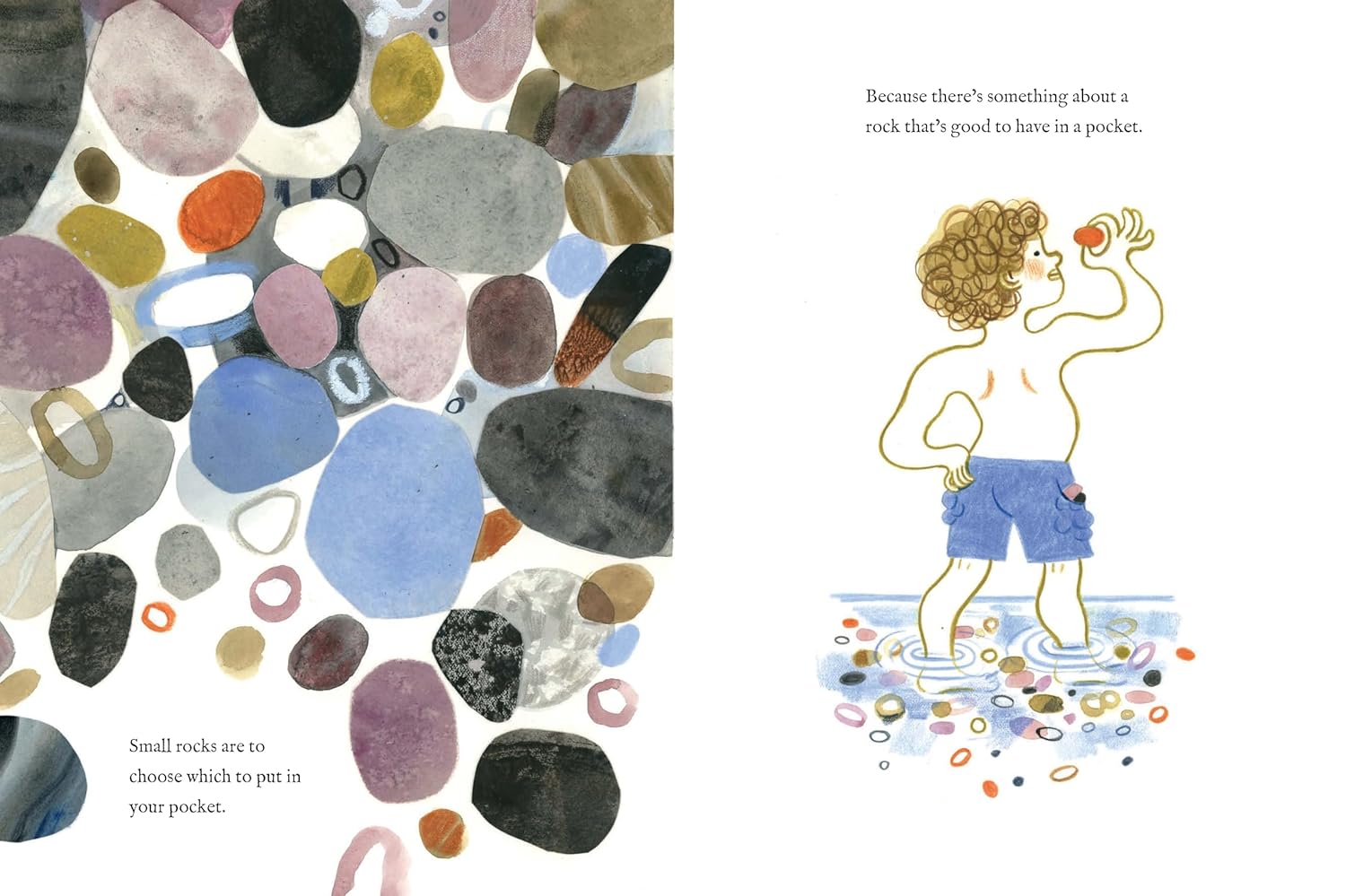
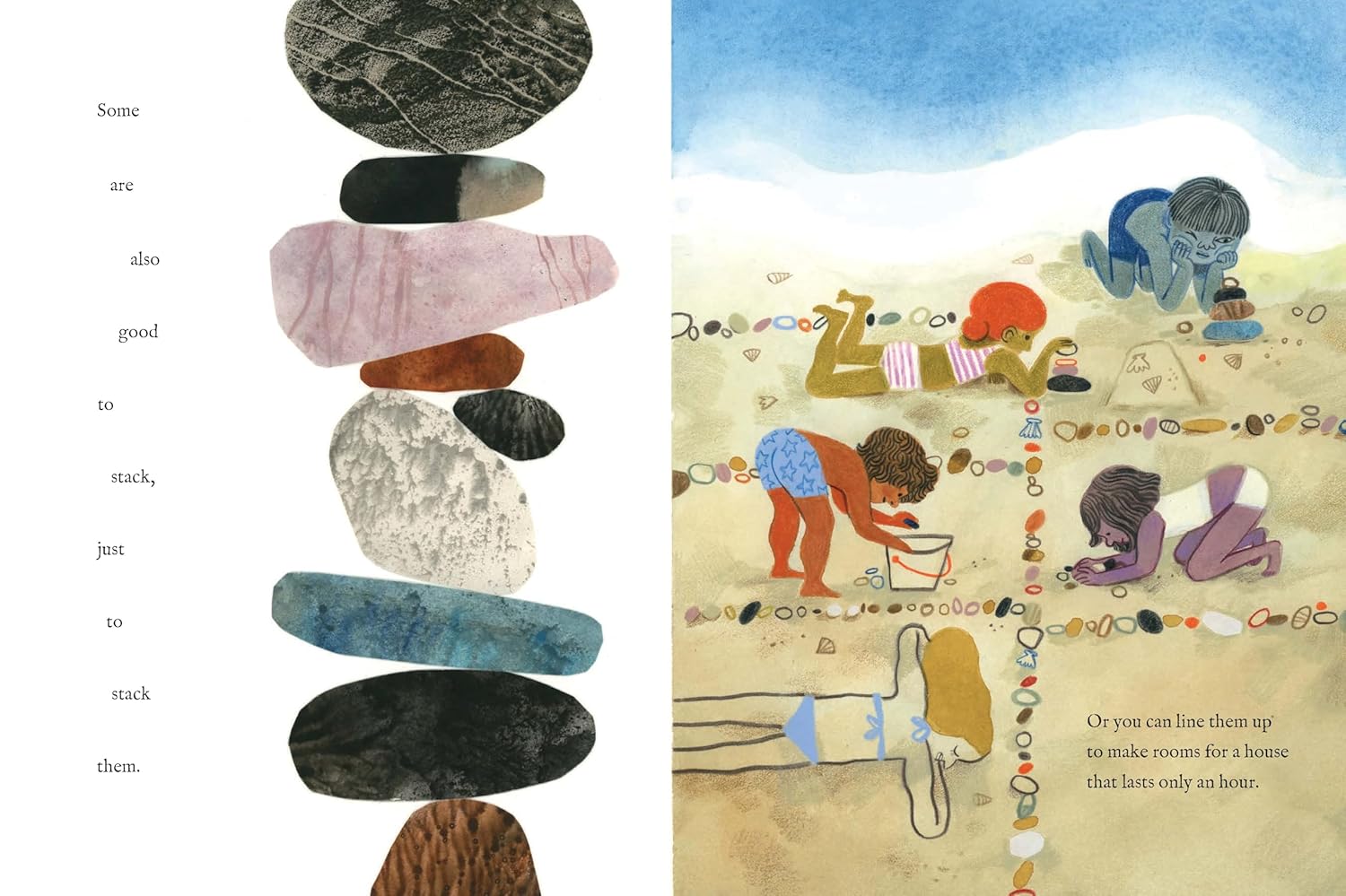
The purposes range from playful (to build a room of a pretend house on the beach) to explorative (“to show you / what heavy feels like”) and even philosophical (medium rocks are for perching on to see how your view of the world can change). Each spread shows a diverse cast of children. All these options hold equal weight. Lyn Ray writes: “Sometimes people might think you’re doing nothing, / same as they might think the rock is doing nothing. / But you and the rock know they’d be wrong.”

celebrate-picture-books-picture-book-review-when-you-find-a-rock-pocket

Image copyright Felicita Sala, 2024, text copyright Mary Lyn Ray, 2024. Courtesy of Chronicle Books.

The story then zooms out to a greater metaphorical sense of finding and grounding oneself in a world of shifting social relations and chaos. Lyn Ray compares finding something special or surprising within yourself (“just when you were maybe feeling sort of ordinary”) to finding a surprising rock in a less exciting bunch of pebbles. Readers are encouraged to reflect and hold on to these moments of inner finding: “You’ll want to keep that discovery in the place inside you where you remember certain things—Same as, maybe, you keep your special rocks somewhere.”

Readers are advised to take the time to “say hi to each rock you meet.” Because maybe if you find a rock that feels right in your hand, “you can feel like you’re holding hands with all the wide world.” On the final spread, we return to the scene of the child with the adult. This time, the child holds a small rock in one hand and rushes to hold the hand of her adult with her other. The two smile at each other, caught in a moment of connection.

celebrate-picture-books-picture-book-review-when-you-find-a-rock-stacked

Image copyright Felicita Sala, 2024, text copyright Mary Lyn Ray, 2024. Courtesy of Chronicle Books.

Illustrator Felicita Sala draws readers into the magic of rocks and relationships with others with detailed watercolor and colored pencil spreads that draw our focus from tiny to large scale as the words follow suit. Brightly colored pages are contrasted with darker-toned images where a rock or the child protagonist are the only ones highlighted. The illustrations masterfully weave in an under-narrative of the child and adult not told in the words, but on an emotional journey of their own, even in the singular one walk depicted.

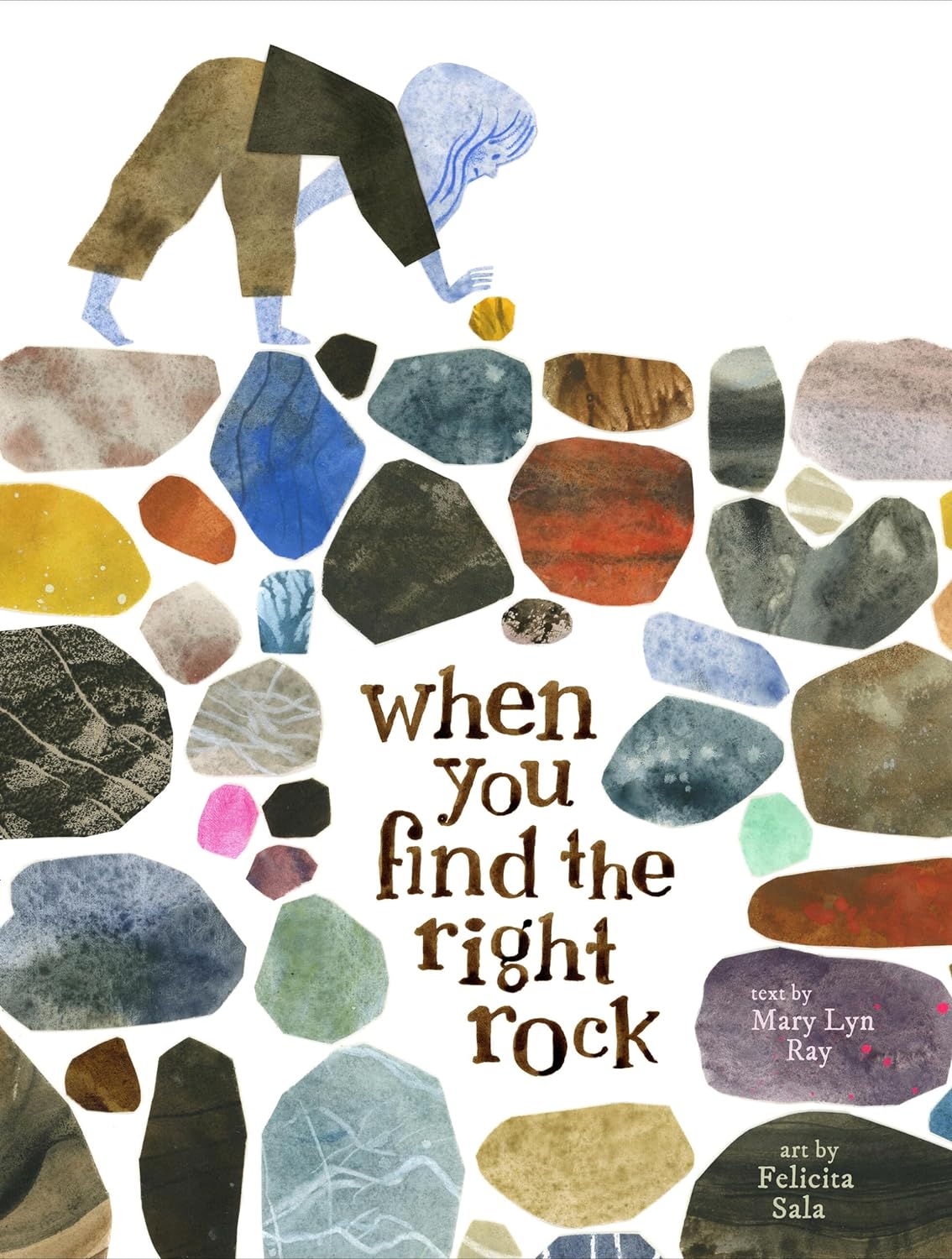
The simplicity of the cover text, with the title displayed in the middle of a jumble of colorful textured rocks of different shapes and sizes—they even bump out of the cover in a glossed shine!—and the small choice to simplify the language to “text by” and “art by” rather than written and illustrated reflects the intentionality behind the beautiful simplicity of Mary Lyn Ray’s story as a whole; you don’t need to be a fancy geologist to admire rocks; you don’t need a reason beyond joy and admiration to stop and look at the world around you. Just like you don’t need to be a child to enjoy a picture book or a rock-lover to enjoy the story of When You Find the Right Rock.

Ages 3 – 8

Chronicle Books, 2024 | ISBN 978-1797214580

About the Author

Mary Lyn Ray has written many acclaimed books for children, including StarsPumpkinsMudThe Thank You Bookand Go to Sleep, Little Farm. She lives in South Danbury, New Hampshire, on an old farm where there are big rocks and pocket rocks, medium-sized and big, big rocks—all just right for saying hello to. Visit Mary at marylynray.com.

About the Illustrator

Felicita Sala is a self-taught illustrator. She studied philosophy and languages in Australia but then decided she wanted to create pictures. Since moving to Italy, she has worked on a few stop-motion animation projects along with her husband, Gianluca, but her passion lies in making picture books. She gets inspired by nature, children, mid-century illustration, folk art, and architecture. She lives in Rome with Gianluca and their daughter, Nina. Visit Felicita at felicitasala.com.

Picture Book Month Activity

celebrate-picture-books-picture-book-review-rock-collection-activity

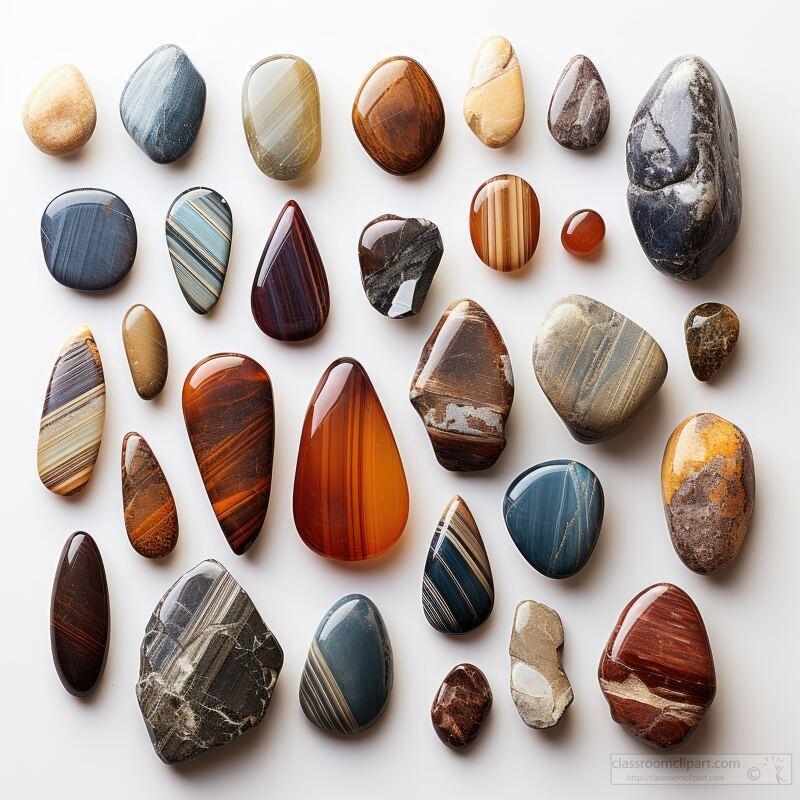
Rock Exploration and Collection Ideas


On her website Early Learning Ideas, Jennifer Hier offers kids and adults a variety of ideas for ways to explore and collect rocks with children. Check out her post: 20 Easy Activities with Rocks that Will Make Learning Fun.

celebrate-picture-books-picture-book-review-when-you-find-a-rock-cover

You can purchase When You Find the Right Rock at these booksellers

Amazon | Barnes & Noble | Bookshop (to support your local independent bookstore)

Picture Book Review