

About the Holiday
Who knew poop could inspire such a thoughtful and health-conscious holiday? But it has! Initiated in 2016 by the Madison Children’s Museum in Wisconsin to celebrate and educate the public on digestion and excretion, the day has become a fun, educational way to encourage people to be more aware of their digestive health and hygiene as well as that of their pets. By normalizing conversations about poop, the holiday aims to improve overall health practices and increase understanding of how our bodies work. The topic is no less fascinating in the world of wildlife, as today’s book shows.
Thank you to Sara Levine and Millbrook Press for sharing a copy of Poop for Breakfast: Why Some Animals Eat It with me!
Poop for Breakfast: Why Some Animals Eat It
Written by Sara Levine | Illustrated by Florence Weiser
So, you wake up starving for a delicious meal. You’ve been dreaming of pancakes, maybe, or a plate of eggs and bacon. But when you get to the table, there’s a bowl of poop waiting for you?! What’s going on?! While you might sulk (and probably hold your nose), there are plenty of creatures who’d be thinking “Bring it on!” Who are these critters? They’re animals that practice coprophagy, and they do it “for a number of surprisingly good reasons,” as Sara Levine reveals.
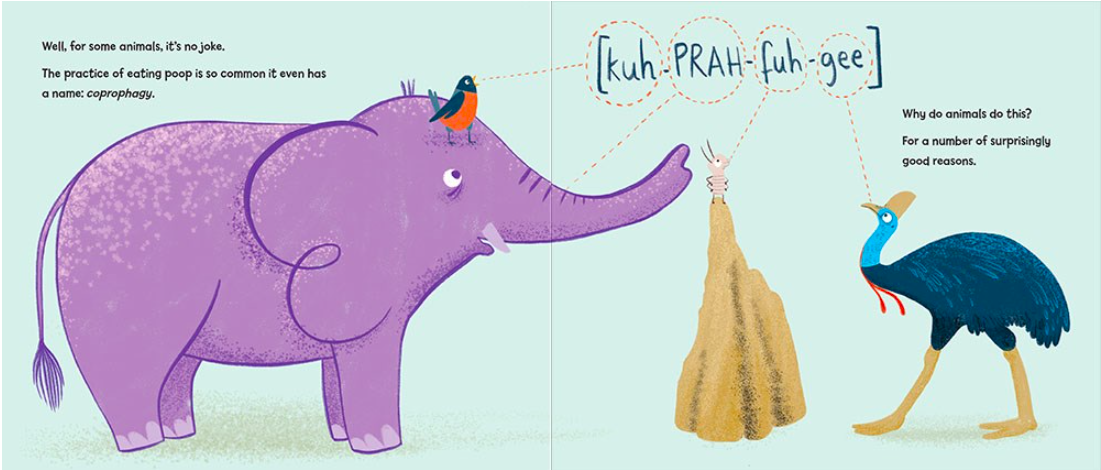
Image copyright Florence Weiser, 2023, text copyright Sara Levine, 2023. Courtesy of Millbrook Press.
For some animals eating poop is just part of being a Number 1 (or maybe Number 2 is better in this case) parent. Butterflies, cats, and dogs as well as robins and other birds all have specific reasons for dining on doo-doo, from making eggs strong to protecting their babies from predators to keeping “a nest clean and tidy.”
While these animals eat poop for external or aesthetic reasons, others engage in coprophagy to keep their digestive system working well. Still others, because of the length or shape of their digestive tract, require that food travels through their body twice to extract all of the nutrients. If you have a rabbit, hamster, guinea pig, or other small rodent as a pet, you know that their poop looks like little round balls or small pellets. As Levine tells readers, “this is the poop that has been through their digestive tract a second time. These animals’ first poop comes out soft, sticky, and full of nutrients. It’s called a cecotrope (SEE-ca-trope).” They then “gobble it up at night when it comes out. That’s why you don’t see it” in the cage.
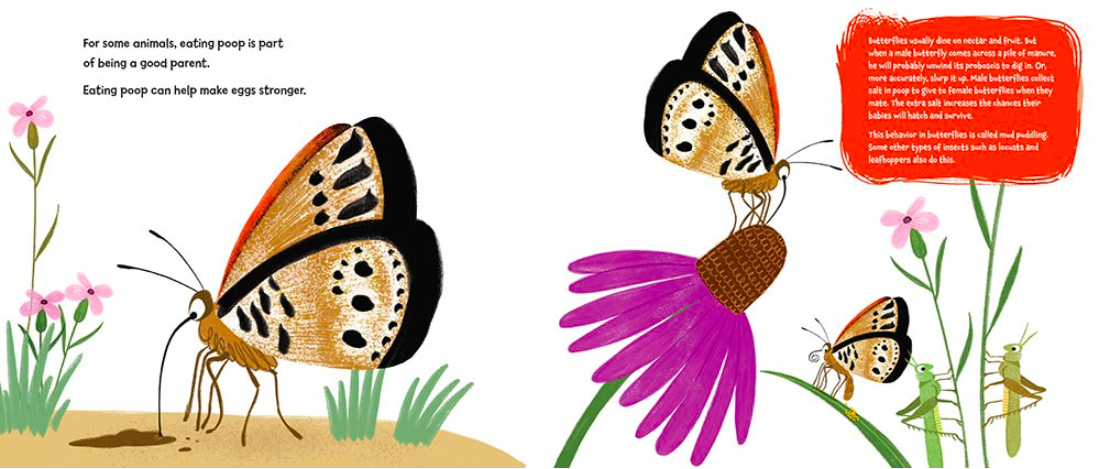
Image copyright Florence Weiser, 2023, text copyright Sara Levine, 2023. Courtesy of Millbrook Press.
Since there are so many creatures who do eat poop, why don’t humans? Levine has included a whole list of reasons for why we don’t—and don’t need to. She also provides back matter that includes “The Scoop on Poop”—an explanation of what poop and pee are, how they’re created in the body, and how they’re eliminated. Kids will also have fun becoming “poop detectives” with the help of the illustrated poop identification guide for common pets and wildlife and also by playing a synonym game.
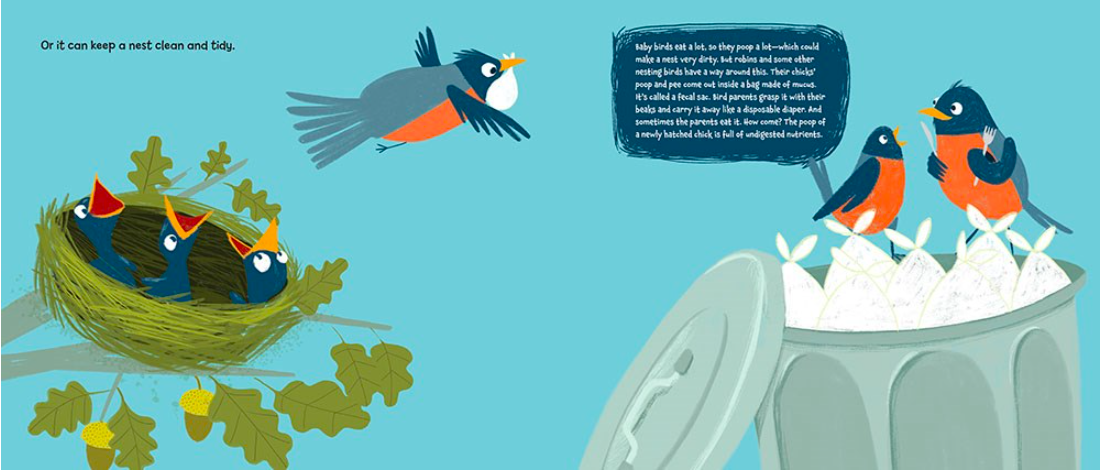
Image copyright Florence Weiser, 2023, text copyright Sara Levine, 2023. Courtesy of Millbrook Press.
Sara Levine is exceptional at presenting fascinating nature science topics in humorous and accessible ways for young audiences, and her latest book is no exception, Leaning into the “Ewww!” factor, Levine dishes up short, take-away reasons certain animals, birds, and insects practice coprophagy followed up with longer passages that explain the science and/or behavior behind them in easy-to-understand language sprinkled with humor that will keep readers riveted to this already high-interest subject.
Florence Weiser’s colorful illustrations perfectly bridge the humorous and the scientific nature of Levine’s text. Readers’ skeptical view of this “gross” habit is amusingly juxtaposed with creatures’ excited anticipation of a delicious meal through the characters’ facial expressions while the anatomical reasons for or against coprophagy are clearly depicted in images of human and various animals’ digestive systems.
Anatomy and nature science education at its best, Poop for Breakfast: Why Some Animals Eat It will keep kids enthralled as each page turn brings on a new round of giggles and avid learning. The book would enhance any home STEM collection and is a must for classroom, school, and public library bookshelves.
Ages 5 – 10
Millbrook Press, 2023 | ISBN 978-1728457963
About the Author
Sara Levine is an author, educator, and veterinarian. Her science books for children include the Animal by Animal series, Germs Up Close, and A Peek at Beaks: Tools Birds Use. Her books have received a number of awards including AAAS/Subaru SB&F Prize, Utah Beehive Book Award, Cook Prize finalist, Monarch Award master list, and Bank Street College Best Children’s Book of the Year. Visit her at saralevine.com and on Instagram at saralevinebooks.
About the Illustrator
Florence Weiser is a French illustrator currently based in beautiful, rainy Belgium. While growing up in Luxembourg, she always knew she wanted to draw and draw. She lives and works surrounded by nature, from which she gathers most of her inspiration. Visit her at florenceweiser.com and on Instagram at florence_weiser_illustration
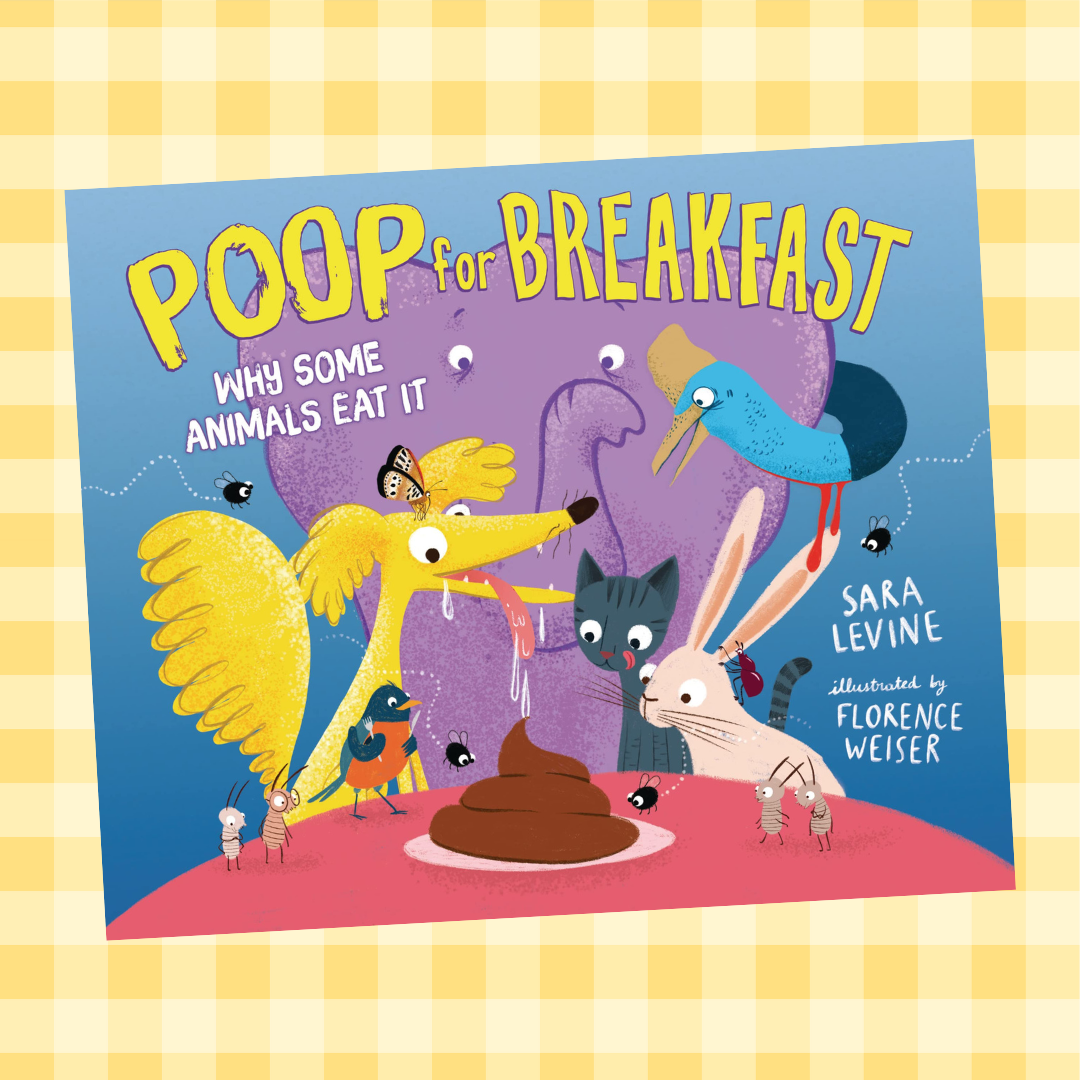
You can find Poop for Breakfast: Why Some Animals Eat It at these booksellers
Amazon | Barnes & Noble | Bookshop (to support your local independent bookstore)
Picture Book Review

 celebratepicturebooks.com