May 14 – International Astronomy Day

celebrate-picture-books-picture-book-review-star-stuff

About the Holiday

Instituted by Doug Berger in 1973, International Astronomy Day is held twice a year—in spring and fall—to raise awareness of the benefits and wonder of studying the stars. Museums, observatories, universities and astronomy clubs around the world provide public access to astronomical instruments and hold special programs about this interesting and ancient science. To celebrate, attend an International Astronomy Day event, take time tonight to gaze at the sky and pick out the constellations you recognize, or read about the stars and their importance to history and the future.

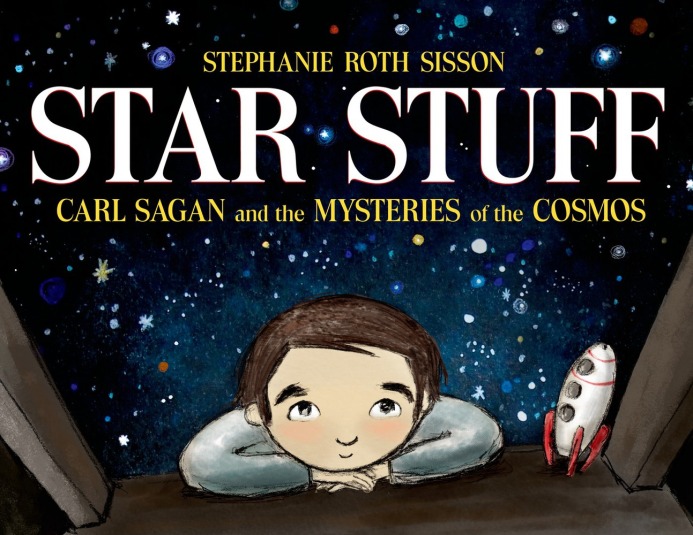
Star Stuff: Carl Sagan and the Mysteries of the Cosmos

By Stephanie Roth Sisson


A boy named Carl Sagan may have lived in a small apartment in Brooklyn, New York, but he was part of so much more—a large city on the third planet from the sun in a “neighborhood of stars” which are part of the Milky Way galaxy. Growing up, Carl marveled at the connections. He had an innate curiosity and was astonished by everything he saw; his imagination was out of this world!

When he attended the 1939 World’s Fair as a young child, he experienced things he had never seen before; he saw a robot, new inventions, and a time capsule filled with messages for the future. At night he looked up at the stars and wondered; he thought they looked like lightbulbs on long black wires. He went to the library to read about the stars.At first the librarian thought he meant movie stars, but soon he got the book he wanted. Reading it made his heart beat fast.

Carl imagined what kinds of creatures and sights he might discover if he were able to travel through space. He tried standing with his arms outstretched and wishing he was on Mars like his favorite science fiction character, John Carter, but nothing happened. He decided he would have to make his “life in space” a reality himself so he went to college and became an astronomer, cosmologist, astrophysicist, astrobiologist, and so much more.

Dr. Carl Sagan then worked with other scientists to develop the exploratory crafts Mariner 2, Mariner 9, and Pioneer 10 that have gone into space to investigate Mars, Venus, and Jupiter. When they sent back pictures, Carl analyzed them and learned more about our solar system

Carl wanted everyone to know and understand Space. He created a television program that explained in easy terms what the stars, planets, and other celestial bodies are made of, how they came to be, and how we are connected to them. The Earth and every living thing are made of star stuff, Carl told his audience. The show – Cosmos: A Personal Voyage – was a hit, watched by millions of people.

Scientists have long wanted to know if life exists on other planets, and as time went on they had the technology to explore the possibilities. Carl worked with other engineers to create Voyager 1 and Voyager 2 to tour the outer solar system and beyond. Remembering that time capsule he saw so long ago at the World’s Fair, Carl had a marvelous idea! He recorded messages and sounds from Earth and made a Golden Record that was carried on each Voyager mission.

Carl Sagan, that boy made of star stuff who grew up to be so many things—astrophysicist, explorer, educator, philosopher, writer, and more—changed the world through the power of his imagination.

Stephanie Roth Sisson’s biography of Carl Sagan wonderfully honors the dreamer and scientist whose imagination went into Space and brought it down to Earth for others to understand and enjoy. The story begins in Sagan’s neighborhood and home, where illustrations depict the curiosity that fueled his passion. Just as the mysteries of Space quickly captured his attention, the pages fill with the night sky and its twinkling lights and celestial bodies. A most ingenious page takes advantage of a two-page vertical spread that transforms Carl’s bedroom window into a space capsule that blasts him into the cosmos as he ponders the stuff of stars.

His work as an adult collaborating with scientists and engineers to develop deep space exploration craft is clearly drawn with pages containing multiple panels of his job and accomplishments up close and from the distance of outer space. A particularly arresting three-page fold-out spread reveals the moment Carl discovered his love of the stars and Earth’s sun (holding a flashlight behind the depiction of the fiery sun would be a show-stopper, especially during a night-time read).

Kids familiar with today’s space travel and the awe-inspiring images sent back to Earth will love this book. To quote Carl Sagan, Star Stuff will definitely elicit a “Wowie!” from readers.

Ages 4 – 8

Roaring Brook Press, 2014 | ISBN 978-1596439603

International Astronomy Day Activity

celebrate-picture-books-picture-book-glow-stars

Make a Room Observatory


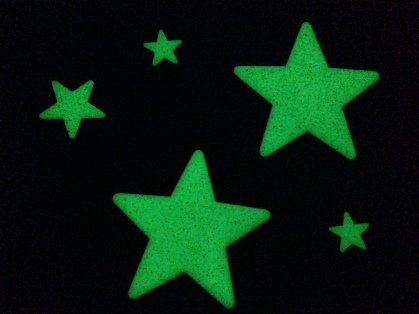
If you like gazing at the stars before going to sleep, why not bring them inside? With adhesive glow-in-the-dark stars, available at craft and toy stores, you can create a night sky full of celestial bodies that stay lit long after you’ve said goodnight. You can add planets, rocket ships—even your favorite constellation! This can be a nice alternative to a night light or transition children from a full night light to a gentle, comforting glow in their room.

Picture Book Review

May 9 – It’s Get Caught Reading Month

celebrate-picture-books-picture-book-review-the-whisper

About the Holiday

Supported by the Association of American Publishers (AAP), Get Caught Reading Month promotes literacy and reminds people of all ages how much fun reading is. Begun in 1999 by former Congresswoman Pat Schroeder, President and CEO of AAP, the initiative brings together publishing industry executives, authors, illustrators, teachers, librarians, politicians, celebrities, and readers to spread the word about the joys of books. To join the celebration, take a picture of yourself or a friend reading, hold a book drive, challenge yourself to a reading goal, and/or read to someone else.

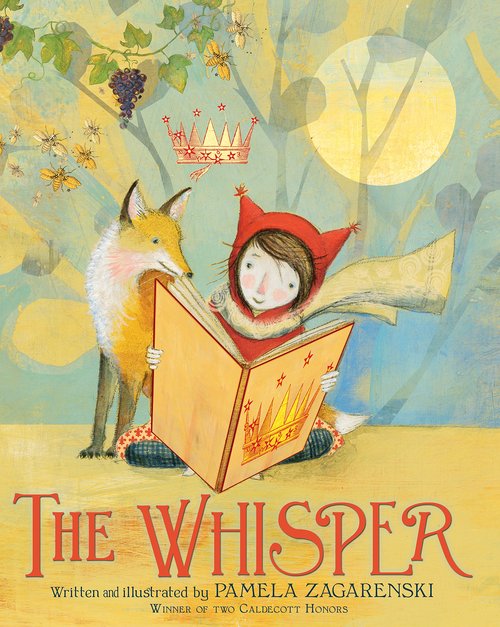
The Whisper

By Pamela Zagarenski


A little girl loves stories and the magical realms they can take her to. One day while waiting for school to be dismissed, she spies a book on a shelf. Her teacher allows her to take it home with her, and the little girl happily runs off with it when the clock strikes 3:00. On the way home, she doesn’t notice that all the letters are escaping from the book or that a wily fox is catching them in a net.

At home she secludes herself in her room, excited to read the mysterious book. She turns the pages, awed by the beautiful pictures. But by the time she has finished, she has tears in her eyes. “Where were the words? Where were the stories?” The girl flips through the book again, but this time she hears a small whisper: “Dear little girl, don’t be disappointed. You can imagine the words. You can imagine the stories.”

The whisper seems so knowing that the girl does at it suggests. She turns to the first page where a blue bear followed by a beekeeper walks under a honeycomb sun toward a brown bear. The girl stares at the picture and thinks of a title: Blue Bear’s Visit. Her story begins: “Blue Bear arrived on the first day of spring. He promised…”

Warming to the idea of creating stories, the girl examines the second picture. She notices the same white rabbit that was in the first picture. In the foreground a “magnificent ox” is listening to a man whispering into its large, soft ear. The Secret, the little girl titles this story, which starts: “Mr. Ox, you must please promise not to tell anyone, but we need your help. Last week…”

With the third picture the words tumble out more easily, forming sentences that give life to the massive white elephant, regal lion, and that rabbit again who are traveling the sea in a long, open boat. The Quest, she calls it. In Tigers Prayer, preparations are being made: tea is brewing, a clown with a pointed hat plays his accordion, a windhorse jumps through hoops, and the rabbit rides a golden ring as a lion hears what Tiger has to say. A Birthday Party comes next, and it seems Pan has planned a very secret party. An owl perches in the crook of a tree asking for the password with a “Hoo, Who?” which is answered quickly because the vanilla cake with raspberry filling and vanilla cream frosting holding 6 candles must be delivered.

The Magical Cloak sees the little girl’s imagination truly take flight as she decides the man in the “elaborate coat” is a wizard or magician whose bubbles come to life once released from the blower. Enormous whales now fill the harbor. They are beautiful, but something must be done….Next, hurry to meet the owl! He is picking up passengers at midnight. But what does the golden key in his beak open? Only the story The Golden Key locked in the little girl’s mind will tell.

Hours go by as the little girl creates tales for each picture in the book. As the night grows late, she sleeps, carried into slumber on dreams woven from the pictures and stories she imagined. When she wakes up, the girl wishes to spend more time with her new friends, but it’s time for school so she gathers up the book and hurries away.

On the path to school she meets a fox who is carrying a bag. “Excuse me, little girl,” says the fox. “I believe I have the words to your book.” The fox then explains how he caught the words as they spilled from the pages the day before. The fox gives her his parcel, but asks for a favor. The girl is happy to oblige and lets the fox stand on her shoulders to reach a bunch of grapes dangling from a nearby vine.

The girl rushes into school and apologizes for being late. She relates the story of the fox and the words and the magical night she has spent making up tales for the pictures in the book. “I have so many stories to tell you,” says the girl to her teacher. “‘I can’t want to hear,’” the teacher replies with a smile.”

Opening a book by Pamela Zagarenski is to fall into an alternate realm of such beauty and imagination that you forget the real world exists.  Her paintings are composed of rich, regal hues swirling with images and designs that overlap and float to create the kind of experience only the deepest, most complex dreams allow. The characters and details follow page to page uniting the pictures and, subtly, the stories the little girl discovers in them: The teapot, once introduced, waits under a tree on the next page and rides the waves of the whale-filled sea in the next. The bees and the rabbit are constant companions on each spread, and the animals will fill the reader with awe.

The little girl’s imagined stories are tantalizing with just the right mix of the mysterious and the tangible to entice readers to add more. The frame of the Aesop Fable The Fox and the Grapes is inspired and could lead to a conversation about how “life is what you make it.”

The Whisper is a book readers will want to linger over and dip into again and again, and would be especially fun on those days when there’s “nothing” to do. It makes a beautiful gift for any occasion.

Ages 4 – 9 (this book would also appeal to adults)

Houghton Mifflin Harcourt, 2015 | ISBN 978-0544416864

Gardening for Wildlife Month Activity

In addition to Get Caught Reading Month, May is Gardening for Wildlife Month. It’s the perfect time to celebrate the joys and colors of spring and enjoy the many plants, flowers, and wildlife nature provides. Whether your garden is small or large, just being planted or already blooming, you can be mindful to make yours wildlife friendly to help and protect the environment.

This week’s crafts and activities will revolve around gardens and plants of all types. I hope you enjoy them!

celebrate-picture-books-picture-book-review-vase

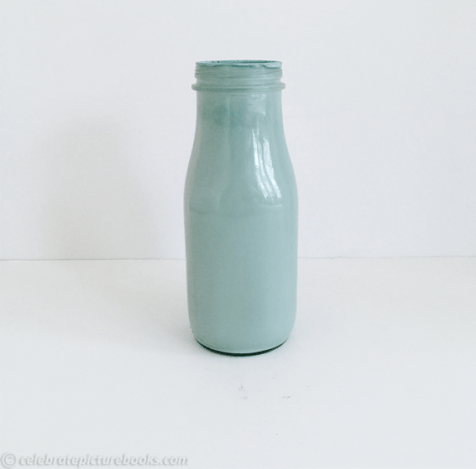
Painted Bottle Vase

Do you often pick up a smoothie or other drink at the grocery store and then just throw away the glass or plastic bottle? Those containers, with their elegant shapes, make beautiful vases with just a little paint!

Supplies

  • Plastic or glass bottle
  • Multi-surface craft paint in your favorite color
  • Paint brush
  • Wax paper

celebrate-picture-books-picture-book-review-vase-top

Directions

  1. Wash and thoroughly dry your bottle.
  2. Pour 3 to 5 tablespoons of craft paint into the bottle
  3. Invert the bottle on the wax paper
  4. Let the paint drip down the sides of the bottle, this may take several hours to overnight
  5. When the paint reaches half-way down the sides of the bottle, you can “help it along” with the paintbrush, filling in any empty spaces
  6. Let the bottle sit, inverted, until the paint dries. This can take one to several days, depending on the atmosphere.
  7. When the paint is dry, use the vase for artificial flowers.

Join me tomorrow to see how to make flowers to go in your vase!

Picture Book Review