February 19 – Bird Feeding Day

National Geographic Kids Bird Guide of North America picture book review

About the Holiday

Today we take time to remember our feathered friends who may have a difficult time finding food during the winter months. Hanging a bird feeder in your yard can bring many hours of entertainment and enjoyment as you get to know the birds in your area and see many of the same birds come back again and again—often with their little ones during the spring!

National Geographic Kids Bird Guide of North America

By Jonathan Alderfer


If you’re looking for a book to learn about the birds in your own backyard or across the country, it’s hard to beat the National Geographic Kids Bird Guide! The prominent birds from 10 habitats in North America are discussed in detail, with amazing close-up action photographs from some of the top nature photographers in the country. Major profiles of the most common birds in a region include information on basic facts, a map and the environment in which they’re found, the sounds they make, food they eat, body parts and what they are used for, nesting behavior, and fun trivia. Mini profiles highlight other birds seen in each area.

The Guide also includes instructions on many how-tos, such as making a bird feeder, making a bird bath, bird watching, building a nest, drawing birds, protecting birds and their environment, and more. There is also a glossary and a list of print and website resources for budding birders.

Ages 7 – 10

National Geographic Kids Books, 2013 | ISBN 978-1426310942

Bird Feeding Day Activity

CPB - Bird Feeder I (2)

Pinecone Birdfeeder


Making a pinecone bird feeder is a quick, fun way to nourish your backyard friends! Here are some simple directions for making your own!

Supplies

  • Large pinecone
  • Vegetable shortening
  • Birdseed
  • String
  • Knife or popsicle stick
  • Spoon
  • 2 Bowls

Directions

  1. Tie a length of string around one of the top layers of pinecone leaves and knot it to make a loop for hanging.
  2. Spoon about 1/3 cup of vegetable shorting into a bowl
  3. With the knife spread the shortening over the leaves of the pinecone, covering it completely.
  4. Pour birdseed into a bowl
  5. Roll the pinecone in the bowl of birdseed, patting seed into the crevices and around the sides.
  6. Hang your pinecone birdfeeder on a branch or pole and watch the birds enjoy it!

February 18 – National Battery Day

Using Batteries Picture Book review

About the Holiday

While not an official holiday, National Battery Day is a great time to think about how these small, ubiquitous power cells have changed and improved our lives, allowing us to take our gadgets and our necessities wherever we go. Batteries themselves may be relatively new, but the idea may have been around for 2,000 years. In 1936 archaeologist Wilhelm Konig unearthed a clay jar from a Parthian tomb that held an iron rod encased in copper that may have been used to electroplate gold onto silver.

It was Benjamin Franklin (of course it was!) who coined the term “battery” in 1748 to describe an array of charged glass plates. The word “volt” or a battery’s electric potential comes from Alessandro Volta, who in 1800 generated electrical current by layering silver, a material soaked in salt or acid, and zinc. William Cruickshank, an English chemist, advanced this method, and in 1802 created a battery for mass production. The first commercially available battery was introduced in 1896 by the company now known as Eveready, and we were off and charging!

It’s Electric Series: Using Batteries

By Chris Oxlade

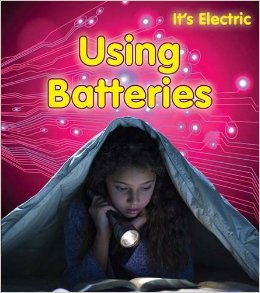
Batteries—those things that make our our cars run, our TV remotes change channels, our little book lights glow, and so much more—are part of our lives from the very beginning, when they’re required (but not included) for our favorite toys. But how many of us really know how they work? This little book explains to children in simple and easily understood language how batteries store and use electricity to fuel many of the world’s machines and gadgets.

Large photographs accompany the text and clearly demonstrate the concepts. Children will learn about using batteries, how batteries work in circuits, the different battery shapes and sizes, battery materials, rechargeable batteries, battery safety, portable power, and more!

For kids interested in electricity – and batteries in particular – theIt’s Electric series of books is a great place to start learning!

Battery Day Activity

Connect the Battery Puzzle

CPB - Battery Day maze

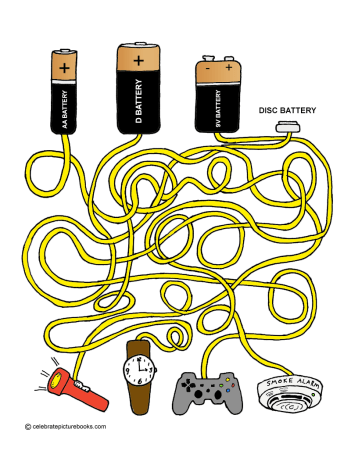
Hmmm…The flashlight, watch, video game controller, and smoke detector are all broken! Can you find which battery goes into which object to make them work again? Print out the Connect the Battery puzzle here.