March 28 – Music in Our Schools Day

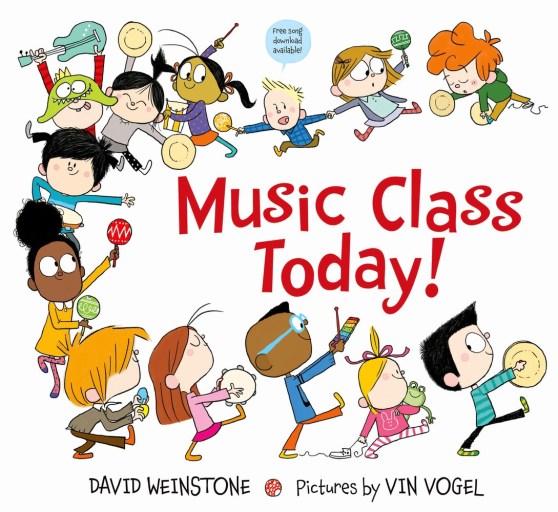
Music Class Today by David Weinstone and Vin Vogel

About the Holiday

The National Association for Music Education sponsors Music in Our Schools Month each March to promote greater awareness of the benefits and enjoyment high-quality music education brings to students and the community. Beginning in 1973 as a single Advocacy Day in New York, this celebration grew to include the entire month in 1985.

During the month special music programs, education, concerts, and classes take place to get kids and adults excited about the joys of music in schools.

Music Class Today

Written by David Weinstone | Illustrated by Vin Vogel


A little boy and his froggy toy join a music class full of other boys and girls led by a guitar-strumming teacher. The class starts with a song welcoming everyone by name and a verse inviting all to shake their musical eggs high and shake the eggs low. “One rolls away—where did it go?”

The new boy peeks around his mom’s back to watch the action, and when it’s time for a song he says, “I think I’ll just watch…But I’m listening!” The teacher gently sings, “That’s all right, that’s okay. / Whenever you’re ready, / come on over and play. / That’s all right, there’s no rush. / Whenever you’re ready, / come play with us!” These verses become a chorus repeated throughout the book, reassuring the little boy that he’s welcome, but that his own speed of acclimation is okay too.

The class continues with the kids kicking up their feet, drumming, and moving around the room in time with the music. The little boy comes out from behind his mom to sit on her lap and watches the fun. The teacher’s chorus brings the boy a little closer—to the edge of his mom’s feet—while clinging tightly to his froggy. He giggles as the kids swirl with scarves, getting dizzy, and falling down.

Now everyone’s dancing, being silly, and having a ball. Froggy joins in, dangling and wiggling at the ends of the boy’s hands. As dancing evolves into free-play time, the little boy accepts the teacher’s invitation to “come join the fun,” and leaves froggy at his mom’s feet with one more request for assurance—“Wait here till I’m done!”

“Good for you, that’s the way. / Everybody’s in the band!” the teacher sings as the little boy takes up the cymbals and leads the parade behind him. All too soon it’s clean-up time and class ends with a good-bye song. The boy is having so much fun that he tells the teacher he and froggy want to stay. The instructor knows just what to say to his happy, excited student: “That’s all right, that’s okay. / We’ll see you soon another day!”

In this cross-genre picture book, David Weinstone brings the musicality and movement of a toddler and preschool music class to the page. His song, also available as a free download, serves as the text of the story about a reluctant joiner who overcomes his apprehension to become a member of the group. The repeated chorus, that calmly and sincerely explains that it is okay for children to wait and watch until they feel comfortable, can be used for many situations and is a welcome message.

Vin Vogel’s sweet illustrations of a wide mix of kids kicking up their heels (literally, as a flying shoe bonks the instructor on the head in one giggle-inducing scene) and having fun are inspired in their focus on the children. The kids play instruments, dance, and cavort across the pages, filling the white space with joy. The view of the classroom changes from page to page to show other mother-child pairs, which helps emphasize that hesitant children are common, as well as baby siblings, toys, instruments, storage bins, and other sights familiar to children.

Ages 1 – 4

Farrar, Straus and Giroux, 2015 | ISBN 978-0374351311

Music in Our Schools Day Activity
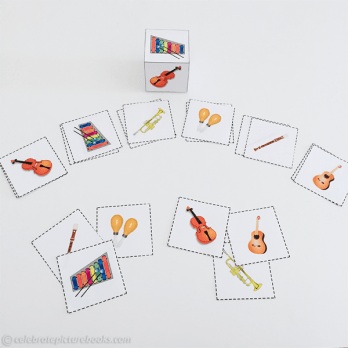
CPB - Music in Schools Day game

It’s Instrumental! Game


Play this fun game to gather all the instruments you need to create a music group. The first person to collect all 6 instrument cards is the winner!

Supplies

Directions

  1. Print the Paper Cube Template, cut it out and assemble the cube die.
  2. Print the Musical Instruments cards, cut out cards, and separate the instruments into piles
  3. Players take turns rolling the die cube to collect musical instrument cards
  4. The first player to collect all 6 instrument cards is the winner


March 24 – National Button Day

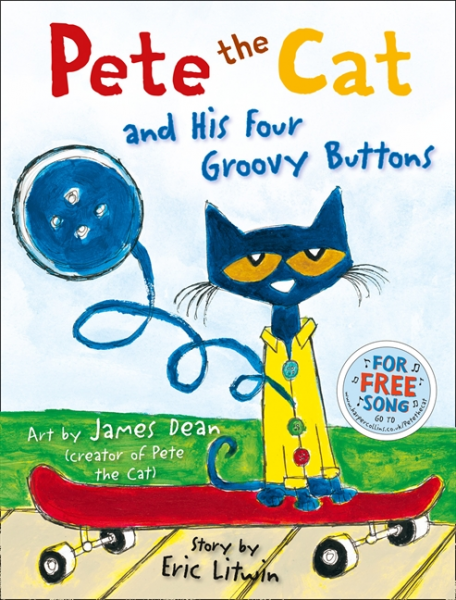
Pete the Cat and His Four Groovy Buttons by Eric Litwin and James Dean Picture Book ReviewAbout the Holiday

You have to admit it—those little round things that hold our clothes and bags shut are indispensable. Sometimes tiny works of art in their own right, buttons are fascinating. Antique buttons made of glass, metal, or even bone and decorated with intricate paintings, engraved designs, or gemstones offer a glimpse into history, both American and International. Today’s buttons, fashioned into engaging shapes or brightly colored, have stories of their own and enhance whatever garment or item they adorn.

Button collecting was recognized as an organized hobby by the National Button Society in 1938, and National Button Week – which I’m celebrating today – was founded in 1989. The goal is to promote awareness of the fun of button collecting and to recognize the study and display of antique and collectible buttons. Button collecting is a fun hobby that is exciting for all ages.

Pete the Cat and His Four Groovy Buttons

Written by Eric Litwin | Created and Illustrated by James Dean


It’s 8:00 in the morning and Pete the Cat is ready to start the day wearing his favorite shirt – the one with 4 groovy buttons. Those buttons are big, they are round, they are colorful, and they inspire him to sing a song: “My buttons, my buttons, my four groovy buttons. My buttons, my buttons, my four groovy buttons.”

Soon, however, one of the buttons pops off! That leaves Pete with how many buttons? 3! Right! Does Pete cry? “Goodness No! Buttons come and buttons go.” Fortunately for readers buttons continue to GO…inviting kids to do the math and sing the infectious song with each “Pop!”

As Pete sits atop his surfboard atop his VW Beetle looking very beachy, his last button goes sprooiiing and rolls away. What does Pete see then? Why, the only button that won’t desert him—his belly button!

Eric Litwin’s short, fast-paced text contains plenty of exciting opportunities for read-along, shout-along fun on every page. The subtraction problems offered as Pete loses buttons provide early learners with confidence-building moments, and Pete’s easy-going attitude is just right for these hyper-busy times.

James Dean’s illustrations are as big, bold, colorful, and groovy as Pete’s buttons. Vibrant primary colors rivet readers to the page, and—Watch out! That popping button is swirling right at you! But through it all Pete the Cat remains his nonchalant self.

Ages 4 – 8

HarperCollins, 2012 | ISBN 978-0062110589

National Button Week Activity

CPB - Button Coat

Pin the Button on the Coat Game


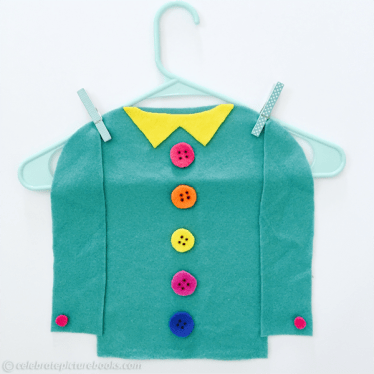
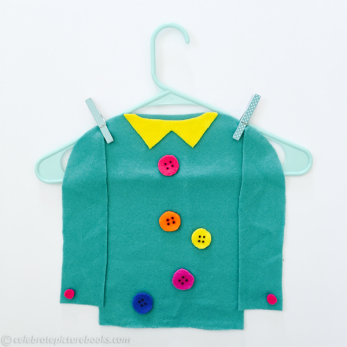
Pin the Button on the Coat is a fun game you can make yourself and play anytime! It’s great for a button-themed party or on any day that you’re holed up and just poppin’ to do something! The game is played like “Pin the Tail on the Donkey,” and the object is to get the buttons as close to the center of the coat as possible. Have fun!

Supplies

CPB - Button Coat II

Directions

  1. Cut out the coat, sleeves, and collar following the printable patterns
  2. With the fabric glue, attach the sleeves to the edge of the coat, and the collar to the top of the coat.
  3. Let dry
  4. Cut circles to represent buttons from the other colors of fleece or felt, as many as you need
  5. With the marker make dots to represent holes in the “buttons”
  6. When the glue on the coat is dry, attach it to the clothes hanger with the clothespins

If you like buttons and button crafts, pop on over to February 29—Haiku Writing Day for Guyku—a fun book of poetry—and directions to make a bookmark with colorful buttons!


March 20 – International Day of Happiness

Double Happiness by Nancy Tupper Ling Picture Book Review

About the Holiday

In 2011, the UN General Assembly adopted a resolution stating that happiness is a “fundamental human goal” and called for a more inclusive, equitable and balanced approach to economic growth that promotes the happiness and well-being on all peoples.” March 20 was chosen by all 193 United Nations member states as the day to remember and honor this goal. The holiday was first celebrated in 2013.

Today you get a free pass to spend the day doing what makes you and others happy—so enjoy! If you’d like to learn more about the holiday visit the International Day of Happiness organization.

Double Happiness

Written by Nancy Tupper Ling | Illustrated by Alina Chau


This quiet, thoughtful picture book tells the story of a family’s move from China to America in a series of unrhymed verses that reveal the experience honestly from alternating viewpoints of a brother, Jake, and his sister, Gracie. Each page is dedicated to one or the other sibling with the boy’s poems written in blue and the girl’s in purple. In several poems the children interact with each other, the blue and purple lines acting as dialog tags.

In the first poem, The Move, Gracie stand on her doorstep surrounded by boxes and suitcases and thinks, “I won’t go! / I won’t move / away / from our city house / by the trolley tracks….” Jake is already imagining his new room in the second poem,Train. After considering different décor, he decides what he really wants is something familiar, something outside—“just one long train / that rocks and wobbles / my bed each night. /I can’t fall asleep until the train passes by.”

The siblings are each given a happiness box by their Nai Nai inGrandmother, who wisely challenges her grandchildren to “Find four treasures each, / leading from this home / to your new.” The search is taken up in the next poems—Treasure, Lucky, and Leaf—in which the kids find objects for their happiness boxes. The train and treasures for the happiness boxes are threads that unite many of the poems and the children’s experiences.

In keeping with the long hours of travel from China to the United States, the next 6 poems chronicle the brother and sister’s experience in the airport, waiting for their plane, and during the flight.

In Here the children wake up to see their new city far below them and wonder, “can I found our house / from the sky?” Marble andSadness juxtapose Jake’s happiness at finding a treasure for his box with the apprehension of Gracie.

At last the family reaches their new home by taxi. Gracie seems only to see the “piles of snow,” but Jake likes the “windy roads, lots of trees, and the curvy driveway.” In Explore Gracie and Jake walk around the countryside, and while Gracie still determines that she won’t like it, Jake hears a train and is happy. My Roomand Dinner see the kids settling in, with a photograph of the family they’ve left behind accompanying them on the table while they eat. In A Surprise, Gracie finds that her grandmother is still with her through a special scarf, and Paints resolves the move as Jake and Gracie paint their happiness boxes: Jake decorates his with a dragon and a train, while Gracie depicts her and her brother walking in the snow and “they look very, / very / happy.”

While Double Happiness tells the story of a family’s distant move, Nancy Tupper Ling’s gentle verses are appropriate for any situation involving change or uncertainty. She reminds children that happiness can be found wherever they are and all around them if they look for it. The unrhymed poems flow as freely as thoughts, fears, and unguarded moments. As Gracie and Jake resolve their feeling, readers or listeners will also see that feelings of apprehension are common, and that happiness is waiting for them.

Alina Chau’s soft, lovely watercolor illustrations are beautiful representations of Gracie and Jake’s move from the familiar surroundings of their home in China to a new home in a snowy countryside. The children’s emotions resonate as they alternate between sadness and happiness and between concrete places and their own imagination.

Ages 5 – 8

Chronicle Books, 2015 | ISBN 978-1452129181

International Day of Happiness Activity

CPB - Happiness typography

Happiness Is…Game


Happiness is all around you! Grab one or more friends to play a game that reveals what things make you happy. Here are two ways to play:

  1. Like the “Geography” game: the first player names something that makes them happy, the next player must think of something that starts with the last letter of the word the previous player said. The game continues with each player continuing the pattern. Players drop out as they cannot think of a word. The last player left is
  2. Within a certain time limit (depending on age), players must think of something that makes them happy. Players drop out if they cannot think of a word within the time limit. The last player left is the winner.