
About the Holiday
Today’s holiday was established to help people focus on how they can be more respectful of others—family, friends, and others around us. Showing respect comes in many forms from appreciating and acknowledging others’ and your own abilities, intelligence, talents, and opinions to using good manners, listening to and including others, and recognizing each person’s humanity and gifts. Today’s book speaks to past injustices while offering hope and inspiration for a future where all people are respected.
Thank you to Heyday and Barbara Fisch at Blue Slip Media for sending me this book for review!
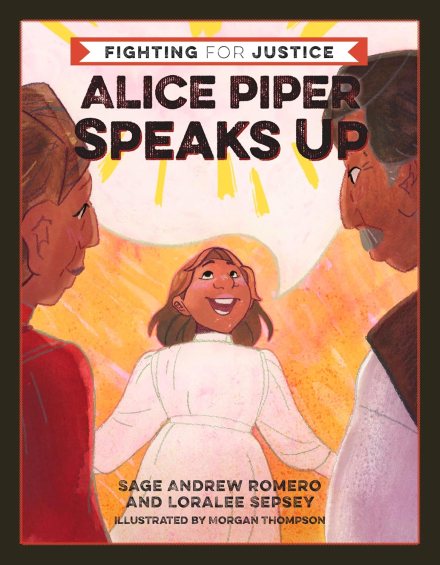
Alice Piper Speaks Up (Fighting for Justice, Volume 3)
Written by Sage Andrew Romero and Loralee Sepsey | Illustrated by Morgan Thompson
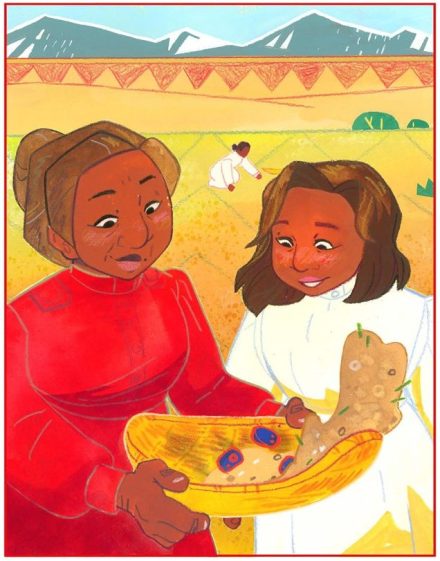
Readers meet Alice Piper as a 13 year old helping her mother and sisters prepare tüba (pine nuts) “in the age-old tradition of the Numu (Paiute in English) people.” They then learn about her home, a bit of the history of the Numu people in California, and that Alice Piper was not the name her parents gave her. Instead, it was one assigned to her by the California Census Bureau based on the rancher her father worked for, whose last name was Piper. They’ll also discover that across California the government renamed place names and erased other Native cultural identifiers with the idea that “if indigenous people lost their cultures, they wouldn’t keep fighting for their land and sovereignty.” Alice’s given name is no longer known, but her father’s Numu name was Maw-che (changed to Pike Piper by the government) while her mother’s was Pow-we-we-ni (changed to Annie).
A typical school day for Alice starts early—well before the sun is up. She attends the Indian day school nearly 40 miles away, traveling by her father’s horse-drawn wagon. Here, the “children don’t learn much reading, writing, or arithmetic. / Instead, they learn how to become maids, laborers, and live-in helpers,” always using proper English and “forbidden from speaking Numu.” Alice longs to go to the new school being built in town. She imagines herself in class, talking with other students, learning from books, becoming “the best person [she] can be.”
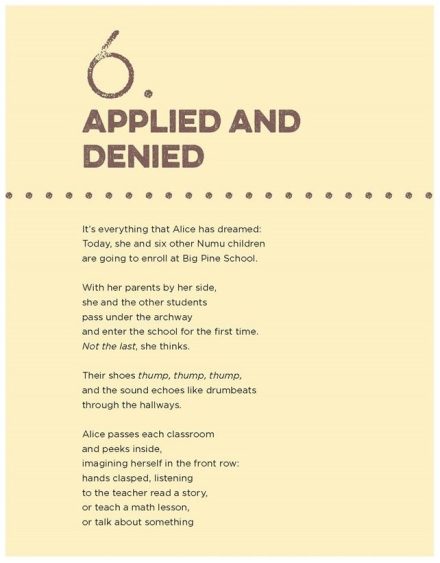
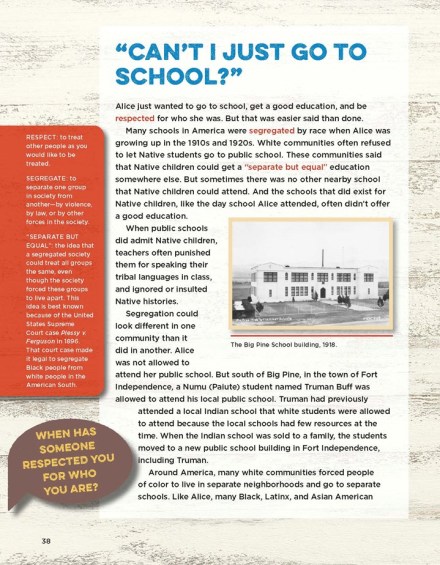
When she asks her parents if she can enroll, they know that “Indian students aren’t welcome in schools built for white children,” but they agree to fight for her. Alice’s struggle to go to public school parallels regional fights over land, access to water, and power in the area, conflicts Alice knew she could assist if she was more educated. At the time, schools were segregated, precluding many Native children from attending. On the first day of the new school year, when Alice and other Numu students ask to enroll, their request is denied.
Alice and her parents don’t stop there. They find support from ministers Frederick G. Collette and Beryl Bishop-Collette and lawyer J. W. Henderson, who sued the School Board of the Big Pine School district. Authors Sage Andrew Romero and Loralee Sepsey chronicle the case, pled in the California Supreme Court between February and June, 1924, relaying the arguments and the judges’ ruling in Alice’s favor that was declared on the same day that “President Calvin Coolidge signed the Indian Citizenship Act of 1924 into law.” They also describe other pivotal court cases that took on segregated schools in other states and for the country as a whole.
Readers also follow Alice as she attends middle school and high school and, following graduation, works at an Indian boarding school, “caring and watching over the children in the dormitories” and empowering Indian children who were still in the boarding school system.” Today, Alice Piper is celebrated with her own annual day—June 2, commemorating the anniversary of the Alice Piper v. Big Pine School District decision. June 2, 2024 saw the 100th anniversary of her groundbreaking win.
Following Alice’s life story, readers learn how they can speak up for what’s right as well as find acknowledgements, source notes, a bibliography, photo credits, an index, more about the authors and illustrator, and short summaries of two more books in the Fighting for Justice series: Fred Korematsu Speaks Up and Biddy Mason Speaks Up.
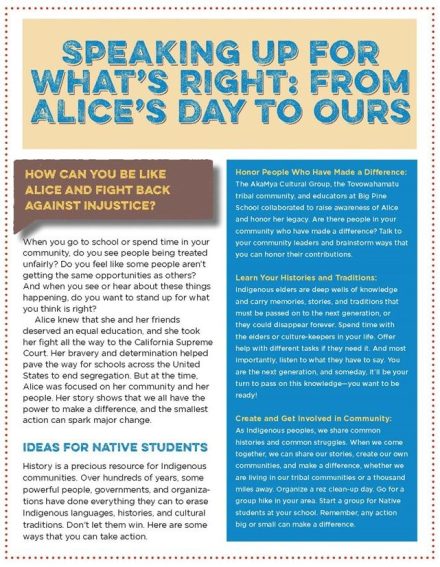
Sage Andrew Romero and Loralee Sepsey harness the power of poetry and biography to introduce young readers to Alice Piper and relate her life experiences in ways that touch their hearts and minds. In each chapter’s introductory poem, children are immersed in Alice’s viewpoint and feelings about events throughout her life. These events are then explained in depth through accessible language and using original, primary source photographs, newspaper clippings, and legal documents. Key words are called out in color while their definitions appear in a sidebar. Timelines orient readers to important dates in each chapter. Sprinkled throughout are questions prompting readers to think about their own relationship with important concepts.
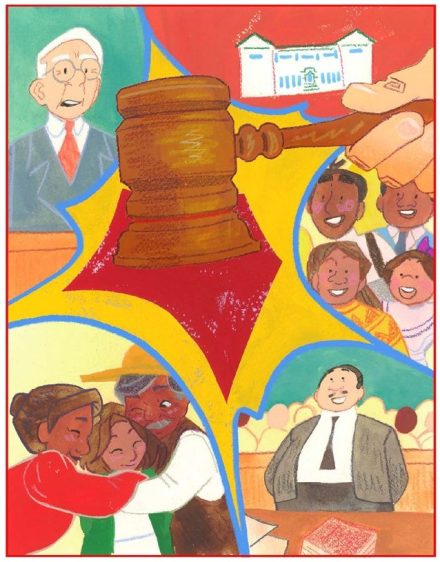
Morgan Thompson’s vibrant and evocative illustrations open each chapter, lending this book another exceptional approach into the life of this young trailblazer. Each illustration keenly captures the nature of the Numu way of life, the discrimination Alice felt, and Alice’s unstinting enthusiasm for education. Readers also see images from the court case, inside classrooms, and of Alice working with students at the Indian boarding school.
Young people will come to this book from varied backgrounds but it will be impossible for any reader to be left unaffected by Alice Piper’s life and work and by extension the experiences of Indigenous people across the country. A comprehensive lesson on civil rights and the fight for equality, Alice Piper Speaks Up will dismay and inspire young activists to continue to advocate for justice for all. Alice Piper Speaks Up is a must for all libraries, classrooms, and civic-minded children.
Ages 8 – 12+
Heyday, 2026 | ISBN 978-1597147057
About the Authors
Sage Andrew Romero is from the Tovowahamatu Numu (Big Pine Paiute) and Tuah-Tahi (Taos Pueblo) tribes. The founder and director of the AkaMya Culture Group, a nonprofit dedicated to cultural revitalization, he lives in Big Pine, California. Follow him on Instagram and learn more on the Native American Media Alliance website.
Loralee Sepsey is a writer and a member of the Big Pine Paiute Tribe of the Owens Valley. Based in Santa Ana, California, she lives with her husband and their two cats. Visit her at loraleesepsey.com.
About the Illustrator
Morgan Thompson is a Cherokee (Cherokee Nation) artist with a love for Indigenous stories. When she’s not working, she enjoys a bit of stomp dancing or some beading on the side. Visit her at skadoodlin.com.
You can purchase Alice Piper Speaks Up (Fighting for Justice, Volume 3) from these booksellers
Amazon | Barnes & Noble | Bookshop
Picture Book Review


