
About the Holiday
With their bald pink heads and dusty brown feathers vultures and turkey vultures may not be the peacocks of the bird kingdom, but they play a crucial role in the environmental cycle. These scavengers live on carrion, clearing away and “recycling” the carcasses of dead animals. Because of the vulture’s appearance and stereotypical depictions, their plight as an endangered species goes largely unnoticed. Environmental groups in South Africa and England established today’s holiday (also known as International Turkey Vulture Day) to promote awareness f the declining number of vultures, a cause that has been picked up by zoos and other conservation groups around the world.
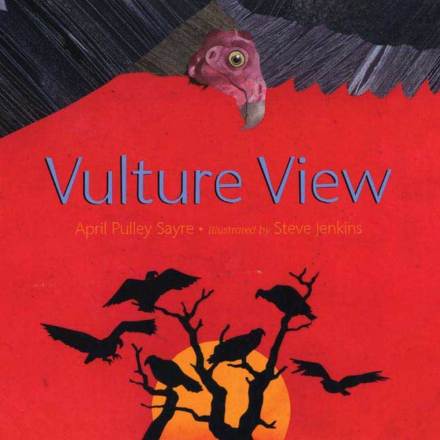
Vulture View
Written by April Pulley Sayre | Illustrated by Steve Jenkins
In the clear blue morning sky the vultures soar. “Wings stretch wide / to catch a ride / on warming air / Going where?” One turkey vulture scans the ground, dipping and tilting as it searches for its breakfast. A snake rattles and hisses in the rocks. The vulture passes it by. A golden fox gazes silently into the distance, but the vulture flies away. A bear half-way up a tree would be easy prey, but the vulture lets him continue his climb.
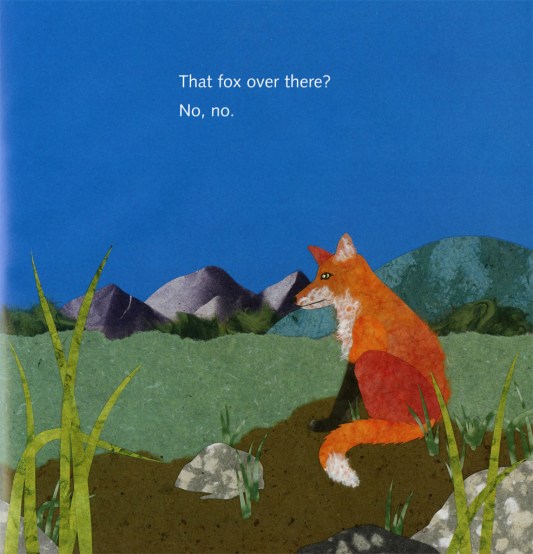
Image copyright Steve Jenkins, courtesy of us.macmillan.com
The turkey vultures are searching for a particular meal. They “smell the air. / They sniff, search, seek / for foods that… / REEK! The aromas of the landscape rise to the vultures. Are they attracted by the “fragrant flowers? / No, no.” “That spicy smoke? No, no.” Maybe “that stinky dead deer? Yes, yes!”
The vultures descend to dine on their “rotten” meal. Afterward they clean themselves in the nearby water and preen their feathers. Still hungry, “they hop, flap, soar / to look for more.” As the sun sets the vultures’ “wings glide, wings ride / through cooling air.” They come from all over to vulture trees—beautiful, bare silhouettes on the sky—to “settle and sleep, like families.”
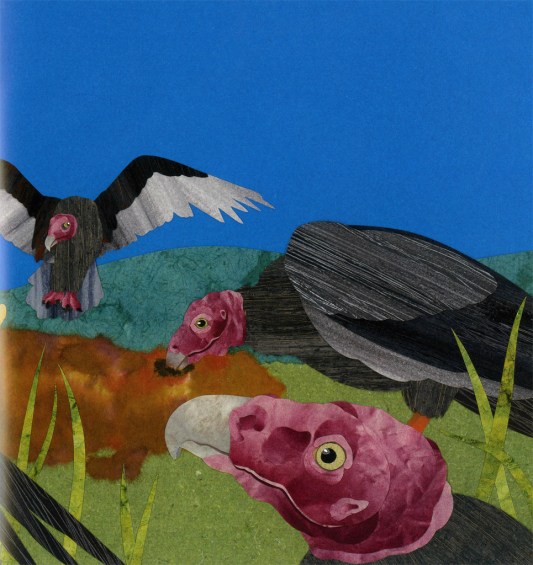
Image copyright Steve Jenkins, courtesy of us.macmillan.com
With the rising sun and the warmer air, the vultures take to the sky again in search of their singular meal.
Intriguing facts about how vultures fly, the seven species of vultures, why and how vultures feed on carrion, nesting behaviors, and vulture festivals around the United States follow the text.
In this Theodor Seuss Geisel Honor Book, April Pulley Sayre brings a poet’s sensibility to the misunderstood vulture. In her lyrical lines the sights and smells of the vulture’s terrain and the vulture’s flight patterns are elevated to educate young readers of the actual beauty of this distinctive species. The benefits vultures provide to the environment as well as their familial attachments make these birds some of the most fascinating animals in the wild kingdom. Who among us doesn’t look up at the circling majesty of birds of prey? Sayre’s text gives readers the bird’s eye Vulture View.
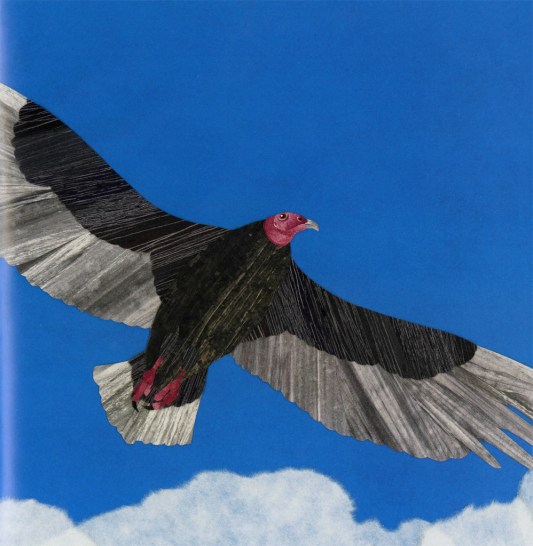
Image copyright Steve Jenkins, courtesy of us.macmillan.com
With his signature cut-paper collage illustrations, Steve Jenkins gives shape to the vulture’s world. The mottled dark body and the wings and tail fringed with white meet layers of pink that form the vulture’s wrinkled head. The rattlesnake is a smooth combination of greens and browns while the fox is brilliantly orange and soft. Hills and mountains jut from the bottom of pages, and a bony carcass lays amid tall grass, decaying and attracting a vulture. As the birds streak through wispy fiber clouds to descend upon the vulture tree in the shadowy evening, readers will come to appreciate the life and role of the vulture.
Ages 4 – 8
Henry Holt and Company, 2007 | ISBN 978-0805075571
Wow! You will find a wealth of information on April Pulley Sayre‘s website which includes her many books, educators’ resources, and much more information on natural history topics.
Even just hovering over the icon links on Steve Jenkins‘ website is fun—and there’s so much more to discover once you click on them!
International Vulture Awareness Day Activity
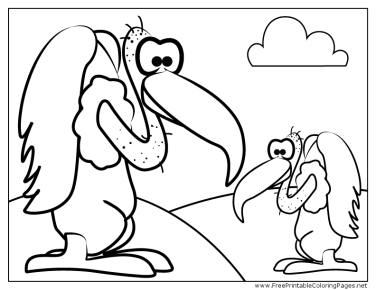
Valuable Vultures Coloring Page
Vultures are a valuable part of our ecosystem. Here’s a printable Valuable Vultures Coloring Page for you to enjoy. Why not try your hand at using cut or torn paper like Steve Jenkins does in Vulture View to fill in the design?
Picture Book Review


 celebratepicturebooks.com